REPOSTING JUST CUZ: E.B. White on Dogs edited by Martha White: A Great Collection of Short Pieces

The Post I have been trying to finish since Monday morning remains undone (I got sooo close today). But I feel the need to post something just to confirm to myself that, yes, I do have a blog. So, here we go, in honor of the 126th anniversary of his birth, why not look at this collection of writings from Elwyn Brooks White.


E.B. White on DogsE. B. White on Dogs

edited by Martha White

DETAILS:
Publisher: Tilbury House Publishers
Publication Date: March 7, 2016
Format: Paperback
Length: 177 pg.
Read Date: December 28-31, 2022
Support Independent Bookstores - Visit IndieBound.org

Next year, when Dog Show time comes round, we would like to see a wholly new brand of showmanship introduced into the Garden… A dog should be made to work for his ribbon, each breed in his own wise. Pointers should have to point, Shepherds should be required to herd a band of sheep from the east goal to the west goal. Poodles should be required to jump through a paper hoop, not just follow Mrs. Sherman Hoyt around the ring. English bull terriers should be made to count up to ten, retrievers retrieve rubber ducks, Scotties chew up old shoes. Greyhounds should be put over the high hurdles. St. Bernards carry brandy to anyone in the audience who feels weak, preferably us. Beagles would jolly well have to bealge, or shut up. How about it, dogs—are you dogs or mice?

What’s E. B. White on Dogs About?

This is a collection of essays, articles, letters, and other brief notes written by E.B. White about dogs. In other words, it’s what the title says. Most of the entries are very short—1-2 pages, some are a paragraph long—but (especially toward the end), we get some longer letters and essays.

Most are about White’s dogs—particularly Fred, a beloved dachshund. But there are pieces about dog shows and other dogs, too.

A Few Highlights

This is going to be tough, there are just too many options. Something about Dog Shows brought out the best and/or snarkiest in White, and are possibly my favorite moments.

There’s a point where he describes how a dachshund climbs up and down stairs and the optimum height for said stairs. I don’t know about the height, but he described perfectly how our pug uses the stairs and it’s something I’m going to borrow. He had, over the course of his life, multiple dachshunds and his affection for the breed is evident. But you can tell that Fred had a big impact on White—both during and after his death. The piece White wrote after his death is possibly the highlight of the book.

There’s a long (for this book, anyway) piece about taking a dog on its first coon hunting trip—it’s just wonderful. It’s tonally different from most of the book, which probably helps it stand out—but it didn’t need much help.

Some Non-Dog Moments

Not everything in this book is focused on dogs but involves them tangentially. The best of these pieces are about contemporary politics—I knew some of the names, but not all of them, but that didn’t change things really.

There’s an essay from The New Yorker that I’d probably have paid half the purchase price of the book for—it’s called “Khrushchev and I (A Study in Similarities).” Some newspaper published a feature on the Soviet premier, and from what I can tell, it was the puffiest puff piece around. White takes some parts of that feature to show how much he and Khrushchev are alike—they’re devoted to their families, like walking in the woods, and so on. The last paragraph points out some important differences, too—size, amount of hair left on their heads, the fact that White has never threatened to bury America…the usual differences. And just as he has you chuckling in a different way than he has for a few pages, the last line or two are somber and sober. Fantastic stuff.

So, what did I think about E. B. White on Dogs?

Overall, this was a great collection. It does feel like Martha White hit “Ctrl-F” on an electronic version of everything her grandfather had written and pasted the entire contents of that search into this book. Some of the letters contain one sentence about a dog—not always that cleverly written or interesting—and I had to wonder why she bothered, outside of a drive for thoroughness.

I don’t recommend reading too much of this at once—but maybe that’s just me, my attention waned after too many entries. But if you’re familiar with White’s non-children’s writing, or have the desire to be, and enjoy reading about dogs (and a couple of cats, and a squirrel or two)—you’ll enjoy this.

Speaking of his non-children’s writing—in her note to the reader describing the impetus for the book, and their approach to editing, keeping the pieces “largely as they appeared originally, not attempting to mesh the inconsistencies.” (including some phrasing I don’t think you’d get away with today). Martha White says,

The letters…are more casual in style and my Tillbury House editor was surprised to find that the co-author of The Elements of Style did not always get his that and which correct, especially in the early years. Our hands-off policy nearly killed her.

I feel for that editor and can’t help but chuckle about E.B. White’s divergence from his own book.

All in all, this book delivers what the title promises, and if that’s up your alley, you’ll enjoy it. I sure did.


4 Stars
This post contains an affiliate link. If you purchase from it, I will get a small commission at no additional cost to you. As always, the opinions expressed are my own.

WWW Wednesday, July 10, 2024

It’s days like this that make me so glad to be a bookworm/bookwyrm/ink drinker and not someone who enjoys spending time outside—as I post this, it’s 107° F. No thank you. I’d be like one of those guys at the end of Raiders of the Lost Ark.

This meme was formerly hosted by MizB at A Daily Rhythm and revived on Taking on a World of Words—and shown to me by Aurore-Anne-Chehoke at Diary-of-a-black-city-girl.

The Three Ws are:
What are you currently reading?
What did you recently finish reading?
What do you think you’ll read next?

Seems easy enough, right? Let’s take a peek at this week’s answers:

What are you currently reading?

I’m reading Steam Opera by James T. Lambert, which is the least steampunk-ish steampunk novel I’ve ever read (at the 30% or so mark) and is also the best thing that Lambert has done to date, so what do I care? I’m listening to Storm Front by Jim Butcher, read by James Marsters on audiobook, because it’s been too long since I spent time with Harry.

Cover of Steam Opera by James T LambertBlank SpaceCover of Storm Front by Jim Butcher

What did you recently finish reading?

I just finished Jordan Harper’s The Last King of California and Breaking the Dark by Lisa Jewell, read by Helen Laser on audio.

Cover of The Last King of California by Jordan HarperBlank SpaceCover of Breaking the Dark by Lisa Jewell

What do you think you’ll read next?

My next book should be for The Camelot Shadow by Sean Gibson and my next audiobook should be Several People Are Typing by Calvin Kasulke, read by MacLeod Andrews, Neil Shah, Dani Martineck, Sophie Amoss, Neil Hellegers, Cary Hite, Sean Patrick Hopkins, Joshua Kane, Amy Landon, Nicole Lewis, Brittany Pressley and Jonathan Todd Ross (which is a lot of people for 208 minutes).

Cover of The Camelot Shadow by Sean GibsonBlank SpaceCover of Several People Are Typing by Calvin Kasulke

Are you “beating the heat” (or at least avoiding it) with anything fun and/or good and/or compelling?

Highlights from May & June: Lines Worth Repeating

Highlights from the Month
June slipped away without me taking care of May. So, it’s time for a little catchup.
Christa Comes Out of Her Shell

Christa Comes Out of Her Shell by Abbi Waxman

If it’s possible to blush all the way down to your DNA, I did it.

It felt very much like home all of a sudden, like a familiar book released in a new edition.


Chasing Empty Caskets

Chasing Empty Caskets by E.N. Crane

“Winnie, seek,” I said, letting her lead me. She was following the boy’s scent back the way he came and I followed her, grudgingly taking the sticky hand. It was small and somehow both wet and freezing. Children were a terrifying medical anomaly, and I suddenly understood why the ladies in mommy groups were nuts.


The Olympian Affair

The Olympian Affair by Jim Butcher

Bayard is a born hero, which is the larval form of a dead hero.

Ransom shook her head. “Some people think that if they’re simply insane and ruthless enough, they can accomplish anything.”

“Terrifying,” Espira said.

“Oh, that’s not the terrifying part,” Calliope said.

“No?”

“The terrifying part,” she murmured, “is that sometimes they’re right.”

Bridget rather forgot how to be conscious for some indistinct length of time.


All Systems Red

All Systems Red by Martha Wells

I liked the imaginary people on the entertainment feed way more than I liked real ones, but you can’t have one without the other.

You may have noticed that when I do manage to care, I’m a pessimist.


Grave Cold

Grave Cold by Shannon Knight

They’d reached her truck. “Nyle, meet the Gremlin, a machine you will love to hate.” The yellow truck looked very much up to the task.

One’s own mortality was a mighty incentive.


Backpacking Through Bedlam

Backpacking Through Bedlam by Seanan McGuire

Family is complicated. Peach cobbler, on the other hand, is refreshingly simple.

“The laws of physics aren’t negotiable.”

Darius laughed, and the sound was loud and joyous as he set his hands back on the wheel. “Sure they are. There’s no law that’s not negotiable, if you know how to get your shoulder against it and push.”

Always be polite to she shapeshifting super predator. It’s a simple rule of life, but a good one all the same.


Dark Days

Dark Days by Derek Landy

“Sometimes you’ve got to admit it when you’re wrong.”

“You never admit it when you’re wrong.”

“But I’m rarely wrong, you see. You, on the other hand, are wrong a bizzarly large amount of the time. Statistically, it’s quite amazing.”


The Ink Black Heart

The Ink Black Heart by Author

He was starting to feel like a truffle pig doing its job in a room full of incense, dead fish, and strong cheese.


First Frost

First Frost by Author

I’d taken the frontage road, but I think I might’ve accidentally taken a few other turns, and now here we were in what might be the middle of nowhere—and when a guy from Wyoming refers to a place as the middle of nowhere that truly means the epicenter of nowhere.

I said nothing, which, when there was a stenographer in the room, was always a safe bet.


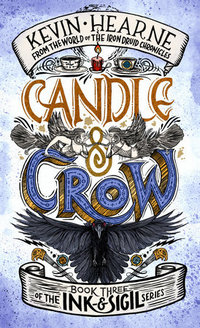
Cover image for the audiobook of Paper and Blood by Kevin Hearne

Paper & Blood by Kevin Hearne

Grief is never easy. But it gets softer around the edges, smoothed over like a river rock given time enough and water. It’s still a rock and it’s heavy and dangerous and capable of hurting you. Just not immediately to the touch, if that makes sense.

When the sky slid from indigo to grey, heralding the dawn, the birds began to wake up and call about their urgent need for Wednesday coffee— or so I imagined. I certainly needed some, as a belligerent caffeine-withdrawal headache had taken up residence in my brain and likely had legal arguments against eviction.

From pulp—utterly lifeless pulp—new life can be born. Add water and pressure and you no longer have mere pulp but a medium for the miraculous. It can carry the words of one lover to another. Express gratitude for gifts and thoughts. Invoice a client. Threaten death. Bear the light touch of poetry or the weighty prose of novels. It can be folded into an airplane, to annoy your teacher, or folded into origami, an artistic appreciation of nature made from wholesome natural ingredients. And on and on. So much can be built from the ruin of plant life.

Which is not to say that humans are noble. We ruin so much else that never gets a new life, and their dissolution—their extinction—is final.

But paper is one thing we got right.

The best we can do sometimes, in absence of actual wisdom, is to simply cease being foolish.


Cover image to E Rathke's Howl

Howl by e rathke

To look back on that day is to sink into a delicate memory. Like a love letter sent to myself, yet left to pulp in the rain.


Cover for the audiobook of The Bitter Past by Bruce Borgos

The Bitter Past by Bruce Borgos

I believe in hunches. I think they’re just the dots in your brain that aren’t fully connected yet.


Cover of the audiobook for Erasure by Percival Everett

Erasure by Percival Everett

There are as many hammers as there are saws, the misplaced thumb knows no difference.

A reiteration of the obvious is never wasted on the oblivious.

I was lonely, angrier than I had been in a long time, angrier than when I was an angry youth, but now I was rich and angry. I realized how much easier it was to be angry when one is rich.

What some people would have you believe is that Duchamp demonstrated that art could be made out of anything, that there is nothing special about an object d’art that makes it what it is, that all that matters is that we are willing to allow it to be art. To say, “this is a work of art” is a strange kind of performative utterance as when the king knights a fellow or the judge pronounces a couple man and wife. But if it turns out that the marriage license was incorrectly filled out, then the declaration is undone and we will say, “I guess you’re not husband and wife after all.” But even as it’s thrown out of the museum, what has been called art it is still art. Discarded art. Shunned art. Bad art. Misunderstood art. Oppressed art. Shocked art. Lost art. Dead art. Art before its time. Artless art. But art nonetheless.


Cover for The Kaiju Preservation Society by John Scalzi

Kaiju Preservation Society by John Scalzi

“I like land,” I said. “I don’t drown there.”

“Any dietary restrictions?”

“I tried being a vegan for a while, but I couldn’t live without cheese.”

“They have vegan cheese.”

“No, they don’t. They have shredded orange and white sadness that mocks cheese and everything it stands for.”

“That thing looks like H. P. Lovecraft’s panic attack.”

It was stupidly perfect how all my problems were suddenly solved with the strategic application of money.


Cover for Detours and Do-Overs by Wesley Parker

Detours and Do-overs by Wesley Parker

Since she doesn’t wanna talk, I do what I assume most men do when confronted with crippling silence from their significant other.

I start to rationalize shit.

“How you holding up?” she says.

“Like a Jenga tower in the middle of a bunch of drunks,”


Cover for Grammar Sex by Robert Germaux

Grammar Sex and Other Stuff by Robert Germaux

Don’t you just love it when a professional athlete ends a long holdout and finally signs that new deal worth multiple millions of dollars, but assures everyone that “it wasn’t about the money”? Bless his little heart. As if any reference to cold hard cash would have somehow sullied the whole salary negotiation process.

(Image by DaModernDaVinci from Pixabay)

LITERARY LOCALS: A Q&A About Writing in Idaho with Jerome Goettsch

Literary Locals logo
Goettsh’s memoir had only been in print for a couple of weeks before I met him at the Library Book Fair. I wish I’d noticed that before I sent him my questions–I’d have tweaked them a little bit–not that there’s any problem with his responses, I’d just have framed things in light of the date.


Before we get into things, why don’t you give the reader a brief introduction to you and your work.
I’m a veteran of 9 years in the Marine Corps, 16 years in the Army, and 7 years working as a Navy civilian. I did 2 tours of duty in Vietnam. The first tour the book is based on as a rifleman and Fire Team Leader for 13 months, and a second tour for 12 months in ordnance. Over 25 years in the military I worked as a rifleman, an ordnance man, a military policeman, a rifle, and shotgun coach, and in administration. As a civilian for the Navy, I worked on the docks unloading munitions off ships and as a document editor. I edited operations manuals for navigation systems on nuclear submarines.

What brought you to Idaho in the first place? What is it about Idaho that keeps you here?
My wife and I moved here 21 years ago to be with our children. We have 2 children, 2 grandchildren, and 2 great-grandchildren in Idaho now.

Are you tied into some sort of local author/bookish group/culture? If so, tell us about it and how it helps you as an author. If you’re not, is there a reason for it?
This is all very new to me. I’m learning to tread the waters of authorship. I have a Facebook page: The Cocoa Kid, and I belong to a few Facebook groups: The Writer’s Forum, Writers For Writers, and Creative Writing. Also, the Kindle Community is very supportive.

What kind of events in the area do you attend—either to sell/promote your books or to network with authors? Are there any outside of this area that you hit regularly and wish we had something like it here?
I did my first book fair at the Nampa Library where we met. I made a few good contacts there. I’ve been talking with local librarians and hope to have something in the future. I need to reach out to new bookstores and book clubs. It’s challenging balancing my book promotion with my artwork.

What’s the breakdown of your audience—do you have a strong local base, or are your readers from other parts of the world?
My readers are from all over the US, but mostly veterans like myself. However, I like to point out the book is not just all about the war. It’s not all shoot ’em up bang bang. It’s about a young man’s journey from childhood to war. About struggle, loyalty, and sacrifice in the face of adversity. It’s about survival and moving on.

Do you think there are particular challenges or advantages to being a writer in the Treasure Valley? (possibly both)
It’s not just Treasure Valley. It’s the book community in general. Lots of people are going to e-books. Paperback books are slowly but surely going the way of hardback books. They will be obsolete collectors’ items someday. I’m not a Luddite; or a technophobe in today’s vernacular. I’m going to be putting an e-book version out soon.

Do you bring Idaho (or some sort of Idaho-sensibility, assuming one exists) to your work? Whether or not anyone else sees it, can you look at some aspect of your writing and think “That’s Idaho” or “I would do ____ differently if I was a Kentuckian or from Illinois?”
I consider myself an Idahoan as I’ve been here 21 years now. I have family and roots in Idaho. But I was born and raised in Green Bay Wisconsin. Later I lived in Milwaukee Wisconsin, Chicago Illinois, Dallas Texas, Phoenix Arizona, and California. After joining the military I was stationed in California, Texas, Virginia, Oklahoma, and Indiana. I did 2 tours (still not sure why they call them tours) in Vietnam. I’ve visited Mexico, Japan, China, Greece, Africa, and most of Western Europe. Working as a civilian for the Navy I traveled to Washington DC, Washington state, New York, Florida, and Georgia. I’m like a sponge, and have picked up some of the customs and language of most everywhere I’ve been.

One final question, is there a book (or two…or 18, if you get really carried away), that embodies Idaho/the Idaho spirit to you to recommend to my readers?
I’m a rockhound and photographer, as well as a writer and artist. I love to explore Idaho, so I have several books such as Rockhounding Idaho, Roadside Geology of Idaho, and books on Idaho’s history. I found reading about how Idaho’s Capitol was moved from Lewiston to Boise most interesting. I would highly recommend reading about the State Capitol’s history. Overall I’m a history buff, and I’m in the habit of reading a few books at a time. I like to pick one up and read a chapter or two, then put it down, pick up another, and repeat. I am presently reading Eiffel’s Tower by Jill Jones, The Greater Journey by David McCullough, and a book written in 1890, How the Other Half Lives by Jacob A. Riis. Riis was part of a movement that led to changes in society such as the Audy Home that I was locked up in, and which is in my book. Riis wrote his book in 1890 and the Audy Home was created by the women of Hull House in 1899.

Thanks for your time and participation! Hope you enjoyed it!


Literary Locals logo

MUSIC MONDAY: Deep Stays Down by Larkin Poe

Music Monday

Music Monday's originated at The Tattooed Book Geek's fantastic blog and has shown up hither, thither, and yon since then.

Irresponsible Reader Pilcrow Icon

HC Chats with Jodie from Witty and Sarcastic Bookclub about Self-Published Authors Appreciation Week

I’m dipping my toe into something new here. There’s some things I’ve wanted to try and the written word just ain’t gonna cut it. (and I hate saying that about the written word–maybe it’s just my capabilities with it that are the problem…that seems more likely).

Jodie was willing to be my first victim, er, chat partner. This comes across a little more interview-y than I’d hoped. I’ll get there, maybe. Still we chat about Jodie’s blog, the origins of Self-Published Authors Appreciation Week, what some of this year’s features are going to be like, some self-published work in general, and a little more. Hope you enjoy!

As an added bonus, you can watch me adjust settings while recording–because who doesn’t do that? And try to awkwardly find a comfortable way to sit while staying in frame. Clearly, I’m not a professional. I’m barely an amateur.

I’ve got one more trial balloon scheduled that you should see in a few days. We’ll see if I schedule more.*

* Obviously, part of that is going to depend on finding people to sit down with me. If you’re interested, let me know.

Irresponsible Reader Pilcrow Icon

Divine Providence by Stephen Charnock, edited by Carolyn Whiting: A Classic Reworked

Cover of Divine ProvidenceDivine Providence

by Stephen Charnock, edited by Carolyn Whiting

DETAILS:
Publisher: P&R Publishing
Publication Date: September 1, 2022
Format: Hardcover
Length: 268 pg.
Read Date: June 16-30, 2024
Buy from Bookshop.org Support Indie Bookstores

What’s Divine Providence About?

Question and Answer 11 of the Westminster Shorter Catechism are:

Q. What are God’s works of providence?
A. God’s works of providence are his most holy, wise and powerful preserving and governing all his creatures, and all their actions.

In this classic work (updated for modern readers), Charnock does his best to explain that idea. It’s something that verges on the inexplicable—but something clearly taught in Scripture—and so Charnock seeks to help his readers (originally, hearers) understand it. He doesn’t really engage in debate about it, or defend it against attacks—he does tackle some objections or hard parts to grapple with. But he’s not doing that in a polemic way, mostly he seems to work from the assumption that if he clarifies the doctrine and clears up misconceptions, that’ll be enough. (also, he’s not really trying to engage with naysayers)

That’s basically the first 13 chapters—133 pages or so, almost half the book. The second half is applying that to the Church and individual believers. I remember a former pastor of mine saying that this (and related) doctrines in Scripture weren’t used in the way most contemporary people use them—to beat up on believers who don’t quite agree with us on providence, predestination, election, and whatnot. Instead, the inspired writers used them to comfort, encourage, and give confidence to believers. And that’s just what Charnock does in the second half.

He starts by describing how Providence is an expression of care and protection for the Church and how we see that. Then he focuses on individual Christians, and how we can find comfort and encouragement in all things from these teachings. Even the last chapter here, “The Duty Providence Requires,” is made up of items like “believe in God’s work,” “remember what He as done,” “wait patiently for Him.” and so on—things that really call for the confidence I mentioned earlier to be expressed.

Bonus materials

Before the introductions, prefaces, etc. the reader is presented with a nine-page outline of the work—which is a great bonus and will be very helpful for students and other readers really wanting to dive into the nitty-gritty of this work.

The editor has also broken this down into clearer chapters (see below) and added summary paragraphs to each chapter to help the reader (I’m not sure how helpful those ultimately were and stopped reading them pretty quickly).

There are also study/discussion questions provided at the end of every chapter. They don’t seem too bad—but again, I didn’t spend much time looking at those. But I think they’ll be a strong selling point for many.

The Modernizing of it All

In the Editor’s Preface, Carolyn Whiting states that

I sought to retain the author’s meaning while updating the language and style, sentence by sentence, to make it more accessible for today’s reader. The original volume, which was a compilation of a series of Charnock’s sermons, had no chapters or subheads and few paragraphs. In addition to adding these features, I have inserted the occasional transition, updated spelling and pronouns for a contemporary audience, replaced archaic vocabulary with modern equivalents, and updated Scripture to the English Standard Version except where noted.

Now, I get updating pronoun use, changing to ESV, and most of the other changes (although typically “language” means changing archaic words that have changed meanings, shortening sentences, etc.). The chapters and subheads idea is great—the original edition is tough to read just because of the organization. I have no issues with what Whiting stated there.

But then I started seeing (and I don’t know how often, but it happens a few times) footnotes saying “Charnock goes on to say…” and giving us a phrase or two beyond that. Why those phrases couldn’t be added above I didn’t once understand. But it tripped me up—just how much was Whiting doing to make Charnock accessible to the modern reader? I spent too much of my mental RAM wondering about that while reading and likely didn’t get as much out of it as I should’ve.

To give you a flavor here are the first few paragraphs of the book (and no, I don’t know why the line spacing is that way…I assure you, I’ve tried to stop it).

This Edition
In the beginning of 2 Chronicles 16, we find Baasha, king of Israel, building and fortifying Ramah. Situated on the road between Jerusalem and Samaria, Ramah is about twelve miles from Jerusalem, the metropolis of Judah and the seat of its king, Asa. Baasha intends to isolate Asa and to prohibit anyone from crossing the border between the two nations (v. 1).

Baasha is probably afraid that the people of Israel will revolt and flee to Judah because Asa has reformed the practice of religion there. Therefore, Baasha fortifies Ramah to hinder and intercept any who try to pass by on that account. “For great numbers had deserted to [Asa] from Israe| when they saw that the Lorp his God was with him” (2 Chron. 15:9).

When Asa realizes what Baasha is doing, he is afraid, and in his fear he sins by seeking help through worldly means rather than by turning to God. He enters into a covenant with Ben-hadad, king of Syria, who is a neighbor and an idolatrous prince, and purchases his assistance for the sacrilegious price of silver and gold from the temple treasury. His plan is for Ben-hadad to invade Israel’s territories and distract Baasha from fortifying Ramah. The large payment easily persuades Ben-hadad to break his covenant with Baasha, and his armies successfully take several cities, including all the store cities of Naphtali (2 Chron. 16:2-4). Baasha is forced to abandon Ramah in order to save his country, and Asa seizes the materials Baasha has left behind and uses them to build two cities, Geba and Mizpah (vv. 5-6).

Original Text
In the beginning of the chapter you find Baasha king of Israel raising walls about, and fortifying Ramah, a place about twelve miles from Jerusalem, the metropolis of Judah, intending by that means to block Asa up, because Ramah lay just upon the road between Jerusalem and Samaria, the seats of the two kings, ver. 1.

Baasha was probably afraid of the revolt of Israel to Judah, upon that reformation of religion wrought by Asa, and therefore would fortify that place, to be a hindrance, and to intercept any that should pass upon that account; and to this purpose makes great preparation, as appears ver. 6, for with the provision Baasha had made for the fortification of Ramah, Asa, after the seizing of the materials, builds two towns, Geba and Mispah.

Asa seeing Baasha so busy about this design, and fearing the consequence of it, hath recourse to carnal policy rather than to God; and therefore enters into league with Benhadad, a neighbour, though an idolatrous prince, and purchaseth his assistance with the sacrilegious price of the treasure of the temple, ver. 2, 3; and hereby engageth him to invade the king of Israel’s territories, that he might thereby find work for Baasha in another part, and so divert him from that design upon which he was so bent: ver. 3, ‘Go, break thy league with Baasha, that he may depart from me.’

Benhadad is easily persuaded by the quantity of gold, &c., to break his league, and make an inroad, and proves victorious, and takes many cities where the magazines and stores were laid up, ver. 4.

Baasha now, to save his country, and make head against his enemies, is forced to leave Ramah; whereupon Asa, who watched his opportunity, seizeth the materials he had left for the fortifying of Ramah, and puts them to another use, ver. 5, 6.

I can’t say the Whiting version is bad…but I don’t know that Charnock needed that much help. My son said it reminded him of copying something (encylopedia entry, article, etc.) for a report in school, but changing just enough of it so as not to be accused of plagiarism.

I do wonder if the wrong name is on the cover/title page, however.

So, what did I think about Divine Providence?

When I could stop focusing on the issues in the above section, I really appreciated the book. The first half was clearly the same kind of thinking seen in The Existence and Attributes of God.

Parts 2 and 3, the application of the doctrine to our lives and the Church? I absolutely loved that and was so encouraged it. There was so much there that was so good to see and be reminded of. It’s truly worth reading the book to get those parts (but you do need to read the first part—you can’t just jump into these sections, you need the foundation).

I can’t be as happy with this as I’d like—I just can’t get over the paraphrasing (for lack of a better term) bothers me more than it maybe should. I do think this is a lot easier to read than the non-modernized version (if only because mostly those are printed with tiny typefaces), and will reach more people. But the purist in me worries we lose too much of Charnock.

The important thing, however, is that Charnock is being brought to readers in a digestible manner. I do encourage people to pick it up because of that.


3 Stars

This post contains an affiliate link. If you purchase from it, I will get a small commission at no additional cost to you. As always, the opinions expressed are my own.

Irresponsible Reader Pilcrow Icon

Saturday Miscellany—7/6/24

As is typical of a holiday week, this is a short post. Less to distract you from your Saturday reading, right?

Odds ‘n ends about books and reading that caught my eye this week. You’ve probably seen some/most/all of them, but just in case:
bullet This is Why Book Marketing Doesn’t Work
bullet ‘Really I just want to stay home and make art about my dog’: An interview with Sara Varon—I’m pretty sure I’ve never run across Varon before, but this interview makes me interested in checking out her stuff.
bullet 7 Thrillers With Shocking Twists
bullet 10 Must-Read Authors for Fans of First-Person Adult Urban Fantasy—This is a very narrow category…but can’t argue with most of this picks.
bullet Tough Questions with Left on the Shelf—the latest in the Tough Questions series

To help talk about backlist titles (and just for fun), What Was I Talking About 10 Years Ago Week? (not much, really)
bullet Don’t Hurt People and Don’t Take Their Stuff: A Libertarian Manifesto by Matt Kibbe
bullet I noted the release of Premonitions by Jamie Schultz and Artful by Peter David

This Week’s New Releases that I’m Excited About and/or You’ll Probably See Here Soon:
bullet Broiler by Eli Cranor—I dunno…it’s by Cranor, isn’t that enough? It’s about revenge, power, economic disparity in the most American of places—a chicken processing plant.
bullet Dog Day Afternoon by David Rosenfelt—Marcus asks Andy for a favor and gets him to represent a suspected mass-shooter. I really enjoyed this one, as I said recently.
bullet Breaking the Dark: A Jessica Jones Marvel Crime Novel by Lisa Jewell—Jessica Jones travels to England to investigate some teens who are too-perfect. It’s hard to explain in a phrase or two…but these are creepy kids and something has to be making them that way.
bullet Boise Longpig Hunting Club by Nick Kolakowski—the new edition of this explosive thriller
bullet The Night Ends with Fire by K. X. Song—a new retelling of the story of Mulan.
bullet Junkyard Roadhouse by Faith Hunter—Shining Smith is neck-deep in trouble—that’s nothing new, sure, but it’s a different kind of trouble.

For books are not absolutely dead things, but do contain a potency of life in them to be as active as that soul was whose progeny they are; nay, they do preserve as in a vial the purest efficacy and extraction of that living intellect that bred them. - John Milton

Shades of Mercy by Bruce Borgos: Memory Brushes the Same Years

Reading back-to-back books featuring a character named Mercy—not to mention writing about one while reading another—is a fun way to trip yourself up. Thankfully the genres are different. But if I start rambling on about the fae or coyotes, you’ll know why. Also, skip to the next sentence or so.


Cover of Shades of Mercy by Bruce BorgosShades of Mercy

by Bruce Borgos

DETAILS:
Series: Porter Beck, #2
Publisher: Minotaur Books
Publication Date: July 16, 2024
Format: e-ARC
Length: 352 pg.
Read Date: June 27-July 1, 2024
Buy from Bookshop.org Support Indie Bookstores

What’s Shades of Mercy About?

Sheriff Porter Beck’s life intersects with a couple of high school buddies for the first time in many years. And both situations should make anyone else from high school leery of running into him.

We open with Beck coming across one of those friends after they’d overdosed. Soon after, a federal investigator recruits Beck to go visit the other one. Jesse Roy has recently moved back to the area, and is renovating his father’s ranch into something that Beck can’t comprehend—it’s just too large, too gaudy, for this area. Cattle ranching is going really well for Jesse (too well?). The night before, something had gone wrong with a test vehicle with the Air Force, and something had fallen on Roy’s prize bull, destroying it. The investigator is here to negotiate a settlement—and it’s not a little one.

But something about the whole deal sets Beck’s B.S.-meter off. He forces the investigator to come clean—someone had hacked an Air Force drone and launched a missile at the cow. It was a targeted hit—but why?

Beck knows if he doesn’t help for the search for this hacker (and they know they’re local, somehow) and get to the root of the problems soon, his county will be overrun by Intelligence officers from all sorts of government agencies.

Oh, and there are wildfires threatening the county on several sides, and a large group assembling to storm Area 51. Just in case it didn’t seem like he had enough going on.

The investigation quickly points at a teenage girl who is serving some time at a teen facility nearby. As hard as it might be to believe. And before he knows it—Beck finds himself dealing with so much more than a hacker.

Comparing Shades of Mercy to The Bitter Past

So, the first book used dual timelines to tell the story—and I was afraid Borgos would try to pull that trick again. I think it could’ve worked, but eventually, his county is going to run out of people who were doing interesting things several decades ago. This time it’s all one timeline (with a little backtracking every now and then, but not much. But we do bounce between a few perspectives, so we still get the advantage of multiple POVs. So he’s able to maintain some of the same feel there.

His deputies are back, but some of them aren’t really seen due to the fires. There’ve been some changes since the last book and it’s good to see that everything isn’t stagnant with this series. We don’t get as much time with them all this time, and that’s a disappointment. Other characters return, too, most of them made me happy and one was a pleasant surprise. I had a more specific sentence there, but decided to remove the names…

The big change is the focus—The Bitter Past is all about the past—what it does in the present, how it can change so much about your life when you learn new things about your own past. Also, the weapons and conflicts of the past.

This one is very present and future-focused. It’s also good to see that Borgos isn’t stuck in one frame of mind.

So, what did I think about Shades of Mercy?

I’m having a hard time talking about this book without saying too much about the content.

In what—I think—was a very nice bit of story-telling is that there were a few things that should make the attentive reader pause and wonder if Borgos is being sloppy. I’m going to try to be vague here, but I’m thinking of some parts of the timelines before the novel started—and some things that happened during the novel that we don’t see first-hand, but see the effects of. I was too invested in the stories to spend time on these myself—I basically shrugged and moved on (not that I noticed everything I should’ve, either). I’m going to give you credit for being perceptive and thoughtful enough to catch these things—then I’m going to reassure you: trust Borgos. Everything gets tied up, everything makes sense, I can’t tell you how often in the last pages I said “Oh, sure—that makes sense,” (I also said “I probably should’ve caught that” about most of those items). It’s really a nice and tidy book.

I’m worried that my last paragraph makes the whole thing seem like a mess. Au contraire. This is a tight thriller—it’s only on a few points that it I was mistaken that he’d left things dangling. The rest of the book is as tightly written as you could hope (which I should’ve realized described the rest, too). There’s a little slowness for a chapter or two, just to bring us back into this world, reintroduce the character, and catch us up on Beck’s life—then we’re off to the races from the moment that Beck is brought to his old friend’s ranch.

The conclusion was just great—exactly what this book (and character) needed.

This book bodes well for the rest of the series that follows—yes, I’d like a “smaller” crime. One that didn’t involve multiple state and federal agencies, for one. Just a matter of Beck and his guys analyzing a crime scene and then figuring out who in their small community could’ve done it. It’d just be more believable than all the federal and military types wanding around all the time. But the way Borgos is dealing with the latter, I’m not sure I care.

There’s enough humor and heart here to take the edge off of things—the tension gets cut, the characters are made more endearing, and the reader can catch their breath before diving into more tension and action.

I wasn’t as wow-ed with this book as I was the first—but I was still impressed, and this book makes me more sure what the following books will be like than I was with The Bitter Past. And it promises to be a very good series. I’m repeating myself, so it’s time to wrap this up. Either with Shades of Mercy or The Bitter Past, you want to get on board this series here at the beginning.

Disclaimer: I received a copy of this book from St. Martin’s Press via NetGalley—thanks to both for this.


4 Stars

This post contains an affiliate link. If you purchase from it, I will get a small commission at no additional cost to you. As always, the opinions expressed are my own.
Irresponsible Reader Pilcrow Icon

June 2024 in Retrospect: What I Read/Listened to/Wrote About

I finished 24 titles (4 up from last month, 6 down from last June), with an equivalent of 7,342 pages or the equivalent (1,128 up from last month), and gave them an average of 3.52 stars (.05 up from last month, so basically it’s a draw).

On the writing front, my new work schedule is really taking its toll, but I think I’m starting to be able to plan around it and prepare for those days that I know are going to be hurting me. We’ll see if I say something in August or not. As is my custom, I really do think I could’ve written more–especially on the review-ish front, but I’m happy enough.

Overall, I’m calling June a win (especially if you look at the Mt. TBR size!). Here’s the breakdown.
Books/Novels/Novellas Read/Listened to

Cover for Poetry Comics by Grant Snider Cover image of Rites of Passage by MD Presley First Frost
3 Stars 3.5 Stars 3.5 Stars
The Ink Black Heart Cover of Cultural Sanctification by Stephen O. Presley Bad Actors
3.5 Stars 4 Stars 3.5 Stars
I'm Afraid You've Got Dragons Cover image to E Rathke's Howl Cover image for the audiobook of Paper and Blood by Kevin Hearne
3.5 Stars 3 Stars 4 Stars
Cover image of The Mercy Chair by MW Craven Cover of Dinosaurs in Trucks Because Hey Why Not? by Sandra Boynton Cover of The Hijacked Conscience
5 Stars 2 1/2 Stars 3 Stars
Cover for the audiobook of The Bitter Past by Bruce Borgos Cover of The Running Grave by Robert Galbraith Cover of the audiobook for Erasure by Percival Everett
4 1/2 Stars 5 Stars 4 Stars
Cover image for The Teachings of Shirelle by Douglas Green Cover for Dog Day Afternoon by David Rosenfelt Cover for The Kaiju Preservation Society by John Scalzi
3 Stars 4 Stars 5 Stars
Cover for Detours and Do-Overs by Wesley Parker Cover for Grammar Sex by Robert Germaux Cover for Labyrinth by Kat Richardson
4 Stars 3 Stars 3 Stars
The Book of Perilous Dishes Cover of Under the Barnyard Light by Carla Crane Osborne Cover to Divine Providence by Stephen Charnock
2 1/2 Stars 3 Stars 3 Stars

Still Reading

Glorifying and Enjoying God Word and Spirit Redemptive History & Biblical Interpretation
Institutes of Elenctic Theology Vol. 2 Cover for Shades of Mercy by Bruce Borgos Cover for A Door in the Dark by Scott Reintgen

Ratings

5 Stars 2 2 1/2 Stars 2
4 1/2 Stars 1 2 Stars 0
4 Stars 5 1 1/2 Stars 0
3.5 Stars 6 1 Star 0
3 Stars 8
Average = 3.52

TBR Stacks/Piles/Heaps

Audio E-book Physical Goodreads
Want-to-Read
NetGalley
Shelf/ARCs/Review Copies
End of
2023
6 47 68 153 5
1st of the
Month
3 52 83 163 8
Added 2 5 6 0 1
Read/
Listened
2 3 10 1 2
Current Total 3 54 79 162 7

Breakdowns:
“Traditionally” Published: 16
Self-/Independent Published: 8

Genre This Month Year to Date
Children’s 1 (4%) 5 (4%)
Fantasy 3 (13%) 16 (12%)
General Fiction/ Literature 2 (8%) 11 (8%)
Mystery/ Suspense/ Thriller 7 (29%) 43 (33%)
Non-Fiction 2 (8%) 13 (10%)
Science Fiction 1 (4%) 9 (7%)
Theology/ Christian Living 3 (13%) 17 (13%)
Urban Fantasy 3 (13%) 15 (11%)
“Other” (Horror/ Humor/ Steampunk/ Western) 1 (4%) 2 (2%)

Review-ish Things Posted

Other Things I Wrote
Other than the Saturday Miscellanies (1st, 8th, 15th, 22ndh, and 29th), I also wrote:

Enough about me—how Was Your June?


June BookMemory Calendar

Page 103 of 616

Powered by WordPress & Theme by Anders Norén