Saturday Miscellany—3/23/24

Odds ‘n ends about books and reading that caught my eye this week. You’ve probably seen some/most/all of them, but just in case:
bullet Why Ban Books When You Can Ban Book Awards?: Suburban Illinois District Cancels Caudill Awards—The Caudill Awards of all things?
bullet A Letter to the Editors of Literary Magazines—I’ve seen variations of this idea before, it never fails to make me smile. Here, a writer offers some critiques of the rejection letters she’s received.
bullet Reimagining Nonfiction—a local library here will be closed for two days (shudder) to reorganize their Adult Nonfiction section, getting rid of Dewey Decimal. On the one hand, I like the concept. But it feels sacrilegious to monkey with Dewey Decimals, right?
bullet Speaking of the Nampa Public Library, their Treasure Valley Book Fair is just around the corner! There are some familiar names on their list, but many that aren’t. I’m looking forward to meeting some new people—and hopefully featuring some of them soon.
bullet The Weirdness of Ambrose Bierce: From “Owl Creek Bridge” to Horror and Satire—I’m always happy to read about Ambrose Bierce, and this is a good piece on him. It’s also a good reminder that I should open the new copy of The Devil’s Dictionary that I recently picked up.
bullet P.L.’s TOP 25 INDIE SFF AUTHORS—P.L. Stuart, who knows a thing or two about Indie SFF, lists his top 25.
bullet Books I’ve Read With Animals In The Title—a good list (and a good list idea for those who need one)
bullet Tough Questions with A Literary Escape—W&S Bookclub puts a favorite under the harsh lights.
bullet My Wife Reacts to My Favorite Books—author Dave Lawson gives his wife’s impressions of some covers. Fun idea.

A Book-ish Related Podcast episode (or two) you might want to give a listen to:
bullet Fiction Fans Interview: Translations with Nevena Andrić—questions I’ve always wanted to ask a translator

To help talk about backlist titles (and just for fun), What Was I Talking About 10 Years Ago Week?
None. It was an entirely dead week here except for a Monday Miscellany because my schedule was just that messed up. I did note the release of Night Broken by Patricia Briggs, and a couple of news-y or silly items that are pretty much dead links now. Fun week around here, eh?

This Week’s New Releases that I’m Excited About and/or You’ll Probably See Here Soon:
bullet The Girl in the Dark by Zoë Sharp—Blake & Bryon team up again to look into the murder of someone who saved Blake’s life.
bullet A Midnight Puzzle by Gigi Pandian—this release snuck up on me, I should’ve been waiting for it instead of hearing about it days later. Tempest Raj suspects that her family’s business is being framed, and it’s up to her to beat the killer at their own game.
bullet The Best Way to Bury Your Husband by Alexia Casale—based on the title, this is a book I will obviously keep from my wife. Based on the description, this sounds like a dark comedy with a lot of heart.
bullet Kill For Me, Kill For You by Steve Cavanagh—Swapping murders for revenge, in a straight-out-of-Hitchcock move, but with a Cavanagh twist. I’m far behind on my Cavanagh reading, this looks like it might be enough to force me to catch up.
bullet The Blues Brothers: An Epic Friendship, the Rise of Improv, and the Making of an American Film Classic by Daniel de Visé—a look at the Ackroyd and Belushi from childhood, to SNL, to the creation of the band and then the beloved movie. How can I resist this? Why would I try?

Lastly, I’d like to say hi and extend a warm welcome to Laure, who subscribed to the blog this week. I hope you enjoy the content and keep coming back.
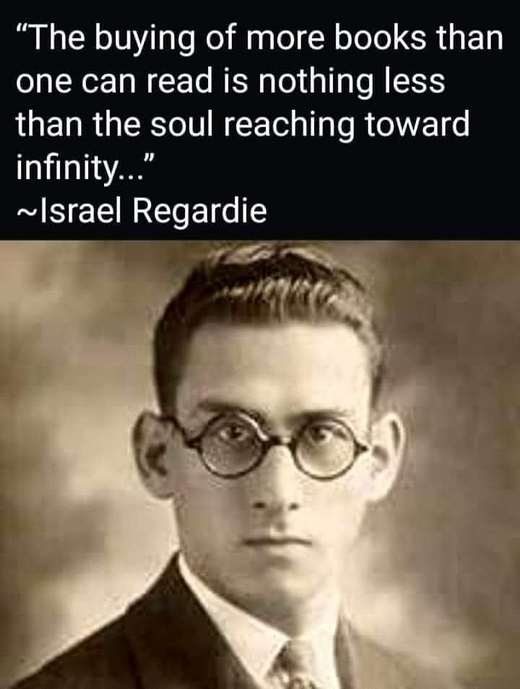
the text 'The buying of more books than one can read is nothing less than the soul reaching toward infinity...' - Israel Regardie above a picture of Regardie

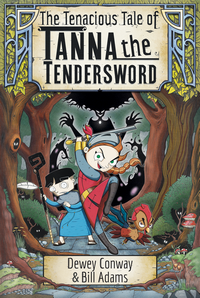
The Tenacious Tale of Tanna the Tendersword by Dewey Conway & Bill Adams: A Would-Be Champion, A Would-Be Scribe, and a Fire-Burping Rooster

The Tenacious Tale of Tanna the TenderswordThe Tenacious Tale of Tanna the Tendersword

by Dewey Conway & Bill Adams

DETAILS:
Series: The Chronicles of Tanna the Champion by Galdifort Quillpen, #1
Publisher: Willow Wraith Press
Publication Date: April 2, 2024
Format: eARC
Length: 283 pg.
Read Date: March 14-18, 2024

What’s The Tenacious Tale of Tanna the Tendersword About?

Tanna is an aspiring Champion, a hero in training, and a student at Edic Academy of Valient Adventurers who is looking for her first quest. It ought to be small, as she’s young and inexperienced, this is the chance to show that she can accept a challenge and complete it successfully, thereby earning the opportunity to further her education.

Traveling with her is a Chronicler-in-training. His duty is to accompany her as she seeks for and then completes her quest, writing the official (and perhaps mildly dramatized) version of her heroics. When/if Tanna becomes a full-fledged Champion, he (or another Chronicler) will accompany her, so someone can tell the tale of her adventures for the entertainment and edification of non-heroes. Galdifort Quillpen is less than appreciative that Tanna’s search for a quest centers on a village populated largely by pigs and pigherders. The sights, smells, and sounds are not what he had in mind.

But she’s not finding a quest, and they only have a few days before they have to return to the Academy. Returning empty-handed will set them back in their training—perhaps derailing it entirely. Tanna is keeping busy helping people with chores and being friendly—but that’s not a guidebook-approved quest.

She excitedly comes to him, however, with an opportunity. Someone knows someone who can send them on a search to request for a quest. They only have to talk to a few people, travel after curfew (and a great distance) to a place that will put them very near the territory of a witch who is largely only referred to as What’s-Her-Name, to hopefully find the person with a quest. Tanna’s dogged determination and some rather exciting circumstances force Galdifort into agreeing to go along with her (complaining and objecting the entire way).

And that’s just the beginning…

Along the way, they will meet a peg-legged Rooster who is a vicious fighter, talking (and crying) mushrooms, a giant hawk-like bird, and enough other strange creatures to fill a Bingo card. They’ll face dangers and personal challenges. And maybe, just maybe, learn something. You know, if they survive.

Spoon!

Okay, Tanna doesn’t have a battle cry that silly. (Yet?) But throughout the book the relationship between Tanna and Galdifort reminded me so much of The Tick and Arthur (in every incarnation, but primarily the animated version, just because I’ve spent more time with that one). Tanna has The Tick’s optimism, the sheer belief that things will work out, she’ll vanquish her foes, and that the right will prevail—because that’s how it goes. She also has The Tick’s, um, poor grasp on vocabulary, understanding of complicated matters, obliviousness toward their companion’s attitutde, and propensity for overblown dialogue.

Meanwhile, Galdifort has Arthur’s intelligence, reluctance to rush into danger, preoccupation with the kinds of things that their heroic companions miss, pessimism (they’d both argue realism), and both find themselves more loyal to and confident in their companion.

I don’t think that Conway and Adams consciously modeled their duo on Edlund’s—but there are worse ideas. I think it’s just that this combination of traits really works for comedy, drama, and ongoing character development. Something they all discovered and used to well. It’s also a good way to explain to blog readers of a certain age what kind of character dynamics are present when they buy a copy of this book of their MG readers (or themselves, I don’t judge).

The Illustrations

This is tricky, because my copy of the ARC didn’t include the illustrations, so I can’t say a lot about them.

However, there are some samples on the author’s site, and they are great. Cute as all get out, Galdifort’s personality is captured perfectly. Tanna’s wide-eyed optimism and energy is clear. And I’d love a print of that Peggs illustration.

I’d like to see what those look like in the book itself, but I can’t imagine they’ll do anything but grab your eyes and help to suck you in. I also don’t know how many there will be in the book. I don’t think I care—the text doesn’t require them, but I can’t imagine (especially after seeing them) that they’d do anything but entertain and engage the reader.

So, what did I think about The Tenacious Tale of Tanna the Tendersword?

This was ridiculously fun. I wish I was in Middle Grades so I could appreciate it a bit more—I’m too jaded and old to really get into it the way I wanted to, I could see what the authors were doing, and so on. It took a little bit of the fun out of it for me. But when I could suspend my, um, advanced adulthood and just enjoy the story, boy howdy, did I.

There were some rough patches for me when it came to grammar and language, and they most likely will have been addressed by publication. I couldn’t even tell you what they were now, so they were pretty minor (nor could I find them easily, because I tried). But I can’t imagine that any 5th +/- grader is going to pick up on them (or care).

The humor and heart are both evident throughout—I don’t know that I laughed out loud (see the jaded bit above), but I was frequently amused. There were some subtle messages/life lessons woven into the text that I appreciated and probably won’t come across as messages or life lessons for the target reader. I have to be vague with what I liked because a lot of the fun is in the discovery—or the way that Galdifort grumpily engages with or describes the world around him (he’s not quite Puddleglum or Eeyore, but he could get there one day with enough effort). But I assure you, it’s entertaining from at least page 3 right up to the end.

I think the experience would be enhanced a bit by having the illustrations, but even without them, I was entertained. The Tenacious Tale of Tanna the Tendersword is good, wholesome fun that will surely engage most readers of all ages, with a satisfying conclusion—and a good hook to bring us all back for the second in the trilogy.

Disclaimer: I received a copy of this ARC from the authors in exchange for my honest opinion.


3.5 Stars

Irresponsible Reader Pilcrow Icon

The “I’ll Get Around to it Later” Book Tag

The “I’ll Get Around to it Later” Book Tag
I saw this over at bookforager a couple of weeks ago, and it seemed fun. I’ve been wanting to do another Book Tag, too. So here we go…


This was created by Liesl Brunner at Quote, Unquote and it has a few rules:

  1. Link back to the original post at Quote, Unquote so the creator can read your answers
  2. Link back to the post of the person who tagged you and thank them. Okay, thanks for the fun read, bookforager!
  3. You may use the included graphic anywhere in your post, but you don’t have to. (you can find it back on Quote, Unquote)
  4. Fill all seven categories
  5. You can either leave this tag open so anyone can do it or tag up to seven people

A classic book that you have been meaning to read forever but haven’t yet

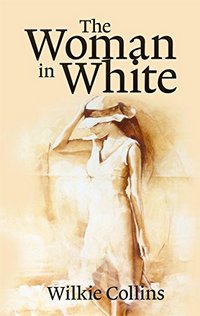
The Woman in White

The Woman in White by Wilkie Collins

I’m certain I could’ve listed about half of “The Western Canon” here (probably much more, but let me live in that river in Egypt), but I went for this one, as the only “classic” I own and haven’t read. (I typically buy classics when I plan to read them) The precursor of much of American detective fiction, you know I’ve got to read this one, (so why haven’t I?)


A book on your shelf that you haven’t read yet

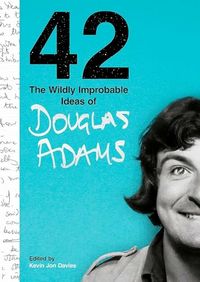
42: The Wildly Improbable Ideas of Douglas Adams

42: The Wildly Improbable Ideas of Douglas Adams edited by Kevin Jon Davies

I’ve been looking forward to it for ages (since the Kickstarter to fund it), so I’m not quite sure why I didn’t dive in immediately. I’m a little intimidated to read this, I guess. It’s literally the densest book on my TBR shelf (really thick, high quality paper, it weighs a ton). My goal is to be able to post about it on Towel Day now.


A book that you got recently that you haven’t read

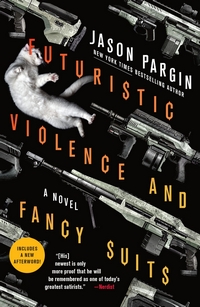
Futuristic Violence and Fancy Suits

Futuristic Violence and Fancy Suits by Jason Pargin

I’ve been told by two very different people (yeah, yeah, everyone’s different, but you know what I meant) separately recommended this to me within a few weeks of each other. Saw it at a bookstore a couple of weeks later, and now, I’m hoping to finish it before Memorial Day.


A book that you’ve had forever but haven’t read

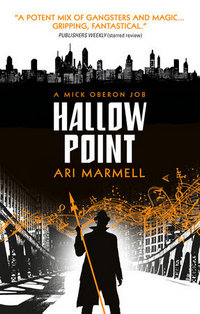
Hallow Point

Hallow Point by Joe Klingler

This is the oldest unread book I own–I read the first Mick Oberon Job, Hot Lead, Cold Iron and thoroughly enjoyed it. Bought this sequel back in January 2016. And then kept putting it off long enough that I can only remember the broadest outlines of the first one. I do need to get around to it (and the 2 following)


A book a friend recommended that you haven’t read

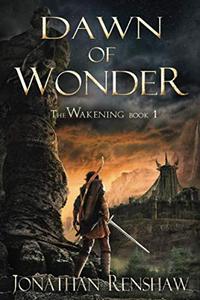
Dawn of Wonder

Dawn of Wonder by Jonathan Renshaw

Actually, my friend Micah more than recommended this one to me, he gave it to me. As this came out in 2015 and book 2 has yet to see the light of day (a fact I just looked up), I’m thinking I may have made the right call on not reading this one (Renshaw’s reasons are incredibly understandable, but I’m still going to hold off a little longer). But since I’ve enjoyed and/or loved (mostly loved) every book Micah’s ever recommended to me, I probably would like this one, if I ever got around to it.


A book you’re procrastinating on

Literally everything in this post or the 270+ other books I’ve got on one list or another? That’s not helpful. Let’s go with:

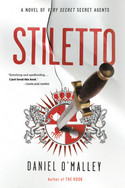
Stiletto

Stiletto by Daniel O’Malley

I’ve used this as tag answers before. And, at the rate I’m going, I’ll continue to do so. But…here we are. I’m a little worried that if I get around to it later, my TBR shelf might fall over. It’s gotta be weight-bearing by now.


The next book on your TBR

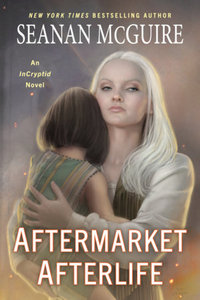
Aftermarket Afterlife

Aftermarket Afterlife by Seanan McGuire

I’m pretty sure the next one I’m reading will be this one, before it becomes one of those “I’ll get around to it” books (I’m not sure why InCryptid books tend to get this way, but they do). Actually, I’m hopefully reading it by the time this posts (but something tells me I won’t be). Otherwise, it’ll be this book (because I’m determined to have read everything I bought at the Nampa Library Book Fair last year before I show up to this year’s.

Cooked Goose

Cooked Goose by Laura Jenski


As usual, I’m not tagging anyone in this—but I’d like to see what you all have to come up with.

Image by OpenClipart-Vectors from Pixabay

WWW Wednesday, March 20, 2024

It’s still, Wednesday, right? Well…it is here, anyway.

This meme was formerly hosted by MizB at A Daily Rhythm and revived on Taking on a World of Words—and shown to me by Aurore-Anne-Chehoke at Diary-of-a-black-city-girl.

The Three Ws are:
What are you currently reading?
What did you recently finish reading?
What do you think you’ll read next?

Seems easy enough, right? Let’s take a peek at this week’s answers:

What are you currently reading?

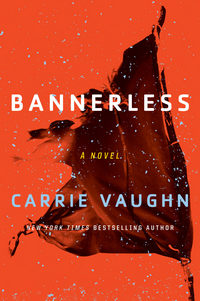
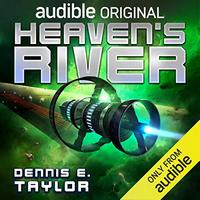
I’m reading Bannerless by Carrie Vaughn, (I cannot believe I waited 6 years to open this!) and am listening to Heaven’s River by Dennis E. Taylor, read by Ray Porter on audiobook. It’s been too long since I listened to Book 3, love getting back to this world.

BannerlessBlank SpaceHeaven's River

What did you recently finish reading?

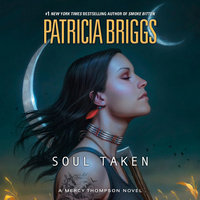
I just finished the rather fun The Tenacious Tale of Tanna the Tendersword by Dewey Conway & Bill Adams and Soul Taken by Patricia Briggs, read by Lorelei King on audio.

The Tenacious Tale of Tanna the TenderswordBlank SpaceSoul Taken

What do you think you’ll read next?

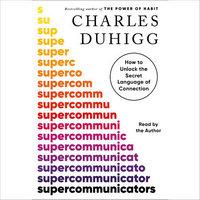
My next book should be Aftermarket Afterlife by Seanan McGuire and my next audiobook should be Supercommunicators: How to Unlock the Secret Language of Connection by Charles Duhigg. I really enjoy the way Duhigg tells a story, and hopefully, I can learn from this one.

Aftermarket AfterlifeBlank SpaceSupercommunicators

What’re you up to this week?

So…this happened

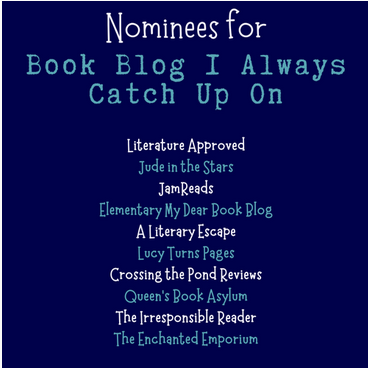
Monday morning I was pleasantly surprised when Nathan’s Fantasy Reviews informed me (and some others) that we’d been nominated for the Indieverse Awards in the category of “Book Blog I Always Catch Up On”!

Book Blog I Always Catch Up On Nominees

I was even more pleased once I read about the Indieverse Awards, their vision, and activities. I’m really hoping this catches on and gets the attention that it should. Take a few mmoments to look around their site and see some of the cool stuff they have planned.

I would like to thank whoever it was that nominated this here patch o’ cyberspace, hopefully they see this post when they catch up on the blog. Also, if they’d tell me why they nominated this blog, I’d appreciate it. Seriously, here’s the rest of the very worthy nominees:

bullet Literature Approved
bullet Jude in the Stars
bullet JamReads
bullet Elementary My Dear Book Blog
bullet A Literary Escape
bullet Lucy Turns Pages
bullet Crossing the Pond Reviews
bullet Queen’s Book Asylum
bullet The Enchanted Emporium

I look forward to losing the vote to them all.

Irresponsible Reader Pilcrow Icon

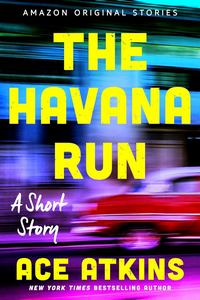
The Havana Run by Ace Atkins: Um, What?

The Havana RunThe Havana Run

by Ace Atkins

DETAILS:
Publisher: Amazon Original Stories
Publication Date: March 12, 2024
Format: eBook
Length: 47 pg.
Read Date: March 18, 2024

What’s The Havana Run About?

George and Jay are a couple of out-of-work newspapermen who spend more time than they ought drinking (but what else are they going to do?). They meet an elderly Cuban immigrant who wants to hire them to go to retrieve some items for him—it’s not safe for him to return, but there should be no problem with them going.

He doesn’t tell them what they’re going for, assuring them that some of his friends will guide them.

What do they have to lose? They have 10K to gain. Once they get to Havana, the very sketchy plan they have evaporates. The pair finds themselves running from criminals and the police, and unable to trust anyone. Including (especially?) their contact.

So, what did I think about The Havana Run?

Ummm…now that’s a good question. I guess I’d have to say, not much. I liked the two protagonists and enjoyed their interactions with each other and just about everyone they encountered. The action scenes were good, too, as one would expect.

But…I didn’t connect with anything else in this book. I didn’t buy their “mission” (or whatever you want to call it), and couldn’t believe that they went for it—even as desperate for money as they seemed to be. And then everything that happened once they get to Cuba? It was all…I don’t know what to say. Pointless? Disappointing? (there are other, better words, I’m sure, but I’m drawing a blank)

I fully expect there are plenty of people who will have enjoyed this and are glad they read it. I just don’t see why they would. I don’t get what Atkins was trying to do (other than something other than Spenser or Quinn Colson)


2 1/2 Stars

This post contains an affiliate link. If you purchase from it, I will get a small commission at no additional cost to you. As always, the opinions expressed are my own.
Irresponsible Reader Pilcrow Icon

MUSIC MONDAY: Somewhere Over The Rainbow by Mandy Patinkin

Music Monday

Music Monday's originated at The Tattooed Book Geek's fantastic blog and has shown up hither, thither, and yon since then.

Doesn’t get better than this…

Irresponsible Reader Pilcrow Icon

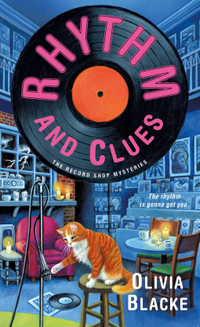
Rhythm and Clues by Olivia Blacke: A Locked-Town Mystery

Rhythm and CluesRhythm and Clues

by Olivia Blacke

DETAILS:
Series: The Record Shop Mysteries, #3
Publisher: St. Martin's Press
Publication Date: March 26, 2024
Format: eARC
Length: 304 pgs.
Read Date: March 8-11, 2024
Buy from Bookshop.org Support Indie Bookstores

What’s Rhythm and Clues About?

An old college acquaintance of Juni Jessup has approached her and her sisters with a proposition—he and his partner will invest in Sip & Spin Records, help it succeed—and take a good portion of the profits. Juni and her old (and maybe future) boyfriend, Beau, attend a hockey game with them for a little wining and dining (or beering and snacking) along with the pitch. It’s not the beginning of a Record Shop Mystery that you’d expect, but it’s pretty fun.

The fun goes away later that night when a monster storm hits their area, knocking out power to the entire town, and threatening to flood buildings as well. Juni and her older sister dash to their store to try to mitigate the damage there. Before you know it, the event readers were waiting for happens—one of the investors is dead outside their shop and Juni is the one who discovers the body.

The police warn her off—but the surviving partner has heard of Juni’s previous adventures and asks for her help. Which is convenient—because she wanted to look into the murder anyway.

The storm has made leaving—or entering—Cedar River impossible for a few days, so the murderer is definitely still around. This could be a problem because it seems that everywhere Juni looks, she finds another suspect with plenty of reasons to want that investor gone. Will she be able to find them before they can get out of town?

The Investors

For various and sundry reasons (starting with all the roads being washed out), Juni ends up spending a lot of time with the dead man’s business partner and gets to know their business practices much better than she did during their pitch to Juni (or her sisters).

While they don’t do anything illegal, and probably not strictly unethical either, there’s something about their methods that just don’t sit right with me (or several others in the novel). As a mystery reader, we get to encounter all sorts of unsavory characters and actions that aren’t necessarily illegal, but sure aren’t good. Very often you wonder how realistic they are while hoping some fiendish writer made it all up out of whole cloth (but secretly knowing they didn’t). I suspect that Blacke is sharing something that came up in her research—or something that people she knows have run into for their own small business.

I truly hope the latter isn’t the case, because I’m sure people like this exist and people suffer because of them. It makes me glad to not own a business and have to worry about it.

Juni’s Growth

She’s been on her own for several years, and until an economic hit at her company led to her coming home, seems to have found some sort of success in life. So you’d think she’d come back to town as an adult—and she does, but she also seems to be largely treated as pretty much the same kid she’s always been. And maybe part of that is just coming back to the place where everyone knows you as that kid you were when you went to college and aren’t ready to accept that you’ve grown up.

But she’s been coming into her own, little by little, over the course of the series—and arguably arrives in this book. Maybe she’s just more comfortable in her own skin and her old hometown. Maybe it’s the way others see her. Probably a little bit of both. It certainly doesn’t hurt things at all the way she keeps finding herself in the middle of murder cases.

The important thing is that it’d be easy for Blacke to freeze all the characters so that they’re who we met in Vinyl Resting Place for the rest of the series. But she doesn’t do that—Juni’s the most notable example of this, but there are others, too. I’m so glad that Blacke has taken this path, it opens the door up for more changes, more development—and will keep readers like me engaged with the characters and the stories they find themselves in.

In my post about the last book, I said, “I do worry that at some point the residents of Cedar River are going to decide that Juni’s the Angel of Death having brought so many murders to town with her.” They still might do that—but so far, they’ve gone in another direction. Particularly the first responders in town. There’s a moment involving them and Juni that got me to laugh out loud. And I don’t know how to say more about it than that.

Juni’s Drinks

Blacke’s music pun-inspired coffee drink names are as good here as they’ve ever been, if not better. Now, I understand why she doesn’t give us too many per novel. But I think she could give her fans some supplemental material—bonus tracks, if you will—just give us some of the seasonal menus from the time between books. Just throwing that out there as an idea.

That Moment

When it comes to a lot of procedurals or other mystery shows on TV there’s a moment where the detective sees something or hears something that a friend/coworker says, they get this look in their eye and they dash out of the room, they’ve got the whole thing solved now. Gregory House was great at these—Temperance Brennan is the other prime example that jumps to mind (but I know there are many others).

It’s hard to depict those moments in novels, however. But you can still see them happening—Juni has one of those here. Well, she starts to anyway, and something comes along to take her out of the moment. For most/all readers, we won’t get taken out of the moment—if anything, we’ll keep going with it and solve the mystery (or at least get a lot closer to it). Blacke really handled that well—a trick I wish she’d teach others.

While commending her for this, her creation got on my nerves because of it. Juni took forever to circle back to that breakthrough moment and finish her thought. I was so relieved when it happened without me having to climb into the book and shake her by her shoulders until she’d focus.

So, what did I think about Rhythm and Clues?

Blacke is really onto something with these books—this is her best yet, and she shows no signs of slowing down (I hope she gets to keep going). The writing was sharp here, the characterizations—particularly of the investors, and the new people Juni encounters during the case—were on point and vivid, the mystery was her best and twistiest yet. The herrings were a bright and lively red—practically vermillion. The resolution was so, so gratifying.

This series is quickly becoming a solid favorite of mine—I’m never going to be a giant cozy mystery fan, but when I read one that works as well as this one does, I want to go find more. It’s a very clever and fast read, with some heartfelt emotional moments and it brings a lot of smiles to my face.

I honestly don’t know of a better way to put it or a better reason to commend it to your attention. Rhythm and Clues was as satisfying a read as you’re going to find. You can jump on here or you can get the first two books in the series and have a good time with them first. Either way, I encourage you to track it down.

Disclaimer: I received a copy of this book from St. Martin’s Press via NetGalley—thanks to both for this.


3.5 Stars

This post contains an affiliate link. If you purchase from it, I will get a small commission at no additional cost to you. As always, the opinions expressed are my own.
Irresponsible Reader Pilcrow Icon

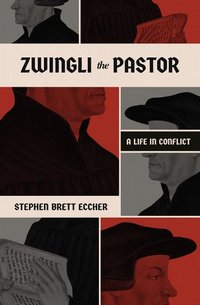
Zwingli the Pastor: A Life in Conflict by Stephen Brett Eccher: A Look at The Reformer’s Most Important Work

Zwingli the PastorZwingli the Pastor:
A Life in Conflict

by Stephen Brett Eccher

DETAILS:
Publisher:  Lexham Press
Publication Date: March 20, 2024
Format: eARC
Length: 288 pg.
Read Date: February 25-March 10, 2024

Buy from Bookshop.org Support Indie Bookstores

What’s Zwingli the Pastor About?

Of the first-generation—or Magisterial—reformers, Huldrych/Ulrich Zwingli is probably the least known today—and a lot of what carries his name popularly isn’t necessarily reflective of his actual positions. From what I’ve heard, there’s somewhat of a resurgence of interest and scholarship in Zwingli. Stephen Brett Eccher brings us this introduction to the reformer as part of that.

This is not a biography of Zwingli, nor is it an in-depth examination of his theological insights and writing. As the title suggests, it’s a look at his pastoral work. His life was defined by conflict, and that’s true as well for his ministry.

After a quick overview of his life, including his pastoral work pre-Zurich, Eccher looks at Zwingli’s pastorate topically rather than chronologically. His focus wasn’t on changing the Church throughout the world, or making history (although he did both)—Zwingli’s focus was ministering to the people of Zurich in the pulpit, in their homes, in sickness, and in rapidly changing times.

Disagreeing with Zwingli

I’m not going to argue that an author writing a book about someone else needs to be in lockstep with him (or how could anyone ever write a book about anyone?). But if you disagree with your subject on significant points (and I think this is more true when it comes to theological points than otherwise), you need to exercise care in describing the subject’s positions you differ with—and those people who differed with him. I think Eccher tried, but he could’ve been more successful at it.

The book is critical of Zwingli—in both his actions and teachings—and Eccher handled that well.* It was when (for example) he would describe Zurich’s Anabaptists as they began to disagree with Zwingli, that he stumbled. He never came out and said, “they were right to separate from him over this,” but the tone suggested both that on point X they were obviously correct and it’s not even worth discussing how they were. Even if he did circle back to point X in a few pages or chapters to discuss it properly, it didn’t seem to me that he really gave Zwingli a fair shake on these points, and just assumed that the Anabaptists (or whoever) were correct and that readers already agreed with Eccher (and didn’t necessarily describe Zwingli’s position to the extent he maybe should’ve).

* Largely, anyway. There are a few sentences that I’d like to challenge Eccher to explain/defend. But I’m not going to get lost in the weeds here.

Not knowing that many details about Zwingli on some of these points, I could be wrong about this. Perhaps Eccher didn’t get into details and nuances because they aren’t present on these points of difference. But it didn’t seem like that to me—and I’m just trying to describe my reaction to the text as a reader.

The Structure of the Chapters

Given everything that Eccher sets out to accomplish (and largely succeeds in doing so), this is a pretty short book*. And I’d imagine that Eccher would want to feature some tight writing to facilitate him meeting his agenda. But he doesn’t, each chapter** starts with an introduction set in contemporary Zurich (or somewhere else in Switzerland), and then he comes to a point leading into the chapter.

* It’s listed at 288 pages, in my electronic version, only 65% of the book makes up the text, the rest is bibliography, indices, etc. Which makes this a very short—but dense—read.
** There might be an exception or two to this, but the point stands. And those exceptions will be very similar.

Then it feels like he backs up to set the historical stage, talk about some of the development in Zwingli’s life/thought/ministry before getting to that introductory point, developing it, and then reaching some kind of conclusion.

I’m not doing the best job of describing the structure, but that’s the gist of it. I think it would’ve been far more economical to cut everything before the point where Eccher backs up and sets the historical stage. I don’t think the glances at contemporary Zurich, etc. added anything to the book beyond word/page count. They didn’t detract from anything, but if they added anything I missed it.

And I’m not sure that we needed the brief introductory summary of the chapter’s point, either. At best, they meant you knew where each chapter was heading (if you couldn’t guess from the chapter title)—at worst, I think they took some of the punch of the points away, because you were waiting for them to show up.

This could just be me. It wouldn’t surprise me a whole lot to find that most readers appreciate one or both of these devices (obviously Eccher and his editor(s) liked them). But by the second time I saw him use them, I got a little tired of it—and it needled me every subsequent time.

Five Theses

Eccher completes the book with “Five Theses on Zwingli.” These are summaries of aspects of his thinking/teaching and Eccher’s reflection of them as a whole. His greatest criticisms of the Reformer are presented and explained here. (and frankly, it’s here that Eccher annoyed me more than elsewhere) I would’ve liked each thesis to have been given more space and more development—50-100% more space each, I think it would’ve made them stronger.

That said, this kind of wrap-up/conclusion is a great way to structure the book and complete the examination of Zwingli. I heartily appreciated it.

So, what did I think about Zwingli the Pastor?

Let me start this section by stressing that the above sections described minor things that niggled at me while I read—they are by no means major complaints or shortcomings. But it just takes a while longer to describe something like that than to pay a compliment. And I have several compliments to offer.

For example, the chapters on Zwingli’s ministry during the time of plague—and the devastating impact it had on his life—and his marriage were very strong. The description of the infamous Affair of the Sausages, the lead-up to it, and the fallout from it was another strong point. Eccher went to great pains to show the influence of others—historic and contemporary to Zwingli—on his thinking and actions. As much as people talk about Erasmus’ influence on Luther (largely Luther reacting against Erasmus), it was good to see Erasmus’ influence bearing such positive fruit in Zwingli (much to Erasmus’ woe, I’m sure) up to the point where the two split. Actually, I’m going to cut myself off here before I just start listing the Table of Contents (I could). I do wish we’d gotten a little more describing the circumstances of his death—that portion of the book felt rushed.

One strength of this book is that it avoided the temptation to turn Zwingli into a 21st-century type of Evangelical, or someone who agreed with the author in almost every way. So often when reading a book about a lesser-known figure in church history, you can get the feeling that the author is saying “outside of this little quirk or that, mostly because of their place in history; this guy is just like me.” Eccher doesn’t say that—he seems to admire a lot about Zwingli, but he’s by no mean prone to hero worship or whitewashing any perceived shortcoming.

Going into this book I had only a rudimentary familiarity with Huldrych/Ulrich Zwingli, and while I’ve often thought about addressing that, I hadn’t. This book hasn’t given me a complete and exhaustive look at him by any means—and wouldn’t claim that. But it’s a great, broad introduction to his work and thought. I feel equipped now to go out and read some of his works, and other books about particular aspects of his theology, having this book give me the overall lay of the land.

I encourage others who are looking for a place to start with this often overlooked Reformer to give this a read. If only so it can spur you to further reading and investigation—like I think it has for me—but you’ll know where to dig in.

Disclaimer: I received a copy of this book from Lexham Press via NetGalley—thanks to both for this.


4 Stars

This post contains an affiliate link. If you purchase from it, I will get a small commission at no additional cost to you. As always, the opinions expressed are my own.

Irresponsible Reader Pilcrow Icon

Saturday Miscellany—3/16/24

Odds ‘n ends about books and reading that caught my eye this week. You’ve probably seen some/most/all of them, but just in case:
bullet Is It A Betrayal To Publish Dead Writers’ Books?: Inside the ethically thorny world of posthumous publishing.
bullet I didn’t get the credit for my bestselling book: the secret life of the celebrity ghost writer—Liam Pieper describes the reality that’s close to what I expected, but is nice to see confirmed.
bullet Not Just Covers, But Every Page: Why Writers Should Talk About Book Design Early On: Debbie Berne on the Intricacies of Literary Interior Design
bullet Why Are These 90s Young Adult Books So Irresistible?—For readers of a certain age, this is a fun collection of posts/articles from Pocket.
bullet Famous Works of Irish Literature as Limericks—what better way to note St. Patrick’s Day than with Amanda Lehr’s latest post to McSweeny’s?
bullet Bookish Death Cleaning: On What We Keep, and What It Means
bullet Page Turners vs. Screen Scribes: The Endless Debate of Physical Books vs. Ebooks—nothing revolutionary here, but that’s not neccesarily a bad thing.
bullet Breaking into the indie market with the Break-Ins! —Over at Before We Go Blog, The Fictional Escapist has a great interview about a great idea.
bullet Bookmark Chat: Guess Who’s Back…—The McBooknerd is back!
bullet A Voracious Reader was under the pressure of handling Witty & Sarcastic Bookclub’s Tough Questions this week (I really need to get on my answers)
bullet Thoughts From A Grumpy Year Of Reading—2024 isn’t treating our pal Peat too well…

A Book-ish Related Podcast episode (or two) you might want to give a listen to:
bullet The Conversation with Nadine Matheson 2.58 S.A. Cosby: We Tell Lies To Tell The Truth

To help talk about backlist titles (and just for fun), What Was I Talking About 10 Years Ago Week?
bullet Red Rising by Pierce Brown—the beginning of a beautiful book friendship for me…
bullet And on the other end of the tonal spectrum…Notorious Nineteen by Janet Evanovich

This Week’s New Releases that I’m Excited About and/or You’ll Probably See Here Soon:
bullet The Ballad of Sprikit The Bard (And Company) by Sean O’Boyle—I’ve seen this described as “A ‘Discworld’ meets ‘Lies of Locke Lamora’ Adventure.” Which is enough for me. Hearing a lot of good about it, too.
bullet Say Hello to My Little Friend by Jennine Capó Crucet—a “darkly comic” book about a Pitbull imitator (the rapper, not a canine) teaming up with a magical orca to become a real-life Tony Montana with shades of Moby Dick. The novel sounds so strange that it just might work.
bullet Black Wolf by Juan Gómez-Jurado—This thriller looks so good that I’m getting the first in the series from the Library today. Click the link, I’m not going to try to summarize it.

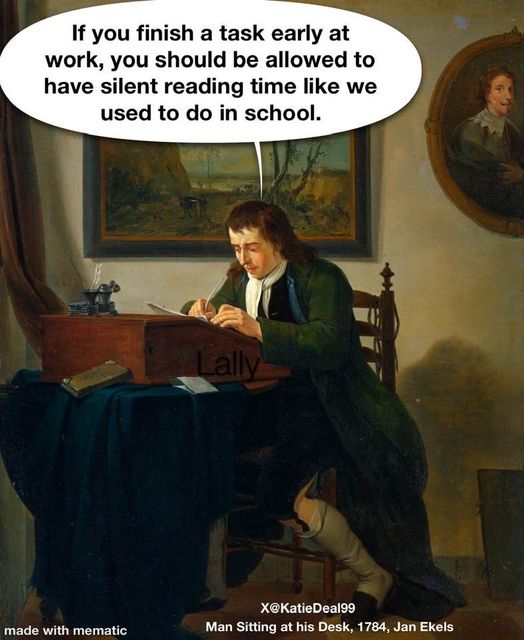
Man Sitting at his desk, 1784, Jan Ekels with a speech bubble reading 'If you finish a task early at work, you should be allowed to have silent reading time like we used to do in school.'

Page 107 of 603

Powered by WordPress & Theme by Anders Norén