2019 While I Was Reading Challenge

I finished this challenge last week and posted about the last couple of items this week (the other reading challenges I participated in this year were just “how many of X can you read?”, so there’s no real endpoint). Like last year, I thought it’d be no trouble whatsoever to get this done, and I’d just finish this by reading what I’d normally read. I was almost right. But not really.

I struggled to find one in a country I wanted to visit, well, just one, anyway–but Ireland (preferably Ronan Boyle’s Ireland, if it only existed) did the trick. I purchased another book for the “one word title” item, but didn’t find the time for it. Thankfully, Jacka’s books are always one word, so I ticked off that box anyway. I’d picked the last two books months ago, but struggled to find time for them. It all worked, it was nice to have something to force me to read some of these and

I’m doing this challenge again next year, I like the way that Romana Mead makes me think a little differently about what I choose to read—and because I enjoy reading some of the discussion on Facebook between participants. Am hoping I don’t have to race to get this finished next year, but . . . I think I know better.

Here’s my official list:

While I Was Reading 2019 Challenge

✔ A book with a curse word in the title: The Girl Who Could Move Sh*t with Her Mind by Jackson Ford
✔ A memoir or biography of a favorite celebrity: Riding the Elephant by Craig Ferguson
✔ An essay collection: Death Valley Superstars by Duke Haney
✔ A book with a one word title: Fallen by Benedict Jacka
✔ A classic you’ve been meaning to get to: The Last Unicorn by Peter S. Beagle
✔ A book written by a comedian: Riding the Elephant by Craig Ferguson
✔ A book set in a country you’d like to visit: Ronan Boyle and the Bridge of Riddles by Thomas Lennon, John Hendrix
✔ A book by an author you’ve never read before: Flight of the Fox by Gray Basnight
✔ A book recommended by someone you trust: An Accidental Death (Audiobook) by Peter Grainger, Gildart Jackson
✔ A book with your favorite animal on the cover or in the title: Heart of Barkness by Spencer Quinn
✔ A book mentioned in another book: The Art of War by by Sun Tzu, James Trapp (Translator)
✔ Read a book with “how to” in the title: How to Kill Friends and Implicate People by Jay Stringer

The Last Unicorn by Peter S. Beagle: A Beautifully Written Fairy Tale that Really Didn’t Do Anything For Me

The Last Unicorn

The Last Unicorn

by Peter S. Beagle

Paperback, 294 pg.
ROC, 1991 (originally published 1968)

Read: December 13-18, 2019

Grab a copy from your local indie bookstore!

The true secret in being a hero lies in knowing the order of things. The swineherd cannot already be wed to the princess when he embarks on his adventures, nor can the boy knock on the witch’s door when she is already away on vacation. The wicked uncle cannot be found out and foiled before he does something wicked. Things must happen when it is time for them to happen. Quests may not simply be abandoned; prophecies may not be left to rot like unpicked fruit; unicorns may go unrescued for a very long time, but not forever. The happy ending cannot come in the middle of the story.

This is the tale of a Unicorn—quite possibly the last in the world (hence the title). On some random day, she discovers that she might be the last of her kind, and so leaves her forest to go throughout the world, searching for others of her kind.

She falls into some trouble after a while, and is helped out by a magician she comes across who ends up traveling with her, as well as a woman associated with a band of outlaws who is looking to get away from them. They travel until they find the cause of the disappearing unicorns and seek to return them to the world.

This is some of the best prose that I read this year. The language is just beautiful. There were several times I had to stop and reread a sentence/paragraph/passage three or four times because it was so good. More than once, I had to force myself to move on or I’d never have made any progress in the book.

That little quotation at the beginning is just a taste of the meta-commentary on fairy tales (specifically) or story (in general) scattered throughout the book. I laughed a lot at some of them, and thought all were very thought-provoking. It’s like a more ambitious <b>The Princess Bride</b> in this regard (probably others, too, now that I say it, but I don’t have time to tease this idea out).

I dug the characters—Schmendrick the Magician (the world’s worst) was wonderful. Molly Grue is an inspired creation, and the kind of character more people need to write. And, of course, the Unicorn herself…

There were several scenes that were just delightful—unique, entertaining. When not unique, Beagle is playing with, twisting, riffing on fantasy/fairy tale mainstays.

But when you put them all together . . . I just didn’t see the point. A combination of these characters, these scenes, and the meta material alone should’ve been a home-run for me. Throw in that language? I should be making plans to re-read it regularly. But somehow, the whole ended up less than the sum of its parts. I just didn’t care about any of it, it never connected to me. I spent so much time trying to figure out why that was the case—and I got nowhere. I’m going to have to try in a couple of years again, see if it was just bad timing or something.

This is one of those books that everyone loves—and as far as I can tell, there’s plenty of reason to love it. Sadly, I didn’t. If you haven’t read this yet, you probably should—I just hope it works out better for you.


3 Stars

✔ A classic you’ve been meaning to get to

This post contains an affiliate link. If you purchase from it, I will get a small commission at no additional cost to you. As always, opinions are my own.


Why Book Bloggers Blog… #Hug/FistBumpABookBloggerToday #SupportYourLocalBookNerd

“There’s a bookstore here somewhere,” Lula said. “I’ve never been in it, but I saw it advertised. Maybe she would like a book.”

“She has four kids,” I said. “She hasn’t got time to read.”

“That’s a shame,” Lula said. “Everyone should read.”

“Do you read?”

“No. But I think about it sometimes. Problem is, I go to a bookstore and there’s so many books I get confused. So, I get coffee. I know what I’m doing when I order a coffee.”

—Janet Evanovich
from Look Alive Twenty-Five

The Art of War by Sun Tzu, James Trapp (Translator): A Classic that Easily Demonstrates Its Classification As One

The Art of War

The Art of War: A New Translation

by Sun Tzu, James Trapp (Translator)

Chinese Bound, 95 pg.
Amber Books Ltd., 2011

Read: December 19, 2019
Grab a copy from your local indie bookstore!

Understanding the nature of war is of viral importance to the State. War is the place where life and death meet; it is the road to destruction or survival It demands study. War has five decisive factors, which you must take into account in your planning; you must fully understand their relevance. First is a Moral Compass; second is Heaven; third is Earth; fourth is the Commander; fifth is Regulation.

So…The Art of War, the classic about military strategy that’s been the inspiration for countless military leaders, business leaders, and all other sorts of people (leaders and would-be leaders alike). I tried a few times in middle/high school to read it, but never really got that far into it.

Having read it now, I wonder what my problem was back then. Also, that version I had was 2-3 times the length of this one. I can’t help but wonder what extra material was in that to get me so distracted.

The quotation above contains the purpose statement of the book as well as an outline—Sun Tzu briefly works through each topic in a simple, practical manner. Sun-Tzu demonstrates wisdom in both the large scope and human psychology.

This is the kind of book that people quote all the time, it’s like the movie The Godfather. You’ve heard/read so many lines from this book over the years, so much of it seemed almost cliché and/or obvious—but, like so many foundational texts, most of it is cliché because Sun Tzu said it first (although he did cite/draw upon sources himself, many of which we don’t have, so…let’s give him the credit).

Once you get past that, it’s easy to see why everyone reads this, why it’s still relevant, and even an idea or two about how you can apply it in your own life/job.

The footnotes are largely about translation choices and textual variants—there’s almost no commentary provided, which I appreciate.

I never do this (but I should), but I want to talk about the physical edition of this thing. I’d originally planned on reading this and then passing it on to my philosophy-reading son for his collection. But as soon as I opened the box, I knew he’d have to buy his own. It’s bound in a Traditional Chinese style (so the book says), abandoned in the early 1900s in favor of Western binding. In it, “single sheets of paper are printed on one side only, and each sheet is folded in half, with the printed pages on the outside. The book block is then sandwiched between two boards and sewn together through punched holes close to the cut ends of the folded sheets.” Also, on the left pages are the Chinese text, with the translation on the right. Which looks great—I have no idea what any of the Chinese texts says, but it’s fun to look at.

So anyway, great, historic text that lives up to its reputation. A translation that’s easy to read in an eye-catching package, and an enjoyable and insightful read. It feels silly to be rating Sun Tzu, of all people, but hey—that’s what’s supposed to come at the end of one of these posts, so:


5 Stars

✔ A book mentioned in another book: Mentioned (a lot) in Lingering by Melissa Simonson and alluded to in System Failure by Joe Zieja

This post contains an affiliate link. If you purchase from it, I will get a small commission at no additional cost to you. As always, opinions are my own.

Festivus 2019: For the Rest of Us

Shunning the commercialization of Christmas/Hanukkah/Kwanzaa/Santaween/Chrismukkah, we’re celebrating Festivus for the rest of us here at The Irresponsible Reader.

Let’s begin our observance!

Festivus PoleHere I am with my Festivus pole. Yeah, it’s a little small, but I’d rather spend money on books than the full aluminum pole. Very high strength to weight ratio, nevertheless.

Note the lack of distracting tinsel. It’s very important.


And now, let the Airing of Grievances begin.

Airing of Grievances
bullet I have a grievance with the It’s 2019, why are we still placing stickers on books? If we have to do that, why hasn’t Science come up with a sticker that doesn’t leave a gummy residue behind? C’mon, Science, if you can’t give us a cure for cancer, a pill so people with Celiac disease can eat bread, or an Oreo that will help me lose weight — at least you can give us stickers that don’t leave gunk on our books!

bullet I have a grievance with Movie/TV covers on books. C’mon people, this is stupid. Sure, it maybe helps sell more copies of the books–but has any book been improved by one of these covers? No! Knock it off!

bullet It’s another year without the next installment from Rothfuss/Butcher/Martin. No, my grievance isn’t with them, it’s with the entitled “fan” of the work, whining at every conceivable moment about how long it’s taking them. Because there’s nothing else around to read? Let ’em get it right and use that energy to support someone whose books could use it.

(still–Martin, Rothfuss…c’mon…Butcher was able to get something ready to go.)

bullet Whether it’s from a mainstream publisher, indie press or a self-pubbed book, we have the technology and (theoretically??) the education that there’s no reason for there to be missing/extra punctuation or misspelled words in books.

bullet I have a grievance with the Book Blogging Community. There are way too many good book bloggers out there to keep up with. Some of you need to write less often! Also, you make the rest of us look bad.

bullet I’ve got a grievance with running out of places to put books and bookshelves that aren’t like a bag of holding or TARDIS and can’t take an increasing number of books. So…physics, I guess. Yeah, that’s right, Laws of the Physics, I’m calling you out. Get your act together!

bullet I’ve got a grievance with how hard it can be to pick the next book to read despite a having piles of books (see above grievance) waiting to be read/multiple files on an e=reader. I know it’s not just me who endures this, so there’s gotta be a conspiracy afoot here.

bullet And what’s more…I lost my train of thought.


Time for Feats of Strength

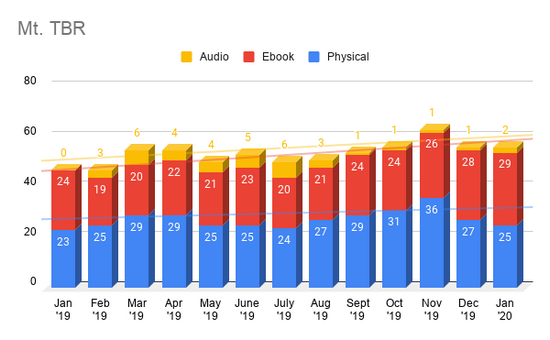
Feat of StrengthFor my Feat of Strenth, here I hold my entire TBR over my head.

(actual photo)

Let’s see how the rest of you do with your feats.


Happy Festivus

When We Were Vikings by Andrew David MacDonald: A Contemporary Legend in the Making

When We Were Vikings

When We Were Vikings

by Andrew David MacDonald

eARC, 336 pg.
Gallery/Scout Press, 2020

Read: December 9-13, 2019
Grab a copy from your local indie bookstore!


We meet our protagonist, Zelda, as she turns 21. It’s a pretty big day for most Americans, and it certainly is for Zelda. Things are going well for her—she has a boyfriend, her meetings with her therapist are going well, the brother (Gert) she lives with is taking college classes as a way to make their lives better, and Zelda’s friend/Gert’s ex gave her an actual small sword.

Zelda, you see, is a major fan of Viking culture and wants to be a Viking hero—and this sword is another step on her way to becoming a Viking legend. She also was born on the Fetal Alcohol Spectrum—as she says her Mom accidentally poisoning her resulted in Zelda being short, with trouble sitting still and thinking.

She has a fantastic therapist, Dr. Laird, who helps both her and Gert (when Gert will let him) navigate her challenges and Gert’s own issues. He’s a few years older than his sister, and once their mother died (their father disappeared years prior to that), he took on the responsibility of taking care of her.

This is a good thing for Zelda, incidentally, they’d been placed with an Uncle after their mother’s death—and he’s about as worthless a character as you can imagine. Gert does some business with people he shouldn’t to get them out of that situation and into their own apartment. This comes back to haunt him around the time of her birthday and old debts and favors need repayment. Meanwhile, his ex had convinced him to take courses at a Community College and helped him get the funding to start.

Gert’s ex/Zelda’s sword provider is known as AK47, by the way. Which says a lot about their neighborhood, I think. She’s actually the moral center of this novel and provides most of the wisdom displayed (although Zelda is a close second on both fronts, especially with AK47’s help).

While Gert’s trying to improve their station in life, Zelda goes to classes at a community center with similarly-aged people with developmental disabilities There, in addition to spending time with friends (including her boyfriend), Zelda learns behavioral and life skills. The staff there are fantastic and really impressed me with the way they interacted with everyone.

Honestly, though the deck seems stacked against these two—they’re taking care of each other and making their way in the world. Things are going as well for them as they could realistically hope (not that Zelda’s great at realistic expectations, she’s convinced she’ll be a Viking legend, for example). Except for that thing I’d said earlier about old debts and favors. And the expenses related to Dr. Laird (even on a sliding scale) and other ways Gert has to take care of Zelda. Oh, and maybe school isn’t going too well, either.

Gert tries to insulate Zelda from all that, but it doesn’t go too well. Zelda doesn’t try to insulate Gert from the fact that she and her boyfriend want to progress their relationship to physical intimacy, but man, he wishes she would (and that she’d drop the idea in general. Spoiler: she doesn’t).

We watch Zelda navigate these changing times, while she deliberately tries to mature and take on added responsibilities to help Gert. And Gert’s life gets out of control.

There are threats of violence. Actual violence. Relationship troubles. A new job for Zelda. And pressures on the two siblings that test their bonds.

The attentive reader is always aware that Gert’s in trouble and that he’s not being all that honest with Zelda—don’t misunderstand me, he’s trying his best to take care of her, but he’s hiding things from her and taking advantage of the fact that she can’t understand everything that’s happening. AK47 is a great character and I wish we’d gotten more time with her—things would’ve gone much better if Gert had stuck with her and listened to her.

Zelda’s an unintentionally unreliable narrator (but man, she tries), and MacDonald does a wonderful job putting us in her head while she navigates these obstacles along the way to becoming a legend. Obviously, your appreciation for the novel will hinge on how much you relate to/connect with/root for/like Zelda. I didn’t really get invested in Zelda as a character until the last 15-20% of the book, despite being hooked almost instantly and enjoying the novel. I think if I’d become invested early on, I would be jumping up and down excited about it.

But, I didn’t. So all I can really say is that MacDonald did yeoman’s work here and I have nothing but respect for the voice and craft displayed here. But I’m not able to muster the excitement that I think this book just might deserve. Part of that might be because I felt that I was supposed to find a lot of this amusing (and it did have its moments), and it is marketed as humorous, but it felt too much like laughing at Zelda, not with her (not that MacDonald ever mocked her).

I can’t tell you why this really didn’t click for me, but I didn’t like it as much as I wanted to (or thought I should). I imagine that I’m going to be in the minority with this and that most readers will rave. I liked the characters, I liked the story, I admire the way MacDonald wrote this—capturing Zelda’s voice and thought-process in a way that is both sympathetic and realistic. It’s a good book, one that will earn fans by the truckload, I expect—if the story/characters sound interesting to you at all, go read it. You’ll probably like it. Do me a favor though, and come back and tell me why I’m wrong not to swoon.


3.5 Stars

Disclaimer: I received this eARC from Gallery, Pocket Books via NetGalley in exchange for this post—thanks to both for this opportunity.

This post contains an affiliate link. If you purchase from it, I will get a small commission at no additional cost to you. As always, opinions are my own.

Quick Takes: God, You, & Sex by David White; Entering God’s Rest by Ken Golden; Redemptive Reversals by G. K. Beale; Grace and Glory by Geerhardus Vos

The point of these quick takes post to catch up on my “To Write About” stack—emphasizing pithiness, not thoroughness.

 God, You & Sex

God, You, & Sex: A Profound Mystery

by David White
Paperback, 240 pg.
New Growth Press, 2019
Read: November 3, 2019
Grab a copy from your local indie bookstore!

(the official blurb)
Okay, I’ve read Ephesians 5:32 and Solomon’s Song—I know there’s much to be learned about the relationship between Christ and the Church from human marriage (and vice versa), but…I still feel squeamish about aspects of that. Nothing against Mr. White, but he’s not Solomon, and I couldn’t really get behind much of what he said on that topic (not that he was wrong, necessarily, I just couldn’t agree with him).

But beyond that—it was refreshing to read actual positive teaching about human sexuality from a Christian perspective and not just a list of “No”s, “Don’t Do That”s, and so on. Yes, the positive teaching necessitates some of the “Nope”s, and I have no problem with that, but it just seems that all the conservative Protestant world can come up with are the anti-whatever books.

In the end, I quite liked most of this and got something out of it.
3 Stars

Entering God's Rest

Entering God’s Rest: The Sabbath from Genesis to Revelation—And What It Means for You

by Ken Golden
Kindle Edition, 112 pg.
Alliance of Confessing Evangelicals, 2018
Read: November 17, 2019
Grab a copy from your local indie bookstore!

(the official blurb)
This is a really good book to cut your teeth with on the subject of the Christian Sabbath/The Lord’s Day. Golden does a decent job in tracing the doctrine of the Sabbath through the Scriptures, gives some good principles for modern observance of the Christian Sabbath and how we ought to think of it—and those who disagree with us.

In the end, he gives some examples of ways one might put those principles to use. Honestly, this last chapter is the weakest, and it seems to me that he wasn’t consistent in his application of his own principles, and ended up with suggestions that were pretty weak (and maybe a compromise?)

Ignoring the last chapter, it was a decent, quick and easy read. But I’d recommend Ryan McGraw’s The Day of Worship: Reassessing the Christian Life in Light of the Sabbath, Joseph A. Pipa’s The Lord’s Day, or Nicholas Bownd’s The True Doctrine of the Sabbath instead (ranked by increasing length, depth, and complexity).
3 Stars

Redemptive Reversals

Redemptive Reversals and the Ironic Overturning of Human Wisdom

by G. K. Beale
Series: Short Studies in Biblical Theology
Paperback, 189 pg.
Crossway, 2019
Read: November 10, 2019
Grab a copy from your local indie bookstore!

(the official blurb)
I’m not really certain what it was that I expected this book to be, but I didn’t get it. What Beale gave us are looks at various topics in Scripture, showing how the way God has/is working is both counter to the ways of the world as well as human intuition.

It was a pretty approachable book, almost deceptive in its simplicity—most of what he says is worth more thought and meditation than your initial impressions might lead you to think. There’s also a lot of rich application for both thought and life—I didn’t expect a book about irony to give me things to do.

I’m not convinced that I walked away from this having learned anything, but Beale did make me think of things that I knew in a different way, with ideas on how to approach similar Scriptural topics/themes in a similar fashion in my own study.
3.5 Stars

Grace & Glory

Grace and Glory: Sermons Preached in the Chapel of Princeton Theological Seminary

by Geerhardus Vos
Paperback, 155 pg.
Solid Ground Christian Books, 2007
Read: December 8-15, 2019
Grab a copy from your local indie bookstore!

(the official blurb)
For most people (who’ve heard of him), Geerhardus Vos is known as a theologian—one of the Twentieth Century’s brightest stars, the man who showed that the academic discipline known as Biblical Theology wasn’t the domain solely of Theological Liberalism, but that a robust, Bible-believing thinker could (and should) contribute to the field.

But before he was a theologian or professor, Vos was a preacher. And this small collection of sermons shows how capable he must have been.

Yes, there’s rich theology behind these sermons, but they’re primarily expositions and applications of the texts for the hearers. And, yes, the audiences of these sermons were students at Princeton Theological Seminary (before the downgrade that led to the creation of Westminster Theological Seminary), but these were not airy, academic addresses.

I don’t think it was by design, it just worked out this way, but the second, fourth and sixth sermons were the ones that I appreciated most—my notes weren’t really that helpful, especially now. All I wrote about #2 “Hungering and Thirsting after Righteousness” was “Wow! Fantastic.” True, but that’s not really helpful—Vos opens up the idea about how Christ uses the believer’s faith (hungering and thirsting) to fill and bless them. The sermon “‘Rabboni'” (about Mary’s encounter with the risen Christ near the tomb) is less than twenty pages long, but was better than Richard Sibbes’ sermon series (184 pages in the Banner of Truth edition) on the same passage—I can’t do it justice here, so I won’t try. And the last sermon? It’s worth more than the purchase price of the whole book.

(I fully expect when I re-read this book in 2021 or so, I’ll say something just as strong about the odd-numbered sermons and wonder what I was talking about now.)

As Scott Clark mentions in his forward, Vos was a poet (particularly in retirement, but before then, too). And you can see that in some of these sermons—they practically sing. I can only imagine how captivating these were hearing them, they’re stirring just reading them.

One of the best collections of sermons I’ve ever read. My only complaint is that there were only six. Get this one.
5 Stars

This post contains affiliate links. If you purchase from any of them, I will get a small commission at no additional cost to you. As always, opinions are my own.
Saturday Miscellany—12/21/19

It’s clearly the end of the year—I’ve got a bare-bones collection this week. But who has time to read things that aren’t books right now between the hustle and bustle of December—not to mention the rush to finish off your reading goals of the 2019? (or is that just me?)

Here’s the handful of odds ‘n ends over the week about books and reading that caught my eye. You’ve probably seen some/most/all of them, but just in case:

Lastly, I’d like to say hi and extend a warm welcome to Gehad Gamal, Anton Michaux, and Brandi Robbins for following the blog this week. Don’t be a stranger, and use that comment box, would you?

46 percent Better Than Dave by Alastair Puddick: Dave meets a better version of himself

46% Better Than Dave

46% Better Than Dave

by Alastair Puddick

Kindle Edition, 245 pg.
Raven Crest Books, 2019

Read: December 14-17, 2019

No matter which way I looked at it, I was now inexplicably living next door to another version of myself. Another Dave Brookman. A richer Dave Brookman. A more successful Dave Brookman. And though I didn’t like to admit it, he was clearly also a slimmer, fitter, more handsome Dave Brookman. It was as if he was better in just about every single way. And, whether it was his intention or not, he was making the old Dave Brookman look bad. Really bad.
To say that our narrator, Dave Brookman, is surprised to find out his new neighbor shares a name with him. He shortly learns that they grew up near each other and are in the same industry. The coincidences are mindblowing. But as our narrator starts comparing the two, he keeps thinking that the “new” Dave has it better—from a literal ex-model wife to a flashy car, and all points in between.

But just how much better is “new” Dave? “Old” Dave puts together a spreadsheet assigning numerical values to various attributes/possessions and ends up with the titular value:

I sighed loudly. Of course, I’d expected there to be a difference. I knew he would come out on top. But 46%? That was nearly 50%. And 50% was half. So New Dave was nearly a whole half better than me. How could this be? What the hell had I done with my life? Had I wasted the opportunities we apparently both shared, as New Dave took full advantage of them? What could my life have been if I’d made different decisions along the way? Would I have my own company and a flash, expensive car? A house with a new extension and swimming pool? Would I be married to a former model, and have robotically clever children?

Dave spends weeks obsessing over this idea and dives into a (very one-sided) competition to become the “better” Dave. Which is ridiculous, preposterous and unsuccessful. And that’s before his wife finds the spreadsheet. After that things go from bad to worse, and then worse. Until they don’t.

It’s a great concept, it hooks you right away. But it’s what happens after the hook that’s vital—how successful is that? Well, that depends on how you read the book.

If you are looking for any real degree of realism, it’s just too hard to swallow. But if you look at “old” Dave as a character in a comedy—he’s a lot of fun. He’s really a decent, successful guy with a good family. At least until his neighbesis (his word) moves in and he becomes an obsessive, jealous mess. In his less-obsessive moments, he seems like a decent, likable guy and it’s these moments that keep you reading. In his most-obsessive moments, he makes it hard to stick with. It’s quite the balancing act that Puddick tries here, and generally, he succeeds.

Everyone else in the novel—”new” Dave and his family, Dave’s family and co-workers—all seem perfectly normal and well-adjusted. Their reactions to him are perfectly rational and understanding, too. This both highlights his irrational behavior and makes everyone else the “straight man” to “old” Dave. Without that, I think the whole thing would’ve collapsed.

Puddick has given his readers a sweet and funny novel about obsession, jealousy, and what happens to someone when they lose sight of what’s important in life. If you’re looking for a fast and fun read, you’d do well to give this a shot.


3 Stars


My thanks to Love Books Group for the invitation to participate in this tour and the materials (including the book) they provided.

Love Books Group

EXCERPT from 46% Better Than Dave by Alastair Puddick

A Sample from Chapter 8

“No offence, mate, but when was the last time you ran further then the end of the street?” said Charlie. “Let alone 10k, jumping over electric fences.”

“Screw you,” I said. “I’ll have you know I used to run all the time. I was pretty good. And I’ve run loads of 10k races in the past. This dirty mother don’t sound too bad!”

“Oh, you haven’t run a 10k in years though, love,” said Catherine, changing tack and trying to bargain with me.

Et tu, you traitorous wife, I thought.

“No, but it’s just like riding a bike, isn’t it? I can quickly get back into it.” My words were really slurring now. “Besides, I’ve been looking to get fit again. This could be exactly the motivation I need to get in shape. When did you say, three months? Piece of piss. I’ll be running 10k, dodging mimes and hopping over eclectic fences before you know it! Then I’ll be round for my hundred quid.”

What the hell was I doing? I had the perfect way to get out of this. I could have blamed it on too much drink. I could have played it off as a big joke, without losing face. But I couldn’t help it. I just dug myself deeper and deeper.

“Come on, Dave, don’t be silly,” said Catherine, her eyes imploring.

“Silly?” I said. “Silly? I’ll show you who’s silly. I will sign up for this race. And I’ll raise loads of money for charity. And I’ll probably fucking even win it, too. That’ll bloody show you, won’t it?”

The mood changed instantly. The gentle mocking ceased. An awkward silence hung between us. People sat uncomfortably looking at their shoes, the stars, the drinks in their hands.

“You know… you move in here,” I slurred, pointing at New Dave, my head swimming and my hand wobbling, “and you’re like the best bloody thing since sliced cheese. Er… bread, I mean. The best thing since cheese bread. And I’m sick of it, actually. Because you’re not better than me. Not really.”

The words were coming thick and fast. I’d tapped into a rich vein of resentment.

“You know… you’re a man,” I continued rambling. “And I’m a man. And you’re a man. And… you know, other men can do equally… And it’s not about how much you’ve got… or the size of your… barbecue… or how nice your hair is… or how many fucking beer fridges you’ve got… What I mean is…” And then the words just stopped, my train of thought derailing violently.

Everyone looked on curiously, wondering if I was going to continue my tirade. But my brain had crashed. My mouth was no longer receiving any signal.

Another very awkward silence.

“Well, if you’re up for it, then I think that’s brilliant,” said New Dave, overenthusiastically. “Hey, we could even train together, if you fancy it?”

“There you go. At least someone believes in me. Thank you, David.” I turned to look at Catherine. I thought I was sneering and delivering menace with my eyes. But I probably just looked drunk and squinteyed.

“Anyway,” I said, standing awkwardly onto wobbly legs, “I need a piss.”

I pushed back my chair, accidentally knocking it over as I stepped away from the table. As I walked off towards the back door of the house, I suddenly felt very unstable.

It came over me like a wave. The world went wildly out of focus. I could barely keep my eyes open. My legs felt weak, like they could barely carry my weight. I swayed, my head swimming, and I wobbled this way and that. The more I tried to keep a straight line, the more my body chose to lurch violently in the opposite direction, like I was fighting a powerful magnet. It was hard enough just staying upright, let alone moving forwards.

Aware that everyone was watching me, I pigeon-stepped across the lawn, trying to stay as straight and upright as I could. I could see the swimming pool in my peripheral vision, and I tried to keep as far from it as possible. I locked in on the light from the door in front of me. All I had to do was walk straight. But the harder I tried, the more I felt myself drifting to the left. Towards the pool.

“Careful of the pool,” I heard someone shout out behind me.

“Yes, thank you,” I shouted back, “I’m perfectly capable of not falling in a swimming pool, thank you.”

Did I say thank you twice? I thought, as I continued to walk, stumbling closer and closer to the pool. And did I really just sign up to run a 10k obstacle course, climbing over electric fences?

I straightened myself again. I walked slowly and steadily, like a drunk driver trying to convince a police officer I was sober. One foot in front of the other. Move towards the light. Just walk in a straight line.

But the swimming pool’s magnetic pull grew stronger. And the more I tried to fight it, the more it pulled me closer.

“Dave, seriously,” I heard Catherine call out behind me.

I threw my hand up in the air, the middle digit extended in an act of childish rebellion. And that was all it took to completely unbalance me. I swerved violently to the left, tripping over my own feet, hopping, lurching and dancing until I tumbled over.

I went into the water sideways.


Read the rest in 46% Better Than Dave by Alastair Puddick .


My thanks to Love Books Group for the invitation to participate in this tour and the materials (including the book) they provided.

Love Books Group

Page 372 of 625

Powered by WordPress & Theme by Anders Norén