by Robert Crais
Series: Elvis Cole, #1
Mass Market Paperback, 201 pg.
Crimeline, 1992 (originally 1987)
Read: August 6, 2014

We start the Reread Project with The Monkey’s Raincoat, which should be read as the pilot for the Elvis Cole series. It establishes the characters, the world, the tone — the story is secondary to that. It’s also the foundation — everything after this will be building on this, and will be an improvement (if for no other reason than Crais gets better). It does all the establishment work pretty well — and some points of the non-establishment work is standard, some of it is quite well done. In the end, its a successful pilot, showing the promise to be delivered in ensuing novels.
“Peter Pan. You told Ellen you wanted to be Peter Pan.”
“Unh-hunh.”
“That’s crap. Stay a little boy forever.”
“It’s not age. Childhood, maybe. All the good things are in childhood. Innocence. Loyalty. Truth. You’re eighteen years old. You’re sitting in a rice paddy. Most guys give it up. I decided eighteen was too young to be old. I work at maintaining my self.”
“So at thirty-five, you’re still eighteen.”
“Fourteen. Fourteen’s my ideal age.”
The left corner of her mouth ticked.
Now, I contend that something happens in a few books to get Elvis to decide to grow up (I’m not convinced he realizes it though) — but for at least a handful/handful-and-a-half novels, this is a great summary of Elvis’ core.
A lot of people will compare Elvis Cole to Spenser and while it’s frequently over-stated, it is a legitimate comparison. And Raincoat Elvis compares pretty strongly with The Godwulf Manuscript Spenser, but Elvis is a lot closer to the character he’ll be from now on, than Godwulf Spenser is to the character he will be following it. Which says something about the thought that Crais put into Elvis before writing, and his experience working with character — Parker really ever had this until he had a few novels under his belt.
Before we get to the Peter Pan self-disclosure, we see that in action — in the decorations of his office, his dress style, the way he talks to prospective clients — all in the first few paragraphs. Which also contain a nice info dump disguised as dialogue, as way to introduce himself to the reader as well as the client who asked him about his qualifications. It gets the job done and it doesn’t feel all clunky and Dan Brown-like. Crais doesn’t do anything ground-breaking here, but so often (especially in first books of a series) this is done in a clumsy way, so it’s nice to see it done smoothly.
There’s a lot to Elvis Cole here that seems straight from the hard-boiled detective starter-kit: he’s got the relationship with a police detective that’s based on mutual respect, but the police detective can’t color outside the lines like Elvis can. He’s got the friend who’s a newspaper reporter — far too busy to have a real conversation with him, but will give him just the right quick answers (while being a real smart aleck) to move the investigation along (in return for tickets to a sporting event). He’s got quite the way with the ladies. He’s a lone wolf type, will drink a lot, he’ll constantly have a wise-crack at the ready, he had a few odd jobs related to law enforcement prior to this, but he can’t work within the system — and so on. It’s what Crais does with these elements — and the rest of Elvis’ characteristics that elevate the character.
So much of the what will separate Elvis from Spenser/Patrick Kenzie/Lincoln Perry/Cormoran Strike/etc. are the quirks and the little details: The nameless, beer drinking cat; the morning yoga; his Elmore Leonard fixation; his Hawaiian shirts and Disney stuff. I liked the fact that Elvis keeps a roll of nickels in his car to use in case of a fist fight. Even more, I like that he had to dig around under the seat to find the roll (and if the interior matches the exterior, it’s not easy to find anything under the seat).
Now, you can’t talk about Elvis Cole without talking about Joe Pike — his business partner with the empty office. Yes, in many ways Joe’s the Hawk to Elvis’ Spenser. But he’s more. By the time we meet him, Elvis has had a couple of very brief phone chats with him, but even the terseness of those won’t prepare us for actually meeting him. Our first introduction to Pike is striking:
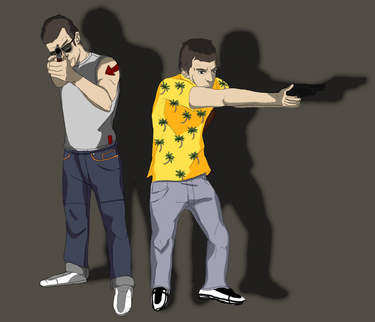
The next morning I woke with brilliant white sunlight in my face, smelling coffee. The sliding glass doors were open and Joe Pike was out on the deck. He was wearing faded jeans and a great sweat shirt with the sleeves cut off and blue Nikes and government issue pilot’s sunglasses. He rare takes the glasses off. He never smiles. He never laughs. I’d known Joe Pike since 1973 and he has never violated those statements. He’s six feet one with short brown hair and muscled the way a fast cornerback is muscled, weighing in somewhere between one eighty-five and one-ninety. He had a red arrow tattooed on the outside of each shoulder when he was in The Nam. They pointed forward.
The description today would be a little different. A little. But on the whole, Joe’s consistent, he’s grown a little bit as a character (because of Elvis, he’d assure us), but even with growth, the Joe you get in Monkey’s is the Joe you get in Taken.
Every time Joe’s name is mentioned around someone from LAPD, it’s answered with scorn (at best). Elvis will shed a little light on this eventually when Ellen asks (again, info dump — however small — and dialogue that doesn’t feel forced). But on the whole, all Crais is doing is a bunch of seeds that he’ll harvest later in a way that probably no one reading this can guess. Since this is Elvis’ narration, and Elvis is his friend, we trust that the LAPD is out to lunch on this, and this is reinforced by the clueless way they handle the disappearance of Perry Lang. Time will tell if our trust in Elvis is well-placed.
There’s a clear affection between Elvis and Joe. They trust each other, they tease each other — they depend on each other (without ever coming out and saying it). They’ve known each other more than 15 years at this point, as partners for most of that, and a lot doesn’t need to be communicated anymore
The thing that truly separates Pike from your typical mercenary/bonebreaker-as-sidekick is the way he deals with Ellen Lang. He tells her things about his past, he helps her learn to shoot, he goes out of his way to empower her — and through that, comfort her. Elvis will give her pep talks, he’ll encourage her — even force her to see reality. But Joe (unintentionally) inspires her, and then will (intentionally) show her the inner strength, the character she has and needs to meet the future. Hawk would never do that.
I’m sure I should say something about the story, too. So, Ellen Lang comes (with a lot of prompting from her friend Janet Simon) to Elvis needing help finding her estranged husband, who seems to have taken off with their son (but not their daughters). Elvis isn’t crazy about the idea, but he has rent to pay — so he takes the case and starts poking around looking for the missing talent agent. He finds Mort’s girlfriend, but that doesn’t help but it sheds some interesting light on Mort’s lifestyle. Before long, there’s a body, a couple of kidnappings, a lot of missing cocaine, and a crime boss’ Eskimo enforcer roughly the size of a small bull.
As Elvis goes through the investigation, it’s good, solid stuff carried along by his narration. But there’s nothing other than his narration and the character work he’s started to make it distinctive over any other of a dozen PI’s. But then you get to the conclusion — a big, guns-blazing, bullets-flying, implausible-but-not-really, story climax — and you really start to see the potential for this Crais guy and his pair of Vietnam Vets.
I’m not sure I’d give this 4-stars if I this was my first read of the series, or even of this book (rather than the 6th or 7th). But it’s not, I know what seeds Crais planted (whether he intended to or not), I know where’s he’s going with this and how well this sets up the books to follow. As such, it deserves no less than 4-stars.
—–

—–
Drawing by Kirsty Stewart, chameleonkirsty on deviantART, used with permission.


 Broken Homes
 Black Arts
 The Player
 Speaking from Among the Bones