The Ballad of Bonaduke—Episode 60: Keys by R. T. Slaywood: An Awfully Convenient Meeting

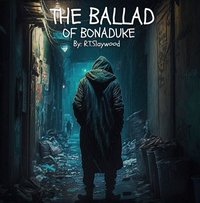
Cover Image for The Ballad of Bonaduke by RT SlaywoodThe Ballad of Bonaduke—
Episode 60: Keys

by R.T. Slaywood

DETAILS:
Series: The Ballad of Bonaduke, #60
Format: Kindle Vella Story
Read Date: November 25, 2024

The Story So Far…

A drunken Michael Bonaduke decides to use a grift (with maybe some sort of magic/magic-like “help”) to win on a scratch-off lottery ticket so he has money to buy more to drink. He pulls off whatever he did, gets his money and some booze and stumbles off into the darkness to drink himself into oblivion so he can start again the next day. He’s hit by dark memories (probably what’s driving him to the drinking) of fire, pleading, and screaming. There’s going to be a price to pay for his grift, and he’s trying to be ready.

He’s abducted by some representatives of a mysterious group who subject him to a test—if he passes, everything will be explained to him (and hopefully the reader, too). He passes—and is brought somewhere for answers, or maybe training, or maybe another test. Time will tell (or things are going to get really annoying). Answers aren’t quick to come—but the mysteries and questions keep piling up.

Things get hairy and Bonaduke leaves and finds himself back in the neighborhood he started from. He takes refuge in a homeless encampment shortly before a police raid. He’s apprehended and finds himself an interrogation room and shortly escapes after using his grift (but with results he didn’t quite intend). He finds himself by a group of squatters who seem to have strapped a woman to a chair for reasons that can’t be good. He attempts to rescue her before he even realizes what he’s doing, and seems to have succeeded—well, the two of them got away from the group anyway—breathing but bruised. They make their way to a fast-food taco joint and Bonaduke really needs to refuel to keep going. He tries, but fails to get food because he keeps passing out. Thankfully, the clerk is the same guy from the liquor store and he both recognizes him and gives him first aid. The woman (Zero) wakes up and shows some abilities of her on as she helps them escape from her captors who’ve tracked her down. One thing leads to another—Zero and Bonaduke’s magics don’t mix well (at least until they understand what each other can do?), and they end up in a video-game race against the squatters in a tricked-out version of Eric (the clerk’s) car. Note, I said video-game race, not a video-game-style race. They’re actually in one. When dumped back into reality, he’s surrounded by bruised and broken bodies (of people and cars). And then he gets into a supernatural fight and survives…just.

Or maybe not. But he gets better. And then his new…friends? Acquaintances? People who keep popping up in his life?…start explaining exactly what’s going on to him while they set up a new HQ and try to teach him about his abilities (and everyone tries to understand them) while they try to fund their further work. This plan doesn’t go so well, they end up stealing a book that contains (for lack of a better word) a malignant presence (something like a demon or nasty djinn), and things have gone really poorly since then. It’s almost like they’ve been cursed.

Bonaduke gets fed up with his little groups plans and aims–deciding his own goals deserve attention and effort–he’s also not so sure about theirs. So, he heads back to the city.

What’s Keys About?

Zero takes him back to the group’s old building so he can talk to (confront?) the vampire Myrrah to get some answers. They encounter someone moving out. He and Zero have a pleasant reunion, and Zero introduces Bonaduke to Keys. Keys is one of those very clever nicknames, he carries a large amount of them–and can supposedly communicate with them (why not? not the strangest things we’ve encountered in this series). Keys gives a particular key to Bonaduke before Myrrah show sup and the episode ends.

So, what did I think about Keys?

We continue the transition from storyline to storyline, I think the next episode will give us actual movement on the new storyline. I really don’t have much to say…it was nice. Keys seems like a fun character (that could get old if he sticks around too long). But essentially, what I ended things with last time is still appropriate:

This is one of those things I wouldn’t give thought to if this were a novel, I’d just keep going and appreciate (if I really paid it any attention), but in a full installment I want a bit more bang for my time.


3 Stars

REPOSTING JUST CUZ: In the Year of Our Lord by Sinclair Ferguson: Sinclair Ferguson brings out the heart as well as the life of Church History

In the Year of Our LordIn the Year of Our Lord: Reflections on Twenty Centuries of Church History

by Sinclair Ferguson

eARC, 229 pg.
Reformation Trust Publishing, 2018
Read: August 26 – September 16, 2018
The seeds of this book were first published in a book Ferguson co-authored called, Church History 101: The Highlights of Twenty Centuries — he’s now taken those chapters, done more research (being retired has freed up some time for him to do some reading), and expanded that into this great survey of Church History.

After a stirring (yes, really) introduction that lays out the purpose of this volume, why the study of Church History is important and what can be gained from even the figures from Church History that may disagree with — Ferguson dives in to his survey. I really can’t say enough good about this introduction — which feels odd, that’s not supposed to be the best part of a book (and it isn’t, actually — but it’s good enough that it really could be). The body of the book is twenty chapters — in case you couldn’t guess, that’s one chapter for each completed century Anno Domini (and Ferguson is committed to the usage of that).

Each chapter starts with an excerpt from a noted piece of writing from the century in question — like The Martyrdom of Polycarp, On the Incarnation, Gottschalk;s Shorter Confession concerning Double Predestination, and Savonarola’s The Triumph of the Cross (noted, not necessarily commonly known, obviously). Following that Ferguson summarizes the events of that century — focusing on particular figures or movements that stand out. Most of these will be at least familiar to the reader by name, if not for activities and attributes. Then he closes the chapter with some words of application to the contemporary Church and a hymn from that century — most of those hymns I was totally unfamiliar with, and am so glad I was exposed to them.

The core of the chapters, the history of that century — as summarized as it may be — is so helpful. I’ve taken classes covering a lot of those chapters — and read enough on my own that I was pretty familiar with the material covered. But I learned something about even those eras and individuals I’ve studied extensively — maybe not a lot, but enough to justify the time. And even those things that were primarily review for me were well worth reading — the story of our family is one we should hear over and over again and this book is a prime example of what we need to hear.

But what about those who haven’t taken the classes, or haven’t had that much exposure to Church History outside of the last century — or maybe the first couple of centuries? This book is even better for them. It’s primarily intended as an introduction to Church History, and it excels at being one. First of all, it gives you the good bird’s eye view from the day after the last chapter of Acts to the present. Which is a perspective that’s all too easy to lose in the details — we’ve got to see the forest. But the trees are also important — and Ferguson gives enough detail (while remembering that these are brief summary chapters) that the reader can get a handle on a particular century and learn enough that they can pursue what they’re interested in. I know from reading that Celtic monasticism is something that I want to read more about (and not just by rereading Thomas Cahill), but that there are other things from that period that don’t spark my interest in the same way. Some people will react that way to Gregory I or Thomas Chalmers or something else — and Ferguson has provided the reader with enough to start on to feel comfortable pursuing that interest.

Whether for review or as an introduction — the meat of this book is just what the doctor ordered.

Even if the history wasn’t that helpful, Ferguson’s application and the hymn made the book worthwhile. Sometimes that application is comforting, sometimes it’s challenging — it’s always helpful. And the bonus of having that hymn? That’s a wonderful, devotional way to bring history to life — that’s the same Lord, the same faith being proclaimed in these words. Loved that. Starting the chapters with a doctrinally rich (if occasionally problematic) excerpt reminds us that our faith is first and foremost about truth, about ideas — but those find expression in the heart and life of the believer — as seen in the hymns.

Yes, it’s a weakness that this book focuses on the Western Church — particularly that represented in the English, Scottish and American branches. Ferguson admits that at the beginning, but that’s his tradition, that’s his background — and that’s the background for most of his, readers, too — so it’s what’s most relevant. To go beyond that would result in a tome unwieldy and not that handy for his audience (as great as it would be to see).

The structure of head (excerpt), life (history) and heart (hymn) is a fantastic outline for this book — and everything hung on that outline is clearly-written, helpful to the Christian and relevant (if only to say “don’t be like that.”) Ferguson knocked it out of the park with this one, and I can’t recommended it highly enough. Great for personal use, family devotion, Sunday Schools, Home Schools — you name it, there’s someone who can benefit from this book.

Disclaimer: I received this eARC from Reformation Trust Publishing via NetGalley in exchange for this post — thanks to both for this.

—–

4 Stars

Saturday Miscellany—11/23/24

Odds ‘n ends about books and reading that caught my eye this week. You’ve probably seen some/most/all of them, but just in case:
bullet Literacy Statistics 2022-2023—We are going to kick things off this week on an incredibly down notes. If you’re prone to despondancy, you might want to avoid this.
bullet Why We Need Fairy Tales—this will help you recover from those numbers
bullet How Does the Writer Say Etcetera?—”Sumana Roy ponders the linguistic and aesthetic significance of ‘etceterization.'”
bullet 10 of the Most Original Murders in Mystery—This is a good list–even without the inclusion of Some Buried Ceasar. But that helps.
bullet Matthew Hanover has put out New/Refreshed Covers for his novels—There are better reasons to pick them up (for example, the contents), but this is a good excuse if you haven’t gotten around to it.
bullet It’s a Really Good Time to Get Loud About the Books You Love: Some ideas to help keep literature and the book community alive.—I try to do these already, but like Templeton, it seems like it’s needed more now (and I need the kick in the pants).
bullet Why I Love to Read Reviews – A Defence of the Blogosphere, Blogging and Reviewers—hear, hear.
bullet What Makes a Good Children’s Book?—another good ‘un

Not Really Book-Related, but I want to talk about it anyway:
bullet Animaleague Baseball Batter Up! Board Game—One of my favorite local authors–who does great picture books (and has provided some of the images here), Jeremy Billups, has realseased his first board game! I got to sample an early version a couple of years ago, and am eager to get my hands on one of the final versions! Go give it a look-see (and, even better, pick one or three up for yourself!)

To help talk about backlist titles (and just for fun), What Was I Talking About 10 Years Ago Week?
bullet Us by David Nicholls
bullet I talked about the releases ofAgatha H. and the Voice of the Castle by Kaja Foglio and Phil Foglio, The Job by Janet Evanovich and Lee Goldberg, and Superheroes Anonymous by Lexie Dunne.

This Week’s New Releases that I’m Excited About and/or You’ll Probably See Here Soon:
bullet Tooth and Claw by Craig Johnson—after he leaves the Corps, Walt needs a job. Why not try Alaska, a state that can make Wyoming look crowded?
bullet The World According to Cunk by Philomena Cunk—just in time for the holidays, a history book that might include an actual fact or two, but does contain several laughs, as I wrote recently.
bullet King Arthur & The Ladies of The Lake by Vincent Pompetti—I really enjoyed this graphic novel retelling of Arthurian legends.
bullet An Icelandic Adventure: One Family’s Mostly Successful Quest for Puffins, Pleasure, and Perfect Pizza by S. Bavey—I’m pretty sure the subtitle tells you what you’re going to find. (but perfect pizza in Iceland seems like a stretch, but what do I know?)

The text 'I do not read for I have renounced life, I read because one life is just not enough for me. - Abbas Al-Akkad' written over a picture of an open book

Craig Johnson, The Osher Institute, and Tooth and Claw

Craig Johnson speaking at the Osher InstituteYesterday, I had the pleasure of seeing Craig Johnson for the third time 7 years. I’m starting to feel like a stalker, or a groupie, or…I dunno, I can’t come up with the third things for that list. Anyway, I’m not either of those–or the other one, either. I only see him when he comes to the Treasure Valley and I see an advtisement. Really.

This time, he came to Boise to do a presentation for students of The Osher Institute–a lifelong learning program that seems like a great idea (I’ve heard a few people talk about it before). Thankfully, they opened it for non-students, too–for a small fee that included the price of his new novella, Tooth and Claw (which he signed afterward, too).

the Cover of Tooth and Claw by Craig JohnsonHe talked a little about the oddly extended process in getting the novella written (by his standards, anyway), the style/influence that was behind this one, and a little bit about the story (maybe too much, almost certainly more than I’ll put in my eventual post about it). He also told a nice little story about the history of the SS Baychimo, a ghost ship that would appear every 10 years or so up in Alaska. I assume that I’m not the only one who had to go home and read more about it later after hearing his recounting.

Then he went into an extended Q&A time for the rest of the hour–I’ve heard a couple of the anecdotes he used before, but he used them to answer different questions, so that was a nice touch. But this wasn’t like the other Q&As I’ve seen him do before–this was a fairly mixed audience. There were plenty of Johnson fans, and plenty of people who’d watched the Longmire show, too. But there were a decent number of people who hadn’t read him at all before (1 person read The Cold Dish in the last couple of weeks). This led to some great questions from people who just wanted to talk about writing, the process of publishing, and then the recommended way to read the books (his wife insists they be read in chronological order, he maintains you can grab them in any order*).

Craig Johnson speaking at the Osher Institute Whether he was just talking about his upcoming book, answering a question about his process, talking about the ages of his characters, what he wrote before Walt Longmire got him a publication deal, a storyline that didn’t turn out the way he planned, or even a problem someone had with the Netflix adaptation, Johnson knows how to engage with an audience. I hope he doesn’t do this anytime soon, but if he quit writing and just toured the country telling stories about the books, his life, or just fun things he learned about history–I’d see him as often as possible and I think he be able to stay as active as he wanted. I don’t know if he’s always been able to work an audience the way he does, or if he grew into it (I think the former based on what he says about his family’s knack for storytelling), but there’s no denying that you walk away from a Craig Johnson appearance fully entertained. If you get the opportunity, take it.

And, of course, he brought that same charm and ability to connect to the autograph line–his lines don’t move that quickly. Once you get to the front, you understand why. He takes enough time so that fans new and old get a little of his attention, which no one is going to complain about.

I was also treated by a friend to a great meal at a nearby Mexican restaurant after we got our books signed. That’s not the point of this piece. I just can’t help thinking of it a day later.

*It’s good to see that even your writing heroes can be wrong.

Irresponsible Reader Pilcrow Icon

BOOK SPOTLIGHT: Skyfleet: March of the Mutabugs by Victoria Williamson

This is the second The Write Reads Blog Tour Spotlight that I’ve been late with. The last one was by a few hours…this one was longer. The Tour ended yesterday, actually. Regardless, I’m excited to talk about Amanda Addison’s Looking for Lucie! You should go to https://twitter.com/WriteReadsTours feed to see all the great things that have been said about the book in the last week and a half. Or, go straight to the sources and check out the posts on the sites listed below. But before you do that, let me tell you a little about this YA novel.

Skyfleet: March of the Mutabugs by Victoria Williamson Tour Banner

Book Details:

Title: Skyfleet: March of the Mutabugs by Victoria Williamson
Genre: Science Fiction, Adventure
Age Category: Middle-Grade
Publisher: Tiny Tree Books
Format: Paperback/Ebook
Length: 198 pages
Publication Date: October 24, 2024
Skyfleet: March of the Mutabugs by Victoria Williamson Cover

About the Book:

When the skies turn deadly, a young heroine must rise from the ashes…

Twelve-year-old Amberley Jain has faced incredible challenges since the crash that took her parents and paralysed her legs. Now, with her best friend Ricardo Lopez about to be sent away and a swarm of mutated insects closing in on the Skyfleet base, the stakes have never been higher. Something monstrous is driving the mutabugs north from the contaminated meteor site known as the Cauldron, and the only plane capable of stopping it – the Firehawk – lies in pieces in the hangar.

Determined to honour her parents’ legacy, Amberley hatches a daring plan. With Ricardo’s help, they stow away on a supply train, trading his most treasured possession for the parts needed to repair the Firehawk. After secret test flights, the legendary jet is ready for action. Now, Amberley and Ricardo must confront the deadly swarm and save their home, discovering their inner strength and the true meaning of friendship along the way.

Skyfleet: March of the Mutabugs
is a thrilling tale of adventure and resilience, perfect for middle-grade readers.

Book Links:

Amazon UK ~ Amazon US ~ Amazon CA ~ Goodreads ~ Storygraph

About the Author:

Victoria WilliamsonVictoria Williamson grew up in Glasgow, Scotland, and has worked as an educator in a number of different countries, including as an English teacher in China, a secondary science teacher in Cameroon, and a teacher trainer in Malawi.

As well as degrees in Physics and Mandarin Chinese, she has completed a Masters degree in Special Needs in Education. In the UK she works as a primary school special needs teacher, working with children with a range of additional support needs including Autistic Spectrum Disorder, Down Syndrome, physical disabilities and behavioural problems.

She is currently working as a full time writer of Middle Grade and YA contemporary fiction, science fiction and fantasy, with a focus on creating diverse characters reflecting the many cultural backgrounds and special needs of the children she has worked with, and building inclusive worlds where all children can see a reflection of themselves in heroic roles.

Victoria’s experiences teaching young children in a school with many families seeking asylum inspired her debut novel, The Fox Girl and the White Gazelle, an uplifting tale of redemption and unlikely friendship between Glaswegian bully Caylin and Syrian refugee Reema.

You can find out more about Victoria’s books, school visits and free resources for schools on her website: www.strangelymagical.com

Author Links:

Website ~ Twitter


My thanks to The Write Reads for the invitation to participate in this tour and the materials they provided.
WWW Wednesday—November 20, 2024

I can’t think of an introductory paragraph (or even a sentence) today. So let’s just jump into things:

This meme was formerly hosted by MizB at A Daily Rhythm and revived on Taking on a World of Words—and shown to me by Aurore-Anne-Chehoke at Diary-of-a-black-city-girl.

The Three Ws are:
What are you currently reading?
What did you recently finish reading?
What do you think you’ll read next?

Seems easy enough, right? Let’s take a peek at this week’s answers:

What are you currently reading?

Cover of Instinct by L. J. Hachmeister Cover of Running and Jumping by Steven Kedie Cover of Comedy Book by Jesse David Fox
Instinct: An Animal Rescuers Anthology
edited by L. J. Hachmeister
Running and Jumping
by Steven Kedie
Comedy Book: How Comedy Conquered Culture–and the Magic That Makes It Work
by Jesse David Fox

I’m almost certainly finishing the Kedie book today–it’s intense. I don’t know where it’s going to end up, but my blood pressure will be better when it does.

Instinct is a mixed bag–but mostly good. The Jim Butcher story made me so glad when I read it I wouldn’t care if the rest of the stories were horrible (they’re not, but I really would be fine with that).

Jesse David Fox is the kind of guy I’d like to talk comedy with, I have so many follow-up questions about the material in the first half of this book (not because he didn’t give enough information, I just want more). This is the kind of book I’ve wanted for ages.

What did you recently finish reading?

Cover of Teen Titans: Starfire by Kami Garcia, Gabriel Picolo Cover of The Late Lord Thorpe by Peter Grainger
Teen Titans: Starfire
by Kami Garcia, Gabriel Picolo (Illustrator)
The Late Lord Thorpe
by Peter Grainger, read by Gildart Jackson

I really liked this take on Starfire (and Cyborg)–giving her Ehlers–Danlos syndrome was an interesting move (and might have got my daughter to read the whole series).

I’m already missing David Smith (and, yes, Grainger fooled me).

What do you think you’ll read next?

Cover of Altered Carbon by Richard K. Morgan Cover of I Hope This Finds You Well by Natalie Sue
Altered Carbon
by Richard K. Morgan
I Hope This Finds You Well
by Natalie Sue, read by Nasim Pedrad

Altered Carbon is one of those that I think I might have read a couple of decades ago, but I’m not sure. Anyway, this is the book for the Sci-Fi book club.

it was a while ago that I put a hold on I Hope This Finds You Well at the library, and I honestly don’t remember what it was about the book that intrigued me. It looks promising, and I trust post-me. Mostly.

Tell me what you’re reading–help me feel like I’m not in this rut I’ve been in lately (you’ll note how slow things have been turning over here lately).

BOOK SPOTLIGHT: Kavithri by Aman J.Bedi

I’m pleased today to welcome The Write Reads Blog Tour for the Indian Progression Fantasy, Kavithri, the first book in The Ghosts of Ethuran. If this looks as good to you from this Spotlight as it does to me, you should go to https://twitter.com/WriteReadsTours feed to see all the great things that people are saying about it. But since you’re here already, you might as well read what I have to tell you about it first.

Kavithri Tour Banner

Book Details:

Title: Kavithri by Aman J.Bedi
Genre: Fantasy
Publisher: Gollancz
Format: Hardcover/Ebook/Audiobook
Length: 448 pages
Publication Date: Oct. 1, 2024
Kavithri by Aman J.Bedi Cover

About the Book:

Meet Kavithri. Outcast. Underdog. Survivor.

Kavi is a Taemu. Her people, once feared berserkers and the spearhead of a continent-spanning invasion, are the dregs of Raayan society. Their spirits crushed. Their swords broken. Their history erased.

But Kavi has a dream and a plan. She will do whatever it takes to earn a place at the secretive mage academy, face the Jinn within its walls, and gain the power to rise above her station and drag her people out of the darkness.

Except power and knowledge come at a cost, and the world no longer needs a Taemu who can fight. So they will break her. Beat her down to her knees. And make her bleed.

But if blood is what they want, Kavi will give them blood. She will give them violence. She will show them a berserker’s fury.

And she will make them remember her name.

An no-holds-barred progression fantasy and empowering South Asian epic – featuring necromancers, djinn and visceral action sequences. An underdog story like no other, Kavithri is perfect for fans of Fonda Lee, Tamsyn Muir and John Gwynne.

‘A richly detailed, darkly gritty world’ Sunyi Dean, Sunday Times bestselling author of The Bone Eaters

‘[A] grim and relentless exploration of colonialism, power, resistance and courage’ Samit Basu

‘Seamlessly packs South Asian lore and progression fantasy into a relentless rollercoaster’ Gourav Mohanty

Book Links:

Amazon UK ~ Amazon ~ Goodreads

About the Author:

Aman J.BediAman was born in Mysore, India. He grew up in Vizag, studied in Bangalore, lived in Bangkok, completed a PhD in experimental psychology at the University of Canterbury, and has settled (for now) in Melbourne, Australia. His writing draws from modern Indian history and is influenced by writers and artists like David Gemmell, Brandon Sanderson, Takehiko Inoue, and Kentaro Miura.

Author Links:

Website ~ Twitter ~ Instagram


My thanks to The Write Reads for the invitation to participate in this tour and the materials they provided.
PUB DAY REPOST: The World According to Cunk by Philomena Cunk: The Story of the World (abbreviated and only accidentally accurate)

Cover of The World According to Cunk by Philomena CunkThe World According to Cunk:
An Illustrated History of All World Events Ever*
*Space Permitting

by Philomena Cunk

DETAILS:
Publisher: Grand Central Publishing
Publication Date: November 19, 2024
Format: eARC
Length: 256 pg.
Read Date: November 2-5, 2024
Buy from Bookshop.org Support Indie Bookstores

This Was Harder to Write than I Expected

There was a part of me that wanted to just do a light edit of my post about Cunk on Everything: The Encyclopedia Philomena and call it good. But that seemed like cheating. But there are giant parts of it that would work.

Still, I’m borrowing a little here and there from it, just so I don’t have to re-invent the wheel. I apologize in advance if you don’t appreciate that. Also, let this section serve as an all-purpose footnote so no one accuses me of plagiarism.

What’s The World According to Cunk About?

It’s a history of the world, as much of one as Cunk can fit into 50,000 words with minimal research, anyway. The point is to get it out in time for the holiday season—targeted toward the UK and the US, so it’ll predominantly be about the history of that/those cultures, while remaining the sort of history book that recognizes that things happen in parts of the world that aren’t dominated by Western Culture.

Also, we’re told, that she’s taking the innovative approach to history and will be writing chronologically, not alphabetically or by some other standard. Whodathunk it? History in order. I tell you, what this Philomena Cunk is a gutsy maverick.

If you’ve watched YouTube videos, Instagram reels, or any of the other quick ways we share videos online (with or without copyright infringement), or if you’ve seen any of the various series/specials on Netflix or British TV networks that I can’t remember the names of, you know what you’re getting into with Philomena Cunk. If you haven’t, well, that’s trickier. It means you’re a reader or something rare like that—Cunk is a fictional documentarian (or at least the presenter of them). her approach to the documentary specials or the history in this book are a combination of naïveté, misunderstandings (especially in mispronunciation/misspellings), and cynicism.

Miscellaneous Observations

Doing a deep dive on this would be difficult for two reasons—I read an ARC, so I don’t want to quote anything (also, it would be very hard to know when to stop. Ask my wife, after you read the end). The second, and primary reason, is that if I talk too much about things, it’ll ruin the jokes for you when you read this (and you really should)

In lieu of that, here are some miscellaneous observations:
bullet Every time Cunk looks at non-English speaking cultures was a win.
bullet You’d think that there are only so many jokes you can make about “the Dark Ages” involving the absence of luminescence—and that few of them would be funny. And you’d be wrong on both counts.
bullet Best WWI humor since Black Adder Goes Forth. I don’t know that there’s a lot of competition there, but Cunk nailed that material.
bullet The technology jokes landed every time.
bullet I’m still chuckling at the phrasing for Caesar’s cause of death
bullet You are going to hear Diane Morgan’s deadpan delivery in your head whether you read this or get the audiobook. Just know that going in. (you likely assumed it that already, so know that you’re right).

It Did Falter a Bit

The last chapter, “The Global Globe” started off strong, but as the history got more and more current, the humor changed. Maybe it’s that Cunk’s particular brand of absurdity requires some distance to really work. However you explain it, this just didn’t work for me.

Now, was it funny political humor? Satisfying satire? Yes—I truly appreciated almost all of it. It just didn’t feel very Cunk-like. I couldn’t “hear” Diane Morgan’s voice. If it’d been in another book, I’d have really liked the end of this last chapter. But here? It just felt out of place.

So, what did I think about The World According to Cunk?

I didn’t see (but maybe overlooked) the writers behind this book listed anywhere—but whoever they were, they deserve a round of applause. Or two.

I chuckled and laughed out loud a lot while reading this. There’s really not much more to say—that’s what they were going for.

My wife doesn’t get the appeal of Philomena, I don’t know why, I think it’s undeniable and obvious. So I really annoyed her by reading lines or paragraphs to my daughter while the three of us were in the same room. Sometimes, I had a stockpile of parts my daughter would like from reading when we weren’t in the same room. My kid and I had a lot of fun laughing together at this while my wife just looked at us strangely. I don’t share this to give you more insight into our fun little family dynamic—but to say that at least once (maybe three times, but Mrs. Reader denies this) even she laughed.

Seriously, up to the end of the last chapter, this was about as fun as you could want. Since I discovered Dave Barry Slept Here decades ago, I’ve been a sucker for history comedy—and The World According to Cunk by Philomena Cunk is a great entry in that category. (you might want to skip most of what happens after 1980).


4 Stars

Disclaimer: I received this eARC from Grand Central Publishing via NetGalley in exchange for this post—thanks to both for this.

This post contains an affiliate link. If you purchase from it, I will get a small commission at no additional cost to you. As always, the opinions expressed are my own.
Irresponsible Reader Pilcrow Icon

PUB DAY POST: King Arthur & The Ladies of The Lake by Vincent Pompetti: The Once and Future Graphic Novel For Our Time

Cover of King Arthur & The Ladies of The Lake by Vincent PompettiKing Arthur & The Ladies of The Lake

by Vincent Pompetti

DETAILS:
Publisher: Black Panel Press
Publication Date: November 19, 2024
Format: eARC
Length: 113 pg.
Read Date: November 9, 2024
Buy from Bookshop.org Support Indie Bookstores

What’s King Arthur & The Ladies of The Lake About?

This is a telling of the Arthur legend with a focus on the women in his life—his mother, sisters, Guinevere, the Lady of the Lake, and so on.

It’s also a telling of the clash between (a) Celtic religion and Christianity, with Arthur trying to maintain an atmosphere that allows both to coexist. I think the version of Celtic theology reeks of anachronistic thinking, and the “new” religion also feels a little off. But it works for this telling. It’s not just about religion—but about the way it works out in the lives and attitudes of Arthur’s people.

It’s really hard to say more than that—it’s Arthur from infancy through the end of his life, the growth of his reputation and kingdom, the controversies and losses.

A Word About the Art

So I really dig the watercolor art—it works well with the subject and the feel that Pompetti’s going for with the storytelling. There’s a dreamy quality to it that matches the storytelling, the magic and the visions that drive Arthur. I don’t know if that’s just how Pompetti works, or if he chose that deliberately for this story. Either way, it’s a win.

Yeah, there’s part of me that would appreciate a good inker and some more standard art and coloring. I think that’s primarily because that’s what I was raised with and am used to. But it just wouldn’t work as well for this work.

Here are a couple of sample pages to give you a taste (obviously, click the thumbnails to see more):

Thumbnail of king-arthur-excalibur.jpeg Thumbnail of king-arthur-goes-to-war_sm.jpeg

So, what did I think about King Arthur & The Ladies of The Lake?

I tipped my hand earlier when I talked about the clash of cultures driven by religion. Whoops (in my defense, I was trying to stretch that section beyond a couple of lines). While I didn’t appreciate the historical depictions, I did think it worked for a Fantasy tale.

In Pompetti’s telling there’s a feeling of groundedness to some of the standard elements of Arthurian legend—Excalibur, Guinevere’s affair, and so on. Yet, he didn’t remove magic and supernatural elements (I did wonder if that was the direction he was going for a moment)—it’s just not entirely the way we’re used to it with this story.

Like most people, I’m game for a good Arthurian retelling—and this is a pretty good one. I think the medium hurt it a little. 113 pages works for graphic novels, but it’s hard to squeeze in a lot of depth into those pages—particularly when the art looks like his does—the pictures are larger than they’d be with other artists, so the story details have to be lighter. It’s a tradeoff that’s worth it, I wouldn’t want Pompetti’s art to be smaller.

I enjoyed this on an initial read, and the bits I reread while preparing this post held up pretty well. I think it’s one of those books that I’ll appreciate more on successive re-reads, too. I’d absolutely read more by Pompetti and would encourage you to do the same.

Disclaimer: I received a copy of this from ARC from the Author via Edelweiss, and i appreciate that, but the thoughts expressed are my own.


3.5 Stars

This post contains an affiliate link. If you purchase from it, I will get a small commission at no additional cost to you. As always, the opinions expressed are my own.
Irresponsible Reader Pilcrow Icon

Book Blogger Hop: Annotate or Untouched?

Whoa…it’s been 2 months since I’ve done one of these?


Book Blogger Hop


This prompt was submitted by Billy @ Coffee Addicted Writer:

Do you like to annotate your books or leave them untouched?

I’m not sure what kind of monster you take me for. Write in a book? I’d just as soon dog-ear a page. Yeah, yeah, yeah…history is replete with examples of marginalia (and it’s proved to be a helpful resource for scholars), and if you own a book, you should be able to write in it–some people insist on it. But every book in the H.C. Newton Not-Yet-Memorial Library is untouched by pen, pencil, highlighter, or (shudder) Sharpie (outside a handful of autographs, which is totally different*).

There are (at least) two reasons for this–I don’t want to ruin a book with my lousy handwriting, or inability to use a highlighter or pen to draw a straight line. Let’s keep these pretty. But more importantly, I don’t like to be trapped by what I thought was interesting, important, noteworthy, and so on last time I read a book–I want to get impressions this time. (if for no other reason than I don’t want to be disappointed in previous-me). Does this hamper going back to find that one quotation, that killer argument, that metaphor that rocked my thinking? Yes. And that has been a problem. Still…books that please my eyes are worth a little effort/memory-straining.

I’m apparently so well-known for this in my social circles that friends and acquaintances will apologize to me before showing a marked-up book. Which is unnecessary, if a little nice. I bear no ill will towards people who choose to riddle their books with graffiti, sure, I wonder about their priorities, but I know they do the same for mine 🙂 I actually used to know someone who’d borrow books from me and then end up buying me a new copy of whatever book they borrowed because they just had to write in something they read. That actually worked out pretty nicely for me.

* Or is it an inconsistency that frees me from Emersonian hobgoblins?

What about you, do you deface or keep ’em clean?

Page 67 of 602

Powered by WordPress & Theme by Anders Norén