Tag: 3 Stars Page 16 of 55

Abandon All Hope by Scott Spires: A Cynic and an Idealist Stumble Through Life

When I scheduled the A Few Quick Questions with…Scott Spires post and said, I’d get this post up “in a little bit”, I didn’t realize that a transformer was about to blow a couple of blocks away from me, making it pretty difficult to finish/proofread/schedule this post. At least it was the same day. 🙂
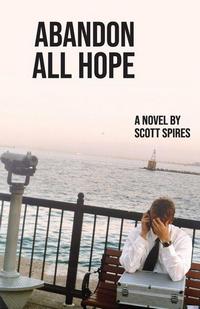

Abandon All Hope

Abandon All Hope

by Scott Spires

eARC, 214 pg.
Auctus Publishers, 2021

Read: October 13-15, 2021
Grab a copy from your local indie bookstore!

What’s Abandon All Hope About?

Set in the 1990s, this novel follows Evan—a cynical writer for an educational software company, Eldritch EduWare (a name that must’ve been the cause of problems for the marketing team—while being fairly apt). He actually commutes to the suburbs to work there, which is a nice twist. Evan doesn’t have a lot of drive or ambition, but he seems to like his life—maybe he could be happier, but he’s comfortable.

One day he encounters Eric, a college dropout. Convinced of his own insight, Eric eschews fiction, music, and the history of philosophy—he doesn’t want anyone else’s ideas. His are pure, new, and will enrich the lives of any who read his book—as soon as he finishes it. To pay the bills, Eric works a succession of temporary jobs, each disastrous in their own way.

Evan is intrigued by Eric, and makes an effort to check in on him from time to time (even trying to hire him for Eldritch at one point), but their storylines are fairly divergent. But common elements are there—we see them socialize (a little bit), muse on art and life, interact with family, colleagues, and supervisors, and so on.

He’s Making a List…

A technique that Spires falls back on often while describing things is the list. For example:

The basic building unit of the bad suburbs was the box. Boxes of various sizes and colors, of concrete, glass, steel and brick, big and small boxes arranged upright and sideways, black, white, gray, brown and transparent boxes, boxes stuck together like Legos or separated by swathes of asphalt, boxes with yards of grass or yards of concrete, could be seen everywhere as you looked out the train window.

Strip malls, mini-malls, and shopping centers alternated with identikit housing developments that bore fanciful names, like Avalon Estates, Balmoral-on-the-Lake, Provence-in-the-Woods, and Renaissance Acres: names that inadvertently highlighted their aesthetic failings.

That’s a lot of dense text that doesn’t say a whole lot—it’s frequently an effective technique. But I think Spires could’ve used a few less and been better for it—a list transitioning to a list transitioning to a list gets a bit mind-numbing. I largely enjoyed the writing, but this was a drawback.

A Scrambled Don Quixote

I typically make a point of not reading anything an author says in our Q&A before I write my post about their book. I’m not sure why I did this time, but if I hadn’t, I wouldn’t have seen his remark about this being a

Don Quixote in reverse – that is, with the somewhat cynical Sancho Panza character being the lead, and the idealistic Don Quixote figure being the secondary protagonist.

There’s part of me that kicked myself for not picking up on that—Spires wasn’t being subtle. At one point, Eric actually equates Evan to Quixote (I was too busy rolling my eyes at the conversation the two characters were having to pick up on it).

Now that I’ve chewed on it a bit now, I can see it to a degree. It’s not one of those insights that opens a fount of meaning to the text—nor is not having it a barrier to understanding the novel*. But it adds some dimension and depth to your understanding.

* He says with only a slightly defensive tone.

So, what did I think about Abandon All Hope?

In the mid-90s, there was a trend of indie movies in the Richard Linklater vein featuring characters who would unburden themselves to each other of their respective philosophical/aesthetic/political takes. This felt a whole lot like those to me. That’s not an evaluation, it’s just an observation.

This novel featured a large cast of unsympathetic and unlikeable characters acting in pretty unsympathetic and unlikeable ways, I’m not sure that there was any growth or development in the primary characters—their circumstances changed, but I think they remained the same (although there are signs that Eric and Evan might be on the verge of growth at the end). But that pretty much describes everyone I know. It might not be what we expect (want?) out of fictional characters, but it’s a pretty solid description of humanity.

This is one of those cases where I think the whole is less than the sum of its parts. A lot of the moments in this book were great–amusing, insightful, interesting—and the same goes for most of the characters. But Spires didn’t combine these moments and characters into a successful overall narrative.

I think overall he might have tried to accomplish too much. If say, Spires cut Evan out entirely (or significantly—just give us his interactions with Eric), in order to spend more time at Eric’s work (maybe requiring more characters there), and I can see my enjoyment of this increasing. Then write another novel about Evan trying to make his way in the world while writing his treatise, I should add. The strength of this book lies in the depictions of these two characters and their career/employment/lack thereof, as the US seems to be in a cultural shift regarding these things at the moment, it’s particularly thought-provoking and relevant on these matters.

Your results may vary, of course. I can think of a couple of people who’d likely disagree (possibly pretty strongly) with me if they picked up the book. I do recommend it for an intriguing experience, and hopefully, in your case something more.

Disclaimer: I received a copy of this novel from the author in exchange for this post and my honest opinion. I thank him for it.


3 Stars
This post contains an affiliate link. If you purchase from it, I will get a small commission at no additional cost to you. As always, opinions are my own.

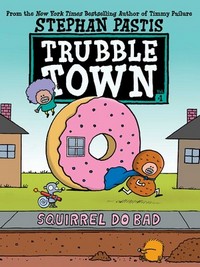
Squirrel Do Bad by Stephen Pastis: The Misadventures of Butterfly Girl

Squirrel Do Bad

Squirrel Do Bad

by Stephan Pastis
Series: Trubble Town, #1

Paperback, 287 pg.
Aladdin, 2021

Read: October 25-26, 2021
Grab a copy from your local indie bookstore!

Always remember—even the smallest thing you do can have big consequences.

What’s Squirrel Do Bad About?

Wendy the Wanderer is a little girl who desperately wants to travel the world, but her over-protective father has other ideas. He’s so focused on safety and caution, he carries an umbrella at all times (for example). But when Dad has to leave town for a while on business, Wendy just might get to do a little exploring, if she can get around her babysitter.

This isn’t a challenge, as the sitter is too focused on her phone to notice pretty much anything. So, Wendy heads out to explore her hometown, Trubble Town. A fitting name, for her at least.

She tries to befriend a squirrel, Squirrely McSquirrel, but is out of nuts. So gives him a little bit of a Mooshy. A Mooshy is a dangerous concoction for a human, much less a squirrel, it’s a “steaming cup o’hot chocolate shoved chock-full with forty marshmallows.” The levels of hyperactivity that this induces in Squirrely can’t really be described, it can only be depicted in graphic terms, really. He also becomes pretty addicted to them—but the destruction wreaked was so great that no one is permitted to give him any.

It’s at this point that things get out of control. The chaos that ensues features a police officer driven by hatred of squirrels, a mayor who refuses to work, a strange town obsession with statues, a would-be nut-themed superhero, a vegetarian squid, civic-minded moles, a lot of dynamite, and too many other things to enumerate. It’s the kind of mad-cap pandemonium that appeals to the little kid in us all (especially the middle-grade target audience).

The big questions addressed are: will Squirrely stay out of trouble? Will Wendy be able to keep all this from her father? Will anyone learn anything?

Pearls Before Swine-Verse

On page 56, Larry the Crocodile appears as Squirrely’s lawyer. Planting this firmly in the same world as Pastis’s comic strip, Pearls Before Swine. But Larry’s the only character that I recognized, it’s not Pearls. The humor’s different than the comic—it’s suited for kids, with a different tone, and a different aim.

Art Style

If you’ve read Pearls, you’ll have noticed the slightly sloppier style, with bolder lines that Pastis uses when one of his characters is drawing—the art’s a lot like that (except for a panel or two at the end). But essentially, it looks a lot like Pearls without Pig and Rat, etc.

So, what did I think about Squirrel Do Bad?

Wendy learns a little about chaos theory and begins to see herself as the butterfly that starts the storm. Which is helpful and maybe a little unhealthy, too. Still, she learns the meaning of her father’s words before he left (see the opening quotation).

The storytelling reminds me of the kind of stories my kids would write/tell when they were little—something that starts off kind of fun and then gets stranger and stranger and stranger. This is both an observation and a warning for people who want structure and logic to their stories—that’s not going to be around.

It’s silly. There is some real sweetness to it. It’s weird. It’s a lot of fun. Pretty much what you’d expect. Give it a shot, or let your kid give it a shot.


3 Stars

2021 Library Love Challenge

This post contains an affiliate link. If you purchase from it, I will get a small commission at no additional cost to you. As always, opinions are my own.
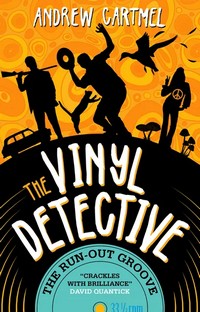
The Vinyl Detective: The Run-Out Groove by Andrew Cartmel: A Bit of a Sophomore Slump, but Still Charmingly Fun

The Run-Out Groove

The Run-Out Groove

by Andrew Cartmel
Series: The Vinyl Detective, #2

Paperback, 398 pg.
Titan Books, 2017

Read: August 28-30, 2021
Grab a copy from your local indie bookstore!


N. B.: The Narrator of this series (so far, anyway) is unnamed. I find it tiresome to keep saying “The Narrator” or “our protagonist” (as I did with the last book.). So, I’m just going to call him “VD” from now until Cartmel gives him a name—as unfortunate as those initials may be.

What’s The Run-Out Groove About?

In the late 60s, there was a band of some repute (not all stellar) with a lead vocalist, Valerian, with an otherworldly voice. A lot of self-destructive tendencies, too, but what a voice. As too many things in that era went, Valerian’s lifestyle spiral out of control and she killed herself following the disappearance/kidnapping of her infant child.

In the present time, VD and his girlfriend, Nevada, are approached by a bickering duo. She’s working on a book about Valerian and he’s Valerian’s estranged brother. Given VD”s success with the hunt for the record (as seen in the previous novel), they’ve come to him. But it’s not just music they want VD to findbut the child.

Urban Legend has it that there’s a clue hidden on a 45 released shortly before her deathbut only a few were sold and are out there in the world. It’s nearly impossible to find. Well, nearly impossible for people who aren’t VD or his friends. So that’s the jumping-off pointlook into the people who remember Valerian, who were in her inner circle, while trying to track down a copy of one of the handful of 45s.

From there things go as you’d predict for a mystery novelthere are threats, some violence, some drugs (although some were ingested willingly), and the uncovering of many secrets.

An Inherently Likeable Series

The appeal to this series comes down to the charactersprimarily VD. With him you’ve got a full-on geek, sitting around and indulging his passion and writing about it while drinking expensive gourmet coffee and spending time with his girlfriend and cats. It’s hard to see that as anything but a fantasy for most readersreplace jazz records with books and cats with the superior pet, and that’s my ideal life. Getting paid ridiculous sums to look into something related toand somewhat involvingyour hobby is just icing on the cake.

Because of this, I think there’s an inherently likable quality to this protagonist. He’s living a life that most of us want and seems to be unspoiled by it. Your choices are either to be envious or want to be his friendand since he seems like such a nice guy, it’s easy to pick “friend” and hang out with him to hear his stories.

A Particular Weakness

“…I’ve got a copy of Graves’s book somewhere. No wait, damn it, I lent it to Clean Head. It was a Penguin edition. That’s why I haven’t got it back. You have to watch that girl. She’s very nice and all that but she will steal your Penguin paperbacks. She has a particular weakness for the Penguin Modern Classics series. It’s a character defect.”

Is that not the coolest supporting character quirk that you’ve ever seen?

Minor Spoiler Alert!…and it’s even exploited for the plot at one point!

So, what did I think about The Run-Out Groove?

I like VD, Nevada and the rest of the gang, the mystery was clever, and the reveal at the end was incredibly satisfying.

But…The Run-Out Groove just never grabbed me the way that Written in Dead Wax did. I don’t know if it’s a problem with me, a defect in the book, or what. (glancing at some other readers’ responses suggests that it’s not just me). I enjoyed the novels and was charmed by it and the charactersand I do plan on giving our Nameless Friend at least one more try. But it was a lesser experience.

Lesser, but not a bad one. I enjoyed the whole thing from cover to cover, I chuckled occasionally and appreciated the challenge of staying a step ahead of VD and Nevada (at least until the final pages) when it comes to sussing out the mystery. It’s a fun read and I do recommend itbut grab the first book in the series to really see the appeal.

And I just dare you to try to get through this novel without heading out to shop for some vinylwhether or not you own a record player (although it’s more fun if you do).


3 Stars

20 Books of Summer '21

This post contains an affiliate link. If you purchase from it, I will get a small commission at no additional cost to you. As always, opinions are my own.
Once Upon a Time in Hollywood by Quentin Tarantino is a thing that I read

Once Upon a Time in Hollywood

Once Upon a Time in Hollywood

by Quentin Tarantino

Mass Market Paperback, 400 pg.
Harper Perennial Paperback, 2021

Read: September 22-23, 2021
Grab a copy from your local indie bookstore!

What’s Once Upon a Time in Hollywood About?

This is novelization—and retooling (as I understand)—of Tarantino’s 2019 movie. It follows two days (with typical Tarantino flashbacks and flashforwards for many of these characters) in the lives of a few people in 1969 Hollywood. A former TV star who had his shot at movie fame, and missed—he’s now a traveling bad guy (“heavy”) guest star on TV shows. His stunt double/gofer/driver, notorious for getting away with murder (and is somehow possibly the most sympathetic character. Also, Sharon Tate, Squeaky Fromme, and Charlie Manson.

The Packaging

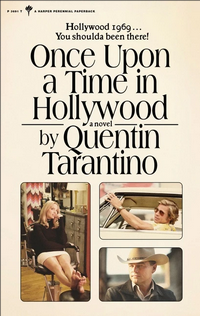
I trust whoever put this book together got a nice bonus—or at least a good bonhomie slap on the back—it’s so well done. The whole thing is a throwback—the cover style looks like a movie novelization from the 70s/early 80s, with stills from the film. Inside you get a lot of the full-page advertisements for novels (and novelizations) that were era-appropriate and common in the back of Mass Market Paperbacks at the time.

It was a nice little treat.

So, what did I think about Once Upon a Time in Hollywood?

Eh…I’m not sure. I guess I should say that I didn’t watch the film—outside of the writer/director—there was nothing about it that appealed to me. I only picked this up out of curiosity about Tarantino as a prose-writer. That colored my appreciation of the novel for sure. It’s not surprising at all that a movie that didn’t appeal to me resulted in a novel that left me unmoved.

I’m glad I got to see what Tarantino was like as a novelist. I know what he’s like as a screenplay writer and director. And this was different—but similar. Had this been anyone else writing, I’d have commented on how well they capture the Tarantino-vibe. There are so many (seemingly?) aimless stories shared by characters that can only come from him (or someone trying to rip him off).

There’s also this nice recurring thing where a story is being told—characters introduced, etc.—that turns out to be the characters and story of the pilot episode that the has-been actor is shooting. Sort of a novelization within a novelization. That was neat—and there’s so much more going on in that story and with those characters than is possible for a 1969 TV Western, that I give myself a little slack

But as for the novel itself? Eh, I don’t know. I guess I think I understand the point—I just don’t see where they were stories that need to be told. It wasn’t a bad novel, and I don’t resent the time I spent reading it (as I frequently do with books that don’t work for me)—and I enjoyed bits of it quite a lot. But I’ve got nothing to say good or ill about it. Put this down as the most tepid of 3 stars.


3 Stars

This post contains an affiliate link. If you purchase from it, I will get a small commission at no additional cost to you. As always, opinions are my own.
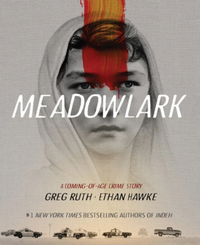
Meadowlark by Greg Ruth, Ethan Hawke: A Gritty Father-Son Story

Meadowlark

Meadowlark:
A Coming-of-Age Crime Story

by Greg Ruth, Ethan Hawke

Hardcover, 245 pg.
Grand Central Publishing, 2021

Read: September 18, 2021
Grab a copy from your local indie bookstore!

What’s Meadowlark About?

Things aren’t going well for Cooper—a little prank leads his father to stop by his mother’s house on his way to work. When his father learns that Cooper’s been expelled from school, he drags him along with him to work.

Cooper’s dad, Jack “Meadowlark” Jackson used to be a boxer of some local renown, but that was then. He’s now a prison guard—one respected by his peers and even most prisoners. But Cooper still thinks of him largely as a hero figure. the boxer whose poster hangs on his bedroom wall.

While Jack gets to work in a prison tower, Cooper hangs out with the Warden—clearly a grandmotherly figure in his life. It seems like a pretty okay kind of day, actually. And then an alarm sounds. Several fights have broken out in various parts of the prison—the guards spread out to imposing order, and in the midst of chaos, three prisoners go missing.

It’s after this that things really start to go south.

The book then focuses on Cooper and Jack trying to make their way through the ensuing bedlam while they deal with their relationship. Being the father of a teen boy brings a certain level of difficulty, especially if there’s trouble between the custodial mother and the father. The violence—horrible violence—of the day creates a heightened atmosphere for their necessary (and rather touching) conversations.

What about the Art?

You can’t talk about a graphic novel without focusing on the graphic part of it, right? Which is really a shame because I’m not equipped for it.

Ruth’s art is exactly what this story needs—as usual, I don’t know how to describe the art, but the pencil work—sort of rough and heavy—fits both the action and the characters. The sort of sepia-coloring says Texas to me—and makes the setting ring true.

I did appreciate the not-at-all-subtle use of Ethan Hawke as Jack, it added a little extra flavor.

So, what did I think about Meadowlark?

This seems like the kind of story that S. A. Cosby or Jordan Harper would write—a mix of family drama and crime.

The emotions and family dynamic felt real, relatable—and was even touching. The violence and criminal behavior were just as visceral—and disturbing. You put them together with some compelling artwork and you’ve got yourself a winner.

I’d have liked a touch more depth—but given the medium, I’m not sure you could get too much deeper (without needing another hundred pages or so)—so I’m not holding that against it too much.

There’s a lot to commend in this graphic novel, and very little to complain about. I see that Hawke and Ruth have collaborated on an earlier graphic novel and I need to track that down.

2021 Library Love Challenge

This post contains an affiliate link. If you purchase from it, I will get a small commission at no additional cost to you. As always, opinions are my own.
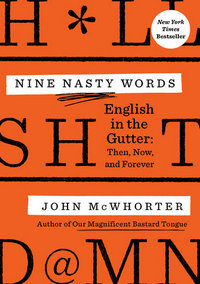
Nine Nasty Words by John McWhorter: Reading This Book Aloud Will Fill Your Swear Jar in a Hurry

Nine Nasty Words

Nine Nasty Words:
English in the Gutter:
Then, Now, and Forever

by John McWhorter

Hardcover, 270 pg.
Avery, 2021

Read: September 2-6, 2021
Grab a copy from your local indie bookstore!

What’s key is that the stock of curses is ever self-refreshing, The fashions change, as always and everywhere, but what persists is taboo itself, a universal of human societies. What is considered taboo itself differs from one epoch to another, but the sheer fact of taboo does not. Language cannot help but reflect something so fundamental to our social consciousness, and thus there will always be words and expressions that are shot out of the right brain rather than gift-wrapped by the left one.

What’s Nine Nasty Words About?

McWhorter looks at nine of the “bigger” profanities in English (with some asides to discuss related words), tracing their history, evolution, varying definitions, and contemporary usage. He points out periods where they were verboten, periods where they were perfectly acceptable—and what made them profane again.

The flow of the book comes from this thesis*:

On that matter of evolution, profanity has known three main eras—when the worst you could say was about religion, when the worst you could say was about the body, and when the worst you could say was about groups of people. The accumulation of those taboos is why “just words” like h***, s***, and n***** respectively harbor such sting.

I don’t know how accurate that is, but it kind of makes sense—and it works pretty well as a framework for the book, too.

* The book uses the actual words, I wimped out and elided them.

The chapter headings give you a pretty good idea of what the book covers and shows how the framework is used (with the addendum at the end):

1 D*** and H***: English’s First Bad Words
2 What Is It About F***?
3 Profanity and S***
4 A Kick-A** Little Word
5 Those Certain Parts.
6 Why Do We Call It “The N-Word”?
7 The Other F-Word
8 Being in Total Control, Honey!
9 A M************ Addendum

So, what did I think about Nine Nasty Words?

I largely enjoyed this book, I find the history and evolution of English fascinating—and while I try to eschew the use of profanity, I’ve found the development of those words very interesting—and I can appreciate a clever and inventive use of them in art.

This was a great look at those words—in particular, I enjoyed McWhorter’s demonstration of how the words function as various parts of speech, as well as the varying nuances of meaning. It was a clever mix of entertainment and education.

McWhorter has a great style, too, throughout the book he sprinkles little gems like:

To understand how language changes without allowing a certain space for serendipity is to understand it not at all.

The [N-]word is indeed twenty-first-century English’s Voldemort term,

The chapters on slurs—”words about groups of people”—mixed in a bit too much contemporary social commentary for my taste, but I’m pretty sure most people won’t agree.

On the whole, this was a great mix of entertainment and education, I doubt this is the definitive work on the subject (and McWhorter would likely agree), but it’s a solid work and I’m glad I read it.


3 Stars

2021 Library Love Challenge

This post contains an affiliate link. If you purchase from it, I will get a small commission at no additional cost to you. As always, opinions are my own.
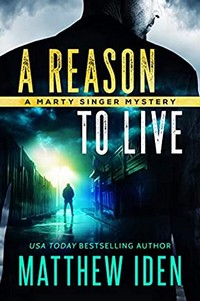
A Reason to Live by Matthew Iden: Back to the Beginning with Marty Singer

A Reason to Live

A Reason to Live

by Matthew Iden
Series: Marty Singer, #1

Kindle Edition, 312 pg.
Thomas & Mercer, 2015

Read: August 6-7, 2021
Grab a copy from your local indie bookstore!


Earlier this year, I read the eighth book in this series, Chasing the Pain, and enjoyed it enough that I had to go back to the first book and read the whole series.

“What’s your first move?”

“We’ve narrowed it down to Michael Wheeler or the rest of humanity,” I said. “So let’s start with Wheeler.”

What’s A Reason to Live About?

Twelve years ago, Detective Marty Singer investigated a murder. A police officer was in the home of a woman he’d been harassing and shot her. Singer didn’t believe his story and arrested him, and worked as hard as he could to put the cop away. It didn’t work, he was acquitted and then disappeared. In the ensuing years, this has haunted Marty.

Now, that woman’s daughter, Amanda, has tracked him down—she’s being stalked, harassed by someone—and all the evidence points to it being the man who killed her mom.

So she comes to the detective she learned to trust all those years ago—she needs his help to keep her alive. The downside is that Marty recently retired from the force so that he could focus on cancer treatment. But there’s no reason to tell Amanda that—Marty feels he owes her (and her mother) a debt he can’t repay, so he’ll do the next best thing—keep her alive.

The Big C

I’d been treating cancer like it was the flu, an inconvenience that I’d have to put up with temporarily. Except cancer wasn’t just a sore throat and a fever, and chemo wasn’t just a shot in the arm. Cancer wasn’t a bump in the road—it was the road, and I’d better make plans to treat it that way. My life, as I knew it, had changed for good.

Sure, there’s a murdering stalker out there, but the “Big Bad” of this novel is Marty’s cancer. It casts a looming shadow over everything, it affects the way that Marty can work—how he can investigate, protect, and defend.

I don’t know how many books will feature this struggle—I hope we get a couple more. I do know, thanks to starting the series where I did, that it’s not a constant presence in the series. I just hope that it sticks around for a bit—it’s refreshing seeing someone have to deal with things like this.

Amanda

Amanda’s face was animated, happy. I realized I wanted it to stay that way. Why? Was it feelings of guilt from a job poorly done more than a decade ago? I’d probably done worse things to more people over the years and I wasn’t hustling to make amends with them. Was it paternal? Misplaced feelings for a kid I’d never had? Maybe. But the real reason was closer at hand. It didn’t take much imagination to wonder what I’d be doing right now, how I would feel, if she hadn’t had the guts to walk up to me

It almost feels like a creepy thing for Marty to find a reason to live in Amanda, but it’s not. As he says in the quotation—it’s like he found the daughter he never had—and he gets to do something for her that he couldn’t do twelve years earlier—identify and then stop her mother’s killer.

Add in the fact that Iden made her sweet and supportive, a nice person with a good heart, and obviously, readers will get invested in her quickly and will frequently be on the edge of their seats to see if Marty can keep her safe.

So, what did I think about A Reason to Live?

And what became clear to me in that infinite moment is that, ironically, a man with cancer has more options than one that doesn’t. Having already stared my own mortality in the face, I couldn’t really be threatened with death.

When you have a thriller where the protagonist really can’t be threatened? That adds a little something

Of course, Marty’s lying to himself—there are threats that would make him stop everything—but as long as he believes he can’t be threatened, it does give him more options and adds a little something to the novel. Throw in the complications of his varying amounts of energy and stamina with the added complication of learning how to act without a badge to back him up.

Sure, some of the tension was eased because I knew the outcome for most of the characters, I knew the relationships that were being created here—just knowing that the series goes at least eight books tells you a lot right there.

Still, it was a gripping read, and a good introduction to Marty and Amanda and Marty’s retired life. A fast, enjoyable novel—it’s easy to see why the series has been going as long as it has been. You should check it out.


3 Stars

20 Books of Summer '21

This post contains an affiliate link. If you purchase from it, I will get a small commission at no additional cost to you. As always, opinions are my own.
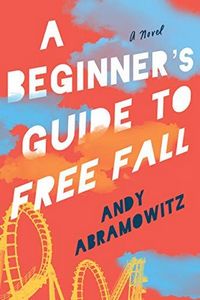
A Beginner’s Guide to Free Fall by Andy Abramowitz: The best and the worst things in life are sudden

A Beginner's Guide to Free Fall

A Beginner’s Guide to Free Fall

by Andy Abramowitz

Kindle Edition, 396 pg.
Lake Union Publishing, 2020

Read: August 9-11, 2021
Grab a copy from your local indie bookstore!

The Opening

Four months from now, on a secluded beach in Turkey, Davis Winger, who came thousands of miles to start over, will drop his towel and paperback on the sand, wade into the sea, and end up under the tire of a Hyundai that has just come screeching over an embankment. He will be trapped under that car, pinned to the seabed with one final breath crowding his lungs. Time enough to lament that his daughter might now grow up without him; that he might never hear words of forgiveness from the woman he adored, and betrayed; that he might not live to build the roller coaster that his six-year-old had dreamed up from a storybook and that he had spent the summer engineering into reality. Constructing that ride, harnessing his daughter’s giddy vision into a set of blueprints, was his best shot at winning back the people he loved and hurt and lost. The promise of redemption was slipping away. All alone and far from home, he’ll reach for the surface as the sea encloses.

That autumn day was coming. But today it was still spring, a mild Saturday in May, and when Davis awakened next to his wife in the charmingly overgrown Baltimore neighborhood of Mount Washington, he was still gainfully employed and still welcome in his own home.

With an opening like that, how do you follow it up? No really, how do you? How do you get your readers to care about your protagonist and what he’s going through when you know this is what he’s headed for?

Well, enough of that…let’s get on with the post.

What’s A Beginner’s Guide to Free Fall About?

Davis Wagner has one of those jobs that you have a hard time believing people actually have, but clearly, someone does. He designs amusement park rides, like roller coasters. Which is cool enough—but he’s witty, friendly, compassionate, has a great daughter, a wonderful wife, and so on. He’s close with his sister, his father, and his father’s…partner, I guess. (she’s lived with him for years, so girlfriend doesn’t seem to fit…)—Davis’s mother ran off with her therapist when he and Molly were young, leaving them to be raised by their father.

But we know from the opening paragraph above, that this charmed life doesn’t stay charmed—after introducing the reader to this family, Abramowitz starts dismantling Davis’s life—after an accident (that Davis bears no responsibility for), his career is on the line; after something that Davis bears all the responsibility for, his marriage is in shambles and doesn’t look like it’ll recover. The only thing that Davis has left is his relationship with his young daughter in the summer before her first-grade year.

In the (apparently) four months he has left on Earth, can Davis build on the foundation of his relationship with his daughter to save his marriage and career?

There are other plotlines, sure, but this is the focus of the book and the weakness of it drags down the rest.

Molly Winger— Not Pictured

The high school yearbook was basically Davis’s personal photo album, but when Molly graduated three years later, below her photo it read: “Molly Winger—Not Pictured.” And the thing is, she was pictured. Her photo was right there, above the words “Not Pictured.” That was the essence of Molly. Seen yet somehow undetected. There but unaccounted for. Actually, she preferred it that way.

I just loved that idea—well, I mean, it’s depressing as all get out when you think about what that says about Molly—but it’s a great image.

Molly’s still pretty undetected. She writes for an independent newspaper—one limping along financially—as if there weren’t another kind—primarily writing features, but really doing whatever she has to help keep it afloat. She’s dating someone years younger than her, and in no way right for her (or she for him)—she’s smart, literate, cultured. He’s in his mid-twenties, and when he’s not working, he’s playing video games or watching horror movies with his “boys.”

While her brother is trying to put his life back together, Molly stumbles upon a series of articles that will help her confront her own demons, help her readers, and maybe get her detected by people.

I’m glad I read this book if only for the Molly storyline/storylines—Abramowitz was at his strongest here. A character you can sympathize with, chuckle at, and hope for.

Sibling Rivalry

At some point years before we meet them, Davis and Molly started playing this game—Davis would call her out of the blue, and they’d pitch horrible ideas for businesses to each other. For example, a store that sells concert T-shirts for bands that you wouldn’t want to wear in public—Hanson, Sheena Easton, Julian Lennon, Spin Doctors, and so on.

It’s one of those things that makes the most sense in terms of siblings—a running joke that they may not be able to remember the origins of, but it’s something they’ll always do. When you stop and think about it, it’s really sweet.

If you don’t stop and think that much and just read the ideas? They’re hilarious.

Tom Petty

Similarly, Davis amuses himself by working Tom Petty song titles into his conversation around or about one character. It’s a strange way of showing affection, but it works. Sure, I think it’d get annoying in real life—but it’s exactly my kind of humor.

So, what did I think about A Beginner’s Guide to Free Fall?

It took me a long time to be able to care about Davis and his woes, much less his attempts at rehabilitation. I just couldn’t shake the opening paragraph. But I eventually came around and appreciated that part of the novel (which is good, because it’s the majority).

Still, I’d have probably DNFed this if Molly wasn’t around—the character and what she does in the novel are its saving graces.

Abramowitz can write a sentence—I really enjoyed the voice, the way he told the story (well, after the opening), and the themes he explored. I laughed and was moved, and thought a little about life. A Beginner’s Guide to Free Fall is worth the time and effort, you’ll enjoy it.


3 Stars

20 Books of Summer '21

This post contains an affiliate link. If you purchase from it, I will get a small commission at no additional cost to you. As always, opinions are my own.
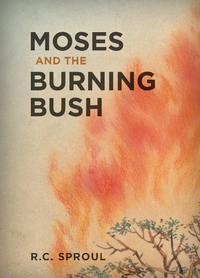
Moses and the Burning Bush by R. C. Sproul: A Brief Examination at What God Shows Moses About Himself

Moses and the Burning Bush

Moses and the Burning Bush

by R. C. Sproul

Kindle Edition, 103 pg.
Reformation Trust Publishing, 2018

Read: August 15, 2021
Grab a copy from your local indie bookstore!

What’s Moses and the Burning Bush About?

One of the church’s biggest problems is that we don’t understand who God is. But in that one revelation—the theophany in which God appeared to Moses—the transcendent majesty of God was partially unveiled. What had been invisible became visible through the theophany.

Sproul examines—briefly—just what God says about himself when he revealed himself to Moses. He shows His holiness, His glory, His Aesity, and more—here is even, as Sproul puts it, “A Shadow of Christ.”

In ten short chapters, Sproul opens up the account of Moses’s encounter with the Lord in the bush that was on fire, but was not consumed.* He doesn’t just camp out in Exodus 3, but spends time in Isaiah, Genesis, and other places, although he brings it all back to this point.

* I’ve learned to appreciate Scott Oliphant’s point that calling it a “burning bush” misses the point, it’s only supernatural to call it an “unburning bush.”

So, what did I think about Moses and the Burning Bush?

… in the burning bush we see the revelation of the person of God, of the power of God, and of the eternality of God. We see the revelation of the compassion of God, the redemption of God, and now, finally, the truth of God.

It has been ages—or at least it feels like it has been—since I’ve read an R. C. Sproul book (at least for the first time). There’s a clarity to the prose that’s almost untouchable by anyone else. He can express deep thoughts in a way that anyone can understand—not that there were a lot of tricky concepts this time out, but that voice is still there. And I’m going to miss it.

This is a nice book, as a sketch of these ideas. I think Sproul was capable of more, he could’ve got into all of these areas with more detail, could have fleshed out the concepts more—and given the reader something to chew on. I’m sure he had his reasons for not, I just wish he’d done more.

Still, if all you’ve thought of is the event itself—not what it meant beyond God calling Moses, it’s probably a good way to introduce yourself to it, but beyond that, there’s probably limited value.


3 Stars

This post contains an affiliate link. If you purchase from it, I will get a small commission at no additional cost to you. As always, opinions are my own.
Page 16 of 55

Powered by WordPress & Theme by Anders Norén