Tag: 4 1/2 Stars Page 18 of 30

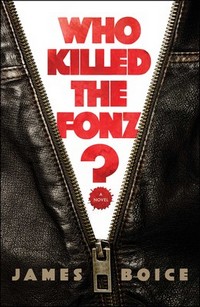
Who Killed the Fonz? by James Boice will leave you groovin’ all week

Who Killed the Fonz?Who Killed the Fonz?

by James Boice
Hardcover , 208 pg.
Simon & Schuster, 2019
Read: March 9, 2018

“Everyone gets old,” said Ralph. “No one stays cool forever. Not even the Fonz.”

Like almost every American of a certain age — I have warm memories about the show Happy Days. Granted, my memories are a bit hazy — the show premiered when I was a few months old, but I was 10 when it ended. So I know I watched a lot of it between the first-run episodes and syndication (surely, someone syndicated those and I watched them) — I mean, we had 3 channels (plus PBS), what else were we going to do? I remember very little about it — I thought Potsie was kind of annoying, Ralph was hilarious, I didn’t care too much about Joanie or Chachi, and the Fonz? I mean . . . who didn’t want to be Fonzie? For everyone in my generation, our first exposure to the concept of “cool” our first symbol of it, the avatar of coolness was Arthur “Fonzie” Fonzarelli.

I have clear memories of being 5 (+/-) and being at a semi-local amusement park riding a Carousel that in addition to animals, had some cars you could ride in — or motorcycles. I hopped on those motorcycles and every time I went around to where my parents were standing and watching, I’d give them a big thumbs up and an “Ayyyyyyy.”

What I’m trying to say is that I am a full-fledged member of the target audience for this book. But then again, pretty much everyone alive who’s roughly my age or old is, too.

This novel takes place in late October of ’84. Filmmaker Richard Cunningham’s career is on the skids, he’s got an epic movie he’s been trying for years to make, but no one wants him to (today we’d call it Oscar-bait, his agent and movie companies considered it to be Box Office poison); he’s just spent time talking to friend/contemporary “Steve” about his new time travel movie with the kid from Family Ties and his agent is trying to get him to write a script for a well-funded Star Wars-knock off.

The poor guy is having a rough day . . . and then he gets home to learn that his old friend, Arthur Fonzarelli has been in a wreck on his beloved motorcycle and is dead. Granted, the two had lost touch, but the knowledge that the Fonz is dead shakes Richard to his core. He quickly makes arrangements to head back to Milwaukee to attend the funeral. Neither his mother (who lives in his home) or Lori Beth can make the flight, so he’ll stay in Joanie and Chachi’s house (they’re on vacation and can’t catch a flight home in time to attend). Shortly after arriving, he runs into Al, Ralph, Potsie — and even the jukebox.

Very quickly, Boice has set the tone (nostalgic, amusing, and wistful) and ticked off the major boxes when it comes to fan-service. He’s going to have some fun with and even re-examine some aspects of the series (see the conversation that opening quote came from) — but he’s going to do it with respect for the source material. This isn’t The Brady Bunch Movie, but it’s not a slave to the original (see, Superman Returns).

That accomplished, he puts Richard into new territory — he’s brought out to the home of a Wisconsin gubernatorial candidate, who wants him to write a commercial for the final days of the campaign — Richard even agrees to direct it. This gives him time to decide if he wants to follow his agent’s wishes as well as an excuse to stay in town. Which he needs once he’s given some information that leads him to conclude that Fonzie wasn’t the victim of an accident, but was murdered.

So Richard has to figure out the direction of his career, convince anyone else that the Fonz was killed and/or find the killer, in a matter of days. All the while coming to terms with being home for the first time since he left for Hollywood, just days after coming home from the Army.

You make this a novel about struggling filmmaker Robert Cummings, returning to Detroit for the funeral of his old friend Frankie — free and clear of pre-existing pop-culture prejudices and baggage — and I’d still probably like t his book. Not as much, but it’d still be good. Wrap this up in beloved characters? The pretty good book becomes something else.

The identity of the killer was pretty clear soon after Richard started thinking about it (maybe even before then), and the motive seemed semi-obvious. But a big reveal close to the end changed the stakes significantly and made the motive and identity much more believable. And like with so many mysteries, the “whodunit” is less important than the journey taken to get to the revelation of the identity — and this journey rocked. Richard’s introspection and self-assessment was well-handled, as was his getting re-acquainted with his old high school friends, seeing what they’d made of themselves, etc. There’s a good balance of sentiment and story here — not unlike a certain situation comedy at its best.

I read this in one sitting, which I love doing, and the book moved along so nicely I didn’t even think about putting it down for any reason. It’s a thoughtful read, but not a ponderous one. It’s a murder mystery, but there’s only one or two moments of danger — it’s very much on the cozy side of the street, and can easily appeal to people who’d never read a murder mystery. It’s lightly told and frequently amusing, but not very comedic. I will say that I laughed once — thanks to Ralph, of course. While frequently amusing, this wasn’t a comedy — but Boice was able to use Richard’s friends to lighten a pretty tense moment — and to use that incident to push the story along rather than detract from the story. It’s not a grab you and won’t let go, kind of book — but it’ll easily keep you engaged.

The nostalgia starts with the Table of Contents (I’m serious here) and flows right to the last page, but never dominates anything. Boice keeps it from being schmaltzy or cheap, it’ snot just about the show, it’s about the characters (which I think would be particularly difficult with this group). This gets a strong recommendation from me — even if you end up not liking it as much as I do, I can’t imagine anyone walking away from this anything but happy about the time they spent with it. It’s one of those that gets better the more you think about it — the way that Boice built-on the foundation of the series and yet created something wholly original (and possibly deserving of a sequel, as long as it didn’t involve a murder) is truly impressive.

—–

4 1/2 Stars

2019 Library Love Challenge 2019 Cloak & Dagger Challenge

Fahrenbruary Repost: Stoned Love by Ian Patrick: No Sophomore Slump in Sight with this Thriller.

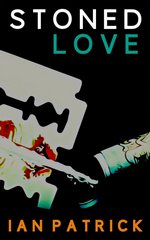
Stoned LoveStoned Love

by Ian Patrick
Series: Sam Batford, #2

Kindle Edition, 246 pg.
Fahrenheit Press, 2018
Read: September 14 – 15, 2018

I need to blend in where I shouldn’t belong. The best undercover officers have no air of ego or the appearance of a police mannequin. After all, one sniff of pig and your ass is bacon. I’ve no intention of being served up at any criminal’s barbecue.

How do you follow up 2017’s Rubicon, the twisty, morally ambiguous (at best) tale of an undercover cop? Well, if you’re Ian Patrick, you do it by bringing that shady cop back and putting him in a tighter spot with threats (physical, legal and career) on all sides.

Sam Batford has had a little time off to recuperate and get his head on straight after Rubicon — hopefully giving the heat on him a little time to cool down, and maybe give Big H time to move on from the setback Batford dealt him.

The Met has a new assignment for him — working with the same DCI as he did last time, DCI Klara Winter. During the last assignment, she wasn’t sure she could trust Batford — now she’s convinced that she can’t. In fact, while she wouldn’t mind taking down the criminals that Batford infiltrates, her main objective is to arrest Batford and his Superintendent Mike Hall, a pair she’s convinced are dirty. She’s right, of course, but that’s beside the point.

Ostensibly, Batford’s assignment is to infiltrate a group that’s supposedly planning a major armed robbery and will need a driver of some sorts. But the clock is ticking so he doesn’t have time to do this carefully. Winter has someone already embedded with the crew giving her information, and their primary purpose is to get dirt on Batford and Hall. Which sounds good, but when you get a couple of guys as cagey and wily as this pair, that’s no easy task.

At the same time, Hall’s told Batford that between family and work stresses, this is his last hurrah. Now, he’d like to start his retirement with a sizeable bankroll, and trusts that Batford will find a way to make the both of them some money from just whatever it is that this crew is up to. The crew’s leader, who goes by the cuddly moniker of Razor, is a long-time “unauthorized informant” of Hall’s. And now, he’s sending Batford in to get him arrested. Which seems odd, but it does give Hall enough of an inside track to help Batford.

So, essentially, Batford needs to find a way to get rich off these criminals, hopefully get enough evidence for some arrests, stop them from pulling off whatever they’re trying to — and avoid getting arrested himself (not that he knows he’s being targeted for that). Oh, yeah, and Big H hasn’t moved on, forgotten or forgiven him — in fact, he has an active contract out for Batford’s life, and there are people trying to collect on that. Sounds like a pretty rough time for him.

In Rubicon, there was a question (at least for me) throughout — just how bent is Batford? Will he actually do law enforcement, or is he just out for himself? What are the limits for him? Will he have any success in either his criminal or police activities? In Stoned Love, the questions are different — we know he’s bent pretty far. So it’s just will Batford survive? Will Winter arrest him? Will Hall use him to save his own skin? Will Razor do something to him? Will Big H’s killers eliminate him?

This changed the dynamic of the book for me, and made it a lot easier for me to enjoy this novel and cheer on Batford. There’s no moral or legal gray area any more. Like Michael Corleone or Hannibal Lechter, Sam Batford is a despicable character that the reader wants to find success. Thankfully, he’s nervy enough and clever enough, that there’s a pretty good chance that he will. At least for a while.

Winter is manipulative, deceptive and devoted more to her career than anything else. But she’s, technically, the good guy here. Everyone else is the kind of criminal that the police are supposed to stop, not become. But because we’re in Batford’s head, and Winter’s primarily seen as an obstacle for him to overcome, the reader roots for him and against her — knowing the whole time that it should be the other way around.

There’s frequent and repeated commentary on the effects of Brexit, budget cuts, personnel cuts and other moves by the British government that are impacting the police services throughout the novel. Patrick is a former police officer and if these aren’t his actual views coming forth through Batford, he’s a better author than I think. If Batford’s diagnosis of what’s going on with the police in Britain is accurate, it sounds pretty frightening.

It’s a minor thing — I only noticed this as I started to write this post, and I’ve recently had a bad experience with reading a novel that couldn’t pick a verb tense, so I was primed — but Patrick’s use of the present tense for these books is a subtle, and incredibly effective way of cranking up the tension, propelling the action forward, and pushing the reader to keep up with the pace of the book. I should’ve picked up on it with Rubicon, and am a little annoyed with myself for taking this long to notice.

I enjoyed Rubicon, but I appreciated what Patrick was doing and how he was doing it more. With Stoned Love, I still admired and appreciated his skill and aims, but I enjoyed the story more — I resented things like work and family for preventing me from finishing this as quickly as I wanted to, and absolutely relished an airline flight that meant I had uninterrupted reading time*. I think Stoned Love is an all-around better effort (which is saying something) and makes me very excited to see what comes from Ian Patrick next.

Not everyone enjoys reading books where the police are just as dirty as those they’re supposed to be stopping — and I understand that — but if you’re someone who can embrace a tarnished knight, someone who seems to be law enforcement malgré lui, you don’t want to waste any more time, get your hands on Rubicon and Stoned Love and prepare to be impressed.


* I also really appreciated having this to focus on rather than the fact that I was in a giant metal tube that has no business being that far off the ground, but that’s another story.

—–

4 1/2 Stars

Fahrenbruary Repost: In The Still by Jacqueline Chadwick

If Fahrenheit Press had done nothing other than bringing Ali Dalglish into my life, they’d rank amongst my favorite publishers. If there’s a female protagonist I like more than her, I can’t think of it (except that one lady whose name rhymes with Schmane Schmair).

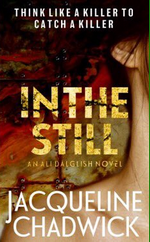
In The StillIn The Still

by Jacqueline Chadwick
Series: Ali Dalglish, #1

Kindle Edition, 422 pg.
Fahrenheit Press, 2017

Read: July 8 – 11, 2017

Maybe the easiest way to describe this book is to say that I had to stay up so late finishing — because there was no way I was putting it down — that I fell asleep the next night writing up a post about it.

When I’d just started this book, I tried to describe it to my wife and this is what I came up with (and still think it works): Imagine Where’d You Go, Bernadette?, but instead of a delightful novel about a genius architect with zero social skills who leaves her profession to raise her child in Seattle, where she has no friends, no life outside of her house and an antagonistic relationship with her neighbors; this is a delightful novel about a genius forensic psychologist with zero social skills who leaves her profession to raise her children in a small town in Vancouver, BC, where she has no friends, no life outside of her house and an antagonistic relationship with her neighbors — and there’s a serial killer.

Yeah, that’s glib and shallow — but it’s kinda true.

Ali Dalglish is our genius former psychologist, she’s enjoying an early morning cigarette when the woman she’s been annoyed by and has antagonized for months shows up at her back porch needing to use her phone. Marlene’s dog has just found a body on the beach, and she doesn’t carry a cell phone. Ali hands her the phone and takes off to try to secure the scene — a good move, as it turns out, because the local police aren’t up to it. They don’t even take her name and address, much less a statement, before they send her home. Ali has already seen enough to conclude that this was no accident or a death by natural causes. This was murder. But the only one that hears her is Marlene.

Neither woman is inspired to confidence by what they see from the local police, and although police with more experience in this sort of thing are on their way, the two decide to investigate the murder on their own. Probably not the wisest choice they could make, but it’s an entertaining one. After a quick glance at the victim, Ali puts together a pretty thorough profile of the killer, and she knows this isn’t his first kill. The two ladies play amateur sleuths, nosing around their suspect pool’s houses and setting up opportunities to observe them. The specialists agree with their suspect lists and profile — even if they take longer to compile them than Ali. They’re also able to confirm many of her theories. Which only emboldens Ali and Marlene to keep at it — even as they brush up against reckless and dangerous plans (although they have some very safe ones, too).

When the book starts, Ali and Marlene can’t stand each other; but events conspire to keep them together, and before either realize it, a friendship is forged — one that I love, the interplay between the two is just fantastic. There’s sort of a Felix/Oscar-vibe between the two, just intensified. Ali also strikes up a friendship/mutual admiration society with one of the investigators that will probably progress interestingly as it continues. In the shadow of the murder, Ali is able to get out of her house and integrate a little with her town in a way she hadn’t found possible before.

Now, there is a dark side to this novel, there is a serial killer running around, after all. Ali’s profile of him is on the mark, we never get as much detail about what makes him tick as other writers give — and I’m fine with that. I wouldn’t have minded a little more, but what we got was good enough. Chadwick stayed on the right side of exploitative writing about the victims and their deaths. We got enough to see that he was a monster, but there’s no relishing in the suffering. There’s one scene where a stranger accidentally finds his way into the dungeon the killer keeps his victims in. This is such a good scene, it’s so powerful and the details are just perfect. What happens to this poor guy, on the other hand . . . On the whole, there’s not much in this part of the novel that we haven’t seen before (really, aren’t most serial killer stories pretty similar?), but it’s the way that Chadwick tells the story that sets it apart from the rest and elevates it.

There’s a great red herring. Dealt with in a way that almost no one else in crime fiction does. The police pretty much know he’s a red herring, but they have to spend the time to investigate him so they can write him off. This was done so well — don’t get me wrong, I don’t enjoy that character, I really didn’t like reading one particular scene with him. But what he does to the overall plot was great — even once he stops being a red herring, he still has a pivotal role to play.

For a first novel, this is put together really well. I was worried in the first few pages, because it was overwritten in a really off-putting way — thankfully, I realized it was because we opened with the killer’s POV. I’m not sure why it is that so many fictional serial killers are written that way, but it works. There were moments where we weren’t reading his POV that Chadwick dipped her toe into overwriting, but it was never too much, and after a few chapters it went away (or I got used to it). That aside, the plotting is brisk, the characters are alive, the humor is real and unforced, the pacing is great — I really can’t say enough good things about it.

I don’t remember ever having as much fun, being so entertained by a serial killer story — not for a second did this become some sort of feel-good romp, don’t misunderstand me. The horror is real, the stakes are high, but there’s a humanity running through this that I just fell under the spell of. There are two more books in this series coming out in the next few months, and you can believe I’ll be jumping on them.

—–

4 1/2 Stars

Fahrenbruary Repost: Video Killed the Radio Star by Duncan MacMaster: A Murder Mystery as Fun as The Buggles’ Song

(or the cover by The Presidents of the United States of America, either will work)

Video Killed the Radio StarVideo Killed the Radio Star

by Duncan MacMaster
Series: Kirby Baxter, #2

Kindle Edition, 261 pg.
Fahrenheit Press, 2018
Read: October 15 – 16, 2018

“I fear we will never be mistaken for the Algonquin Round Table.”

“We’ll have to work on our witty repartee,” said Molly. “I plan on taking a course on banter, ripostes, badinage, and persiflage.”

“Even persiflage?”

“Especially persiflage,” said Molly. “There is nothing worse than sub-par persiflage.”

“You might need to get a sub-par persiflage lanced.”

“We’ve hit the nonsense phase of the night earlier than usual.”

“I like nonsense,” said Kirby, “it distracts me.”

Kirby Baxter just wants to live a quiet life out of the spotlight: hanging out with his girlfriend, Molly, when he can; restoring a car with his valet/bodyguard/etc.; and drawing his comics. And now that the excitement about the murder he solved at Omnicon dying down, he’s on the verge of doing that. But the mayor of his hometown knows Kirby, and has no shame in extorting his cooperation with a small problem that he’s having.

You see, one of the town’s major landmarks — an old, abandoned mansion — is in dire need of upkeep and remodeling. And a reality show full of C-List celebrities (maybe D- or E-list) have recently set up shop to do that work. But the city’s having second thoughts and they want Kirby and his über-perception skills to find a reason to shut down production and send them packing to disrupt another locale.

Kirby visits the production, talks to the cast and producers, looks around and comes up with a lot of observations and conclusions — and could cause a lot of inconvenience and embarrassment for everyone involved from those observations — but he can’t find what the mayor wants. That accomplished, he gets back to pursuing his best life now — which lasts just a few hours. Because before he can start to collect from the mayor for the work, one of the celebrities is found dead.

So, it’s back to the mansion for Kirby, this time to act as a consultant ot the local police as they investigate this suspicious death. Which is soon followed by another. And an attack on another cast member. And . . . well, you get the idea.

It’s nice that MacMaster didn’t repeat the whole “Kirby has to win over a skeptical and antagonistic police officer” thing — this time, thanks to most of the force having grown up with him, they all accept his talents and skills — an expect him to deliver.

The cast of the reality show, “Million Dollar Madhouse,” is filled with the typical collection of has-beens, almost-weres, and celebs trying to stage a comeback. Initially, I rolled my eyes at each of them, but the more time I spent with them, the more I appreciated and enjoyed them. In particular, the Kardashian-esque character totally won me over. Like in the previous book, there’s a large cast of characters that MacMaster juggles expertly — there are so many suspects to the murders, as well as witnesses for Kirby and the police to wade through.

Almost every serious suspect has the same defense — they didn’t want the initial victim dead. They wanted him to make a fool out of himself on national TV, possibly seriously injuring himself with a power tool. Some would follow that up with some other form of revenge — but if he’s dead, no one could get the revenge they wanted. It’s not ideal, but it’s an honest defense.

Gustave was slightly less super-human this time out — but he’s still in the Ranger/Hawk/Joe Pike nigh-impossible stratosphere. As much as I like everyone else in this series, it’s arguable that Gustave is MacMaster’s best creation — not just the character, but how MacMaster uses him.

I did miss Mitch. But was glad to see Molly and Kirby talk about him — and even make a joke he wasn’t around to make himself. It’s probably good that he wasn’t around — it’ll mean when we see him again, it’ll be easy to appreciate him without worrying about over exposure.

In the place of Mitch, we have Molly’s assertive and cunning cousin — she runs a gossip-website and wheedles her way into the investigation in order to land a story big enough to put her and her site on the map. Kirby clearly vacillates between finding uses for her and finding her distracting.

Molly and Kirby are cuter together than they were previously, and I could watch the two of them banter any day. It seemed harder to incorporate Molly into the story this time, and hopefully it’s easier for MacMaster in Kirby #3, but as difficult as it was, it was absolutely worth it.

I’m not sure exactly what it is about MacMaster’s writing that works so well for me, but it does. Just before I started writing this, I started to draw some parallels between these Kirby Baxter books and Ellen Raskin’s The Westing Game and The Mysterious Disappearance of Leon (I Mean Noel). I didn’t have time to fully flesh this idea out, but Raskin’s work definitely was formative for me and if the comparison hold up, that could explain a lot. The mix of humor, real emotions and complex mystery is the sweet spot for me and MacMaster consistently hits it. It’s not easy, there are precious few who try — and fewer that succeed. This is the third novel I’ve read by him and it seals the deal, I’ll buy everything he writes as soon as I can without really looking at what the book is about.

I was a little worried that this book wouldn’t live up to A Mint-Conditioned Corpse, and I don’t think it did — but I don’t know what could have for me. I’d enjoyed the other so much that it’s almost impossible to live up to — and the reality show setting didn’t do anything for me — they just leave me cold. The fact I’m rating Video Killed the Radio Star as high as I am is all about how effortlessly charming and entertaining this seems. Effortless always, always, always equals blood, sweat and tears — or at least a lot of work. This must’ve taken a great deal of labor, and it was absolutely worth it. A clever mystery, clever dialogue, and very clever characters in a funny, twisty story. The Kirby Baxter books are must reads, no doubt about it. Give this one a shot — I don’t see how you can’t enjoy it.

—–

4 1/2 Stars

Seraphina’s Lament by Sarah Chorn: Beautiful, moving, and brutal. You haven’t read anything like this fantasy.

I just reread this, and it doesn’t cover everything I wanted to, but it’s approaching that length where it becomes untenable — and I really don’t have time to add the 3-5 paragraphs that I want to (and who knows what else I’d think of when I open the floodgates). It’s a good start, anyway…

Seraphina's LamentSeraphina’s Lament

by Sarah Chorn
Series: The Bloodlands, #1

eARC, 342 pg.
2019

Read: February 12 – 15, 2018


I just don’t know that I can do an adequate job describing this book — actually, I do know that I can’t do an adequate job describing this book. But I can sort of explain things enough that you might get an idea if this book is for you. Maybe.

This takes place in some sort of Fantasy World, one rich in magic — elemental magic. There are those with Fire Magic, Earth Magic, Animal magic — and so on It’s hard to tell just ow the various people use their magic — but you get an idea that the world was full of a lot of magic that just isn’t working any more. The planet seems to be dying and one of the first signs was that fewer people were showing signs of magic and those who had it couldn’t use it has they could before. That right there is a great hook for a fantasy story — but for this book, it feels like it might be the seventh or eighth most important thing to know.

There’s a little bit of chicken and egg to this situation — did the economic and political upheaval happen because of the dying magic, or is they dying magic a response to the upheaval? I don’t think the book answers the question and I think I could argue for both positions (I’ve only read the book once, and I might be forgetting the one or two lines that definitively answer this question). The dynasty that had ruled The Sunset Lands was toppled by revolutionary forces — collectivist rebels seeking to remake not just the government, but society as a whole. After the Revolution, the Premier ends up pushing the citizens into collective farms and mines to provide for the nation as a whole. This is met with resistance, counter-revolutionary movements and problems. As the world dies, as the magic that aided people in both industries fades, the situation gets worse and people are pushed to desperate actions — and things that are even beyond desperation — just to survive.

In the midst of all this we focus on a few people — one farmer who lost everything, his home, his family, his hope. Seraphina, the title character, a personal prisoner of the premier, a slave that he spends years tormenting and crippling. Her twin brother, who escaped from the premier because of Seraphina’s sacrifice. We also meet others who offer aid and succor to as many as they can — food, shelter, assistance fleeing from the government’s forces — they’re dubbed counter-revolutionaries, and while they might aspire to that, they basically just help people live a little longer. We also, of course, spend a lot of time with the Premier — who can do nothing to prevent the collapse of his world and his society, but puts all his efforts into it. Lastly, we see the sleeping gods of this world awaken to watch the approaching end. I don’t feel comfortable enough talking about the characters in any more detail than that — they will grab your heart, break your heart, inspire and frighten you.

I’ve seen a couple of reviews that use the phrase “grimdark” to describe this book. Maybe I’m being restrictive in the way I use the term, but I don’t see the book in that model. It’s a different kind of dark, if you ask me (there’s a torturer that I can imagine Abercrombie’s Glotka accusing of going too far). This novel feels like it’s a few steps beyond dystopia, when the status quo of unjust society, environmental woes, extreme poverty are looked back on by people in a sense of “remember when we still had a chance to turn things around?” One character prepares for death and thinks back on his full and happy life. My notes focused on that “happy” with an all caps, “HOW?” Yet somehow, and I wish I could give a reason for this, somehow the book never becomes burdensome to read, you’re never thinking, “I’ve got to trudge through how many pages before we can get to some resolution?” You don’t want to see more tragedy befall the characters you know, you don’t want to face another interlude where you see the horrors that other characters face, where society breaks down further, where taboos disappear like a mist. But you can’t stop reading this book, you can’t help but read on.

This comes down to the way that Chorn tells the story, the language she uses to talk about the heartbreak, the horror, the tragedy, the atrocities, everything. So often, she’d be talking about life being pain, and death being the release in ways that elevated the idea, that seemed new and revolutionary, yet so true, so familiar that you intuitively related to the sentiment. It’s not right of me to talk about this without examples — but I have an ARC, so I can’t quote from it (and even if I had a published version, I don’t know that I could’ve picked just one or two examples — I’d have had a hard time limiting myself to a dozen favorites). There’s a lyrical, poetic quality to the language. There’s a humanity that infuses every nook and cranny of this novel in a way that I can’t imagine not appealing to readers.

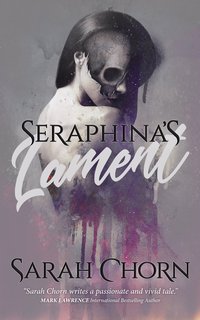
Before I forget, I want to talk about this cover a little bit. Is that not one of the most disturbing images you’ve seen lately? When Chorn’s publicist approached me about reading this book, I (mostly) jokingly said something about having to read this book just to get the image out of my brain — like you have to listen to an earworm all the way through to get it dislodged from your brain. It’s a perfect cover for this book.

This isn’t a perfect book — there were times I wondered if she’d gone to far with the depravity expressed by one character or another. The repeated uses of “closure” as in a character getting or needing “closure” or “moving on,” seemed out of place for this world — the same for “survivor’s guilt.” And honestly I have no problem with the conventional wisdom of a world like this having a concepts similar to those, but talking about it in the psychological language of late 20th/early 21st century seems odd to me. The Yeats allusion really struck me as unsuitable. (any of these might have been addressed in the final edits and might not appear in the final copy). None of these ruined a scene or a moment for me, but they did all cause me to take a beat and ask, “really?” It’s nothing significant, but they all felt inappropriate in this setting.

Time and time again while reading this book, I was struck by how unique, how unusual this experience was — I hadn’t felt like this since I read Darrell Drake’s A Star-Reckoner’s Lot a couple of years ago. Which doesn’t say much to most readers, because it’s a criminally unknown book. So I stretched my memory some more and came up with N. K. Jemisin’s The Hundred Thousand Kingdoms as having a similar impact on the way I thought about the story, and how unusual it feels compared to other fantasies I’ve read. The experience of reading this isn’t something I’ll forget any time soon.

Now, this is the first book of a trilogy, and I’m left totally unprepared for the second book. The middle book of a trilogy is where things are supposed to take a turn for the worse, leaving the reader wondering where the story is going to be able to take a turn for the better. I don’t see how things can get worse from this point, how there’s more chaos, more destruction, more peril possible. Which means that Chorn’s going to have to cast off traditional story structure, or pull a rabbit out of her hat (well, probably a few nests’ worth). Maybe both. I’m eager to see how she accomplishes book two.

But to focus on this book — this is a special fantasy. Beautiful, moving, and brutal. Read it.

Disclaimer: I received an ARC of this novel from the author, it didn’t impact my opinion beyond giving me something to have an opinion about..

—–

4 1/2 Stars
LetsReadIndie Reading Challenge

Main Bad Guy by Nick Kolakowski: A Blast of an Ending to this Trilogy

Yeah, weird day for me to post something like this, but it’s what Kolakowski asked for — and he wasn’t a jerk about it like the last guy who wanted a Saturday post.

Main Bad GuyMain Bad Guy

by Nick Kolakowski
Series: A Love & Bullets Hookup, #3

Kindle Edition, 152 pg.
Shotgun Honey, 2019
Read: January 28 – 29, 2019

           Bill could tell you all about things going haywire.

Like Fiona’s plan, for instance.

How the hell had he agreed to this insanity?

The answer was obvious: They had no choice.

It had to come down to this, didn’t it? After being on the run for a book to a book and a half (depending on the character), Bill and Fiona have to face off with the Dean, the Rockaway Mob leader who put out the hits on them both. They really don’t much choice, the whole starting over quietly thing didn’t work too well. Or at all.

This picks up right after Slaughterhouse Blues, the pair are having a difficult time getting out of New York, and ultimately find themselves locked in a panic room at the top of a skyscraper, surrounded by Crow Man — “a stellar chemist, and a better botanist” — his crew, and his product. Which is a pretty awkward place to be. Unsurprisingly, Crow Man works for the Dean (don’t you love these names?). The Dean had been having a pretty lousy day up until this point — and when the Dean has a bad day, a lot of people suffer. Then things start looking up, and the Dean is handed two of his most wanted on a silver platter.

Meanwhile, a mysterious figure named Walker is making his way from Canada to New York. He’s seen that the pair found some trouble in Oklahoma and assumed Fiona wold need help. By the time that word got out that they were in New York, he was already on the way, knowing that’d be the case. Walker is one of those classic aged “been there, done that” characters. The old pro who’s tried to retire and ends up having to get back into action one more time — which is good, because they really don’t do well with the quiet life anyway. I’d sign up for a series focusing on him in a heartbeat. I’d almost say this is worth reading just for Walker — even if you know nothing about Bill, Fiona, the Dean, etc. Eh, I’ll go ahead and say it, read this just for Walker. But you’ll like it more if you’ve read the others.

Walker’s travel is beset by trouble from uneasy allies, his age, and just how much the city has changed. One of the best scenes with him starts with Walker revisiting a favorite dive bar that had been “gentrified into a monstrosity” where he felt like he was “attending a wake for someone that nobody in the room had liked” in the middle of the velvet art, sky-blue walls and pop music. Kolakowski grounds this with reflections on September 11 and the effect it had on the City and its citizens — making it more than just a fun moment in the book. The intelligence he picks up in the bar justifies his brush with gentrification and enables him to come to Fiona’s aid. Hopefully in time.

Bill and Fiona are great together, their dialogue crackles. Watching these two try to get out of Dodge is so much fun, you find yourself wishing that Kolakowski had figured out way to stretch this into a quatrology. One of the problems I had, I now realize, with Slaughterhouse Blues was how little Bill and Fiona were together. They spent a lot of A Brutal Bunch of Heartbroken Saps apart, too — but that was different. Bill’s a better character with her around, and Fiona works better too — if for no other reason than she has to be a bad-ass and watch out for him, instead of just being pure bad-ass all the time. I’m not sure that makes sense to anyone not living in my head. Hopefully it does.

There’s excitement, there’s gunplay, there are explosives, violence, witty dialogue and a whole lot of bad-ass characters facing off with each other (and Bill’s around, too). This is the literary equivalent of a Martin McDonagh film (when he’s in a more playful mood) — or, if that doesn’t work for you, think Fargo meets Tarantino, but not as long-winded. Kolakowski ties this to A Brutal Bunch so well (and in ways you won’t expect), providing a perfect ending to this saga. There are so many quote-worthy lines in this brief novella that it’s driving me crazy that I can’t work more of them into this.

A lot of novella-series can be read in a clump, like one big novel. This is not one of them. Each novella has its own feel, its own themes and structure — while being one story. Last year, Kolakowski impressed me with his novel, Boise Longpig Hunting Club, this series has shown me that wasn’t a fluke at all and that I need to read anything I can by him.

I can’t tell you what’s holding me back from making this a full 5 Star, but something is. It’s close enough, though (and on Amazon/Goodreads, I round up), so I don’t feel too bad about chopping off that half-star here. But focus on the important things here — it’s a great read, a great conclusion and about as much fun as you’ll have in a thriller this year. Bill and Fiona are a great couple (at least in fiction, they’d probably crash and burn in real life) — and a lot of fun to read about.

Disclaimer: I received a copy of this book from the author in exchange for my honest opinion.

—–

4 1/2 Stars

2019 Cloak & Dagger Challenge
LetsReadIndie Reading Challenge

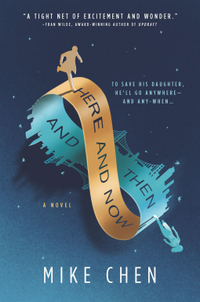
Pub Day Repost: Here and Now and Then by Mike Chen: A Dad. A Daughter. And Time Travel. (Kleenex may be required)

When I really love a book and don’t know how to express it, I tend to ramble. Case in point:

Here and Now and ThenHere and Now and Then

by Mike Chen

eARC, 336 pg.
Mira Books, 2019

Read: January 15 – 16, 2019

You can have fun with a son
But you gotta be a father to a girl

That’s Rodgers and Oscar Hammerstein, not Mike Chen — but the spirit of the book is in that second line, so I’m going to use it. I found myself singing those lines a lot while thinking about the book. If you’re a father to a daughter, you will love this book. I don’t think it’s necessary to appreciate the book — non-parents, mothers, people with sons should still be able to see how good it is and to empathize with the characters. But I can’t imagine any Father of a Daughter won’t see themselves (and Daddy’s Little Princess) in these pages.

In the past, I’ve said something about not really liking non-Doctor Who Time Travel stories. I’m starting to think it’s because I haven’t been reading the right kind of Time Travel stories. In the last year (give or take), I’ve read and loved four Time Travel novels — All Our Wrong Todays by Elan Mastai, Just One Damned Thing After Another by Jodi Taylor, Paradox Bound by Peter Clines, and now Here and Now and Then by Mike Chen. In all of them, the tropes of Time Travel are honored — while played with a little bit — but are really just excuses to tell very real emotional stories about some pretty great characters. Which is what Who does best, too, now that I think about it. So maybe for me, Time Travel has to be a means to an end, not the end itself.

Maybe I should leave the introspection for another time, and just get on with talking about the book, eh? My point was supposed to be that, like Matsai, Taylor and Clines, Mike Chen has surprised and excited me beyond expectations and hopes.

The day I started (and fell in love with) this book, I tried to explain it briefly to someone. I did so in a way that was clearly reductionistic (because, that’s what you do in a couple of sentences), spot on, and yet horribly inaccurate — all at the same time. Here’s what I said: It’s a gender-flipped Outlander, except the protagonist goes to the future instead of the past, and they use science-y stuff to the Time Travel instead of magic-y stuff.

Kin (pronounced /ˈkēn/) is, or was — or will be — a Secret Agent for the Temporal Corruption Bureau in 2142. He came back to 1996 to prevent a Twenty-Second Century criminal from altering the timeline for their own profit — and did so. But things went wrong in carrying out the mission and he was unable to be returned to his time. So he got stuck in 1996 for a bit. For him, it was 18 years. For the TCB it was a couple of weeks. For Kin, he had to give up hope of rescue, get a job — and then he fell in love, got married and had a kid. He has a nice life — he’s a success in IT for a video game company, he’s a pretty decent amateur chef and is working on trying out for a reality show for home chefs, his wife is great, and his daughter is, too. Miranda’s fourteen, a soccer star, wicked smart, a SF nerd and loves her parents.

Then his partner Markus shows up to bring him back to their time — Kin’s largely forgotten his former, er, past, er…other life and has really become a resident of 2014 (this is explained in science-y wibbly wobbly, timey wimey terms that actually make sense in context), so Markus has to take him by force. Once he’s back to his future, Kin starts remembering his life — his job, his hobbies, his utter ineptitude in the kitchen — and his fiancé (Markus’ sister). But it doesn’t come back to him immediately, and he has to work at it.

One thing he can’t do, is let go of his Twenty-First Century life, and he schemes for ways to remain a part of Miranda’s life. For awhile, this works — but only for a while. The instant it starts, every reader knows that Kin won’t be able to fly under the radar forever and he gets found out. It turns out that what he’s doing risks the future — but the only fix the TCB has in mind will mean Miranda’s death. While Kin can understand their decision, there’s no way he can let that happen to his daughter.

I don’t think I’ve said (much) more than the publisher’s blurb — but I can’t say much more without spoiling. And trust me, Chen’s version is much better than mine would be.

Kin is a great character — he’s thoughtful, skilled, smart — and human. He makes a lot of mistakes, his judgement is shaky (not just when it comes to Miranda, either) — but he tries to do the right thing. His loved ones — in all eras — are people you can believe are in his life and you can see why he cares for them, and you do too — because of Kin. That’s all I’m going to say about the other characters because I can’t talk about any of them without ruining something.

The world of 2142 is just about perfect — it’s different than 2014, but there are straight lines connecting it all. It’s the little changes that make it right — often Kin’s perspective allows us to see it. Like the offhand way he mentions to someone that temperatures are 5 degrees lower in 2014. Or the way he reacts to a recreation of 21st Century fast food. There are things about Mars that are just tossed off in conversation without explanation that clearly mean humans are doing something on the surface of the planet. Don’t ask me what — Chen doesn’t say. It even took me seeing him use the phrase a couple of times before I realized what it meant. But once I did, I got very excited about how he pulled it off. There are many subtle details like these that really make this a believable read.

The story and the writing are imaginative and playful — you will smile a lot while reading this. But the instant that Markus shows up and says it’s time to go, you just know that your heart is going to get broken in these pages. And you will be right. Thankfully, Chen will give you almost as many reasons to be happy — some small, some big. It’d have been very easy to make this maudlin or depressing. He could’ve also make this a playful romp. Chen instead walks the tightrope between the extremes in a performance worthy of Philippe Petit. The pages fly by, I really couldn’t believe how quickly I read this — part of it was because I just had to find out what happened to Kin, Miranda and the rest — but part of it was Chen’s writing. Despite hitting you with all that he hits you with, it’s very (and at times, deceptively) easy to read.

(this next paragraph could get a bit spoiler-y. But not really, just in vague sentiments, no particulars…Still, skip if you want)
This worked for me on just about every level and on just about every front — it checked all of my boxes and did just about every superlative thing I can think of. But the ending — I loved the ending, don’t get me wrong — just felt a little too easy. Things worked a little too well. Which the fanboy in me loves, but . . . I dunno, the book was filled with twists and struggles and challenges and the in the last three or four chapters everything was a little too easily overcome — and even the challenges melted away. And yes, I cheered, but I wanted Kin and everyone to have to work a little harder for my cheers. So, I’m docking this 1/2 star. (which is easy to do because on Goodreads/Amazon/NetGalley I have to round up, because they won’t accept half-stars, so the ratings average still gets to stay high).

Heart, soul, laughs, and heartbreak — I don’t know what else you want out of a time travel story. Or any story, really. Characters you can like (even when they do things you don’t like), characters you want to know better, characters you want to hang out with after the story (or during it, just not during the major plot point times), and a great plotline. This book is about as good as it gets. Grab your copy now while I start eagerly anticipating Chen’s next book.

Disclaimer: I received this eARC from HARLEQUIN – MIRA via NetGalley in exchange for this post — thanks to both for this. These are my own honest — and hopefully not convoluted — thoughts and opinions.

—–

4 1/2 Stars

Here and Now and Then by Mike Chen: A Dad. A Daughter. And Time Travel. (Kleenex may be required)

When I really love a book and don’t know how to express it, I tend to ramble. Case in point:

Here and Now and ThenHere and Now and Then

by Mike Chen


eARC, 336 pg.
Mira Books, 2019

Read: January 15 – 16, 2019

You can have fun with a son
But you gotta be a father to a girl

That’s Rodgers and Oscar Hammerstein, not Mike Chen — but the spirit of the book is in that second line, so I’m going to use it. I found myself singing those lines a lot while thinking about the book. If you’re a father to a daughter, you will love this book. I don’t think it’s necessary to appreciate the book — non-parents, mothers, people with sons should still be able to see how good it is and to empathize with the characters. But I can’t imagine any Father of a Daughter won’t see themselves (and Daddy’s Little Princess) in these pages.

In the past, I’ve said something about not really liking non-Doctor Who Time Travel stories. I’m starting to think it’s because I haven’t been reading the right kind of Time Travel stories. In the last year (give or take), I’ve read and loved four Time Travel novels — All Our Wrong Todays by Elan Mastai, Just One Damned Thing After Another by Jodi Taylor, Paradox Bound by Peter Clines, and now Here and Now and Then by Mike Chen. In all of them, the tropes of Time Travel are honored — while played with a little bit — but are really just excuses to tell very real emotional stories about some pretty great characters. Which is what Who does best, too, now that I think about it. So maybe for me, Time Travel has to be a means to an end, not the end itself.

Maybe I should leave the introspection for another time, and just get on with talking about the book, eh? My point was supposed to be that, like Matsai, Taylor and Clines, Mike Chen has surprised and excited me beyond expectations and hopes.

The day I started (and fell in love with) this book, I tried to explain it briefly to someone. I did so in a way that was clearly reductionistic (because, that’s what you do in a couple of sentences), spot on, and yet horribly inaccurate — all at the same time. Here’s what I said: It’s a gender-flipped Outlander, except the protagonist goes to the future instead of the past, and they use science-y stuff to the Time Travel instead of magic-y stuff.

Kin (pronounced /ˈkēn/) is, or was — or will be — a Secret Agent for the Temporal Corruption Bureau in 2142. He came back to 1996 to prevent a Twenty-Second Century criminal from altering the timeline for their own profit — and did so. But things went wrong in carrying out the mission and he was unable to be returned to his time. So he got stuck in 1996 for a bit. For him, it was 18 years. For the TCB it was a couple of weeks. For Kin, he had to give up hope of rescue, get a job — and then he fell in love, got married and had a kid. He has a nice life — he’s a success in IT for a video game company, he’s a pretty decent amateur chef and is working on trying out for a reality show for home chefs, his wife is great, and his daughter is, too. Miranda’s fourteen, a soccer star, wicked smart, a SF nerd and loves her parents.

Then his partner Markus shows up to bring him back to their time — Kin’s largely forgotten his former, er, past, er…other life and has really become a resident of 2014 (this is explained in science-y wibbly wobbly, timey wimey terms that actually make sense in context), so Markus has to take him by force. Once he’s back to his future, Kin starts remembering his life — his job, his hobbies, his utter ineptitude in the kitchen — and his fiancé (Markus’ sister). But it doesn’t come back to him immediately, and he has to work at it.

One thing he can’t do, is let go of his Twenty-First Century life, and he schemes for ways to remain a part of Miranda’s life. For awhile, this works — but only for a while. The instant it starts, every reader knows that Kin won’t be able to fly under the radar forever and he gets found out. It turns out that what he’s doing risks the future — but the only fix the TCB has in mind will mean Miranda’s death. While Kin can understand their decision, there’s no way he can let that happen to his daughter.

I don’t think I’ve said (much) more than the publisher’s blurb — but I can’t say much more without spoiling. And trust me, Chen’s version is much better than mine would be.

Kin is a great character — he’s thoughtful, skilled, smart — and human. He makes a lot of mistakes, his judgement is shaky (not just when it comes to Miranda, either) — but he tries to do the right thing. His loved ones — in all eras — are people you can believe are in his life and you can see why he cares for them, and you do too — because of Kin. That’s all I’m going to say about the other characters because I can’t talk about any of them without ruining something.

The world of 2142 is just about perfect — it’s different than 2014, but there are straight lines connecting it all. It’s the little changes that make it right — often Kin’s perspective allows us to see it. Like the offhand way he mentions to someone that temperatures are 5 degrees lower in 2014. Or the way he reacts to a recreation of 21st Century fast food. There are things about Mars that are just tossed off in conversation without explanation that clearly mean humans are doing something on the surface of the planet. Don’t ask me what — Chen doesn’t say. It even took me seeing him use the phrase a couple of times before I realized what it meant. But once I did, I got very excited about how he pulled it off. There are many subtle details like these that really make this a believable read.

The story and the writing are imaginative and playful — you will smile a lot while reading this. But the instant that Markus shows up and says it’s time to go, you just know that your heart is going to get broken in these pages. And you will be right. Thankfully, Chen will give you almost as many reasons to be happy — some small, some big. It’d have been very easy to make this maudlin or depressing. He could’ve also make this a playful romp. Chen instead walks the tightrope between the extremes in a performance worthy of Philippe Petit. The pages fly by, I really couldn’t believe how quickly I read this — part of it was because I just had to find out what happened to Kin, Miranda and the rest — but part of it was Chen’s writing. Despite hitting you with all that he hits you with, it’s very (and at times, deceptively) easy to read.

(this next paragraph could get a bit spoiler-y. But not really, just in vague sentiments, no particulars…Still, skip if you want)
This worked for me on just about every level and on just about every front — it checked all of my boxes and did just about every superlative thing I can think of. But the ending — I loved the ending, don’t get me wrong — just felt a little too easy. Things worked a little too well. Which the fanboy in me loves, but . . . I dunno, the book was filled with twists and struggles and challenges and the in the last three or four chapters everything was a little too easily overcome — and even the challenges melted away. And yes, I cheered, but I wanted Kin and everyone to have to work a little harder for my cheers. So, I’m docking this 1/2 star. (which is easy to do because on Goodreads/Amazon/NetGalley I have to round up, because they won’t accept half-stars, so the ratings average still gets to stay high).

Heart, soul, laughs, and heartbreak — I don’t know what else you want out of a time travel story. Or any story, really. Characters you can like (even when they do things you don’t like), characters you want to know better, characters you want to hang out with after the story (or during it, just not during the major plot point times), and a great plotline. This book is about as good as it gets. Grab your copy now while I start eagerly anticipating Chen’s next book.

Disclaimer: I received this eARC from HARLEQUIN – MIRA via NetGalley in exchange for this post — thanks to both for this. These are my own honest — and hopefully not convoluted — thoughts and opinions.

—–

4 1/2 Stars

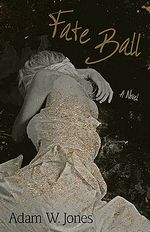
Flashback Friday: Fate Ball by Adam W. Jones

The post I’m working on just isn’t going to be finished on time — at least not while leaving me capable of working today. So here’s a post from the past about a book that I’ve thought about lately.


Welcome to Part One of our participation in the Fate Ball Book Tour — a brief interview will follow in a couple of minutes. Hope you enjoy both of these posts half as much as I enjoyed this book.

Fate BallFate Ball

by Adam W. Jones
PDF, 279 pg.
Wisdom House Books, 2016
Read: April 14 – 15, 2016

Parents always seem to think that saving the day is a good thing, but really it just postpones the inevitable. Sometimes, they should just let their kids crash and burn, so they learn their lesson the hard way. Parents can be the biggest enablers of them all when they’re acting out of love and kindness, but that usually just makes things worse.

That’s not the most dazzling piece of writing in Fate Ball, nothing catchy or inherently memorable, like I try to start with — but this is the heart of the book. People trying to help an addict not ready to be helped, and inadvertently making things worse.

In the prologue, Able Curran receives news that Ava Dubose has died — Chapter One takes us back 14 years to 1980 to meet her. In Chapter Two (one of the best chapters I’ve read this year), Able meets her — and falls for her almost instantly (and many readers will, too). Over the next few chapters, you see the two falling deeper and deeper in love — one of the cutest couples you’ve read.

All the while, you know that things are leading to the fateful phone call Able receives in 1994. We start to see some signs of trouble (well, those started before this) long before Able does. When he finally gets clued it, it destroys him — and they don’t see each other for some time. From there we watch these two lives intersect from time to time over the next 15 years (usually, Able trying to help her), as well as getting glimpses of their lives between the intersections.

This is really the story of two addicts — one who lets their dependency control and destroy them. The other who learns how to live with the problem, controlling and eventually overcoming. And even as you know it’s happening, you still hold out hope for Ave to shake things off, to achieve the serenity — or at least the contentment that she so desperately needs. Things get worse and worse — yet Jones is able to keep things from despairing, there’s a lightness to the prose that keeps things moving. While things fall apart for Ava, they move on for Able and their friends — success, new love, children, life.

In some hands, you’d be beaten over the head with the contrast, Jones doesn’t do that however. It all spools out naturally, easily (the kind of ease that takes work to pull off). You like everyone here enough that you’re pulling for them, no matter what stupid choices they make. Jones as come up with a perfect blend of humor, romance, drama, and tragedy.

There are plenty of little touches along the way to keep things light, to immerse you in the world — which is good because the book could become too fixated on Able and Ava.

His mother was always asking, then answering her own questions. That’s why she was always right. She could have a whole conversation with herself, even a fight depending on the subject matter, and no one had to say a word. All Able needed to do was just nod his head once in a while and she would take care of the rest.

This is not the best book I’ve read — not even the best novel on addiction. But it works well enough that it doesn’t matter. I’m not saying it’s a bad book, or there are glaring problems — but objectively, I just think it could be better. But when you’re reading it? It delivers everything you want, and some things you don’t expect. I really enjoyed this and think you will, too.

Disclaimer: I received a copy of this book from the kind folks at Wisdom House Books in exchange for an honest review.

—–

4 1/2 Stars

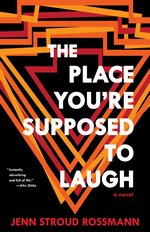
The Place You’re Supposed to Laugh by Jenn Stroud Rossmann: A Great Read about the Less-Glamorous, Less-Successful Side of Silicon Valley

The Place You're Supposed to LaughThe Place You’re Supposed to Laugh

by Jenn Stroud Rossmann

eARC, 330 pg.
7.13 Books, 2018

Read: November 5 – 7, 2018

Those inclined to irony might find it in the Palo Alto Farmers Market assembled on asphalt, where there had once been an apricot orchard. Each weekend from May through December, the workweek parking lot filled with vendor stands and umbrellas protecting bins of trucked-in garlic cloves, avocados, tomatillos, et al. The University down the street was known as “The Farm,” though it hadn’t been one since the Stanfords donated their country estate and chartered a college in the 1880s. Stanford grads and especially its dropouts had been transforming the Valley ever since; the fruit came from further and further away.

It’s really hard to grab a representative quotation from this novel — but this comes close. There’s a hint of the humor, the capturing of a moment in time, societal observation, a hint of wistfulness, and even a modicum of critique.

It’s 2002, in many parts of the country the shadow of 9/11 looms large. It’s present in Palo Alto, but not to the degree it is other places — what looms larger is the bursting of the dot-com bubble, everyone around them has been impacted in some way by it — most people have been impacted in significant ways, although the ripples are still going out from them and affecting the lives of everyone in their community in some way.

Our focus in this novel is on the life of Chad Loudermilk and those who are near him. Chad’s 14 and is enduring his first year in high school. His best friend since . . . well, forever, Walter Chen attended there briefly, but was pulled out by his parents to attend the Roman Catholic academy nearby — for a greater focus on academics, and fewer active shooter drills. Life’s hard without Walter around. Chad’s mother works with “at risk” youth, on making wise decisions, while she’s still reeling from her mother’s death a few months earlier. Chad’s father, Ray, is dealing with ripples of the burst — the advertising agency he’s part of his dealing with a shift in clientele. There’s Scot, Chad’s next-door neighbor, the creator of Latte (wink, wink) — the Macromedia tool — a big brother figure, dispensing non-parental advice and playing video games (his wife really doesn’t have any time for Chad). There’s a new girl in school that Chad can’t stop talking about, and a couple of guys from the proverbial other side of the tracks that he met at a record store and is spending time with. The major focus of the plot is following Chad’s interactions with them over the course of a few months — we get chapters focusing on his parents and what’s going on in their lives, but on the whole, the rest of the characters are seen filtered through Chad’s experience.

The other major thread follows Chad’s maternal aunt, Diana, a physics professor we meet as she registers for a conference in Barcelona. She’s trying to re-establish her career after pressing pause on things to have a child with her best friend. It’s not easy for her to get back into the swing of things, but she’s close. As Chad’s aunt, there’s a lot of opportunity for the plotlines to intersect and overlap — but the sisters aren’t that close, so it’s not as frequent as it could’ve been. By the end of the novel, events have transpired enough that Diana’s as large a fixture in Chad’s life as Scot (maybe larger), so it’s easy to intermingle the story lines. But for the first 1/2-2/3 or so, there a clear distinction between the two — and it’s not clear why we’re getting both stories.

Another thing that’s not clear is what exactly is Chad’s story. This is close to a Bildungsroman, but we only really see the beginning of Chad’s development — it’s like the first Act of Chad’s Bildungsroman. Which isn’t to say that it’s an incomplete story, it’s not. It’s just about Chad starting adolescence. You don’t want to get the details from me, you want to get them from the book, but a lot of stuff happens. Nothing major like a school shooting, a terrorist attack, or anything. Just life, the ebbs and flows of people’s lives. I could actually sum up the major events of the novel in 2 sentences. One of them might be long-ish, but just two sentences.

Don’t get me wrong — there’s a plot to this book. But really, you don’t see it (well, I didn’t see it) until toward the end — maybe even after the end. This is not a bad thing, it just means you have to think about things a lot. My notes are filled with comments along the lines of “I really don’t see where this is going” or “I’m not sure what the point of all this is” — and they’re always followed with, “Don’t care, great stuff.” I really didn’t care where Rossmann was going, I was too busy enjoying the ride — the voice, the characters, the atmosphere, the little bits like the Farmers Market (above), were enough to keep me engaged, entertained and turning the pages.

I’m not going to drill down and talk about the various characters — or even just one. I could do a post just about Ray, or Scot, or a long one on Chad or Diane — I think I’d have to do a series on Chad’s mom. Instead I’ll talk about them as a collective whole — they’re people. There are things to like about them all, there’s plenty to dislike about them all (particularly the adults). A lot of what they do seem inconsistent with the characters as Rossmann has presented them, but that just makes them more human. There’s not one character in this book that isn’t a human — no one larger than life (Scot kind of is, but he’s larger than life in the way that we all know someone who seems to be that way). Any person in this book could easily be the person next to you in the bagel shop, sipping on their caffeinated beverage of choice. They’re delightful in that perceived realism, also in the way that Rossmann talks about them. Without approval of anything, you get the feeling that she has affection for every character in the book.

The clergymen who appeared — however briefly — in this book were a couple of the least objectionable depictions of clergy I can remember seeing lately. Not hypocritical, they actually seemed to believe in what they were saying, and were actually trying to help those they encountered. It’s not often you get to see that anymore, and it should be acknowledged when you see it.

I’ve been struggling for a few days — and I’m not sure I’m succeeding at the moment — to put into words the experience that is The Place You’re Supposed to Laugh. I think I was hooked by the end of chapter 1 — definitely by some point in the third chapter. I liked the book, I liked the characters, I liked the writing. It’s a pleasant, thoughtful experience. It’s what reading a book should be like — skillful writing, wonderfully drawn characters and prose you enjoy immersing yourself in.

The novel talks about a lot of things — one of the biggest themes is forgiveness. I don’t think I’ve ever seen the topic discussed in quite the same way in any format. I won’t suggest that Rossmann exhausted the idea, obviously, but she talked about it, depicted it, and had her characters think about it in ways I found refreshing and encouraging.

I’m not sure what else to say — The Place You’re Supposed to Laugh is a great read. It’s a strong novel that will make you think, will make you feel, and will leave you satisfied. Rossman writes with sensitivity, wit and skill. What else are you looking for?

Disclaimer: I was provided with a copy of this novel by the author in exchange for my honest opinion, which is seen above.

—–

4 1/2 Stars

Page 18 of 30

Powered by WordPress & Theme by Anders Norén