Tag: 4 1/2 Stars Page 19 of 30

Dark Sacred Night by Michael Connelly: Bosch and Ballard Team Up in one of Connelly’s best

Dark Sacred NightDark Sacred Night

by Michael Connelly
Harry Bosch, #20/Renée Ballard, #2

Hardcover, 433 pg.
Little, Brown and Company, 2018
Read: October 31 – November 1, 2018

In a series that’s over twenty books long, there’s a lot of character development, recurring faces and names, and the like — there just has to be. But on the whole, there’s not a lot of connective tissue between the books, most of what happens in one book stays in that novel, and the next very likely won’t even mention those events. Which is really kind of odd, when you think of it. But that’s not the case here — this picks up the action from Two Kinds of Truth a few months later and the central case of this novel is one that Harry had reopened in it. This really is a sequel to Two Kinds of Truth in a way that Connelly really hasn’t given us since The Poet/The Narrows.

LAPD politics has moved Lucia Soto off from the case that Harry asked her to pick up — a murder of a fifteen year-old prostitute, Daisy Clayton — so she can devote time to something more pressing, but Harry doesn’t have to play that game. His own work on that cold case brings him back to the Hollywood Station, where he tries to look at some old files (without anyone knowing what he was up to). He’s caught by our new friend, Renée Ballard. Renée being the curious type quickly figures out what he’s looking into and pushes her way into the investigation — unlike Soto, she has time; unlike Harry, she has standing; it’s really the best thing that could happen for the case.

While she’s poking into this cold case and developing some sort of relationship with Harry Bosch — Renée has her own active cases, and regular Late Show duties to perform. I really like the way we get several little cases along the way with her in these two books — sure, there’s the big murder mysteries, but there’s also a robbery, a rape allegation, and other crimes that she has to deal with. This adds variety to the book (as it did in The Late Show), a touch of realism, and gives the readers multiple ways to see her in action.

Harry also has an official investigation to pursue — a cold case in San Fernando is heating up thanks to Harry’s work uncovering a witness. His prime suspect is now a high-ranking member of a pretty serious gang and the consequences for this witness are potentially huge — and things go quickly wrong with this case. So wrong that Harry’s future with SFPD — and his own safety — are in jeopardy.

There are so many balls in the air in this novel that it’s a testament to Connelly’s skill that they never get confused, he devotes time to each as he should, in a way that does justice to each storyline and the book never feels over-populated. If Dark Sacred Night had nothing else going for it, just the construction would be enough to commend it. But there’s so much more to commend the novel, too. There’s a little levity, a lot of darkness, a lot of solid procedural material, a couple of bent rules, and some satisfying story telling — just to name a few of the commendable things. I’m leaving a lot off that list, if only for reasons of space and time.

There’s one criminal here — I’m trying not to spoil anything — who spouts off about his victims not being anyone, of not counting. He’s the philosophical opposite of Harry’s “Everyone counts” mission. It’s an excellent way to highlight just what makes Harry — and maybe Renée — tick and what separates them and some of the gray areas they walk in from those on the other side of the law. We have multiple murderers in this book for whom their victims are just tools, just objects, things go be used. While for Harry, Renée, and those like them — these are people with hopes, dreams, pain and suffering that need to be protected, defended and avenged.

A downside for me was how little non-case work time we got with Renée. Harry had time with Maddie, Cisco and Elizabeth in addition to all the police. Renée got almost no time with Lola, nothing with her grandmother, and only a little time with anyone outside of the Hollywood Station that wasn’t involved in a crime she was investigating. I liked her non-police world just as much as I like Harry’s and wish we’d have gotten time in it.

Like many, I knew that Bosch and Ballard would team-up eventually. But no one expected it so soon. Before reading this, I’d said that I would’ve liked another book or two just to get to know Renée a bit more before bringing Harry in. However, having read this — I’m glad it happened now (still, wouldn’t have minded the other). Having the two of them together emphasizes the non-Bosch-ness of Renée, which is good. Also, it gives her someone she can count on, not overly-influenced by her history, department politics, or any of the nonsense that will follow her for the rest of her career. This also gives Harry a way away from cold cases and San Fernando. Altogether, it’s a smart move on Connelly’s part. Now I guess we just wait on the inevitable involvement of Mickey.

Between the merging of the two worlds, the strong emotional tie Harry has to Daisy and her mother, the upheaval the other case brings to his life, and the continued development of Renée Ballard as a character — there’s just so many positives to this book that it’s hard to enumerate them all. I think this is the best book that Connelly has done — in any of his series — in years. It’s been ages (if ever) that he’s had a clunker of a novel, but this one seems more effective, more entertaining than most. It’s just so well done. This is a must-read for Bosch fans, Renée Ballard fans, Connelly fans or anyone who likes seeing one of the masters of the genre at the top of his game.

—–

4 1/2 Stars

Video Killed the Radio Star by Duncan MacMaster: A Murder Mystery as Fun as The Buggles’ Song

(or the cover by The Presidents of the United States of America, either will work)

Video Killed the Radio StarVideo Killed the Radio Star

by Duncan MacMaster
Series: Kirby Baxter, #2

Kindle Edition, 261 pg.
Fahrenheit Press, 2018
Read: October 15 – 16, 2018

“I fear we will never be mistaken for the Algonquin Round Table.”

“We’ll have to work on our witty repartee,” said Molly. “I plan on taking a course on banter, ripostes, badinage, and persiflage.”

“Even persiflage?”

“Especially persiflage,” said Molly. “There is nothing worse than sub-par persiflage.”

“You might need to get a sub-par persiflage lanced.”

“We’ve hit the nonsense phase of the night earlier than usual.”

“I like nonsense,” said Kirby, “it distracts me.”

Kirby Baxter just wants to live a quiet life out of the spotlight: hanging out with his girlfriend, Molly, when he can; restoring a car with his valet/bodyguard/etc.; and drawing his comics. And now that the excitement about the murder he solved at Omnicon dying down, he’s on the verge of doing that. But the mayor of his hometown knows Kirby, and has no shame in extorting his cooperation with a small problem that he’s having.

You see, one of the town’s major landmarks — an old, abandoned mansion — is in dire need of upkeep and remodeling. And a reality show full of C-List celebrities (maybe D- or E-list) have recently set up shop to do that work. But the city’s having second thoughts and they want Kirby and his über-perception skills to find a reason to shut down production and send them packing to disrupt another locale.

Kirby visits the production, talks to the cast and producers, looks around and comes up with a lot of observations and conclusions — and could cause a lot of inconvenience and embarrassment for everyone involved from those observations — but he can’t find what the mayor wants. That accomplished, he gets back to pursuing his best life now — which lasts just a few hours. Because before he can start to collect from the mayor for the work, one of the celebrities is found dead.

So, it’s back to the mansion for Kirby, this time to act as a consultant ot the local police as they investigate this suspicious death. Which is soon followed by another. And an attack on another cast member. And . . . well, you get the idea.

It’s nice that MacMaster didn’t repeat the whole “Kirby has to win over a skeptical and antagonistic police officer” thing — this time, thanks to most of the force having grown up with him, they all accept his talents and skills — an expect him to deliver.

The cast of the reality show, “Million Dollar Madhouse,” is filled with the typical collection of has-beens, almost-weres, and celebs trying to stage a comeback. Initially, I rolled my eyes at each of them, but the more time I spent with them, the more I appreciated and enjoyed them. In particular, the Kardashian-esque character totally won me over. Like in the previous book, there’s a large cast of characters that MacMaster juggles expertly — there are so many suspects to the murders, as well as witnesses for Kirby and the police to wade through.

Almost every serious suspect has the same defense — they didn’t want the initial victim dead. They wanted him to make a fool out of himself on national TV, possibly seriously injuring himself with a power tool. Some would follow that up with some other form of revenge — but if he’s dead, no one could get the revenge they wanted. It’s not ideal, but it’s an honest defense.

Gustave was slightly less super-human this time out — but he’s still in the Ranger/Hawk/Joe Pike nigh-impossible stratosphere. As much as I like everyone else in this series, it’s arguable that Gustave is MacMaster’s best creation — not just the character, but how MacMaster uses him.

I did miss Mitch. But was glad to see Molly and Kirby talk about him — and even make a joke he wasn’t around to make himself. It’s probably good that he wasn’t around — it’ll mean when we see him again, it’ll be easy to appreciate him without worrying about over exposure.

In the place of Mitch, we have Molly’s assertive and cunning cousin — she runs a gossip-website and wheedles her way into the investigation in order to land a story big enough to put her and her site on the map. Kirby clearly vacillates between finding uses for her and finding her distracting.

Molly and Kirby are cuter together than they were previously, and I could watch the two of them banter any day. It seemed harder to incorporate Molly into the story this time, and hopefully it’s easier for MacMaster in Kirby #3, but as difficult as it was, it was absolutely worth it.

I’m not sure exactly what it is about MacMaster’s writing that works so well for me, but it does. Just before I started writing this, I started to draw some parallels between these Kirby Baxter books and Ellen Raskin’s The Westing Game and The Mysterious Disappearance of Leon (I Mean Noel). I didn’t have time to fully flesh this idea out, but Raskin’s work definitely was formative for me and if the comparison hold up, that could explain a lot. The mix of humor, real emotions and complex mystery is the sweet spot for me and MacMaster consistently hits it. It’s not easy, there are precious few who try — and fewer that succeed. This is the third novel I’ve read by him and it seals the deal, I’ll buy everything he writes as soon as I can without really looking at what the book is about.

I was a little worried that this book wouldn’t live up to A Mint-Conditioned Corpse, and I don’t think it did — but I don’t know what could have for me. I’d enjoyed the other so much that it’s almost impossible to live up to — and the reality show setting didn’t do anything for me — they just leave me cold. The fact I’m rating Video Killed the Radio Star as high as I am is all about how effortlessly charming and entertaining this seems. Effortless always, always, always equals blood, sweat and tears — or at least a lot of work. This must’ve taken a great deal of labor, and it was absolutely worth it. A clever mystery, clever dialogue, and very clever characters in a funny, twisty story. The Kirby Baxter books are must reads, no doubt about it. Give this one a shot — I don’t see how you can’t enjoy it.

—–

4 1/2 Stars

Stoned Love by Ian Patrick: No Sophomore Slump in Sight with this Thriller.

Stoned LoveStoned Love

by Ian Patrick
Series: Sam Batford, #2

Kindle Edition, 246 pg.
Fahrenheit Press, 2018
Read: September 14 – 15, 2018

I need to blend in where I shouldn’t belong. The best undercover officers have no air of ego or the appearance of a police mannequin. After all, one sniff of pig and your ass is bacon. I’ve no intention of being served up at any criminal’s barbecue.

How do you follow up 2017’s Rubicon, the twisty, morally ambiguous (at best) tale of an undercover cop? Well, if you’re Ian Patrick, you do it by bringing that shady cop back and putting him in a tighter spot with threats (physical, legal and career) on all sides.

Sam Batford has had a little time off to recuperate and get his head on straight after Rubicon — hopefully giving the heat on him a little time to cool down, and maybe give Big H time to move on from the setback Batford dealt him.

The Met has a new assignment for him — working with the same DCI as he did last time, DCI Klara Winter. During the last assignment, she wasn’t sure she could trust Batford — now she’s convinced that she can’t. In fact, while she wouldn’t mind taking down the criminals that Batford infiltrates, her main objective is to arrest Batford and his Superintendent Mike Hall, a pair she’s convinced are dirty. She’s right, of course, but that’s beside the point.

Ostensibly, Batford’s assignment is to infiltrate a group that’s supposedly planning a major armed robbery and will need a driver of some sorts. But the clock is ticking so he doesn’t have time to do this carefully. Winter has someone already embedded with the crew giving her information, and their primary purpose is to get dirt on Batford and Hall. Which sounds good, but when you get a couple of guys as cagey and wily as this pair, that’s no easy task.

At the same time, Hall’s told Batford that between family and work stresses, this is his last hurrah. Now, he’d like to start his retirement with a sizeable bankroll, and trusts that Batford will find a way to make the both of them some money from just whatever it is that this crew is up to. The crew’s leader, who goes by the cuddly moniker of Razor, is a long-time “unauthorized informant” of Hall’s. And now, he’s sending Batford in to get him arrested. Which seems odd, but it does give Hall enough of an inside track to help Batford.

So, essentially, Batford needs to find a way to get rich off these criminals, hopefully get enough evidence for some arrests, stop them from pulling off whatever they’re trying to — and avoid getting arrested himself (not that he knows he’s being targeted for that). Oh, yeah, and Big H hasn’t moved on, forgotten or forgiven him — in fact, he has an active contract out for Batford’s life, and there are people trying to collect on that. Sounds like a pretty rough time for him.

In Rubicon, there was a question (at least for me) throughout — just how bent is Batford? Will he actually do law enforcement, or is he just out for himself? What are the limits for him? Will he have any success in either his criminal or police activities? In Stoned Love, the questions are different — we know he’s bent pretty far. So it’s just will Batford survive? Will Winter arrest him? Will Hall use him to save his own skin? Will Razor do something to him? Will Big H’s killers eliminate him?

This changed the dynamic of the book for me, and made it a lot easier for me to enjoy this novel and cheer on Batford. There’s no moral or legal gray area any more. Like Michael Corleone or Hannibal Lechter, Sam Batford is a despicable character that the reader wants to find success. Thankfully, he’s nervy enough and clever enough, that there’s a pretty good chance that he will. At least for a while.

Winter is manipulative, deceptive and devoted more to her career than anything else. But she’s, technically, the good guy here. Everyone else is the kind of criminal that the police are supposed to stop, not become. But because we’re in Batford’s head, and Winter’s primarily seen as an obstacle for him to overcome, the reader roots for him and against her — knowing the whole time that it should be the other way around.

There’s frequent and repeated commentary on the effects of Brexit, budget cuts, personnel cuts and other moves by the British government that are impacting the police services throughout the novel. Patrick is a former police officer and if these aren’t his actual views coming forth through Batford, he’s a better author than I think. If Batford’s diagnosis of what’s going on with the police in Britain is accurate, it sounds pretty frightening.

It’s a minor thing — I only noticed this as I started to write this post, and I’ve recently had a bad experience with reading a novel that couldn’t pick a verb tense, so I was primed — but Patrick’s use of the present tense for these books is a subtle, and incredibly effective way of cranking up the tension, propelling the action forward, and pushing the reader to keep up with the pace of the book. I should’ve picked up on it with Rubicon, and am a little annoyed with myself for taking this long to notice.

I enjoyed Rubicon, but I appreciated what Patrick was doing and how he was doing it more. With Stoned Love, I still admired and appreciated his skill and aims, but I enjoyed the story more — I resented things like work and family for preventing me from finishing this as quickly as I wanted to, and absolutely relished an airline flight that meant I had uninterrupted reading time*. I think Stoned Love is an all-around better effort (which is saying something) and makes me very excited to see what comes from Ian Patrick next.

Not everyone enjoys reading books where the police are just as dirty as those they’re supposed to be stopping — and I understand that — but if you’re someone who can embrace a tarnished knight, someone who seems to be law enforcement malgré lui, you don’t want to waste any more time, get your hands on Rubicon and Stoned Love and prepare to be impressed.


* I also really appreciated having this to focus on rather than the fact that I was in a giant metal tube that has no business being that far off the ground, but that’s another story.

—–

4 1/2 Stars

Pub Day Repost: Colorblind by Reed Farrel Coleman: Jesse Stone is Clean, Sober and in Dire Straits

ColorblindRobert B. Parker’s Colorblind

by Reed Farrel Coleman
Series: Jesse Stone, #17
eARC, 368 pg.
G. P. Putnam’s Sons, 2018
Read: July 18, 2018

This is Coleman’s fifth Jesse Stone novel, the seventeenth in the series overall and Coleman has really put his stamp on the character here. He’s made the series his own already, adding depth and shades of color to characters that’ve been around for years, don’t get me wrong. But everything he’s done could be changed, dropped, or ignored in the next — like an old Star Trek or Columbo episode. But following up from the closing pages of The Hangman’s Sonnet, in Colorblind he’s enacted permanent change on Jesse — yeah, things might not go smoothly from this point — he may stumble. But things won’t be the same — cannot be the same without some sort of Star Wars Expanded Universe level retcon. But I’m getting ahead of myself.

First we need to start with the crime part of the novel — it’s ostensibly what people are buying this for, and the novel’s focus. I can absolutely see this happening in Real Life ™ — a white supremacist group from New York is attacking mixed race couples (and by “mixed,” I obviously mean one white person and one person from another race — they wouldn’t care if an Asian man and a Hispanic woman were together) and spreading propaganda in Paradise, of all places. There’s a reason Paradise was chosen — several, actually, and it actually makes sense in context — it’s not just a convenient way to get it into a Jesse Stone novel. Only one of the crimes involved is technically something that Jesse is supposed to be investigating.

Once one of his officers becomes embroiled in this series of crimes — and the possible target of an elaborate frame job — Jesse stops really caring about things like jurisdictions, and will stop at nothing to find the truth. If there’s a connection between the different crimes, he’ll find it. The question he has no answer to is: for what end? Why are these people in Paradise? What do they have to gain from framing his officer?

Yes, certain elements of this story stretch credulity a bit — but in context it absolutely works. And while I say something stretches credulity, I can’t help but wonder if it really does. The actions of this particular supremacist group might not be that much different from the dreams of too many. Also, the race-based crimes, the murders, the vandalism — everything that Paradise or Massachusetts can prosecute people for — are not the biggest evil perpetrated by the members of that group. There’s a deeper darkness working here, something that people with radically different views can also perpetrate — Coleman could’ve gone the easy route and made it all about “Them,” but he points at something that everyone can and should recoil from.

While Jesse works to prevent things from getting out of hand in Paradise, he is struggling to prevent himself from doing what he’s so often done before — retreat to the bottle. He has several reasons to, several excuses to — and decades of experience telling him to do so. Fresh (Very, very fresh) off a stint at rehab, Jesse starts attending AA meetings (in Boston, nothing local that could cause problems for himself or anyone else in the meeting). I absolutely loved this part of the book — I think Coleman’s treatment of Jesse’s drinking (and his various attempts to limit/stop it) has been so much better, realistic and helpful than anything that came before. Colorblind takes that another step up, and sets the character on a path that he needs to be on. Jesse’s not a rock, but he’s working on becoming one when it comes to this addiction. I don’t know (don’t want to know) where Coleman is going with this — but I love it. Character growth/development, an actual healthy approach, and Coleman’s own stamp on the series. Even if Jesse relapses in the future, he’s actually been sober (not just taken a break from drinking) — I love it (have I mentioned that?). It may have been a little too on-the-nose to have Jesse’s new AA friend be named Bill, but, it made me smile.

As for the regulars — we’ve got some good use of Healy (retirement can’t stop him!); Lundquist is settling in nicely to this world (very glad about that, I’ve liked him since his intro back that other Parker series, whatever it was called); Molly was outstanding (it’s hard to mis-write Molly, but it’s very nice when it’s done correctly); and Suit is still the guy you want riding shotgun when things get harry (ignoring the fact that someone else was actually carrying the shotgun when it came to it — it’s a metaphor, folks!). Surprisingly enough, given the B-Story, Dix doesn’t make an appearance — but Jesse can’t stop thinking about him, so he’s here, he’s just “offscreen.” That was a nice touch (and hopefully not too much of a spoiler), it’d have been very easy to have almost as much Dix in this book as Jesse. Coleman has not only got the original cast of characters done well, he’s introduced a few of his own regulars and has merged them into this world well (e.g., Mayor Walker, Monty Bernstein). And it’s not just characters he’s blending, this book is full (not overstuffed) of call-backs to the oldest Stone novels as well as Coleman’s — this universe is alive and well and whole.

As far as the writing — it’s Reed Farrel Coleman, I really don’t need to say anything else. I will say a little bit, though, he balances the various stories and tones of these stories well — the book feels like a natural outgrowth of every book that came before, however minor the stylistic choices and depth have changed over the last few years. Parker could have written this. I don’t think (especially in the latter years) he would have, but he could have. Yet, it’s undeniably a Coleman book. It’s impressive the way that Coleman can do this (see almost everyone that’s tried a Bond novel [honestly haven’t tried one in years, maybe someone has], or Robert Goldsborough to see that not everyone is capable of it). There is one moment, I thought, that Coleman faltered a bit and got into some pretty heavy editorializing — if this was a first person book, it would have worked; or if he had been obviously channeling one of the characters, I wouldn’t have said anything; but when your omniscient third-person narrator gets that opinionated, it’s not good.

A solid crime story that resonates near the too-close-for-comfort zone given the cultural events (which probably is how some people felt with 1970’s Parker), some great character development — and plenty of fodder for Coleman’s next (I ignored one storyline above because I don’t think I can talk about it without ruining it). This is a must for Jesse Stone fans and a decent entry point for new readers, too — it’ll get you to go back and read at least a few older books (I’m more than willing to help a new reader with an “Essential Jesse Stone” reading list — just let me know). Give this one a look folks, it deserves it.

Disclaimer: I received this eARC from Putnam Books via NetGalley in exchange for this post — thanks to both for this.

—–

4 1/2 Stars

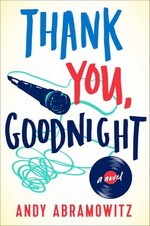
Flashback Friday – Thank You, Goodnight by Andy Abramowitz: A book about a one-hit wonder by an author who I hope has a few more in him.

Long, tiring, but good week. But there’s just nothing left in the tank for something new, so I’m going to repost about couple of books from the past that I loved.

Thank You, GoodnightThank You, Goodnight”

by Andy Abramowitz
Hardcover, 338 pg.
Touchstone, 2015
Read: June 30 – July 3, 2015

In most instances, space between people grows like mold, neglected just long enough to be noticed. You intended to wipe it clean, but the more of it there is, the more daunting a task it becomes to erase it. Not so with me and the band. I’d discontinued those people as if they were a premium cable channel that I’d finally realized was broadcasting nothing I wanted to watch.

From passages like that, a nice mix of thoughtful, sentimental, with a bit of a grin; to the out-and-out funny, like the funniest suicide attempt I’ve read in a long time, possibly ever (something worthy Save Steve Holland’s Lane Myer, but longer); this book covers the spectrum. Not only covers it, but does so with assurance and panache. It’s one of those first novels that makes you wonder what could possibly be done as a follow up.

Teddy Tremble is a successful enough lawyer for someone who’s heart isn’t really in it, while still being good at it. He’s sort of coasting through life — being good enough at his job, good enough with his girlfriend of forever, good enough for his social circle, but not good enough for his father (but after meeting him, you understand that’s just a given). He’s forty-ish and realizes that life is going to pretty much stay this way. On the whole, he seems okay with that — but in the back of his mind he knows he’s not. He won an Academy Award. His band was huge for a little while in the 1990’s, before his hubris ruined things. Sure, things are good enough now, but once upon a time they were great.

Then through a truly humbling and bewildering set of circumstances, Teddy comes across a group of huge Tremble fans. Seriously, die-hard doesn’t begin to describe these people. Think something akin to the kind of people that organized the first Star Trek convention back when it wasn’t a cultural phenomenon, just a short-lived and then canceled show. This changes everything. The adulation, the attention, the satisfaction of performing gets under his skin and he starts writing music for the first time in a long time.

Pretty soon, he’s (forgive the cliché) trying to get the band back together — his agent and producer are on board, convinced that what he’s written exceeds his former quality. Incidentally, both of these characters are the kind that we readers hope to come across — supporting characters that threaten to steal the entire novel, but when used properly just make the whole thing better.

Anyway, with these two on board — Teddy just has to convince the rest of the band to give it a shot, to trust him. Maybe even to forgive him for what he did to them so long ago. Then he has to convince music fans to take them seriously. Neither of these tasks is going to be easy. Both are practically impossible, really.

The book starts out as pretty entertaining, definitely amusing. But it doesn’t stop there — it gets better, deeper, emotionally richer all the while. By the time I got to (and through) Chapter 20, I tweeted that, “Not sure I need to read another word (am going to), but that was as close to perfect as it gets.” I’m still thinking about it a month later.

At various places through the novel, Teddy observes: “One day I’ll die, and this will be one of the things I did with my time.” I’m not sure if I’ve ever seen one sentence used so many different ways with so many different meanings depending on the context. Sometimes he’s says it wryly, sometimes caustically, sometimes wistfully, sometimes with pride. It’s one of those writerly things that when you see it in action, you wonder why more people don’t try it.

Each of these characters — the agent, the producer, the bandmates, their (sometimes very odd) families, Teddy’s girlfriend, associates in the law firm, and others — are well-drawn. Occasionally familiar, without being stock characters or cliché, each character ends up being strong enough that you want to spend at least a little more time with them. But Abramowtitz is too capable of steward of his resources and gives us just enough to leave us wanting more.

I’ve seen a lot of comparisons of Thank You to Hornby’s High Fidelity and Tropper’s This is Where I Leave You. I don’t get that. Maybe it’s just because these people haven’t read anything else by these authors — they should be comparing this to Hornby’s Juliet, Naked and Tropper’s One Last Thing Before I Go (to be fair, I have seen a little of this comparison, but no one else that I’ve seen has tagged Juliet). These three cover some of the same territory, and Abramowitz comes out looking really good in that company. Don’t get me wrong, I really liked Juliet, I know I liked it more than most people I know. But I don’t think it was as good as it wanted to be or as it thought it was. Thank You seems to do the things that Juliet was wanting to do but didn’t get done. I’m not necessarily saying it’s a better book (I might lean that way), but this is more successful in the areas they overlap. Similarly, while I wouldn’t say that One Last Thing is a bad book, it can’t hold a candle to this one. I’m not trying to make this a competition, but for this first-time novelist to get things better than old pros like Hornby and Tropper says so much about him.

One day I’ll die, and reading this will be one of the things I did with my time. I’m so glad it was.

—–

4 1/2 Stars

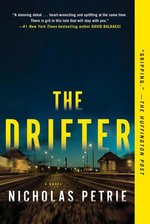
The Drifter by Nicholas Petrie: A Near-Perfect Thriller Debut that You Won’t Want to Miss

The DrifterThe Drifter

by Nicholas Petrie
Series: Peter Ash, #1

Trade Paperback, 371 pg.
G. P. Putnam’s Sons, 2015

Read: August 16 – 17, 2018

Peter pushed the truck hard toward downtown, the city roads rough with potholes, trying to get to Lake Capital begot they closed the doors for the day.

One eye on the rearview, watching for the black Ford. But it would be easy to miss in heavy traffic. And Peter’s truck would be easy to follow. Unless he was willing to rent a beige sedan, he couldn’t do anything about it.

He didn’t have a plan for Lake Capital. But the principle wasn’t complicated. It was the same principle he’d operated under for years.

Poke a stick into something and see what happened.

This approach to problem solving isn’t new — Philip Marlowe employed it, Spenser loves it, Harry Dresden has invoked it — and I’m pretty sure a certain homeless former MP has mentioned it a time or two. It may be tried and true — but that’s only because it works really well (at least in fiction). Peter Ash is one of the leading candidates for “the next Jack Reacher,” so he might as well employ it, too. It’s a very effective stick in this instance, I should add.

Now Reacher, as you probably know, was a career Army MP, the son of a career Marine officer — he’d spent his entire life living on military bases until his discharge following the Army’s downsizing after the fall of the Berlin Wall. In reaction to that kind of living, he’s taken to walking all over the US, getting to know the country. Peter Ash is a recently discharged Marine Lieutenant, with a couple of degrees in economics, who is wandering around the country a little bit. His reason for it differs from Reacher’s, since coming back to the States after tours in Iraq and Afghanistan, Peter has panic attacks anytime he’s indoors — he calls it “white static.”

This has led to him essentially living in the woods for the past few months, until he heard that his former sergeant and friend, Jimmy Johnson, has killed himself. Peter quickly came to Milwaukee to visit Jimmy’s wife, Dinah. He wasn’t around to help his friend, but maybe he can assuage his guilt by helping out with some much needed home repairs on his behalf.

He starts with the front porch — and while he’s working on it, discovers a hidden suitcase filled with money, and four bricks of plastic explosive. This seems strange, Peter hides the bricks, and gives the money to Dinah. Around the same time, a mysterious figure comes by looking for something (probably the suitcase, but he never mentions is). The two of these together gets Peter’s curiosity piqued — and he sets out to find out what his friend was up to before he died. He barely beings this before someone tries to kill him.

Peter survives, and becomes even more certain that something is going on — Jimmy was on to something just before he died. Peter has to find out what — to honor Jimmy’s memory, protect Dinah and her two sons, and maybe get a little peace for himself — maybe find some forgiveness for failing to help Jimmy.

This isn’t just guy wanders into town, finds trouble and starts hitting/shooting things and people until the problem is solved. Peter has to think, he has to investigate, he takes wrong paths, he really needs to find a shower and a way to clean a very large dog — which isn’t saying anything about the investigation, it’s just another thing he has to do along the way (still, harder problems than you might expect when you throw in his white static). There’s plenty of hitting and shooting, but it’s not the focus.

Yes, Peter is very much in the Reacher mold — but he’s different in very significant ways. The ways in which he’s not Reacher make him a fascinating character on his own. He has a sense of humor, he’s lonely, he’s a bit more self-reflective — he knows that he didn’t come back from the wars whole and intact, and is seeking to fix that. Maybe. He’s got a different kind of education, and a different way of looking at the world. The ways he’s similar to Reacher (good with weapons, devastating to hand-to-hand combat opponents, fast thinking, strategic, etc.) simply ensure that he’s fun to read about. Both of these sides together give us a Thriller protagonist that’s a sheer pleasure to read.

So Peter has “White Static”, Jimmy clearly had problems adjusting to being back home, but they’re not treated as the only ones — there are many others seen and talked about in this book. It’s not done exploitatively, it’s done to highlight the problems and the many, various ways they can be addressed successfully. Nor are they talked about in a way that suggests everyone who comes back from combat service comes back damaged. Nothing is universalized or generalized. I’m certainly not speaking from any kind of first, or even second-hand, experience here — but it appears to me that Petrie dealt with these psyches in just the right way — compassionate, understanding, and accepting.

As there is an element of mystery to the story, I’m not going to talk about the villains much. But they are just as good as the rest of the book — wide-ranging motivations, differing levels of commitment to the enterprise, they’re not all cookie-cutter types. They are not cartoonish, they are not super-villains. They are straight-from-the-headlines evil though. I could absolutely see something like this happening and it working.

I could have spent more time with just about every other supporting character — not in a “hey, you could’ve developed them better” way, but in a “I liked them and enjoyed Peter’s interactions with them” kind of way. Sure, that would’ve involved more character development, but not because they were lacking anything, it just would have worked out that way. Dinah’s an ER nurse with a lot of grit, and isn’t sure what to think of her late husband — but is dedicated to being the best mom she can to their kids. Charlie, their oldest, has learned a lot from his dad and is trying his pre-teen best to live like he should and be “the man of the house.” There’s a woman from the Veteran’s group that tried to help Jimmy who is a wonderful character, too. I could say more about her and the other supporting characters, but you should meet them yourself.

The last advantage that this one has over any of the Jack Reacher novels — and frankly, most Thrillers, is Mingus. He’s a very large dog that Ash finds living under the porch at his friend’s house (that porch led to the discovery of a lot) — he’s a bigger, nastier version of Walt Longmire’s Dog. Just as friendly, too — toward people not being threatening, anyway.

Okay, I obviously found this fantastic. The tension was high throughout; the pacing was fantastic; the actions scenes were fast, furious and believable; the story was clever and yet sensitive to current events, and the people represented by the characters; the stakes were real and believable; Peter’s code and the code(s) of those around him are wonderful to think about, examine and possibly try to adopt. They don’t get much closer to perfect than this — I’m definitely picking up the next two in the series as soon as I can, and I can’t wait to talk about them without nearly so many references to Jack Whatshisname.

—–

4 1/2 Stars

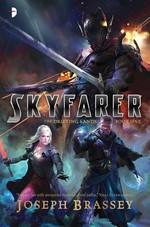
Reposting Just ‘Cuz: Skyfarer by Joseph Brassey

Last night I found myself reading when I “should have been” writing — which meant that by the time I finished, there wasn’t time enough to really get anything ready for today. Well, today, I find myself almost at the half-way point in the sequel to this outstanding book, the possibly more-outstanding (outstandinger?) Dragon Road. But I can’t talk about it yet, which is what I really want to do. So instead, let me once again post this little nugget.

SkyfarerSkyfarer

by Joseph Brassey
Series: Drifting Lands, #1
eARC, 352 pg.
Angry Robot Books, 2017
Read: August 11 – 14, 2017

I’ve read a few interesting mergers of SF and Fantasy this year — some that were just that, interesting, some that were good — a couple that were more than good. Thankfully, Brassey’s Skyfarer was in that latter camp. Even in those early chapters where I was still trying to figure out the world, remember which name lined up with what character, and get a handle on the plot, I had a sense that this was going to be one of those books I talked about very positively — and very often. That sense just only got stronger as the book went on.

I feel like could go on for pages about this book — but won’t let myself (so I can avoid the wrath of Angry Robot and you can actually get something out of reading it yourself — which you have to go do as soon as it comes out).

So you’ve got this group called the Eternal Order — a group committed to death, destruction, power, and plunder. When it comes to numbers, they can’t stand up to the civilizations around them, at least when they ally themselves against the Order. But when they (rarely, it seems) can come in with a quick strike against one people they can wreak much havoc. Which is exactly what they do here — they come in and demand that the rulers of Port Providence hand over the Axiom Diamond, or they will wipe them out — and it’s clear that Lord Azrael, the commander, isn’t being hyperbolic. The royal family responds with armed resistance, which has some measure of success, but is primarily fighting losing battles.

Into the midst of this looming genocide comes a wayward spacecraft, the Elysium. The Elysium is a small carrier with more weapons than one should expect (we’re initially told this, anyway). The crew has just welcomed an apprentice mage, fresh from the academy, to complete her studies with her mentor/professor. Aimee de Laurent has been pushing herself for years to excel, to be the best — if there’s a sacrifice to be made for her studies, she’s made it. All leading up to this day, where her professor, Harkon Bright has taken her as an apprentice on his exploration ship to complete her education. She joins a crew that’s been together for years and is eager to find her place within them.

When the Elysium arrives in the middle of this, it doesn’t take anything approaching calculus for them to figure out what this particular crew is going to do. There’s The Eternal Order on one side, civilians and the remnants of the military on the other. There’s a ravaged civilization on one side and the ravagers on the other. There’s a group trying to prevent The Eternal Order from getting something they want and there’s, well, The Eternal Order. So our band of adventurers tell the remnants of the royal family that they’ll hunt down the Axiom and protect it.

This isn’t exactly a revolutionary idea for a story — but man, it doesn’t matter. There’s a reason everyone and their brother has tried this — it’s a good story. Especially when it’s told well. And, I’m here to tell you that Joseph Brassey tells it really well. Not just because of his hybridization of SF and Fantasy, but because he can take a story that everyone’s taken a shot at and make it seem fresh, he can deliver the excitement, he can deliver the emotion. There is some horrible stuff depicted — either in the present or in flashbacks; there’s some pretty tragic stuff; and yet this is a fun read — the pacing, the tone, everything makes this feel like the adventure films and books that I grew up on. You want to read it — not just to find out what’s going to happen next, but because it’s written in such a way that you just want to be reading the book, like a having a glass of iced tea on a summer’s day.

The characters could uniformly use a little more fleshing out — which isn’t a weakness in the writing. Brassey pretty much points at the places where the reader will more details (especially when it comes to Aimee and Harkon), making us want more than he’s giving us. What we’re given, though, is enough to make you root for or against them, hope that they survive (or are subjected to painful and humiliating defeat), or simply enjoy the camaraderie. The good news is, that there’s more to learn about everyone — about their past and their present — and how those shape their future.

You’ve got magic — various schools of magic, too, each with its own understanding of what magic is and how it can be used; you’ve got swords and lasers (and similar kinds of weapons); you’ve got space ships running of magic (not just hyperspace drives that act like magic); objects and persons of prophecy; beings and intelligences that aren’t explicable — tell me why you wouldn’t want to read this? Especially when you throw in epic sword fights, magic duels, and spacecraft action all written by someone who writes like a seasoned pro. Sign me up for the sequel!

Disclaimer: I received this eARC from Angry Robot Books via NetGalley in exchange for this post — thanks to both for this.

—–

4 1/2 Stars

Colorblind by Reed Farrel Coleman: Jesse Stone is Clean, Sober and in Dire Straits

ColorblindRobert B. Parker’s Colorblind

by Reed Farrel Coleman
Series: Jesse Stone, #17

eARC, 368 pg.
G. P. Putnam’s Sons, 2018
Read: July 18, 2018

This is Coleman’s fifth Jesse Stone novel, the seventeenth in the series overall and Coleman has really put his stamp on the character here. He’s made the series his own already, adding depth and shades of color to characters that’ve been around for years, don’t get me wrong. But everything he’s done could be changed, dropped, or ignored in the next — like an old Star Trek or Columbo episode. But following up from the closing pages of The Hangman’s Sonnet, in Colorblind he’s enacted permanent change on Jesse — yeah, things might not go smoothly from this point — he may stumble. But things won’t be the same — cannot be the same without some sort of Star Wars Expanded Universe level retcon. But I’m getting ahead of myself.

First we need to start with the crime part of the novel — it’s ostensibly what people are buying this for, and the novel’s focus. I can absolutely see this happening in Real Life ™ — a white supremacist group from New York is attacking mixed race couples (and by “mixed,” I obviously mean one white person and one person from another race — they wouldn’t care if an Asian man and a Hispanic woman were together) and spreading propaganda in Paradise, of all places. There’s a reason Paradise was chosen — several, actually, and it actually makes sense in context — it’s not just a convenient way to get it into a Jesse Stone novel. Only one of the crimes involved is technically something that Jesse is supposed to be investigating.

Once one of his officers becomes embroiled in this series of crimes — and the possible target of an elaborate frame job — Jesse stops really caring about things like jurisdictions, and will stop at nothing to find the truth. If there’s a connection between the different crimes, he’ll find it. The question he has no answer to is: for what end? Why are these people in Paradise? What do they have to gain from framing his officer?

Yes, certain elements of this story stretch credulity a bit — but in context it absolutely works. And while I say something stretches credulity, I can’t help but wonder if it really does. The actions of this particular supremacist group might not be that much different from the dreams of too many. Also, the race-based crimes, the murders, the vandalism — everything that Paradise or Massachusetts can prosecute people for — are not the biggest evil perpetrated by the members of that group. There’s a deeper darkness working here, something that people with radically different views can also perpetrate — Coleman could’ve gone the easy route and made it all about “Them,” but he points at something that everyone can and should recoil from.

While Jesse works to prevent things from getting out of hand in Paradise, he is struggling to prevent himself from doing what he’s so often done before — retreat to the bottle. He has several reasons to, several excuses to — and decades of experience telling him to do so. Fresh (Very, very fresh) off a stint at rehab, Jesse starts attending AA meetings (in Boston, nothing local that could cause problems for himself or anyone else in the meeting). I absolutely loved this part of the book — I think Coleman’s treatment of Jesse’s drinking (and his various attempts to limit/stop it) has been so much better, realistic and helpful than anything that came before. Colorblind takes that another step up, and sets the character on a path that he needs to be on. Jesse’s not a rock, but he’s working on becoming one when it comes to this addiction. I don’t know (don’t want to know) where Coleman is going with this — but I love it. Character growth/development, an actual healthy approach, and Coleman’s own stamp on the series. Even if Jesse relapses in the future, he’s actually been sober (not just taken a break from drinking) — I love it (have I mentioned that?). It may have been a little too on-the-nose to have Jesse’s new AA friend be named Bill, but, it made me smile.

As for the regulars — we’ve got some good use of Healy (retirement can’t stop him!); Lundquist is settling in nicely to this world (very glad about that, I’ve liked him since his intro back that other Parker series, whatever it was called); Molly was outstanding (it’s hard to mis-write Molly, but it’s very nice when it’s done correctly); and Suit is still the guy you want riding shotgun when things get harry (ignoring the fact that someone else was actually carrying the shotgun when it came to it — it’s a metaphor, folks!). Surprisingly enough, given the B-Story, Dix doesn’t make an appearance — but Jesse can’t stop thinking about him, so he’s here, he’s just “offscreen.” That was a nice touch (and hopefully not too much of a spoiler), it’d have been very easy to have almost as much Dix in this book as Jesse. Coleman has not only got the original cast of characters done well, he’s introduced a few of his own regulars and has merged them into this world well (e.g., Mayor Walker, Monty Bernstein). And it’s not just characters he’s blending, this book is full (not overstuffed) of call-backs to the oldest Stone novels as well as Coleman’s — this universe is alive and well and whole.

As far as the writing — it’s Reed Farrel Coleman, I really don’t need to say anything else. I will say a little bit, though, he balances the various stories and tones of these stories well — the book feels like a natural outgrowth of every book that came before, however minor the stylistic choices and depth have changed over the last few years. Parker could have written this. I don’t think (especially in the latter years) he would have, but he could have. Yet, it’s undeniably a Coleman book. It’s impressive the way that Coleman can do this (see almost everyone that’s tried a Bond novel [honestly haven’t tried one in years, maybe someone has], or Robert Goldsborough to see that not everyone is capable of it). There is one moment, I thought, that Coleman faltered a bit and got into some pretty heavy editorializing — if this was a first person book, it would have worked; or if he had been obviously channeling one of the characters, I wouldn’t have said anything; but when your omniscient third-person narrator gets that opinionated, it’s not good.

A solid crime story that resonates near the too-close-for-comfort zone given the cultural events (which probably is how some people felt with 1970’s Parker), some great character development — and plenty of fodder for Coleman’s next (I ignored one storyline above because I don’t think I can talk about it without ruining it). This is a must for Jesse Stone fans and a decent entry point for new readers, too — it’ll get you to go back and read at least a few older books (I’m more than willing to help a new reader with an “Essential Jesse Stone” reading list — just let me know). Give this one a look folks, it deserves it.

Disclaimer: I received this eARC from Putnam Books via NetGalley in exchange for this post — thanks to both for this.

—–

4 1/2 Stars

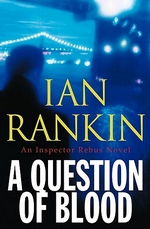
A Question of Blood by Ian Rankin: Rebus Deals with Gun Violence on Multiple Fronts

A Question of BloodA Question of Blood

by Ian Rankin
Series: John Rebus, #14

Hardcover, 406 pg.
Little, Brown and Company, 2003

Read: April 19 – 21, 2018


I’m torn between quotations to open with, on the one hand, you have this one which captures the environment this novel takes place in — it’s a perfect encapsulation of the frustration of so many civilians. Particularly the ones in the town near the focal crime.

Fear: the crucial word. Most people would live their whole lives untouched by crime, yet they still feared it, and that fear was real and smothering. The police force existed to allay such fears, yet too often was shown to be fallible, powerless, on hand only after the event, clearing up the mess rather than preventing it.

On the other hand, this seems to be the perfect encapsulation of the sentiments of Rebus, Clarke, Hogan and so many (most?) of the police in this novel (and most police novels in general):

He checked the radio to see if anything bearable was being broadcast, but all he could find were rap and dance. There was a tape in the player, but it was Rory Gallagher, Jinx, and he wasn’t in the mood. Seemed to remember one of the tracks was called “The Devil Made Me Do It.” Not much of a defense these days, but plenty of others had come along in Old Nick‘s place. No such thing as an inexplicable crime, not now that there were scientists and psychologists who’d talk about genes and abuse, brain damage and peer pressure. Always a reason . . . always, it seemed, an excuse.

So the story is, an ex-SAS soldier walks in to a school, shoots three students and then kills himself. One of the students — the son of a local politician — survives. His dad sees this crime as an opportunity to get himself out of some PR trouble and some prominence — so he keeps popping up in inopportune places to grandstand and shine a negative light on the police. Which goes a long way to make a complicated situation worse for Bobby Hogan — the detective running the investigation. There’s not much to investigate, the only surviving witness has told his story, the culprit is dead — but there’s a lot of why questions floating around, Hogan’s got to try to answer some of them. Hogan knows two things: 1. His friend John Rebus was almost an SAS soldier, so he might understand the mindset of this man better than the rest, and 2. Rebus could use an excuse to get out of Edinburgh for a few days. The Army’s in town, doing what it can to shape the narrative — i.e. “this isn’t the way we train our men to be, maybe there’s something else going on.” Hogan’s having trouble getting anywhere, the press isn’t helping, and the evidence isn’t doing wonders for anyone at all.

I liked the fact that we’re dealing with Rebus’s military past again — it’s largely been untouched (at least to any real depth) since Knots & Crosses, and conversations between Rebus and Clarke show that he hasn’t talked to her about it at all. As much as the first book might have helped Rebus deal with some of what happened to him, it’s clear that there’s more t do. Hopefully, this is the start of it — at least to help him.

The more this crime is investigated, the less it looks as cut-and-dry as it was at the beginning. This was all wonderfully constructed, a strong multi-layered story that’ll keep the reader glued to the action to find out what happened (or why it happened). And it’s really not the best part of the novel — it could’ve been, easily. But no.

The reason that Rebus could use a few days away from home base is that he has a mysterious injury. One that could have a completely innocent explanation — or one that puts him at the center of a suspicious death investigation. There’s this creep who’s been stalking Clarke, threatening her. Rebus is seen at a bar with him one night, and the next day, he’s dead and Rebus is getting medical care that suggests he could have been present at the time of death. Clarke and Hogan believe him because he says he didn’t do it. Good ol’ Gill Templar isn’t sure (raising the question: who knows him best? Siobhan or Gill?), and frankly, none of Rebus’ legion of enemies in the police or press are less sure than Templar. There’s a little question about letting Siobhan fight her own battles rather than take the avuncular and/or misogynistic approach of helping her. The two get past that pretty quickly, but Clarke harbors a doubt or two about Rebus’ involvement.

Rebus, actually, wasn’t that concerned with protecting Clarke — he just used that situation to help him with another investigation. Which is typical of him. It’s this last story that’s really — in a way — the center of the whole novel. The events investigated, the motives for a lot of it, and the emotional core are all tied (at the very least) to this story. Rankin’s structuring of the novel in this way shows him at his best. And that’s really all I can say without ruining the experience for anyone (in fact, I arguably said too much).

Then there’s the last chapter == which is all I’m going to say about it — I’m torn. On the one hand, it seems to undercut a lot of the emotional weight of the climactic moments. But that doesn’t mean it wasn’t believable. It’s probably more believable than the alternative. Still .. . it left me dissatisfied. On the other hand, Rankin seems to be setting us up to revisit many of these characters in the future. I bet that’ll be worth it.

It’s hard to come up with things to talk about in a series that’s 14 books-old. It’s got to be hard to come up with things to talk about with a character that’s 14 books-old. Which might be part of the reason that Rankin circled back for another look at the end of Rebus’ time with the SAS, which definitely could use another look. How he did it — and the situations the characters found themselves in regarding that case,and all the others going on — is what makes Ian Rankin the modern legend that he is. A Question of Blood is one of those books that improves, the more you think about it.

—–

4 1/2 Stars

2018 Library Love Challenge

Scourged by Kevin Hearne: The Iron Druid Chronicles conclude with a bang.

This took me longer to write than I intended. Maybe I should’ve talked about it right after finishing it after all.

ScourgedScourged

by Kevin Hearne
Series: The Iron Druid Chronicles, #9

Hardcover, 265 pg.
Del Rey, 2018
Read: April 4, 2018

So, in a fast 265 pages Kevin Hearne gives us: Ragnarok; a lot of dead vampires; environmental crises; a friendly sloth; puppies; send-offs to many, many characters; shocking deaths; less-than-shocking deaths; surprise non-deaths; and more discussion of poots (elven and jaguar) than one’d expect in this kind of book. The amount that he accomplishes here is really staggering. Some of it, alas, could’ve been deeper — explored more thoroughly — if he hadn’t set out to do so much or if he’d taken more time with some things (and less time with others). Still, this was a heckuva way to end the series.

This is not the book to start this series with, go back and read Hounded if you’re curious (one of the best series kick-offs around), and I’m not going to get into the plot much. It’s Ragnarok. We’ve all known it was coming and now it’s here — ’nuff said. Along those lines, however, Hearne also gets bonus points for including a “where we are in the series” introduction, summarizing the first 8 novels and the short stories/novellas that got us to this point. Again, this should be a requirement for long-running series.

There’s no easy way to say it: there was just too much of Granuaile and Owen. Yes, it’s the best use of Owen since his introduction, don’t get me wrong. But it’s the Iron Druid Chronicles — fine, use the others if you want, but they shouldn’t get equal time to the Iron Druid here in the last book. Especially given the number of things — and scope of action — that had to be accomplished in Atticus’ story, it really should’ve had more room to breathe. That said — for End-of-the-World Showdowns featuring deities from multiple pantheons? This rocked. He wrapped up the story he kicked off in Hammered and Two Ravens and One Crow in a fantastic fashion, full of death, blood and tension. At the same time, he maintained the very idiosyncratic characterizations he’d created for the various gods and goddesses.

Speaking of Two Ravens and One Crow, a small, but fun, point from that comes back in these pages in a way that no one could have expected and added just the right level of fun to the battle.

Hearne did a great job integrating the short stories from Besieged into this book — I didn’t expect to see so much from them carry over to this. It all worked well and set the stage for Hearne to get in to the action of Scourged right away and he took full advantage of that.

There were more than a few things that seemed like they needed better explanations — doesn’t the convenient dog sitter find the way that Atticus spoils his dogs more than a little strange? Given that they’ve known the clock was ticking on Ragnarok, why did Atticus wait until the last second to give Granuaile and Owen their assignments? I mean, it works out well for dramatic purposes, and allows certain plot points to be triggered, but that’s not a good reason for the characters to work that way. At the very least, why weren’t his former apprentice and his former teacher pestering Atticus to lay out his plans long before this? While I eventually saw what Atticus and Hearne were up to, in the moment, a lot of the plan just didn’t make sense. When the world is falling apart, why set someone up for an extended training session (for one example)?

I’m not giving away anything about anyone dying — or living — but we know this is the finale, so we’re seeing the end of stories for these characters. Some good, some shocking, some disappointing, some sad. In no particular order: Laksha got a nice send-off, I really didn’t expect to see her here — and I really appreciated what Hearne did with her. It’s not honestly the ending I’ve had wanted for Atticus — but it’s the kind of ending that Hearne’s been building to for a while now, so it’s fitting. I can appreciate the way that Hearne accomplished his goals, even if I think Atticus deserved better. Owen’s ending was everything you could’ve hoped for. Granuaile’s story was fitting for her — and a good reminder that I stopped liking her a few books ago (seriously, why couldn’t she adopt an attitude similar to Owen or Flidias when it comes to their assignments during the battle?). I would’ve liked to have seen Perun one more time, but he got a good send off in Besieged.

Oberon was sidelined for most of the book — I understand why: Atticus wanted to keep his buddy safe, and Hearne needed to keep things ominous, dramatic and threatening, which is hard to do with everyone’s favorite Irish Wolfhound putting his two cents in (it’s hard enough with Coyote around). Still, we got some good Oberonisms, and he elicited more than one smile from me — and you could argue he saved the day ultimately. If I didn’t know that Hearne was writing one more of Oberon’s Meaty Mysteries, I’d be despondent over not seeing him again.

Scourged wasn’t perfect, but it was very satisfying. If I have to say good-bye to these characters, this is a pretty good way to do it. There was enough excitement, drama, and happenings to fill a couple of books and Hearne got it all into one — no mean feat — and it was a great read. It’s not easy letting go of most of these characters and this world (I mean, apart from re-reads), but I’m glad Hearne got out when he did and the way he wanted to. I’m looking forward to his future projects.

—–

4 1/2 Stars

Page 19 of 30

Powered by WordPress & Theme by Anders Norén