Tag: 4 1/2 Stars Page 29 of 30

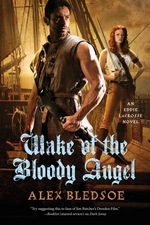
Wake of the Bloody Angel by Alex Bledsoe

Wake of the Bloody Angel (Eddie LaCrosse, #4)Wake of the Bloody Angel

by Alex Bledsoe

Paperback, 350 pages
Tor Books, 2012
Read: May 28, 2014

I looked up at the stars. Finding one pirate after twenty years was a lot like picking one star out of this sky. Just when you thought you had it, a cloud slid by and you had to start all over when it passed.

Yet that’s just what Eddie LaCrosse sets out to do — find the unfindable, track the untrackable. For those of you who don’t know — Eddie lives in a fairly standard fantasy realm, and makes his living as a “sword jockey” — what we’d call a P.I. in our world. These books are first person narratives and read a lot like good detective novels — but with swords, horses and the occasional dragon or whatnot.

Eddie doesn’t go alone on his search for a pirate — he brings along his old friend/colleague, Jane Argo. Jane’s a former pirate turned pirate hunter turned sword jockey and is as tough as that rĂ©sumĂ© suggests. Having her come along on this adventure as the Hawk/Joe Pike figure was a great addition to a series that I didn’t think required it. But now, I want more of her — back in Eddie LaCrosse #6, or in Jane Argo #1. I could be pleased either way, as long as it’s soon.

There’s adventure, piracy, sword-play, banter, friendship, and a bit of betrayal. Enough to keep you engaged, if not turning pages as quickly as you can. Every now and then, in the middle of this fun read, Bledsoe reminds you he can do more than tell a fun action story, and drop a sentence, or phrase that shows he’s just a good writer, period. One such line that stood out to me, and I’ve tried to find excuses to use in the last couple days is:

Hawk’s been called many things over the years, but you know what captures him best, in my opinion? That he’s simply a shiver looking for a spine to run up.

You get a real clear idea about this Hawk guy, the image is pretty creepy in and of itself, and yet, it looks and sounds breezy unless you think about it. I like Eddie and the rest of his world plenty — but it’s that kind of thing that keeps me coming back to Bledsoe.

Part of me is glad I read Lynch’s Red Seas Under Red Skies before this, if I hadn’t, I’d have spent too much time comparing the pirate-y bits between the two while reading — and I think Lynch would’ve come up short. Bledsoe did a great job of nailing the life of a ship (says the guy who gets too seasick to even contemplate a day-long voyage) — both the tedium of day-to-day and the excitement of the boarding.

The last thing I can think to note, is that this book briefly features the creepiest little girl I can remember since Let the Right One In. I really can’t talk about her without ruining too much, but let me just say that absolutely loved the way that Bledsoe used her.

I couldn’t have seen the ending coming, nor the details it revealed. But it worked, it absolutely worked both as an interesting plot development, and as strong character moments. So well done. Shame on me for putting this off for so long — not a mistake I’ll make again.*

—–

* and I mean that — book 5, He Drank, and Saw the Spider came out this year, and is on my hold list at the library.

—–

4 1/2 Stars

John Knox by Simonetta Carr, Matt Abraxas (Illustrator)

John KnoxJohn Knox

by Simonetta Carr, Matt Abraxas (Illustrator)
Hardcover, 64 pgs.
Reformation Heritage Books, 2014
Read: May 25, 2014

I’m tempted to say, for a children’s book, this is quite good. But honestly? For a brief biography for any reading level, it’s quite good.

In these pages we get a good picture of Knox’s life (public and private), his historical context, and his teachings/beliefs. Essentially, everything you could want. There’s excitement, there’s hardship, there’s triumph and there’s tragedy. This isn’t a hagiography — Carr isn’t afraid to point out weaknesses, or problems with Knox (although she could’ve gone a little further in that direction). Nor is this all sweetness and light, as you might expect from a children’s book. While not dwelling on the details of the violence in Knox’s Scotland, she doesn’t sweep it under the rug, either.

The illustrations are great — the map, the photos and historic portraits are as well. Abraxas does a really good job in making his illustrations pop — but not to the degree that they become the focal point. The text carries this book, but the illustrations aid the text, as it should be.

Assuming this is a representative sample (and, based on a couple of interviews I’ve heard with Carr, I think it is), this is “Christian Biographies For Young Readers” series to get for anyone with kids. Or anyone just wanting small biographies to teach them Church History without having to wade through a tome like Shelley or GonzĂ¡lez.

—–

4 1/2 Stars

The Humans by Matt Haig

The HumansThe Humans

by Matt Haig
Hardcover, 304 pg.
Simon & Schuster, 2013
Read: Feb. 4-6, 2014

A couple of years back, I remember enjoying Haig’s The Radley’s about a family of vampires who’ve stopped feeding on humans, and have (mostly) assimilated into everyday society. It was fun, quirky, and had a lot more to offer than I’d have guessed. So when I stumbled onto this at the library, I had to grab it (and shame on me for not keeping an eye out for more by him).

The concept’s pretty simple: a brilliant mathematician has just made a break-through that puts humanity far, far ahead of where an alien race thinks they ought to be in terms of development based on how emotional and violent we are as a race. So, they send one of their own to kill him, take on his form and eradicate any and all people who might have knowledge of this breakthrough. Along the way, said assassin starts to understand and even appreciate humanity’s quirks and tries to stop the killing. Along the way we are treated to his observations about humanity. For example,

…I was able to work out that what humans may have lacked in physical attractiveness, they made up for in gullibility. You could tell them anything in a convincing-enough voice and they would believe it. Anything, of course, except the truth.

Basically, the key rule is, if you want to appear sane on Earth, you have to be in the right place, wearing the right clothes, saying the right things, and only stepping on the right kind of grass.

Or this description of browsing a bookstore:

Understandably, humans need to know what kind of book they are about to read, because time is money and money costs time and there’s no time like the present and all of that. They need to know if it is a love story. Or a murder story. Or a story about aliens. Perhaps the book they have in their hands is a war story. It wouldn’t be a surprise.
There are other questions too that humans have in bookstores. Such as, is it one of those books they read to feel clever, or one of those they will pretend they never read in order to stay looking clever? Will it make them laugh or cry? Or will it simply force them to stare out of the window watching the tracks of raindrops? Is it a true story? Or is it a false one? Is it the kind of story that will work on their brain or one which aims for lower organs? Is it one of those books that ends up acquiring religious followers or getting burned by them? Is it a book about mathematics or — like everything else in the universe — simply because of it? And also, of course, there is the ultimate, all-important questions: does it have a dog in it?

(amen to that last question)

A lot of these observations reminded me of the classic article, “Body Ritual among the Nacirema,” that social science undergrads have chuckled at for decades. And, at a point they got a little tired — but by the point that the book threatened to become an endless series of “here’s another way humans are odd” riffs, the story took over, and the characters became more than a collection of quirks. Which isn’t to say that the alien stopped having the observations, they were just mixed in with enough plot and character development that they became seasoning.

Another danger for the reader is that you could easily get so busy chuckling at things like a partial list of inventions that humans don’t know how to handle: “the atomic bomb, the Internet, the semicolon”; or the observation that a cat “was very much like a dog. But smaller, and without the self-esteem issues.” that you can let the poignant and thoughtful things slip by. This was not unlike Scalzi’s Redshirts in that way (it was on my mind because I was reading this when the news was released about the Redshirts TV adaptation).

Funny, moving, profound (not as profound as it wants to be, I don’t think — but close), look at what it means to be human, what it means to live, to love and why we bother with any of it.

—–

4 1/2 Stars

Screwed by Eoin Colfer

Screwed (Daniel McEvoy, #2)Screwed

by Eoin Colfer
Hardcover, 304 pg.
Overlook Hardcover, 2013
Read: Jan. 27-31, 2014

I saw that the sequel to Colfer’s Plugged was out, and I had a dim recollection that I enjoyed Plugged (and can look up my rating on Goodreads), but I can’t remember a lick of it. Which bothered me, but I figure it’ll come back to me with some work — so I put a reserve on it at the library. When I went to pick it up, I still couldn’t remember anything about its predecessor, which still bugged me. I read the jacket copy — doesn’t help, and now it’s driving me crazy. I read the first two pages — nothing. But at the bottom of the second page I read:

And those eyes? Big and blue, rimmed with way too much eyeliner. Men have climbed into hollow wooden horses for eyes like that.

With lines like that, who cares what I remembered? This is a great read, so much fun, and laugh out loud funny when you’re not horrified by the violence. Colfer writes like a Don Winslow who hasn’t slept in a week thanks to existing on a truly inhuman amount of energy drinks.

It’s not long after that observation that the tide starts to turn for Daniel McEvoy, our narrator. The two-bit gangster he angered in Plugged has decided on a way for McEvoy to start to make things right between them. Sure, it’s probably just a set-up, but what choice does he have? Especially with his best friend and the owner of those eyes serving as handy targets.

Before he gets the chance to figure out just what’s going on, Daniel stumbles across his long-lost aunt (in the middle of a decades-long bender), his grandfather’s fourth (or so, I don’t remember exactly) wife, a young wanna-be wiseguy, the wanna-be’s actual wiseguy henchman, the would-be gangster, a couple of corrupt policemen, a masked assassin, a killer lightning bolt, a car at the bottom of the river, and a few other obstacles. Daniel deals with each of these with a combination of world-weary cynicism, gallows humor, an unexpected romanticism with a trace of optimism and lethal force. The latter is really what carries the day, obviously, but it’s the rest that makes reading his exploits worth it — and darn enjoyable.

For example, towards the end of the book, Daniel makes this aside:

The Key to staying alive until you die is to not get yourself killed.
I saved this nugget till close to the end on account of how bleeding obvious it reads, which might bring on a little gnashing of teeth. But to most people not getting yourself killed involves nothing more than just doing what you’re already doing and maybe cutting down on mayonnaise, which is more or less liquid fat.

All Daniel wants to do is hang out with his friends, make some money with the casino/bar he and a partner are opening, and maybe, juuuust maybe pursue a romance. When describing some of the jokes he and his friend are making rather than deal with the harsh reality of their situation, he says

. . . Zeb and I spend a lot of our free time, as two single middle-aged bucks, watching TV. How cool and edgy is that? Most of our references are pop culture and our favorites at the moment are old episodes of the egregiously canceled shows Terriers and Deadwood.

Colfer buys himself and extra half-star or more for name-dropping Terriers and complaining about its cancellation — twice!!*

When you boil things down in the end, Daniel McEvoy is a basically decent man who’s seen and done things that no one should. Which prepares him (possibly makes him seek out) more of the same now. Which doesn’t change the fact that he’s really a good Irish man who likes telling a story and loves to play with language — even if the story (and his life) end up being hyper-violent and he has a propensity for letting his metaphors run out of control. Grab Plugged for context if you want, but definitely grab Screwed and buckle-in for a fun ride.

One more quotation that doesn’t fit anywhere, but made me chuckle enough to copy it down:

[I]f you want to see teenagers crap themselves laughing, try explaining what a pager used to be. You tell ’em about cassette tapes and they think you’re only a lying, old Depends-wearing motherfucker.
The following is a transcript of a conversation I had with Jason’s nephew:
Me: The songs were pressed onto a long tape. Six songs per side, then you turned it over.
Nephew: Turned what over?
Me: The tape in the machine, but you had to be careful or the machine would eat the tape and you’d have to straighten it out with a pencil.
Nephew: Fuck off, Gandalf. You’re making this shit up.

—–

* Not entirely true. It was my plan early on, but the book turned out to be too good to require that.

—–

4 1/2 Stars

A Wanted Man by Lee Child

A Wanted Man (Jack Reacher, #17)A Wanted Man

by Lee Child
Series: Jack Reacher, #17

Hardcover, 405 pg.
Delacorte Press, 2012
Read: Dec. 16-17, 2013

Despite the fact that I’d written 2 paragraphs of this while reading it, I had a really hard time coming up with something to say here. This is about the most reliable series I know — how do you say something new and/or interesting about Old Faithful? Every 60-110 minutes it goes off, you can count on it. Every year or so, Lee Child let’s Jack Reacher go off. This is not a problem at all for the reader — far from it — but it’s a pain in the rear if you’re trying to write about it.

The greatest strength of this series is how different each novel/adventure is, totally unlike the rest — and yet each is quintessentially Reacher. There’s an unmistakable feel to reading about everyone’s favorite nomadic ex-MP.

This time out, Reacher’s still hitchhiking his way to Virginia — the same trip he started shortly after 61 Hours, and is picked up by two men and a woman on their way back from a corporate retreat (he assumes). He starts to notice a few things not quite right about the way they’re acting, but on page 33 he says, “Not my problem.” Which pretty much guarantees we’ll be spending the next 400 pages dealing with these people.

So what makes this one different from all the rest? It’s the twistiest, turniest Reacher in ages (if not ever). Like any good suspense writer, Child specializes in throwing a good curveball or five at you in the course of a novel — but (again, this is common with the best) usually you can look back at what’s come before and see where that plot twist came from. But there were a couple of turns in this one that took me totally by surprise. Not that Child cheated at all, or used a Deus ex machina, or the like. Just honest, out of the blue, surprises. I would’ve enjoyed the novel without those touches, but having them was a pleasant bonus.

I’m really looking forward to this next adventure — Reacher’s worked harder to get to Virginia this time than we’ve seen him before. He’s had a goal longer than we’re used to. I expect a humdinger of a read next time — and who knows?* Maybe it’ll be worth more than just one.

—–

* who knew? Actually got to use the word “humdinger.”

—–

4 1/2 Stars

Dusted Off: Cherry Bomb by J. A. Konrath

Cherry Bomb (Jack Daniels Mystery, #6)Cherry Bomb

by J.A. Konrath
Hardcover, 290 pg.
Hyperion, 2009

If you thought Rusty Nail was taught, action-packed, and gut-punchingly grisly, you ain’t seen nothin’ yet. This picks up a couple of days afterwards and jumps into action almost immediately. Konrath seems determined to pick apart his heroine, to destroy her mind, soul, and body the way one of his serial killer characters would. And the series — and maybe Jack herself — is better off for it

I don’t know what to say about this that doesn’t veer into spoiler-territory, so I’ll just leave it as this–I lost sleep over this book, there was no way I was going to wait to finish this — and anyway, given the adrenaline this induced, it’s not like I could sleep anyway.

—–

4 1/2 Stars

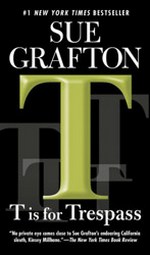
T is for Trespass by Sue Grafton

T is for Trespass
T is for Trespass by Sue Grafton
Series: Kinsey Millhone, #20

Hardcover, 374 pg.
G.P. Putnam’s Sons, 2007

First thing I noted about this was, “This Prologue’s a bit heavy handed and overly dramatic . . . who knows? Maybe it’ll be justified.” I still think it was a bit too much — but on the whole, it was justified.

This was a slow burn of a novel. Sure, the reader is introduced to the villain, Solana Rojas, right off the bat (thanks to third person narration focusing on her in chapters interspersed with Kinsey’s narration), but Kinsey isn’t even hired for anything regarding her until roughly 100 pages in. The whole setup for this book is so unlike Grafton. I liked this, and it bugged me at the same time. Mostly the former, though, I’m all for Grafton stretching herself.

There was a time where Rojas had the upper hand over Kinsey, and while we know in the end that Kinsey will win out, Grafton sure could’ve made things look a little more dire for Santa Teresa’s hero. It was just a little too easy for Kinsey to convince others what was going on. In the end, that didn’t make this less satisfying.

Grafton’s never been a slouch, but in these last few books she’s really upped her game — this is the best thing she’s done. Her characters are better drawn, the plot’s more intricate, Rojas was probably a little more evil than anyone that Kinsey’s crossed paths with before. This is definitely the creepiest, most disturbing Grafton novel — haven’t read much in the last couple of years that’s as unnerving, really, when I stopped to think of it. Not as gory or violent as many in the genre (nowhere near that), but when you look at the trail of destruction that Rojas has left before she’s stopped — she’s unsettling in a way that your typical fictional serial killer isn’t.

—–

4 1/2 Stars

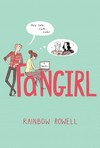
Fangirl by Rainbow Rowell

Fangirl
Fangirl

by Rainbow Rowell
Hardcover, 438 pg.
St. Martin’s Griffin, 2013

No one can write messed-up characters like Rainbow Rowell can — socially awkward, clever, emotionally scarred, and incredibly likeable. A lot like many people.

Speaking of likeable, it takes no more than a few pages, maybe even a couple of paragraphs before Cath wins the reader over completely. Okay, so she’s a little too into this semi-Harry Potter world, and spends what many would consider an unhealthy amount of time on her fanfic — but she gets great grades, and something resembling a social life, who’s to judge? She’s having a hard time adjusting to college life — her identical twin (Wren — get it?) is taking the opportunity to go out on her own, and Cath’s just not ready for that. For the first time in her life, she’s really not half of a set, and that takes a toll on her esteem, confidence, and — actually — everything. Her high school boyfriend being in another state and mostly incommunicado makes it all worse.

Slowly, Cath starts to find a place in college — makes a friends (most of which are worth having). There’s a lot of ups and downs along the way — there’s plenty of family drama — friction between the sisters, emotional troubles for their dad at home, and a lot of unresolved issues surrounding their mother’s/wife’s abandoning the family years ago. Which doesn’t help out her schoolwork at all — and drives her further into her fanfic.

This is done in such a way that it doesn’t feel like silly teen/young adult dramatics — it feels like a rough patch that a dear friend is going through. The former would be easy for many authors to evoke, and I’d probably end up walking away from the book. But because Rowell can make us feel the latter, we pull for Cath, and keep reading on, getting further invested in her character.

There are bright spots — Cath and others make some progress in dealing with troubles from their past, Cath meets some fans of her fanfic, and — not at all surprisingly — there’s some fun (and awkward) and heartwarming romance kindled.

I know precious little about fanfic, honestly — I’ve read a few authors pouring out the hate for it, and some defending and/or celebrating it. I hardly have enough time to read the original works set in the worlds I like, I certainly have no time for the “unofficial” takes on it. So I really didn’t care about Cath’s passion for her hobby — or for those who had a different take on it. I thought Rowell dealt with it pretty well, on the whole, and was fair enough to both poles while staying fairly realistic.

Not as gut- and heart-wrenching as Eleanor & Park, but told with the same amount of heart (and more laughs). This is one of those books that when you see the end coming, you start to read slower, because you’re just not done with these people yet. If she had the story, I’d have read another few hundred pages just to stick with Cath, Wren, Levi, Reagan and the rest for a little longer — honestly, I’d have done it without the story.

—–

4 1/2 Stars

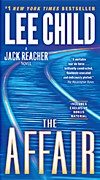
The Affair by Lee Child

The Affair
The Affair

by Lee Child
Series: Jack Reacher, #16

Hardcover, 405 pg.
Delacorte Press, 2011

“You want me to impersonate a civilian?” [Reacher said]

“It’s not that hard. we’re all members of the same species, more our less. You’ll figure it out.”

Thus begins the sixteenth Jack Reacher novel. Taking place in 1997, he’s still an MP, and is being sent undercover into a small town near an army base, while another investigator is being sent into the base it self to investigate a murder possibly tied to base personnel.

His undercover disguise looks pretty much like the post-discharge Jack Reacher we know — no job, good pair of boots, a toothbrush and one shirt. He wanders into town, finds an ally or two and gets to work.

It takes very little time for Reacher to find himself at odds with some locals (I didn’t think this storyline was all that satisfying, but it gave Reacher a chance to bash in a few heads). Not that he’s ever short of ego, but he seems cockier than I’m used to — I’m assuming that comes from the inherent authority of an MP as opposed to a loan wanderer. Regardless, it was a kick to read his encounters, with this extended family:

He said, “Is there a reason I don’t get out of this truck and kick your butt?”

I said, “Two hundred and six reasons.”

He said, “What?”

“That’s how many bones you got in your body. I could break them all before you put a glove on me.”

Which got his buddy going. Hist instinct was to stick up for his friend and face down a challenge. He leaned further out his own window and said, “You think?”

I said, “Often all day long. It’s a good habit to have.”

The local county sheriff is a former Marine MP, and it takes her no time at all to suss out Reacher’s purpose and to recruit him to help her investigation into this — and related — murders. Yes, her — that particular plotline is self-evident (although this is a bit . . . more explicit than Child’s norm).

There’s little suspense in this — 1. It takes place before Killing Floor, so you know Reacher’s not killed, 2. how seriously worried are you ever that Reacher will survive? Sure, you wonder what will happen to those around him — what the collateral damage is going to be, but that’s about it. Nevertheless — the final hundred pages or so of this is an edge of your seat ride. Which is par for the course for Child, doesn’t make it any less fun.

Beyond the murder investigation — or more properly, around it — are politics (federal, local and military), discussion of the role (and shape) of the military, the future of the U. S. Army (contrasted with some other branches). In the end, the identity of the murder is pretty obvious — but the twisty path that Reacher and the others travel to find it, what obstacles they overcome, and the fallout — that’s what makes this a very satisfying read.

—–

4 1/2 Stars

Chimes at Midnight by Seanan McGuire

Chimes at Midnight
Chimes at Midnight by Seanan McGuire
Series: Toby Daye, #7

My rating: 4.75 of 5 stars

Seanan McGuire is a writing monster — she’s pumping books out like crazy — she’s got the Toby Daye books, the InCryptid books, the Indexing serial, other short fiction — plus the stuff she puts out under the name Mira Grant. And they’re all really good (well, I assume the Grant ones are — not my taste — but based on reviews/awards, etc. they’re just as good). It’s really not fair. But I’m not complaining. As much as I’m enjoying Indexing and the InCryptid books are just plain fun, neither are in the same league as the Toby Daye books — and somehow, I forget just how good that series is between novels. I’ve been hooked since, maybe Chapter 3 of Rosemary and Rue and the addiction just grows each time.

Chimes starts off with Toby looking into the Goblin Fruit trade, seeing what she can do about it. It turns out that the situation is worse than she thought it was, and so she decides she needs to take it to the Queen. Which makes sense, unless you think about how well things go between those two, but Toby does her duty — and things go from bad to horrible (skipping right over “worse”) in a New York minute.

The series grows by a few new characters, most of whom I fully expect to see returning often, if not in every book from now on — all interesting, powerful, and I want to know more about. The stakes are higher than normal here, which is saying something, because they’re usually pretty high — and the long-term ramifications of the possible (and actual) plot developments are significant. You can feel the significance of the choices Toby’s making on almost every page, she’s pushed to new limits and deals with them in her own inimitable way.

A couple of highlights for me: I swear at one point at the end of Chapter 5, Toby channels Leverage‘s Nathan Ford, which was a lot of fun to read, and says a lot about the improbability of what Toby’s trying to pull off. Also, we’re introduced to a new Sidhe — the Cu Sidhe (the canine equivalent of Tybalt’s Cait Sidhe) — and it might be my favorite thing ever that Maguire’s created. Sure, I’m a sucker for well written dog characters, and the way she introduces and uses this particular character? Magic.

The only quibble I have here is how quickly things are resolved — to get the ending that we do, I’d expect another 70+ pages of action, maybe even another book before we get to the conclusion we have here. I don’t want to say that McGuire rushes or hurries through things here, because I see (I think) how and why she did what she did. It just seems to be that it’d have been better to spend more time on it. Then again, considering the tension I felt during the last 100 pages or so, maybe it’s better that things went they way they did.

McGuire calls this this start of the second stage of Toby’s adventures, and in retrospect, I can see an element of closure in Ashes of Honor. Based on the shake up in royalty, the deals Toby has to make to get things done and save those she cares about, and the revelations about one particular character — there’s plenty of fodder for a great second stage, even without whatever new ideas she has in store.

I cannot wait.

Page 29 of 30

Powered by WordPress & Theme by Anders Norén