Tag: 4 Stars Page 71 of 88

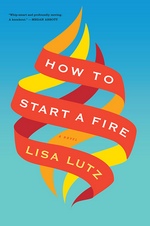
How to Start a Fire by Lisa Lutz

How to Start a Fire How to Start a Fire

by Lisa Lutz

Hardcover, 337 pg.
Houghton Mifflin Harcourt, 2015
Read: June 5 – 6, 2015
I really enjoyed Lisa Lutz’s latest, best, and most mature novel and want to encourage you to give it a read. That said, I’m not really sure how to start this post — or how to finish it, now that I think about it. It’s not really a plot-driven book, it’s more about the relationships between the three main characters, and others in their lives. But, it’s really difficult to talk about the book without talking about the two (maybe three) plot points that drive the whole thing.

Early on, I jotted down the note, “I’m either going to love or hate this book,” and while I stayed in the former camp, I could easily see where some wouldn’t (a quick skim of goodreads today, suggests I was right). This book plays with chronology, skipping around throughout the 20+ year history of the characters (plus some in-chapter flashbacks), with no easily noticeable pattern. So, in the first few chapters (most of Part One), once I started a new chapter, I’d have to flip back to the first page of the 3-4 previous chapters to make sure I was placing the current one in the right spot on my mental timeline. Eventually, I didn’t have to physically turn the pages, and was able to re-arrange things without much thought — and I know two other readers that experienced the same

At its core, How to Start a Fire is about the relationships of three women over time, from meeting in college through everything that happens over the next twenty plus years — ups, downs, fights, make-ups, forgiveness, betrayal, estrangement, personal growth, self-destruction, and the ability of friendship to forget all of that and just care in the moment. To boil it down to its essence: real friendship.

I had to repeatedly remind myself that this was a Lisa Lutz novel, it didn’t feel like one. Not any of The Spellman Files or Heads you Lose, this was a totally different creature (not being a mystery novel plays into that, obviously). Of course, like with my fixation on chronology eventually I got into the book and stopped caring about that. Most of the humor is different, most of the heart is different — the types of people are different, too. Still, the humor is solid, the heart is genuine, and the people are, y’know, people.

Yet . . . there’s no denying the Lutz DNA here. The three main characters were aggressively quirky like Izzy or Rae, Anna ‘s brother could’ve been David), and Malcom has a very Henry-esque quality. There’s so much more about the novel to think about than the parallels to the Spellman books. I don’t want to focus on it, but I did make those notes at one point. I think if I hadn’t written it down, I’d have forgotten about it by the time I reached the end.

This is Chick Lit that can be appreciated by the non-Chick reader* — there’s a little bit of something for just about everything in these pages, laughs, chuckles, an “Aww” or three, and maybe a something to make your eyes misty. It’s a bit too fresh for me to confirm this, but I’m betting this is one of those novels that rewards re-reads (especially when you’re not trying to figure out what’s going on in the opening chapters). Not my favorite Lutz book, but probably her best — and it demonstrates what many of her readers have suspected: she can write whatever she sets her mind to. Frankly, I want something back in the comedy/crime area again, but I’ll line up for whatever.

—–

* Which is the mark of the best of Chick-Lit — or any genre — even those outside the target demographic can appreciate it.

—–

4 Stars

The Fold by Peter Clines

Sigh. Vacation took more out of me than I thought, it took me far too long to get this written. I really hoped that I could get caught up this week. Oh well…

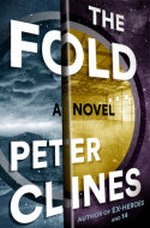
The FoldThe Fold

by Peter Clines

Hardcover, 372 pg.
Crown, 2015
Read: June 4 – 5, 2015
If you’ve ever wanted an episode of Fringe with more contemporary pop-culture references and a more obvious sense of humor — yet with all the mind-bendy science and disturbing images, this just might be the book for you.

Reggie Magnus is in a bind — he’s some muckety-muck in DARPA and a secret project he’s been funding to develop teleportation has diverged a bit from its original design and started generating unbelievable results. At the same time . . . he knows something’s just not right out there at the development facility — he has no idea what’s wrong, but he knows something is. What’s a guy to do? Well, considering that he’s spent billions (yup, with a “b”) on this project, he needs to make sure he delivers something. Thankfully, Reggie’s got a genius friend with a few months free to send out to California, see what’s going on — hopefully fix the problem and help Reggie to justify the budget for this program.

Enter Mike (Leland Erikson, actually, but he answers to Mike — long story). He is a genius, with a photographic memory (a frighteningly detailed one), a curious streak a mile wide, and….three months off to do this since he’s a High School English teacher just done for the summer. So, he goes to California, meets some legendary scientists (and a few others no one has head of), and then excitement ensures.

While I was reading the second chapter, I scrawled the note: “The tonal shift between chaps 1 & 2 was enough to give me Whiplash (and I’m talking the kind where J K Simmons slaps you repeatedly, not the kind you get a TV lawyer to help with). Think it bodes well for the book.” And it did. After the jarring sensation between the first two chapters (think of the typical NCIS/Bones/etc. type opening wherein someone going about their routine, daily life stumbles on to a body before we join our heroes bantering around the office), things calmed down. The plot unwinds at a good pace — building up a good head of steam until everything goes cuckoo bananas. Eventually, all the pieces come together — but the explanation doesn’t end things, it only sets up a action-packed, mind-scrambling conclusion.

Like Mike, we get a nice orientation to the research facility and its team. Most come thi-i-i-i-s close to being right out of Central Casting, but Clines tweaks them just enough to keep them from being a frightening cliché. Ditto for Reggie, actually. This is not to say that Clines spends all that much time fully developing these characters — he comes close with Dr. Arthur Cross and Jamie Parker.

Jamie’s your basic attractive blond with severe emotional issues, when she’s not being a ultra-professional uber-computer scientist, that is. Dr. Cross is the 4th most popular scientist in the world — behind Neil deGrasse Tyson, Stephen Hawking and Bill Nye. He writes books for popular audiences and heads up research projects like this one (to over-do the Fringe comparisons, he’s William Bell). When he’s not being dark and mysterious, he’s the kind of scientist you want to learn from, dropping lines like: “Almost any concept or idea in the world can be expressed through comparison with a classic Warner Bros. cartoon,” and then goes on to demonstrate just that.

Actually, it may not be character development. Those two might be the characters we spend the most time with. This sounds like a criticism, but it’s not really. It’s not that type of book, all it requires are characters to move the plot along, not people you get too invested in.

Now, Mike is another story, he’s fully fleshed out. He is sort of a Robert Langdon type character — brilliant, in the right place at the right time, driven, and courageous enough to jump into danger, yada yada yada. — but with one significant difference: I liked Mike from the moment I met him, and I never, not for one sentence (over two books) liked Langdon. He’s charming, down-to-earth (in his own way), and is desperate just to be a regular guy. It’s hard not to respond to that.

It’s an engaging story, told well, filled with likeable characters doing out-of-this-world things. Solid SF work. Give this one a shot.

Disclaimer: I received this book from the nice folks over at Blogging for Books for this review. Not sure they got their money’s worth, but I came out pretty good on the deal.

—–

4 Stars

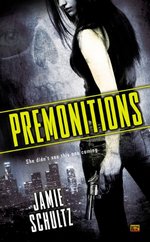
Premonitions by Jamie Schultz Redux

I read this one last year, and in anticipation of the sequel, decided to take another crack at it over my vacation. On the whole, I’ll stand by what I said below — that’s about what I’d say about it today if I was starting from scratch. There is one new thought that I’ll add, I thought about deleting/reworking some of what I said before, but…eh, it’s close enough (and I’m tired). Still, the main point stands: this is not your typical UF, and it’s worth your time.

PremonitionsPremonitions

by Jamie SchultzSeries: Arcane Underworld, #1

Mass Market Paperback, 384 pg.
Roc, 2014
Reread: June 7, 2015I spent a lot of time staring at a blank screen trying to figure out how to talk about this. I came close to just posting, “This is seriously effed-up. But in a good way. Read it!”

Really, that might have been the way to go. But let’s give this a try…

Premonitions is not your typical Urban Fantasy. Karyn isn’t full of spunk, battling her way through some challenges with only her wits, a snappy line and her powers in a quest to defeat evil/save a life/protect justice. Nope, all she’s trying to do is survive. Same for the rest of her gang — they steal, they work only to make it to the next day. They’re not well off, they’re really not even comfortable — borderline desperate, really. So when they’re given the opportunity to split a 2 million dollar score, it’s an offer they cannot refuse (in many ways)

In this world, magic — or precognitive abilities — come with a price. A nasty, dirty, life-altering price. Neither the magic or the precog life seems at all worth it — and with one possible exception, everyone we meet in these pages with some sort of ability realizes that. Yet, those who can choose to pay that price or not, keep coming back to it. Karyn, on the other hand has no choice. Her abilities come with horrible hallucinations that she has to keep suppressed with a drug. Which is, of course, hard to find and only available on the black market. So like any good junkie, she steals to support her habit. Karyn’s psychic ability is like a less-pretty, less specific and more unreliable version of Alex Verus’ magic. Not that I think for a second that Schultz was going for that — it’s just what occurred to me as I read. I like the slightly different take on the idea.

Premonitions is a Heist story — so, of course, things go horribly wrong (that’s the point of these, right?), it’s watching how this particular band of thieves respond to this that makes this compelling. In fact, the broad brush strokes of the plot are pretty apparent within the first few pages — this isn’t a knock on Schultz, it’s just evidence that he knows what he’s doing. This is a classic Heist story, told in his own particular way, with his unique blend of characters — thieves, marks and obstacles.

We have two central characters — Karyn and Anna, with a crew of others — magicians(is that the word?), an ex-Marine and — well, some others they pick up along the way. Years ago, Karyn and Anna become friends, and for reasons we’re not privy to, and Anna may not fully recognize, Anna hitched her wagon to Karyn. She could’ve gone off and had a successful career, family, and whatnot. Instead, she’s a criminal scratching by, doing all she can to help her friend make it to the next day.

That’s the heart of this novel — the friendship between these two. Their dedication to each other, to each other’s needs, wants, desires and lives — and by extension, those members of their team, romantic partners, and miscellaneous allies. There’s no flashy swords, or government conspiracies, or prince to rescue — but this is really a one for all and all for one group. As long as they remember that.

This is the new thought:
One thing I’ve been thinking about lately is the concept of found-family, especially as portrayed in TV, movies and novels. There are two found-families here — probably three — and each is under stress in some ways. There’s one rotting from within, one that’s dealing with a defection, and one that’s dealing with an addition or two (and some subtractions). Each responds to the stress in a different way — mostly in a pretty destructive way. If you step back and think of them as families — and not criminal organizations or cults — the reactions are entirely understandable, and you can sympathize with those lashing out (actually, they’re understandable for criminal enterprises or cults, too — but far less sympathetic). I’m not suggesting this is terribly profound or anything, but this time through this idea jumped out at me. Particularly when the various characters are thinking about/voicing what connects them to their “family.”

There is a pervasive atmosphere that characterizes this novel, a mood. The whole thing is dark and moody. In my mind, it looks like the sets from Season 1 of The Wire, lit by whoever picked the look for Blade Runner. This gives it a different feel than most of your Urban Fantasies on the market. Not that they’re all rainbows and unicorns, but there is a “blue sky” feel to Urban Fantasies by Underwood, Butcher, Hearne, Harrison, Briggs and whatnot — that is not shared here. Schultz is not Richard Kadray-dark, but he’s close. Honestly, this reminded me of the Twenty Palaces world of Harry Connolly. Obviously, the magic system is different — but I’d have no problem at all seeing Ray Lilly and Annalise Powliss bump into Karyn and her crew (thankfully, I’m pretty sure their magic isn’t the sort that Annalise would feel compelled to eliminate anyone).

When I was 34 pages from the end of the book, I jotted down a note: “Not only do I have no clear idea how all this will end (frankly, I didn’t see what happened three pages ago happening), but I also have no clue what a sequel to this looks like.” That’s not normal, that says a lot about how Schultz is working. Now, by the end of the novel, that wasn’t the case — I had a clear idea what to expect Splintered to be like (I’m also prepared to be totally wrong). But to be that close to the end, and not sure what’s around the corner? That’s pretty cool. To be fair, it could be that I was being dumb — but I’m going to give the credit to Schultz for keeping me on my toes.

Give this one a try, folks, don’t think you’ll be sorry.

—–

Note: I was provided a copy of this by the author, who seems like a pretty cool guy — which made the fact that I really enjoyed this a relief.

—–

4 Stars

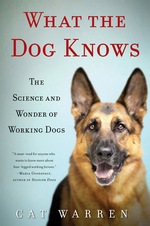
What the Dog Knows: The Science and Wonder of Working Dogs by Cat Warren

What the Dog KnowsWhat the Dog Knows: The Science and Wonder of Working Dogs

by Cat Warren

Hardcover, 280 pg.
Touchstone, 2013
Read: May 7 – 15, 2015

People are smart, just like dogs.

Seriously, how do you not like a book that contains that line?

Honestly, the only reason I gave this book a second glance — okay, a first glance — is that Robert Crais blurbed the paperback edition and it showed up on his Facebook page. It seemed kind of interesting, but I wasn’t sure — then I noticed that Spencer Quinn also wrote a blurb. And if two of my favorite mystery novelists (who have a thing for dogs) tell me the book is good, it must be.*

They were right — Warren was a journalist, is now a professor, and knows her way around a sentence. She clearly cares about the subject and has invested a lot of time and effort into getting to know it, her style is engaging and charming (I was chuckling within a couple of pages), and she doesn’t mind showing her own failings and weaknesses.

The history and science of dogs/other animals being used for their sense of smell, is probably the most fascinating part of this book, but it’d be really easy for the material to be too dry to bother with — Warren’s voice keeps that from happening. I think it’s terrific that at the end of the day, no one knows what it is about the smell of the human body that dogs sense — she’ll explain it better than me, but that’s the kernel the story. I just really enjoy it when the best and the brightest have to shrug and say, “I don’t know.” The chapter she spends on the future of dogs and/or digital replacements is good for similar reasons. Actually, I could just keep listing little facts/factoids/ideas here, but I don’t want to steal Warren’s thunder.

The best part of the book — the part that I found most interesting, and most frustratingly small — is the Warren’s story about getting Solo, discovering he had just too much energy and personality, and needing to find an outlet for it all. Which is followed by the trials and tribulations of a newbie cadaver dog handler and her pup-in-training, growing into a capable working dog. Anyone who has a dog lover as a Facebook friend knows just how easy it is for someone’s stories about their dog to get to the point where you can’t stand to hear another**. Somehow, Warren avoids this totally — not an easy feat. It probably helps that dog does far more fascinating things than just hiking through the woods or chasing a ball.

The stories about the others — her friends, colleagues, teachers, etc. — round out the book. It’s not just about Warren and Solo, it’s not just about the military/police efforts with training animals — it’s about dedicated volunteers, K-9 officers and dogs all over the country (and the world) making a difference. In places and ways you wouldn’t expect. Really? Sending in one guy and his dogs into Vietnam decades later to search for POW/MIA? Also, seeing how different dogs act differently, yet get the same job done was mind-boggling. Especially for dogs trained together/by the same person, you’d think they’d act similarly.

I imagine it’s to spotlight the work of others, to not brag about Solo too much, to talk about things that she and her dog haven’t done/seen/smelled — or whatever reason there is, I wanted more Solo. A lot more. I have no problem with the rest of the book, it’s just that there’s not enough Solo (or Coda).

Fascinating, entertaining, and educational — can’t ask for much more than that.

—–

* Yes, I’m aware there are flaws in the thinking there.
** Of course, your friends don’t have dogs as cool as mine. Let me tell you a little bit about her . . .

—–

4 Stars

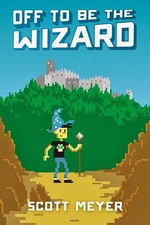
Off to Be the Wizard by Scott Meyer

Off to Be the WizardOff to Be the Wizard

by Scott Meyer
Series: Magic 2.0, #1

Kindle, 374 pg.

47North, 2014

Read: May 23 – 26, 2015

4 Stars

The first thing Martin always did when he found some new data file was to search for his own name. It may seem egocentric, but Martin wasn’t worried about that. He had spent a lot of time thinking about himself, and had come to the conclusion that he was definitely not self-absorbed.

There’s a great temptation — and frequently a rush — when discussing an amusing/funny book in SF or Fantasy to compare it with, well — the name rhymes with Schmouglas Schmadams — this can be damning, because almost nothing can live up to it. So I’m going to resist even saying the name. If anything, I think you could say this was reminiscent of Schmon Schmalzi — only funnier.

Martin Banks is the rather unimpressive hero here — a college dropout, living in a poorly-furnished apartment, working in “a cubicle farm, . . . a fluorescent-lighted, beige-walled abattoir for the human spirit where he had to spend most of his time,” and doing some minor hacking on the weekends, just to amuse himself. He stumbles upon a way to manipulate reality, to change things just a little bit here and there around him. Being human, it takes very little time before he begins using that ability in a way to draw the attention of the Federal Authorities. Which is not all that comfortable, so he heads off to England in the Middle Ages where he figures he can do okay for himself, living as a wizard using these abilities.

That’s when things start to get really entertaining (and I had no complaints up to this point). Anything more I say on this front is a horrible spoiler, so we’ll just leave it with really entertaining.

This is a coming of age tale — and, as it’s about a Millennial, it’s a delayed-coming-of-age story. But Martin’s not one of those protagonists that you have to see mature before you like him — you connect with him right away (or you’re probably wasting your time reading on). He definitely doesn’t mature in your typical way, which is part of the fun. I can’t help comparing Martin to Wesley Chu’s Roen Tan. But without the stakes that Roen had to deal with (and a nicer mentor).

Most of the characters we get to know are met after Martin’s time jump — so don’t worry if you find everyone in 2012 a little shallow and undeveloped. They are, but other people won’t be.

There are several things in the book that won’t hold up to much scrutiny — like his ability to get a smartphone signal in Dover, England in 1150. Adapt the advice Joel and the ‘bots used to give us, “just repeat to yourself . . . you should really just relax.” It’s worth it.

The book is just littered with wit — from the extended jokes, the funny visuals, or little asides like: “The fact that wristwatches weren’t invented yet made it difficult to look impatient, but he managed.” On nearly every page, there’s something to make you chuckle or laugh — or at least grin. I laughed enough that it was annoying to my family — not that I cared, mind you. But it’s not just a yuk-fest, there’s a well-written story here, in a great world with some characters you want to spend time with.

I’m looking forward to the rest of the trilogy and have promised myself that I won’t have to wait too long for it. A great mix of SF, Fantasy, Magic, Computers, the Middle Ages and laughs. What are you waiting for?

—–

4 Stars

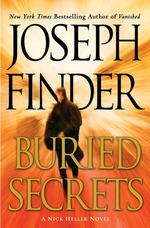
Buried Secrets by Joseph Finder

Buried SecretsBuried Secrets

by Joseph Finder
Series: Nick Heller, #2

Hardcover, 386 pg.
St. Martin’s Press, 2011
Read: April 13, 2015

Private Spy, Private Investigator, Private Vengeance-Taker, whatever you want to call him, Nick Heller one of the best — he’s tough, he’s resourceful, troubled kids like him and he quotes The Punisher. Who doesn’t love that?

Heller’s relocated himself, his computer wiz, and his nephew to Boston since we saw him last, setting up shop marketing his peculiar trade. True to form, he’s pretty picky about who he accepts as a client, but there is one who he can’t turn away. Marshall Marcus, the richest man in Boston, was a lifeline for Heller’s mother after his father’s prison sentence was handed down. Now he needs a lifeline — actually, his 17 year old daughter does. She’s been kidnapped and will be executed if her father doesn’t give the men responsible exactly what they want.

The kidnapping itself, and the way Alexa is being held captive aren’t that novel — most readers who’ve watched a police procedural or two in the last few years will have seen one or two scenarios like it. But Finder does make it distinctive by making the man holding her into a particularly sick and evil man. Thankfully, we don’t spend so much time with Dragomir that the reader sympathizes with him, or starts to like him (à la Dr. Lecter). What he’s doing to Alexa is just wrong — as is pretty much everything that has led up to this point in his life.

Nick’s not just up against this twisted man — and those behind him — he also has to contend with a client who continually lies to him, an FBI official that seems to be blocking his efforts, and more than one person who isn’t who they say they are. Thankfully, he has Dorothy, his old military friends, international intelligence contacts, and a different FBI agent backing him.

There’s less action (as defined by explosions, gunplay, fights, etc.) than in Vanished, but it’s more suspenseful. In Vanished, it wasn’t until the closing pages that you had any idea what was happening with the victim — but here, there’s never any doubt about what’s going on with her, and what’s going to happen to her if Nick doesn’t put the pieces together. Soon. Which isn’t to say it’s all-thriller-all-the-time, there’s moments where Nick and the reader catch their breath. Even a couple moments of levity (Nick’s narrative voice helps a lot on that front) — his observation, “Veganism is apparently the paramilitary wing of vegetarianism” helped set the tone. Dorothy’s eventual use of the word “Pepsi” to close a chapter made me chuckle audibly (you’ll get it when you read this).

I should probably add that this book includes one of the grosser character deaths I’ve read in the last couple of years. Didn’t bother me much, he had it coming.

We get to see a bit more of Nick’s life and backstory this time. He’s a better-rounded character now. It’d have been easy to see him as a workaholic who had no contact with anyone outside of work and his nephew before. But that’s clearly not the case now. There’s not much more to him — but there used to be, and getting that glimpse helps you care a bit.

It’s taught, it’s a page turner, it’s a “I can always sleep later” kind of read. Man, oh man, I hope Finder has at least one other Heller adventure up his sleeve.
4 Stars

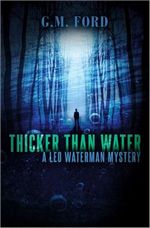
Thicker Than Water by G.M. Ford

Thicker than WaterThicker than Water

by G. M. Ford
Series:Leo Waterman, #7

Kindle Edition, 264 pg.
Thomas & Mercer, 2012
Read: April 29 – 30, 2015
So, I stumbled onto this series in ’06, I think — and read them in a pretty quick succession. I don’t have crystal clear memory of them, but I remembered Waterman, the lovely (and smart) Rebecca, the homeless people that he uses to help, his wit — and a scene or two from books 1-5. I remember book 6, The Deader the Better pretty well — I really remember how much I wanted to go on to to the next one, and how frustrated I felt when I discovered there was no book 7. How could Ford leave us hanging like that? Just when I was really getting to like the guy (see also: Koryta’s Lincoln Perry; Levine’s Solomon vs. Lord; Lehane’s Kenzie and Gennaro).

So imagine my delight when I stumbled onto a new Leo Waterman (even if I found it a few years late). It took me very little time to get back into things — Ford quickly reminded me of the details I’d forgotten while plunging Waterman (and the reader) into the thick of things.

I’d forgotten how quotable Ford can be. This description of a lifelong, um, acquaintance and current gun dealer probably beats the competition in this book (by a hair):

Junior Bailey couldn’t have been more than a couple of Oreos short of three hundred pounds. A corpulent corpuscle in a hideous purple suit, he looked like a Cuban headwaiter who had been held hostage in a doughnut shop. Except for the rosebud lips, he bore little or no resemblance to his father.

How can you not like a book with lines like that? 1. It’s funny, 2. You have a clear picture of this guy in your head, 3. Given the phrasing, you’re pretty sure just what the narrator thinks of ol’ Junior Bailey. This kind of writing keeps me turning pages — I almost don’t care about plot or character. Almost.

But despite the years, Ford hasn’t lost a step with these characters — Leo is still Leo. Yes, aged, and clearly affected by Rebecca’s moving on. But still the same man — and when called upon to come to her aid, he dives right in. The folks at the bar are still as fun (and tragic) and silly as remembered.

And the case? Rebecca’s gone missing, her bad choice of husband is, too — and no one seems to care other than her mother. Granted, she thinks Leo would’ve been a worse choice for Rebecca, but she knows that if anyone will look for Rebecca it’d be Leo. There’s some brutal action, some good twists and turns to the tale, a few criminals that are requisitely evil and demented, and more than enough chuckles before reaching a very satisfying conclusion. I’m so glad to see that Ford’s at work on another in this series.

And I truly wish I could say more about the biggest laugh, but it’d take too long and it’d ruin it for you, so I’ll just conclude with this:

That last chapter? Reader, I lol-ed.

—–

4 Stars

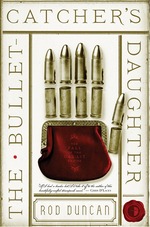
The Bullet-Catcher’s Daughter by Rod Duncan

The Bullet-Catcher’s DaughterThe Bullet-Catcher’s Daughter

by Rod Duncan
Series: Fall of the Gas-Lit Empire, #1

Mass Market Paperback, 364 pg.
Angry Robot, 2014
Read: April 27 – 29, 2015

This, my friends, is how you create a world. And populate it with a great character — and several really good supporting characters. Oh, and manage to tell a rollickingly good story while you’re at it.

The back of this book says that this is supposed to be shelved in “Fantasy,” which is just about the last thing that I’d have put it under, but . . . sure, why not? This is a very alternate history — 1973, but operating on Steampunk-ish technology after a global moratorium on technological advancement (this is just a quick and dirty summary, read the book to really get it). Edwin Barnabus makes ends meet (and that’s about it) working as a Private Intelligence Gatherer with a little help from his twin, Elizabeth, they’re looking for the missing brother of a Duchess — who is more than capable of helping ends meet for quite a while.

Here’s the thing: Edwin doesn’t exist. And underneath her Victorian-era dress, Elizabeth keeps fairly decent disguise so she can go out and about as a male when necessary. There is one pretty noticeable flaw with her disguise, but she’s pretty good at covering it up — but the fact that’s there’s such a chink in her armor makes me like it all the more.

Elizabeth is smart, resourceful, kind — and haunted by a threat from the past. You can easily see this as a later entry in an ongoing series, sort of where everything Elizabeth has worked to establish is jeopardized. The search for this missing brother will push Elizabeth to her extremes, as she dodges debt collectors, representatives of two different pseudo-governmental forces, and some very driven circus performers.

The narration is crisp, and Elizabeth is charming. Her few friends, and at least one person who may be some sort of ally — or patient enemy — are well used to round-out her universe and give her the aid she needs to get the job done.

Give it a shot. This is the first of a duology, and I’m afraid that just might not be enough.

—–

4 Stars

The Diamond Conspiracy by Pip Ballantine & Tee Morris

The Diamond ConspiracyThe Diamond Conspiracy

by Pip Ballantine & Tee Morris
Series: Ministry of Peculiar Occurrences, #4

Mass Market Paperback, 357 pg.
Ace, 2015
Read: April 9 – 15, 2015
Most authors let a series go for awhile before they break formula, but not these two — here were are in Book #4, and they’re shaking things up in this follow-up to that intriguing cliffhanger. On the one hand, I wish they’d given us a one or two more of the standard Brooks & Braun head off on a mission somewhere (even to another country or something like their trip to the States) before this one — but I’m not sure it could’ve waited.

This is not a good year for me and Book 4s. Like, Pocket Apocalypse, this one took me far too long to get into. There was no point where I wasn’t interested, where I thought the story dragged or anything — but I think it took 5 days to read half of this book, but only one other to read the last half. I’m not sure what to make of that, honestly, but it’s annoying, if nothing else.

You get a glimpse of what’s coming in the previous book — the Ministry has been decommissioned. The agents who served the Crown so faithfully are now hunted by her government. Yet, they stay true to their mission, as you’d expect. Not the easiest task, even for these agents, used to the peculiar and the impossible. And what they’re about to go up against is a lot more peculiar than they’re used to. I’m always a sucker for tales of second chances — and we got a few here, to boot. This book really has a little bit of everything.

Beyond the events of the story, there is just so much here to blow the reader’s mind — events, revelations, characters — in the last hundred pages that I cannot talk about without utterly ruining the experience for anyone. But if you don’t sit up in your chairs a little straighter, mouth agape, at least twice in Chapters 14 and 15 (for example), there’s something wrong with you. And the last chapter? Great, just great.

I’ve always enjoyed the back and forth between the Brooks and Braun, but now they’ve added this flirtatious (and then some) aspect to it, making the scenes between two cackle with a new energy. The growth in their relationship feels natural, and doesn’t go too far. Sure, they’re ga-ga over each other, and in the first blush of new love — but they’re still professionals, with work to be done. Now that there’s a little more trust in each other, maybe that works better, but it’s still the same base relationship we’ve been following since Phoenix Rising.

One final thought: Is it just me or does that position Eliza is in on the cover look: 1. really uncomfortable, and 2. not that useful for shooting?

A dash of steam=punk, a bit of romance, some intrigue, some “you’ve got to be kidding me” moments, and good character progression. This is one of my favorite series going, and this entry just solidifies it.

—–

4 Stars

Dark Digital Sky by Carac Allison

So . . . here’s where I talk about what a jerk I can be. Last September, I get this email from a pretty friendly author asking me if I’d like a copy of his book in exchange for a review. I said what I always say when offered a free book, “yes, please,” (or words to that effect). I read and enjoyed it — we exchanged a couple messages about the book, he answered a question or two. And then because: 1. it was a little more difficult than I’d think and, 2. I got distracted, I never got around to reviewing it. I noticed this yesterday, while looking for something else and felt horrible — which is the way I should feel, over half a year late with this. Can’t do much to make it up to Allison other than put this up now and promise to buy the next book as soon as it’s possible.

Dark Digital SkyDark Digital Sky

by Carac Allison
Series: Dark Pantheon, #1


Kindle Edition, 302 pg.
Crime Planet Press, 2014
Read: October 02 – 03, 2014

“Your real name is Chaucer?”
“My father was an English Professor. I’m not. Call me Chalk.”

In a genre where the names Marlowe and Spenser cast such huge shadows, of course it’s time for a Chaucer. Better yet? He hates the name.

Allison frequently begins chapters with a lengthy info-dump about something — a mini-essay from Chalk’s perspective. Sometimes the info-dumps these work, other times they’re pretty jarring. The information about say, medical insurance, prior to meeting the analyst for Blue Shield? That one worked for me. The listing of Chalk’s tattoos? Eh, not so much.

This starts off with a new client with a very 21st century kind of case, but still proceeds like something out of Chandler. The further that Chalk gets into it, the stranger and twistier it gets. But in the background, we keep learning about a spree of atypical robberies. The way that the various threads start to integrate is something I didn’t expect. And once integrated? The whole thing gets even more unexpected.

The action of the novel belongs to the present — to Chalk’s case, the drug crimes — but the heart, the grounding of the character? That belongs to the flashbacks, the doomed marriage, the child he doesn’t get to see, the hunt for a serial killer that no one else believes exists. The more outrageous parts of his character, the outlandish abilities, activities — that’s the fun, that’s the fantasy. The book as a whole is a great mix of the two.

Chalk is damaged, an outsider, an underdog in classic noir-style (see also: his name). At the same time — he’s very successful and impossibly gifted, something out of a science fiction novel, really. Giving this sort of a cyberpunk feel — but instead of being set 15 minutes in the future (which is how I see all cyberpunk), Dark Digital Sky is a cyberpunk novel set 15 minutes ago.

I’m not convinced these elements work on their own — but even if they do, this is definitely a “whole is greater than the sum of its parts” kind of thing, somehow this all works. I’ve never read anything like this before — which is probably good, because most people would make a wreck of it. Not Allison, this is a strong vision told with a sure voice. Can’t wait for more.

—–

Note: I was provided a copy of this by the author, who seems like a pretty cool guy — which made the fact that I really enjoyed even better. I like it when pretty cool people write pretty cool stuff.

—–

4 Stars

Page 71 of 88

Powered by WordPress & Theme by Anders Norén