Tag: 4 Stars Page 70 of 88

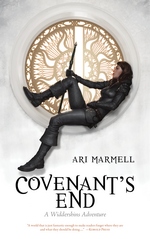
Covenant’s End by Ari Marmell

Covenant's EndCovenant’s End

by Ari Marmell
Series: Widdershins Adventures, #4
Hardcover, 265 pg.

Pyr, 2015

Read: September 10, 2015

So Ari Marmell has decided to bring our time with Widdershins to a close. On the one hand, I understand the choice. On the other hand, I enjoy these too much to let go willingly.

It turns out that the great and nasty demon that she pushed herself and her friends to — and past — the limit to defeat back in False Covenant had friends — or at least family. And thanks to Widdershins old foe Lisette, they are getting closer and closer to setting up camp in Davillon (and probably the whole world, really).

Widdershins has to call on all her allies — old, new, unwanted and not terribly wiling — and friends, play every trick in the book (and invent a few), and be prepared to sacrifice everything just to have a fighting chance here.

Emotionally, spiritually, physically — whatever she’s gone through before is nothing compared to this. While it is very much a team effort, let’s not get confused — her name is in the series title, and she’s the only one on the cover. It’s Widdershins story, and the weight of this falls on her. Yet, she faces the danger with humor, aplomb and panache (and the help the deity living in her head).

For a book as dark, foreboding, bloody and so . . . final; I sure spent a lot of time smiling and chuckling. It’s a quick, exciting read that checks off every tick box you might have for a finale.

—–

4 Stars

Reread Project: The Van by Roddy Doyle

The VanThe Van

by Roddy Doyle
Series: The Barrytown Trilogy, #3

Trade Paperback, 311 pg.
Minerva, 1991
Read: August 25 – , 2015
Jimmy Rabbitte, Sr. started off as a supporting character in The Commitments, moved up to co-star in The Snapper, and finally moves to the forefront in The Van, which is more about him than the other two were about any one person. Which isn’t to say that Jimmy, Jr., Sharon, Veronica, Darren and the twins aren’t here, they’re just in the background — as are most of Jimmy, Sr.’s friends (actually, I think Jr.’s in this far more than he was The Snapper).

Not only is the focus more narrow, the final installment in the trilogy is different in other ways — it’s almost 100 pages longer (depending on the printing) than The Snapper which was about 50 pages longer than The Commitments. Which gives Doyle more space to do things he hadn’t really before. It’s still primarily told through heavily stylized In the first 90 pages, I estimated I’d read more (significantly more) narration than I did in the first two volumes of the trilogy.

It’s not been clear before what Jimmy did for a living, but whatever it was, it was pretty clear the bills were barely paid. They stretched what they had pretty far, but they seemed to manage. Somewhere along the line, pretty sure it was post-Snapper, but I’m not sure, Jimmy lost his job. Unemployment isn’t setting well with him — he can’t support his family, he’s bored, he can’t even go down to the pub to have a few pints with his friends.

Jimmy’s trying to grow — he’s reading the classics. Thinking of taking some classes. But it’s not enough. At some point his friend, Bimbo, also gets laid off. The two spend a lot of time together — having a companion in his unemployment makes the whole thing tolerable for Jimmy — almost like summer vacation from school. Bimbo isn’t quite as accepting of this new reality — he almost applies to work at McDonald’s, but is shamed out of it by Jimmy. Bimbo’s wife is even less satisfied with his job status. Which leads to a reckless move on Bimbo’s part — reckless, yet maybe inspired — he uses some of his last dollars on a Chip Van (minus an engine). In the midst of the U.S.’ current Food Truck craze, this might not seem so risky, but in the early 90s? (then again, what do I know of early 90’s Dublin, other than what I’ve picked up from Doyle’s novels and the movies based on them?)

They’ve just a few weeks until the World Cup games start when they hope they can cash in on the post-game crowds. So Jimmy and Bimbo rush to clean the, learn to cook, design a menu, etc. And now you’ve got yourself a plot — can these two make a go of this? Can they remain friends and co-workers? Will they start a grease fire that destroys the whole of Barrytown?

There was, it seemed to me, a maturing of Jimmy that started back in The Snapper. Not that he wasn’t a good father before, but he kicked it into a higher gear with Sharon during her pregnancy. Here, that seems to manifest itself in a paternal pride — Junior’s having some sort of success out there, is getting married; his other son, Darren, is doing very well in school (better than anyone else in the family, that’s sure). Part of Jimmy’s reaction to it is finding pleasure in someone else’s success for what it means to them. I’m not convinced that the Jimmy of The Commitments or the first part of The Snapper could do that.

That’s not to say that he’s Man of the Year material or anything. There are some real (human) flaws to him. He’s petty, he’s jealous, he’s proud — there’s some sort of mid-life crisis that he’s got a half-hearted interest in involving Other Women. As in all good fiction, these just make him someone you can like, someone you can relate to, someone you can get annoyed with — even pity.

There’s some great, great stuff about sports fans here — national pride around The World Cup, the joy in sports, the very real camaraderie that can exist for a few moments around a shared experience. That’s not my typical milieu, but I’ve tasted it a time or two — and I can’t imagine many capture it better than Doyle did here. Even if I didn’t like the rest of the book, I think that part would’ve been worth it.

In the end, this is Doyle’s best work (to date), not the most enjoyable, but the best. It’s impossible after reading this, to ignore Jimmy, Sr.’s brief appearances in The Commitments, to not pull for him earlier than you should in The Snapper, and really to forget him. Just a great character in a world you really don’t want to leave.

—–

4 Stars

Hostile Takeover by Shane Kuhn

Hostile TakeoverHostile Takeover

by Shane Kuhn
Series: John Lago Thriller, #2

Hardcover, 246 pg.

Simon & Schuster, 2015

Read: August 24, 2015


John Lago is back, folks — and he picks up right where he left off, with some of the most adrenaline and testosterone-fueled writing you’ll come across this year. That may not be your cup of tea.

Hostile Takeover is one of those sequels I didn’t think needed to exist. Seriously, who was dissatisfied with where things ended up for Lago? It was narratively sufficient as it was — but as the opening lines of this book could’ve literally been the next page in The Intern’s Handbook, it’s hard to complain.

So, John decides to tie up two loose ends: 1. Alice and 2. HR, Inc. He marries Alice and the two take over HR but it doesn’t take too long (at least not many pages) before both of those go wrong — they break up and she kicks him out of the company (not really spoiler material, folks, it’s in the Jacket Copy). John switches to Plan B, the complete destruction of both. Which is not the most mature of plans, you’ve got to admit.

Which is the bulk of the book — John going undercover again, John trying (and/or being the target of) elaborate assassination schemes, great fight scenes and enough munitions used to make Michael Bay choke. All delivered in that movie-obsessed, rapid-fire (no pun intended) narration that won over so many fans before.

I thoroughly enjoyed, have used already, and will continue to do so, Lago’s comments on the movie Fletch. It was that line that reminded me how much I liked the first book.

Did I enjoy this as much as The Intern’s Handbook? Nope. Only because it didn’t blow me away with it’s freshness. But it’s a worthy sequel, as good as it’s predecessor and leaves me wanting more. An intense, fast read — buckle up and enjoy the ride.

—–

4 Stars

Hell is Empty by Craig Johnson

Hell is EmptyHell is Empty

by Craig Johnson
Series: Walt Longmire, #7

Hardcover, 312 pg.

Viking, 2011

Read: August 21, 2015

Where Junkyard Dogs started off with a chuckle inducing bang, this one starts slower, and makes it clear early on that creepy and foreboding are going to be the order of the day.

We join Walt and Deputy Santiago ‘Sancho’ Saizarbitoria as they’re transporting three felons to meet up with a prison transport and a FBI team. Two of them are pretty hardened guys, guys who scare people like me — but the third? He’s the kind who scares people like them. He goes by the name Shade, and right away, he fixates on Walt in a pretty unhealthy way. And you know that the rest of the novel is going to be about this.

Turns out, Shade is going to help the FBI locate his first victim’s remains, they’re somewhere around where the meet up is to happen. Naturally, the remains are in Absaroka County, so Walt and Sancho get to spend more time with Shade and the FBI. It doesn’t take a genius to figure out what’s going to happen — Shade’s going to escape, he’s going to kill many law enforcement officials, and Walt’s going to have to save the day. Johnson telegraphs this (there’s no way to avoid it), and even though you know it’s inevitable, you still watch it through half-opened eyes.

Oh, naturally, there’s a record-setting winter storm about to hit, too. Can’t forget that.

As standard, boiler-plate as much of this sounds, Johnson makes it work. It’s taught, it’s gripping, with just the right mix of tension, determination, and humor. It will keep you turning the pages, needing to know what’s coming next. Even as most readers are going to have the whole thing pretty-well mapped out in their heads from the beginning — it’s how Johnson executes this so well is a testimony to his skill and the reason that you’ll keep turning those pages as fast as you can.

Vic and Henry are almost absent through this book — and Cady’s appearance is token at best. But Johnson uses their brief appearances to their most. This novel is about Walt’s struggle against Shade and against nature — both seem to be focused on killing him.

Sancho, who is really becoming my favorite non-Walt character in the series is around more than those other three combined; although after the introductory chapters he’s off-screen until the end as well. Before then, he not only makes amusing contributions to a very dark book, he’s an important part of the plot. After his recent near-death experience and career crisis, Sancho’s taken to trying to expand his horizons and catch up on the Liberal Arts education he skipped over. So he had those who did get that education to compile a reading list for him — a copy of which is included as an Appendix. It’s a good list and would be helpful for most people — and gives us a nice look into the personalities of those that compiled the list.

In the acknowledgments, Johnson talked about how difficult this novel was to write — and I can see why. But, as we have come to expect form him, when he set his mind to it, he pulled it off. A gripping tale of man against nature, man against man, man against himself, told with Johnson’s signature style and wit, with one foot in Dante and the other in Indian folklore. Not an easy task, but one well done.

—–

4 Stars

Veiled by Benedict Jacka

VeiledVeiled

by Benedict Jacka
Series: Alex Verus, #6

Mass Market Paperback, 295 pg.

Ace, 2015

Read: August 11 – 13, 2015


This was not at all what I expected going in to this (granted, I only read the first couple of lines of the Publisher’s Description) — sure, I knew Alex’s mouth would get him in trouble, he’d have to outwit someone more powerful than him, Luna would be underused — despite Alex depending on his friends to pull him out of trouble.

What I didn’t expect was Alex Verus vs. Bureaucracy, not the catchiest of titles, but pretty accurate. Don’t get me wrong, it’s not like the Star Wars prequels with all the bureaucracy, trade negotiations, etc. Jacka keeps things tense, keeps things interesting, even as what Alex is battling is really just Office Politics (along with other kinds of politics).

Alex tries to take one more step towards credibility, of shedding his Dark mage past (not that almost anyone will let him), to a position where he can do some good, and hopefully have allies when Richard steps out into the limelight. Long-term, strategic thinking — I like it when UF heroes act like that. It’s brains, not brawn, that carry the day here.

This isn’t to suggest, that this is a dry — or combat-free — book. Alex gets down and dirty, as usual — against some pretty tough characters. But, I’m not convinced that the worst people that Alex and his friends went up against were the ones wearing the Black Hats. Not that they were angels, but, man, there were some nasty people in these pages.

There are some really interesting developments with Luna’s training and development. Alex makes a couple of useful allies — including a combat mage who is quite possibly the most entertaining character in the series thus far. And because that’s never enough for him — Alex picks up one new enemy and deepens tensions with another.

And Richard? Well, something tells me that specter’s going to be looming for a bit longer. But then again, I thought we were going to get a few more Kitty Norville books and that we’d see Richard in action here — so what do I know?

I seem to be mostly rambling here, so I’m just going to say: Alex Verus is a character you should get to know, in a series that should be on your TBR list. I wouldn’t start with this one, I really think Fated is where you want to climb aboard.

—–

4 Stars

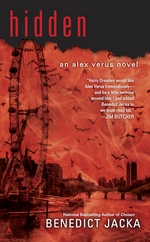
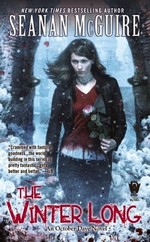
Review Catch-Up: Hidden by Benedict Jacka; The Winter Long by Seanan McGuire

These have been nagging at me for eleven months now. No, I have no explanation for why it took me so long, but I’m glad I took a lot of notes on both. I’m going to get this posted before I start the next Jacka novel (which should be happening today). While I’m at it, the next Toby Day is a couple of weeks away.

Anyway, overdue mini-looks at a couple of the best Urban Fantasies I read in 2014:

HiddenHidden

by Benedict Jacka
Series: Alex Verus, #5


Mass Market Paperback, 293 pg.
Ace, 2014
Read: September 26 – 30, 2014
. . . man, I have really missed Alex. Everyone’s favorite diviner has really come a long way, lately — shedding the near lone-wolf thing, and is now looking after a passel of magic rookies. Whether they want him to or not.

Anne Walker is definitely in the “or not” category. She’s done all she can to stay away from Alex — but she probably didn’t mean to include being kidnapped as one of those ways. Alex goes to some pretty dark places to help someone who doesn’t want it.

At the same time, Alex (via the Council) is feeling some pressure for the events of the last book. They’re also pressuring him to do some official work for them. Plus the rumors are getting more and more intense that his mentor, Richard, is back. If that’s true, no one is going to be happy. Naturally, everyone thinks that Alex knows what Richard is up to. And every time he says he doesn’t, he convinces them that he does.

So yeah, Alex has his hands full.

I think it was Chekhov who said that if a magic user grabs a focus in the opening chapters, that by the end of the book . . . Anyway, that was a nice use of it.

Not that Alex has had an easy life over the last couple books (or we wouldn’t be reading them) but the one big take away from Hidden is that it’s going to get a lot worse for our friend (I swear I hadn’t read that note when I wrote about Veiled over the weekend). There are other take aways, mostly happier, but I’ll leave that to you to find.

A wholly satisfying read. Get to know Alex Verus.

4 Stars

The Winter LongThe Winter Long

by Seanan McGuire
Series: Toby Daye, #8


Mass Market Paperback, 358 pg.
DAW, 2014
Read: September 13 – 16, 2014

I don’t like parties. Someone always tries to assassinate someone I actually like, and there are never enough of those little stuffed mushroom caps.

A book starts off with a line like that? You’re going to have fun.

Thankfully, one’s appreciation of a book doesn’t depend on how the protagonist acts. When I was on page 46, I wrote , “Granted, this is early, but Toby’s being stupid, foolishly so. She’s not paying attention to anything said during the fight she just had — actually, technically didn’t really have. Instead, she’s reacting to something that happened to a friend, and acting out of fear, prejudice and alarm. That disappoints me. Her saying, ‘that smile, brief as it had been, was all I could have asked for. A smiling Tybalt was a Tybalt who was still capable of stepping back and looking at the situation rationally. I loved him, but even I could find him frightening when he was fixated on vengeance.’ Man, choke me on the irony, McGuire.”

There’s just go much about this novel that I can’t describe without spoiling it. Let me limit myself to a couple of more notes: Toby lost a lot of blood on this one — I mean like The Bride in the Showdown at the House of Blue Leaves kind of a lot. It’s a good thing she has a healing factor to make Logan jealous. While she’s bleeding she’s having her world rocked.

McGuire takes a lot of what Toby’s “known” since we met her (all of which is what we’ve “known,” too) and turns it upside down and shakes the truth out. Every other book in the series has been affected by these revelations — in one fell swoop, she re-wrote previous 7 books — which is just so cool. It’s not that we’ve (we= readers and Toby) been wrong, our understanding is just . . . askew. There’s also some nice warm fuzzies in this book, which isn’t that typical for the series. McGuire’s outdone herself.
5 Stars

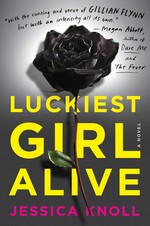
Luckiest Girl Alive by Jessica Knoll

Luckiest Girl Alive Luckiest Girl Alive

by Jessica Knoll

Hardcover, 338 pg.

Simon & Schuster, 2015

Read: July 27 – 31, 2015
There has been so much buzz about this book the last couple of months, it might as well be inhabited by bees. There’s been a couple of times this summer that half of my Twitter feed seems obsessed with it — it’s really only one or two people, but they really like posting reviews about it. I get the love for it — I don’t share it (at least to the extent that so many seem to) — but I can see where some would go ga-ga over it.

For me, not since Mark Watney from last year’s The Martian has a book depended so much on a narrator’s voice for me. This thing rises and falls with what you think of Ani FaNelli. If she doesn’t turn you off in the first 10 pages (odds are, I know the exact line), you’ll enjoy the ride.

The book opens on Ani and her fiancé working on their wedding gift registry, but it’s pretty much unlike every such trip you’ve seen/read. I’m pretty sure I emitted an audible chuckle or two. The fiancé is not really a cad, not really a bore, more of a guy who would be a jerk, or a really good guy if he just put a little effort into things in either direction, but can’t seem to bother to care. Ani is driven, emotionally-complex, with a dark sense of humor, there’s a subtext straight from the start that says some nasty stuff has happened to her, and it’s shaped the way she relates to life — it should be said that this subtext isn’t all that “sub.”

As we march towards the wedding day, we start to look back at how Ani’s (then TifAni’s) high school life made her into who she is today — her trials, her trauma, her friends, and everything else. As we get further along in each story, we gain more understanding of why she does what she does. I’m not all that certain I liked Ani as a person, but as a character? Oh, yeah. She’s a damaged mess of various disorders, doing her best to keep things together and progressing (it’s clear that she’s earned every one of those disorders). In the end, Ani just wants acceptance, love (for who she is, not what someone wants her to be), and a little public vindication. It’s just harder for her to find that because of who she is.

It’s hard to argue with desires like that — particularly from someone who’s gone through what she’s gone through. I’ve seen more than one review who talked about not being able to connect to Ani, and while I enjoyed her voice, I’m not sure I could either. What I could connect with was her goals, her desires. So my emotional investment came from wondering what kind of success she’d find.

Ani had a plan — one overarching plan since high school — she developed it, let it evolve, but by and large her plan was everything to her, a religion. I don’t think you could say it was a great plan, but it seems plausible. More than that, it was Ani’s and she liked it. But — somewhere in these pages, a little of that character growth thing happens — plus a handy accident occurs — that necessitates change in her plan. It’s impossible to say if that growth would’ve without the accident, or without the growth if she’d been able to take advantage of the accident. Either way, it’s how you handle a change in your circumstance and plans that reveals the most about you, right? The payoff here was satisfying.

The book promises a lot of twists — and there are several — but most of them I could see coming. That didn’t matter, Knoll teases them just long enough, and then brings them to light just at the right time for them to be fully effective. The ones I didn’t see coming, on the other hand? They were just as effective, and oh, so wonderful.

Thanks to the cover copy and promotions, this is being compared to Gone Girl — some people like the comparison, some don’t. I’m not going to make that comparison (mostly because I haven’t read the other). But for cryin’ out loud — don’t base you opinion of this book on that comparison. That’s not Knoll’s comparison, it belongs to someone at Simon & Schuster’s marketing department (and valid or not, that bit of cover copy paid off for the company).

Give this 10-30 pages. If you’re curious about what happened to Ani, if you like her voice, if you want to if she succeeds in her goals, keep going. If you don’t? Drop it and grab something else.

—–

4 Stars

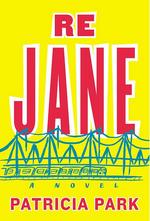
Re Jane by Patricia Park

This is frustrating…I’ve been working on this post for a couple of weeks now, and have spent a lot of time re-writing, re-writing and throwing out material. I finally decided what to keep and how to organize it, I think. I’m tempted to just put this cover image next to a big .gif of a thumbs up and call it a day.

—-

Re JaneRe Jane

by Patricia Park
Hardcover, 338 pg.
Pamela Dorman Books, 2015

Read: July 6 – 8, 2015

There are two ways to look at this book — as a retelling of Jane Eyre and as a novel on its own terms. It’s clearly indebted to Jane Eyre — frequently, the allusions are subtle; sometimes, she might as well be jumping up and down waving a flag. Still, Park’s her own writer — this is its own story, with its own characters — and a heroine who’s not just Brontë’s best-known character thinly disguised.

If you haven’t read Jane Eyre, first of all — shame on you. Secondly, yes, you can read this and appreciate it — you’ll just miss some of Park’s cleverness. Instead, what you’ll get is a straight-forward story about the trials and travails (and travels) of a young Korean-American woman.

Jane Re’s a half-Korean college graduate who becomes a nanny for the daughter of a couple of silly (white) New Yorkers — she’s a stereotypical college professor in Women’s Studies, he’s a henpecked high-school English teacher. Their daughter was adopted from China, and is now old enough that she doesn’t need a nanny — which makes the whole thing a greater challenge. Still, it’s better than the alternative — returning to live with her uncle and aunt, who were forced to take her in after the death of her mother in Korea (and her family there being unwilling to keep her).

Then through a series of events you can read about yourself, she finds herself living for a bit in South Korea. This is as fascinating as you’d think it’d be. It’s not just about a young South Korean woman, it’s about a young half-South Korean woman, raised in the States (by people who left Korea decades before), trying to acclimate to Korea. A stranger in the U.S. to many because of culture and appearance, finds herself a greater stranger there for the same reasons.

Which leads to . . . spoiler stuff. Which is even more interesting. Along the way there’s a whole mess of family issues, stranger-in-a-strange-land issues, self-acceptance issues, romance issues, and other things I can’t pair with the word “issues.” Jane goes through a lot, I’ve got to say — maybe a wider-range of challenges than Eyre. I frequently found myself wanting a bit more spunk, a bit more chutzpah from Jane throughout. But, like her namesake, when she needed it, she found it within — and it was great to see.

Park makes a pivotal choice in her selection of chronological setting — and one that worried me. It’d have been so easy to go wrong with this, and I’m used to seeing it go badly — but Park pulls it off, and actually makes it work for her.

In the end, I liked Jane. I rooted for her. I liked (some of) her family and friends. I was invested in the story. It’s not going to go down as good as, or as important as, its inspiration — but it’s a well-written, warm, look at a woman learning how to take charge of her life.

—–

4 Stars

Dusted Off: Kitty’s Big Trouble by Carrie Vaughn

While starting the post for Kitty Saves the World, I noticed I’d reviewed only two other books in this series here. Unthinkable. It was one of the first UF series I ever tried and it’s one of my favorites to this day. Turns out, that somehow I’ve only written one other post on the series. I’m still having trouble coming to grips with that. So, I figured I’d better throw this up before I forgot.

Kitty's Big TroubleKitty’s Big Trouble

by Carrie Vaughn
Series: Kitty Norville, #9

Mass Market Paperback, 307 pg.

Tor Books, 2011

Read: July 3 – 4, 2011
It’s been far too long since we’ve had a new Kitty Norville adventure, and Carrie Vaughn didn’t disappoint with this one.

We begin with Kitty’s most recent hobby–trying to out historical figures as weres or vampires or whatever. Which is a lot of fun, and is a well Vaughn hopefully returns to.

But the main action focuses on the Long Game between various vampire factions that we’ve seen a few peaks into lately. Kitty’s ally Anastasia is racing against Roman for possession of a magical artifact that could turn the tide in this competition forever.

Honestly, I don’t think this was the strongest entry in the series plotwise–this seems more about setting the stage for bigger things down the road. But while setting the stage, we get to spend some good quality time with some great characters, learn more about Cormac’s situation, and meet a few new characters (a couple of which I hope to see again, soon).

Should add that it took me far too long to get the title, and when I finally did I wondered where my head had been for a couple hundred pages.

Can’t wait to see what trouble Kitty gets into next.

—–

4 Stars

Splintered by Jamie Schultz

SplinteredSplintered

by Jamie Schultz
Series: Arcane Underworld, #2

Mass Market Paperback, 336 pg.

Roc, 2015

Read: June 9 – 10, 2015 Last year’s Premonitions stuck with me more than many Urban Fantasies I’d consider equal to or better than it. For example: Seanan McGuire’s The Winter Long blew me away, but when I finished it, I thought about it for a couple of days and then moved on. But Schultz’ debut (which I thoroughly enjoyed) stuck around the back of my mind, and every so often I’d speculate about Karyn’s future, Genevieve’s motives, etc. Part of it was that is that McGuire’s got 7 novels of history in her series, I have (some) idea what she’ll be putting Toby et al. through in the future and had a solid idea about what had happened in The Winter Long. But Schultz is a question mark, who knew what he had up his sleeve for the future, and there were still some questions about what I’d read hanging in the back of my mind. But it was more than that — something about the book as a whole — the world as a whole — that lingered.

So, yeah, I was more than ready for Splintered by the time I got my hands on it. Thankfully, I can report that Schultz stepped up his game a bit.

It’s been a few weeks since the events of Premonitions, most wounds and injuries have healed, Karyn’s still overcome by an onslaught of visions and is unable to care for herself, Anna’s dividing her time between caring for her and running around for Enoch Sobell (while suffering emotional damage from Premonitions), Sobell’s just about finished piecing his organization back together, and everything else is returning to normal. Now, Anna and the team aren’t exactly sure what Sobell’s got them running around doing — but they’re not crazy about it.

Then things get serious — Sobell “asks” the team to do something for him that’s another level of criminality than they’ve engaged in before — with yet another inevitably following. This involves a handful of magic users in a class beyond what they’re used to. In the middle of all this, the FBI raids Sobell’s headquarters (making it difficult for him to keep the team on task). Oh, and someone’s looking for a Karyn. Someone Anna’s never heard of, and isn’t so sure about. Things get complicated, twisted, and disturbing from here — hopeful steps and/or events, are tarnished by failure or corruption; every victory looks Pyrrhic, and defeat seems inevitable.

Which is not to say that this book is all doom and gloom, a read only fit for the masochistic or self-loathing. On the contrary, there’s a lot of life in these characters, hope, gumption and devotion. You want to know what’s happening to them, you want to see them prevail in some small way (at least). This world may not be filled with blue skies, but there are patches of blue in the smog.

There’s something about the L.A. of these books that make me think Schultz is depicting a near-future dystopian city. But I’m so glad that Nail’s around so we get references to 9/11 and the Iraq War, and I can be reminded that this is taking place roughly now and that what I consider to by a dystopian future is simply a dystopian present for far too many people.

I don’t typically spend enough time thinking about titles, it’s one of those things I keep meaning to do. In this case, however, it doesn’t take a lot of effort to see the title’s applicability. At some point — if not several points — every character in this book is on their own, splintered off from the rest and looking out for their own interest with no attention or care about any one else. Occasionally, it’s in opposition to anyone else (even those they’re supposed to be aligned with). This cuts across all the various relationships depicted; from the purely financial, to the heartfelt, to the creepy and cultic. Each individual makes a deal with someone along the way — almost always for short-term gain (shorter than many expect, it should be added) and potentially long-term loss (longer than many expect). Sometimes, the characters can think that there might not actually be consequences to the deal, but they feel dirty just thinking about making it. Even those characters who start out at least partially altruistic or team/family/friend-centered in their approach to a problem, end up cutting a deal with someone. Anna, for example, primarily makes deals to help — or at least give her a chance at helping — Karyn. That act of caring doesn’t shield either one from the price to be paid for it.

Throughout Splintered (but not a stranger to Premonitions) is the deep sense that there are always consequences for one’s actions. Most serialized fiction will deal with consequences for “the big stuff” — X killed Y, so in 3 books, Y’s family will come for revenge. Or some seemingly insignificant event will turn out 5 books from now to have significant effects on the world/characters/etc. But here, every single time someone does anything magical, there are consequences, potentially (probably?) eternal consequences. This alone sets the Arcane Underworld books apart from the crowd. But it’s not just the magical actions; it’s conversations, it’s the past, it’s these deals, it’s being in the wrong place at the wrong time. What these characters do matters. Sometimes it matters for them, sometimes it matters for their loved ones, sometimes it’s their enemies. Horrifically (and realistically), sometimes, it’s complete and utter strangers. I’m not suggesting that Butcher, or Hearne, or Harrison don’t have Harry, Atticus or Rachel deal with repercussions of their actions — but somehow, Schultz is able to permeate the atmosphere with this idea. Some of his characters see the consequences and shrug them off before acting, others see the consequences and accept them, others figure they can find a way to get out of them (or have someone else rescue them).

But at the end of the day — if not before noon — no one comes out unscathed. Well, okay, some tertiary (or quaternary) characters do — but most of even them don’t. I don’t think there’s a single thing that remains the same from beginning of the book to the end — health, relationship, financial status, legal situation, family, soul — I think every character takes a hit on at least two of those, if not all. Not many authors can achieve that in 350 pages.

Lastly, I like the fact that the FBI is aware enough that strange things are happening in the world to have the Non-Standard Investigations Branch. Primarily, because it reminded me of the Chicago Police Department’s Special Investigations division in the early Dresden Files, but I also liked that the FBI is clever enough to see the need for something like that in a world where magic actually exists (see almost every other UF series for worlds where the authorities aren’t that insightful). It sure looks like they’re going to be around for a while, making life difficult for everyone. I’m looking forward to getting to see Special Agent Elliot and the rest in action.

What keeps this from getting a 5-star rating? I’m not sure I’m always engaged as I should be in either the action or with the characters. Some of that could be my subconscious refusing to get to tied to these people so that it’s easier to take when they meet the supernatural equivalent of Vic Vega/Mr. Blonde in a warehouse with a straight razor. Maybe it’s because these characters are the kind that we usually root against. Or maybe it’s just that I’m not reading it right.

Can you read this without reading the previous novel? Yeah. But I don’t recommend it, too much of this is a reaction to it.

With Premonitions, Jamie Schultz promised something new to the genre. Splintered shows us that he’s keeping that promise. I have no idea what book three of the Arcane Underworld is going to bring, but I can’t wait for it.

—–

Note: I was provided a copy of this novel by the author, which didn’t alter my opinion of the work — I can be bought, but not that cheaply.

—–

4 Stars

Page 70 of 88

Powered by WordPress & Theme by Anders Norén