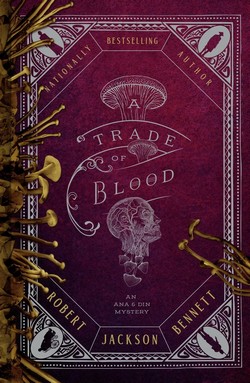
 A Trade of Blood
DETAILS:
Series: Shadow of the Leviathan, #3
Publisher: Del Rey
Publication Date: August 4, 2026
Format: eARC
Length: 400 pg.
Read Date: July 23-29, 2026


What’s A Trade of Blood About?
The book opens with Ana Dolabra going on a screed about why the murders of young, rich women get so much more attention—and seem to shock the general populace more—than any other murder or other crime. And anyone who’s watched cable news in the last couple of decades (or read a newspaper ever), will instantly understand what she’s saying—just one of the many ways their Fantasy world reminds a reader of ours.
Ana and her assistant, Dinios Kol. are called to investigate a gruesome murder of a young, rich woman, not-at-all-coincidentally. Well that’s officially what they’re about. But really, they’re on hand to keep an all-out feud from exploding between two rich and powerful families in the primary meat-producing canton in the kingdom. If these people go to war, it’s going to have a devastating impact on the food supply.
The victim was a young “Capulet” woman, and the presumed killer—butcher, really—is a young “Montague” gentleman. And the remaining members of their families and many of their allies and all of their servants are ready to go. Ana and Din quickly ascertain something’s fishy about the whole thing—and what Ana’s initial experiments prove gives a new definition to unnerving. But it definitely shows that there’s more to this murder than meets the eye.
The crimes multiply—especially as the pair starts asking questions about the recent past for these families. This murder is just the latest in a cleverly disguised series, and the killing isn’t done. In fact, the victim count is about to skyrocket. And if these investigators don’t stop the killings, it’s going to be even worse than that.
Before they arrive at the crime scene, Ana is afraid this case is going to be boring. By the time it’s over, I think she’d have been happier to have been bored.
Dinios Kol
As Ana’s assistant—the one who interacts with people for her, gathers clues and witnesses, and basically does all the legwork so she doesn’t have to risk over-stimulation—we’ve spent more time with Din than Ana over the course of the series. And that’s still true. So reader feel like we know him pretty well—and that’s true. (he’s also the first-person narrator, but his reporting is so frequently as dispassionate as a third-person narrator, so it’s forgettable)
But putting him in a region that reminds him so much of home? Well, now we’re really getting to know him. We’ve known since the first book that he came from a poor family and that he entered government service to pay off some debts incurred by his dead father. Well, we get more details about that—and the financial status of the family (and more about the family as well).
More than that, Din’s looking around at circumstances like he knew growing up from fresh eyes. Eyes that have seen the sea walls protecting the nation, seen a leviathan, seen areas of the kingdom that are so far away and so different from his home that it’s hard to believe they’re part of the same kingdom, seen horrible deaths and the blackness of the human heart. And, given his augmentations, he’ll never forget any of that. Now he comes back to see this area through different eyes. That’s got to do a number on him.
And his boss uses this to poke at him a little, too. In mostly good fun.
The Worldbuilding
Bennett has put on a clinic on how to do worldbuilding in the first two books of this series—and he follows it up in this third book by doing it again. I want to go on and on and on about it, but I don’t know how to do that without spoiling anything.
Let’s see if I can do this obliquely enough that Del Rey won’t get so annoyed that I won’t get approved for the next book in the series. We get introduced to a species of cattle, a feline species, some fungal types that have some fascinating properties, new religious figures, a take on a type of economy, and a sign of some truly devastating ecological problems on the horizon. And more, too.
It’s just amazing to watch him at work over these three books—and I cannot wait to see what we learn about this world next. If you thought Ana revealed some mind-blowing stuff last time (in addition to what they learned through the case, which was staggering in itself), buckle up, cowpokes.
Why did I pick this up? Why did I keep reading?
I picked this up because before the first book in this series was finished, I knew I was going to read every book in it. I finished it for the same reason—and it’s probably my favorite of the three. Which is saying something when I recall that the first two books were among my favorites of their respective years. If I’m not talking about this in December/January, I’ll be shocked.
So, what did I think about A Trade of Blood?
I really shouldn’t have had as much fun reading this as I did, because this book is grim. In a way, worse than what Michel, Abercrombie, Martin, or Fletcher put out. But the characters are great, they’ve been established so well with readers that it’s like visiting a friend. Moreover, Ana Dolabra was on fire this outing. Yeah, she’s creepifying and off-putting as usual (in addition to strange and brilliant), but she made me grin in almost every conversation, and I laughed more than once because of her.
As far as the mystery goes—Bennett got me. I repeatedly wrote in my notes who I thought—no, who I was convinced—the killer was and shot down various other theories and lines of dialogue that suggested otherwise. It’s rare I’m that convinced in a mystery novel that I’m right, although I have a pretty good average when I am that certain. I should’ve known that Bennett wouldn’t make it that easy. I was correct once, but I talked myself out of it for a far lesser candidate, and really didn’t reconsider the actual killer until unmasked.
There’s a lot of ugliness to be found in tis book, as I alluded to earlier. The motives for the crimes are bad enough. But the actions and attitudes that led to those motives are possibly worse—not to justify any of the crimes or anything—but you can take it in and say, “yeah, I see where someone could break because of that.” And then, when you take in the economic and scientific context and conditions…and where it looks like those economics and science are going to leave the populace. Well, I tell ya, “ugly” and “grim” don’t seem to go far enough.
At the end of the day, though, this is a story about very relatable people and very relatable wounds. It could be fair to say that heartbreak is at the core of it all. Bennett just wraps it up in a fantastical package.
In case I’ve been too subtle—go get this. Like now. It’d work as a jumping on point, but I think you’d be better off starting from The Tainted Cup. Either way, read all of this series.
Disclaimer: I received this eARC from Del Rey via NetGalley in exchange for this post which contains my honest opinion—thanks to both for this.
This post contains an affiliate link. If you purchase from it, I will get a small commission at no additional cost to you. As always, the opinions expressed are my own.