

Tag: Shadow of the Leviathan

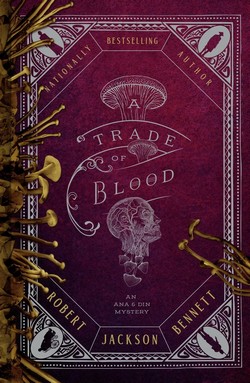
A Trade of Blood by Robert Jackson Bennett: Two Households, Both Alike In Infamy

Cover of A Trade of Blood by Robert Jackson BennettA Trade of Blood

by Robert Jackson Bennett

DETAILS:
Series: Shadow of the Leviathan, #3
Publisher: Del Rey
Publication Date: August 4, 2026
Format: eARC
Length: 400 pg.
Read Date: July 23-29, 2026

Buy from Bookshop.org Support Indie Bookstores

What’s A Trade of Blood About?

The book opens with Ana Dolabra going on a screed about why the murders of young, rich women get so much more attention—and seem to shock the general populace more—than any other murder or other crime. And anyone who’s watched cable news in the last couple of decades (or read a newspaper ever), will instantly understand what she’s saying—just one of the many ways their Fantasy world reminds a reader of ours.

Ana and her assistant, Dinios Kol. are called to investigate a gruesome murder of a young, rich woman, not-at-all-coincidentally. Well that’s officially what they’re about. But really, they’re on hand to keep an all-out feud from exploding between two rich and powerful families in the primary meat-producing canton in the kingdom. If these people go to war, it’s going to have a devastating impact on the food supply.

The victim was a young “Capulet” woman, and the presumed killer—butcher, really—is a young “Montague” gentleman. And the remaining members of their families and many of their allies and all of their servants are ready to go. Ana and Din quickly ascertain something’s fishy about the whole thing—and what Ana’s initial experiments prove gives a new definition to unnerving. But it definitely shows that there’s more to this murder than meets the eye.

The crimes multiply—especially as the pair starts asking questions about the recent past for these families. This murder is just the latest in a cleverly disguised series, and the killing isn’t done. In fact, the victim count is about to skyrocket. And if these investigators don’t stop the killings, it’s going to be even worse than that.

Before they arrive at the crime scene, Ana is afraid this case is going to be boring. By the time it’s over, I think she’d have been happier to have been bored.

Dinios Kol

As Ana’s assistant—the one who interacts with people for her, gathers clues and witnesses, and basically does all the legwork so she doesn’t have to risk over-stimulation—we’ve spent more time with Din than Ana over the course of the series. And that’s still true. So reader feel like we know him pretty well—and that’s true. (he’s also the first-person narrator, but his reporting is so frequently as dispassionate as a third-person narrator, so it’s forgettable)

But putting him in a region that reminds him so much of home? Well, now we’re really getting to know him. We’ve known since the first book that he came from a poor family and that he entered government service to pay off some debts incurred by his dead father. Well, we get more details about that—and the financial status of the family (and more about the family as well).

More than that, Din’s looking around at circumstances like he knew growing up from fresh eyes. Eyes that have seen the sea walls protecting the nation, seen a leviathan, seen areas of the kingdom that are so far away and so different from his home that it’s hard to believe they’re part of the same kingdom, seen horrible deaths and the blackness of the human heart. And, given his augmentations, he’ll never forget any of that. Now he comes back to see this area through different eyes. That’s got to do a number on him.

And his boss uses this to poke at him a little, too. In mostly good fun.

The Worldbuilding

Bennett has put on a clinic on how to do worldbuilding in the first two books of this series—and he follows it up in this third book by doing it again. I want to go on and on and on about it, but I don’t know how to do that without spoiling anything.

Let’s see if I can do this obliquely enough that Del Rey won’t get so annoyed that I won’t get approved for the next book in the series. We get introduced to a species of cattle, a feline species, some fungal types that have some fascinating properties, new religious figures, a take on a type of economy, and a sign of some truly devastating ecological problems on the horizon. And more, too.

It’s just amazing to watch him at work over these three books—and I cannot wait to see what we learn about this world next. If you thought Ana revealed some mind-blowing stuff last time (in addition to what they learned through the case, which was staggering in itself), buckle up, cowpokes.

Why did I pick this up? Why did I keep reading?

I picked this up because before the first book in this series was finished, I knew I was going to read every book in it. I finished it for the same reason—and it’s probably my favorite of the three. Which is saying something when I recall that the first two books were among my favorites of their respective years. If I’m not talking about this in December/January, I’ll be shocked.

So, what did I think about A Trade of Blood?

I really shouldn’t have had as much fun reading this as I did, because this book is grim. In a way, worse than what Michel, Abercrombie, Martin, or Fletcher put out. But the characters are great, they’ve been established so well with readers that it’s like visiting a friend. Moreover, Ana Dolabra was on fire this outing. Yeah, she’s creepifying and off-putting as usual (in addition to strange and brilliant), but she made me grin in almost every conversation, and I laughed more than once because of her.

As far as the mystery goes—Bennett got me. I repeatedly wrote in my notes who I thought—no, who I was convinced—the killer was and shot down various other theories and lines of dialogue that suggested otherwise. It’s rare I’m that convinced in a mystery novel that I’m right, although I have a pretty good average when I am that certain. I should’ve known that Bennett wouldn’t make it that easy. I was correct once, but I talked myself out of it for a far lesser candidate, and really didn’t reconsider the actual killer until unmasked.

There’s a lot of ugliness to be found in tis book, as I alluded to earlier. The motives for the crimes are bad enough. But the actions and attitudes that led to those motives are possibly worse—not to justify any of the crimes or anything—but you can take it in and say, “yeah, I see where someone could break because of that.” And then, when you take in the economic and scientific context and conditions…and where it looks like those economics and science are going to leave the populace. Well, I tell ya, “ugly” and “grim” don’t seem to go far enough.

At the end of the day, though, this is a story about very relatable people and very relatable wounds. It could be fair to say that heartbreak is at the core of it all. Bennett just wraps it up in a fantastical package.

In case I’ve been too subtle—go get this. Like now. It’d work as a jumping on point, but I think you’d be better off starting from The Tainted Cup. Either way, read all of this series.

Disclaimer: I received this eARC from Del Rey via NetGalley in exchange for this post which contains my honest opinion—thanks to both for this.

This post contains an affiliate link. If you purchase from it, I will get a small commission at no additional cost to you. As always, the opinions expressed are my own.


20 Books of Summer 2026

Irresponsible Reader Pilcrow Icon

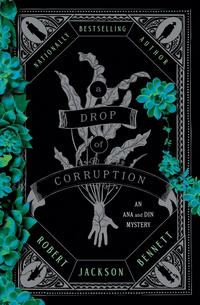
A Drop of Corruption by Robert Jackson Bennett: There’s Not More than A Drop of this to Complain About (so I won’t)

Cover of A Drop of Corruption by Robert Jackson Bennett A Drop of Corruption

by Robert Jackson Bennett

DETAILS:
Series: Shadow of the Leviathan, #2
Publisher: Del Rey
Publication Date: April 1, 2025
Format: eARC
Length: 480 pgs.
Read Date: March 17-21, 2025
Buy from Bookshop.org Support Indie Bookstores

What’s A Drop of Corruption About?

Dinios Kol arrives (as is his custom) in the canton of Yarrowdale, ahead of his boss, Ana Dolabra. They’ve been assigned to investigate the disappearance of a Treasury officer. This officer—and the rest of the Treasury delegation—is in Yarrowdale to negotiate with the King the final steps of Yarrowdale fully joining the Empire once and for all.

Right now, Yarrowdale is (rightly or wrongly) considered a backwater territory, valuable for one thing only—it’s a place that the leviathans do not travel to, so their corpses can be moved there and harvested for the copious near-magical substances used by the Empire. (incidentally, I found this whole aspect just tremendously cool. I won’t say more than that, but if we only got a novella about this part, I’d have been satisfied). This is the only place where this is safely done, so it’s hard to understate the strategic importance of Yarrowdale.

So one of the Empire’s chief negotiators going missing is no small thing—so Dolabra is assigned to find him.

Not at all shockingly (to any reader), the corpse of the officer is quickly located once Kol arrives. Its condition raises eyebrows and concerns—and that’s just the beginning, the more they investigate the circumstances around this killing the less sense things make, and the greatness of the mind behind it is seen. Dolabra is excited by the challenge, while everyone around her becomes more and more apprehensive with each discovery or conclusion she makes.

I won’t go on much beyond this—I’d love to summarize the whole book for you, but why? More victims are found, more questions are raised, the stakes keep climbing higher, and the implications for the future of the Empire are great.

Dolabra and Kol

When I talked about The Tainted Cup, I didn’t really talk about the primary characters. I hesitate to start now because I’m going to have a hard time stopping. But let me try to dip my toe into it.

Ana Dolabra is a brilliant investigator for the Empire—being sent to the trickiest investigations and given almost unlimited authority to get the answers she seeks. Due to some physical (and psychological) limitations—and the fact that she has zero interpersonal skills (and that’s being generous)—she requires a deputy to handle most of the actual investigating, bringing her the evidence and testimony that she needs to solve the crimes.

Which is where Dinios Kol comes in. He’s been altered to have a perfect memory—sights, sounds, smells, conversation…you name it, he remembers it all (even if he doesn’t want to). So he’s the perfect assistant for someone who will not interact with people of her own volition. There are jobs he’d rather perform—and places he’d rather perform them. But his family needs money to pay medical debt, and this is the surest way for him to accomplish that. He escapes into drink, drugs (I think it’s more like tobacco than anything, but I’m prepared to be shown that I’m wrong), and sex as often as he can. But is reliable when the chips are down—he has to be.

Ana Dolabra is very much in the Nero Wolfe mold—purposefully so. But she breaks the mold in all the right ways—her reasons for relying on someone else to interact with the outside world are different and less self-imposed. Her ego is as large (I wasn’t sure that was possible), and she takes some of these crimes as a personal attack on her and her genius (like Wolfe occasionally does). But she relishes the challenge—and talks openly about enjoying this case compared to the boring murders and whatnot she’s solved recently. She has a strange relationship with eating so that sometimes she sounds like her antecedent and other times the complete opposite.

Most people will not care about this (and I assure you, that paragraph could be longer)—but I’m incapable of reading any section featuring Dolabra without pausing to contrast her to Wolfe. She never comes out bad in these comparisons—just different in a creative way.

Her Archie Goodwin, Dinios Kol, can be compared and contrasted in the same way. I started to say he’s less like Archie, and I really want to. But I can really think of one major difference—what drives them. Kol’s motivation for the work (at this point, anyway, it may be shifting toward the end) is different. So he behaves with a little less loyalty. This makes him more interesting and makes up for his lack of humor. Ah, look there—I found another notable difference. Kol is far too serious to really be an Archie, but I wouldn’t want to change a thing about him.

Building on the Worldbuilding

In The Tainted Cup, Bennett introduced us to a fascinating and complex world of kaiju-esque monsters, magic-feeling science, and a massive empire that’s keeping humanity alive. it was both awesome and strange. In A Drop of Corruption, it’s almost as if Bennet tells the reader, “So you’ve seen the typical in this world, but you ain’t ready for this.” As strange and terrible as we thought things were…ha.

We get to see new augmentations, we get to see how outsiders (or semi-outsiders) regard the Empire, we learn a whole lot of history about the Empire, the monsters, the science behind the augmentations, and so much more. I’m having trouble expressing it all.

In both books so far Bennett can bring the unbelievable and indescribable to life. Din will start a sentence by saying something like, “Words cannot express ___” or “It’s too incredible to explain” or something like that—and then will falteringly describe it in such a way that the reader comes away with a pretty good idea of what Din saw. Even when he’s not calling his shot like that, item after item, phenomenon after phenomenon, creature after creature that really shouldn’t make sense when written about comes through with a level of detail that leads the reader to think they’re imagining what Bennett imagined.

Sure….it’s likely that no two readers will have similar mental images. But that’s not important—you’ll think you do.

The Author’s Note

The Author’s Note (largely an Acknowledgement section, but a little bit more) is a must-read. I don’t know if you’re prone to reading them—particularly if they feel more like an Acknowledgment than anything else. But make an exception for this one. It’s worth your time.

So, what did I think about A Drop of Corruption?

I was blown away by The Tainted Cup, and so I was apprehensive about this one—could it live up to it? I’m pleased to say that it did. I very likely enjoyed this much more—because I was ready for the strangeness and could just let it build on what the prior book did.

I feel bad saying I had fun reading about all the trauma that these victims went through, but I really did. Kol and Dolabra—and Kol’s new local acquaintances are just so well-conceived and vividly drawn, that it’d be harder to be disinterested than captivated.

The mystery kept me guessing until the end (except for the time I thought I’d figured it out, and I was very wrong). There was even a point where I wrote in my notes, “Could this be a redder herring?” and it was anything but. I won’t go into details so you can be fooled like I was, but man… The only thing I like more than the smug satisfaction of figuring out a mystery before a brilliant detective is an author who can fool me into that smugness only to pull the rug out from under me. Not to get elitist or anything, but a fantasy writer should be worse at this than a mystery writer. Bennett didn’t get that memo.

I do think you could read this book without the first in the series—but don’t do that to yourself. Buy a copy of this now (or get on your Library’s waitlist), but get The Tainted Cup at the same time. If I’m right about where this series is going (or even almost close to right), you’re going to want to be ready for it. This is just dynamite.

This book deserves more compliments from me—but who has the time? (not the guy who meant to post this a week or so ago). A great mystery novel, a great fantasy novel, with characters that you’d want to read about even if the plots weren’t worth the time or trouble.

Disclaimer: I received this eARC from Random House Publishing Group – Del Rey, Random House Worlds, Inklore via NetGalley in exchange for this post which contains my honest opinion—thanks to both for this.


5 Stars

This post contains an affiliate link. If you purchase from it, I will get a small commission at no additional cost to you. As always, the opinions expressed are my own.
Irresponsible Reader Pilcrow Icon

PUB DAY REPOST: The Tainted Cup by Robert Jackson Bennett: This Mystery/Fantasy Hybrid is My First 5-Star Read of the Year

The Tainted CupThe Tainted Cup

by Robert Jackson Bennett

DETAILS:
Series: Shadow of the Leviathan, #1
Publisher: Del Rey Books
Publication Date: February 6, 2024
Format: eARC
Length: 432 pg.
Read Date: January 4-9, 2023
Buy from Bookshop.org Support Indie Bookstores

What’s The Tainted Cup About?

This is a Mystery/Detective novel set in a Fantasy world. But to say that almost diminishes it. This is a Fantasy world you’re not used to seeing—well, I’m not anyway, you might be better read in the genre than I am. At the core of the mystery story are tropes, characters, motives, and twists that anyone familiar with that genre will recognize and resonate with. Combining the two genres here only serves to make them better.

The instigating event is the murder of a significant, but not hugely important, military figure on an estate of one of the most powerful and rich families in the Empire. That’s enough to get the official investigator, Ana Dolabra, and her assistant, Dinios Kol, involved. When you add in the cause of death—a clutch of trees erupted from the Commander’s chest—well, that’s definitely going to get some official notice. And quickly put you in a Fantasy world. Feel free to read that cause of death a couple of times, it’s still not going to make sense.

There’s just so much to talk about with The Tainted Cup—I’m going to talk about some of the best parts of this book as you would an Oreo cookie. The Mystery part is the creamy center (at least a Double Stuff in this case), and then the crispy cookie halves of the World Building/Setting and the Science of this World.

The Mystery

I already wrote a section below that quibbles with the official description, and I feel bad about doing that twice (am I risking future NetGalley approvals by this?), but I have to. It starts off by saying, “A Holmes and Watson–style detective duo.” You can maybe stretch things and call Ana Dolabra a Holmes-type character. Maybe. But outside of being the first-person narrator, there is nothing Dr. Watson-esque about Dinios Kol. I do not know if Bennett is a Rex Stout/Nero Wolfe reader. I suspect he is, though, because Dolabra and Kol are firmly in the Nero Wolfe/Archie Goodwin mold. (there are other versions of this duo, Pentecost and Parker and Jake and the Fatman spring to mind, but there are others).

I mention this because I think the duo of Wolfe and Archie is one of the greatest achievements in Detective Fiction, and will joyously talk at length about them at length at any opportunity. Bennett using these types at the center of this book almost automatically guaranteed that I’m going to enjoy it. Particularly if he does it successfully. And, boy howdy, does he.

Ana Dolabra is a brilliant and eccentric figure. Our Nero Wolfe. She can be pressed into politeness with enough reason, but on the whole, she’s blunt, crass, and solely focused on things that interest her. For a variety of reasons, Ana rarely leaves her quarters, instead, she has clues, interviewees, and suspects brought to her (and frequently, those she reports to, too). More than once she brings suspects and interview subjects together to question and/or to reveal a solution, putting on a show for others.

She has a new assistant, Dinios Kol, to serve as her eyes and ears in the outside world—and to bring back those bits of the world she needs to do her work. Thanks to a special augmentation, he has a perfect and permanent memory and will remember entire conversations and things he sees perfectly, with the ability to describe them to the detail Ana needs. He looks at crime scenes, records, bodies, etc. for her, conducts initial interviews with witnesses and experts, and so on. He also seems to do his best to keep her interactions with others at socially-appropriate levels (although this is a challenge). If this isn’t Archie Goodwin to a T.

They’ve been working together for a while now—mostly on fraud cases. This is their first murder case—and they wrap it up quickly and efficiently. Except, Ana is pretty sure that this murder will be linked to others—something more than murder is afoot here, she’s certain. And she’s right. (I assume this is almost always the case—Dinios certainly does)

Soon, she and her assistant are assigned to help in the investigation in a nearby city where several others have been killed in the same way. Dinios is partnered up with an experienced Assistant Investigator, Capt. Tazi Miljin, who does some on-the-job training and mentoring while working the case.

Soon, they determine that this isn’t just a murder case—nor is it several connected murder cases, there is something much bigger going on. Something that puts an entire city—possibly the entire Empire—at risk.

The World

I don’t know that I want to get too in-depth here, because the discovery of it all* is part of the magic of this book.

* And by “all,” I mean all that Bennett is going to share with us in this book—there’s much more to learn in books to come.

We find ourselves in a minor city in an Empire at the beginning of the novel before we move to a larger city, a major center of military importance. We don’t know a lot about this Empire—it’s centuries old, there are civic religions/cults but we see very few true adherents, and many people are cynical about the government. But it doesn’t matter—they need the Empire to keep them alive. So they push on.

The military isn’t focused on other nations/city-states/bands of roving mercenaries or outside human threats (although they do take the time to focus on bands of deserters). Instead, they’re focused on the seas. Each year, during the rainy season, monstrously large sea creatures they dub Leviathans (both think and don’t think about other Leviathans you’ve come across—other than large, water-bound, and scary) attempt to come ashore and snack on humans, cattle, whatever.

Places like Talagray, where we spend most of the novel, exist to maintain the wall between sea and land—leviathan and Empire—it’s a massive wall (massive in a way I cannot get across to you) with the occasional weapons mounted to attack the leviathan. I saw Talagray as sort of Jackson’s vision of Minas Tirith, but flattened to one elevation. I’m not sure if that’s what Bennet was going for, but that’s what my mind saw. Maybe a little muddier.

While the local canton is concerned with the murders, naturally, their primary concern during this season is the maintenance of the wall. Some of these murders have threatened the integrity of the wall in important ways, threatening all of Talagray. As important as solving the murder is—stopping further murders and therefore preventing further damage to the wall is far more important. Also…they probably have something special in store for anyone who’d risk the wall in any way.

The Science

I’m disagreeing a bit here with the official description—so take my observation with a grain of salt (but I stand by it). There’s no magic in this Fantasy novel—which, sure, happens sometimes. But it’s still strange and notable.

What this novel does have is “sufficiently advanced technology [which] is indistinguishable from magic.” It’s not often that I get to apply Clarke’s Third Law this way, but it works. This is a very technological society, but nothing we’d recognize, really. There are no circuits anywhere, no electricity…horses and carts are the primary means of transportation for those who are going too far or need to go too quickly to walk. But they practice all sorts of engineering feats, genetic manipulation, medical marvels, and so on.

The source of their raw materials? The Leviathans that threaten them all. When these Leviathans die/are killed, the Empire’s scientists harvest blood, tissue, and bone for all sorts of things to accomplish the above. Leviathan bone is difficult to shape, but it results in tools and swords that are beyond the strength and endurance of metal. Tissues can be manipulated and applied to humans to extend their abilities (augmenting strength, enabling them to have memories that are like eidetic memory to the nth power, control of their pheromones to alter the behavior of those around them, and so on).

Especially when it comes to the abilities that some of these people have, or the freakish contamination that the murderer is using, in a Fantasy book featuring people on horseback using swords, this looks like magic. But it ain’t. It’s just a kind of science that’s sufficiently advanced that 21st-century Western Readers can’t distinguish. And I love that. Bennett does such a convincing and thorough job of describing this (without getting mired in the details) that it just comes alive and you believe it all—and want to learn more about it.

So, what did I think about The Tainted Cup?

My reflex reaction ought to be, I want more of the detective-y stuff. How could I not? That’s my default genre, Ana is a fantastic character, Dinios at work is so much fun, and the pair of them being new incarnations of Wolfe and Archie. But when you add in the world-building, the intrigue and politics, and all the cool science-y bits? I wouldn’t have it any other way. You need all of it to make something this good. And it really does—each section above would probably earn 4 stars or so from me. But when you put them together, the accumulated score has to be at least 5.

Also, all the other stuff in the book distracts from a couple of the problems with the mystery story. These aren’t significant problems by any means, but at one point Ana reveals that Person X is Person Y, and her assistants are shocked and amazed. I assumed everyone realized that as soon as Person Y was introduced and described. For it to take umpteen chapters for everyone to catch up astounded me (am pretty sure Ana was as fast as me, for the record). The other thing that I’d consider a problem, I won’t get into for spoiler-reasons, but I was distracted enough that I didn’t see it until the reveal. Also, it’s the kind of thing that Rex Stout himself would do, so I’m never going to complain about it. Mostly, because it worked really well for the story, so who cares?

Regular readers may have noted that I haven’t spent that much time talking about the characters. I chose not to for time/space reasons. If I focused on writing about Ana, Dinios, and Miljin alone—I’d double the length of this post. If I included every major character I want to talk about? I’d triple the length. No one wants to read me going on that long. So I’ll sum it up by saying that his characters are just as good and developed (and strange) as everything else I’ve talked about.

Bennett doesn’t show a lot of flair in this writing. It has almost none of Elmore’s “Hooptedoodle”—although he violates a lot of Elmore’s other rules (and does so for the betterment of the novel). This is a description, not a criticism, you’re not going to be wowed with his style. He doesn’t need that. The descriptions of characters, structures, and monsters are so vivid, so detailed you have no problem seeing exactly what he wants you to see (with just enough room for the reader’s imagination). The action scenes are well-executed. The descriptions of the trees growing from outside of a person are as disturbing as they should be. There are flashes of humor, flashes of hope and optimism in both the characters and the story—but it’s all in the shadow of the imminent threat posed by the Leviathans and weakened walls. So there’s a strong “The World May Be Ending Tomorrow if not Tonight” feel throughout. I was under the spell of the narration and story from early on.

I didn’t set out to rave about this book. I was going to enthusiastically recommend it, but as I started to put my notes into some sort of order and write, I discovered that I really needed and wanted to rave about this. Fantasy fans are really going to get into this. Mystery/Detective Fiction fans who aren’t afraid to play in other worlds are going to go nuts over this. And I want to read the next book in the series today. But I’m willing to be patient—The Tainted Cup won’t even be published for 26 days. So I won’t start complaining about the delay in getting the next volume for 90 days (that seems fair).

Go place your orders or library holds now.

Disclaimer: I received this eARC from Penguin Random House via NetGalley in exchange for this post—thanks to both for this.


5 Stars

This post contains an affiliate link. If you purchase from it, I will get a small commission at no additional cost to you. As always, the opinions expressed are my own.

Irresponsible Reader Pilcrow Icon

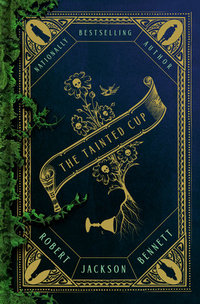
The Tainted Cup by Robert Jackson Bennett: This Mystery/Fantasy Hybrid is My First 5-Star Read of the Year

The Tainted CupThe Tainted Cup

by Robert Jackson Bennett

DETAILS:
Series: Shadow of the Leviathan, #1
Publisher: Del Rey Books
Publication Date: February 6, 2024
Format: eARC
Length: 432 pg.
Read Date: January 4-9, 2023
Buy from Bookshop.org Support Indie Bookstores

What’s The Tainted Cup About?

This is a Mystery/Detective novel set in a Fantasy world. But to say that almost diminishes it. This is a Fantasy world you’re not used to seeing—well, I’m not anyway, you might be better read in the genre than I am. At the core of the mystery story are tropes, characters, motives, and twists that anyone familiar with that genre will recognize and resonate with. Combining the two genres here only serves to make them better.

The instigating event is the murder of a significant, but not hugely important, military figure on an estate of one of the most powerful and rich families in the Empire. That’s enough to get the official investigator, Ana Dolabra, and her assistant, Dinios Kol, involved. When you add in the cause of death—a clutch of trees erupted from the Commander’s chest—well, that’s definitely going to get some official notice. And quickly put you in a Fantasy world. Feel free to read that cause of death a couple of times, it’s still not going to make sense.

There’s just so much to talk about with The Tainted Cup—I’m going to talk about some of the best parts of this book as you would an Oreo cookie. The Mystery part is the creamy center (at least a Double Stuff in this case), and then the crispy cookie halves of the World Building/Setting and the Science of this World.

The Mystery

I already wrote a section below that quibbles with the official description, and I feel bad about doing that twice (am I risking future NetGalley approvals by this?), but I have to. It starts off by saying, “A Holmes and Watson–style detective duo.” You can maybe stretch things and call Ana Dolabra a Holmes-type character. Maybe. But outside of being the first-person narrator, there is nothing Dr. Watson-esque about Dinios Kol. I do not know if Bennett is a Rex Stout/Nero Wolfe reader. I suspect he is, though, because Dolabra and Kol are firmly in the Nero Wolfe/Archie Goodwin mold. (there are other versions of this duo, Pentecost and Parker and Jake and the Fatman spring to mind, but there are others).

I mention this because I think the duo of Wolfe and Archie is one of the greatest achievements in Detective Fiction, and will joyously talk at length about them at length at any opportunity. Bennett using these types at the center of this book almost automatically guaranteed that I’m going to enjoy it. Particularly if he does it successfully. And, boy howdy, does he.

Ana Dolabra is a brilliant and eccentric figure. Our Nero Wolfe. She can be pressed into politeness with enough reason, but on the whole, she’s blunt, crass, and solely focused on things that interest her. For a variety of reasons, Ana rarely leaves her quarters, instead, she has clues, interviewees, and suspects brought to her (and frequently, those she reports to, too). More than once she brings suspects and interview subjects together to question and/or to reveal a solution, putting on a show for others.

She has a new assistant, Dinios Kol, to serve as her eyes and ears in the outside world—and to bring back those bits of the world she needs to do her work. Thanks to a special augmentation, he has a perfect and permanent memory and will remember entire conversations and things he sees perfectly, with the ability to describe them to the detail Ana needs. He looks at crime scenes, records, bodies, etc. for her, conducts initial interviews with witnesses and experts, and so on. He also seems to do his best to keep her interactions with others at socially-appropriate levels (although this is a challenge). If this isn’t Archie Goodwin to a T.

They’ve been working together for a while now—mostly on fraud cases. This is their first murder case—and they wrap it up quickly and efficiently. Except, Ana is pretty sure that this murder will be linked to others—something more than murder is afoot here, she’s certain. And she’s right. (I assume this is almost always the case—Dinios certainly does)

Soon, she and her assistant are assigned to help in the investigation in a nearby city where several others have been killed in the same way. Dinios is partnered up with an experienced Assistant Investigator, Capt. Tazi Miljin, who does some on-the-job training and mentoring while working the case.

Soon, they determine that this isn’t just a murder case—nor is it several connected murder cases, there is something much bigger going on. Something that puts an entire city—possibly the entire Empire—at risk.

The World

I don’t know that I want to get too in-depth here, because the discovery of it all* is part of the magic of this book.

* And by “all,” I mean all that Bennett is going to share with us in this book—there’s much more to learn in books to come.

We find ourselves in a minor city in an Empire at the beginning of the novel before we move to a larger city, a major center of military importance. We don’t know a lot about this Empire—it’s centuries old, there are civic religions/cults but we see very few true adherents, and many people are cynical about the government. But it doesn’t matter—they need the Empire to keep them alive. So they push on.

The military isn’t focused on other nations/city-states/bands of roving mercenaries or outside human threats (although they do take the time to focus on bands of deserters). Instead, they’re focused on the seas. Each year, during the rainy season, monstrously large sea creatures they dub Leviathans (both think and don’t think about other Leviathans you’ve come across—other than large, water-bound, and scary) attempt to come ashore and snack on humans, cattle, whatever.

Places like Talagray, where we spend most of the novel, exist to maintain the wall between sea and land—leviathan and Empire—it’s a massive wall (massive in a way I cannot get across to you) with the occasional weapons mounted to attack the leviathan. I saw Talagray as sort of Jackson’s vision of Minas Tirith, but flattened to one elevation. I’m not sure if that’s what Bennet was going for, but that’s what my mind saw. Maybe a little muddier.

While the local canton is concerned with the murders, naturally, their primary concern during this season is the maintenance of the wall. Some of these murders have threatened the integrity of the wall in important ways, threatening all of Talagray. As important as solving the murder is—stopping further murders and therefore preventing further damage to the wall is far more important. Also…they probably have something special in store for anyone who’d risk the wall in any way.

The Science

I’m disagreeing a bit here with the official description—so take my observation with a grain of salt (but I stand by it). There’s no magic in this Fantasy novel—which, sure, happens sometimes. But it’s still strange and notable.

What this novel does have is “sufficiently advanced technology [which] is indistinguishable from magic.” It’s not often that I get to apply Clarke’s Third Law this way, but it works. This is a very technological society, but nothing we’d recognize, really. There are no circuits anywhere, no electricity…horses and carts are the primary means of transportation for those who are going too far or need to go too quickly to walk. But they practice all sorts of engineering feats, genetic manipulation, medical marvels, and so on.

The source of their raw materials? The Leviathans that threaten them all. When these Leviathans die/are killed, the Empire’s scientists harvest blood, tissue, and bone for all sorts of things to accomplish the above. Leviathan bone is difficult to shape, but it results in tools and swords that are beyond the strength and endurance of metal. Tissues can be manipulated and applied to humans to extend their abilities (augmenting strength, enabling them to have memories that are like eidetic memory to the nth power, control of their pheromones to alter the behavior of those around them, and so on).

Especially when it comes to the abilities that some of these people have, or the freakish contamination that the murderer is using, in a Fantasy book featuring people on horseback using swords, this looks like magic. But it ain’t. It’s just a kind of science that’s sufficiently advanced that 21st-century Western Readers can’t distinguish. And I love that. Bennett does such a convincing and thorough job of describing this (without getting mired in the details) that it just comes alive and you believe it all—and want to learn more about it.

So, what did I think about The Tainted Cup?

My reflex reaction ought to be, I want more of the detective-y stuff. How could I not? That’s my default genre, Ana is a fantastic character, Dinios at work is so much fun, and the pair of them being new incarnations of Wolfe and Archie. But when you add in the world-building, the intrigue and politics, and all the cool science-y bits? I wouldn’t have it any other way. You need all of it to make something this good. And it really does—each section above would probably earn 4 stars or so from me. But when you put them together, the accumulated score has to be at least 5.

Also, all the other stuff in the book distracts from a couple of the problems with the mystery story. These aren’t significant problems by any means, but at one point Ana reveals that Person X is Person Y, and her assistants are shocked and amazed. I assumed everyone realized that as soon as Person Y was introduced and described. For it to take umpteen chapters for everyone to catch up astounded me (am pretty sure Ana was as fast as me, for the record). The other thing that I’d consider a problem, I won’t get into for spoiler-reasons, but I was distracted enough that I didn’t see it until the reveal. Also, it’s the kind of thing that Rex Stout himself would do, so I’m never going to complain about it. Mostly, because it worked really well for the story, so who cares?

Regular readers may have noted that I haven’t spent that much time talking about the characters. I chose not to for time/space reasons. If I focused on writing about Ana, Dinios, and Miljin alone—I’d double the length of this post. If I included every major character I want to talk about? I’d triple the length. No one wants to read me going on that long. So I’ll sum it up by saying that his characters are just as good and developed (and strange) as everything else I’ve talked about.

Bennett doesn’t show a lot of flair in this writing. It has almost none of Elmore’s “Hooptedoodle”—although he violates a lot of Elmore’s other rules (and does so for the betterment of the novel). This is a description, not a criticism, you’re not going to be wowed with his style. He doesn’t need that. The descriptions of characters, structures, and monsters are so vivid, so detailed you have no problem seeing exactly what he wants you to see (with just enough room for the reader’s imagination). The action scenes are well-executed. The descriptions of the trees growing from outside of a person are as disturbing as they should be. There are flashes of humor, flashes of hope and optimism in both the characters and the story—but it’s all in the shadow of the imminent threat posed by the Leviathans and weakened walls. So there’s a strong “The World May Be Ending Tomorrow if not Tonight” feel throughout. I was under the spell of the narration and story from early on.

I didn’t set out to rave about this book. I was going to enthusiastically recommend it, but as I started to put my notes into some sort of order and write, I discovered that I really needed and wanted to rave about this. Fantasy fans are really going to get into this. Mystery/Detective Fiction fans who aren’t afraid to play in other worlds are going to go nuts over this. And I want to read the next book in the series today. But I’m willing to be patient—The Tainted Cup won’t even be published for 26 days. So I won’t start complaining about the delay in getting the next volume for 90 days (that seems fair).

Go place your orders or library holds now.

Disclaimer: I received this eARC from Penguin Random House via NetGalley in exchange for this post—thanks to both for this.


5 Stars

This post contains an affiliate link. If you purchase from it, I will get a small commission at no additional cost to you. As always, the opinions expressed are my own.
Irresponsible Reader Pilcrow Icon

Powered by WordPress & Theme by Anders Norén