Tag: Fantasy Page 15 of 57

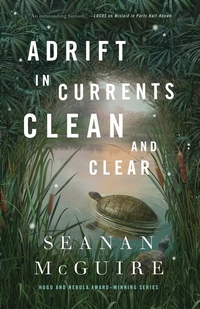
Adrift in Currents Clean and Clear by Seanan McGuire: Water Loves Falling

Cover of Adrift in Currents Clean and Clear by Seanan McGuireAdrift in Currents Clean and Clear

by Seanan McGuire

DETAILS:
Series: Wayward Children, #10
Publisher: Tordotcom
Publication Date: January 7, 2025
Format: eARC
Length: 160 pgs.
Read Date: December 16-18, 2024

Buy from Bookshop.org Support Indie Bookstores

What’s Adrift in Currents Clean and Clear About?

One of the advantages (and, to be fair, aggravating parts) of this series is that each book can be from anywhere on the series timeline. Here in the tenth installment, we get the origin story of someone that we got to know in the third book (Beneath the Sugar Sky). Reality itself is wibbly-wobbly in this series, why not timey wimey?

We meet Nadya at birth—where a young Russian woman who is not ready to be a mother is rushing to give her up—even before she’s freaked out that Nadya is missing an arm. As we watch Nadya growing up, she doesn’t really seem to care about the arm she never had. But when a couple of Americans come to adopt a disadvantaged Russian child, it starts to become a factor in her life.

She’s not comfortable with her new life in the States (yet?), but when a prosthetic arm is imposed on her (in the name of help—see below), she’s made to feel incomplete as well as Other. Her only solace is the pond a short walk from her adoptive parents’ home where she can watch turtles—an animal that has long fascinated her.

Before she knows it, she falls through a Door and ends up in a world she doesn’t understand or recognize (but really isn’t that much stranger than the change from a Russian orphanage to a Colorado suburb).

The Lost and the Lonely

I probably shouldn’t have—but I laughed when she got the “Be Sure” message. It’s in a seemingly-cruel place, but it was original and it meant the story was progressing. I also found her Door rather intriguing.

But better than that was the way her arrival in Belyrreka, the Land Beneath the Lake, was explained to her. Sometimes people come to Belyrreka* because a hero is needed to do something. But sometimes, it’s just that someone isn’t at home in their world and they need a place to fit in. Nadya is the latter, so it seems. Given that most of the children we’ve seen go through a Door to do something heroic, it’s nice to see this option.

This doesn’t mean she’s incapable of heroism, or of doing something important. It just means that she probably ended up in Belyrreka because she belonged there more than on Earth.

This is really a slice-of-life story. We just get to see how Nadya lives and matures in a place where she feels that she belongs, with family, friends, and a purpose. Yes, in the back of our minds, we know that something is going to happen and she’s going to end up at Eleanor West’s Home for Wayward Children. But until then… This novella is like the years between Aslan coronating the Pevensies and the fateful hunt for the White Stag—nothing heroic, nothing particularly notable. Just…life. Regular, ordinary, day-to-day life.

Well, “ordinary” in a world that’s described as Beneath a Lake, where everyone is underwater to one degree or another (breathing without gills), full of talking animals, and where a river can magically endow people with gifts/obligations. So it’s a loose use of the word “ordinary.”

* And by implication, other worlds

I’m Not Entirely Sure This One is Fair

Many of the children we’ve met—particularly if we’ve met their parents, too—aren’t all that fond of their parents. They’re critical of them (even before their Doors appear, definitely afterward). By and large, I’ve been with the children in their critiques and evaluations of the parents—even when it’s clear that the parents are doing their best (which doesn’t happen as often as it should).

I’m not convinced that Nadya is entirely fair when thinking about the adults in her life. Her appraisal of the orphanage staff (at least after they arranged for her to get adopted) is harsh when they really just did what they could to help her get out of the orphanage (which she sees, but attributes it to less-than-altruistic ends). Her parents really don’t understand her (beyond the language) and are clumsy at best in their attempts to help her fit into Colorado. It’s hard to tell how much of the assessment of their motivations and attempts comes from the omniscient narrator and how much is Nadya’s. But really, I think whoever is doing the assessing could be more charitable (without giving blanket approval).

Particularly her adoptive father—I really get the sense that his affection is real and that in time, he’d have become what she needs. I’m not so sure about his wife, however… On some level, they are trying to make life better. But her ideas of better and what needs improved differ.

Now, Nadya is a prepubescent child yanked out of the only home she ever knew, brought to another country and culture without warning (or consent), and forced into a mold and environment that she’s unprepared for. So, sure, she’s going to be less than charitable—it’s justified and understandable. I just wish the narration did a slightly better job of showing that.

So, what did I think about Adrift in Currents Clean and Clear?

That aside…I loved Nadya. Getting to know her like this was great.

This is a book about home. About acceptance. About finding your place in the world, with people who “get” you, who care about you, and who want the best for you—even if that best doesn’t necessarily make a lot of sense to them.

It’s nice, it’s comforting, and it’s reassuring to see Nadya find this for herself and getting to enjoy it for as long as she does. Yes, it’s hard to see her end up back in the “real world” knowing that means some misery before Eleanor comes to her (at least partial) rescue.

There’s a little less whimsy to this novella than many of the other installments in the series—outside of the construction of the world. But if I had to tag this with any description, I’d probably use “cozy.” If I didn’t know this series, I’d assume it would belong with Travis Baldtree or S.L. Rowland. Maybe Heather Fawcett. But I do know better—this series continues to transcend easy categorization. Wayward Children is its own subgenre.

McGuire brings the emotional depth that Nadya and her story need. Belyrreka is a great world that operates on its own (self-aware) logic—it’s a place I’d love to visit (assuming I wouldn’t panic at the whole living underwater thing, which I can’t promise), but wouldn’t want to live. But McGuire brings it to life and fills it with people I wish I could get to know more.

This is definitely one of the stronger books in this series that is on a great roll lately, I commend it to your attention. As with just about every book in the series, it can be read as a stand-alone or as an entry point (but I strongly encourage reading at least Every Heart a Doorway before any of the others). I was sad when it ended—not because of the way it ended, I just wasn’t ready to move on. I predict I won’t be alone in that.

Now, excuse me…I need to go figure out a way to cram in a re-read of Beneath a Sugar Sky to my schedule.

Disclaimer: I received this eARC from Tordotcom Publishing via NetGalley in exchange for this post—thanks to both for this.


4 1/2 Stars

This post contains an affiliate link. If you purchase from it, I will get a small commission at no additional cost to you. As always, the opinions expressed are my own.

Irresponsible Reader Pilcrow Icon

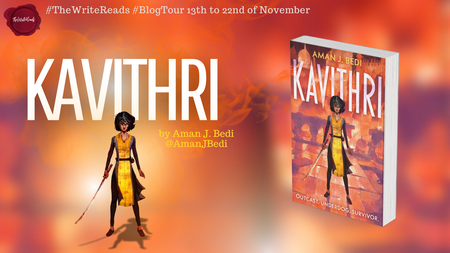
BOOK SPOTLIGHT: Kavithri by Aman J.Bedi

I’m pleased today to welcome The Write Reads Blog Tour for the Indian Progression Fantasy, Kavithri, the first book in The Ghosts of Ethuran. If this looks as good to you from this Spotlight as it does to me, you should go to https://twitter.com/WriteReadsTours feed to see all the great things that people are saying about it. But since you’re here already, you might as well read what I have to tell you about it first.

Kavithri Tour Banner

Book Details:

Title: Kavithri by Aman J.Bedi
Genre: Fantasy
Publisher: Gollancz
Format: Hardcover/Ebook/Audiobook
Length: 448 pages
Publication Date: Oct. 1, 2024
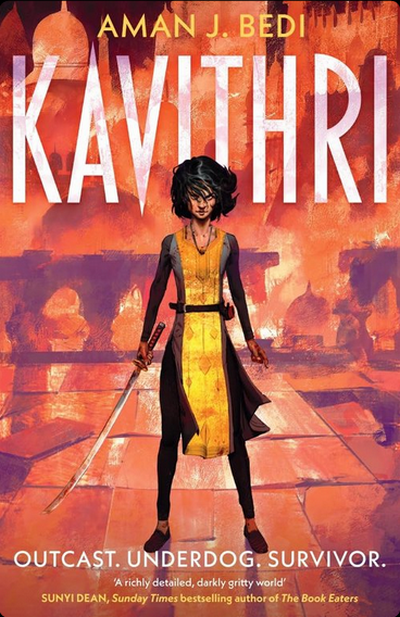
Kavithri by Aman J.Bedi Cover

About the Book:

Meet Kavithri. Outcast. Underdog. Survivor.

Kavi is a Taemu. Her people, once feared berserkers and the spearhead of a continent-spanning invasion, are the dregs of Raayan society. Their spirits crushed. Their swords broken. Their history erased.

But Kavi has a dream and a plan. She will do whatever it takes to earn a place at the secretive mage academy, face the Jinn within its walls, and gain the power to rise above her station and drag her people out of the darkness.

Except power and knowledge come at a cost, and the world no longer needs a Taemu who can fight. So they will break her. Beat her down to her knees. And make her bleed.

But if blood is what they want, Kavi will give them blood. She will give them violence. She will show them a berserker’s fury.

And she will make them remember her name.

An no-holds-barred progression fantasy and empowering South Asian epic – featuring necromancers, djinn and visceral action sequences. An underdog story like no other, Kavithri is perfect for fans of Fonda Lee, Tamsyn Muir and John Gwynne.

‘A richly detailed, darkly gritty world’ Sunyi Dean, Sunday Times bestselling author of The Bone Eaters

‘[A] grim and relentless exploration of colonialism, power, resistance and courage’ Samit Basu

‘Seamlessly packs South Asian lore and progression fantasy into a relentless rollercoaster’ Gourav Mohanty

Book Links:

Amazon UK ~ Amazon ~ Goodreads

About the Author:

Aman J.BediAman was born in Mysore, India. He grew up in Vizag, studied in Bangalore, lived in Bangkok, completed a PhD in experimental psychology at the University of Canterbury, and has settled (for now) in Melbourne, Australia. His writing draws from modern Indian history and is influenced by writers and artists like David Gemmell, Brandon Sanderson, Takehiko Inoue, and Kentaro Miura.

Author Links:

Website ~ Twitter ~ Instagram


My thanks to The Write Reads for the invitation to participate in this tour and the materials they provided.

PUB DAY POST: King Arthur & The Ladies of The Lake by Vincent Pompetti: The Once and Future Graphic Novel For Our Time

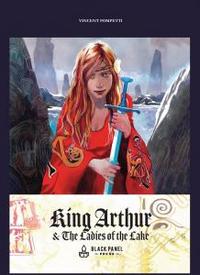
Cover of King Arthur & The Ladies of The Lake by Vincent PompettiKing Arthur & The Ladies of The Lake

by Vincent Pompetti

DETAILS:
Publisher: Black Panel Press
Publication Date: November 19, 2024
Format: eARC
Length: 113 pg.
Read Date: November 9, 2024
Buy from Bookshop.org Support Indie Bookstores

What’s King Arthur & The Ladies of The Lake About?

This is a telling of the Arthur legend with a focus on the women in his life—his mother, sisters, Guinevere, the Lady of the Lake, and so on.

It’s also a telling of the clash between (a) Celtic religion and Christianity, with Arthur trying to maintain an atmosphere that allows both to coexist. I think the version of Celtic theology reeks of anachronistic thinking, and the “new” religion also feels a little off. But it works for this telling. It’s not just about religion—but about the way it works out in the lives and attitudes of Arthur’s people.

It’s really hard to say more than that—it’s Arthur from infancy through the end of his life, the growth of his reputation and kingdom, the controversies and losses.

A Word About the Art

So I really dig the watercolor art—it works well with the subject and the feel that Pompetti’s going for with the storytelling. There’s a dreamy quality to it that matches the storytelling, the magic and the visions that drive Arthur. I don’t know if that’s just how Pompetti works, or if he chose that deliberately for this story. Either way, it’s a win.

Yeah, there’s part of me that would appreciate a good inker and some more standard art and coloring. I think that’s primarily because that’s what I was raised with and am used to. But it just wouldn’t work as well for this work.

Here are a couple of sample pages to give you a taste (obviously, click the thumbnails to see more):

Thumbnail of king-arthur-excalibur.jpeg Thumbnail of king-arthur-goes-to-war_sm.jpeg

So, what did I think about King Arthur & The Ladies of The Lake?

I tipped my hand earlier when I talked about the clash of cultures driven by religion. Whoops (in my defense, I was trying to stretch that section beyond a couple of lines). While I didn’t appreciate the historical depictions, I did think it worked for a Fantasy tale.

In Pompetti’s telling there’s a feeling of groundedness to some of the standard elements of Arthurian legend—Excalibur, Guinevere’s affair, and so on. Yet, he didn’t remove magic and supernatural elements (I did wonder if that was the direction he was going for a moment)—it’s just not entirely the way we’re used to it with this story.

Like most people, I’m game for a good Arthurian retelling—and this is a pretty good one. I think the medium hurt it a little. 113 pages works for graphic novels, but it’s hard to squeeze in a lot of depth into those pages—particularly when the art looks like his does—the pictures are larger than they’d be with other artists, so the story details have to be lighter. It’s a tradeoff that’s worth it, I wouldn’t want Pompetti’s art to be smaller.

I enjoyed this on an initial read, and the bits I reread while preparing this post held up pretty well. I think it’s one of those books that I’ll appreciate more on successive re-reads, too. I’d absolutely read more by Pompetti and would encourage you to do the same.

Disclaimer: I received a copy of this from ARC from the Author via Edelweiss, and i appreciate that, but the thoughts expressed are my own.


3.5 Stars

This post contains an affiliate link. If you purchase from it, I will get a small commission at no additional cost to you. As always, the opinions expressed are my own.
Irresponsible Reader Pilcrow Icon

Heart of Fire by Raina Nightingale: A Mixed Bag with Cool Dragons, Some Good Characters, and a Lot of Promise

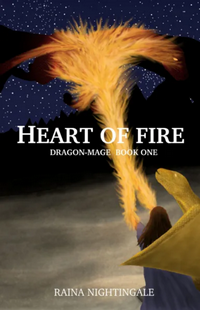
Cover of Heart of Fire by Raina NightingaleHeart of Fire

by Raina Nightingale

DETAILS:
Series: Dragon-Mage, Book One
Publication Date: April 16, 2023
Format: eBook
Length: 278 pg.
Read Date: August 12-14, 2024

What’s Heart of Fire About?

I can’t quite talk about the story of the book without saying something I shouldn’t, so, I’ll let Nightingale describe it:

Camilla has always been told that humans are inferior. They cannot use magic. If they bond to dragons, they will doom the creatures to extinction. She has never believed a word of it. She has always known that she can use magic, and she suspects it is the elves who harm the dragons by keeping them to themselves. Now, she is presented with the opportunity of a lifetime: a dragon’s clutch is hatching and while she will earn the wrath of her captors if she is caught, she has the chance to see a dragon hatch and perhaps even to Recognize.

Kario’s people have feared dragons since time immemorial. When an unrealistically huge black dragon flies in while she is hunting, she is certain she will die. Instead, her life is changed when Nelexi, Obsidian Guardian of Areaer, chooses her as her final rider. Kario takes the name Flameheart, but she is soon homesick and afraid that she is insufficient to be the partner of a god.

The Good

First off, the dragons are cool. You give me cool dragons and I’m going to let you get away with a lot.

I think this world is fantastic. I love the relationships between dragons and riders—the bonds between them, and how they communicate with one another. I like a lot of the suggested ways that dragons and riders change and evolve over time.

I think the geo-political and racial relationships are intriguing—and how people on different continents relate to dragons (and many other creatures, likely). The elven-human dynamic is something I really want to see developed.

I think Kario is a fasctinating character and I relished the bits of time we got with her and Nelexi—I wanted more.

The Bad

I don’t think that Nightingale brought everything in her mind onto the page. She clearly has a lot of this world worked out in details that there’s no way to communicate. Every author has those—that’s not what I’m talking about. But in the Preface, she talks about having two of the characters in her mind since childhood—she knows them well, she understands their story in a way that many authors would likely envy. But—this is just a guess—I think she knows the story so well that I don’t think she realized she didn’t give her readers all the details we needed to follow.

I stopped writing things like “so, I missed something?” or “how did we get here?” after a bit. I just couldn’t follow good chunks of both storylines—but Camillla’s more than Kario’s.

Although—and this gets us on to the other “Bad” topic—I’m okay with not following Camilla’s because I just couldn’t like her. She was petulant, self-centered, egotistical, and short-sighted. All these are things that can be grown out of, and I’m not suggesting protagonists have to be likable. But I didn’t want to spend time in her head—it’s just a nasty place. Her dragon, Radiance, was fine. Her brother seemed okay—as did the other dragon rider with them (I’m going to leave names out because it feels like something you need to learn as you read)—although there’s room for some personal growth there, although I think that character has made the right kind of strides on that front so you can root for them.

But Camilla? I really hope in the next book in the series, she’s grown up a lot.

So, what did I think about Heart of Fire?

Nightingale swung for the fences with this one, you can practically see the effort on the page as you read. But I think she missed too many of the pitches she took, and foul-tipped pretty frequently when she made contact. But she got on-base enough to stay in the game, and even to chalk up a win. That’s the end of the baseball metaphors, I promise.

There’s so much promise in this book—and enough delivery on them to come back for the second volume. But not enough to be enthusiastic about it. I do want to know what happens, and I think most who read this will share in that.

Also, cool dragons. Can’t overlook that.

The parts of the book that worked—worked pretty well, and made me want to keep going. Still, I can only give this the most lukewarm of recommendations—I know I’m in the minority when it comes to this book—go read what others had to say about it.

3 Stars

Irresponsible Reader Pilcrow Icon

Nugget’s Tenth Life by Adam Holcombe: The Backstory I Didn’t Need, But Am So Glad I Got

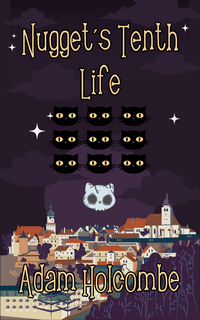
Cover of Nugget’s Tenth Life by Adam HolcombeNugget’s Tenth Life

by Adam Holcombe,

DETAILS:
Series: Chronicles of Gam Gam
Publisher: Bounty Ink Press 
Format: eBook
Length: 32 pgs.
Read Date: September 23, 2024

There is a saying among humans that a cat has nine lives, but this is not entirely accurate. See, it is simply that cats are notoriously skilled at almost dying. It is only by the ninth time that the dying tends to stick.

What’s Nugget’s Tenth Life About?

For those who are familiar with Gam Gam the Necromancer, you are familiar with her familiar*, Nugget. If you haven’t read anything about Nugget before—let me introduce him to you.

Gam Gam is a newly graduated necromancer, despite being…well, a Gam Gam. Her familiar is a cat she revivified—I guess it’s better to call Nugget the animated skeleton of a cat—with all the memories, habits, and attitudes of the stray cat he was before he needed revivification to prowl around.

This would be his tenth life—this short story is the recounting of the previous nine lives he enjoyed (or at least lived through). It’s about his Brother, Sister, Mother, and his Sister’s two kits as well—but primarily about Nugget doing his best to help his family survive and keep their shelter.

* A phrase that I wrote without forethought.

So, what did I think about Nugget’s Tenth Life?

Maybe (very likely) I’m in the minority here. But I was not curious at all about Nugget’s life (or, lives) before Gam Gam. I was curious about Gam Gam’s backstory. I was curious about the Knight Revenant. I can see reading more about Mina. But an elderly necromancer (or any necromancer, really) with a skeleton familiar? That seems fitting and generally unsurprising—I didn’t need to know any more about him.

But now??? I’m so glad we got this. I loved that opening I quoted above and was quickly invested in Nugget’s story.

Getting that little bit of time with Gam Gam at the end reminded me how much I liked the character—and I’m now more than ready for The Wishing Stone‘s release next month so I can spend some extended time in this world.

This would make a decent jumping-on point for those who haven’t tried this series before. If you have, I probably don’t need to encourage you to give it a shot (but I will anyway).

Irresponsible Reader Pilcrow Icon

Pictures by J.R.R. Tolkien: A Nice Bit of Insight into Middle Earth

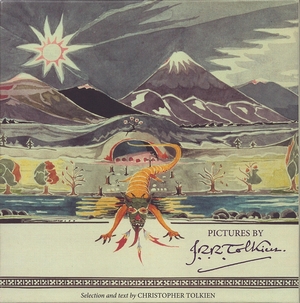
Cover of Pictures by J.R.R. TolkienPictures by J.R.R. Tolkien

DETAILS:
Publisher: William Morrow & Company
Publication Date: November 16, 2021
Format: Hardcover 
Length: 104 pgs.
Read Date: September 21, 2024
Buy from Bookshop.org Support Indie Bookstores

Why this Book Today?

Last Spring, I read Lashaan Balasingam talk about this book at Roars and Echoes and put it on a wish list instantly. I was given a copy of it last year, but aside from glancing through it then, I hadn’t taken the time to really sit down with it. But with Hobbit Day yesterday, I made time Saturday to do just that—so I could post about it today (and maybe add this and some other things to a recurring thing like I do with Towel Day).

You should really see what Lashaan had to say about it, not only does he do a (typically) better job of it than I’m about to, but he liked it a lot more than I did.

What’s Pictures by J.R.R. Tolkien About?

Well, it’s pictures drawn by Tolkein in his spare time—when he wasn’t teaching, creating new languages, writing epic fantasies, or smoking his pipe (well, he probably did both of those at the same time).

The Publisher describes it this way:

With Christopher Tolkien as your guide, take a tour through this colorful gallery of enchanting art by J.R.R. Tolkien, as published originally in the first groundbreaking Tolkien Calendars of the 1970s.

This collection of pictures, with a text by Christopher Tolkien, now reissued after almost thirty years, confirms J.R.R. Tolkien’s considerable talent as an artist. It provides fascinating insight into his visual conception of many of the places and events familiar to readers of The Hobbit, The Lord of the Rings, and The Silmarillion.

Examples of his art range from delicate watercolors depicting Rivendell, the Forest of Lothlorien, Smaug, and Old Man Willow, to drawings and sketches of Moria Gate and Minas Tirith. Together they form a comprehensive collection of Tolkien’s own illustrations for his most popular books.

Also included are many of his beautiful designs showing patterns of flowers and trees, friezes, tapestries, and heraldic devices associated with the world of Middle-earth. In their variety and scope, they provide abundant visual evidence of the richness of his imagination.

This enchanting gallery was personally selected by Christopher Tolkien who, through detailed notes on the sources for each picture, provides unique insight into the artistic vision of his father, J.R.R. Tolkien.

How’s the Writing?

Well, it’s pretty bland. It’s just straightforward descriptions of the pictures, where it came from, where it was originally published—who added color (sometimes), and so on.

It’s not bad, it’s not good—it’s just there. And that’s good enough, this isn’t supposed to be about Christopher Tolkien’s wordsmithery—this is about the pictures.

How’s the Art?

Well, I think it’s clear why we think of Tolkien as a writer, scholar, and storyteller and not a visual artist. Don’t get me wrong—I can’t hold a candle to his drawing. But it’s nothing stellar.

But it does deliver the flavor of Middle Earth and its denizens in a way the books can’t quite manage (or does manage, in a different way). You get a real sense of the scope and scale of the world. It’s clear that Jackson and his team spent some time with Tolkien’s art and drew a lot from it—and you can see why they’d want to (beyond just trying for authenticity). I did like it—and could easily spend time studying the details.

Lashaan’s post has a couple of samples if you’re curious. But honestly, if you’re basing getting your hands on this book on the quality of the art, you might be missing the point. (still, check out the samples to get a feel for it)

If you want great fantasy art, may I suggest starting with Larry Elmore, Chris McGrath, or Isabeau Backhaus? But there’s something about seeing it from the hand of the creator, you know?

So, what did I think about Pictures by J.R.R. Tolkien?

As a book, it’s…fine. As a collection of pictures, it’s…nice enough. As a way to get to know a different side of Tolkein and how his brain, his creativity, and his personality worked? It’s pretty cool. I’d love to see sketches, drawings, and even paintings by other authors to get inside their heads (okay, no one wants inside Thomas Harris’ mind, but you know what I’m saying. Keep the visuals for Hannibal and the rest locked away.)

Am I glad that I own this? Yes. Am I glad that I finally got around to taking it out of its slipcase and really worked through it? You bet. Am I just a little underwhelmed by the whole thing? Yup.

But I will return to flip through it and pour over the contents repeatedly.


3 Stars

This post contains an affiliate link. If you purchase from it, I will get a small commission at no additional cost to you. As always, the opinions expressed are my own.
Irresponsible Reader Pilcrow Icon

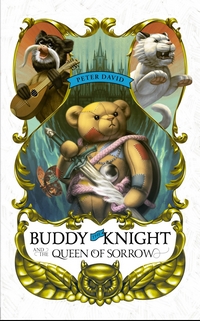
Buddy the Knight and The Queen of Sorrow by Peter David: A Tale of Friendship, Devotion, Bravery and Heart

Cover of Buddy the Knight and The Queen of Sorrow by Peter DavidBuddy the Knight and The Queen of Sorrow

by Peter David

DETAILS:
Publication Date: August 22, 2024
Format: eARC
Length: 168 pg.
Read Date: September 2, 2024
Buy from Bookshop.org Support Indie Bookstores

What’s Buddy the Knight and The Queen of Sorrow About?

Buddy the Knight is a teddy bear. A valiant teddy bear, devoted to protecting his Person from the monsters from The Realm-Under-The-Bed. He’s a knight and has spent years defending a little girl named Mieya from these fearsome foes. He’s frequently assisted by his companion, a stuffed tamarin—a mandolin-playing bard. Esteban not only fights at Buddy’s side, but his songs frequently tell the tales of Buddy’s victories.

One night before Buddy can dispatch it, a monster inscribes a rune over Mieya—one that will bring her certain doom unless Buddy can defeat the monster’s master—the Queen of Sorrows. Buddy is given an enchanted googly eye to guide him and Esteban as they journey to the heart of The Realm-Under-The-Bed to find this Queen. There are countless enemies and obstacles along the way, but they have until dawn breaks to complete their quest, so they will have to be quick as well as brave.

The Cover

I don’t do this enough, but I need to call out the cover here. Candice Broersma knocked it out of the park with this one. I just love this cover. It’s one that you want to have on your shelf/eReader.

Also, I’d buy a print if Broersma/David were to make them available.

A Little Treat

There’s a reference at one point to a series of books that Mieya read. I hope, hope, hope that kids who read this have their curiousity piqued and go ask someone (like a librarian or bookseller) what it might be a reference to and then read those books. They’ll be in for (another) treat if they do.

Just seeing the reference was enough for me.

There are other nods to fiction and movies, too—cleverly hidden throughout, and just enough to make the grown-ups reading this smile (the Captain Shakespeare/Captain Johannas Alberic nod was particularly well done). None of them made me quite as happy as the series of books she read, but that’s me. You (if you’re above the age of 15), will likely have other favorites—but you’ll enjoy all that you catch.

So, what did I think about Buddy the Knight and The Queen of Sorrow?

I know that many people think that Paladins are boring characters. I’m not one of them—just think of Sturm Brightblade, Superman, Michael Carpenter, or Paksenarrion and tell me they aren’t great to read (okay, some people have made Supes a little boring—but not all of them). Buddy the Knight is yet another entry in the Great Paladin Characters list I should get around to compiling sometime.

Esteban is one of the better comic relief sidekicks with a lot of heart, too. As funny and heartfelt as Shrek‘s Donkey with the devotion of Samwise Gamgee. The other allies and people—including the sentient magic sword—who help Buddy out are really well done, too.

The monsters, other antagonists, and (of course) the Queen of Sorrows are equally well depicted—but unlike the above, you really don’t want to spend time with them. They’re all drawn from types we’ve all seen before, but given a twist to make them feel new—and the reason we’ve all seen them before anyway is that they’re just about always compelling, and with David’s twist? They’re just what this book needed.

Throughout the book—either in flashbacks that Buddy has to his maker’s lessons or in the things the characters say to motivate each other or themselves—the reader is going to get a lot of slogans, life lessons, or morals thrown at them. I appreciated reading them—and I expect that readers 40 years (plus or minus a couple) younger than me will, too. Coming from stuffed animals probably makes them more palatable and somehow less corny than they’d be coming from an authority figure (in fiction or real life). It’s likely that some of these will get lodged in the back of a young reader’s mind and will prove beneficial later in life.

The story itself is a pretty straightforward Fantasy tale—the hero and his allies (some picked up along the way) are on a journey with a deadline to fight a powerful in order to rescue someone. As always, it too, is effective.

There’s a lightness to the prose, but it’s not a comedy—it comes across as whimsical and fantastical. It will charm you as it draws you in. We don’t really see Mieya in action and don’t get to know her, but we want her safe, we worry for her, because Buddy, Esteban, and the others are so devoted to her. We care about her because we care about the bear and the tamarin, and anything they think is important we think is important.

This is the kind of book that 10 year-old me would’ve curled up with and read and re-read. It’s also the kind of thing that my kids would’ve loved—and I’d have had a blast reading to them. And 51 year-old me was just about as captivated with it as my younger self would’ve been. I strongly recommend this to those young at heart and those young readers you happen to buy books for.

Disclaimer: I received a copy of this eARC from the author in exchange for my honest opinion.


4 1/2 Stars

This post contains an affiliate link. If you purchase from it, I will get a small commission at no additional cost to you. As always, the opinions expressed are my own.
Irresponsible Reader Pilcrow Icon

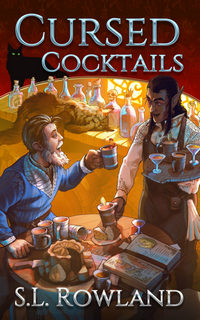
Cursed Cocktails by S.L. Rowland: Mixing Drinks and Starting Over

Cover of Cursed Cocktails by S.L. RowlandCursed Cocktails

by S.L. Rowland

DETAILS:
Series: Tales of Aedrea, #1
Publisher: Aethervale Publishing
Publication Date: February 18, 2023
Format: Paperback
Length: 265 pg.
Read Date: July 22, 2024
Buy from Bookshop.org Support Indie Bookstores

What’s Cursed Cocktails About?

The cynical side of me wants to summarize this as a gender-flipped Legends & Lattes with a couple of twists. But as apt as that is, it feels petty and dismissive.

Rhoren is a retired blood mage. I won’t get into what a blood mage is, but it’s about as pretty as the name would lead you to believe. The fact that his nickname “Bloodbane” (a nickname known throughout the nine kingdoms, I should add), is another clue. The “retired” part of Rhoren’s description is a rarity, not many blood mages survive long enough to retire. Those who do, like Rhoren, aren’t in the best of health. Rohren’s given some advice about relocating to the coast (and away from the cold) for his health. Needing a change of pace and scenery, that’s just what he does.

And it’s just the right call for him.

Being in the military (and a fairly active part of it), he didn’t have a lot of chances—or reasons—to spend his earnings, so he has a pretty nice nest egg in addition to his pension. A new place to live and a good amount of funding—just what you need to start the second part of your life.

One of the first things he does when he moves to his new city is befriend a bartender, Kallum. Kallum loves his job, but dreams of being able to be more creative with a menu and creating new cocktails.

Rhoren needs a new purpose in his life and finds an open storefront building with an apartment above it. Sure, it’s open because it seems to be haunted, but what’s a rogue spirit (if the place is actually haunted) for a guy like Rhoren? So he buys the place, moves in, and suggests a partnership with Kallum.

It’s not smooth sailing by any means from this point forward, but chasing dreams (old or new) is worth a few risks, right?

Bloodbane

Rohren doesn’t like to think about his days of service—and likes to talk about it even less. He doesn’t want anyone to know he was a blood mage—especially not Bloodbane. He’s ready to shed that name, that vocation, and the reputation that follows both.

Also, using that kind of power the way he has for decades is the biggest thing impacting his health—the very reason he had to move.

But even the best-kept secrets have a tendency to come to light—especially when events outside of Rohren’s control might call upon him to unleash his abilities.

While I really have no complaints about anything in this book, I thought this was its strongest point. Rowland depicted Rohren’s desire to get away from his past, dealing with his health (both how he’s still limited, and how he’s improving with the weather), and having to step up and tell people about his past, with sensitivity and precision. That was really well done.

The Cozy-ness

After a little peak at the hardships of those who serve and protect in the north and the hazards they face, we shift into the cozy atmosphere we’re promised in this book. And aside from a scene or two (which don’t detract that much), that atmosphere pervades the rest of the book.

There’s some light humor (including some fantastic liquor names—and a cameo from a distinctive bottle design)—there’s a warmth between the characters, a largely supportive populace in the city, and the setting is ripe for stories.

You just can’t help but feel comfortable while reading this. You really might as well be kicking back in your favorite cocktail bar while reading this (and, I should add, you really should have something to drink—not necessarily alcoholic—nearby), you just feel content and warm.

So, what did I think about Cursed Cocktails?

There’s just enough conflict and danger to keep this from being the coziest fantasy that I’ve ever read—but it’s close. In fact, one source of potential conflict never produced any (which was a relief, but also a mild irritation), making the whole thing cozier.

That doesn’t mean the book is dull—far from it. It’s just that you turn the pages for another reason—instead of being on the edge of your seat to see what happens next. You keep going to keep the warm and fuzzy feelings going. It’s here that my mostly joking comparison to Baldree’s book really comes into play, if you got into one, you’ll get into the other.

And that’s a feeling that I don’t mind in the slightest. If you need a break from mayhem and suspense in your reading—or an escape from the world at large—Cursed Cocktails will give you the oasis you need. With at least two more books in this series that promise the same kind of thing, you’d best be hopping on board—you’ll be glad that you did.


3 Stars

This post contains an affiliate link. If you purchase from it, I will get a small commission at no additional cost to you. As always, the opinions expressed are my own.
Irresponsible Reader Pilcrow Icon

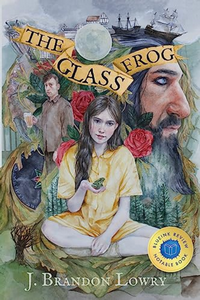
The Glass Frog by J. Brandon Lowry: A Fairy-Tale-esque Fantasy for All Ages

Cover for The Glass Frog by J Brandon LowryThe Glass Frog

by J. Brandon Lowry

DETAILS:
Publisher: Trailerback Books
Publication Date: June 20, 2023
Format: Paperback
Length: 376 pg.
Read Date: July 27-30, 2024
Buy from Bookshop.org Support Indie Bookstores

Every Who is shaped by a Where.

In this case, the Where is a tiny coastal village named Seaside. from the beach there is a constant, breathy shhh-ahhh sound as the waves flow first in, then out, each exhalation coating the simple, whitewashed buildings with a fine, salty mist. Through the village center runs the Queen’s Road, a winding ribbon that traces the curving shoreline of the island nation to which Seaside belongs. Grassy, rolling hills surround the village to the north, so that when viewed from above, it appears as a single pearl on a string nestled on a bed of seagrass.

Seaside was given its unimaginative name by its unimaginative people. In fact, hostility toward creativity and change is a central feature of the Seasider mentality, a proud tradition handed down from generation to generation. They value simplicity, practicality, and—above all—uniformity. For this reason, it has been decreed that every building in the village must adhere to the same basic plan: squarish shape, white walls, dark roof. This arrangement makes it obvious which villagers are lax in their home maintenance, and are therefore not to be trusted. The same principle applies to matters of appearance, behavior, and topics of conversation. Unsurprisingly, the most popular topic of conversation is the failure of others to conform….

With the matter of Where set aside, it is time to meet our Who—Sophie Farrier, a kind-hearted and imaginative young girl who fits into Seaside about as well as a whale fits into a rowboat, and has been just as uncomfortably shaped.

What’s The Glass Frog About?

Thankfully for her, Sophie will not spend the entire novel in Seaside. But she has indeed been shaped by that village, and try as she might, she will act in the way she was shaped (both in ways she recognizes and ways she doesn’t). She’s also been shaped by books she’s read—a scandalous notion to many people in Seaside—and a devoted older brother, Damon, who has stepped up in so many ways that her deceased parents cannot and that her guardian aunt will not. Without her books and her brother, Seaside would’ve turned Sophie into a successfully conformed young woman.

Things change in Seaside one day when some kelp harvesters find an unconscious stranger who had the absolute temerity to wash up on shore. It’s rude, unheard of, and not at all fitting with the unimaginative ethos they prefer. There’s some debate amongst the villagers—with a majority wanting to send this stranger back to the sea he came from—but a couple of stalwarts (including Damon) refuse and arrange for him to be cared for by the local doctor. Sophie helps the doctor in her own way—and the doctor beings to think she might have a future in medicine.

When the stranger finally awakes, he wastes little time before he sets out to leave Seaside and resume his interrupted quest. Something about him, about what he says to her—and some drama at home—drives Sophie to follow him. Or try to, anyway. He has a pretty solid headstart and can move much more quickly than she can. Also…Sophie’s never left Seaside, so she really doesn’t know what to expect or how to interact with people who aren’t from there.

Meanwhile, a powerful group arrives at Seaside, demanding that the stranger be returned to them or the city will be destroyed. Everyone in the Village who was ready to throw him back into the sea are more than ready to give him up. If they only knew where he was.

So, what did I think about The Glass Frog?

I’m not certain who Lowry’s audience is, like the BlueInk Review cited on the back cover says, it can work for “discerning reader[s], from middle grade to adult.” I can think of readers I know/have known up and down that range who would appreciate the book, and I can’t think of any reasons to try to wave off a middle grader (which is refreshing).

It’s hard not to like Sophie—and I don’t understand why anyone would resist it—her brother is a little tougher to like, but that’s not necessarily his fault. Most people that she encounters after she leaves Seaside are pretty likable, too (with some notable, and easy-to-identify exceptions). The people of Seaside are an interesting mix—most (maybe all of them, I didn’t take a census) are good fictional characters and the reader will appreciate them as such. As people? Eh, it’s a mixed bag. But it’s a more complicated question than you’d expect from the early descriptions of the village.

I don’t believe Lowry’s prose was particularly purple at the beginning of the book, but it was headed to that end of the visible light spectrum. My notes said something like, “you’d better not use every adjective in your account too early or you won’t have any leftover for the last chapters.” I do think he got it under control pretty quickly—or I became inured to it, I’d believe either, but I think it’s the former.

There was some pretty solid comedy in this book (particularly involving the citizenry of Seaside), but it’s not a humorous fantasy in the mode of Terry Pratchett or Sean Gibson. I’d categorize it as a light, whimsical fantasy with some really funny moments. But there are some serious moments, too. A lot of heartbreak and loneliness—some self-destructive behaviors on display, too. Maybe a dash or two of romance. Plus some villainy, cowardice, avarice, xenophobia, and manipulation to balance out the acts of heroism (intentional or inadvertent). A little bit of everything, really.

I don’t know that I want a sequel to this—but I would like other books set in this work (with Sophie and those close to her showing up in the background). There’s just so much to explore, and Lowry has created a bunch of fun places and ideas to play with. Some of the minor characters from this book would be great to see again as protagonists—or at least, playing a larger role than they got to here.

But most of all, I’m curious about what the next novel (in this world or another) from Lowry will look like, I bet it’ll be worth the time—just like The Glass Frog was. You should check it out.


3.5 Stars

This post contains an affiliate link. If you purchase from it, I will get a small commission at no additional cost to you. As always, the opinions expressed are my own.

20 Books of SummerLiterary Locals logo

(belated) PUB DAY REPOST: Some Further Thoughts about The White Door by Pierce Taylor Hibbs

I had a few more things to say about the book after my original post…


Cover for The White Door by Pierce Taylor HibbsThe White Door

by Pierce Taylor Hibbs

DETAILS:
Publisher: Truth Ablaze
Publication Date: August 15, 2024
Format: eARC
Length: 484 pg.
Read Date: July 7-20, 2024
Buy from Bookshop.org Support Indie Bookstores


Obviously, this will make more sense if you’ve read my original post about The White Door. And I should add that these are just thoughts that’ve come to mind as I’ve continued to chew on this book. I’m not making a full argument here, or anything like that. Some ruminations is all. (the conclusion is particularly weak, if you ask me, because I am just ruminating. )

One thing readers really like to do is to try to determine what they can about a novelist’s beliefs, points of view, and whatnot from the way things in their novel(s) are depicted. Frequently, some of the theories are pretty out there—and even those that are closer to reality are limited and have some noteworthy flaws.

That’s not the case with this book—Hibbs has already written a good number of non-fiction books showing his views on a number of ideas and topics. So readers of this novel have a different task before them (if they’re of a mind to wonder about these things)—how are Hibbs’ ideas depicted and brought to “life” in this novel? Are they at all? I haven’t read all of Hibbs’ previous work (yet), but I’ve read a number of his books and thought about them while reading the novel.

An obvious point here is that the protagonist, Seth, has an anxiety disorder, not unlike the one that Hibbs talked about in Struck Down but Not Destroyed: Living Faithfully with Anxiety. But there are plenty of other places you can see Hibbes’ previous writing.

In my original post, I said a couple of things that I want to return to. The first is:

…there are two doors (in places that have no business having doors, see McGuire’s Wayward Children series for examples). A white one and a black one—those who walk through them are changed. What, and how, they see is altered in ways that say a lot more about the doors than anything else.

The second thing is:

First of all, anyone who’s read much of Hibbs is going to recognize his thinking here. Narnia, Seth, and Cleft sound like they’ve studied Hibbs’ work (ignoring the anachronism there)—which is good. If only so you know that you’re supposed to think they’re on the right path. Other characters largely sound ilke they’re on their way to sounding that way, too.

Two of Hibbs’ books that came to mind were Finding God in the Ordinary and In Divine Company: Growing Closer to the God Who Speaks.

The part of In Divine Company* that came to mind in The White Door was:

We live in what I have called a worded world, a world that everywhere reveals something about the God who made it, a world that, in a sense, “speaks” about God.

* He also has a book called The Speaking Trinity and His Worded World that probably does a better job of explaining this point and expanding on it, but I haven’t read that one yet.

In Finding God in the Ordinary, Hibbs quotes John Calvin:

Whichever way we turn our eyes, there is no part of the world, however small, in which at least some spark of God’s glory does not shine. In particular, we cannot gaze upon this beautiful masterpiece of the world, in all its length and breadth, without being completely dazzled, as it were, by an endless flood of light. Accordingly, in Hebrews, the apostle aptly calls the world the mirror of things invisible, because the structure of the world serves as a mirror in which we behold God, who otherwise can not be seen (Heb 11:3).

Calvin influenced Hibbs on this point, and you can see it in the rest of that book. Let me bring up a few other short quotations from the book along those lines:

if we do not search for God in the ordinary, we do not perceive the world as it truly is. God has revealed that his entire creation manifests his character.

The whole earth, every crevice of creation, has been endowed by God himself with a revelatory component. We can choose to ignore this component if we wish, but then we will not be seeing the world as it truly is. We will be seeing a world of our own making.

if we do not search for God in the ordinary, we will miss very precious parts of life.

The tagline on the cover of The White Door is: “To enter is to see.” This is part of what I meant by “What, and how, they see is altered.” Both Roland (Cleft’s steward dog) and Cleft call those who’ve gone through the White Door “gazers”*

* I called them “seekers” in my original post. Oops. Why do I take notes, if I’m not going to look at them while writing?

These people gaze upon the world in a clearer fashion than they have before as if a film had been cleared off what they see. They see things in a new way—able to seek God in the ordinary, perceiving the world as it truly is. Not completely—and not necessarily all in the same way. Yet, their vision is better. They see things that others do not/cannot.

Now, walking through this door is in some way analogous of or is an allegory of regeneration. I have questions about it (as I talked about before), and I’m not sure if that’s because I misunderstood something or if Hibbs was unclear (I fully expect the former, but I think it’s the latter).* Regardless, that’s the case. Given “eyes to see and ears to hear,” these gazers see things that others don’t. In our world, it’s because darkened eyes don’t think of it, and renewed eyes need to be taught it (so we get books like Finding God in the Ordinary and teaching along those lines)—but when we know we can see the world, the skies, and nature in general declaring the glory of God—we, like those gazers, do see things others don’t.

* To paraphrase Mr. Simon, when I get something wrong, I’m the first to admit it, the last one to know-ow-ow-ow.

On the other hand, those who walk through the Black Door also have their sight altered. As you might imagine, it’s not as beneficial—but that’s all I’m going to say about that.

I really appreciate the way that Hibbs put “flesh” on his arguments from other books in this novel—not just for a good way to solidify it in the minds of his non-fiction readers, but to provoke his novel’s readers to consider how that piece of fiction might apply to their lives.

This post contains an affiliate link. If you purchase from it, I will get a small commission at no additional cost to you. As always, the opinions expressed are my own.
Irresponsible Reader Pilcrow Icon

Page 15 of 57

Powered by WordPress & Theme by Anders Norén