Tag: Fantasy Page 25 of 54

The Traitor’s Heir by Anna Thayer: He’s Gonna Have to Serve Somebody

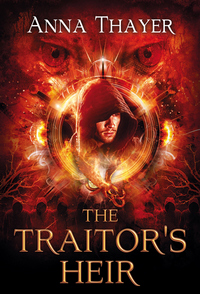
The Traitor's HeirThe Traitor’s Heir

by Anna Thayer

DETAILS:
Series: The Knight of Eldaran, #1
Publisher: Lion Fiction
Publication Date: May 15, 2014
Format: Paperback
Length: 541 pg.
Read Date: May 16-17, 2022

Support Independent Bookstores - Visit IndieBound.org

What’s The Traitor’s Heir About?

When the book opens, Eamon Goodman, the orphaned son of a bookbinder currently a cadet in the final stages of his training as a member of the army of the Master of the River Realm. He doesn’t seem to be very good at being a soldier but is committed to passing and taking the oath. Beyond that, his heart doesn’t seem to be in it, either—but maybe it’s just the best route for some sort of security for him.

He seems to be a decent guy in an army that doesn’t have a lot of them—although those traits seem to be highly valued. After taking his oath, and achieving more success than seems deserved he meets someone who claims to be a descendant of the true king, deposed some centuries ago. Eamon agrees to work for this King in the capital.

Eamon isn’t the Chosen One—that’s (presumably) the King. However, Eamon is a direct descendant of the last King’s First Knight—champion and advisor. He’s not the Chosen One—he’s more like the Chosen Sidekick. Eamon’s calling seems to be to aid the King to reclaim the throne and serve him.

He goes to the capital and follows the King’s wishes. Until, with the help of a beautiful noblewoman, he gets distracted and serves the Master. Then circumstances lead him back to the King. And then…he ping-pongs between the two until he makes a final choice.

What I Don’t Get…

I’ve run into this issue before, this isn’t me picking on Thayer. The reader is clearly to get invested in this struggle between the King and the Master, we’re supposed to want to see the Master defeated and the King to retake the throne. But…

There is no reason to root for the King and his forces here beyond “generations ago his ancestor lost the throne due to the duplicity of his trusted knight. We have no vision of how he’ll improve anything for anyone but those supporters of his that have to hide their allegiance or have to live in his secret campground. His being on the throne would allow them to live openly and/or in society. Yes, he seems to be kind, compassionate, and honorable, but…there are a lot of good guys who happen to be related to someone who used to be in power that shouldn’t be put back in a position of authority.

There aren’t a lot of reasons for the reader to want to see the downfall of The Master. Sure, he treats those sewing dissension in the populace and/or actively working to bring down his government harshly. But…what government doesn’t? The methods he uses seem extreme and capricious, but also seem like the kind of thing a government in this setting would do.

Don’t get me wrong, it’s clear that The Master is evil, he manipulates Eamon throughout—and anyone who gets “behind the curtain” to see how the government is run should have qualms about it. But John and Jane Smith working away in their village outside the city aren’t being oppressed. They’re not being starved. They’re not being exploited. The same is true for Jill or Joe practicing their trades or selling their wares in the cities.

I can tell you why Panem’s President Snow should be defeated. I can tell you why the Golds should be replaced by the government that Darrow’s revolt made possible. The Sheriff of Nottingham? Oh, absolutely—Robin Hood is in the right. The White Witch and her never-ending (and Christmas-free) Winter need to be overthrown. But I can’t tell you how things are going to be better for the River Realm or its people. That’s really hard for me to push past.

So, what did I think about The Traitor’s Heir?

Thayer has a thinly disguised allegory here—our protagonist is a good man who has sworn an allegiance to an evil master while being given grace by the rightful king, who appeals to him to freely choose to serve this king. Allegories aren’t necessarily supposed to be subtle, but this was just one degree shy of Pilgrim’s Progress-level obviousness. Go for allegory if you want, but unless you’re Bunyan, do something other than use it like a 2×4 in the hands of “Hacksaw” Jim Duggan.

Eamon didn’t struggle between the two who wanted his allegiance. If you think of his allegiance as a number line from -10 to 10, he was wholly devoted to -10 and then swung to the other extreme. Then he’d rush back to -10. He never spent any time at 5, or -5—always the extreme. Show me some wavering. Show him spending some time around 0, teetering in each direction. Give me conflict. All I see is a flake that two antagonists are vying over—for no discernible reason than his status as Chosen Sidekick.

Eamon is a problematic character for me—even without his wavering allegiances. I clearly can’t buy into the political struggle. I’m dissatisfied with the world-building (I had a section detailing it, but deleted it because this post was becoming too negative). This book was headed for the DNF pile…and yet.

And yet…

Thayer kept ensnaring me. I couldn’t stop reading. I wasn’t enjoying anything, didn’t think I was reading a decent book—but I had to know what the next page held. And the next. And the next. Sure, I kept checking the page number so I knew how much longer this would go (and kept wishing the number was closer to 541)—but I’d have to see what 253 held. It makes no sense to me—but Thayer got her hooks in me. Her knack for that means I can’t go lower than 3 (begrudging) stars

So yeah, this was a compelling, if frustrating, read. Your results may vary. I know at least one friend/sometimes reader of this blog will disagree with me (he is, after all, who recommended the book to me). Others are more than welcome—encouraged, even—to weigh in and tell me what I missed. Give this a shot if the idea appeals to you—the trilogy looks like it’ll take a different shape than most. Just that novelty may be enough to intrigue you (it pulls on me).


3 Stars

This post contains an affiliate link. If you purchase from it, I will get a small commission at no additional cost to you. As always, opinions are my own.


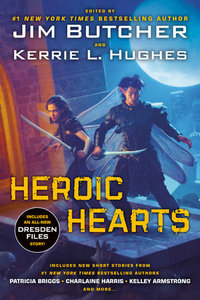
The Friday 56 for 5/20/22: Heroic Hearts edited by Jim Butcher and Kerrie L. Hughes

The Friday 56This is a weekly bloghop hosted by Freda’s Voice.

RULES:
The Friday 56 Grab a book, any book.
The Friday 56 Turn to Page 56 or 56% on your ereader. If you have to improvise, that is okay.
The Friday 56 Find a snippet, short and sweet.
The Friday 56 Post it.

from Page 56 of:
Heroic Hearts

Heroic Hearts edited by Jim Butcher and Kerrie Hughes, “Comfort Zone” by Kelley Armstrong

My faith in humanity has been tested by the sheer number of the last kind. Ghosts trapped in this realm by bitterness and a need for revenge. I’ve taken to humming “Let It Go” as my answer, which works much better on modern ghosts.

Then there are the ghosts who treat necromancers like an Internet connection. They want us to pop off an e-mail. Or check the stock market. Hey, you there, necromancer, can you tell me how the Cubs are doing this season? Can you tell me how my favorite TV show ended? Simple requests, easily completed, but once you start doing them, you never stop, and pretty soon, you have a dozen ghosts wanting weekly coffee dates, during which they watch you creep on their family and friends’ social media accounts.

Just say no. The mantra of necromancers everywhere.

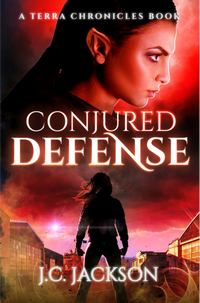
Conjured Defense by J.C. Jackson: A Solid Step Forward for this Series

Conjured DefenseConjured Defense

by J.C. Jackson

DETAILS:
Series: Terra Chronicles, #4
Publisher: Shadow Phoenix Publishing
Publication Date: June 20, 2019
Format: Paperback
Length: 252 pg.
Read Date: May 12-13, 2022
Support Independent Bookstores - Visit IndieBound.org

What’s Conjured Defense About?

Ketayl and Silver are sent to a Naval research facility to investigate some sort of mishap. There’s a company, Spelltech, that’s trying to incorporate technology and magic into a defense system. Not just merging tech and magic (like Ketayl does in her TIO work), but it’s a merging of divine and arcane magics—just like Ketayl and Silver.

They’re the ideal team to run this investigation—assuming they can get the cooperation of the Naval Command and Spelltech. The head of Spelltech seems eager to work with them, once he has a glimmer of an idea of what Ketayl can do—just the fact that Ketayl and Silver get along and can work together puts them ahead of any pair that they have to work with.

It’s not long before Ketayl realizes that Spelltech assembled something without any real understanding of what was going on with it. She’s not so sure either, but she’s getting closer. This sets off a series of “near-misses” with cars as they move around the base—and then things get worse.

So, what did I think about Conjured Defense?

It was a solid story and it’s good to see Ketayl’s powers continue to grow. Ditto for the relationship between the two partners—although it sometimes feels more appropriate for a couple of high schoolers. But hey, they’re elves and will live a long time, maybe things take longer.

Jackson’s action scenes are improving—there are a couple of great ones here. I re-read the first major action scene twice because it was so good (that’s not a comment on the ones I didn’t reread—I was too involved in the story to stop with those)

There are a few bits of dialogue that frustrate me. Jackson obviously has a clear vision for what’s going on in her world and with ongoing arcs, but she’s not the best a communicating that. Ketayl has ongoing conversations with both her partner and her sister in which they allude to something without coming out and saying it—which is perfectly fine and normal. However, there needs to be something in or around those conversations that makes sure the reader can pick up on the allusion. Maybe I’m being dense, or maybe this is a continuation of something from a previous book that I’m forgetting (if that’s the case, it needs to be clarified in this book)—but I don’t think so. I think it’s a case of Jackson knows what the characters are talking about and doesn’t realize that readers don’t.

As usual, that took a lot longer to say than the paragraph about the action scenes—and it means less to me than everything else. I like these characters and really enjoy exploring this world with them, I’ve got two more of these sitting on the shelf and am eager to dive in. Fast action, charming characters, and a great SF/Fantasy setting—what’s not to enjoy? Recommended.


3.5 Stars

This post contains an affiliate link. If you purchase from it, I will get a small commission at no additional cost to you. As always, opinions expressed are my own.

COVER REVEAL: The Obsidian Eyes of Klief by Alex Robins

The Obsidian Eyes of Klief Cover Reveal Banner

I’m very pleased to welcome the Escapist Book Tour’s Cover Reveal for Alex Robins’ The Obsidian eyes of Klief to The Irresponsible Reader this morning! This is the fourth and final book in The War of the Twelve, and it looks like this book is going out with a bang. Before we get to the cover, let’s learn a bit about this book.

Book Details:

Book Title: The Obsidian Eyes of Klief by Alex Robins
Series: The War of the Twelve #4
Publisher: Bradypus Publishing (Self Published)
Release date: June 30, 2022
Format: Ebook
Length: 408 pages
Genre: Epic Fantasy

About the Book

War ravages the troubled lands of the nine Baronies. The once-great cities of Arelium, Kessrin, and Talth are forever scarred by the passage of the greyling tide, their graveyards filled with the corpses of those who fought and died on their blood-stained walls.

Surrounded and exhausted, the fragile alliance of men must wager all on a final, daring plan: to find and destroy the creatures’ leader, an enigmatic entity known as the weaver. One of the Twelve, Makara, may hold the key to the weaver’s location, but he too is missing, lost somewhere in the remote Barony of Klief.

The tattered remains of the human armies have no choice but to follow Makara’s trail north, pursued by a relentless horde of greylings. At their head rides Zygos, his god-like intellect transferred into the body of the traitor Praxis.

The town of Klief beckons, as friend and foe alike are drawn to its dim light. It is here, before its golden gates, that the War of the Twelve will be decided.

It is here that an ancient evil will rise …

And heroes will fall.

See Also:

The Final CountdownKnives OutAnother Brick in the Wall

Book Links

Amazon ~ Universal Link ~ Goodreads

About the Author

Alex RobinsAlex Robins was born in Norwich, England back when it was still trendy to wear lycra tracksuits and bright pink headbands. Norwich School Library was where he first discovered his love of reading, an old converted undercroft packed to the rafters with books. The first fantasy series he read was The Dragonlance Chronicles by Margaret Weis & Tracey Hickman, quickly followed by The Hobbit, The Lord of the Rings, and David Eddings’ The Belgariad.

At the age of twelve Alex moved across the channel to Nantes in France. Speaking very little French, the first few years were difficult and sometimes lonely as he scrambled to get a grip on the intricate grammar and vocabulary of the French language. His taste in books branched out from epic fantasy to science-fiction, mysteries, thrillers, and historical fiction, but he always came back to his favourite fantasy authors when looking to escape the outside world.

After degrees in agronomy, project management, and computer sciences, Alex founded his own company dedicated to online voting. He met his wife during a game of badminton and they spent several years getting trounced in various regional tournaments before getting married. Alex now lives in the sunny Loire Valley in western France, surrounded by imposing castles, sprawling vineyards, and two children. After reading fantasy books for the last thirty years he decided to write one. The Broken Heart of Arelium is his first novel, and the first in the War of the Twelve series.

Twitter ~ Facebook ~ Amazon Author Page

and now…

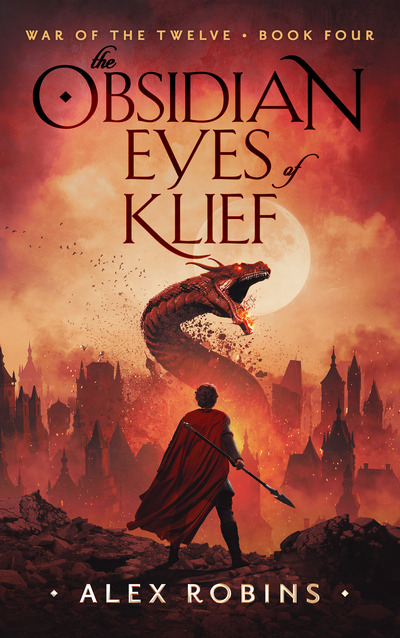
The Cover

The Obsidian Eyes of Klief Cover

That’s a cover that’d make me stop and take a second and third look. Probably even get me to hunt for Book #1, too.


My thanks to Escapist Book Tours for the invitation to participate in this tour and the materials they provided. The opinions expressed by me are honest and my own.

Escapist Book Tours

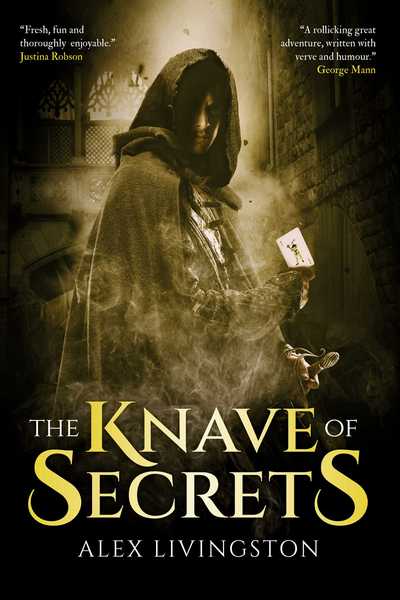
The Knave of Secrets by Alex Livingston: One night in Valtiffe and the Tough Guys Tumble

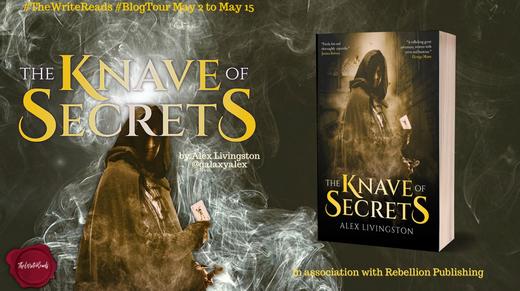
The Knave of Secrets Tour Banner

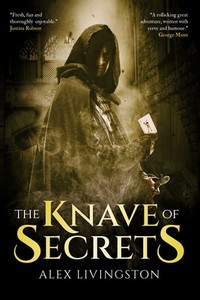
The Knave of SecretsThe Knave of Secrets

by Alex Livingston

DETAILS:
Publisher: Solaris (US), Rebellion Publishing (UK)
Publication Date: June 7, 2022 (US), June 9, 2022 (UK)
Format: eARC
Length: 400 pg.
Read Date: April 28- May 2, 2022
Support Independent Bookstores - Visit IndieBound.org

What’s The Knave of Secrets About?

Valen Quinol has pretty modest ambitions—he’s not looking to become rich or famous or anything, he’s seeking stability and comfort. He wants to open a casino with his wife, he just needs to get the money to do that. Earlier in his life, he went to wizarding school and left in a pretty noteworthy fashion, when it was clear that his scholarly ambitions were going to be thwarted. So he turned to the only thing he knew he could support himself with—gambling. And sure, in addition to being a pretty savvy gamesman, he became pretty skillful in ways to rig games.

Valen’s wife, a friend who left school with him—Teneriève—and another friend work with him now—traveling around from casino to casino, from tavern to inn, etc. making enough money to support themselves, and maybe put a little away.

After the reader meets the crew, a local ganglord pays Valen and Margo a visit to hire/threaten them into doing a job for him. Valen typically shuns his work, but this one comes with some tantalizing bait—Valen will be given the buy-in for a local tournament and can keep the money he earns. All he has to do is make sure one competitor walks losing everything they came to play with. If he turns this down, well, there’ll be a duel in his future. And Valen’s a cardsharp, not a fighter. It will not go well for him.

Because this isn’t that kind of Fantasy novel, Valen and his talents go with the less violent option. What Valen doesn’t realize—and his sponsor doesn’t either—what the defeat of his target is going to kick off and drag them all into.

Espionage, murder, political intrigue, societal upheaval—and the imminent possibility of a world war. All because of a game of chance.

We get to watch Valen and his crew (partially) realize what they’ve instigated, as well as getting points of view of several of the major players in the fallout.

Teneriève

Teneriève is one of the more interesting characters in the novel—she’s from a group that’s essentially an analogue to the Roma, and faces hostility and discrimination everywhere she goes. Valen’s crew are the only family she’s known since leaving home, but even then, she doesn’t feel secure—not because of anything they do/think, but because of her own issues.

Her story arc doesn’t go the way you think it will initially, and I’m glad it didn’t. Her story definitely doesn’t get wrapped up in a tidy bow. She could probably serve as the central character in a follow-up novel because there’s a lot to her that could be explored. I also really appreciated while the Roma-esque nature of her background informs her actions and attitudes, her story isn’t all about that identity.

Quick tip: As good as the other storylines are, pay special attention to her scenes, they’re better (and frequently more frustrating and rewarding) than the rest.

Something that Just Occurred to Me

Before I hit Publish, I was struck by the thought that this is one of the most PG-13 Fantasy novels I’ve read in a dog’s age that wasn’t targeted at an MG audience. Maybe even PG (but a couple of the deaths probably shove it into the PG-13 world).

I don’t know that this is a plus or a minus in some readers’ minds, but I thought it was noteworthy—who writes like that anymore?

So, what did I think about The Knave of Secrets?

I’ll tell you this upfront: I was not in the right frame of mind for this book when I started it. A novel with a new magic system, an involved history, a complicated (but not convoluted) political situation, and gambling—and people cheating at gambling. So you’ve got to understand the new games pretty well to visualize not just how to play, but how to cheat. Frankly, that’s a lot of work.

Now, that’s not unusual for a Fantasy novel—and I’m not complaining. I’m just saying that when I started this book I didn’t have the mental energy to dive in, and I really wasn’t in the mood for it. So when I say that before the halfway point Livingston had me very engaged and invested in the plot and characters, that’s saying something.

Livingston has done his homework and has created a very rich world here, we get to see some of it, but probably not all of it. Whether or not this is true, he really gives the sense that he knows all of the ins and outs of the history of these nations going back centuries—and (most importantly) has resisted the impulse to dump it all on the reader. Instead, he gives us just what we need to ground the story and character actions. Give me a book that hints at worldbuilding any day over a book that reads like a history textbook (however interesting the history may be).

All the marketing for this mentions The Lies of Locke Lamora, and insofar as the book centers on a specialized form of criminals fleecing the rich, sure, I can get behind it. But this has a very different flavor and feel than Lynch’s novel. Some marketing mentions The Mask of Mirrors—and that feels a bit more on point. Other comparisons involve Casino Royale—beyond the gambling, I don’t know if that’s appropriate or not, I fell asleep each of the four times I started that flick. The political intrigue of this makes it more like The Mask of Mirrors or the less bloody and sexy parts of A Song of Ice and Fire. I don’t point this out (just) to criticize the marketing materials, just to help expectations—don’t go into this novel to meet the next Gentleman Bastards, go into it for a new and distinct kind of Fantasy novel.

Despite not being in the right headspace for The Knave of Secrets and going into it with wrong expectations, I ended up pretty impressed with this novel and would definitely recommend this to a wide audience. It’s a satisfying read that will leave you wanting to know more about this world and most of these characters.

This post contains an affiliate link. If you purchase from it, I will get a small commission at no additional cost to you. As always, opinions are my own.


My thanks to The Write Reads for the invitation to participate in this tour and the materials (including the novel via NetGalley and Rebellion/Solaris) they provided.

BOOK SPOTLIGHT: The Knave of Secrets by Alex Livingston

I’m very pleased today to welcome The Write Reads Blog Tour for Alex Livingston’s The Knave of Secrets. Later today, and I won’t guess when, I’ll be posting my take on the novel and you should definitely take a look at the feed for https://twitter.com/WriteReadsTours to see what other bloggers have to say about the book. But first, let’s get to know a little bit about it.

The Knave of Secrets Tour Banner

Book Details:

Title: The Knave of Secrets by Alex Livingston
Genre: Fantasy
Publisher: Rebellion Publishing
Release date: June 7, 2022 (US), June 9, 2022 (UK)
Format: Paperback/Ebook/Audiobook
Length: 400 pages
The Knave of Secrets

About the Book:

A twisty tale of magicians, con artists and card games, where secrets are traded and gambled like coin, for fans of The Lies of Locke Lamora and The Mask of Mirrors.

Never stake more than you can afford to lose.

When failed magician turned cardsharp Valen Quinol is given the chance to play in the Forbearance Game—the invitation-only tournament where players gamble with secrets—he can’t resist. Or refuse, for that matter, according to the petty gangster sponsoring his seat at the table. Valen beats the man he was sent to play, and wins the most valuable secret ever staked in the history of the tournament.

Now Valen and his motley crew are being hunted by thieves, gangsters, spies and wizards, all with their own reasons for wanting what’s in that envelope. It’s a game of nations where Valen doesn’t know all the rules or who all the players are, and can’t see all the moves. But he does know if the secret falls into the wrong hands, it could plunge the whole world into war…


Book Links:

Amazon ~ Goodreads

About the Author:

Alex LivingstonAlex Livingston grew up in various quiet New England towns before moving to Buffalo, NY to study English at Canisius College. He writes SFF prose and interactive fiction. Alex is married and lives in an old house with his brilliant wife and a pile of aged videogame systems.


My thanks to The Write Reads for the invitation to participate in this tour and the materials they provided.

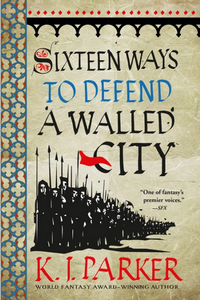
Sixteen Ways to Defend a Walled City by K.J. Parker: A Curmudgeon to the Rescue?

Sixteen Ways to Defend a Walled CitySixteen Ways to Defend a Walled City

by K.J. Parker

DETAILS:
Series: The Siege, #1
Publisher: Orbit
Publication Date: April 8, 2019
Format: Paperback
Length:  350 pg.
Read Date: April 20-25, 2022
Support Independent Bookstores - Visit IndieBound.org

According to the books (there’s an extensive literature on the subject) there are fifteen ways to defend a walled city. You can try one of them, and if that doesn’t work—

Indeed. But the books were written for generals, kings, emperors; better luck next time, and we have plenty more cities where that one came from. And, to be fair, each of the fifteen ways is practical and sensible, provided you’ve got an adequate garrison, and sufficient supplies and materiel, and a competent staff of trained officers making up a properly constituted chain of command.

What the books don’t tell you is, there’s a sixteenth way. You can use it when you’ve got nothing; no stuff, no men and nobody to lead them. Apart from that, it’s got nothing to recommend it whatsoever.

Fine, I thought. Let’s give it a go.

What’s Sixteen Ways to Defend a Walled City About?

Orhan is a colonel in charge of a company of engineers—and a very good one. He knows what it takes to work the system to equip his engineers with what they need (and if it takes forgery of official documents and bribery to get people to do their jobs, so be it). Then in the field, he gets his men to do what they need to do.

As his company returns from some bridge building and repair work, they start to suspect something is afoot (okay, more than that, but I’m trying to keep it vague) and they hustle back to “the City.” Once there, they discover that one mistake after another has been made and upon the engineers’ return, Orhan is the highest-ranking military officer in the City—and therefore, he’s solely responsible for defending the capital of the Robur empire.

Whoops.

Now, Orhan may not be the hero that the City deserves (although he might be), but is he the hero the City needs?

Orhan

This is one of those books where your enjoyment of the book is going to be wholly dependent on your opinion of the narrator/protagonist. If you enjoy his voice and are entertained by the idiomatic way he goes about his work, you’re going to have a good time reading this. If you read a few pages of this book and aren’t taken with him—do yourself a favor and move on.

He has almost no social skills and seems to thrive on offending those in power and authority (when he bothers to care about his social skills, that is). He’s confident-bordering-on-arrogant, misogynistic (although I think it’s more applied misanthropy than anything else), quick thinking, decisive, and too clever for his own good. This will strike some readers as off-putting, and would be in a real person, but it works in this fictional world.

Really, at the end of the day, it’s all about solving problems—give him a problem and he’ll come up with a solution, and everything else isn’t that important. It leaves a few bruised egos and ruffled feathers in his wake—but he gets the job done.

But man, the way he tells a story and his attitude throughout really works for me—I read those first few pages and knew we were going to be friends.

A Series?

I don’t see how this functions as the beginning of a trilogy without hurting the last couple of pages—I don’t know if this was intended to be the start of a series, or if that came later. If it was supposed to spawn a sequel all along, I misread the last chapter or two.

I really don’t think Sixteen Ways to Defend a Walled City needs more books to tell this story, but what do I know? Parker (and his alter-ego) have written so many books that they clearly understand story, so I assume that I’m wrong on this point—and he’s very likely doing something I don’t expect.

While I want to see how wrong I am, the fact that this works so well as a stand-alone makes me disinclined to jump on the sequel. I don’t need more in this story, as fun as it probably is.

So, what did I think about Sixteen Ways to Defend a Walled City?

“We’ve been ingenious, resourceful and inventive, and we haven’t let ourselves be hindered by outmoded or irrelevant ways of thinking. It’s a shame, really, because nobody will ever know how clever we were.”

The fact that the narrator lives long enough to leave a record suggests that his second-in-command is wrong in his evaluation of their chances—at least some will survive (and Orhan mentions that a few times). But still, you know that a besieged city doesn’t have a lot going for it, and reading about the siege should be grim going. And it is at times, but that doesn’t stop this from being a fun fantasy read—almost all of that is due to the narrative voice, this isn’t a comedy by any means. But it is frequently funny.

This really struck me as similar to what Sand dan Glokta went through in defending the city of Dagoska. However many his faults, Orhan is no Glotka—he’s not as vicious, he really doesn’t torture anyone, and he’s not as limited by his own injuries. But there is something about the two characters that are similar. Orhan also reminds me of R. Wilson Rogers from Zieja’s Epic Failure series—an engineer who knows how to get things done in the Armed Forces (by manipulating the system) who is thrust into a leadership role at a critical time. Orhan really is the overlapping area in the Venn diagram of Glotka and Rogers, the more I think of it.

Several of the characters could be drawn better—but they really don’t need to be, we get enough depth to understand them, but not much more. It fits with Orhan’s character—he sees most of them as tools to use in solving his problems. You don’t spend a lot of time thinking about your hammer’s backstory. He does understand, and helps the readers to understand, the more important figures in the story. In most books, I’d criticize the lack of depth, but in this one, it actually fits.

There are a few battle scenes, but not to the extent you would get in similar books—Orhan and his men aren’t fighters by trade, they’re builders. So even the fight scenes are different than what you’re used to. I’m all for variety—especially variety that fits with the story.

There’s a whole lot going for this book, and little to complain about—for a fun, fairly quick, fantasy read, give Sixteen Ways to Defend a Walled City a shot.


3.5 Stars
This post contains an affiliate link. If you purchase from it, I will get a small commission at no additional cost to you. As always, opinions are my own.

Opening Lines: Sixteen Ways to Defend a Walled City by K.J. Parker

We all know we’re not supposed to judge a book by its cover (yet, publishing companies spend big bucks on cover design/art). But, the opening sentence(s)/paragraph(s) are fair game. So, when I stumble on a good opening (or remember one and pull it off the shelves), I like to throw it up here. This one grabbed me with the voice, the perspective, and the attitude. If Parker can maintain this, I’m in for a great time.

from Sixteen Ways to Defend a Walled City by K.J. Parker:

I was in Classis on business. I needed sixty miles of second-grade four-inch hemp rope—I build pontoon bridges—and all the military rope in the empire goes through Classis. What you’re supposed to do is put in a requisition to Divisional Supply, who send it on to Central Supply, who send it on to the Treasurer General, who approves it and sends it back to Divisional Supply, who send it on to Central Supply, who forward it to Classis, where the quartermaster says, sorry, we have no rope. Or you can hire a clever forger in Herennis to cut you an exact copy of the treasury seal, which you use to stamp your requisition, which you then take personally to the office of the deputy quartermaster in Classis, where there’s a senior clerk who’d have done time in the slate quarries if you hadn’t pulled certain documents out of the file a few years back. Of course, you burned the documents as soon as you took them, but he doesn’t know that. And that’s how you get sixty miles of rope in this man’s army.

Opening Lines Logo

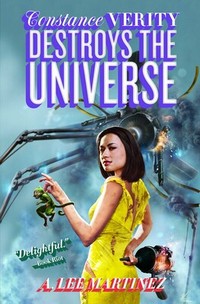
Constance Verity Destroys the Universe by A. Lee Martinez: Saying Good-Bye to this Hero

Constance Verity Destroys the UniverseConstance Verity Destroys the Universe

by A. Lee Martinez

DETAILS:
Series: Constance Verity, #3
Publisher: Gallery / Saga Press
Publication Date: March 7, 2022
Format: Hardcover
Length: 290 pg    
Read Date: April 6-8, 2022
Support Independent Bookstores - Visit IndieBound.org

She pushed a chair into a corner of the room not visible from the street and sat. There was a feel to her life. Danger didn’t usually feel this dangerous. Danger was just background noise. But this was a lot of people trying to kill her. More than normal.

What’s Constance Verity Destroys the Universe About?

This book starts off with Constance Verity doing something almost unbelievable for her—normal things. She attends a dinner party to celebrate her best friend’s/sidekick’s upcoming wedding, she spends a day hanging out with her fiancé at a park and museum—sure, there’s a duel with an alien in there, as well as dealing with an international crisis, etc. But for Connie, that’s pretty sedate.

Then things stop happening—no death rays, mad scientists, pan-dimensional threats—not even a kitten stuck in a tree. It’s unnerving to all who know her well. On the plus side, Tia and Hiro’s wedding should go off without an interruption, right? And it does—the reception, however…

When things start happening again, there’s a distressing trend—people from all over the universe and time show up because they’ve been told that Constance Verity is going to destroy the universe, and they’re going to stop her. The assassins are plentiful enough that Connie’s getting nervous—so she does what she can to keep her loved ones safe and then sets out to see why people are saying she’s going to destroy the universe. All she’s ever done is save it, why would she change?

A Plethora of Ideas

Connie had a problem with Nebraska. And that problem was that it was too close to Kansas.

Kansas, where dark gods waited to rise from their forgotten tombs and bring about the extinction of mankind.

Kansas, where all time travel led to a black void where a pale, wizened figure would greet you, playing a banjo and singing endless choruses of “Achy Breaky Heart.”

Kansas, where Connie had come the closest to death on more than one occasion.

Kansas, her kryptonite.

In a sentence or two—or five brief paragraphs in the above quotation—Martinez is able to tell a whole story—or at least hint at one. Most of these little stories could be fodder for a novella or a novel, but in this trilogy, they’re given anywhere from a sentence fragment to a page. And then he moves on to something else so the plot can be advanced.

Every A. Lee Martinez novel has a surfeit of ideas that come flying at you, that’s nothing new. But I think in these Constance Verity novels that he’s outdone himself. Martinez treats these all as throw-away remarks, with no real investment of time on the reader’s part. But it has to be the kind of thing that would drive your average novelist to exhaustion just trying to come up with them all.

You get just a taste of a fantastic adventure or death-defying feat that Connie’s pulled off (frequently with Tia at her side) in these. You add enough of these together and you really start to see all the things that Constance has done and you understand how much is riding on her successes and how she’s become a legendary figure throughout the universe.

Sorry, Desiderius Erasmus Roterodamus*

It probably says something about the way my brain works that my favorite writing on Free Will vs. Determinism comes from Science Fiction—particularly those prone to a comedic tone. Okay, it says a lot about me, but that’s for another time.

Constance Verity Destroys the Universe plays with those ideas a lot—even knowing (after being told repeatedly from reliable sources) that she’s going to destroy the Universe, Connie refuses to believe it and flat out says she won’t. This idea is treated with derision by some (rightly) and supported and echoed by others (also, rightly). The mostly retired demigoddess of destiny that has moved into Connie’s apartment building cannot muster up the desire to weigh in on this, and of anyone, you’d think she’d have a lot to say about it.

I’m not saying that I think Martinez has penned a well-developed treatise on the idea in the middle of this SF/Fantasy Action novel—I’m just saying he has a lot of fun playing with the idea and that anyone who enjoys that sort of thing will find the Free Will vs. Determinism discussion a tasty side dish to accompany the SF/Fantasy entree.

* Okay, not really sorry.

So, what did I think about Constance Verity Destroys the Universe?

“I don’t have a lot of other leads, and if there’s one thing I know, it’s that when in doubt, point myself toward the nearest adventure and let it work itself out.”

I hate that this volume is the end of the road for this trilogy—but I’m not sure what else he could accomplish in this world. When the series started, Connie was an adventurer/savior-of-the-universe wanting a normal life and being unable to; and we wrap up things up with her finding her own brand of normal, which she’ll be able to enjoy if she survives the assassination attempts and doesn’t destroy the universe. That’s a pretty decent arc.

I think I like the arc that her side-kick/best friend Tia goes on a smidge better, but that might be because Tia’s a bit more relatable to those of us not burdened with cosmic destiny. Either way, it’s a good run.

The ending of this is perfect on several levels—exactly how a novel (or a series) like this should end.

Could you read this apart from the other two novels? Yeah, I suppose. But I don’t think it’d be a great stand-alone, but you could get away with it. Why you’d want to, I don’t know—the first two books in the series are a blast.

On Twitter and his blog, Martinez will insist that he doesn’t write humor or comedy, that he’s not that satirical. I’m not so sure, but let’s take him at his word. His SF/Fantasy adventures (this one and all his others) are so funny that you can see why people would make that mistake. But when you ignore the humor, you get a very satisfying SF/Fantasy story that takes tropes and themes you’re very familiar with and presents them to you in a way that makes you see them with fresh eyes and frequently makes you re-evaluate the trope/theme to come at it with a new appreciation. If you happen to chuckle along the way, consider that a bonus.

Obviously, I recommend Constance Verity Destroys the Universe to you—and everything else Martinez has penned. Thank me later (if you remember to).


4 Stars

This post contains an affiliate link. If you purchase from it, I will get a small commission at no additional cost to you. As always, opinions are my own.

REPOSTING JUST ‘CUZ: Constance Verity Saves the World by A. Lee Martinez: Connie Verity is trying to have it all — a personal life while saving the world on a regular basis

Like I said earlier, I’m not having any success with my post about the third book in this series. So I’m reposting what I said about the previous two books to 1: To Have something to post today, and B. To hopefully use this as a way to get my brain in gear.

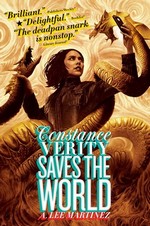
Constance Verity Saves the WorldConstance Verity Saves the World

by A. Lee Martinez
Series: Constance Verity, #2

Trade Paperback, 385 pg.
Saga Press , 2018<br/
Read: August 18 – 20, 2018

“It’s a problem I have. When you’re ten years old and dangling from a cliff while rabid hyenas circle below, you learn to be stubborn. You can’t quit, because quitting isn’t an option. You dig your fingernails and pray that root doesn’t come loose. And if it does, you plan how best to fend off hyenas when all you have is a Pez dispenser and a priceless diamond in your pocket. I fight. It’s what I do. It’s how I survive. When people turn and run, I go forward. It’s kept me alive so far, but it’s skewed how I look at things.

“Somebody tells me I can’t do something, I want to do it more. Want isn’t a strong enough word. I need to do it. Give me that big red button labeled DO NOT PUSH in bright neon letters, and I’ll push it every time.”

Having fought for the ability to have a normal life in The Last Adventure of Constance Verity Connie’s out to try to have one. Which is harder than saving the world a few times a week. She’s still saving the world regularly, as well as having all sorts of adventures. She’s trying to settle down with her boyfriend Byron the accountant, while relying on her best friend/sidekick Tia some more (all the while, Tia is trying to strengthen her relationship with her ninja-thief boyfriend, Hiro). There are evil geniuses, aliens, robots, and vampires living in her condo — all of them behaving themselves, thank you very much.

One of the activities that takes most of Connie’s time right now is trying to help out an old friend cleanup the supercriminal organization that he’s in charge of now that his mother has apparently died. There’s a lot of rogue agents, assassins and experiments that need cleaning up if the organization is going to be come a legitimate force for good — or at least not a force for evil and chaos in the world. Connie’s tempted to spend more time doing that than she should, to the detriment of her relationship with Byron. Thankfully, Tia’s there to help keep her priorities in order. Hopefully, that’ll be enough.

You ever find yourself eating something — say, some cake — and you’re not sure if it’s too rich, if the frosting is too sweet? And then you realize how stupid you sound? Wondering if the cake is too good? Well, that’s the experience I had with this (and, I’m pretty sure with the previous Constance Verity book) — where there too many quips? Too many (seemingly) random ideas, aliens, evil masterminds, robots, henchmen of a variety of stripes, strange occurrences? What a stupid thing to ask. Yeah, there’s a lot going on, but it actually doesn’t get to the overload status. It may come close, but it stays on the right side. It’s like asking if there are too many animated personages in Who Framed Roger Rabbit?, if there are too many Easter Eggs in whatever your Super-Hero movie of choice is. No, there’s not — there’s a lot of good things that are fun. Shut up and enjoy.

Really, that’s the worst thing I can say about the book — occasionally, there are too many fun things happening. The pacing is great, the characters are rich, lively, and well-developed (including many of those only around for a page or so), you’ll laugh, you’ll be moved, you might even have a thought provoked. It’s just a charming book set in a delightful world.

Do not make the mistake of thinking this is a romp, just a free-wheeling ball of fun, snark and self-referential humor. It’s an A. Lee Martinez book, so yeah, there’s a lot of that — but laying underneath that is a good story, some interesting ideas about relationships, about trust, about fate. A whole lot of other things, too, I’m sure, but let’s stick with those. Too many people will read this, focus on the “fun” stuff and will miss the very thoughtful portions — it’s Martinez’ strength and weakness that it’s so easy to do with his works. There’s nothing wrong with a silly adventure story, and there’s nothing wrong with a book that’s about something. But when you have a novel that’s both — you should pay attention to both.

I knew Martinez could write a series if he wanted to — I had no idea what it was going to look like when he did. I’m glad I got the chance to find out. Constance Verity Saves the World is equal to its predecessor in every way that it doesn’t outdo The Last Adventure of Constance Verity — which is no mean feat. It’s fun, the characters are better defined and have grown some, and there’s never a dull moment. Constance Verity, the caretaker of the universe, the Legendary Snurkab, possibly the only woman with more titles than Daenerys Targaryen, is a character you need to get to know. Her sidekick Tia is, too. I cannot wait to see what the two of them do next.

—–

4 Stars

Page 25 of 54

Powered by WordPress & Theme by Anders Norén