
Tag: Fantasy Page 48 of 54

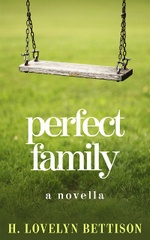
Perfect Family by H. Lovelyn Bettison

Perfect FamilyPerfect Family

by H. Lovelyn Bettison

Kindle Edition, 162 pg.
Nebulous Mooch, 2016

Read: May 5, 2016


Let me just get this out of the way, if this doesn’t make you think of an episode (I won’t say which) of Star Trek: The Next Generation you’re not paying attention. Bettison’s take on it is more satisfactory, however.

Bettison has given us a nice little piece of Magical Realism — Sadie and her husband, Kevin, have a cute little boy named Marcus, and a devoted golden retriever, Sammy. All in all, it’s a perfect family, a part of the perfect life that Sadie’s always wanted.

And then Marcus starts doing things that are beyond belief. As the reader learns about what Marcus’ abilities are and start to wonder where those abilities come from (as Kevin and Sadie are). But we also start to learn that their family isn’t quite as ideal as they might seem — but perhaps even more perfect, than Sadie realizes (that makes sense to me, and will probably make sense to anyone who’s read this).

There are parts of this book — when Marcus first displays his abilities, for example — that are disturbing, there’s some real dark times, too. In other hands, this could’ve been a very different kind of book — not that hopeful or anything, but borderline-horror. But that’s not what Bettison gave us — there’s life and love amidst the darkness.

On the one hand, I wanted more detail, more explanation, more exploration of Marcus’ abilities, but I’m pretty sure that if I got what I wanted, the story wouldn’t work as well as it did.

Give this one a read, you’ll be pleased.

Disclaimer: I received a copy of this from the author in exchange for an honest review.

—–

3 Stars

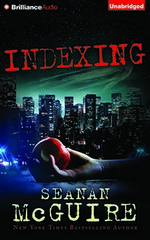
Indexing (Audiobook) by Seanan McGuire, Mary Robinette Kowal

Indexing AudiobookIndexing

by Seanan McGuire, Mary Robinette Kowal
(Narrator)
Series: Indexing, #1

Unabridged Audiobook, 13 hours
BrillianceAudio, 2015
It could easily be argued that I’ve said enough (if not too much) about Indexing. So I’m not going to talk about the story, the writing, and so on, beyond this: not listening to this episodically like I read it, highlights strengths and weaknesses. For example, it’s minor, but the way she has to re-introduce the cast in every episode gets pretty tiring when you hear them all minutes apart — but you don’t really notice at all when you read them every 2 weeks.

The book as a whole is developed better and more fully than I realized initially — the whole thing is a lot more connected than I realized. I’d been intending to kick back and read the whole thing sometime to see how it held together, and I’m glad I got the chance to with the audiobook. It’s really a much stronger whole than I realized.

The main thing I want to talk about is Mary Robinette Kowal (that’s three audiobooks in a row from her, I have to take a break before I just assume that every audiobook is by her). She was fantastic. Her Sloane wasn’t anything like the Sloane in my head, but far superior. The rest of the team was spot on — but the best was Henry. The little inflections of her voice when Henry was closest to her Story, when she was at her most Snow White-ness, added so much to McGuire’s words. I really couldn’t believe how much more I got out of it through her interpretation of the character. Just outstanding.

If you haven’t read the stories or book yet, I do recommend them — but if you get the chance, go with the audio instead. A recommendation I never thought I’d say about any book and audiobook.

—–

4 Stars

Off to See the Wizard by Clay Johnson


Here we are at the end of our day-long Book Tour stop for Off to See the Wizard (see Parts One, Two, and Three). Hope you enjoyed it.

Off to See the WizardOff to See the Wizard

by Clay Johnson

Kindle Edition, 373 pg.

Ravenswood Publishing, 2016
Read: April 18 – 22, 2016

From the beginning? Are you certain? The beginning is pretty dull, you know. All of the violence comes later. The beginning is just sex and blood and guts, and— yes, right, I see it now; fair point.

Let’s see… it began with that dwarf. At least, I think he was a dwarf. He may have been a child. I don’t honestly pay much attention to the jesters they hire. Mostly, they are little more than jingling bells in the background. I know he was very short. Wait! He had a beard. One of those awful, disgusting sort that grow scraggly and in patches. Looked like he’d glued stringy chunks of carpet to his cheeks; do you know the sort?

Yes, had to have been a dwarf.

A tale of an attempted apocalypse, a quest to thwart it, love (or something like it) in bloom, love (or something like it) in trouble, and the aftermath of it all. It may not sound like fodder for comedy, but in Clay Johnson’s hands, it is.

A royal feast ends abruptly, and in a disturbing way (although the way it’s narrated, its pretty humorous). And then soon, horrible things (mostly involving blood in places and amounts no one wants) start happening all over. Naturally, citizens, royalty and everyone in between demands answers — so they turn to a wizard to tell them what’s going on and how to stop it. The wizard has no clue (this will be a recurring theme), but sets off on a quest to find out. He takes his girlfriend, a swordsman, and a redshirt (the wizard has a strong sense of self-preservation). He soon regrets all of these choices — his girlfriend spends most of the time upset with him, the redshirt is a mopey kid who writes horrible poems (and is never used as cannon fodder), the swordsman deserts them. Thankfully, a better swordsman, and a drunken elf queen in training join up after that. Really, very little goes well on the quest.

Meanwhile, the Demon Lord who started the whole thing, really didn’t mean to — he was actually trying to do something else, and it went horribly wrong (I’ll leave it to you to learn what) — and he spends most of the book trying to ameliorate the situation and get his original purpose back on track. Very little goes well for him, either.

In the end, things are a giant mess, so a Royal Inquisitor is sent out to investigate it afterwards, and the book is a edited together compilation of transcripts of his interviews with witnesses, the quest party, the villains of the piece, and others. The mutually contradictory takes on the events given by the various interviewees are hilarious — each person has a strong voice, you pretty much get to the point where you skip the text identifying who’s speaking, you can tell who it is just from their language. It doesn’t take long for the reader to suss out how to take the competing versions and get to a pretty good idea of what really happened.

I don’t remember the details, and am short on time, so I can’t look for them. But somewhere, C. S. Lewis talks about why it’s appropriate (well, at least not totally inappropriate) to laugh at bawdy jokes if they’re cleverly told, involve some creative word play, and so on — not at the vulgarity of them. Given that cover by the noted apologist, I can freely admit that I laughed plenty at this. Johnson’s characters, their dialogue, and his creative use of words and imagery are wielded so well, that you just could help but laugh (even a few times when I knew Lewis wouldn’t approve of it). This is what Franco, McBride and the rest were going for in the movie Your Highness a couple of years ago — a funny fantasy. The Princess Bride for those who appreciate rated-R comedies.

For example, there’s a moment that got me laughing out loud — a lot — where someone inadvertently invents/coins one of the seven words you can’t couldn’t say on TV. The effect that word has on the most hardened criminals in the kingdoms was fantastic — it’s a moment that’ll stick with me for awhile.

From time to time the narrative started to drag a little bit, and I’d start to wonder if anything was actually going to happen. But within a page, I’d chuckle at something again and forget about the slow plot.

In the end, it was a little too off-color for me, but Johnson pulled it off in such a way that I was able to put that aside and enjoy his story and his story-telling. Really, Off to See the Wizard is the funniest thing I’ve read this year — and I can’t imagine much topping it.

Disclaimer: I received this book from the nice folks at Ravenswood Publishing in exchange for an honest review.

—–

4 Stars

Guest Post: The Machine Keeps Feeding Me by Clay Johnson


Welcome to Part Two of our participation in the Off to See the Wizard Book Tour (see Part One), a couple more posts will be up in a while. This is a Guest Post by Clay Johnson, the novel’s author, about his process:


I have to hear the words in my head before I start writing, or I’m pretty much hosed. I used to plan out the whole story, or at least try to. I spent a lot of time thinking about it, picturing the action and the plot points, really getting into the thing. I did a lot of imagining while listening to music. I figured if I could see what I wanted to write, then I was golden. Unfortunately, when it came time to actually sit down and do it, I’d hit a dry spot. It wasn’t writer’s block, though; it was more like I was incredibly bored. What I pictured so vividly in my head just wasn’t coming out anywhere nearly so thrilling, and in the few instances that it did I still wasn’t particularly captivated by the process. I kept trying though, and I kept ending up with a bunch of barely started or, at best, half-finished manuscripts.

One day, somewhere around senior year, of high school, instead of an idea, I had just a line. It wasn’t a particularly good line. It was something like: Bill woke up to find death staring down at him and asking if they had any nachos. But I liked what the line made me think of, and I was bored in class, so instead of trying to plan out what that story might be I just went with it. The result was an awesome mess. But it was an “awesome” mess. It was full of great little moments, and a lot of threads that led nowhere. I couldn’t use the story for anything, but I felt invigorated the whole way through. In working on that story I finally figured out my problem. If I knew where the story was going, I didn’t care. I’d already thought that part out; I just wanted to move on to the next story. Somewhere in the transition from over-planning to not planning, I’d found my voice.

I started riffing on just a line, or a vague idea built around a specific image. But the trick was that I had to be able to hear at least the opening line in my head. I had to be able to hear the voice the character would use. As long as I could tap into that, then I could continue the story. The rest seems to take place beneath the surface.

It feels like there is some constantly running story machine cranking away somewhere in the basement of my mind, and while I’m busy doing other things, it’s making connections and drawing paths between two unplanned plot points. Those are the moments I love the most when I write, those moments where two bits that I wrote on a whim meet up and fit together so well that I can’t believe they weren’t planned. Writing this way makes it harder in the revision process, because I end up with a lot of gems I want to keep and can’t, and there’s also a lot of connections that still have to be made after the fact, but almost always less of them than I would expect. As long as I can tap into the sound of the story, the way the words flow and the beat of the thing, the machine keeps feeding me.

Off to See the Wizard


Welcome to Part One of our participation in the Off to See the Wizard Book Tour — we’ve got a couple of Guest Posts from the author, Clay Johnson, and a review coming up in a bit.

Let me tell you a little about the book (well, let me steal some text from the publisher to talk about the book)

TITLE: Off to See the Wizard
RELEASE DATE: March 20, 2016
AUTHOR: Clay Johnson
KEYWORDS: fantasy, mystery, magic, wizards, fairies, ogres, elves
CATEGORIES: Epic/High Fantasy/Adventure
SYNOPSIS: At the end of most heroic quests, after a plucky band of heroes has averted the apocalypse, all is well, and everyone lives happily ever after… (until the next book in the series.)

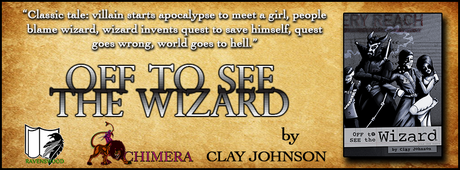
Now, for the first time, readers get an in depth look into what really happens after the quest. This is the collected case file of the Grand Inquisitor’s investigation into the Misery Reach debacle. Read first hand as the participants try to explain their actions and make their case. Did the Demon Lord Krevassius really try to end the world just to impress a girl? Would everyone be better off if the Wizard Galbraith hadn’t invented a quest in order to stave off criticism? And what about an elf queen peeing on a Minotaur? A swordsman’s losing battle with a young raccoon? And the transvestite assassin with a heart of gold?

ONE LINER: Classic tale: villain starts apocalypse to meet a girl, people blame wizard, wizard invents quest to save himself, quest goes wrong, world goes to hell.

PAGE COUNT: 373
ISBN: 978-0692638170
IMPRINT: Chimera

Book Page: http://ravenswoodpublishing.com/bookpages/offtoseethewizard.html

AUTHOR BIO: Clay Johnson received an MFA from an old man running a forged documents booth under the 8th street bridge. When he’s not out saving the world as an international super spy and master of kung fu, he makes graphics and animation for a TV station. Clay lives with his wife and daughter in New Hampshire.

Author Link: http://www.ravenswoodpublishing.com/authors4.html#

Every Heart a Doorway by Seanan McGuire

Every Heart a DoorwayEvery Heart a Doorway

by Seanan McGuire
Series: Wayward Children, #1

Hardcover, 169 pg.
Tor.com, 2016

Read: April 16, 2016

“. . . we went through. We came out on this moor that seemed to go on forever, between the mountains and the angry sea. And that sky! I’d never seen so many stars before, or such a red, red moon. The door slammed shut behind us. We couldn’t have gone back if we’d wanted to — and we didn’t want to. We were twelve. We are going to have an adventure if it killed us.”

“Did you? asked Nancy. “Have an adventure, I mean?”

“Sure,” said Jack bleakly. “It didn’t even kill us. Not permanently anyway. But it changed everything.”

One of my favorite book bloggers to read (and not just because our tastes are similar) began his take on Every Heart a Doorway by saying:

Sometimes we either meet a book (or a novella, in this case,) that is precisely the right fit for your soul, (at the moment,) or just happens to be original enough right when you need it, that it fills your life and your mind with brightness and joy.

For me, this is one of those pieces. To muddy the waters even more, I’m an unabashed fan of the author and I’m likely to pick up all of her writings without even checking the subject matter because I simply trust the woman to steer me to any shore.

If I didn’t start off by quoting that, I’d end paraphrasing/plagiarizing it.

So here’s the deal in a world where portal fantasies are possible, and children all over the world are going through them — à la Lucy Pevensie et al., Dorothy Gale, September, Quentin Coldwater, Alice, Jason Walker, etc. — and, sadly (?) most of these children end up back home. Some of them are glad to be back in this world and want to put their adventures behind them — a lot of them don’t want to be here anymore and want to return to wherever it was they went. Both kinds of children have a hard time coping in this world and need help. Eleanor West’s Home for Wayward Children is for the latter kind.

Nancy is a girl recently returned, and is very different than the girl her parents have been missing. They want her fixed, they want their daughter back — not whoever this person is with different attitudes, actions, clothes, etc. — West doesn’t promise that (but she may have allowed them to think she’ll do that, just so she can help Nancy), but she can help Nancy adjust to this world. So she joins the small student body at the private school/treatment center. The last thing Nancy wants is to be fixed, to be that girl again — which just means she fits in here, with returned kids from all over the country, who’ve been in all sorts of worlds. As Nancy begins to understand the nature of these other worlds, the effects they have on children, and why many of them want to leave again, so do we.

It turns out, all of the residents of West’s Home are going to learn that you can have plenty of adventures here, too. And that’s all I’m going to say about that.

I really liked all of these children — the adults we met, too, actually — Jack in particular. But every one of them — even the less-than-nice ones — are great characters and I’d have gladly spent another 200 pages with them, easy.

The writing is incredible — not that I’ve ever had any real problems with McGuire before, but she kicked it up a notch here — and is writing a different kind of story than I’m used to, so she writes differently. This book took me longer to read than it should’ve, because I had to go back and reread several sentences/lines/paragraphs — not because I needed to read them again for clarification, but because they were so perfect, so quotable, so . . . something. I’m not going to start quoting beyond what I opened with, because I don’t know if I could stop — Laura got two of them I made notes about. You could literally be amused, melancholy, horrified, feeling whimsy, and nervous within a couple of paragraphs — only to turn the page and start all over again. Not because she was jerking you around or anything, it’s just that kind of story, that kind of playing with language, just that kind of broken reality.

McGuire gave us such a satisfying ending — complete, tidy, fitting, bittersweet, heartwarming — and then I read another paragraph or so, and it’s so much better (and all of the above to the next degree) once you got to the actual ending. Then I closed the book and I teared up a little — for no reason at all, really, but it felt really appropriate.

Can I say this is positively Gaiman-esque without making it sound like McGuire’s derivative in any way? I don’t want to even hint at suggesting that — but man, if you like Neil Gaiman’s stuff — get this. If you’ve ever read a portal fantasy and wondered what happened to the kids afterwards– get this. If you like things that are good, and don’t mind magic in your reading — get this.

—–

5 Stars

Heroes and Villains: Pawn in the Game by Tara R

Heroes and Villains: Pawn in the Game Heroes and Villains: Pawn in the Game

by Tara R
Series: Heroes and Villains, #1

Kindle, 243 pg.
2015

Read: March 26 – 27, 2016


I’m not really sure where to start with this, to tell you the truth. Tara R has put a lot of effort into this, there’s clearly an ambitious story she’s wanting to tell. Sadly, she’s not the kind of writer (yet?) who can pull it off.

She has a hard enough time pulling off basic grammar, punctuation and vocabulary, much less a consistent voice and created culture. I’d given up on this thing by the end of chapter three, but was willing (and eager) for her to win me back — it’s been done before. It’s been done in the last week, but this novel just isn’t capable of it.

I’d try to describe the book a little, but I’m not sure I can — it’s a dystopian fantasy, a world full of despots using their subjects as cannon fodder. There’s magic, to a degree, there’s widespread suffering and abuse, there’s an idealistic revolutionary or two — but no golden age to hearken back to. Just an idea (with no observable origin) that the world could be better. But there’s no one on this world that’s ever seen a better world, so why they’d think there is one is beyond me.

That said, various people — royalty and commoners both, have senses of humor, moments of joy and joking, and even non-royals get dressed in tuxedos (because what epic fantasy doesn’t have guys in tuxes?). In fact, for a dytopian world, it frequently doesn’t seem that bad — except for the people talking about how horrible it is all the time. Again, there’s no basis for them to think so given that this is the way the world has always worked.

The various governmental entities, secret societies, and would-be insurrections just don’t make sense. Their operation isn’t coherent (nor do they fit the setting), their goals are confusing — and then you get the totally out of the blue and bizarre lecture on DNA and I just gave up. This is a barely educated society, and sure, our protagonist is founding secret schools all over the place, but it’s a mighty big leap to go from an agrarian-based culture in a near-constant state of war with only underground schools to people casually discussing genetic manipulation.

Could I have tried harder to understand everything? Maybe — but I was really searching for something to hold on to, I tried pretty hard. But other than curiosity, there was no reason to — there’s not a single character interesting enough to keep you going, to make you care whether they live, die, or are never mentioned again in any way by the author.

It is simply, and perhaps too bluntly, a disappointing mess.

I’m giving it two stars because I didn’t actively hate it. Also, I do think that there’s something buried deep down here that’s worth looking at, and I really do think that in Tara R’s mind, this all makes sense — she’s clearly put the time and thought into it. But she just did not get that to the page. If you’re willing to put in the work, you might find the nuggets. But I wouldn’t recommend spending your time on it, it’s just not worth it.

Disclaimer: I was provided with a copy of this by the author in exchange for an honest review, she hopefully doesn’t regret that exchange too much.

—–

2 Stars

Risen by M. T. Miller

RisenRisen: First Book of the Nameless Chronicle

by M. T. Miller
Series: The Nameless Chronicle, #1

Kindle, 87 pg.
2016

Read: March 11, 2016


This kicks off with one of my favorite first chapters in months. Sure, it only takes a second or two to know what’s going on in it, but it’s really well done, even if it isn’t a mystery (I’m not sure it was supposed to be, but it seemed that way). Risen grabbed me right off and didn’t let go until the end.

Our protagonist is suffering some sort of amnesia — he doesn’t know who he is, where he is — even when he is. He finds himself in a city that’s definitely seen better days. It’s pretty much the poster child for dystopian ruins — Chicago in Divergent, for example. But with fewer people (maybe).

He enlists the assistance of a homeless man to guide him through both the culture and geography of this city and the surrounding. They encounter a street gang that seems to run just about all the city, a severely under-staffed church that seems to be just about the only place in town not run by the gang, and an extended family (of sorts) that lives outside the city.

And by “encounter,” on the whole, I’m speaking of the violent type. Nameless remembers very little, but he seems to remember how to fight. Each fight does tell us a little more about the world and Nameless, so they’re not just fun bits of gratuitous violence.

There’s some supernatural stuff going on (not just in this city, but on the other side of the country), possibly Spiritual forces (in the religious sense), and . . . who knows what all, really?

All this is told with grim humor and a strong narrative voice that keeps the reader engaged in the story and characters — not just in the “I wonder what’s going on in this strange world” kind of way. Even knowing practically nothing about Nameless (making me a lot like him), I liked him as a character and want to read more about him.

My one complaint is length — just about everything is too short. The story is too short, most of the scenes are, too. But I’m pretty sure that’s just my wanting more for myself — to give us longer scenes would ruin the pacing, would mess with the way Miller’s constructing the series. And really, when you get down to it “I wanted more!” is more of a compliment than a complaint — but I’m calling it one nonetheless.

A fast, gripping read that’ll leave you wanting more. A perfect little palate-cleanser between heavy reads. I’m eagerly waiting for further adventures of Nameless and finding out more about him and his world.

Disclaimer: I was provided a copy of Risen by the author in exchange for an honest (and, it turns out, over a month overdue) review.

—–

3.5 Stars

Steal the Sky by Megan E. O’Keefe

Steal the SkySteal the Sky

by Megan E. O’Keefe
Series: The Scorched Continent, #1

Mass Market Paperback, 439 pg.
Angry Robot, 2016

Read: February 20 – 23, 2016
It’s both overly-simplistic and inaccurate to describe Steal the Sky as The Gentlemen Bastards in the Firefly ‘Verse. But it’s not completely wrong.

I’m not sure I can defend that, but I tell you this: read the book and you’ll probably agree. I’m going to try to reference those other works as little as I can, because the book is more than just a combination of their DNA, but I’m going to have to a couple of times. There’s also a smattering of Steampunk-ish elements, some Epic Fantasy-like things, and a dash of The Stainless Steel Rat. You know how Data downplayed his violin playing as a combination of all those various artists, and Picard and Crusher (I think it was her, anyway) telling him that he’s the one who took all those various characteristics and made it his own? That’s what O’Keefe did here, and I hate to minimize what she did by just referencing these other works — but in the interest of brevity, you pretty much have to. I, frankly can’t wait to see in future books what other ingredients she puts in her secret sauce.

But before then, we have to step onto the Scorch, an unforgiving continent, to be sure.

What is it with SF novels and mining? Everywhere I turn lately, there are people slaving away (literally) in mines — Pierce Brown’s Darrow (and the rest of the Reds); almost everyone on Josi Russel’s Minea; and countless people in Aransa and the rest of the Scorched Continent. Really, it wouldn’t surprise me to see Raylan Givens and Boyd Crowder’s descendants digging for spaceship fuel next year on FX. One reason that you see them everywhere is that it’s really effective — you read “miner” and you see poor workers, toiling in unsafe conditions, who are very likely being taken advantage of. If that’s not grounds for compelling drama, well — did you not get where Katniss Everdeen was from?

Like on Minea, there’s a special kind of person who can find the precious resource, called Sel. Sel-sensitives — no matter what their social class, family, or other abilities — go work in the mines (well, a very few become pilots). They can find Sel, they can manipulate Sel, they are the key to getting it out of the planet and into their ships (as an aside, Sel seems to be somewhat renewable, which is nice). The last things the government wants is turmoil — and the thing they want most are Sel-sensitives who can do more than get Sel out of the ground.

The Scorched Continent looks and acts like something from the Old West (at least as we know it from movies, TV, etc.) small communities, mostly poor, with some nobility with a lot of on the “have” side of the equation. Which is where Detan Honding comes in — he’s the black sheep of the oldest of the noble houses, a small-time con man staying one step above starvation and another step ahead of the law (I’m about to break into “Street Rat” from Aladdin, so I’m going to stop). Along for the ride is his long-suffering ship’s pilot, friend, and resident voice of reason (probably the only one who keeps him from getting carried away), Tibs.

The two find themselves in Aransa, a larger city with a big mine. Detan and Tibs are known in some quarters of the city, most notably by the Captain of the Watch, Ripke Leshe, who wants them out of town. But has a unique business proposal first . . .

This is getting too long — let’s leave things there, with some people left for you to meet. And you want to, trust me. Including the villains — both petty and Big Bads (especially the Bigger Bads that you don’t think of that way at first).

O’Keefe has created a great world, with a robust culture, a specialized vocabulary, its own technology, politics and whatnot. There’s a whole invaders taking exploiting indigenous/traditional cultures thing that’s also going on — but O’Keefe doesn’t spend too much time on it, just gives us a quick glance of that — but it looks like future books will explore this more. So I’ll just leave it there, but I’m pretty curious about the whole thing. Speaking of local customs — anytime people talk about Walking the Black — put aside anything you may be snacking on.

Now, since I (and many others) have invoked The Gentlemen Bastards and Firefly, I should say that both of those have a sense of fun — a sense of play — that’s really not that present in Steal the Sky. You get the impression that maybe (probably) whatever happened before this did, though. This book is mostly like the part of Lynch’s work where play time is over and Locke is going for vengeance, not just a payday. Which is not to say that isn’t fun — there are plenty of laughs, jokes, witty rejoinders and whatnot — I’d love to quote some, but the amount of context it’d take for the you to get the joke would kill this. This novel doesn’t have the joie de vivre that the other works do, but it could.

One more Firefly reference and I’m done — towards the end, when things look pretty dire for some of our characters — you get the impression that O’Keefe spent a lot of time wondering just what happened to River while at The Academy, and a few people here would probably find themselves capable of swapping notes with Ms. Tam.

There’s excitement, piracy, politics, thievery, general mischief, subterfuge, revenge, friendship, loyalty in this story — told in a great world, with hints of more worlds to come (as well as more to learn about this one). People are going to be talking about this one for a while, I think. I am, at least.

—–

4 Stars

Top Ten (and a bonus) Books from My Childhood

I was bemoaning how long my current read was the other day and how it was going to leave me without a post for today, and my ever-so-clever daughter suggested, “Why don’t you list the Top 10 Books from your childhood?” That sounded pretty fun, so I figured that I might as well. It turned out to have been better than I thought, so kudos to her.

Ranking them really would be impossible, but then 11 came to mind really without any effort, and I couldn’t axe one of them, so there’s a bonus entry to the list. All of these I read more than I can count — if they’re part of a series, these were the ones that I came back to most often. The links are to Goodreads pages because I can’t find good official pages for all the books/authors (a true sign of my age, I guess).

Enough of that, on with the trip down Amnesia Lane:

The Castle of LlyrThe Castle of Llyr

by Lloyd Alexander

The Chronicles of Prydain taught me most of what I needed to know about Fantasy (augmenting The Chronicles of Narnia‘s lessons). Fflewddur Fflam here is at his best, I think it’s here that I fell in love with Eilonwy, Taran’s more of a real hero than before, and you get plenty of Gurgi (who I just have to mention because thinking of him makes me smile). There’s peril, the characters grow more than they have before, a hint of romance . . . it’s not the most important book in the series, but I think it’s pivotal.

Danny Dunn and the Anti-Gravity PaintDanny Dunn and the Anti-Gravity Paint

by Raymond Abrashkin and Jay Williams

I didn’t know until today that this was the first in the series, I always figured it was mid-series. It’s the only one of the series that I owned — thankfully, the library had a few more — so it’s the one I read most. It was also my favorite — I just loved the stuff at the edge of our solar system and Prof. Bullfinch and Doctor Grimes making musical instruments from their hair — stupid as all get out, but it worked for me.

The Mystery of the Dead Man's RiddleThe Mystery of the Dead Man’s Riddle

by William Arden

While Encyclopedia Brown (see below) got me reading mysteries, it was The Three Investigators — Jupiter Jones, Bob Andrews and Pete Crenshaw (btw, the only thing there I had to look up was Pete’s last name — not bad for a series I haven’t touched since the late 80’s) got me hooked on reading detective series. The Dead Man’s Riddle was one of my favorites — and I think the first or second I read — something about the Cockney slang kept bringing me back to it. I read what I do today because of this series, really.

SuperfudgeSuperfudge

by Judy Blume

I remember Tales of a Fourth-Grade Nothing being funnier, but this was a better story — the Fletchers leaving NYC, Peter maturing, Fudge being a real pain, not just a cute nuisance. Blume taught me a lot about how to read non-genre stuff, probably paving the way for Hornby, Tropper, Weiner, etc.

The Last of the Really Great WhangdoodlesThe Last of the Really Great Whangdoodles

by Julie Edwards

What a great world, what a great magic system . . . I’m not sure I can express what this book meant to me as a kid, and the copious warm-fuzzies the memory brings up. I remember that it was in the pages of this book about a magic kingdom that I first learned about DNA and RNA (and what those letters meant) — thanks, elementary school science classes. The creatures’ names in this are great (and, as an adult, I can “hear” Andrews saying them in my mind for an added layer of fun). There’s a great deal of whimsy here, a sense of play that permeates this — even when it gets silly. The kingdom’s motto, “peace, love and a sense of fun” really sums up the spirit of the book.

Me and My Little BrainMe and My Little Brain

by John D. Fitzgerald, Mercer Mayer (illus.)

Sure, the series was supposedly about Tom, but J. D.’s the real hero of the books. He has a conscience, a better moral compass than his brother — and is probably just as smart. This is the book that lets him shine as he ought to have all along. All the books had their strong points, and were fun, but this ruled them all.

The Phantom TollboothThe Phantom Tollbooth

by Norton Juster, Jules Feiffer (illus.)

Such wordplay! What a great, twisted way to teach how important words and ideas are. Seriously, just a wonderful book. The humor is so off-kilter, any appreciation I have for puns came from this book (and it set the standard that a pun must achieve for me not to groan). If you haven’t seen the documentary about it, The Phantom Tollbooth: Beyond Expectations, get on it. (I contributed to the Kickstarter for it, I should add).

The Voyage of the Dawn TreaderThe Voyage of the Dawn Treader

by C. S. Lewis

I remember the bookstore where I bought this, the date and month that I bought it, and reading a good chunk of it before I got home. I read this one more than the rest of the series (Prince Caspian a close second). I just love this one — you get Reep at his bravest and funniest, some really odd creatures, an epic story, and Eustace’s redemption (back when I did crazy things like this, I almost got a tattoo of Eustace as Dragon). Who could ask for more?

Alan Mendelsohn the Boy from MarsAlan Mendelsohn, the Boy from Mars

by Daniel M. Pinkwater

Pinkwater has funnier and stranger books (both before and after this one), but there was heart, there was depth — there was length! — to this story about a kid who didn’t really fit in until he made a friend who didn’t want to fit in. This is another one where I can peg the place and time I bought it. Science Fiction-y in a real world (didn’t know you could do that!), comic book geeks as heroes, and real non-sanitized-for-kids emotions. There’s no way this wouldn’t be a favorite. More than the rest on this list, I’m thinking of finding my old copy and taking it out for another spin (because I just read the next one a couple of years ago).

The Westing GameThe Westing Game

by Ellen Raskin

If I had to pick one off this list (and I don’t), this would probably be my favorite. I re-read it two years ago, and it was one of my favorite experiences that year with a book. The characters are great, the story was so clever, the writing so crisp. There’s nothing wrong with this book at all.

I saw a hardcover reprinting of this on Monday, and had to fight to resist buying a new copy. Kind of regretting that now.

Encyclopedia Brown Boy DetectiveEncyclopedia Brown, Boy Detective

by Donald J. Sobol

Summer after second grade, we were on a forever-long road trip and I was bored, so I demanded my parents buy me something to read. I must’ve been a real snot about it, because at the next town, they did. I got two books, this one and Sugar Creek Gang Screams in the Night (not the best in the series, but it was good enough to read several times). It blew me away — I loved the puzzles, the characters, the idea. I wanted to be a P. I. This was my first mystery book, and it clearly set the stage for most of what I’ve read since (about a third of what I read).
Were you a fan of any of these as a kid? What were some of your faves? Have you read them lately?

Page 48 of 54

Powered by WordPress & Theme by Anders Norén