Tag: From the Archives Page 21 of 28

Dusted Off: Attack of the Spoilers

So, the instant I heard that Joe Torre had a book coming out about his time with the Yankees, I ordered it (even if he technically wrote nothing). Now I’m wondering if I wasted my money. The book comes out today, and it’s already been making news thanks to a copy that a couple of NY journalists got their hands on a week or so early.

The leaked portion of the book couldn’t be more than a few paragraphs, and yet hours of TV/radio time, gallons of ink, GB of internet traffic has been devoted to it. Now that the book is out, and we’ll get more than an isolated comment about A-Rod or a description of Cashman’s treatment of Torre toward the end. I can’t imagine that we’ll see less reporting.

Now, I’ll try to avoid as much of that as I can, but it won’t be enough. If I’m not careful, I’ll end up reading/hearing the whole book before my copy arrives on Thursday, and I really won’t have time to dig in to it until Saturday.

I understand our media culture is all about getting the story out before anyone else. But when it comes getting the details of a book–memoir or best-selling novel (how many leaks about the ending of Deathly Hallows were there?)–movie, TV series finale, etc. what’s the rush? Can’t we wait for the intended audience to get a crack at it before rushing to print? What’s the benefit to spilling the details/ending/spoilers?

Internet fan sites and whatnot have the decency to warn readers about spoilers, so we can avoid them. Can’t legitimate news groups (or reasonable facsimiles thereof) do the same?

just a little griping, I guess.

Dusted Off: Exactly what I’d Write if I was Erudite

Terry Teachout’s blogpost today, “Forty years with Nero Wolfe” is one of those posts I really wish I could’ve written.

Give it a read, hopefully Teachout can convince you to pick up Wolfe. Outside The Bible, a handful of Reformed and Puritan writers, Stout’s the only author I’d recommend to every person I know w/o a disclaimer or a second thought.

Dusted Off: Wishful Drinking by Carrie Fisher

This is by no means the best written book I’ve read this year–which is a shame, because Carrie Fisher is a skillful writer. It is, however, probably the funniest thing I’ve read since I Love You, Beth Cooper.

Adapted from her one-woman show, Wishful Thinking is an autobiography by anecdote–a series of recollections from her star-studded childhood, through her early addictions while starting in film, through her later addictions and failed marriages, and to her hospitalization in a mental health facility and electroshock therapy–and a bunch of stuff in between.

Sounds like a blast, doesn’t it? Well, here’s the opening paragraphs, where she explains that.

I have to start by telling you that my entire existence could be summed up in one phrase. And that is: If my life wasn’t funny it would just be true, and that is unacceptable.

What that really means, other than what it sounds like, is, let’s say something happens and from a certain slant maybe it’s tragic, even a little bit shocking. Then time passes and you go to the funny slant, and now that very same thing can no longer do you any harm.

So what we’re really talking about then is: location, location, location.

Fisher’s clearly at the point where this material can do her no harm, what it can do is entertain. You can hear her voice reading the book–I’ve got to remember to see if she reads the audiobook, gotta grab it–I can only imagine how fun seeing the show would be.

Yes, there are cheap shots at Republicans, Sarah Palin, President Bush, and several other things that will offend many. But Fisher is so refreshingly honest and frank in telling her story that you really just don’t care.

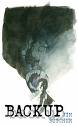
Dusted Off: Backup by Jim Butcher

Well, that was a fun, 45 minutes (give or take).

Just knocked off Jim Butcher’s Backup: A Story of the Dresden Files. Weighing in at about 12K words, it’s almost as meaty as the 4-issue mini-series comic book Welcome to the Jungle (recently collected and published in hardcover form).

This is a different way of telling a Harry Dresden story, coming at it from the POV of his brother, Thomas. Not only does this give us a new way of seeing Harry, it gives us a better appreciation for Thomas. (In many ways, it reminded me of Crais’ The Watchman from last year.)

Quick read; decent story–resolution came a bit too soon, but given the length, such was unavoidable; probably paid too much for it, given my budget; hope some of the backstory spills over into the regular Dresden File novels. Something any fan should pick up.

Dusted Off: Happy Birthday, Archie!

On Oct 23 in Chillicothe, Ohio, Archie Goodwin entered this world–no doubt with a smile for the pretty nurses–and American detective literature was never the same.

I’m toasting him in one of the ways I think he’d appreciate most–by raising a glass of milk in his honor.

Who was Archie? Archie summed up his life thusly:

Born in Ohio. Public high school, pretty good at geometry and football, graduated with honor but no honors. Went to college two weeks, decided it was childish, came to New York and got a job guarding a pier, shot and killed two men and was fired, was recommended to Nero Wolfe for a chore he wanted done, did it, was offered a full-time job by Mr. Wolfe, took it, still have it.” (Fourth of July Picinic)

Long may he keep it. Just what was he employed by Wolfe to do? In The Black Mountain he answers the statement, “I thought you was a private eye” with:

I don’t like the way you say it, but I am. Also I am an accountant, an amanuensis, and a cocklebur. Eight to five you never heard the word amanuensis and you never saw a cocklebur.

In The Red Box, he says

I know pretty well what my field is. Aside from my primary function as the thorn in the seat of Wolfe’s chair to keep him from going to sleep and waking up only for meals, I’m chiefly cut out for two things: to jump and grab something before the other guy can get his paws on it, and to collect pieces of the puzzle for Wolfe to work on.

In case you’re wondering if this post was simply an excuse to go through some collections of Archie Goodwin quotations, you wouldn’t be totally wrong…he’s one of the fictional characters I like spending time with most in this world–he’s the literary equivalent of comfort food. So just one more great line I’ve quoted here before:

I would appreciate it if they would call a halt on all their devoted efforts to find a way to abolish war or eliminate disease or run trains with atoms or extend the span of human life to a couple of centuries, and everybody concentrate for a while on how to wake me up in the morning without my resenting it. It may be that a bevy of beautiful maidens in pure silk yellow very sheer gowns, barefooted, singing “Oh, What a Beautiful Morning” and scattering rose petals over me would do the trick, but I’d have to try it.

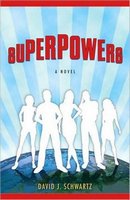
Dusted Off: Superpowers: A Novel by David J. Schwartz

If one’s going to write about superheroes there’s really only so much you can do–A. Write a prose equivalent of a comic book or B. Go out of your way to make sure that no once can describe your work as an example of “A.” Typically, the “A” books are shoddy, and wouldn’t be accepted as a script by a decent comic publisher; and the “B” books are so caught up in not being “A”s that they lose something–they might do well exploring the nature of “heroes” or satirizing/politicizing the genre or whatever, but they don’t work as novels.

I’ve had my fill of the “B”s lately, and think I’ve finished only one out of the handful I’ve started in the last couple of years–Tom De Haven’s It’s Superman, which really did work as a novel. Schwartz’ Superpowers: A Novel, stands as an example of how to do an “A” right.

Superpowers is the origin story of a super-hero team from Madison, Wisconsin, of all places. A group of college students one day find themselves with superpowers (super-strenghth/invulnerability; super-speed; invisibility; telepathy; and power of flight), and it doesn’t take too long before they decide to don costumes and fight crime as the All-Stars, despite the very clear absence of any super villainy. A solid, “A” start–and if Schwartz kept at it at this level, I’d probably really have enjoyed the read.

He did a great job of focusing on each of the five heroes in turn, never focusing on one for too long, essential to any good team book (unlike the Justice League, which all to0 frequently turns into Superman and some other guys (or Batman and…;or Wonder Woman and…; or…). The early chapters are told with a solid amount of humor–think the early parts of the Spider-Man movie, where Peter’s learning about his powers. And like I said, if he’d kept it there, Schwartz would’ve produced a fun read.

But he didn’t, and he made it a better read.

There’s a cost to these powers for each character–personal, vocational, mental, physical, familial and/or academic. Each one had a full life before tacking on crime-fighting. And life keeps going on–new changes, challenges, and developments–it’s possible that a decent story could’ve been told about these five and their associates without the powers. So they’re having to grow as people, as well as nascent heroes.

Then a few short months after receiving their powers, well–don’t want to give it away, but something happens hundreds of miles away from them that their powers can’t help. The public as a whole isn’t sure what to make of anyone being a super-hero (particularly the police). This is worsened when they make a couple of mistakes that wreak havoc on civilians.

The book is really about how people react to these powers, the costs, and the events surrounding them. The plot doesn’t depend on a super villain or three for conflict–conflict and drama come from living–lLaughter, love, anger, pain, ambition, parent-child relationships (of varying degrees of health/disfunction), hatred, fear, revenge…

These are not paragons of virtue, Schwartz depicts them as people. That’s what makes the book worth the time. While I was reading it, I kept saying to myself “If Robert Kirkman or Brian Michael Bendis wrote a novel, it would read like this.” Come to think of it, for my comic reading friends, that’s probably all I had to say in this post (a much more economical way to say everything I just did). If you’re not one of my comic-reading friends, and you want to be–read this book, and if you like it, go pick up the trade paperbacks of Ultimate Spider-Man and Invincible.

You can thank me later.

Dusted Off: Chasing Darkness by Robert Crais

I was able to steal 10 minutes here and there, and was able to finish Elvis Cole’s latest adventure. This is the best Cole in years (The Watchman, technically a Joe Pike novel, doesn’t count).
Pike is Pike (Hawk to the 3rd power); Elvis is still the less-funny, more-broody of the later novels; the nameless cat is still the nameless cat, and the regular supporting cast is at least mentioned.

The status remains quo with Elvis’ relationships with Carol and Lucy. Elvis won’t let go of Lucy, who is trying to distance herself from him (with a degree of success). Carol’s still hung up on Elvis, but seems in more control of her emotions. I’ve liked Starkey in every one of her appearances, this time, perhaps more than others.

Crais was near the top of his game when it came to plotting–I suspected the culprit early on, but it was still well plotted. What appealed to me most about this was that what drew Elvis into the case wasn’t something in his personal history, a friend’s past, Pike’s past, etc. Yes, there was a historical draw–but it was professional, making this a case of Elvis finishing a job, not exploring what made him who he is today, etc.

The ending was also pleasantly small. There was no apocalyptic battle between Elvis, Pike and several gunmen, or whatever. A simple, solid resolution. Yes, something that resonated, something that read well and contained the requisite suspense…just not an ‘end of the world’ scenario.

Sadly, have to wait another year for the next installment–but am sure it’ll be worth it.

Dusted Off: Not Gomer Pyle’s Catchphrase

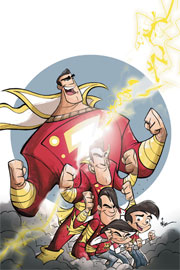
I know not all of you read comics, but for the few of you who do regularly/occasionally, let me heartily recommend Billy Batson and the Magic of Shazam! #1. The splash page rightly credits Mike Kunkel with “pictures, words & heart”–this looks and feels like a labor of love.
From the great animation-style drawings, to the clever plot, to the horribly-detailed and annoying coded-intro pages, to the use of the old “Solomon=Wisom, Hercules=strength…. acronym; this was a fun, clever, well-written book.

It seems to be marketed like a DCKids title, but it’s produced better than the rest of that line–and it’s technically not one; but it is for “all ages” (something far to rare in comics these days, even from The Big Two). I enjoyed it, and am sure the Offspring will, too.

Dusted Off: Mr. Monk in Outer Space

If I had more energy, I’d go through the archives and see how many of Lee Goldberg’s Monk novels I’ve talked about, but I’m pretty sure my take on all of them is pretty much the same: theyyyyy’re grrreaaat! The latest, just released in paperback (making it cheap enough for Frodo to give it to me for Father’s Day) is no exception.
Essentially, the novel centers on the death of the creator of a Star Trek-like show at a con. Monk has a hard time understading the obsessive nature of the fans and is convinced these adults walking around in costumes are tripping on acid. Hilarity ensues. Goldberg is able to spoof fandom, TV reimaginings, not to mention TV in general. He doesn’t do so meanly, there’s respect, affection, and understanding. Which is a pleasant change–normally fanboys are painted with the broadest brush in these circumstances and played for only cheap laughs, Goldberg resists this impulse (generally), which results in better jokes.

Outer Space‘s mystery holds up a little better than it’s fore-runners, but as with the show, the mystery is secondary to watching Monk navigate through society–particularly one as strange as SciFi fandom. I laughed out loud a lot at this one–but it was more than just a comedic romp. There were some good, more serious, moments that really get ya in the cockles—-as they do in the TV episodes featuring Ambrose (oh, did I forget to mention that Ambrose makes his first appearance in the books? Silly me). They, along with Monk’s final appraisal of fandom, really elevate the book.

Another solid outing for Goldberg–his best yet, actually. Can’t wait for the next installment.

Dusted Off: Towel Day 2008 (observed)

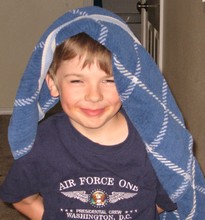
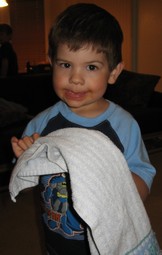
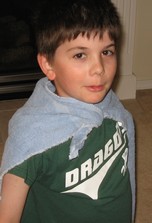
We observed Towel Day on Monday, once again celebrating the author who permanently skewed my mind back in Junior High. Couldn’t get things organized enough for a group shot this year, but I was able to snag some individual shots:

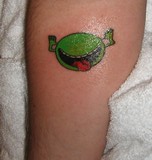
oh, yeah, and a little gift from The Love of my Life…

(will try to get a better shot of that soon)

Page 21 of 28

Powered by WordPress & Theme by Anders Norén