Tag: General Fiction Page 23 of 46

Fridays with The Foundling: An Introduction

Fridays with the Foundling
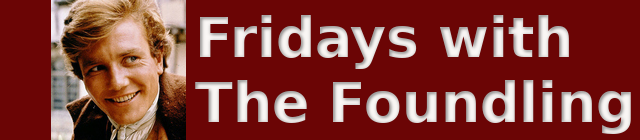
(yeah, I know, I typically hate using actor’s images when it comes to discussing the source material…but, w/o Finney, I’m not doing this)

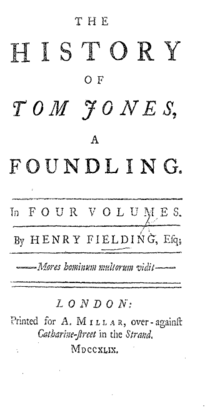
https://www.gutenberg.org/ebooks/6593My history with Tom Jones goes back to 1995 when we watched it in class for a Survey of British Literature class. It was the week before finals, and the professor thought we all (him included) could use a little less to do, and there was no way we could’ve fit the novel into our schedule. To be fair, he interrupted the movie frequently for us to learn a little about the novel.

And, really, who cares? We got to watch the 1963 classic.

But like with all good movies adapted from a book, all it really made me want to do is read the book. If for no other reason than it being one of the first things in English that is considered a novel. It literally defined the convention of what a novel is. I’ve attempted to follow through and read the book several times. But I’ve never managed to get too far into it. The reasons vary, but I’ve just not made this particular summit. One obstacle I do remember stumbling over repeatedly is the length. I’d start reading and decide there was no way I could finish the tome before it was due back at the library. Don’t ask me why it took me until 2019 to come up with the solution: buy a copy.

So, I’m going to approach it differently this year. Every Friday, I’m going to read 4 chapters. Then post about those the next week. The chapters are pretty short, so I should be able to accomplish this with little difficulty.

Now, I reserve the right to abandon this and just finish the whole thing if I really get into the story and just can’t wait for the next regularly-scheduled reading session.

Anyone else ever read this thing? Any thoughts?

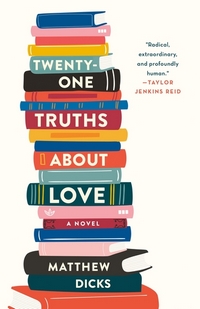
Twenty-one Thoughts About Twenty-one Truths About Love by Matthew Dicks

Twenty-one Truths About Love

Twenty-one Truths About Love

by Matthew Dicks

Hardcover, 352pg.
St. Martin’s Press, 2019

Read: December 5-9, 2019
Grab a copy from your local indie bookstore!

NOVEMBER 4
8:10 AM

5 Problems with Lying
1. We lie most often to the people we love.
2. There is no greater shame than getting caught in a lie.
3. A lie often requires additional lies, making it impossible to ever come clean.
4. Liars are the worst human beings.
5. Lies always cover up the worst parts of you.

NOVEMBER 4
8:40 AM

How liars with the best intentions are like the owners of every iteration of Jurassic Park
They never set out to hurt anyone.
They operate with enormous hubris.
Denial both perpetuates and intensifies the problem.
The situation inevitably gets worse and worse as time goes by.
The end is never pretty.

1. Yes, that’s how this entire book is written.

2. No, it doesn’t get old or tiresome or start to feel overused. In fact, you’ll probably end up wishing you could read more books written like this.

3. But you’ll know if you did, they’d feel like cheap rip-offs of this great idea.

4. Some time back Daniel Mayrock’s therapist wanted him to keep a journal, making lists about his life/likes/thoughts was the compromise they reached. Now, this is how he processes things in his life, tracks ideas, and even occasionally plans things (including incredibly stupid things that even he realizes that he shouldn’t be planning).

5. A year ago, Daniel quit his job as a teacher to open a bookstore.

6. The bookstore is struggling, and he’s losing money

7. The lying that he’s focused on in that quotation above (and throughout the book) is primarily focused on that—Daniel’s lying to his wife to the extent she thinks they’re turning a profit

8. Other things that Daniel lies to Jill about include: his interest in/preparedness for having a baby (not just about the financial strain this would be, but that’s a big chunk of it); and the amount of jealousy he has toward his wife’s first husband, who died young.

9. The book contains the cutest authorial cameo this side of the stand-alone novels that Brad Parks has been putting out lately.

10. This guy is so addicted to Little Debbie Snack Cakes, I’m beginning to wonder if the frosting is laced with nicotine.

11. We don’t get to know Jill very well, because this book is about what’s going on in Daniel’s mind, with a focus on his issues, not the people around him. We know she has trouble with the principal at her school, that she really wants a baby, is still in love with her dead husband—and is apparently crazy about Daniel (not that he’s great at seeing it).

12. The other big thing we learn about her is that she is really bad at putting away clothing after it’s been laundered.

13. I mentioned earlier that Daniel plans something incredibly stupid, with the goal of helping finances. It is incredibly stupid, but along the way, he unintentionally makes a friend. My sole complaint with this book is that we don’t get to spend more time with this friend. Thankfully, we get enough to enjoy him.

14. I spent a lot of time thinking this plan was a fantasy/daydream kind of thing that he was indulging in—and liked it. When I realized (later than I should have) that Daniel was serious about it, I worried that this would ruin the book for me. It didn’t, so I’m glad I didn’t give up on it.

15. You’d think that given the unique way this book is written in that you’d speed through it in an afternoon.

16. You’d be wrong—it’ll take you about as long as any other 350-page book would take to read. You end up having to think a little bit more about the words than usual to piece together the story from the snippets given in the lists. (this is not a complaint, it’s an observation)

17. This is one of the funniest books I’ve read this year. But it’s not all about the laughs—there’s brutal honesty, there’s the inherent ugliness of jealousy, the despair of hopelessness, Daniel’s self-loathing at lying to his wife . . . Daniel’s a great, flawed, human character that you can’t help but root for (including rooting for him addressing some obvious character flaws).

18. I remember in a Creative Writing Class in College spending about 40 minutes going over the rules/strategies involved in using lists in fiction. I’m pretty sure that Dicks breaks half of them—and the book is better for it. I’d love to discuss this book with that instructor. (Unlike a lot of what I read, I can see her enjoying this book and appreciating the craft). The execution is perfect—and it’s easy to tell that, if it wasn’t this would’ve been a disaster of a novel.

19. No, I did not sit in my car weeping while reading the end of this book.

20. If the eponymous title was Thirty-Six Truths . . . I might have. I probably would have. (It might have only taken 25 truths)

21. I’ve been telling myself for years that I needed to pick up another Matthew Dicks novel, and I’m so glad that I did and that it was this one. It’s one of my favorite reads of 2019.


5 Stars2019 Library Love Challenge

This post contains an affiliate link. If you purchase from it, I will get a small commission at no additional cost to you. As always, opinions are my own.

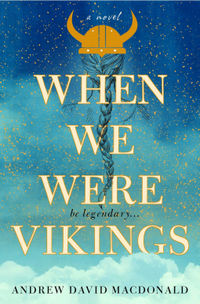
When We Were Vikings by Andrew David MacDonald: A Contemporary Legend in the Making

When We Were Vikings

When We Were Vikings

by Andrew David MacDonald

eARC, 336 pg.
Gallery/Scout Press, 2020

Read: December 9-13, 2019
Grab a copy from your local indie bookstore!


We meet our protagonist, Zelda, as she turns 21. It’s a pretty big day for most Americans, and it certainly is for Zelda. Things are going well for her—she has a boyfriend, her meetings with her therapist are going well, the brother (Gert) she lives with is taking college classes as a way to make their lives better, and Zelda’s friend/Gert’s ex gave her an actual small sword.

Zelda, you see, is a major fan of Viking culture and wants to be a Viking hero—and this sword is another step on her way to becoming a Viking legend. She also was born on the Fetal Alcohol Spectrum—as she says her Mom accidentally poisoning her resulted in Zelda being short, with trouble sitting still and thinking.

She has a fantastic therapist, Dr. Laird, who helps both her and Gert (when Gert will let him) navigate her challenges and Gert’s own issues. He’s a few years older than his sister, and once their mother died (their father disappeared years prior to that), he took on the responsibility of taking care of her.

This is a good thing for Zelda, incidentally, they’d been placed with an Uncle after their mother’s death—and he’s about as worthless a character as you can imagine. Gert does some business with people he shouldn’t to get them out of that situation and into their own apartment. This comes back to haunt him around the time of her birthday and old debts and favors need repayment. Meanwhile, his ex had convinced him to take courses at a Community College and helped him get the funding to start.

Gert’s ex/Zelda’s sword provider is known as AK47, by the way. Which says a lot about their neighborhood, I think. She’s actually the moral center of this novel and provides most of the wisdom displayed (although Zelda is a close second on both fronts, especially with AK47’s help).

While Gert’s trying to improve their station in life, Zelda goes to classes at a community center with similarly-aged people with developmental disabilities There, in addition to spending time with friends (including her boyfriend), Zelda learns behavioral and life skills. The staff there are fantastic and really impressed me with the way they interacted with everyone.

Honestly, though the deck seems stacked against these two—they’re taking care of each other and making their way in the world. Things are going as well for them as they could realistically hope (not that Zelda’s great at realistic expectations, she’s convinced she’ll be a Viking legend, for example). Except for that thing I’d said earlier about old debts and favors. And the expenses related to Dr. Laird (even on a sliding scale) and other ways Gert has to take care of Zelda. Oh, and maybe school isn’t going too well, either.

Gert tries to insulate Zelda from all that, but it doesn’t go too well. Zelda doesn’t try to insulate Gert from the fact that she and her boyfriend want to progress their relationship to physical intimacy, but man, he wishes she would (and that she’d drop the idea in general. Spoiler: she doesn’t).

We watch Zelda navigate these changing times, while she deliberately tries to mature and take on added responsibilities to help Gert. And Gert’s life gets out of control.

There are threats of violence. Actual violence. Relationship troubles. A new job for Zelda. And pressures on the two siblings that test their bonds.

The attentive reader is always aware that Gert’s in trouble and that he’s not being all that honest with Zelda—don’t misunderstand me, he’s trying his best to take care of her, but he’s hiding things from her and taking advantage of the fact that she can’t understand everything that’s happening. AK47 is a great character and I wish we’d gotten more time with her—things would’ve gone much better if Gert had stuck with her and listened to her.

Zelda’s an unintentionally unreliable narrator (but man, she tries), and MacDonald does a wonderful job putting us in her head while she navigates these obstacles along the way to becoming a legend. Obviously, your appreciation for the novel will hinge on how much you relate to/connect with/root for/like Zelda. I didn’t really get invested in Zelda as a character until the last 15-20% of the book, despite being hooked almost instantly and enjoying the novel. I think if I’d become invested early on, I would be jumping up and down excited about it.

But, I didn’t. So all I can really say is that MacDonald did yeoman’s work here and I have nothing but respect for the voice and craft displayed here. But I’m not able to muster the excitement that I think this book just might deserve. Part of that might be because I felt that I was supposed to find a lot of this amusing (and it did have its moments), and it is marketed as humorous, but it felt too much like laughing at Zelda, not with her (not that MacDonald ever mocked her).

I can’t tell you why this really didn’t click for me, but I didn’t like it as much as I wanted to (or thought I should). I imagine that I’m going to be in the minority with this and that most readers will rave. I liked the characters, I liked the story, I admire the way MacDonald wrote this—capturing Zelda’s voice and thought-process in a way that is both sympathetic and realistic. It’s a good book, one that will earn fans by the truckload, I expect—if the story/characters sound interesting to you at all, go read it. You’ll probably like it. Do me a favor though, and come back and tell me why I’m wrong not to swoon.


3.5 Stars

Disclaimer: I received this eARC from Gallery, Pocket Books via NetGalley in exchange for this post—thanks to both for this opportunity.

This post contains an affiliate link. If you purchase from it, I will get a small commission at no additional cost to you. As always, opinions are my own.

46 percent Better Than Dave by Alastair Puddick: Dave meets a better version of himself

46% Better Than Dave

46% Better Than Dave

by Alastair Puddick

Kindle Edition, 245 pg.
Raven Crest Books, 2019

Read: December 14-17, 2019

No matter which way I looked at it, I was now inexplicably living next door to another version of myself. Another Dave Brookman. A richer Dave Brookman. A more successful Dave Brookman. And though I didn’t like to admit it, he was clearly also a slimmer, fitter, more handsome Dave Brookman. It was as if he was better in just about every single way. And, whether it was his intention or not, he was making the old Dave Brookman look bad. Really bad.

To say that our narrator, Dave Brookman, is surprised to find out his new neighbor shares a name with him. He shortly learns that they grew up near each other and are in the same industry. The coincidences are mindblowing. But as our narrator starts comparing the two, he keeps thinking that the “new” Dave has it better—from a literal ex-model wife to a flashy car, and all points in between.

But just how much better is “new” Dave? “Old” Dave puts together a spreadsheet assigning numerical values to various attributes/possessions and ends up with the titular value:

I sighed loudly. Of course, I’d expected there to be a difference. I knew he would come out on top. But 46%? That was nearly 50%. And 50% was half. So New Dave was nearly a whole half better than me. How could this be? What the hell had I done with my life? Had I wasted the opportunities we apparently both shared, as New Dave took full advantage of them? What could my life have been if I’d made different decisions along the way? Would I have my own company and a flash, expensive car? A house with a new extension and swimming pool? Would I be married to a former model, and have robotically clever children?

Dave spends weeks obsessing over this idea and dives into a (very one-sided) competition to become the “better” Dave. Which is ridiculous, preposterous and unsuccessful. And that’s before his wife finds the spreadsheet. After that things go from bad to worse, and then worse. Until they don’t.

It’s a great concept, it hooks you right away. But it’s what happens after the hook that’s vital—how successful is that? Well, that depends on how you read the book.

If you are looking for any real degree of realism, it’s just too hard to swallow. But if you look at “old” Dave as a character in a comedy—he’s a lot of fun. He’s really a decent, successful guy with a good family. At least until his neighbesis (his word) moves in and he becomes an obsessive, jealous mess. In his less-obsessive moments, he seems like a decent, likable guy and it’s these moments that keep you reading. In his most-obsessive moments, he makes it hard to stick with. It’s quite the balancing act that Puddick tries here, and generally, he succeeds.

Everyone else in the novel—”new” Dave and his family, Dave’s family and co-workers—all seem perfectly normal and well-adjusted. Their reactions to him are perfectly rational and understanding, too. This both highlights his irrational behavior and makes everyone else the “straight man” to “old” Dave. Without that, I think the whole thing would’ve collapsed.

Puddick has given his readers a sweet and funny novel about obsession, jealousy, and what happens to someone when they lose sight of what’s important in life. If you’re looking for a fast and fun read, you’d do well to give this a shot.


3 Stars


My thanks to Love Books Group for the invitation to participate in this tour and the materials (including the book) they provided.

Love Books Group

EXCERPT from 46% Better Than Dave by Alastair Puddick

A Sample from Chapter 8

“No offence, mate, but when was the last time you ran further then the end of the street?” said Charlie. “Let alone 10k, jumping over electric fences.”

“Screw you,” I said. “I’ll have you know I used to run all the time. I was pretty good. And I’ve run loads of 10k races in the past. This dirty mother don’t sound too bad!”

“Oh, you haven’t run a 10k in years though, love,” said Catherine, changing tack and trying to bargain with me.

Et tu, you traitorous wife, I thought.

“No, but it’s just like riding a bike, isn’t it? I can quickly get back into it.” My words were really slurring now. “Besides, I’ve been looking to get fit again. This could be exactly the motivation I need to get in shape. When did you say, three months? Piece of piss. I’ll be running 10k, dodging mimes and hopping over eclectic fences before you know it! Then I’ll be round for my hundred quid.”

What the hell was I doing? I had the perfect way to get out of this. I could have blamed it on too much drink. I could have played it off as a big joke, without losing face. But I couldn’t help it. I just dug myself deeper and deeper.

“Come on, Dave, don’t be silly,” said Catherine, her eyes imploring.

“Silly?” I said. “Silly? I’ll show you who’s silly. I will sign up for this race. And I’ll raise loads of money for charity. And I’ll probably fucking even win it, too. That’ll bloody show you, won’t it?”

The mood changed instantly. The gentle mocking ceased. An awkward silence hung between us. People sat uncomfortably looking at their shoes, the stars, the drinks in their hands.

“You know… you move in here,” I slurred, pointing at New Dave, my head swimming and my hand wobbling, “and you’re like the best bloody thing since sliced cheese. Er… bread, I mean. The best thing since cheese bread. And I’m sick of it, actually. Because you’re not better than me. Not really.”

The words were coming thick and fast. I’d tapped into a rich vein of resentment.

“You know… you’re a man,” I continued rambling. “And I’m a man. And you’re a man. And… you know, other men can do equally… And it’s not about how much you’ve got… or the size of your… barbecue… or how nice your hair is… or how many fucking beer fridges you’ve got… What I mean is…” And then the words just stopped, my train of thought derailing violently.

Everyone looked on curiously, wondering if I was going to continue my tirade. But my brain had crashed. My mouth was no longer receiving any signal.

Another very awkward silence.

“Well, if you’re up for it, then I think that’s brilliant,” said New Dave, overenthusiastically. “Hey, we could even train together, if you fancy it?”

“There you go. At least someone believes in me. Thank you, David.” I turned to look at Catherine. I thought I was sneering and delivering menace with my eyes. But I probably just looked drunk and squinteyed.

“Anyway,” I said, standing awkwardly onto wobbly legs, “I need a piss.”

I pushed back my chair, accidentally knocking it over as I stepped away from the table. As I walked off towards the back door of the house, I suddenly felt very unstable.

It came over me like a wave. The world went wildly out of focus. I could barely keep my eyes open. My legs felt weak, like they could barely carry my weight. I swayed, my head swimming, and I wobbled this way and that. The more I tried to keep a straight line, the more my body chose to lurch violently in the opposite direction, like I was fighting a powerful magnet. It was hard enough just staying upright, let alone moving forwards.

Aware that everyone was watching me, I pigeon-stepped across the lawn, trying to stay as straight and upright as I could. I could see the swimming pool in my peripheral vision, and I tried to keep as far from it as possible. I locked in on the light from the door in front of me. All I had to do was walk straight. But the harder I tried, the more I felt myself drifting to the left. Towards the pool.

“Careful of the pool,” I heard someone shout out behind me.

“Yes, thank you,” I shouted back, “I’m perfectly capable of not falling in a swimming pool, thank you.”

Did I say thank you twice? I thought, as I continued to walk, stumbling closer and closer to the pool. And did I really just sign up to run a 10k obstacle course, climbing over electric fences?

I straightened myself again. I walked slowly and steadily, like a drunk driver trying to convince a police officer I was sober. One foot in front of the other. Move towards the light. Just walk in a straight line.

But the swimming pool’s magnetic pull grew stronger. And the more I tried to fight it, the more it pulled me closer.

“Dave, seriously,” I heard Catherine call out behind me.

I threw my hand up in the air, the middle digit extended in an act of childish rebellion. And that was all it took to completely unbalance me. I swerved violently to the left, tripping over my own feet, hopping, lurching and dancing until I tumbled over.

I went into the water sideways.


Read the rest in 46% Better Than Dave by Alastair Puddick .


My thanks to Love Books Group for the invitation to participate in this tour and the materials (including the book) they provided.

Love Books Group

BOOK SPOTLIGHT: 46% Better Than Dave by Alastair Puddick

Today, I’m very happy to welcome the Book Tour for Alastair Puddick’s 46% Better Than Dave. We’ll kick it off with this spotlight post, then I have a small sample from the book, and then I’ll be giving my take on the book here in a bit. But like I said, let’s start by learning a little about this here book, okay?

Book Details:

Book Title: 46% Better Than Dave by Alastair Puddick
Publisher: Raven Crest Books
Release date: October 12, 2019
Format: Ebook/Paperback
Length: 245 pages

Book Blurb:

A novel of jealousy, muddy shoes and giant barbecues.

Dave Brookman’s new next-door neighbour is ruining his life. Because in a bizarre coincidence, he’s also called Dave Brookman, he’s the same age and he even grew up in the same town. There is one big difference, though. This new Dave is vastly more successful in every way.

As Dave starts questioning everything about himself, suddenly his perfect life seems a lot less than perfect. And what starts as friendly rivalry soon turns into obsessive jealousy and crazy behaviour that could see Dave lose it all. Can he get a grip before it’s too late? Everybody in the kingdom is supporting the brave knight Leo in his battle against his fearsome dragons. They try lots of different things to help him defeat them but eventually Leo realises that the most important thing to do is to believe in himself.

About Alastair Puddick:

William KnightAlastair Puddick is a writer and editor who has spent the past 20 years writing for a variety of magazines and websites. His work has spanned many different paths, from jetting off to exciting cities across the world to writing about dating advice, data centres, facilities management and the exciting world of flooring. He also once wrote an agony advice column posing as Elvis Presley’s ghost.

Alastair still works as a copywriter and lives in Sussex with his wife, Laura, and cat, George. He has written three novels: The Unexpected Vacation of George Thring, Killing Dylan and his newest book, 46% Better Than Dave.

Alastair Puddick’s Social Media:

Twitter ~ Facebook ~ Website


My thanks to Love Books Group for the invitation to participate in this tour and the materials (including the book) they provided.

Love Books Group

A Few Quick Questions With…T Gamache

Earlier this morning, I posted my thoughts about T Gamache’s novel, Not-So-Common People. He was kind enough to take a few minutes to A a few Q’s that I sent his way. I think you’ll appreciate these answers, I did.

Most authors have dozens of ideas bouncing around their craniums at once — what was it about this idea that made you say, “Yup — this is the one for me.”?
                     Well, it’s interesting. This started as a way to write with my 12-year-old son. He had a story idea he was trying to get out but I couldn’t get him to commit to writing. So we both did NaNoWriMo in 2018. I had no idea what I was going to do and then one day Nathan showed up.

He was a fully formed character in my head so I just started putting him on an adventure and the story began unfolding for me. So, I guess there weren’t many other ideas at that time, so this one stuck. Now, I have a couple of plot lines I’m trying to work on, but Nathan is calling back into his world, so I think I need to finish that one first.

In the writing of Not-So-Common People, what was the biggest surprise about the writing itself? Either, “I can’t believe X is so easy!” or “If I had known Y was going to be so hard, I’d have skipped this and watched more TV.”
                     Being that it was my first venture into writing, I wasn’t aware of the pantser vs plotter approach to the art. And I am definitely a pantser. I found it really cool when I would sit down and I had the major plot points in my head, and I knew I needed to get from A to B, but once the story would start to move it would take its own direction. I would get there, but now I had new side stories and things to think about.

Many of the characters were spun on the fly and looking back that seemed really cool to me. As a musician, I am used to improvising when playing and thinking my parts up as I go, but to see this happen in another art form was really a new experience for me.

Nate’s feud with Rick felt very real – is this an autobiographical bit? Did you have a fued/frenemy relationship with a Record Store owner you based it on? Or is it just a bit of genius on your part?
                     Lol-I would love to say genius on my part, but I think it more comes from many 2 AM conversations I have had with other musicians whether it was when I was in college as a music major or on the road playing in my early 20’s. You know there are always those arguments, Beatles vs. Stones or Paul vs John, or any other rock comparison you want to make. And true music lovers are an opinionated bunch. So Rick just embodies those conversations for me. I knew that Nathan needed another neurotic person that he could relate to, but in true Nathan form, would also annoy him.
Why is it, do you think, that male readers respond so strongly to books about music/protagonists who are so focused on music? (your novel, Hornby’s, etc.)
                     I have often wondered that myself. I’ve seen it be a common theme in the lad-lit world, and I have to think that it ties to the passion many males have for music and the feelings it brings out. For me, it was writing about what I know, so it came easy. Also, I think that music lovers tend to make interesting and deep characters that a “thinking man” can relate to. I mean if you look at Hornby, it’s music and sports. Two things that are very tribal to guys and when you combine that with a passionate fandom (I think Fever Pitch and High Fidelity) I think it makes for a really interesting story. Plus, as a guy, when I walk into a bookstore and I want to find a fiction story, sometimes I don’t want a story about war or spies or murder, I just want a happy and funny book. I’m not really all that interested in what I see in the romance isle, so I think that’s where stories like this come in. And music seems to be a place of common ground.
There are a lot of characters to focus on in this book, but let’s go with Anne – how did you go about creating that character? How do you keep someone like her from being idealized/unrealistic?
                     Well, to be honest, when I first started developing the character of Anne I based a lot of her on how I felt when I first met my wife. She (Anne, not my wife) has since taken a different direction in book 2, but being that we are seeing her through Nathan’s lens, she was seen as someone who he had never had in his life in this way before. When you meet your spouse to be, I find that it is not the fireworks they like to portray in the movies, but more of a feeling of “I can’t imagine my life without this person” and it grows from there. At least that’s how it happened for me. So being that we are so close to Nathan’s emotions in all of this, we are seeing her as someone he feels he can’t be without because he has never had something outside of his friends and his music that he has ever been passionate about. He is an “all or nothing” personality so everything in his life is either an obsession or part of the background noise. So, in his mind she is someone that may come across as unrealistic, but again that is her being Nathanized. When I am able to flesh out her story more in the next book, I think she will read as a little more grounded. That’s my hope, we’ll see how I do.
Thanks for your time and willingness to let me badger you with these questions – again, I enjoyed Not-So-Common People and hope it finds success.

Not-So-Common People by T Gamache: Family disasters bring out the best in this protagonist

Not-So-Common People

Not-So-Common People

by T Gamache

Paperback, 209 pg.
Indie Owl Press, 2019

Read: November 27-28, 2019

Grab a copy from your local indie bookstore!

” . . . I don’t want to surprise you.”

Surprise me, hell I’m Captain Blindside lately! Every time I turn around one of my siblings is tossing a proverbial bombshell in my direction. I’m barely keeping this crap together, Calvin! When did it become a good idea to throw your emotions at Nathan? I’ll tell you when, NEVER! I’m the introverted, quiet, keep to myself guy in the family. Not the “hey, here’s our crazy laundry” guy!

Nate is a self-professed music geek/snob. That’s his primary description. He’s also a hipster barista with control issues (which he keeps hidden most of the time). He’s around thirty now and should really be making an effort to do something with his life/college degree rather than work part-time at a coffee house. This novel isn’t so much a coming-of-age novel about Nate, as it is that external forces impose age/maturity upon Nate. Which is a great and novel way to approach this kind of character.

I was trying to come up with something to say about the other characters in the novel, and realized that I really didn’t get enough of any of them, except maybe Rick and his parents. I do think they’re probably well-developed and three-dimensional, but there’s so many of them (including people who are maybe around for one scene—like various co-workers) that they can come across as flat and two-dimensional just because we don’t get to spend that much time with them.

For starters, we’ve got Claire, the BFF and roommate—always good for emotional support and sage advice; Frank, his other roommate; Gary, Frank’s fiancé; and Rick, the proprietor of Nate’s record shop—a frenemy of sorts. There’s Nate’s parents and then his siblings—Graham, the Type-A businessman; Calvin, the Lutheran minister; and Marcie, a housewife and mother. Last, but not least, we have the object of his affections, Anne, a little quirky, a little geeky, and driven to succeed.

In the weeks following a fateful Thanksgiving, each of his siblings goes through a major life-changing event (or series of events). And for reasons that he cannot understand, they turn to Nate. Not only do they turn to him, he steps up to help (which might surprise him more than the fact that they came to him for support). Sure, he doesn’t always know what to do for them (this is where Claire and Frank come in), but he’s willing.

In the middle of all this induced maturing, Nate meets Anne. Who is charming, attractive, and funny. Nate falls for her—probably in a ridiculous way—in a time when that’s the last thing he has time for.

While his siblings are reeling and he’s twitterpated, Nate realizes that his life needs some less dramatic life-changing, too.

We really need more time with Anne—it’s hard to buy how involved he gets given their time together (but, it’s cute and you do want to root for them to have a Happily Ever After). And it would be good for us to get more time with the siblings and roommates, too—they all need a little more space.

I have issues with Calvin being a Lutheran minister. If he was some sort of Methodist or non-denominational minister, I’d buy it. But he doesn’t seem that Lutheran to me (he’s definitely not a Missouri Synod or Wisconsin Evangelical Lutheran; and he’s not believable as a ELCA minister, either—but that’s closer). I definitely am uncomfortable with the way his religious activities are portrayed, but I can understand why an author would characterize them in the way that Gamache does.

This is a sweet story, a touching story, with a very likable protagonist (even if he wouldn’t believe me saying that), and you can’t help but want to cheer all these characters through their lives being upturned. If my biggest complaint is that we don’t spend enough time with the characters, I think that’s a pretty decent compliment. Recommended.

Disclaimer: I received a copy of this book from the author in exchange for my honest opinion. I appreciate getting the book, but not so much that I altered my opinion.


3 Stars

This post contains an affiliate link. If you purchase from it, I will get a small commission at no additional cost to you. As always, opinions are my own.

Catch-Up Quick Takes on Audiobooks of This is Where I Leave You, When You Reach Me, How Not to Die Alone, The Right Stuff

Trying to clear the decks here with these quick takes on Audiobooks, like I indicated I would be doing yesterday (which also helps from the deep dive I took on Hands Up yesterday, too).

This is Where I Leave YouThis is Where I Leave You

by Jonathan Tropper, Ramón de Ocampo (Narrator)
Unabridged Audiobook, 10 hrs., 17 mins
Recorded Books, 2009
Read: October 9-10, 2019

(the official blurb)
This is not my favorite Tropper novel—but it’s a really good one, and I get why this is his most successful and the only one that’s actually been adapted as a movie (or anything).

From the hilarious (and painful in many senses) opening to the heights of hope, the lows of sorrow, the uncomfortable nature of sitting shiva with estranged family, oh, and the obligatory Tropper awkward fight scene, this is a heartfelt, funny, and entertaining read (or, listen, in this case)

de Ocampo does a better job than I’d anticipated anyone doing with this—he captures Judd’s anger, heartbreak, grief and everything else. He also gets the other characters—including some of the more difficult ones (Phillip, Tracy, Alice). I was really impressed with him, and am a little tempted to get a Wimpy Kid audiobook just to see how he does with that.
4 1/2 Stars


When You Reach MeWhen You Reach Me

by Rebecca Stead, Cynthia Holloway (Narrator)
Unabridged Audiobook, 4 hrs., 19 mins.
Listening Library, 2019
Read: October 29, 2019

(the official blurb)
I didn’t realize this was an MG novel when I grabbed it—I thought it was YA—it wouldn’t have made much of a difference, it just would’ve been good to know what I was getting into.

Miranda is in 6th Grade, has one friend (who has just decided not to be friends anymore), and is obsessed with A Wrinkle in Time. Her mom is a paralegal and is dating a lawyer in her firm. It’s the late 70’s and latch-key kids are becoming more common, but not as much as they will be.

As Miranda tries to find new people to connect with, she receives odd messages about needing to write a thorough and completely true account of something that’s about to happen. She’ll know the thing when it happens. Totally normal, right?

There’s some time travel, there’s some personal growth, there’s some tribute to L’Engle’s novel. It’s a charming little work, really. Sure, I could see most of it coming from miles away, but that’s because I’m a few decades older than the audience, not because Stead didn’t know what she was doing.

Holloway does a fine job, too. Capturing the bouncing emotions just right. I dug it, upper MG readers probably will, too (L’Engle fans are shoo-ins).
3.5 Stars


How Not to Die AloneHow Not to Die Alone

by Richard Roper, Simon Vance (Narrator)
Unabridged Audiobook, 8 hrs., 52 mins.
Penguin Audio, 2019
Read: October 14-16, 2019

(the official blurb)
The concept for this novel feels like something that’d happen to George Costanza, but what makes this novel work is that Roper makes Andrew a believable, sympathetic human being—not the dumpster fire of a person that George was. It’s utterly preposterous, really. But you can’t help but believe it happening (and can likely see yourself doing something similar).

I’ve seen repeated—almost ubiquitous—comparisons to Eleanor Oliphant is Completely Fine. And I get that, and can kind of agree with it. I found the character and story in this novel better than Ms. Oliphant or her life. Although that book seems much more plausible. (and I quickly decided not to care).

Andrew’s friendship with Peggy is wonderful, I wish we had more time with them working/hanging out. Peggy’s a great character on her own—and if Roper were to write one of those ridiculous “same story just from someone else’s POV” sequels, I’d have to cast aside my prejudice against those so I could spend more time with her.

Vance gives one of those audiobook narrations that convinces you there’s no other way for the book to sound—if you read the text version, the voice in your head would have to be Vance. And if you’d never heard of him before, that’s okay, because your subconscious would invent a voice just like his.

Moving, amusing, hopeful. Great job.
4 Stars


The Right StuffThe Right Stuff

by Tom Wolfe, Dennis Quaid (Narrator)
Unabridged Audiobook, 15 hrs., 42 mins.
Audible Studios, 2018
Read: October 29-30, 2019

(the official blurb)
I read this book about 2-3 times a year from Middle School to the first or second year of college, and haven’t been able to do it since (I’ve tried off and on). But when Audible had a sale on this earlier in the year, I had to give it a shot. Especially with one of the stars of the remarkable movie adaptation doing the narration.

Now an audiobook of Wolfe is a tricky proposition (at best). Wolfe’s a master stylist. But so much of it (to me anyway) is how the words are on the page. His idiosyncratic capitalization, punctuation, visual rhythms . . . it’s all about how the text shows up in the book. But Quaid gets close enough. So I was able to fully enjoy and immerse myself in this story about the early years of the US/USSR Space Race—the test pilots around Yeager’s feat and then transitioning into the Mercury Program and a little beyond.

Wolfe educates and then entertains with the way he tells the story, editorializes about the events and people, and captures the essence of the various people involved. Listening to this brought me back to the first time I read this book and reminded me why I fell in love with Wolfe.

Quaid did the near-impossible here, he got as close to humanly possible to capturing Wolfe’s style, sensibilities and je ne sais quoi. He didn’t quite get it, but I can’t imagine anyone doing better. It’s probably one of my favorite audiobook performances to date. I’m going to go out on a limb here and say that Quaid guy just might have a future in show biz.
4 Stars

2019 Library Love Challenge

Hands Up by Stephen Clark: The Aftermath of a Police Shooting Seen from Multiple Angles

Hands Up

Hands Up

by Stephen Clark

Kindle Edition, 292 pg.
Wido Publishing, 2019

Read: November 5, 2019

“If you want to survive as a cop on these streets, then you need to check your conscience at the door. Sometimes there’s casualties. But if we don’t do whatever it takes to get the bad guy, then we could end up like your dad”

About a month ago, I posted about N. Lombardi, Jr.’s Justice Gone, and as I started to write this post, I noticed I was about to write something very similar here. But why re-invent the wheel? I’m just going to repeat the first few sentences (don’t worry, I get original after that).

I’ve mentioned before here that after I decide to read a book I forget what its about (if I even know) to keep myself coming from being disappointed by preconceived notions. It worked this time, I really had no idea what it was about when I opened it on my Kindle last week.

Which made the opening pages, featuring the killing of an innocent and unarmed black teen by the police, as shocking as they could’ve been. But they also led me to believe I was in for a grim, adult version of The Hate U Give.

That I’ve used that idea twice in a month says a few things to me, including: 1. Angie Thomas has clearly taken up residence in a corner of my mind (welcome, Angie, sorry for the clutter); 2. the fact that I keep running into novels about the police killing innocents says something about our cultural moment (and it’s not positive); and 3. thankfully, all three of these authors run with the concept in very different directions.

Lombardi quickly becomes about other killings (prompted by the police’s unjust actions and the officers not facing any consequences), Thomas focuses on what happens to the witness of the shooting (but includes what happens to the family of the victim and the city in the aftermath), Clark focuses on the aftermath of the killing on the victim’s family and the officer who pulled the trigger ending Tyrell Wakefield’s life.

Let’s start with that officer, Ryan Quinn, shall we? We meet him in the opening pages, working to reassure himself that he’s not a murderer as he prepares to give a statement about the shooting. He’s been a part of the Philadelphia Police Department for 8 months at this time. His partner, Sgt. Greg Byrnes knew Ryan’s father when he was an officer, too. And after Ryan’s dad was killed on the job, Byrnes has acted as a surrogate father. It’s because of Byrnes that Ryan was in a position where he had to make that fatal choice, and it’s Byrnes that guides him through the aftermath (for good or ill, I’ll let the reader decide).

Clark makes the very uncomfortable choice (for the reader, and I can only imagine for the author) of making Ryan the only first-person narrator of this book. Early on, I resented having to be in his head through all of this—especially as I learned just how sketchy the circumstances around the shooting (and what Byrnes did afterward) were. I didn’t want to be that close to this man’s thoughts at this time, I didn’t want to find him sympathetic, I didn’t want to pull for him at all through this process. Which is exactly the reaction I think that Clark wants. It’s uncomfortable by design.

The shooting affects Ryan, his family and his fiancé. He starts having panic attacks, getting professional help, and taking steps to become a different person on the one hand, while trying to keep his job, avoid prosecution, and rescue his career on the other hand. Too many authors would make him a complete villain or a misunderstood hero. Clark does neither. Or maybe he does both. Either way, Ryan is depicted in a very believable way.

One complaint with Ryan: throughout the book, Ryan thinks of his mother by her first name. I found that distracting at best. I can’t help but wonder if Clark changed him from third-person to first late in the process and forgot to change that to “Mom” (or an equivalent) in the editing process.

As far as Byrnes? Ugh. Clark clearly wants the reader to not trust him, not like him, and wish that Ryan would get away from his influence. He succeeded in all of that with me. He’s not a cartoonish racist cop or anything, he’s just a horrible person.

Now, on to Tyrell’s family. We first meet his sister Jade minutes before she discovers what had happened to him. She then has to break the news to her mother. Their grief and anger feels real, it feels raw, and you can’t help but share their desire for justice and their pain.

Jade’s our second protagonist and from the moment we meet her up until the very end of the book, she’s the one you really identify with, pull for, and agree with almost every step of the way. If Clark had put her in another novel, I’d really enjoy spending time with her as a character instead of watching her in the tumultuous days of anger and grief.

She’s a bartender, and one day Ryan comes into her bar for a few drinks. She recognizes him, he has no idea about Tyrell’s family. Things get interesting from there.

The third protagonist in the book is Tyrell’s estranged father who comes back to Philadelphia after a decade or so away when he gets the news.

Kelly saw his son for the first time in ten years, lying still in a casket, he could feel his heart breaking. He knew he could never get back all the time he lost with him. But if only he could have five minutes. Five minutes to catch up on his life. Five minutes to pass on his wisdom. Five minutes to tell him how much he loved him. Kelly just sat in the pew, staring at his son’s body in silence.

Now, Kelly’s a major complication that this family didn’t need at this time. Initially, I was very sympathetic toward him and wasn’t sure that Jade (and the others, but primarily Jade) were giving him a fair shake. Jade’s openly hostile toward her father—even when others warm to him. It didn’t take me long, though, to get on Jade’s side and start to wonder about Kelly (and Clark did a nice, subtle job with his character).

Each protagonist’s storyline takes on turns that you might not expect going into the book—Kelly and Ryan do a lot in a short amount of time and their characters change and develop. Everything that happens—even though much of it has nothing directly to do with the shooting happens in the shadow of Tyrell’s killing. It colors every conversation, every event, every reaction. In time Jade, Ryan, Kelly and the others will be able to move past this and do other things with their lives. But none of that happens now.

There’s some stuff with Kelly and Jade at the end that made me think about rating this lower, but in the end, Clark pulled it off (and more than once I wondered if he could). Kelly makes some choices that I initially thought unnecessarily complicated a pretty full plot, and I’m still not sure that Jade would have done what she did (and I’m less sure I should accept her explanation of it). But the more space I give those events, and the more I mull about Clark’s resolution, the better I feel about them. But I’m primarily giving this rating for what happens in the first 80 or so percent of the book.

Also, some of my reactions (still) to what happened in this book are so visceral that I’ve got to give Clark the credit for that. This is a much more even work than his first novel (which I liked, but had reservations about), but shares his talent for taking people who should be antagonistic toward each other, untrusting, and disinclined to to build any sort of relationship with each other—and helping them see the common humanity in each other and moving on past their differences. I’m a sucker for that kind of thing, as long as it’s not done in a cheesy, “A Very Special Episode of…” kind of way. Which, I want to stress is why I like Clark’s approach.

It’s not a perfect book, but it’s a good one—with some powerful moments that are dealt with skillfully. I encourage you to check out Clark’s work and join me in waiting to see what he’ll do next.


4 Stars

LetsReadIndie Reading Challenge2019 Cloak & Dagger Challenge

Page 23 of 46

Powered by WordPress & Theme by Anders Norén