Tag: General Fiction Page 35 of 45

United States of Books – Maud Martha by Gwendolyn Brooks

Maud MarthaMaud Martha

by Gwendolyn Brooks

Author: Serena M. Agusto-Cox at Savvy Verse & Wit

For Illinois, Entertainment Weekly says, “Sure you can always go with Saul Bellow’s Chicago, but if you’re looking for another view of the windy city, pick up this challenging, essential look at urban black life, with all its beauty and pain.”

Maud Martha by Gwendolyn Brooks is her only novel, and despite being familiar with her poetry for a long time, I’ve never read it. Maud Martha is darker than her sister, and this is a shadow that follows her throughout the novel until she eventually learns that it is not about her outward appearance but the well of strength she has inside. As a child, she looks at the world around her and finds the beauty everywhere, like the dandelions she calls “yellow jewels for everyday.” (pg. 2) Maud is very observant, even as she enjoys every moment, she does note that things are not as merry as others make them seem. In her own family, she notes that everyone is “enslaved” by her sister’s beauty (Helen), but Maud is never bitter because she knows that they cannot help it.

Like many, New York City becomes a symbol of dreams and greater things, but like many symbols, they can be tarnished. Maud meets Paul, and she knows that he could have a prettier, lighter woman as his wife. Even as he marries her, she does not delude herself. Leaving her mother’s home for her own with her husband, Maud discovers that her dreams are much different.

“But she was learning to love moments. To love moments for themselves.” (pg. 78)

Brooks’ style is very different from the traditional novelist, where things happen but not necessarily on the page before the reader. She leaves a great many plot points unobserved, while at the same time, enabling the reader to hear directly from Maud. Her observations, her thoughts … providing readers with an inside look at how life of an urban black woman truly was. Through these observations, Brooks provides a window into the racial divide within even the black community, as well as how tough it was during the depression and the beginning of WWII. At the same time, Maud has opportunities to work outside the home, and these moments provide her with insight into how her husband is treated in the workplace.

“When they sat, their heights were equal, for his length was in the legs. But he thought he was looking down at her, and she was very willing to concede that that was what he was doing, for the immediate effect of the look was to make her sit straight as a stick.” (pg. 131)

Maud Martha by Gwendolyn Brooks paints a stark picture of urban life within the black community, the differences between how the community perceived the use of the n-word and how it was perceived by whites, and the plight of women in the community. Maud says, “What was unreal to you, you could deal with violently,” and isn’t that true of all of us. What is real to us is harder to deal with head on, but we must push aside our fears. “On the whole, she felt, life was more comedy than tragedy.” (pg. 165) Maud is a pillar of inner strength from whom other women could take lessons.

RATING: Cinquain

About the Author:

Although she was born in 1917 in Topeka, Kansas–the first child of David and Keziah Brooks–Gwendolyn Brooks is “a Chicagoan.” The family moved to Chicago shortly after her birth, and despite her extensive travels and periods in some of the major universities of the country, she has remained associated with the city’s South Side. What her strong family unit lacked in material wealth was made bearable by the wealth of human capital that resulted from warm interpersonal relationships. When she writes about families that–despite their daily adversities–are not dysfunctional, Gwendolyn Brooks writes from an intimate knowledge reinforced by her own life.

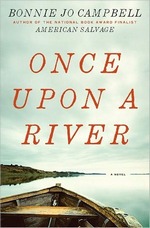
United States of Books – Once Upon a River by Bonnie Jo Campbell

Once Upon a RiverOnce Upon a River

by Bonnie Jo Campbell

Author: Teri at Sportochick’s Musings

Synopsis

Bonnie Jo Campbell has created an unforgettable heroine in sixteen-year-old Margo Crane, a beauty whose unflinching gaze and uncanny ability with a rifle have not made her life any easier.

After the violent death of her father, in which she is complicit, Margo takes to the Stark River in her boat, with only a few supplies and a biography of Annie Oakley, in search of her vanished mother. But the river, Margo’s childhood paradise, is a dangerous place for a young woman traveling alone, and she must be strong to survive, using her knowledge of the natural world and her ability to look unsparingly into the hearts of those around her. Her river odyssey through rural Michigan becomes a defining journey, one that leads her beyond self-preservation and to the decision of what price she is willing to pay for her choices.

Review

I am not sure where to start with this review. I had a very hard time listening to Margo make bad decision after bad decision in this story line. I understand her upbringing and that she didn’t have choices like most 16 year olds do. Margo had a mother who didn’t function well in life and a father who had checked out of life because of her mother leaving and the loss of his job. She only had two people who showed her the love she deserved. One whose husband raped her and a man who honestly loved her, treated her like a queen but she lost him because of what she did in front of him with one of her rapists.

The author did a phenomenal job in the area of describing the scenery and setting up the story. What I had a hard time with is the roughness of the characters. Not that they weren’t well written they were. For me it was about something I dislike reading about or witnessing. I don’t want to read about the raping of a minor, being raped, murdering and taking revenge by death of those that do it to you. Though I understand why one would want to do it. For me it wasn’t realistic that she would get away with so much and never get caught.

For many people they will enjoy this book, for me I did not. It did cause me to think about what and how I would have reacted in the same situations. Also it made me wonder why is it that some people can overcome what she went through and others keep repeating the cycle of dysfunction.

For the overall impact I give this 2 1/2 Stars

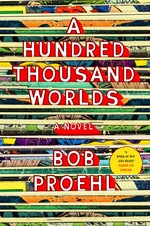
A Hundred Thousand Worlds by Bob Proehl

This was supposed to post on July 21, believe it or not, but that morning before work, I gave it one final skim and decided it wasn’t right. I made a couple of notes and cancelled the post. And then promptly forgot about it. I’ve tried a couple of times since then to address the notes, but sadly, they were too note-ish and not enough worked out to really help me remember what I wanted to address. So…I’ve had to settle for this. The book is better than my post (they usually are, in case you haven’t noticed)

A Hundred Thousand WorldsA Hundred Thousand Worlds

by Bob Proehl

Hardcover, 354 pg.

Viking, 2016
Read: July 13 – 16, 2016

Only you can decide where your home is. And every good story is about finding your way there.

I want to invoke The Amazing Adventures of Kavalier & Clay, or one of the Grossmans, or Ernest Cline — but who isn’t invoking them when it comes to this book? So consider them invoked, I’ve done my duty, and now I’m going to avoid them. Proehl’s book about people attending a series of Comic Conventions will attract those are into “Geek Culture,” but it’s not really targeted toward them (us). The book is set in the world of Comics and SF, but that’s it — it’s just where this novel about mothers and sons, artists of sundry stripes finding their place in the world, and a boy learning about story happens to take place.

Val, an actress on a now-cancelled show that’s sort of X-Files mixed with Fringe (and how many of you want to watch that show, right now?) is spending a few weeks of the summer going from Comic Con to Comic Con on a cross-country trip with her son, Alex. She’s not an unemployed actor, she’s busy off-Broadway, but isn’t flush, so the Cons are paying their way to L.A., where a major shakeup in their family structure is going to take place. As they move West, we travel through time to trace Val’s relationship with Alex’s father, up to the devastating events that led to her moving to New York with her son and without her husband. Val is having a hard time wrapping her head around the fans attending the Cons and what they expect from her — but she’s getting it.

Alex is almost too perfect — which is a pretty big danger when it comes to writing kids, they’re either too precious, too precocious, too stupid, too . . . well, you get the idea. Alex is clever, intuitive, and sensitive. He’s got a great imagination, and just needs a little direction as a creative-type. (N.B.: This is one of those paragraphs I needed to develop better and failed to, for those of you keeping score at home.) He’s the hinge that all this stuff hangs on — as much as this is a story about Val (more than anything else), without Alex it just doesn’t happen. Entire posts/articles/essays could and should be written about Alex — but they’ll have to be done by people better than me. He’s not entirely realistic, but he’s a great character.

Gail is an up-and-coming comic writer, who may have found her level in the industry (lower than anyone wants). She has a couple of good friends who are rooting for her. While she travels form con to con, she wrestles with her own personal demons and history and dos what she can to help others with theirs. Her new friendship with Val is one of those things that will reward them both.

Brett is an artist/co-writer of an indie comic with his long-time-friend. The two aren’t having the best time working together anymore, each getting distracted with their own projects. From future professional gigs to helping Alex out with his story.

Alex’s “Idea Man” and the traveling troupe of female cosplayers are deserving of far more attention and analysis than I can provide — so let me just say that they’re all fun to read, thought-provoking and ignored at the reader’s loss.

Val didn’t know the name, but she knew there was a lot of excitement around it. It’s something she likes quite a bit about this little world: the capability of those within it to get deeply and sincerely excited about things. She wonders how they fare in the real world, where excitement is poorly valued, and she tries to think of things she has been excited about. There are so few.

If “the capability . . . to get deeply and sincerely excited about things” isn’t one of the best descriptions of contemporary Geeks, I don’t know what is.

There are a handful of goodies for those who are into Comics, SF and whatnot — the Doctor Who analog is great, ditto for the Alan Moore and Green Lantern analogs. There are some that are more subtle, too. I think I got most of them, but I’m sure I missed a few.

The writing is strong — although Proehl has a couple of ticks I could do without. For example, I’m not sure how many times he said something like, “Before she got her start in comics, Gail ran . . . ” and then talked about her blog. Once would’ve been enough with that (although it does fit in nicely with the origin-story thing he has going on, and maybe that’s the point). I don’t know that you could call this “light” at any time, but there is an optimism (mostly) throughout — but an optimism tinged with realism.

At the end of the day, this was a very compelling tale, full of characters that you wanted to spend time with (more time with, actually). Proehl might give one or two storylines a very “happily ever after” feel, but some of them are left to the reader to conclude on their own. I liked that. Nicely written, compelling characters in a setting that is very relatable — how can I not love this?

—–

5 Stars

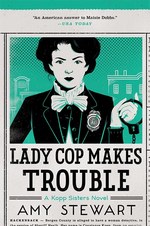
Pub Day Repost: Lady Cop Makes Trouble by Amy Stewart

Lady Cop Makes TroubleLady Cop Makes Trouble

by Amy Stewart
Series: The Kopp Sisters, #2
eARC, 320 pg.
Houghton Mifflin Harcourt, 2016
Read: August 6 – 8, 2016

Miss Constance Kopp, who once hid behind a tree near her home in Wyckoff, N.J., for five hours waiting to get a shot at a gang of Black Handers who had annoyed her, is now a Deputy Sheriff of Bergen County, N.J., and a terror to evildoers. — New York Press, December 20, 1915

The novel’s epigraph tells you pretty much everything you need to know. In the previous book, Girl Waits with Gun, Constance goes to extremes to protect her family from criminals, now she’s moved on to being an official “terror to evildoers.”

Constance begins the novel as a Deputy Sheriff, but political pressure removes her (temporarily she’s assured) and she’s demoted to matron of the women’s jail. She’d been serving in that capacity anyway, but now that’s all she does. She notes, and is probably on to something, that the police are far more willing to arrest women knowing there;s a matron at the jail to watch over them than they were when it was just men. That’s probably not the kind of women’s equality that people hoped for, but I guess you take what you can get. During this time, Constance makes a horrible blunder — one that jeopardizes her career as well as that of Sheriff Heath.

Bound and determined to keep her job (and for her friend and boss to keep his), as well as to see justice done, Constance ignores orders, protocol and (what some would consider) good sense and sets off to correct her error. Doing so will take her out of her comfort zone and into a long investigation that will remind her just what kind of evil lurks in the hearts of men.

Reading about Constance — and some of the professional women she meets in NYC — reminds me of the book I recently read about Nelly Bly and the efforts of female journalists to be taken seriously, and given the opportunities to do more than society page work. Another female law enforcement officer that Constance meets in the opening pages isn’t allowed to do much at all in her role — far less than Constance can (and does). Now this other woman seems content in that, even scandalized at Constance manhandling a suspect, but that doesn’t change the fact that times are changing, and it’s determined women like Constance and Nelly Bly that are going to make them change.

The friendship — and mutual respect — between Constance and Sheriff Heath continues to bloom, and be misunderstood by everyone (with the possible exception of Norma) from Mrs. Heath to juvenile delinquents. But really, there are no romantic sparks (and I expect Stewart will keep things that way — as did history, it seems). I do wish that more people in Bergen County — particularly some of her coworkers (even just one) — most people outside of her home (see especially almost everyone in New York) seem to be encouraging/accepting of a female Deputy.

Norma and Fleurette aren’t as important to the progress of the plot in the sequel — Norma’s stubborn, no-nonsense streak keeps Constance moving when she needs it. Fleurette’s naïveté and desire for a different life fuel Constance’s desire to make the world a better place — at least their corner of it — and to keep the money rolling in. Watching the Sheriff Heath interact with these ladies is a hoot.

I’m not sure it stacks up to its predecessor as a novel — it’s not as deep, the story’s really straightforward, and you might argue the ending is a bit rushed. But, it’s a whole lot more fun to read. Having established the world so effectively in the first book, Stewart can just let her characters live in it. This is a solid crime novel, elevated by the historical circumstances and actual history that undergirds it. Stewart really won me over with this one, I hope we have many more installments to come.

Disclaimer: I received this eARC from Houghton Mifflin Harcourt via NetGalley in exchange for this post — thanks to both for this.
N.B.: As this was an ARC, any quotations above may be changed in the published work — I will endeavor to verify them as soon as possible.

—–

4 Stars

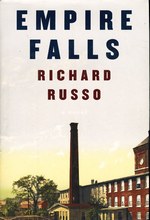
United States of Books – Empire Falls by Richard Russo

Believe it or not — this was almost a lot longer, but I trimmed a lot to hopefully make it better.

Empire FallsEmpire Falls

by Richard Russo

Hardcover, 483 pg.
Knopf, 2001

A few years ago, my parents took a trip through New England in the Fall to look at the leaves — I know, not an original idea, but for people from the Northwest, it’s not as common as it is for others. One of the places they drove through was Empire Falls and were telling me about some HBO series/book based there — I was vaguely aware of the book, having recently finished Russo’s Straight Man and told them that they’d probably enjoy it. I don’t think either of them gave it a shot (I could be wrong).

A few months later, I got around to reading it myself — wow. It so different in style and content from Straight Man, but it took me a long time to read, and (best of all) it was fantastic. It sent me reeling and made me want to read more by Russo. Sadly, the next book I read by him just about killed that (That Old Cape Magic). A couple of years go by and I decide to read all of his novels in order. When I get to Empire Falls, I skipped it. I just couldn’t do it again. I really didn’t enjoy about half of Russo’s novels, but I couldn’t deny the power of them, nor his skill. Nobody’s Fool, for example, I really didn’t enjoy — but here I am a couple of years later, and I still find myself thinking about a couple of characters and scenes at least three times a month. That’s staying power. (no, I haven’t gotten to the sequel that came out this year, for reasons I don’t fully understand)

Incidentally, I liked That Old Cape Magic better the second time around — actually, I think that was true for Straight Man, too. Liking Cape Magic was almost a given (would be hard to like it less), but I really enjoyed Straight Man the first time out — the second time I loved it. Both of those books deal with a different kinds characters than the rest of his books (including Empire Falls, which I’m getting to — I promise). Most of his books are about small towns and their citizens, usually dealing with economic hardships on the municipal and individual level. Frequently, cafes and bars are used to get the characters to interact with each other and there’s typically one guy who drinks too much, is fairly unreliable, yet everyone likes and enables. There’s humor, tragedy, history (actual and fictional), mixed with character and family struggles. Empire Falls checks every single box on the “what makes a Richard Russo novel” list, but does it bigger. If you’ve read Empire Falls, you’ve read almost every one of his books — which is not to say you shouldn’t read the rest (especially Straight Man and Bridge of Sighs) — but you’ll get a good idea what kind of things Russo typically deals with and how he does it.

Richard Russo is what Jonathan Tropper, Nick Hornby and Matthew Norman (and many others, probably, but these are the three I’m most familiar with) could easily become if they got a little more serious and a little darker. On the whole, the latter three are more entertaining (and funnier) — but Russo can pull that off when he wants to. You could also say that Russo is what Jonathan Franzen could be if he lightened up and got less pretentious. But mostly, you can say that I’m a giant fan.

Why am I blathering on? Mostly trying to give context for this post, but partially because it is just daunting to try to talk about this book — especially in something that’d make a decent-length blog post and not a full-fledged dissertation. But I’d better suck it up and get to it.

Empire Falls won Richard Russo his (seemingly) inevitable Pulitzer Prize in 2002 and stands as one of the greatest achievements in his storied career. It is at once a story about a town and a man, microcosms for the state and the nation; it’s both sweeping and epic while being personal and intimate.

The story centers on Miles Roby, manager of the Empire Grill in Empire Falls, ME. He has an ex-wife (who I truly despised), a daughter (who I wanted more of), an ex-mother-in-law that seems to like and respect him a lot more than her own daughter, s (even if they don’t see eye to eye much lately). But more importantly he has a patron — the town matriarch, owner of the Empire Grill, and most of the various places of employment in town. She’s a patron, a would-be surrogate mother (for a select few), and petty tyrant over the city. It’s one of those small towns where the mayor/council/etc. have real power, but it’s only the power she lets them have, you know? Francine Whiting isn’t evil — well, I’ll let you decide for yourself — but at the end of the day, she thinks she’s doing what is right for Empire Falls, the Whiting legacy and her daughter — whether or not anyone wants what she thinks is best. She still could be evil, I guess, and I could very likely made a case for it. Anyhow, let the reader decide.

The trials and dreams and efforts of Miles and his family as he tries to do something different with his life are the core of the novel — but they’re not all of it. The town is full of interesting people — many aren’t vital to the overall story (but you can’t know until the end who those are), but they all add flavor. Most are so fleshed out that you could imagine a short story/novel centered on them. While reading Song in Ordinary Time a few months back, I kept asking myself what made the people in that novel so unlikeable when in many ways they reminded me of Empire Falls‘ cast. I came to this conclusion (and have since reconsidered and still think it’s basically right): Russo uses the flaws in his characters to emphasize their humanity, Morris uses the flaws to emphasize their flaws.

But I come not to bury Morris (again), but to talk about Empire Falls, so let me focus on this a bit more: the flawed humanity isn’t pretty, it’s frequently ugly, people who make mistakes (some tragic, some dumb) are usually trying to do the right/moral/noble thing and it doesn’t work. But it’s real. This could all be real. Even Janice, Miles’ ex, is a well-developed character — and I think I’ve met a handful of people just like her — and I wouldn’t dislike her as much as I did if Russo hadn’t nailed the writing.

There’s an event towards the end — one of the two or three that you ultimately realize the whole novel has been leading up to — that in 2001 would’ve been truly shocking (shocked me a few years ago), but in many ways it’s de rigueur now. 2016 readers might be bored by it, but I can’t imagine that many readers in 2001 were. I’m not going to say more — just if you read this, put yourself in the shoes of readers from 15 years ago when you get to that bit.

Yes, Empire Falls is slow (sometimes), ponderous (sometimes) but it’s also inspiring (sometimes), heartwarming (sometimes) and many other things that I could parenthetically qualify. But every negative about it is utterly worth it for the positives.

What I learned about Maine: (haven’t done this in awhile, whoops). It’s a beautiful state, filled with people who could be better educated, who aren’t vocationally ready for what’s coming for them thanks to the technological shift in jobs. It’s a state where people, nature and industry who have been damaged by reckless policies and practices. It’s a state where nature exerts itself every now and then to remind people how powerful it is. Basically, Maine’s just like every other state in the union — just a little different.

One more thing, not that this’ll surprise many, but I’d advise skipping the HBO miniseries — yeah, it’s a fairly faithful adaptation, it just doesn’t have the heart.

I’ll be honest with you, I didn’t read this book for this series of posts — breaking a personal resolution. There were 3 reasons for this: 1. Time; 2. I really wasn’t up for the emotional punches this delivers, and 3. I didn’t need to — I still remember it well enough to discuss at a length greater than I have despite being 4 years and change since I read it. That right there should tell you something about the book — hundreds of books later and I almost feel like I read it a couple of weeks ago. I’m not sure that this is the Russo novel I’d tell people to start with (probably Straight Man), and I don’t think it’s his best (probably Bridge of Sighs (tells a story almost as epic in scope, with greater economy and greater depth when it comes to individual characters), but there’s no denying the talent on display here, the greatness of the execution, the vibrancy of the characters, or the impact it has on the reader. No brainer, 5 Stars from me.

—–

5 Stars

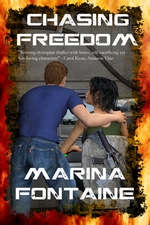
Chasing Freedom by Marina Fontaine

Chasing FreedomChasing Freedom

by Marina Fontaine

Kindle Edition, 222 pg.
Createspace Independent Publishing Platform, 2016

Read: July 27 – 28, 2016


A few decades from now, the government of the United States (although I don’t think it’s directly called that, but it’s clear that’s what it is) has become the totalitarian regime so many fear, imposing a type of public “civility” on the citizenry. Public protests are closed down by the authorities, but keep springing up (and seem to be coordinated in a way that the authorities can’t pin down) — and then they evolve into organized resistance groups and information dissemination efforts (counter-propaganda efforts).

On the whole, the book focuses on the resistance groups, their allies and those they aid — with the occasional look at those in power and their operatives. The resistance groups are full of people who are looking for different things — some out of ideology, some out of concern for the safety and health of their loved ones, there are even criminals who help just to get under the heavy thumb of the government, some just want a way to express themselves and make art rather than be “contributing members of society.”

In different ways, these people (and many others) work together (and apart) to force the government to get back to its own foundational principles. There are glimpses of violence here, but mostly this takes place between the battles — in the ramping up to them, or in the aftermath. It’s violent enough to satisfy those who want that and to seem grounded in the subject, but that’s not the focus. The focus is on what the struggle means to people and what it does to them — some characters are scarred, some characters are driven to find hidden strength(s), a few characters are both.

I noted while reading this that the type of government/society depicted in a dystopian novel tells you a lot about the politics of the author — as does what the characters of behind the resistance/opposition want to replace it. Fontaine grew up in the U.S.S.R., and knows a little about real dystopia, that’s reflected in these pages, too. Her vision of the future isn’t one you typically see in fiction — and agree with her or not — it’s a breath of fresh air.

I’ve read works that were better written, more convincing — but this one hit me right. I love the vision of this book, the way that Fontaine gets her characters to work together — even when there’s little reason to. Their hopes of the good life — or at least a better one — really resonated with me. There wasn’t (much) drive for vengeance, it wasn’t one or two people against the system — it was a variety of people, doing various things that drove the action of this novel. A solid effort, an entertaining and borderline inspirational read. I hope to see more from Fontaine in the future.

Disclaimer: I received a copy of this book from the author in exchange for my honest opinion.

—–

4 Stars

United States of Books – Independence Day (Audiobook) by Richard Ford, Richard Poe

Independence DayIndependence Day

by Richard Ford, Richard Poe, Narrator

Author: Serena at Savvy Verse & Wit

Synopsis from Goodreads – A visionary account of American life–and the long-awaited sequel to one of the most celebrated novels of the past decade–Independence Day reveals a man and our country with unflinching comedy and the specter of hope and even permanence, all of which Richard Ford evokes with keen intelligence, perfect emotional pitch, and a voice invested with absolute authority.

Entertainment Weekly said, “The second of four books to feature Frank Basscombe, a sportswriter-turned-Realtor who’s the perfect sarcastic resident of that great big suburb called New Jersey.”

Independence Day by Richard Ford, narrated by Richard Poe, is one of those novels in which readers can be frustrated, as the main character, Frank Basscombe, often scurries along tangents just when the narration appears to be going somewhere relevant. Poe does a good job of narrating this character. He’s a divorced man who lives alone in his former wife’s house in Haddam, N.J., and he’s entered the real-estate game. He barely sees his children, still wants to hang onto his newly married ex-wife, but also says that he loves his girlfriend.

Basscombe tells the truth as he sees it in that moment, but from moment-to-moment that truth can change. He’s not steady in his beliefs, and much of that is because he’s clearly in the midst of a crisis. He’s unsure of his own direction and his own place in life and in his family. On a trip with his son to the Basketball and Baseball Halls of Fame, Basscombe makes a concerted effort to be someone to at least one somebody — his son. However, like him, his son is going through a period of unease, as he’s unsure how to be and act, and he’s trying on different hats — some of which raise concern with his mother about his mental stability.

In many ways, Basscombe and his son’s inability to stand firm and find their own peace in the world mirror the wishy-washy perception of New Jersey — which ET calls a suburb. The view of New Jersey can be its industrial gas and oil farms or the fact that it is the neighbor of New York, a place where those who work in the city come to escape the fast-paced life and find some green.

It’s hard to believe that there are four books about this character, given his disinterest and disdain for everything. Independence Day by Richard Ford, narrated by Richard Poe, is one man’s search for a final independence — he’s looking to free himself from the ties that bind him to his ex-wife, trying to carve out a new career, and to find some direction for his own life without being hampered by the past.

RATING: Tercet (3 stars)

About the Author:

Richard Ford is a Pulitzer Prize-winning American novelist and short story writer. His best-known works are the novel The Sportswriter and its sequels, Independence Day and The Lay of the Land, and the short story collection Rock Springs, which contains several widely anthologized stories.

Lady Cop Makes Trouble by Amy Stewart

(slightly modified to address something I forgot earlier)

Lady Cop Makes TroubleLady Cop Makes Trouble

by Amy Stewart
Series: The Kopp Sisters, #2

eARC, 320 pg.
Houghton Mifflin Harcourt, 2016

Read: August 6 – 8, 2016

Miss Constance Kopp, who once hid behind a tree near her home in Wyckoff, N.J., for five hours waiting to get a shot at a gang of Black Handers who had annoyed her, is now a Deputy Sheriff of Bergen County, N.J., and a terror to evildoers. — New York Press, December 20, 1915

The novel’s epigraph tells you pretty much everything you need to know. In the previous book, Girl Waits with Gun, Constance goes to extremes to protect her family from criminals, now she’s moved on to being an official “terror to evildoers.”

Constance begins the novel as a Deputy Sheriff, but political pressure removes her (temporarily she’s assured) and she’s demoted to matron of the women’s jail. She’d been serving in that capacity anyway, but now that’s all she does. She notes, and is probably on to something, that the police are far more willing to arrest women knowing there;s a matron at the jail to watch over them than they were when it was just men. That’s probably not the kind of women’s equality that people hoped for, but I guess you take what you can get. During this time, Constance makes a horrible blunder — one that jeopardizes her career as well as that of Sheriff Heath.

Bound and determined to keep her job (and for her friend and boss to keep his), as well as to see justice done, Constance ignores orders, protocol and (what some would consider) good sense and sets off to correct her error. Doing so will take her out of her comfort zone and into a long investigation that will remind her just what kind of evil lurks in the hearts of men.

Reading about Constance — and some of the professional women she meets in NYC — reminds me of the book I recently read about Nelly Bly and the efforts of female journalists to be taken seriously, and given the opportunities to do more than society page work. Another female law enforcement officer that Constance meets in the opening pages isn’t allowed to do much at all in her role — far less than Constance can (and does). Now this other woman seems content in that, even scandalized at Constance manhandling a suspect, but that doesn’t change the fact that times are changing, and it’s determined women like Constance and Nelly Bly that are going to make them change.

The friendship — and mutual respect — between Constance and Sheriff Heath continues to bloom, and be misunderstood by everyone (with the possible exception of Norma) from Mrs. Heath to juvenile delinquents. But really, there are no romantic sparks (and I expect Stewart will keep things that way — as did history, it seems). I do wish that more people in Bergen County — particularly some of her coworkers (even just one) — most people outside of her home (see especially almost everyone in New York) seem to be encouraging/accepting of a female Deputy.

Norma and Fleurette aren’t as important to the progress of the plot in the sequel — Norma’s stubborn, no-nonsense streak keeps Constance moving when she needs it. Fleurette’s naïveté and desire for a different life fuel Constance’s desire to make the world a better place — at least their corner of it — and to keep the money rolling in. Watching the Sheriff Heath interact with these ladies is a hoot.

I’m not sure it stacks up to its predecessor as a novel — it’s not as deep, the story’s really straightforward, and you might argue the ending is a bit rushed. But, it’s a whole lot more fun to read. Having established the world so effectively in the first book, Stewart can just let her characters live in it. This is a solid crime novel, elevated by the historical circumstances and actual history that undergirds it. Stewart really won me over with this one, I hope we have many more installments to come.

Disclaimer: I received this eARC from Houghton Mifflin Harcourt via NetGalley in exchange for this post — thanks to both for this.
N.B.: As this was an ARC, any quotations above may be changed in the published work — I will endeavor to verify them as soon as possible.

—–

4 Stars

United States of Books – The Known World by Edward P. Jones

The Known WorldThe Known World

by Edward P. Jones

Author: Laura at 125 Pages

This week takes us to Virginia with The Known World by Edward P. Jones. Entertainment Weekly says – This award-winning examination of man’s ownership of man refuses to succumb to the calcifying effect of history, presenting Virginia’s past as raw, urgent and human.

Synopsis from Goodreads – One of the most acclaimed novels in recent memory, The Known World is a daring and ambitious work by Pulitzer Prize winner Edward P. Jones.

The Known World tells the story of Henry Townsend, a black farmer and former slave who falls under the tutelage of William Robbins, the most powerful man in Manchester County, Virginia. Making certain he never circumvents the law, Townsend runs his affairs with unusual discipline. But when death takes him unexpectedly, his widow, Caldonia, can’t uphold the estate’s order, and chaos ensues. Jones has woven a footnote of history into an epic that takes an unflinching look at slavery in all its moral complexities.

Review

1/2 Star

The Known World by Edward P. Jones is a read that made me question. It made me question if editors actually read the whole book. It made me question if the Pulitzer judges read the whole book. It made me question if I had picked up the wrong book, because this could not be the book with all of those rave reviews. This novel won a National Book Critics Circle Award and the Pulitzer Prize for Fiction in 2004. In 2005 it won the International IMPAC Dublin Literary Award and it was a finalist for the 2003 National Book Award. In 2009, the website The Millions polled 48 critics, writers, and editors; the panel voted The Known World the second best novel since 2000. The book I read was a disjointed mess. No seriously, I can read difficult books. I like non-linear time lines and twisty prose but this took it to a whole new level. The synopsis tells us that this is the tale of Manchester County in Virginia during the antebellum era and a black former slave who is now a slave owner himself. This sounds like a deep and thought provoking read right? It would have been if it was actually readable.

There were approximately 80 characters, so I had no idea who anyone was.

The white man at the front door was from the Atlas Life, Casualty and Assurance Company, based in Hartford, Connecticut. His talking to Calvin at the door was what kept Bennett so long. Calvin eventually came back with Bennett and when Moses told him, Calvin went back and returned with Caldonia, followed by Maude, and Fern Elston.

The time line skipped back and forth often times decades in the future to tell what happened to just one person or object and then skipped back.

This series was Anderson’s most successful, and nothing was more successful within that series than the 1883 pamphlet on free Negroes who had owned other Negroes before the War between the States. The pamphlet on slaveowning Negroes went through ten printings. Only seven of those particular pamphlets survived until the late twentieth century. Five of them were in the Library of Congress in 1994 when the remaining two pamphlets were sold as part of a collection of black memorabilia owned by a black man in Cleveland, Ohio. That collection, upon the man’s death in 1994, sold for $1.7 million to an automobile manufacturer in Germany.

There was so much unnecessary description.

Clarence sat beside his wife and after a time he put a hand, the one not stained with milk, to the back of his wife’s head and rubbed her hair. The cow swung its tail and chewed its cud. It farted.

His horse, Sir Guilderham, was idling two or so paces behind his master. And just as the horse began to wander away, Robbins turned and picked up the reins, mounted. ‘No more visits for a month,’ he said, picking one piece of lint from the horse’s ear.

Seriously, I do not care about lint on a horse and a cow farting. This really detracted from the story for me. The Known World by Edward P. Jones could have and should have been a powerful read. Instead I got bogged down in the minutia and was not able to process the tale.

I had originally picked this up at the library and then, when I found the style to be so odd, I got the Audible version. I really want my credit and the 14 hours I spent listing to this back.

United States of Books – A River Runs through It by Norman Maclean

A River Runs Through ItA River Runs Through It

by Norman Maclean

Author: Elisha at Rainy Day Reviews

Entertainment Weekly says – In his semiautobiographical story collection, Maclean paints a sumptuous portrait of the state’s beauty.

Summary from Goodreads:
Just as Norman Maclean writes at the end of “A River Runs through It” that he is “haunted by waters,” so have readers been haunted by his novella. A retired English professor who began writing fiction at the age of 70, Maclean produced what is now recognized as one of the classic American stories of the twentieth century. Originally published in 1976, A River Runs through It and Other Stories now celebrates its twenty-fifth anniversary, marked by this new edition that includes a foreword by Annie Proulx.

Maclean grew up in the western Rocky Mountains in the first decades of the twentieth century. As a young man he worked many summers in logging camps and for the United States Forest Service. The two novellas and short story in this collection are based on his own experiences—the experiences of a young man who found that life was only a step from art in its structures and beauty. The beauty he found was in reality, and so he leaves a careful record of what it was like to work in the woods when it was still a world of horse and hand and foot, without power saws, “cats,” or four-wheel drives. Populated with drunks, loggers, card sharks, and whores, and set in the small towns and surrounding trout streams and mountains of western Montana, the stories concern themselves with the complexities of fly fishing, logging, fighting forest fires, playing cribbage, and being a husband, a son, and a father.

My Review

Firstly, I did not know this was turned into a movie. Now that is on my list.

The writing in this book was smooth, cohesive, eloquent, and smart. This novella was mixed with sadness of real life as well as the joys. This story has more than one level, at the surface, it is a good and well written story about Maclean and his father and brother; his family. They all have a shared bond of fishing, it is like the air that they breathe, what seems to hold them to hold them together.

However, going beneath this well-crafted story, I think the moral, the reason behind this book is: relationships that we have, memories that we create with those we hold dear, and the bonds that are made. I think the saddest but truest message to take is, from all that we can learn from this book is, those that are the ‘last survivor’ of those memories, those bonds that were made during the yesteryears, and the relationship that were made before it all changed and while it all changed.

I can definitely see why this is a classic. I’d recommend this to all.

Page 35 of 45

Powered by WordPress & Theme by Anders Norén