Tag: General Fiction Page 38 of 45

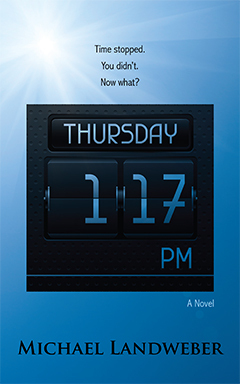
Thursday, 1:17 PM Book Tour

Thursday, 1:17 PMTime stopped. You didn’t. Now what?

Duck is 17. He will never be 18.

Tomorrow is his birthday. It will never be tomorrow.

Time stopped at 1:17 p.m. on a beautiful Thursday afternoon in Washington, DC. Duck is the only person moving in a world where all other living beings have been frozen into statues in an endless diorama. Duck was already in limbo, having lost his mother to cancer and his father to mental illness.

Now, faced with the unimaginable, he approaches his dilemma with the eye of an anthropologist and the heart of a teenager trying to do the right thing under the strangest of circumstances. Ultimately, he realizes that while he doesn’t understand the boundaries between friendship and love, that uncertain territory may be the key to restarting the world.

Trade Paperback – Available now
Publisher: Coffeetown Press
ISBN13: 9781603813570
208 pages

Coming up: We’ve got a Guest Post from Michael Landweber, a Q & A with him, too — and finally, my $.02 about the book. Come back and check these posts out (the links will work when the posts go up) — or just go get the book. Whatever.

United States of Books – Doc by Mary Doria Russell

DocDoc

by Mary Doria Russell

Author: Elisha at Rainy Day Reviews

Entertainment Weekly says – Set in the saloons of Dodge City in 1878 before the shoot-out at the O.K. Corral, this murder mystery paints Doc Holiday as a tragic hero and gambler, bringing one of the state’s most legendary events and personages to life.

(Courtesy of goodreads)

Born to the life of a Southern gentleman, Dr. John Henry Holliday arrives on the Texas frontier hoping that the dry air and sunshine of the West will restore him to health. Soon, with few job prospects, Doc Holliday is gambling professionally with his partner, Mária Katarina Harony, a high-strung, classically educated Hungarian whore. In search of high-stakes poker, the couple hits the saloons of Dodge City. And that is where the unlikely friendship of Doc Holliday and a fearless lawman named Wyatt Earp begins–before the gunfight at the O.K. Corral links their names forever in American frontier mythology when neither man wanted fame or deserved notoriety

I have to say, I had heard of this book, was told about this book, but never read the book. Until now. The synopsis was intriguing yet kept an air of mystery. I was even more intrigued and excited to read this book after finding out it was based off of a true story. I love a good non-fiction read, and this did not disappoint. Set in western Texas during the frontier, Doc Holliday makes his name known through gambling with his co-conspirators. Then, there’s a twist among all the other twists in the story…a murder. Or was it a murder?

I loved the thick plot, the western touch, the “old days” feel, the relationships…especially with Doc’s “special” on again-off again friend. I found this story very interesting and it did captivate my attention. I was worried it wouldn’t because I am not a fan of a lot of westerns, I am a bit picky in that area. But all in all, it was really good and I would definitely recommend this story.

(fwiw, I had a few things to say about this a couple of years ago)

United States of Books – The Monkey Wrench Gang by Edward Abbey

The Monkey Wrench GangThe Monkey Wrench Gang

by Edward Abbey

Author: Laura at 125pages.com

1 Star
Today we visit Utah with The Monkey Wrench Gang by Edward Abbey. EW says – “Abbey’s tale of four ecological activists seeking to destroy the Glen Canyon Dam became a primer for other green-minded saboteurs.”

The Monkey Wrench Gang by Edward Abbey is touted as a comic look at social justice warriors. True environmentalists that strive to bring the land back to its natural state. Um, no. That is not at all the book I read. What I read was a book steeped in misogyny, homophobia, stereotyping and stupidity. From the derision of Native Americans, to showing the only Mormon member of the group as a polygamist, this book played everyone as a buffoon.

The plot was a grand look at what a bored drunk man will concoct when he gives no thought to others. George is painted as a lover of the natural state who is upset by the creeping industrialism on the desert he calls home. He decides that action must be taken, extreme action. Because blowing up bridges is cool but littering is just fine – “Of course I litter the public highway. Every chance I get. After all, it’s not the beer cans that are ugly; it’s the highway that is ugly.” The writing was a mishmash of clichés and was difficult to read at times due to the constant changing of tone and pace. The world built was also difficult to navigate as locations moved frequently and at times I was unsure what state they were even in. The emotions and the characters were also all over the place. Everyone but the “gang” was painted as ignorant and useless and it became quite grating.

Some books get better with age and become classics. The Monkey Wrench Gang is not one of those books. It was a draining experience to read it and I cannot understand why it is considered by many to be so good. It has a 4.3 star rating on Amazon but I cannot fathom how. An example of the comedic showcases, to me, what was once thought great, but I just see it as super lowbrow.

“All this violence,” Doc said. “We are a law-abiding people.” “What’s more American than violence?” Hayduke wanted to know. “Violence, it’s as American as pizza pie.” “Chop suey,” said Bonnie. “Chile con carne.” “Bagels and lox.”

As for the connection to Utah, I did not really see it as an overall. Utah was not mentioned until 60% into the book and then as more of a joke (see the polygamist). Sadly my home state of Arizona fielded most of the action with New Mexico coming in second and Utah as third. The Glen Canyon Dam, the featured target, is also in Arizona not Utah, so again, I have to wonder if the EW staff read the books before placing them in the states.

The five players are Dr. and Mrs. Sarvis, Mr. and Mrs. Smith, and their communal probation officer, a young fellow named Greenspan, who is a relative newcomer to the state of Utah. (Newcomers are always welcome in the Beehive State but are advised to set their watches back fifty years when entering.)

Favorite lines – The river in its measureless sublimity rolled softly by, whispering of time. Which heals, they say, all. But does it? The stars looked kindly down. A lie. A wind in the willows suggested sleep.

Biggest cliché – I will save you even if you do not want saving.

Have you read The Monkey Wrench Gang, or added it to your TBR?

The Old World by Roy M. Griffis

The Old World The Old World

by Roy M. Griffis
Series: By the Hands of Men, Book One

Kindle Edition, 262 pg.
CreateSpace Independent Publishing Platform, 2013

Read: April 29 – 30, 2016


I was blindsided by this one — I knew what to expect plot-wise, don’t get me wrong — what I didn’t know what how little time it’d take for me to care. I got invested in this story and the characters far faster than I normally would.

Charlotte Braninov was sent to a boarding school in England to keep her safe during the tumult leading up to the October Revolution, not one to hide away, she volunteered to become a nurse tending to the English wounded in France during the Great War. Her American friend (who we could’ve spent a little more time with), Kathleen, is in a similar position. Toiling away at a hospital near the front lines — there’s a great focus on the nurses here, not just the doctors and surgeons (as one usually gets), those who tend to the wounded and dying all the time. I really appreciated that.

Charlotte has a brief encounter with a charming and wounded British officer that leaves a mark on her psyche. Not surprisingly (because this is a novel, and people like that don’t just vanish), Lt. Robert Fitzgerald is stationed at the hospital Charlotte serves. Events conspire to get them to spend time together, a friendship blooms — and maybe something else will as well.

Through Robert, we get a glimpse or two of life in the trenches while Charlotte is our entry to medical care. Between the two, you get a decent idea what things were like in France (or at least Griffis lets you think you do). The research is there, but you get the idea Griffis wouldn’t let historical data get in the way of his story (which is the way it ought to be in historical fiction). He also doesn’t overwhelm you with details the way so many slip up and do in early works — just enough to provide atmosphere and add an air of authenticity.

Tragedy, hardship, horrors of war intrude and complicate life. Honestly, peacetime isn’t a picnic for anyone, either — especially for someone from Russia. The plot takes a couple of twists and turns, setting things up nicely for a sequel that you really need after the last couple of paragraphs.

This isn’t just a love story, nor is it really that much of a war story — it’s both and a lot more. You’ll chuckle, you’ll “awww,” you’ll get ticked off, you’ll be moved. Pretty much, if you name it, Griffis characters will make you feel it.

I’m not going to tell you that Griffis is a master of style, a wizard with subtle characterization, or a weaver of intricate plots, or anything like that. What he is, however, is a compelling story-teller. You like Charlotte, Kathleen, Orlando, Robert, Matron, and the rest almost effortlessly and want to see them happy, healthy, etc. You care about the events surrounding them and the outcomes for the characters. I really liked this one and am trying to find a hole in my schedule to throw the sequel into, you should do the same.

Disclaimer: I received a copy of this from the author — sorry for imposing on your patience, Roy — in exchange for an honest review.

Perfect Family by H. Lovelyn Bettison

Perfect FamilyPerfect Family

by H. Lovelyn Bettison

Kindle Edition, 162 pg.
Nebulous Mooch, 2016

Read: May 5, 2016


Let me just get this out of the way, if this doesn’t make you think of an episode (I won’t say which) of Star Trek: The Next Generation you’re not paying attention. Bettison’s take on it is more satisfactory, however.

Bettison has given us a nice little piece of Magical Realism — Sadie and her husband, Kevin, have a cute little boy named Marcus, and a devoted golden retriever, Sammy. All in all, it’s a perfect family, a part of the perfect life that Sadie’s always wanted.

And then Marcus starts doing things that are beyond belief. As the reader learns about what Marcus’ abilities are and start to wonder where those abilities come from (as Kevin and Sadie are). But we also start to learn that their family isn’t quite as ideal as they might seem — but perhaps even more perfect, than Sadie realizes (that makes sense to me, and will probably make sense to anyone who’s read this).

There are parts of this book — when Marcus first displays his abilities, for example — that are disturbing, there’s some real dark times, too. In other hands, this could’ve been a very different kind of book — not that hopeful or anything, but borderline-horror. But that’s not what Bettison gave us — there’s life and love amidst the darkness.

On the one hand, I wanted more detail, more explanation, more exploration of Marcus’ abilities, but I’m pretty sure that if I got what I wanted, the story wouldn’t work as well as it did.

Give this one a read, you’ll be pleased.

Disclaimer: I received a copy of this from the author in exchange for an honest review.

—–

3 Stars

United States of Books – Close Range (Audiobook) by Annie Proulx

Close RangeClose Range: Wyoming Stories

by Annie Proulx

Author: Teri at Sportochick’s Musings

2 Stars Book
4 Stars Narrators

Synopsis

Annie Proulx’s masterful language and fierce love of Wyoming are evident in this collection of stories about loneliness, quick violence, and wrong kinds of love. In “The Mud Below”, a rodeo rider’s obsession marks the deepening fissures between his family life and self-imposed isolation. In “The Half-Skinned Steer”, an elderly fool drives west to the ranch he grew up on for his brother’s funeral, and dies a mile from home. In “Brokeback Mountain”, the difficult affair between two cowboys survives everything but the world’s violent intolerance.

These are stories of desperation, hard times, and unlikely elation, set in a landscape both brutal and magnificent. Enlivened by folk tales, flights of fancy, and details of ranch and rural work, they juxtapose Wyoming’s traditional character and attitudes, confrontation of tough problems, prejudice, persistence in the face of difficulty, with the more benign values of the new west.

This collection includes:

  • “The Half-Skinned Steer”, read by Bruce Greenwood
  • “A Lonely Coast”, read by Frances Fisher
  • “People in Hell Just Want a Drink of Water”, read by Campbell Scott
  • “The Mud Below”, read by Bruce Greenwood
  • “The Blood Bay”, read by Campbell Scott
  • “The Bunch-Grass Edge of the World”, read by Frances Fisher
  • “Brokeback Mountain”, read by Campbell Scott

Review

The best part of the book as far as the stories go was Brokeback Mountain. A movie was made from that story and it won 3 Oscars. I never saw the movie so I can’t give a review on the differences between the two though. This story walks the reader through a relationship between two cowboys that last years. While written with a slow western pace it shows how these two love each other through the years and opens the readers heart to their love for each other and their families.

As for the other stories, I understand that there are many people in the world that love this type of writing and I am afraid to say it is not me. I love to read for pleasure and to escape reality. This book is written in a harsh, blunt, no nonsense style. It was for me too brutal and depressing regarding how women and family were treated.

The narrators were great but hearing it instead of reading it made it much worse for me because it was so much more vivid. I know the old days were very rough but yikes this was so graphic it had me cringing.

For all you people out there that like this kind of reading I am sure you would rate it much higher than I did.

So will you give this a try and form your own decision?

Kill the Boy Band by Goldy Moldavsky

Kill the Boy BandKill the Boy Band

by Goldy Moldavsky

Hardcover, 312 pg.
Point, 2016

Read: May 3 – 4, 2016

It’s not every day you get to be alone with a member of the most popular boy band ever.

Wait. Let me rephrase that.

It’s not every day you get to be alone with the biggest flop in the most popular boy band ever while he is blindfolded and bound to a hotel armchair.

The Ruperts were formed by the producers of the TV show, So You Think the British Don’t Have Talent? because they were about the same age and had the same first name. I should add, I can absolutely see this happening. They go on to become the biggest music stars on the planet. Again, I can absolutely see this happening. A group of four friends get a suite in the same hotel the band is staying at while filming a Thanksgiving special, and inadvertently kidnaps one of them. You know what? I can see it happening, too — at least the way Moldavsky writes it.

I hate books like this when it comes to writing about them — it is next to impossible to talk about them without ruining everything. Half the fun in this is seeing how Moldavsky reveals tidbit after tidbit during the story. How they accidentally kidnapped the Rupert, what ulterior motives might be at work here, why do we need to know the size of Apple’s bag? Seriously, I don’t want to say anything about the book beyond the hook.

What I can say is that it’s funny, it’s smart, it’s strangely heartfelt, satirical without being mean, celebratory without turning off the brain and its critical faculties. In the midst of telling a clever dark comedic story, Moldavsky blends in a commentary on fangirl culture, a critique of them, as well as a celebration of them. It’s very thoughtful when the book isn’t wickedly fun.

The characters were well-drawn, you can see them all very clearly in your mind. The dialogue rings true (even if I think some of the 80’s references will go over the heads of the target audience — I don’t care, I caught them — and enjoyed them). Moldavsky has a great ear, and I hope to see it displayed again.

Somehow I knew we were going to meet The Ruperts. I didn’t know yet if I would cry or scream or faint. And I know that sounds like the reaction you’d have while getting mugged or something, but getting mugged and meeting your idols was basically the same thing: a moment of pure hysteria where you lose our mind and all control. The Ruperts could do that to a person. They could do it to me. And I couldn’t care less.

For fathers of teenaged girls this will help you understand your daughters’ obsession(s) with bands, both the whys and the hows. It may also scare you (and even provide a little relief knowing that your Not-So-Little Princess is a lot like other Not-So-Little Princesses out there). I know it did all of the above for me.

Give this one a read, you’ll probably enjoy it.

—–

3 Stars

United States of Books – Songs In Ordinary Time by Mary McGarry Morris

I somehow managed to make 3 references to The Simpsons in my original draft of these — and almost made one more before I decided to knock it off. I only left one, it seemed apt. The major difference between this book and The Simpsons, of course, is that one brings happiness, smiles and joy to people; the other one has no yellow people and everyone has 5 fingers on each hand.

Songs In Ordinary TimeSongs In Ordinary Time

by Mary McGarry Morris

Paperback, 740 pg.
Penguin Books, 1996

Read: April 6 – 13, 2016

There’s a stereotype about Oscar-bait movies the come out late in the year, super-serious movies with super-serious actors about families in crisis, social unrest, a woman standing on her own, and so on. Nothing anyone really wants to see, but we all take it seriously. Yes, that’s a stereotype, an over-generalization, blah blah blah — but we all know that kind of movie. This book is like that — deadly serious, grim, full of people with no capacity for joy or to make a wise decision — or any action that involves a lack of melodrama.

I just couldn’t force myself to care about this one — not one bit.

The book centers on a divorced mother of three, Marie Fermoyle, and her children: Alice, Norm and Benjy. Marie’s barely scraping by, teeters between despondency and angry outbursts. Until Omar Duvall comes to town. The best thing that could possibly be said about Omar is that he’s a two-bit hustler and womanizer. Much worse could be said about him. Marie is so desperate for a way out of her life, that she falls for his flummery. Sam, Marie’s ex, is the town drunkard — a hopeless alcoholic, surviving on crumbs his sister gives him to get by, the children go out of their way to avoid him — as does pretty much everyone. The new priest in town, and Sam’s brother-in-law are pretty much the only exceptions to that. The priest is, well — he has problems, and the brother-in-law is henpecked and an obscene phone-caller. There are other characters — several, in fact — but let’s limit this to these characters. I could go on and on. Not unlike Morris.

A couple of months back, I caught a little flack because I didn’t buy a Roman Catholic priest character in crisis — I bought this one. I didn’t like him as a person or a character, but I could absolutely buy him. Just a point of personal privilege there, back to this book.

This collection of characters are the greatest conglomeration of self-centered, self-pitying, self-deceived (often), self-justifying, and miserable people I can imagine. And everything they do (well, 99% of the things they do, anyway) make their lives worse (and half of that other 1% is ruined almost immediately). On page 508, I jotted down in my notes, “Please, someone, stop this book — just put these people out of their misery! Mine, too!”

These people are so miserable, so self-pitying that I laughed out loud when I read Marie thinking, “Hope . . . there was more of that in her veins than blood.” Really? I couldn’t believe that for a second. About 200 pages later, we read, “She was so very, very tired. All this, she thought, biting her lip, all this because once, a long time ago, she had made a fatal mistake. She had fallen in love too young with the wrong man. Imagine, it was as simple as that and now she would never catch up. She would never be happy.” That I could believe. That’s one of the most honest sentences in the book.

Each male character (I think without exception — two children, are probably exempt) is able to talk a good game, able to spin a tale about something to make the people around him believe in him — and typically even fools himself. It happens at least once for every character — each time I disliked them more and more for it.

The main plot centers around Marie falling for Omar’s line and risking everything while underwriting a pyramid scheme that he’s peddling (as does a whole lot of the town), while alienating her two older children along the way. Her youngest knows better than the others suspect how terrible Omar is, but he suppresses that information and knowledge so his mother can hopefully be happy. There are crimes not associated with Omar, people dying, people suffering, people trying (and generally failing) to escape their pasts and improve their life. There are two characters out of this that might succeed in improving their lot in life, but we’re not given enough information to know for sure — a couple of others that seem to have turned a corner, but if the 700 previous pages are any indication these latter characters are 5 pages away from running back around that corner the other way.

So why did Entertainment Weekly put this one on their list for Vermont? I’m only guessing here — there aren’t that many novels set in the Green Mountain State. There was nothing distinctly Vermont about this book, as far as I could tell. It was Anytown, USA — there was a lake nearby, a university not too far away (but far enough), a Roman Catholic Church in town (maybe a Protestant one, too — but I’m not sure), one drive in, and a few small towns within an hour or two by car. That’s really all we learn about the geography. The state name is invoked a few times, but otherwise, it could literally be anywhere — like The Simpsons‘ Springfield. I learned nothing about that state, its people, or anything beyond another lesson in endurance in the face of overwhelming tedium.

Plot(s), character, setting — this book failed on all three. It was well-written, I guess, but there was nothing special about even that. I really have nothing positive to say about this one, if you haven’t noticed.

—–

1 Star

United States of Books – Fear and Loathing in Las Vegas (Audiobook) by Hunter S. Thompson, Ron McLarty

I’m a long-time fan of the Narrator, Ron McLarty, but didn’t know he did audiobooks — I need to go track some down, probably not this one, though.

Fear and Loathing in Las Vegas Fear and Loathing in Las Vegas

by Hunter S. Thompson, Ron McLarty
(Narrator)

Author: Wattle at Whimsical Nature

2 Stars

Synopsis: In Las Vegas to cover a motorcycle race, Raoul Duke (Thompson) and his attorney Dr. Gonzo (inspired by a friend of Thompson) are quickly diverted to search for the American dream. Their quest is fueled by nearly every drug imaginable and quickly becomes a surreal experience that blurs the line between reality and fantasy. But there is more to this hilarious tale than reckless behavior, for underneath the hallucinogenic facade is a stinging criticism of American greed and consumerism.

Review: I’ve been to Las Vegas exactly once, I thought it was a bit odd, a bit dirty and not a place I would like to spend any considerable amount of time in.

I felt similar things toward this book. I’ve tried to read it before in paperback, and I put it down after five pages or so. I have seen the film and hated it; so when I saw this on my list for review I was a little worried.

Rightly so, it turns out.

I opted to listen to the audiobook in the hope that I would find it more engaging than if it were text. Ron McLarty did a wonderful job with the narration, I really liked listening to him, but Fear and Loathing in Las Vegas was such a tedious story. The 6 hours I spent listening to it felt like 6 years.

This story is meant to be hilarious and surreal. I think I laughed once, and it was more of a derisive snort than actual laughter. I’m still not entirely sure what the point of the book was, there was such excess and stupidity and vastly irresponsible behavior.

If it was trying to teach me a lesson, I failed to see it (unless that lesson was – don’t do drugs). The characters were all unlikable; the story felt like it was just a rambling bunch of sentences thrown together with little direction. The content was definitely not for me (I don’t even drink, so the characters desire to be constantly wasted was beyond me), I felt the casualness of their drug taking and ridiculous behavior in general was more worrying than amusing.

I gave it two stars, 1.5 for the narration (which was really very good) and 0.5 for the work itself – it was much too far out of my comfort zone and just a bit too strange for me to get into. A pity, because I think if it had been written in a different way, it would have been a much more engaging work.

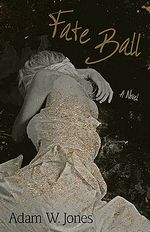
Fate Ball by Adam W. Jones


Welcome to Part One of our participation in the Fate Ball Book Tour — a brief interview will follow in a couple of minutes. Hope you enjoy both of these posts half as much as I enjoyed this book.

Fate BallFate Ball

by Adam W. Jones

PDF, 279 pg.
Wisdom House Books, 2016

Read: April 14 – 15, 2016

Parents always seem to think that saving the day is a good thing, but really it just postpones the inevitable. Sometimes, they should just let their kids crash and burn, so they learn their lesson the hard way. Parents can be the biggest enablers of them all when they’re acting out of love and kindness, but that usually just makes things worse.

That’s not the most dazzling piece of writing in Fate Ball, nothing catchy or inherently memorable, like I try to start with — but this is the heart of the book. People trying to help an addict not ready to be helped, and inadvertently making things worse.

In the prologue, Able Curran receives news that Ava Dubose has died — Chapter One takes us back 14 years to 1980 to meet her. In Chapter Two (one of the best chapters I’ve read this year), Able meets her — and falls for her almost instantly (and many readers will, too). Over the next few chapters, you see the two falling deeper and deeper in love — one of the cutest couples you’ve read.

All the while, you know that things are leading to the fateful phone call Able receives in 1994. We start to see some signs of trouble (well, those started before this) long before Able does. When he finally gets clued it, it destroys him — and they don’t see each other for some time. From there we watch these two lives intersect from time to time over the next 15 years (usually, Able trying to help her), as well as getting glimpses of their lives between the intersections.

This is really the story of two addicts — one who lets their dependency control and destroy them. The other who learns how to live with the problem, controlling and eventually overcoming. And even as you know it’s happening, you still hold out hope for Ave to shake things off, to achieve the serenity — or at least the contentment that she so desperately needs. Things get worse and worse — yet Jones is able to keep things from despairing, there’s a lightness to the prose that keeps things moving. While things fall apart for Ava, they move on for Able and their friends — success, new love, children, life.

In some hands, you’d be beaten over the head with the contrast, Jones doesn’t do that however. It all spools out naturally, easily (the kind of ease that takes work to pull off). You like everyone here enough that you’re pulling for them, no matter what stupid choices they make. Jones as come up with a perfect blend of humor, romance, drama, and tragedy.

There are plenty of little touches along the way to keep things light, to immerse you in the world — which is good because the book could become too fixated on Able and Ava.

His mother was always asking, then answering her own questions. That’s why she was always right. She could have a whole conversation with herself, even a fight depending on the subject matter, and no one had to say a word. All Able needed to do was just nod his head once in a while and she would take care of the rest.

This is not the best book I’ve read — not even the best novel on addiction. But it works well enough that it doesn’t matter. I’m not saying it’s a bad book, or there are glaring problems — but objectively, I just think it could be better. But when you’re reading it? It delivers everything you want, and some things you don’t expect. I really enjoyed this and think you will, too.

Disclaimer: I received a copy of this book from the kind folks at Wisdom House Books in exchange for an honest review.

—–

4 1/2 Stars

Page 38 of 45

Powered by WordPress & Theme by Anders Norén