Tag: Interview Page 2 of 20

LITERARY LOCALS: A Q&A About Writing in Idaho with Ashley DeLeon

Literary Locals logo
I met Ashely at this year’s Book Faire and really enjoyed our conversation, which will hopefully not be our last. I also really enjoyed the book she mentions below and hope to write about it soon (hopefully in conjunction with a conversation). Get to know her a little here and then search out her book and social media accounts. You’ll be glad you did!


Before we get into things, why don’t you give the reader a brief introduction to you and your work.
My name is Ashley and I like to describe myself as a “spooky writer & witchy crafter.” Last September, I published my 1st book, Memes & Mayhem. It’s a spooky humor book that retells a few of my fave ghosty stories with memes such as The Bell Witch, Krampus, Amityville Horror, etc. I also make wreaths & gift baskets. My website is twisted-ash.com where you can find all my spooky & crafty things. I’m also on Instagram @twisted_ash.co & TikTok @twisted_ash.co

Are you a native Idahoan? What brought you to Idaho in the first place? (answer whichever question applies) What is it about Idaho that keeps you here?
I’m actually an Army brat. I was born in Frankfurt, Germany and have lived in several places throughout my childhood: Tennessee, Texas, Ohio, Washington, Maryland. My mom is from Weiser, Idaho so I grew up visiting my grandparents almost every summer. I even went to Kindergarten at Pioneer Elementary in Weiser! In 2004, I finished college in Memphis, TN and moved to Boise with my parents & brothers. We’ve been here ever since and I have no plans to leave. I absolutely adore Boise and can’t imagine living anywhere else.

Are you tied into some sort of local author/bookish group/culture? If so, tell us about it and how it helps you as an author. If you’re not, is there a reason for it?
I’m not really a part of any groups. I’m a super introvert & homebody.

What kind of events in the area do you attend—either to sell/promote your books or to network with authors? Are there any outside of this area that you hit regularly and wish we had something like it here?
I’m very new to the indie author scene. I’ve attended 3 local book fairs to promote my book. Since I also craft, I like to attend local pop-up markets where I can sell my book, wreaths & gift baskets. I don’t really push online sales as I really prefer the in-person & local book/craft markets. There is a Haunted Farmer’s Market in Tacoma, WA that I really wish we had here in Boise. That is totally my jam & I think my whole vibe would work really well at something like that.

This is off-topic, but I’ve got to know a little more—what is a Haunted Farmer’s Market? How well do you think that would go over around here?
It’s pretty much a farmer’s market but make it spooky. I’ve never been but it’s ton of vendors that make it look like Halloween in the Summer!

More on-topic—despite your introversion (and that of many of your peers), have you been able to make any connections at these book fairs? Would you say there’s a sense of camaraderie among local authors?
The local authors who attend these fairs have been AMAZING. So many helpful tips: writing tips, marketing tips, etc. Extremely friendly & supportive. Many of us are indie authors so knowing we’re all kind of in the trenches of indie publishing & marketing is reassuring.

What’s the breakdown of your audience—do you have a strong local base, or are your readers from other parts of the world?
Since I’m so new with my writing & crafts, I’m still trying to find my peeps. I haven’t really found my niche group yet but anyone who likes all things spooky, witchy & funny, should check out my book. My wreaths & gift baskets are all seasons, all occasions so anyone can enjoy them.

Do you think there are particular challenges or advantages to being a writer in the Treasure Valley? (possibly both)
The support I’ve seen at the local book fairs & markets has been awesome. The Treasure Valley really loves & supports its local scene i.e. shops, artists, restaurants. It’s pretty incredible to witness.

I’ve got some friends who get booths at local craft markets and the like—they frequently tell me about authors booths at them. Do you get good reactions at them? Is this a market local writers should try to exploit?
As soon as I explain to someone that I wrote the book I have on display, they immediately smile & engage. Even if my genre is not their jam, they still express how awesome it is to have written & published a book.

Do you bring Idaho (or some sort of Idaho-sensibility, assuming one exists) to your work? Whether or not anyone else sees it, can you look at some aspect of your writing and think “That’s Idaho” or “I would do ____ differently if I was a Kentuckian or from Illinois?”
I’m hoping to make my book a series with different spooky stories in each book. I’d love to include some Idaho ghost stories. I just know we have a plethora to choose from.

One final question, is there a book (or two…or 18, if you get really carried away), that embodies Idaho/the Idaho spirit to you to recommend to my readers?
I’ve really enjoyed Forgotten Tales of Idaho by Andy Weeks and Murder & Mayhem in Boise by Mark Iverson & Jeff Wade.

Thanks for your time and participation! Hope you enjoyed it!
Thank you so much for reaching out!!


Literary Locals logo

LITERARY LOCALS: A Q&A About Writing in Idaho with Cindi Hartley

Literary Locals logo
I haven’t had a chance to read Cindi Hartley’s work yet, but I’m very excited to introduce you to her. When I met her at the Nampa Library’s Book Faire last month, her effervescent personality made me a fan. She’s new to being a published author, which brings a fun perspective. Hope you enjoy this–and that you give her book a shot.


Before we get into things, why don’t you give the reader a brief introduction to you and your work.
Hi, my name is Cindi Hartley. I am a volunteer disability advocate and accessibility advisor with experience in training volunteer forces, setting up accessible spaces, and hosting events that focus on helping those with special needs and various physical disabilities find more inclusion within the community. I myself live with a condition known as Ehlers-Danlos Syndrome, Arthrochalasia type (aEDS) which has progressed to the point of needing a wheelchair due to stability issues when I try to walk. As my health has weakened through the years, I have had to step back more, but I continue to do what I can when I am asked for help which has included hosting a wheelchair challenge for my city leaders and being on call to answer accessibility questions or brainstorm solutions to accessibility barriers in the community.

I have been an avid reader and book lover for as long as I can remember. I have often dreamed of being a writer and have won small awards for various essays, poetry, and an old blog through the years. Even with all that though, I never thought I would get to see the day my name appeared on the byline of a book. It’s been humbling, overwhelming, exciting, and nerve-wracking all at once. Definitely a whole new experience, but one I am grateful to be having. My main goal with “Fifth Sparrow Rising” is to provide encouragement and a few simple ideas for how my readers can help bring more light into the world around them. I share a bit of my personal story and faith as well as experiences through some of the hardest parts of my life and things I have learned through it all in hopes that at least one person might feel seen and find help, hope, or courage from it. This is not a tell-all memoir, nor is it a complete summary of my life, but I hope it is enough to help show others they are not alone and that there is a way to find light again, as well as be a light, even when one has lived through darkness.

You can reach me through my Facebook page, titled the same as my book, or through my email address: The5thSparrow@yahoo.com, and I will do my best to respond as quickly as I can. My book is currently available through Mail Room ‘n’ More (Nampa), Mustard Seed (Nampa), or Sweet Zola’s (Boise). You can also get it directly from me at book signings. My next one is coming up on May 17th at Shared Stories in Caldwell.

What brought you to Idaho in the first place? What is it about Idaho that keeps you here?
I am not a native Idahoan. I moved here from Kansas back in 2015 when my family and friends helped raise funds to get me to the Treasure Valley after a few doctors here made national news in the EDS community. I was able to see a couple of them before they retired or moved their practice out to the East Coast. Their help gave me back my stability for a few extra years, which I will always be grateful for.

What keeps me here is twofold. The nature and beauty of this state fills my heart, and the kindness and acceptance of the overall community and people here have helped me feel at home. I may be a Kansan by birth, but I am an Idahoan at heart.

Are you tied into some sort of local author/bookish group/culture? If so, tell us about it and how it helps you as an author. If you’re not, is there a reason for it?
My book was published in January of this year so I am still trying to find my feet in this new experience of being an author. I do however appreciate the kind and welcoming nature of other local authors who welcomed me with open arms at my first book fair. These are writers I have been a fan of and have eagerly looked forward to seeing at various book fairs over the years, and when I stepped to the other side of the table for the first time in April they immediately embraced me as one of their own which meant the world to me and provided more encouragement than I could express. I also have a friend I made from being a fan of her writing who has helped with advice and encouragement when I needed it while trying to complete my book.

What kind of events in the area do you attend—either to sell/promote your books or to network with authors? Are there any outside of this area that you hit regularly and wish we had something like it here?
I am still new to all this, but so far I have been at the Nampa Library book fair this past April and a book signing at Mail Room ‘n’ More in Nampa. I have another book signing coming up in May at Shared Stories in Caldwell and hope to be able to find a spot in another book fair in the fall.

What’s the breakdown of your audience—do you have a strong local base, or are your readers from other parts of the world?
Through past writings I have known a global audience, but for this book my audience as been mostly local or from Vermont, where the artists responsible for the beautiful cover art are from. I have a few readers in a handful of other states as well, and one reader in Australia, which was a humbling thing to experience.

Do you think there are particular challenges or advantages to being a writer in the Treasure Valley? (possibly both)
I am not sure about challenges, but one advantage was the Nampa Library and the librarians who work there. They were a huge support throughout my writing process by helping with everything from beta reading and light editing support to helping me tackle tech issues when trying to transport my book from my trusty notebook to the computer. I could never have done all this so quickly without their support.

I also believe I couldn’t find more genuine support and encouragement than I do from the local author community here and the community of readers. That in itself is a huge asset tied to being in the Treasure Valley.

Do you bring Idaho (or some sort of Idaho-sensibility, assuming one exists) to your work? Whether or not anyone else sees it, can you look at some aspect of your writing and think “That’s Idaho” or “I would do ____ differently if I was a Kentuckian or from Illinois?”
I don’t mention Idaho specifically, but I do draw from some of my experiences while living here. I also highlight the importance of kindness, acceptance, and community which I believe are values that are shared by fellow Idahoans.

One final question, is there a book (or two…or 18, if you get really carried away), that embodies Idaho/the Idaho spirit to you to recommend to my readers?
Oh, that’s a hard one for a book dragon. lol If I had to narrow it down, I would say “Idaho’s Remarkable Women: Daughters, Wives, Sisters, and Mothers Who Shaped History” by L.E. Bragg and “Fuzzwiggs: the Switcheroo” by Amy Maren Rice. An odd pair at first glance, I admit, but I honestly feel they help summarize what makes Idaho so great. The former is a non-fiction book about some key people in Idaho’s past that helped shape this state and is full of the grit, heart, and the kind of determination that makes Idaho strong. The latter is a fun fantasy that highlights humor, nature, and adventure while bringing you a story of family bonds and personal growth, while the main characters learn the value of working together and building a mentality of teamwork and community. Idaho to me is a magical and beautiful place, where the history and culture is rooted in perseverance, strength, and courage, and the sense of community and family here is strong. There are several more books that I could add to this list, but I choose these two books to highlight because I believe that together they help capture a good summary of what makes this state what it is.


Thanks for your time and participation! Hope you enjoyed it!


Literary Locals logo

LITERARY LOCALS: A Q&A About Writing in Idaho with Nathan Keys

Literary Locals logo
Nathan Keys and I tried to get this posted last year, but communication errors led to that plan going out the window. But after the Treasure Valley Book Faire a couple of weeks ago, we brushed this up, updated it, and now I’m happy to bring this to you. Hope you enjoy.


Before we get into things, why don’t you give the reader a brief introduction to you and your work.
Hello there! I’m Nathan Keys, author of the epic fantasy adventure series, The Epic of Marindel. My mission is to write captivating stories that will bring readers hope and purpose. I believe every person has a story, and every story is a part of something Greater. My faith in Christ is central to everything I do.

I have three books published as of this interview. Chosen and Redemption are Books I and II in The Epic of Marindel series. I also have a companion study guide called The Great Story of Marindel that offers the Marindel gospel allegory as a stand-alone tale, with guided questions after each chapter for those who would like to dive into the symbolism and Scripture references behind the story. Currently, I’m writing Books III and IV in the fantasy series.

You can find me on Facebook and Instagram @nathankeys23. Below are links to my website, YouTube, Goodreads, and Amazon page.

https://nathankeys.com/
https://www.youtube.com/@nathankeys23
https://www.goodreads.com/author/show/19341586.Nathan_Keys
https://www.amazon.com/stores/author/B07V5CCZWQ/allbooks?ingress=0&visitId=c113121d-7d33-402f-8bb4-e29c353973fc&ref_=pe_1724030_132998060

What brought you to Idaho in the first place? What is it about Idaho that keeps you here?
I was born and raised in the Southern California town of Rancho Cucamonga. I moved to San Diego for college, where I lived for ten years until the pandemic hit and I lost the means to afford the big city. My parents had been looking to move out of state for years, but the way the pandemic was handled in California pushed them over the edge, and they bought a property in the Treasure Valley. When they invited me to come with them, what was I going to say, no? We’ve been here for over three years now, and I have no regrets!

My favorite things about Idaho are its abundant natural beauty, the existence of four seasons, and the friendly neighborhood feel that I so rarely encountered in Southern California.

Are you tied into some sort of local author/bookish group/culture? If so, tell us about it and how it helps you as an author. If you’re not, is there a reason for it?
I’ve been part of a Christian writing group called the Kingdom Writers Association (KWA) for several years. I encountered them when I was just finishing the first draft of my first book, and they provided me with valuable information about how to publish, and connections with editors and illustrators. Though it was initially founded in San Diego, KWA has since expanded globally, including a local Boise chapter called Sacred Scribes, which I now help lead. We meet once a month to encourage one another in our writing, just like CS Lewis and JRR Tolkien did in their writing group, the Inklings.

Oh, great! Yet another writing group in the area—I keep finding new ones every time I turn around. Tell us a little about Sacred Scribes—how big is it? How active? Is it more of a mutual encouragement group, or do you critique each other and so on?
Sacred Scribes meets once per month, usually on the first Saturday. We’re pretty small for now, but slowly growing – our average attendance is between 8 and 15 people per meeting, with 65 people in our Facebook group (look this up if you, reader, are curious about joining). Our major focus is encouragement of the writer, though we also do regular writing prompts and critique circles. I’m the point-person for getting more of our published members involved in events like the Treasure Valley Book Faire!

What kind of events in the area do you attend—either to sell/promote your books or to network with authors? Are there any outside of this area that you hit regularly and wish we had something like it here?
Being relatively new to Idaho, I’m still learning about all the events that are possible to attend. I’m very pleased to see the local author/bookish community in the Treasure Valley growing so quickly. I was worried there would be fewer opportunities here than there were in San Diego, but it seems like each library in the TV is trying to put on an event at least annually. I’m also curious to discover which craft/community fairs will allow book tables. I’m sure there are more opportunities here than I’m aware of, so I’m open to suggestions!
If there are community/craft fairs that don’t allow them, I haven’t heard of any. I’m always getting tips from friends who attend more of them than I can.

What’s the breakdown of your audience—do you have a strong local base, or are your readers from other parts of the world?
I have a growing local fan base, which I’m very thankful for. Word-of-mouth is my favorite way to market! However, through my connections with the Kingdom Writers Association and as I grow my social media following, I have fans popping up all over the country. I’ve even gotten a few sales internationally. A library in the UK recently stocked my first book!

I have to imagine that hearing about that UK library had to be a great encouragement. Do you have solid plans for how to grow your social media following? I’m just curious about how authors experiment with these kinds of things. Have you tried some things previously that haven’t worked out?
For now, consistency is key. I’m not willing to allow social media to drain me, so I set realistic goals that I know I can accomplish, even if it’s less than what some other authors are doing. Right now, my goal is posting consistently twice per week. As for things that haven’t worked, I haven’t seen much luck with paid ads, though I think it may require more experimentation on my part.

Do you think there are particular challenges or advantages to being a writer in the Treasure Valley? (possibly both)
For advantages, the community-forward culture of the Treasure Valley makes it easier to connect with people through word-of-mouth. Getting into events at libraries, bookstores, etc. is also much less competitive than what I experienced in California with my first book release (2019). Here, I feel it’s much easier for indie authors to make connections and find their fan base. As for challenges, all I can think of is the lack of bigger writers’ groups and writing conferences that bring in renowned field experts. A TV writer will have to travel to take advantage of those!

You mentioned finding your fan base here. A couple of weeks ago, we were both at the same event, and I talked to someone who was so excited that their “favorite writer” had a table there—you. So you’re at least finding some fans here—has there been a strategy behind that, or is it just happening?
It’s happening by me showing up, being present, and talking to people! At every event I attend, networking is the most important objective. I don’t stress too much about sales, at least not in the short-term sense. Personal connection and brand familiarity often precede sales.

Do you bring Idaho (or some sort of Idaho-sensibility, assuming one exists) to your work? Whether or not anyone else sees it, can you look at some aspect of your writing and think, “That’s Idaho” or “I would do ____ differently if I was a Kentuckian or from Illinois?”
In my WIP (Marindel Book 3), I’ve introduced a tavern called “The Hardy Bluebird,” which is an intentional reference to Idaho’s state bird. The tavern’s entrance sign depicts a flying bluebird clutching a sage branch in its talons. The setting is more or less a ghost town (as much as a fantasy realm can delve into the wild west genre), and it’s very exploratory at the moment, but I’m enjoying the world-building so far!

One final question, is there a book (or two…or 18, if you get really carried away), that embodies Idaho/the Idaho spirit to you to recommend to my readers?
This is a question I’d like to turn on everyone reading this. I love both history and historical fiction, and I’m still getting familiar with Idaho’s story. Any recommendations?
Readers, feel free to give him some recs! I have a couple of ideas, but I’d love to hear yours.
 

Thanks for your time and participation! Hope you enjoyed it!


Literary Locals logo

HC Chats with Michael Michel about The Price of Power and some other stuff

HC sat down with gritty Fantasy author extraordinaire Michael Michel (https://michaelmichelauthor.com/) to talk about his book The Price of Power (released 4/2/25!) his other books, influences, and things of that nature. HC also works in an error-filled description of Thespis–a mischievous ghost (apologies to Jeremy Goodwin).

Some of the books we mentioned were:
Michael’s books:
The Price of Power
A Graveyard for Heroes
War Song
Way of the Wizard

Other books we mentioned/discussed:
Prince of Thorns by Mark Lawrence
The Trouble with Peace by Joe Abercrombie (Book 2 of The Age of Madness)
The Steel Remains(Author) by Richard K Morgan (Book 1 of A Land Fit for Heroes)
Sons of Darkness by Gourav Mohanty (I’m pretty sure about this one, my handwriting got hard to read, and if I’m wrong, it looks like something we should’ve talked about)

For the two of you who might be curious, what I should’ve said about Thespis:

Jeremy:…in 534 B.C. that Thespis stepped out onto the stage of the Theater Dionysis during a choral song and dance and became the first man to speak words as an actor in a play.

Dana: Thespis?
Jeremy: The first actor. Now a mischievous ghost. He likes to wreak havoc on performances of any kind.


HC Chats with Paul Regnier about Monster Therapist and the Warlock’s Citadel and some other stuff

HC sat down with literary local Paul Regnier (https://www.pauljregnier.com/) to talk about his books, influences, and things of that nature.

Some of the books we mentioned were:
Paul’s books/writing:
Space Drifters trilogy
Luke and Bandit cozy mysteries
Bard Tidings
Monster Therapist and the Warlock’s Citadel
Almost the Chosen One Substack by Paul Regnier

Other books we mentioned/discussed:
The Sword of Shannara Trilogy by Terry Brooks
Magic Kingdom for Sale–Sold! by Terry Brooks
MythAdventures by Robert Asprin series
Mark of the Fool by J.M. Clarke
Sir Hereward and Mister Fitz by Garth Nix
The Unraveling of Emlyn DuLaine by Lindsay A. Franklin
I’m Afraid You’ve Got Dragons by Peter S. Beagle


Literary Locals logo

HC Chats with M.D. Presley about Laurel K. Hamilton

Covers of The Inner Circle novels by M.D. PresleyLast year, you’ll have seen the name M.D. Presley here a few times–thanks to the first two books in his Inner Circle UF series. We had a fun chat last week that I bring to you today. Matt introduced me to the work of Laurel K. Hamilton and her influence on the genre.

Of course, better than that, would be checking out her site and work for yourself. But you might as well start with this chat.

M.D. Presley Links:

Website ~ Bluesky ~ Facebook ~ Rites of Passage (Inner Circle book 1) ~ Worldbuilding Nonfiction


Are you a Reader of Things and want to chat with me about an author/series/something other than promoting your own work (which we will do, just not primarily)? I’d love to keep trying this, but I’m not ready to start pestering people about it. So please let me know.

Irresponsible Reader Pilcrow Icon

A Few Quick Questions With…Kate Ashwin

Earlier today, I posted my thoughts about Ashwin’s Hit the Ground Running, and now I get the fun of presenting this Q&A with the author Kate Ashwin.


Why don’t you take a moment to introduce yourself to the readers, and tell us about your comics, before hitting us with an elevator pitch for Hit The Ground Running?
Heya! I’m Kate Ashwin, and I’ve been getting away with putting stories on the internet for over twenty years now. Comics-wise, I’ve worked for UK kids’ comics such as The Phoenix and The Dandy, and my (award winning!?) Victorian-era wizardy adventure webcomic Widdershins is entirely free to read online at https://www.widdershinscomic.com/ !

Having worked on a bunch of goofy caper comics, I fancied trying my hand at writing a goofy caper novel, and that’s where Hit The Ground Running comes in! It’s an offbeat cyberpunk heist novel about robbing a megacorp’s Christmas party, and it reads kinda like Leverage, but gayer and with more cyberarms.

I can’t/won’t be the first to ask you about the difference between what you’ve been doing for years and novel-writing. Nor the last. So while apologizing for that, I have to. What was the hardest part about the switch and was that what you expected it to be? Is there a different kind of internal reward to it? (if there’s anything else about the differences/similarities you want to ramble about, go for it.)
Hey, it’s a good question! The biggest thing I kept getting tripped up on was dialogue length, oddly enough. When you’re working with comics, you really have to consider how many words fit in a speech bubble and how many bubbles you can fit onto a page. There’s a real economy of space going on to prevent clutter, so I was finding myself automatically “clipping” dialogue to fit non-existent spaces. Didn’t see that one coming! It’s also difficult to adjust your sense of comic timing to no longer include the visual, a lot of the anatomy of how I traditionally crack a joke is in the break between panels, or the facial expressions of the character, so to switch to using turn of phrase for that instead required some thought.

One of the most rewarding parts was the one I was expecting and hoping for–it’s nice to be able to get into a character’s internal narration a lot more, y’know? When you’re drawing out a scene, unless you’re doing something high-concept, a setting will look the same to the character as to the reader since you have to convey a readable sense of space. But when you’re writing it from a character’s perspective, you really get to play around with what they’re noticing in particular, any internal judgments they may be making, and such. This also applies to how they see other characters, too. Happy to report that it’s exactly as fun as I was hoping!

I could probably talk for days on this question in particular, but I’ll save that rambling for another day.

What was it about this idea—out of all of the dozens likely flitting about your mind—that made you say, “yup, this is what I’m going to spend years(?) and thousands of words on.”
Might be kind of a simplistic answer, but I just love heists. I could write heists for years and never get tired of ’em. There’s something in watching a plan come together (or fall apart) that really tickles my brain nicely.

What came first—these characters (or at least a couple of them) or the world/story?
Renji in particular has been kicking about in my head for quite a while now. I love an impulsive rebel, I love a fast-talker, I love someone who notices something is wrong with the world and sets out to do their bit to change it, and that’s all him! A guy who is going to have to shake off a lot of bad habits, but is sure as hell willing to try.

Hanging the series on a heist crew means you already have roles that need filled–the hacker, the bruiser, the stealth expert- so it’s all about building it out from there. Creating an idea for a character, then layering up little quirks and foibles like a love of plants or zines or french press coffee is one of my favourite things to do. I got to write a scene where everyone’s having tea while planning their heist, and deciding what each of their orders would be is how I get my kicks, it turns out.

The setting came kinda naturally–a cyberpunk version of the UK felt like a fairly obvious leap to make, since that’s pretty much just a step or two away from where I live anyway, and while the ol’ “vertical city as class signifier” deal is not uncommon, it’s still a fun one to play with, and there’s just a hell of a lot to say on that front, unfortunately.

This is the point where I like to ask about a supporting character or two that caught my attention. But I can’t pick just one. Truly. So, if you’re in the mood, you pick one that you want to talk about to highlight for a paragraph or two.
I’d be remiss if I didn’t pick Cadence, really. She and her sister Melody are, through circumstances they don’t wish to explain yet, stuck sharing the same body, and neither of them are having a good time with this arrangement. While Melody is the laid-back type, a hacker with a love of 90s pop and garish clothing, her sister Cadence is a furious mess of energy and punches. Her scenes were fun as I do love to write a good punch-up, and her two cyberarms were a fun addition to the usual brawl, but mostly I enjoyed writing her and Renji sniping at each other. Renji has come from a far more privileged background than Cadence, so she very much views him as some rich boy playing at rebel, fully expecting him to cut and run at the first sign of trouble. Renji doesn’t quite grasp the intricacies of this beyond “the mean lady is yelling at me” which leads to some of that good conflict where both sides have a point, which is always the best kind of conflict.

The core of Cadence is her big tangled ball of feelings- she isn’t some cold combat machine, she’s a conflicted mess in this situation where she isn’t even in control of her own body half of the time, stuck with strong desire for vengeance with nowhere to park it because her enemy is an entire city, and she can’t even talk it out with her sister since they physically can’t inhabit the same room.

It’s no wonder she punches so many people.

In lieu of asking questions about a character, I want to talk about two non-characters a. At what point did you start thinking that Renji carting around a potted plant with him everywhere was a good idea (it was, btw)? Is there, in your mind, a point to it?
Oh man, the plant ended up as more of a running theme than I’d intended. While he wouldn’t admit it, Renji steals the thing from the airship because he’s burdened with an inconvenient amount of empathy, and sometimes that peeks out in unexpected ways. He steals it from the airship, where it ought to be doing well enough in the care of the company, and totes it down to the dark lower levels of the city, where it ends up thriving and cared for in a place where society does not expect things to be able to grow. So, yeah, I never met a phor I didn’t like..!

The plant actually nearly made it onto the cover–one of Ben’s sketches included it, but I decided not to go with that one as it made Renji look like he knew a single goddamn thing about plant care.

The sword—primarily the one Renji carries with him, but beyond that, the culture around these people carrying them. It seems so out-of-place, yet so fitting. Where’d that come from?
Searching for a better answer than “Swords Are Cool”, searching…

Ah, there we go, found one. I had the upper class of this setting carry swords and enact duels because it’s such a ridiculous bit of history that seems to happen whenever there are people with too much cash and not enough to do. There used to be something of a trend for “dueling scars”, to the point where people would even have them added intentionally to their own faces, and that’s just an intoxicating bit of nonsense, isn’t it? It felt kinda right to have that included, but based more around cyber arms, implants, etc. It also leaves a little more room for close combat than an excess of guns might, and simply feels like a more natural fit for a city-state that’s physically attached to the UK.

As for the sword Renji had in this book, it mostly just tickled me to have him steal the thing despite having little to no idea how to use it. Will he get better at swordfighting? I’m led to understand that it takes years of diligent practice, so the odds… are not great.

What’s next for Kate Ashwin, author? Does that depend on the reaction to Hit The Ground Running or are you already neck deep in your next project or five?
The reaction’s been good, but a little quiet- part of that is my insistence on writing for a very quiet genre, though, so that’s on me, but getting an independent book in front of people is even harder than getting an independent comic in front of them, it turns out!

All the same, I have another book or two planned out for this series, and would very much like the encouragement to get stuck in on those. The second one will be from Melody and Cadence’s point of view, and would include corporate espionage, cyborg assassin romance, and infiltrating a robot wars tournament, so obviously I very much do want to write it..!

Otherwise, I’ve been picking at a standalone spy vs spy romance novel; and my webcomic Widdershins is going to be wrapping up in the next year or two with its eleventh and final book, so that is going to be a hell of a feeling. Which feeling in particular, I am not sure, but it will very much be felt.

Thanks for your time and participation! I hope Hit The Ground Running finds its audience—I had a lot of fun with it!
Thank you! So did I!


A Few Quick Questions

A Few Quick Questions With…Ed Duncan

Earlier this morning, I gave my take on Ed Duncan’s Pigeon-Blood Red (and it occurs to me that I didn’t explain that interesting title choice–one more reason for you to listen to/read it). Now I get to share a quick Q&A that Duncan was kind enough to make time for. I hope you enjoy this as I did!


Why don’t you introduce yourself to my audience, and talk about what led to you writing thrillers—has this been a plan for a while, and post-retirement you had time for it? Or is this a later-in-life choice?
I have enjoyed writing since English composition days in high school.  I always planned to write a novel when I got the chance, but I never found time until after a career of practicing law.  Along the way, in 2008 I wrote a legal treatise entitled Ohio Insurance Coverage, which I updated annually through 2012, the year I retired.

I read The Maltese Falcon by Dashiell Hammett as an adult and was so taken by it that I decided that crime fiction would be my genre.  Indeed, I still find inspiration in Hammett’s masterful dialogue, much of which is reproduced almost word for word in the last movie version of the novel written and directed by John Huston.  For example, there is this:

Spade to Wunderle:

I’m going to send you over.  The chances are you’ll get off with life.  That means you’ll be out again in twenty years.  You’re an angel.  I’ll wait for you…. If they hang you I’ll always   remember you.


Later he tells her:

Don’t be silly.  You’re taking the fall.  One of us has got to take it …. They’d hang me sure.  You’re likely to get a better break….


Still later Spade says to her:

I don’t care who loves who.  I’m not going to play the sap for you.  I won’t walk in Thursby’s and Christ knows who else’s footsteps.  You killed Miles and you’re going over for it.


For you –at least when it came to Pigeon-Blood Red – what came first? Rico, or one of the other characters, and you had to come up with a story to put them into; or was it a story that you needed to populate?
You have hit upon something here because the two alternatives you present are closely related.  Because the two main characters in this story come from such different worlds, and yet would be interacting together, before I could begin to write, I had to imagine a plot line in which they could believably exist and interact together.  In other words, I had to come up with a story that brought a lawyer from a big corporate law firm together with a hit man for more than a fleeting instant.  And, because I’ve written a trilogy, I had to do it three times!  I think I mostly succeeded but not with everyone.  For instance, despite giving me an overall positive review, a recent reviewer called the storyline in Pigeon-Blood Red “absurd.”  The foregoing notwithstanding, I already knew who Rico and Paul were, which is to say, what kind of man each was and what each would find that was positive about the other’s character, however reluctantly.  I just needed interesting supporting characters and an intriguing crime to bring them and everyone else together.

There are a lot of balls in the air at once here – how do you approach something like this – did you write a character/group of character’s arc at a time and then layered them together?  And was getting all the ducks to line up in a row just right enough to make you think of writing a sequel to Ohio Insurance Coverage instead?
First, there was never a possibility that I would write a sequel to Ohio Insurance Coverage.  That legal treatise and its annual supplements was a project that I happily bequeathed to another lawyer in my old law firm after I retired in 2012.  You are correct, however, that for such a slender novel, there are a lot of balls in the air.  Writing it chronologically helped me to keep each of those balls in the air.  However, I did write chapter one out of order both so that I could start the novel with a bang, so to speak, and so that I could introduce the reader to two warring sides to Rico’s complex personality: his inability to recognize his cruelty toward his own girlfriend when he believes it is required by “business” and the pleasure he gets out of turning the tables on a husband who is bullying his wife.

There were some great characters in here—and most of them weren’t who I expected to find when I started the book. What was the bigger challenge—getting these people to live and breathe in a way that was satisfying to you (and the reader) or getting the action/plot just right?
Again, both challenges were related and almost equally formidable.  I needed to construct a story that was dramatic and exciting and yet believable.  While in general that is the challenge of almost any writer of fiction, and in particular it is the challenge of any writer of crime novels, the task is made more difficult if the story is implausible.  So, while it was a close call, getting the action/plot right was more of a challenge.

What lessons were you able to take from finishing Pigeon-Blood Red to make The Last Straw  easier—or was it such a different animal that you were back to Square One?
There is a famous writer’s quote that is often attributed to Ernest Hemingway but whose author is probably unknown.  I learned how true the quote was when I wrote Pigeon-Blood Red and it was no less true when I wrote the other novels in my trilogy.  Thus, it is the lesson I was able to take from finishing each novel.  Unfortunately, it did not make writing either the second or the third novel easier.  Here is the quote: “Writing is easy.  All you have to do is sit down in front of a blank sheet of paper and open a vein.”

Who are some of your major influences? (whether or not you think those influences can be seen in your work — you know they’re there)
I think Dashiell Hammett and Lee Child are my major influences.  Others include Walter Mosley and Frederick Forsythe.

Is there a genre that you particularly enjoy reading, but could never write? Or are you primarily a mystery/suspense/thriller reader?
Duke Ellington once said, “There are only two kinds of music:  good music and bad music.”*  I feel the same way about writing.  Therefore, I enjoy reading in every genre, but I particularly enjoy histories of the Civil War and its Generals, histories of World War II, biographies, and literary fiction.  I may take a crack at literary fiction one day, but I could never write in any of the other genres.

* I thought it was Country and Western. Guess you learn something every day.

What’s next for Ed Duncan, author?
I would like to write a fourth installment in the adventures of Rico and Paul and Jean and Evelyn.  Then I would like to write that literary novel.  I hope I get to both.

Thanks for your time and participation–and for this entertaining listen!
Thanks for your interest. You posed some intriguing questions.


A Few Quick Questions

A Few More Quick Questions With…Steven Max Russo

This morning I brought you my (overdue) take on Steven Max Russo’s third novel, The Debt Collector, and now I’m very pleased to bring you a few questions about the book with the author.


Last time we talked, you stressed how you were a pantser and many things about the books I asked about just came about as you were writing. But I have to wonder—that striking visual that opens The Debt Collector—did you sit down with that in mind, or did it come up later and put it in during revisions?
That’s a very perceptive question. With my first two novels, Thieves and The Dead Don’t Sleep, the prologues were both written after the novels were pretty much completed. I wanted something vivid and dramatic at the very beginning to draw the reader in. But that wasn’t the case with The Debt Collector.

When I was in college, I was driving through town when I witnessed a young man walk nonchalantly out of liquor store wearing nothing but his underpants – tighty-whities as I recall. It was early afternoon on a warm and sunny spring day. He was carrying what appeared to be a bottle of vodka in one hand and his wallet in the other. It wasn’t a robbery or anything nefarious. No alarms or people screaming or any commotion whatsoever, just a young guy in his underpants walking out of a store in the middle of the day. When I began writing what turned into the The Debt Collector, I just started typing one evening and that memory from my youth of the young guy in his underpants walking out of the store popped into my head and I built the story from there.
Great story…

Along the same lines—with this book, did you have a vague idea for the plot, or did you start with Abigail and/or Hector and create a story for them?
I had no idea of a plot or any characters beyond the opening scene with Abigail and Hector. The story simply emerged as I began writing. When I write, I often feel like I’m just following my characters around in a parallel universe or watching them in something like an old-time newsreel that runs in my head and I simply write what I see and hear. I often feel more like a reporter than a fiction author. I know that sounds strange, but that’s how it feels.

Do you see some sort of line between your protagonists? Are their common traits? Is there some sort of progression between Skooley/Esmeralda, Frank/Bill, and Abigail/Hector?
I’m not really sure how to answer this. I strive to make all of my characters relatable and believable. Their environments and their history and their circumstances are different than those of most people and that obviously affects their world view, but once you learn a little about the individuals, you can at least recognize if not understand their motivations from their unique perspectives. And I guess there are some common traits in my characters, but heck, you can say that about most people. As for any progression of the pairings mentioned in your question, I don’t really see any. Each relationship between the characters is different – Skooley and Esmeralda start as reluctant partners and then evolve into lethal adversaries; Frank and Bill have a warm, familial relationship as uncle and nephew that gets somewhat tested under stress; and Abigail and Hector are basically strangers who develop a friendship and bond under unique circumstances.

Going back to the pantser idea, there are so many little clues, little tidbits tying elements of this novel together—things you may gloss over early on that come back in a satisfying way.
A big part of writing is reading what you wrote – and then re-writing, re-reading, and re-writing over and over (and over) again. Once the main story is established and I have an idea for what I think will make for a satisfying ending, then I go back, re-read (again), and drop in those little clues and tidbits where I think they work best to lead the reader along, help raise the stakes, and/or tie things together.

There are a few characters I’d like to ask you about, but I can’t think of a way to do so without spoiling something (next time—first time?—you’re in Idaho, I’ll buy you a drink and ask), so I’ll let you decide who to talk about? Is there a supporting/minor character that surprised you as you wrote this, that you ended up enjoying more than you expected? Maybe someone that you expected would be around for a scene or two to move the story along and then ended up being a major player?
I think the character in The Debt Collector that surprised me the most was Gino, the mobster who befriends Abby. He’s tough, fearless, smarter than he gives himself credit for, can be empathetic yet follows orders much like a soldier doing what he is ordered to do regardless of his own feelings about what he is doing. Gino is someone who I think could have been successful (and happier) in any number of careers outside of crime, yet probably fell into the life early on and feels trapped in it. He is not college-educated, but I wouldn’t be surprised if he secretly read deeply about issues or topics that he found interesting. He is better than his circumstances and I believe somewhat troubled by his job, but doesn’t feel deep down that he deserves better. I get the feeling that he is neat and tidy, likes literature and art and philosophy and cooking yet can’t really share those interests with others in his circle. He likes and admires Abagail, yet wouldn’t hesitate to take her out if he were ordered to by his boss. I didn’t plan on Gino emerging as a major character until I wrote that scene of he and Albert meeting Abby for the first time in the motel parking lot. I really liked the interaction between the two characters. After that, he just sort or wormed his way into my brain and he kept coming up in the story. He’s the type of character I love; definitely a “bad” guy, but there are also things about him that make him both honorable and endearing in an odd sort of way.

There’s a game we play around here, called “Online Bookstore Algorithm”. What are 3-5 books whose readers may like The Debt Collector?
I’m not very good at picking books for Online Bookstore Algorithm – so I’d rather pick authors. I think if you enjoy the writing styles and books of authors like Elmore Leonard, John Sandford, S.A. Cosby, Lou Berney, and Jordan Harper, then you may like my writing.
I’d co-sign Leonard, Cosby, and Harper. I’ll have to check out the others.

In our last interview, you said you had two other novels underway at that point. Are those finished, or have you moved on to something else? Do you know when we should expect something—and what’s it going to look like?
I am actually working on several new novels (one is a sequel to The Debt Collector) and I’ve written a few short stories. At some point I’d like to put together a collection of my short fiction, but the truth is I don’t have a solid timeline on any of those projects.
Oooh, a sequel? Sign me up!!

well, sign me up for any of those, but really the sequel.

Thanks for your time—and thanks for this read, I enjoyed it and hope you have plenty of success with it!


A Few Quick Questions

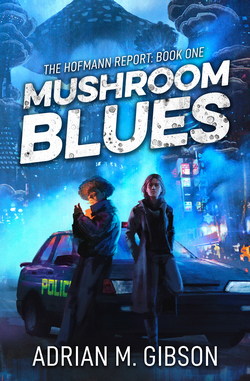
HC Chats with Adrian M. Gibson about Jeff VanderMeer

Cover of Mushroom Blues by Adrian M. GibsonIf you’ve been on Bookish Social Medial at all in the 6+ months, I’m willing to bet you’ve seen the name Adrian Gibson or at least the cover of Mushroom Blues. You may also know him from the podcast he hosts with M.J. Kuhn, SFF Addicts. Last week, Adrian was gracious enough to struggle with StreamYard (and it was in a mood) in order that we could sit down and talk about Jeff VanderMeer–an author that I’ve been intimidated to pick up and try, but who has been instrumental in Gibson’s career. I walked away excited to try VanderMeer, and I had a good time in general. I hope you watch this and walk away thinking the same.

As I said, StreamYard wasn’t happy, so the video freezes a couple of times on both of us, but the audio is fine.

Adrian M. Gibson Links:

Twitter ~ Instagram ~ Website ~ Newsletter ~ Amazon ~ Goodreads


Are you a Reader of Things and want to chat with me about an author/series/something other than promoting your own work (which we will do, just not primarily)? I’d love to keep trying this, but I’m not ready to start pestering people about it. So please let me know.

Irresponsible Reader Pilcrow Icon

Page 2 of 20

Powered by WordPress & Theme by Anders Norén