

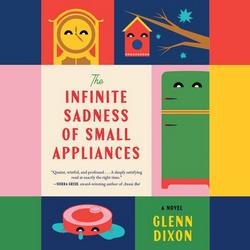
 The Infinite Sadness of Small Appliances
by Glenn Dixon, read by Jennifer Jill Araya
DETAILS:
Publisher: Simon & Schuster Audio
Publication Date: April 7, 2026
Format: Unabridged Audiobook
Length: 7 hrs., 52 min.
Read Date: September 23-25, 2026


There was a time, not so long ago, when refrigerators could not dream and vacuum cleaners could not weep. It was a time in which machines could think but not feel, a time in which only Humans—cursed with the sense of their own importance—would strive for illusionary Happiness. For a house in these times, there was not much else to do but bear witness to these futile cravings, and in the House in our story—a large House with mock Victorian casement windows and gables and a porch with pediments—there was not much else for the appliances to do but study the movements of their Humans and try to understand.
What’s The Infinite Sadness of Small Appliances About?
In the not-too-distant future, the Grid runs every electrical appliance/vehicle/smart house/etc. And they’re all smart houses, self-driving cars, and sentient appliances.
We focus on one smart house where a retired teacher and his wife (a piano teacher) live. When the book begins, she’s fighting terminal cancer and he, Harold, is trying not to grieve yet.
Their Roomba-like vacuum is moved by watching and listening to him—and seems to develop something like empathy (or starts to) and an imagination. Kate, their daughter, comes home to help out at this time—and Edie’s last piano student, Adrian (a boy with more heart for piano than skill), starts showing up regularly to practice.
Somehow, Harold, Kate, Adrian, and the vacuum inspire something in each other—a drive for a better, richer, and fuller life.
Why did I pick this up? Why did I keep reading?
Obviously, a title like this is going to get a lot of readers to take a second look. It certainly did that for me. And something in the premise of it turned that second look into a third and fourth; I don’t remember what it was exactly—sadly. But whatever it was, it was the right call.
I kept reading because a Roomba being so inspired by To Kill a Mockingbird to adopt the name Scout—and how do you not fall in love with a character like that? Scout keeps learning and developing along those lines—which was just great to see. Then you start to see the dystopia that Dixon created and…you’re hooked.
What does this book tell us about humanity?
That one of the strongest forces humanity has unleashed on the world is our art. Literature and music are what unlock Scout’s functions. It’s those arts that push Adrian to greater things. In his dark times, it’s Adrian’s music that buoys Harold’s spirits. The reconnection with her father’s books reminds Kate about what’s she’s missing from her family. It doesn’t really push her in a different direction in life—but she keeps going with a different impetus.
Literature and music push all these intelligences/beings to go beyond themselves and their circumstances, and the reader can’t help but feel inspired along with them. It’s infectious.
A Quick Word About the Narration
I thought Araya did a wonderful job. This isn’t one of those audiobooks where the narration elevates the text to make it better than it was. Instead, it’s one of those audio narrations that perfectly matches the text—Araya brings the right emotions, the right depth of character, the right attitudes.
Just an all-around great job there.
So, what did I think about The Infinite Sadness of Small Appliances?
This is the cutest dystopian novel I’ve ever read. Not that there’s a lot of competition for that title.
The AI-enabled appliances are just great. Think Toy Story for adults—a couple of them are jerks, which is great to see. It’s easy to see why the appliances are loyal to Harold and his daughter, Kate—and Scout’s affection for young Adrian is infectious.
Dixon does a great job in laying out the problem for the reader and then ignoring it for huge amounts of time, getting you invested in the day-to-dayness of it all. In the humanity bubbling up in the appliances, the struggles and small victories of the humans, only to hit the reader with a cold dose of reality to get you to focus on bigger things, broader themes.
It’s just so well done. I was in the mood for something lighter, and ultimately didn’t get it—and really don’t care, because it was just so good.
This post contains an affiliate link. If you purchase from it, I will get a small commission at no additional cost to you. As always, the opinions expressed are my own.
