Tag: Maria Ressa

My Favorite Non-Fiction Books of 2025

Covers of Algospeak, Class Clown, Food for Thought, Enshittification, Everything Is Tuberculosis, Killer Conversations with Rex Stout and John McAleer, Pronoun Trouble, How to Stand Up to a Dictator, and Robert E. Lee and Me, next to an image of an anthropomorphized Pilcrow and the words 'My Favorites of 2025 Non-Fiction'
My 2025 Wrap-up continues and now we’re on to the Non-Fiction list. While I liked a number of works that didn’t make this list, I felt strange calling them a “favorite.” These are the ones that stuck with me through the year; the ones I cited in conversation; that I thought about when reading something else or watching something on TV. Yeah, there’s some overlap between this list and the audiobook list from yesterday—lately, most Non-Fiction books I work through are in audiobook format. So it makes sense, even if it makes this post seem like an echo.

As always, I only put books that I’ve read for the first time on this list. I don’t typically return to NF books (outside of looking up things for one or three points), but occasionally I do—for example, The Pleasures of Reading in an Age of Distraction by Alan Jacobs would get a permanent spot on this list, were it not for this rule.

(in alphabetical order by author)
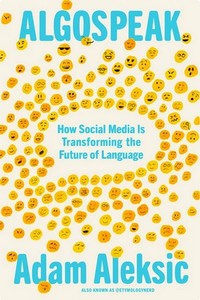
Cover of Algospeak by Adam AleksicAlgospeak:
How Social Media Is Transforming the Future of Language

by Adam Aleksic

My original post
Language in general—but English particularly—is a constantly-changing thing, and these changes are happening faster and faster all the time. Algospeak is a great look at the hows and whys of a lot of the current evolutionary processes. It is about more than language—it’s also about how the Internet changes the way we think and express ourselves in general. And therefore, how society changes (which leads to Internet changes, and other circle-of-life things).

Aleksic has obvious expertise and passion for the subject (look at just one of his videos). He’s also active in these areas. It’s a great read, informative and entertaining. Hard to ask for more.
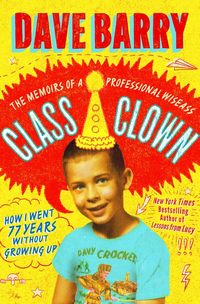

Cover of Class Clown by Dave BarryClass Clown: The Memoirs of a Professional Wiseass—How I Went 77 Years Without Growing Up

by Dave Barry

My original post
It comes as no surprise to any that I loved a Dave Barry book. It takes something pretty lackluster by him to get that reaction (and he doesn’t do that often–but I can prove it if you want). But this is something else–it’s insightful, it’s touching, it’s (seemingly) honest, and human. It’s a look at his childhood, his professional humorist origin story, and then scattered accounts of some of the very strange things that his profession has let him do.

I don’t say this about many authors–but I really don’t know that I’ve wondered anything about Barry’s personal life. But now that I know? I am more than happy to get some understanding about it. Does it necessarily help me understand his work better? No (but we’ll see the next time I take up his work, I guess). But it makes me like Barry the person a bit more.


Cover of Food for Thought by Alton BrownFood for Thought: Essays and Ruminations

by Alton Brown

Like any good fan of a TV show/personality, I like to know how they got started, how the show was developed, etc. Brown talks about how he got into food education media–and it’s not really how you’d expect. How he moved on from Good Eats to other things. There’s some great stuff about his education. But perhaps the most rewarding portion of the book is his musing and observations on the place of food/eating to human society (writ large or on an individual level).

Really, there’s so little to not appreciate from this book. Alton Brown has spent decades thinking and writing about food. This is the result of all that.


Cover of Enshittification by Cory DoctorowEnshittification: Why Everything Suddenly Got Worse and What to Do About It

by Cory Doctorow

I don’t know how to talk about Doctorow’s screed against Big Tech, the policies that led to these platforms that have taken over the internet and made it less-good than it used to be. Even that sentence is not a great way to talk about the book. The book wowed me. I wouldn’t say it radicalized me on some of this, but I sort of wish it did. The Ressa book below really struck me as a giant proof for Doctorow’s case (good idea to read the two of them around the same time). It’s a great–and terrifying–read.


Cover of Everything Is Tuberculosis by John GreenEverything Is Tuberculosis: The History and Persistence of Our Deadliest Infection

by John Green

I never imagined I would appreciate a book about an infectious disease. And despite all the good things I heard about this book, I didn’t rush to pick it up. But I’m so glad I did.

First of all, you could probably pick any number of things to use in place of Tuberculosis to trace human history, seemingly at major turning points and shaping societal developments. Say…bread, or writing, or…I dunno this is a sentence I regret starting. But from a certain point of view–you can buy the theory posited at the beginning of this book, that Tuberculosis shaped human history.

Green talks about the treatments that have been tried (and failed), the way it impacted population sizes, the devastation it’s left in it’s wake, and how things are going in the battle against the disease now. Interwoven with these is the story of one particular patient in Sierra Leone that Green met years ago. We follow his personal struggle–ups, downs, way downs, and more.

Green can relate these facts–even the bleak ones–in an engaging way that will stick with the reader. But then he drives it home and makes it gets you emotionally involved through the patient’s story.

You just can’t help but being taken in by the book and it’ll leave a lasting impression.


Cover of Killer Conversations with Rex Stout and John McAleerKiller Conversations with Rex Stout and John McAleer

My original post
Granted, there is a very limited audience for this kind of thing. But for that audience (and I’m part of it), this is catnip.

These snippets of conversations between Rex Stout and his biographer and friend are just wonderful. Quick back and forths on any number of topics–life, death, love, reputation, writing, Stout’s characters, his career, and more–it’s fun to read. It’s fun to think about. You’ll wish you were half as clever as Stout.
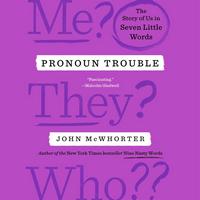

Cover of Pronoun Trouble by John McWhorterPronoun Trouble: The Story of Us in Seven Little Words

by John McWhorter

So, sure–this looks like it’s nothing but a screed on one side or the other about the problem we’re having with third-person pronouns the a socio-political front in English. And, yes, it is about that, (but only from a linguistic point of view), but there’s more to it. There’s also that pesky second-person plural.

Like in his book, Nine Nasty Words, McWhorter gives a quick look at the history of English pronouns one at a time–looking at various forms, usages, spellings, and assorted trivia. When appropriate, the then talks about some of the contemporary challenges and controversies with them.

Completely entertaining–McWhorter’s a great narrator–and very educating. I heartily commend this to you (no matter what you think of using “they” for the third-person singular).


Cover of How to Stand Up to a Dictator by Maria RessaHow to Stand Up to a Dictator: The Fight for Our Future

by Maria Ressa, read by Maria Ressa & Rebecca Mozo

Maria Ressa’s story is fascinating. It’s just that simple. I mean, you rarely find a Nobel Peace Prize recipient without an interesting backstory of some sort.

Like I said above, when you add this to Doctorow’s book and you see how everything he said is entirely possible and how it can work against someone.

There’s, of course, more than just Ressa’s story and struggles reflected here. There’s a call to action, a call to do the necessary work, and a call to hope, when it comes to oppressive governments or platforms.
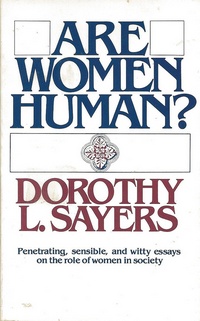

Cover of Are Women Human by Dorothy L. SayersAre Women Human?

by Dorothy L. Sayers

These are two essays by Sayers on the subject of women in society–with a particular look at academia. They are pointed, clear, and witty.

I’m not sure what else to say, really.


Cover of Robert E. Lee and Me by Ty SeiduleRobert E. Lee and Me:
A Southerner’s Reckoning with the Myth of the Lost Cause

by Ty Seidule

My original post

This is a powerful read. This very-Southern, Lost Cause adherent, West Point history professor starts looking at what he’d been raised believing, and the systemic racism of the culture he’d been raised in. The book then recounts example after example after example of the racism everywhere and the excuses made for covering up the treason of the Confederacy everywhere, including the U.S. Army–the army he left and fought against.

I thought Seifert made a compelling case in an engaging read that will stick with you for a long time.

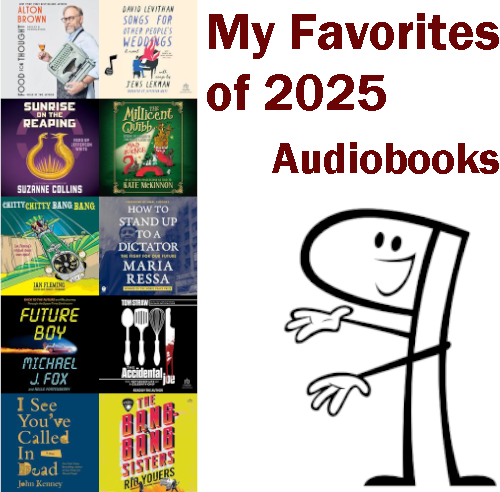
My Favorite Audiobooks of 2025

My Favorite Audiobooks of 2025

It’s time to talk about my favorite Audiobooks. How do I keep this from being just a rehash of my other year-end lists? By focusing on the audiobook experience over the content. What was it like to listen to it? How engaging was it, how did the narrator do? Was it a good match in terms of tone, content, and performance? All of these books are/were good—but the audiobooks are a bit better because of the narrator and the rest of the people involved in the production.

As always, re-reads don’t count for these lists.

(in alphabetical order by author)

Cover of Food for Thought by Alton BrownFood for Thought: Essays and Ruminations

by Alton Brown

If you’re a fan of Brown, this is essential. It’s part memoir; it’s part behind the scenes of Good Eats, Iron Chef America, and more; it’s part musings on the state of cooking, food television, eating, etc.; and there’s even some cooking tips. I wouldn’t be surprised to learn a little more than that is covered.

The audiobook brings his signature style, snark, and passion to the material–which really doesn’t need anything to raise the level–but it doesn’t hurt. I had a blast reading it–I don’t know how many people I’ve pushed it on, either.


Cover of Sunrise on the Reaping by Suzanne CollinsSunrise on the Reaping

by Suzanne Collins, read by Jefferson White

I thought I was over the whole Panem/Hunger Games thing. I loved the original trilogy, but just couldn’t bring myself to read the prequels. A review or two and a co-worker convinced me to try this one.

As messed up as you may think that Haymitch was when we first met him…he deserved to be. He earned that–and more. Collins made that clear in the book, but Jefferson White brought that to life–with all the heartbreak, anger, and grief.

It was the audiobook that kept this from being something I checked off to satisfy an itch (and that itch would’ve been greatly satisfied, don’t get me wrong), and turned it into an experience that unsettled me in all the right ways.


Cover of Chitty Chitty Bang Bang by Ian FlemingChitty Chitty Bang Bang

by Ian Fleming, read by David Tennant

I remember precious little about the movie version of Chitty Chitty Bang Bang, and most of that is just the car. But some fellow-blogger mentioned Tennant doing this audiobook (and I’ve lost track of who that was, I feel lousy for it). Curious, I gave it a shot.

I came away with this with two firm impressions: when Fleming let his hair down, he could spin a fun tale. Not one that necessarily makes a lot of sense–but it’s fun. Second–David Tennant was as fantastic at this as I imagined.

I don’t know what else to say–I’m sure I’d have been entertained by just about anyone reading this book. But very few (if any) could’ve made me relish the experience the way I did.


Cover of Future Boy by Michael J. Fox and Nelle FortenberryFuture Boy:
Back to the Future and My Journey Through the Space-Time Continuum

by Michael J. Fox and Nelle Fortenberry

My original post

I was a huge Michael J. Fox fan at the time this book is set (okay, I’ve pretty much been a huge Michael J. Fox fan since then, too),  I was definitely part of the target audience for this. Throw in Fox as narrator, and you know I’m in.

As far as the narration goes, age and disease have impacted his voice—but it’s still Fox, and he delivers it well. The quick audio clips from others involved in the productions Back to the Future and Family Ties are fun bonuses.

This is a fun—and fast—look at a madcap time in Fox’s life with enough of the behind-the-scenes stuff. Fox’s trademark self-deprecation is on display as well.

The only problem with this book is its brevity. Beyond that, I have no complaints—fans of the actor or the film should enjoy this book. I sure did.


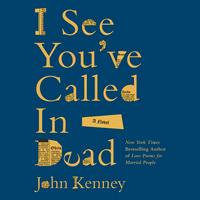
Cover of I See You've Called in Dead by John KenneyI See You’ve Called in Dead

by John Kenney, read by Sean Patrick Hopkins

My original post

Hopkins did a great job of bringing this very strange book to life and convinced me that an outrageous character like Bud Stanley could not only exist, but be someone I wanted to spend several hours with. Not just Bud Stanely, either–there’s a pretty diverse and wide cast of supporting characters that Hopkins did an equally convincing job with (the little neighbor boy was one of his best).

It’s not just the performance, obviously, I really got into this funny and heartfelt novel about friendship, mortality, and thinking about mortality. But it’s what pops to mind as I’m talking about audiobooks.

This was the whole package.


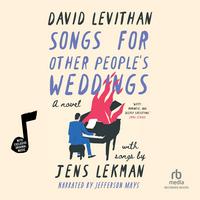
Cover of Songs for Other People's Weddings by David LevithanSongs for Other People’s Weddings

by David Levithan with songs by Jens Lekman, read by Jefferson Mays

I found the resolution of this novel disappointing, but I enjoyed a lot of the journey worth the time. This is a novel about a pop musician of some (small) renown who is much sought after as a Wedding Musician–it’s more than I can get into here, but alone is a charming story.

A bonus to this book is that Jens Lekman wrote and performs songs to go with the weddings. I don’t know what this looks like in the text version of the book–maybe just the lyrics, which is nice enough. But a novel about a singer that contains actual songs (purportedly by this singer) is a great bonus and adds something to the book.

Sure, I’m not crazy about most of the songs–just not my vibe. But that they’re there is really nice.


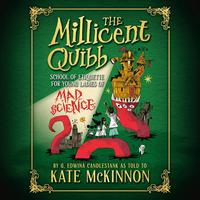
Cover of The Millicent Quibb School of Etiquette for Young Ladies of Mad Science by Kate McKinnonThe Millicent Quibb School of Etiquette for Young Ladies of Mad Science

by Kate McKinnon, read by Kate McKinnon & Emily Lynne (Narrator)

My original post
(Edging out the sequel, Secrets of the Purple Pearl, by a hair–I did go back and forth on it a bit)

Would I enjoy this in print? Yeah—especially the illustrations. But the performance by McKinnon & Lynne makes these things you have to listen to. And likely re-listen to.

These are silly, silly, silly adventure novels about three sisters who wind up at The Millicent Quibb School of Etiquette because they can’t manage to stay in other schools without being disruptive by being themselves. Quibb introduces them to a world of pizza, self-expression, curiosity, mystery, danger—and the chance to save the world from mad scientists.

I cannot say enough good things about this book. The plot is insane, the text are ridiculous, and the jokes are a great balance of silly enough for children but clever enough for adults. They’re perfect for young or young-at-heart readers. McKinnon and Lynne make a good book a great audio experience.


Cover of How to Stand Up to a Dictator by Maria RessaHow to Stand Up to a Dictator: The Fight for Our Future

by Maria Ressa, read by Maria Ressa & Rebecca Mozo

Ressa’s story–from childhood up through the present–is mind-blowing, and the kind of thing one might be skeptical about in a novel. And I’m not going to say more about it now.

But it’s her delivering this material–the raw emotion, the pride, the anger, the conviction–that makes this audiobook. It’s a great story, it’s a powerful call to action–and a strong dose of hope for the future.


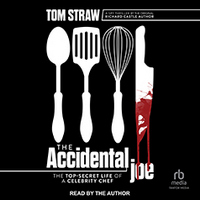
Cover of The Accidental Joe by Tom StrawThe Accidental Joe

by Tom Straw

It is difficult to explain just how entertaining this is–and I’m not sure if the narration or the text gets the majority of the credit. Tom Straw did both, so he gets all the credit.

This is the story of a celebrity chef with a travel show who is recruited by the government to use his show as a way to conduct espionage. Which totally makes sense, right? Well…with an iron-clad plan like that, things get out of control.

The book is a hoot. The jinks are hi. And Straw’s narration is perfectly suited to the material.


Cover of The Bang-Bang Sisters by Rio YouersThe Bang-Bang Sisters

by Rio Youers, Kristen Sieh (Narrator)

My original post
So, this is a story about a touring rock band–and after their shows at various bars around the country, they occasionally slip away to kill some criminals that the judicial system can’t put away. Totally normal, stuff right.

Youers fills it with humor, heart, and so, so much violence. It’s fast, it’s furious, it’s bloody, it’s raw emotion, it’s dangerous. It is so much fun. It is Rock and Roll.

And Kristen Sieh? She’s just the lead vocalist that this album needed. I believed the music, I believed the vigilantism, I believed the sisterly-tie between the bandmates/friends/allies; I believed every second of the trap they were caught in and the way they got out of it.

It’s the kind of audiobook that leads me to overhyping.


Powered by WordPress & Theme by Anders Norén