Tag: Mystery/Detective Fiction/Crime Fiction/Thriller Page 11 of 61

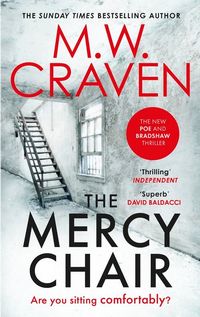
The Mercy Chair by M.W. Craven: We’re All Stories, In The End.

Cover of The Mercy Chair by MW CravenThe Mercy Chair

by M.W. Craven

DETAILS:
Series: Washington Poe, #6
Publisher: Constable
Publication Date: June 6, 2024
Format: Hardcover
Length: 414 pg.
Read Date: June 10-13, 2024

Buy from Bookshop.org Support Indie Bookstores

What’s The Mercy Chair About?

The book opens with Washington Poe in one of the least likely places we’ve seen him—therapy. Sure, he’s not there because he really wants to be—but he’s still there. Dr. Clara Lang is a trauma therapist, and she’s trying to help Poe recover from a case that drove him to the point that an “incident” occurred (SPOILER: it’s nothing as bad as what he did prior to The Puppet Show, but this one had witnesses).

He’s not in a good space—nightmares are plaguing him, and the circumstances around this case are likely what pushed him over the edge. The founder of a group called The Children of Job—an independent religious group associated with “extreme” views on sex, sexuality, government, and several other “culture war”-type issues—has been murdered. Stoned to death, to be precise. Poe and Tilly’s old friend, the Bishop of Carlisle, wants them to look into this—the Children of Job have been trying to be recognized for years, and while he’s disinclined to do that, he’d like to get this murder cleared up and to explore the group some. Enter our heroes.

It’s a brutal, brutal murder—but as the investigation goes on, they learn more and more about this Church, its practices and beliefs—practices that aren’t just questionably acceptable or orthodox—but some that are downright criminal. And every secret, every layer of mystery, that Poe uncovers shows another layer of dirt and darkness. You won’t feel that bad for the murder victim for too long.

Also, their agency is being audited by the government—one auditor, Linus, is assigned to Poe and Tilly while they conduct this investigation. Poe dubs him an intern and treats him like one—hoping to dissuade him from continuing this “audit” or at least not to let things get bogged down by Linus. Poe can see through the story he and his DI have been fed about this auditor, but he’s still stuck with him for the duration, as complicating as his presence/observation is (if only because Poe has to worry about his real purpose).

The Religion of The Children of Job (and others)

I have several questions regarding the beliefs of this group, The Children of Job. For example, what’s with that name? It’s an odd one to pick. The leader/founder of the group is covered in religious tattoos, but they seem like a fundamentalist group (and are compared to Westboro Baptist Church)—and I really don’t see those two going together. But I could be wrong there. But other things that don’t work with that group are things like the dichotomy of mortal and venial sins (something we’re told the CoJ do hold to).

I get it—the main thing we’re supposed to focus on with this group is their controversial (at best) beliefs and practices. They’re supposed to be the intolerant, unthinking group that Poe can rail and push against. But the lack of a coherent religious worldview and practice really doesn’t work. Yes, they should seem aberrant to Poe and Tilly’s secular point of view and to the Bishop of Carlisle’s very un-secular perspective, that’s beside the point. It should sill seem internally consistent—and the Children of Job don’t. They really feel like a hodgepodge of hot-button Evangelical/Evangelical-ish beliefs and practices forced into some religious chimera.

If, like most readers (I suspect), you don’t notice or care about this sort of thing, you’ll do fine. On the other hand, if you take this stuff seriously and expect sectarian groups that border on being a cult would take it seriously, too…it will bother you. It should bother the COJ. Does this impact the experience of the reader? Not really. Does it impact the hunt for the killer, his/her/their motivation? Nope. Does it impact Poe, Tilly, or anyone else we care about in the book? Nope. Did it/does it occupy too much real estate in my mind? Yup.

Along these lines—sort of, we’re told that Poe’s “intern” Linus read theology at university, and he’s treated as the investigation’s religion expert after that. Which is fine, it’s not like they can call the Bishop of Carlisle every time something comes up. But in Chapter 17 he pokes at one of my pet peeves, calling the last book in the New Testament “Revelations.” Now, the name of the book is singular—coming from the opening line, “The Revelation of Jesus Christ…” Back in Chapter 11, he got the name right. So, is he just sloppy? Maybe (but the more we get to know him, the less likely that seems). And for all her lack of interest in religion, how does Tilly not catch something like that and harp on it? Is this a case of sloppy copy editing? That’s possible. But I don’t know, and it irks me. It’s not a big deal, but it’s one of those errors that’s like nails on a chalkboard to me.

Poe’s Life Battles

One of the problems with juice and smoothie bars was that however much they dressed it up, they really only served fruit and vegetables. It didn’t matter that the ingredients had been blended, put in a cup and served with a soggy cardboard straw, it was still a gunky mess of unpalatable leafy greens and unbearably sour or sickeningly sweet fruits. Ingredients supermarkets wouldn’t put on the same aisles were forced together then given misleading names such as Liquid Sunshine and Endless Summer.

But the main problem was that for a supposedly fast and convenient food, smoothie and juice bars were slow and inconvenient. Poe reckoned he and Linus had been waiting for fifteen minutes. And, to make matters worse, the place Bradshaw had sent them no longer did milkshakes. The teenager behind the counter had offered Poe frozen yoghurt instead, to which Poe had replied, ‘T’d rather piss in my shoes.’

While they waited Linus said, “You seem to have a lot of these little “life battles”, Poe.’

‘What battles?’

‘Well, this one for a start. All you had to do was say no thanks to the frozen yoghurt. Instead, it became a whole big thing. I’d be surprised if they don’t spit in our smoothies.’

‘And I’d be surprised if you noticed,’ Poe said.

It will come as no surprise to anyone who’s read this series—or any of Craven’s work because it’s true of all his protagonists—that Washington Poe’s greatest enemy is himself. As seen, even Linus (who hasn’t known Poe that long—and is kept at arm’s length) can see it.*

* Also, I rather enjoyed that pericope.

Each book in the series explores—in one way or another—Poe’s propensity to engage in these life battles, and what they cost him—whether it be his home, his job, his credibility, the purchase price for a roasted goat, or spit in Tilly’s smoothie (spit in Linus’ smoothie would be a gift to Poe).

To some extent those close to Poe, or those who’ve worked with him and have seen what his methods/personality result in, can tolerate this, or make allowances for it. But

Now, any armchair therapist would tie this into his mother abandoning him and him telling himself (or Linus in a couple of pages after this) that he just doesn’t care about what other people think. But that’s garbage, and as much as Poe will tell that story to himself—he may even believe it—this comes from a dark place (no surprise) and potentially wreaks havoc on his personal life. It’s done that to his career—and it may do it to individual cases.

When we first met him, there was D.I. Stephanie Flynn—a friend of sorts—and, that’s about all we know about in Poe’s life outside of work (and since they worked together…). But now he has a home, he has Edgar. He has grown over this series—see his relationship with Tilly, with Estelle—and even his working relationship with the police in Cumbria. There are people and things besides his stubborn self-reliance in his life. He might even be fighting fewer life battles. Hopefully not too many—he might be a slightly less entertaining character if he gives up on them completely. But seeing gradual change—growth, thankfully—in a mature character is a great feature in a series.

And all of that is due to Tilly Bradshaw. But following up on that is for another time…

Physical Descriptions

In the past, I’ve talked about Craven’s ability to make you see a physical location—and kind of feel, smell, and hear it, too. There are a couple of locations like that in this book (the most striking I’m not going to talk about, you get to find it and be haunted by it yourself).

But I haven’t done a great job in talking about his gift for physical description. There are some dazzling examples in this book. Like:

[Name] was as thin as garlic skin and twice as pale. He had hair like an unshorn sheep, and the physique of someone who drank his meals. His back was banana-curved. Given his background, Poe had been expecting an older version of Joshua Meade. Prim and prissy with a distasteful look, as if he had something smelly on his upper lip. But, in his ratty dressing gown and even rattier sandals, [Name] looked like a featherweight Merlin. His toenails were jagged and yellow and dirtier than a dustbin lid.

Virginia Rose was thinner than a lolly stick and meaner than skimmed milk. Her words were precise, her vowels trimmed. She spoke as if it was a necessary but unpleasant chore. Poe reckoned that five hundred years earlier she would have been a witchfinder’s assistant, gleefully passing them the heretic’s fork. Some people just gave off that vibe.

You don’t get descriptions like that everywhere, you know? Seriously, I could read pages and pages of those kinds of snapshots. I’m not even sure that Poe needs to do much but wander around a city and people-watch to make me want to read the thing.

Yes, I read this and other series for the stories and the characters—but when an author like Craven gives you this kind of detail, delivered in this kind of way (what one author recently described to me as “sparkle”)? That’s when he gets a lifelong reader, even if he doesn’t seem to know how many times to use the letter s in “Revelation.”

Story-Telling

The novel as a whole is about Washington Poe telling a story. And throughout it, a few people have stories to tell him (sometimes announced as such, sometimes not).

There’s an extent to which every mystery/detective/police procedural is about storytelling—the story the evidence presents (or seems to present, for Mickey Haller, Eddie Flynn, Andy Carpenter, and the like), the stories the witnesses tell, the stories that the detective/whoever assembles over the case, the stories the criminal tells, and so on—in addition to the story the novelist is telling.

But few are as upfront and in-your-face about it as The Mercy Chair is. Craven forces the reader—well, okay, that’s overstating it. Craven invites the reader to think about the layers of story in the book you’re holding/listening to—it’s similar to Churchill’s line about “a riddle, wrapped in a mystery, inside an enigma.” I can’t delve into it to the depth it deserves in a post like this—nor am I sure I have the ability to explore it as it should be in general—but, like the section above, not every author delivers this kind of layer, meta-commentary, or element (whatever you choose to think of it) to a police procedural. So many—many that I enjoy, I hasten to add—are satisfied delivering a plot, a dose of character development, a clever mystery, and calling it a day. It’s the special authors that give you space and textual reasons to chew on things beyond the basics.

So, what did I think about The Mercy Chair?

Don’t ask me why—I don’t often find myself suffering from (and/or enjoying) the phenomenon called “Book Hangovers”—I think part of it is that I have so many books on my TBR that I don’t have time. For those of you who don’t know what I’m talking about, one blogger defines them as “all those thoughts and feelings you get after reading a good book that prevents you from moving forward in your real life and/or your reading life.” Well, I got one from The Mercy Chair—not only could I not move on nearly as quickly as I typically do, I couldn’t even write anything that night. I was just in a mental daze that left me in a state to watch some mindless TV until I went to sleep. It just got under my skin, worked its way into the folds of my cerebral cortex, and into my bone marrow.

Basically, it haunted me for a few days.

And I loved it for it. Make no mistake, all of this is a good thing. A very good thing.

And then…when it came time to write this post, I kept coming up with more and more to say—and have exerted more self-control than I like (and a lot of trimming) to keep this from being a pamphlet.

I’ve said little about Tilly, which is a little odd. I could be wrong (I likely am), but I think the percentage of the novel that features her is smaller than usual. But it works (this time), due to the nature of the stories that Poe and Craven are telling. But when she’s around, she’s as fantastic as always (I have to bite my tongue on a couple of scenes that I really want to get into). Also, before the events of the novel begin—Tilly gets to shine in a very non-crime-fighting way. It’s good to have the reminder that not only does Poe think she’s brilliant—she actually is.

The book as a whole is the darkest yet in this series—possibly the darkest thing that Craven has written (I still have one pre-Poe book to read, so I can’t weigh in on that). But it doesn’t stop being entertaining—thankfully. There’s at least one “awwww”-inducing moment as well as some lightness, some hope, some Poe and Tilly nonsense just around the corner up until the end game. And by that point, you’re so hooked by the tension and wowed by the revelations that you don’t care. I’m including the revelations that you may have guessed at, or close to—because the bits of them that you haven’t guessed at will make you feel like your hunches were useless anyway. It’s a good thing no one in my family dared to interrupt me during the last 80-100 pages, I’d probably have fewer people talking to me today.

It didn’t end quite as neatly as many of these books do—but it’s so close that no one’s going to care (and who doesn’t like a little ambivalence anyway?)—and there’s a problem discussed in the closing pages that is going to make things difficult for the partnership in at least the next book. I don’t expect that it’ll last too long—and at the very least it’ll be something that Poe and Tilly overcome. I’m not saying it’ll be a “super easy, barely an inconvenience” type of thing, but I don’t see Craven as having written himself into a corner. Still, it’s the closest thing we’ve gotten to a cliffhanger in the series.

The Mercy Chair is going to go down as one of my highlights of the year, and will likely be one of the high points of this series. It’ll be hard to distinguish it from the rest of the high points—the Washington Poe/Tilly Bradshaw books are filled with them, but I do think The Mercy Chair will poke up a little higher than the rest of this Himilayan-esque series.

Read this. Read everything Craven has published—and probably will publish. Heck, go through his trash to see if you can find a to-do list/shopping list—they’re probably worth reading.* Once you shake the heebie-jeebies that this novel will induce, you’ll be glad you did.

* Please don’t do that, I was just joking. That’d be creepy. Also…probably not safe, we know what kind of twisted things his mind is capable of, don’t make him angry.


5 Stars

This post contains an affiliate link. If you purchase from it, I will get a small commission at no additional cost to you. As always, the opinions expressed are my own.

Irresponsible Reader Pilcrow Icon

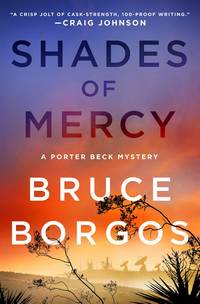
Shades of Mercy by Bruce Borgos: Memory Brushes the Same Years

Reading back-to-back books featuring a character named Mercy—not to mention writing about one while reading another—is a fun way to trip yourself up. Thankfully the genres are different. But if I start rambling on about the fae or coyotes, you’ll know why. Also, skip to the next sentence or so.


Cover of Shades of Mercy by Bruce BorgosShades of Mercy

by Bruce Borgos

DETAILS:
Series: Porter Beck, #2
Publisher: Minotaur Books
Publication Date: July 16, 2024
Format: e-ARC
Length: 352 pg.
Read Date: June 27-July 1, 2024
Buy from Bookshop.org Support Indie Bookstores

What’s Shades of Mercy About?

Sheriff Porter Beck’s life intersects with a couple of high school buddies for the first time in many years. And both situations should make anyone else from high school leery of running into him.

We open with Beck coming across one of those friends after they’d overdosed. Soon after, a federal investigator recruits Beck to go visit the other one. Jesse Roy has recently moved back to the area, and is renovating his father’s ranch into something that Beck can’t comprehend—it’s just too large, too gaudy, for this area. Cattle ranching is going really well for Jesse (too well?). The night before, something had gone wrong with a test vehicle with the Air Force, and something had fallen on Roy’s prize bull, destroying it. The investigator is here to negotiate a settlement—and it’s not a little one.

But something about the whole deal sets Beck’s B.S.-meter off. He forces the investigator to come clean—someone had hacked an Air Force drone and launched a missile at the cow. It was a targeted hit—but why?

Beck knows if he doesn’t help for the search for this hacker (and they know they’re local, somehow) and get to the root of the problems soon, his county will be overrun by Intelligence officers from all sorts of government agencies.

Oh, and there are wildfires threatening the county on several sides, and a large group assembling to storm Area 51. Just in case it didn’t seem like he had enough going on.

The investigation quickly points at a teenage girl who is serving some time at a teen facility nearby. As hard as it might be to believe. And before he knows it—Beck finds himself dealing with so much more than a hacker.

Comparing Shades of Mercy to The Bitter Past

So, the first book used dual timelines to tell the story—and I was afraid Borgos would try to pull that trick again. I think it could’ve worked, but eventually, his county is going to run out of people who were doing interesting things several decades ago. This time it’s all one timeline (with a little backtracking every now and then, but not much. But we do bounce between a few perspectives, so we still get the advantage of multiple POVs. So he’s able to maintain some of the same feel there.

His deputies are back, but some of them aren’t really seen due to the fires. There’ve been some changes since the last book and it’s good to see that everything isn’t stagnant with this series. We don’t get as much time with them all this time, and that’s a disappointment. Other characters return, too, most of them made me happy and one was a pleasant surprise. I had a more specific sentence there, but decided to remove the names…

The big change is the focus—The Bitter Past is all about the past—what it does in the present, how it can change so much about your life when you learn new things about your own past. Also, the weapons and conflicts of the past.

This one is very present and future-focused. It’s also good to see that Borgos isn’t stuck in one frame of mind.

So, what did I think about Shades of Mercy?

I’m having a hard time talking about this book without saying too much about the content.

In what—I think—was a very nice bit of story-telling is that there were a few things that should make the attentive reader pause and wonder if Borgos is being sloppy. I’m going to try to be vague here, but I’m thinking of some parts of the timelines before the novel started—and some things that happened during the novel that we don’t see first-hand, but see the effects of. I was too invested in the stories to spend time on these myself—I basically shrugged and moved on (not that I noticed everything I should’ve, either). I’m going to give you credit for being perceptive and thoughtful enough to catch these things—then I’m going to reassure you: trust Borgos. Everything gets tied up, everything makes sense, I can’t tell you how often in the last pages I said “Oh, sure—that makes sense,” (I also said “I probably should’ve caught that” about most of those items). It’s really a nice and tidy book.

I’m worried that my last paragraph makes the whole thing seem like a mess. Au contraire. This is a tight thriller—it’s only on a few points that it I was mistaken that he’d left things dangling. The rest of the book is as tightly written as you could hope (which I should’ve realized described the rest, too). There’s a little slowness for a chapter or two, just to bring us back into this world, reintroduce the character, and catch us up on Beck’s life—then we’re off to the races from the moment that Beck is brought to his old friend’s ranch.

The conclusion was just great—exactly what this book (and character) needed.

This book bodes well for the rest of the series that follows—yes, I’d like a “smaller” crime. One that didn’t involve multiple state and federal agencies, for one. Just a matter of Beck and his guys analyzing a crime scene and then figuring out who in their small community could’ve done it. It’d just be more believable than all the federal and military types wanding around all the time. But the way Borgos is dealing with the latter, I’m not sure I care.

There’s enough humor and heart here to take the edge off of things—the tension gets cut, the characters are made more endearing, and the reader can catch their breath before diving into more tension and action.

I wasn’t as wow-ed with this book as I was the first—but I was still impressed, and this book makes me more sure what the following books will be like than I was with The Bitter Past. And it promises to be a very good series. I’m repeating myself, so it’s time to wrap this up. Either with Shades of Mercy or The Bitter Past, you want to get on board this series here at the beginning.

Disclaimer: I received a copy of this book from St. Martin’s Press via NetGalley—thanks to both for this.


4 Stars

This post contains an affiliate link. If you purchase from it, I will get a small commission at no additional cost to you. As always, the opinions expressed are my own.
Irresponsible Reader Pilcrow Icon

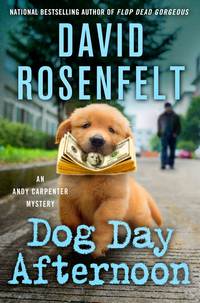
PUB DAY REPOST: Dog Day Afternoon by David Rosenfelt: Understanding Marcus

Cover for Dog Day Afternoon by David RosenfeltDog Day Afternoon

by David Rosenfelt

DETAILS:
Series: Andy Carpenter, #29
Publisher: Minotaur Books
Publication Date: July 2, 2024
Format: eARC
Length: 304 pg.
Read Date: June 20-21, 2024
Buy from Bookshop.org Support Indie Bookstores

What’s Dog Day Afternoon About?

Overall, I’m not sure that the body count in this book is that much higher than in other books in this series—but the way it opens is very different. The instigating crime feels like something straight out of a mass-shooter video your HR people make you watch annually (assuming your workplace is similar to mine, I guess)—it’s cold, calculated, with a casual disregard for human life we don’t often see in this series. (Andy says something similar at one or two points).

So you’re left wondering—how does Andy get roped into representing the accused? (although many readers are going to read that scene and pick out the places the defense is going to take advantage of). This is where Marcus comes in.

Andy learned about this earlier, but we readers learn about this now—Marcus mentors young people in his neighborhood who have had a rough time of it and have run afoul of the law in the past. They need some help, some guidance, and some favors—Marcus provides this.

He also helps a couple of those he mentors to adopt a dog from the Tara Foundation. One of these two is accused of the crime—Marcus comes to Andy for help, and he gets it. That Willie also vouches for the accused helps—there’s no chance that Willie agrees to let one of their dogs go to someone capable of this crime.

That’s not evidence he can introduce in court, but it’s compelling for Andy. Now he just needs to find something that will be compelling in court.

Marcus

Marcus can’t become too well-rounded of a character—we need him in the shadows, doing things that defy belief. But we can learn more about him than we have prior to this.

We see that he can have attachments to people other than Laurie (and by extension, Andy). We see just how far he’s willing to go to help someone.

I was interested in this book because I’ve enjoyed almost every one of its predecessors enough that I don’t bother to see what they’re about before I add them to the TBR list. But once I noted that this one featured Marcus like that—my excitement grew. I love watching the character at work, and to see him in a different situation than we’re used to made my day. Also, we got just what the doctor ordered from a Marcus-centric book.

So, what did I think about Dog Day Afternoon?

I cannot believe that I’ve read 29 books in this series (plus a few in a spin-off). Twenty-nine. That’s just insane. Now, am I going to say that they’re all as fresh as they were in 2002 when Open and Shut came out? Of course not. But they have their moments when they feel that way.

* According to my logs, I read it in 2011—I’ve been with these characters for 13 years. Mind-boggling.

So, Rosenfelt has his work cut out for him to do something to keep the audience engaged. Over the last few books, he’s worked on deepening the relationship between Andy and Marcus, which has been nice. This book takes a big step forward in that. I don’t know that we’re going to see much more than this anytime soon—you need to preserve some of Marcus’ mystique to keep him nearly-superhuman in Andy’s (and the reader’s) eyes. Similarly, we readers can know Hawk a little better than when Spenser first ran into him in Promised Land—but not too much.

So, we’d better enjoy what we get here, right?

And naturally, that’s really easy. Other fun bonuses—Andy getting along with the prosecutor. Cory clearly being annoyed with Sam Willis wanting to get in on the action. Even some of the Andy and Tara interactions felt a little different (not unusually so, and not negatively). There was also the attempt of a law firm to hire the most reluctant lawyer in the world—that did bring a smile to my face.

There’s a good mix of the tried and true Andy bits, fun material with our old friends, a clever mystery, a new side of Marcus, and Rosenfelt’s trademark zippy prose. It’s easy to see why this series has gone on as long as it has—and may it continue to do so.

Can you hop on here? Absolutely—and you’ll have the fun bonus of a healthy backlist to work your way through once you get done with this one.

Disclaimer: I received a copy of this book from St. Martin’s Press via NetGalley—thanks to both for this.


4 Stars

This post contains an affiliate link. If you purchase from it, I will get a small commission at no additional cost to you. As always, the opinions expressed are my own.

Irresponsible Reader Pilcrow Icon

Dog Day Afternoon by David Rosenfelt: Understanding Marcus

Cover for Dog Day Afternoon by David RosenfeltDog Day Afternoon

by David Rosenfelt

DETAILS:
Series: Andy Carpenter, #29
Publisher: Minotaur Books
Publication Date: July 2, 2024
Format: eARC
Length: 304 pg.
Read Date: June 20-21, 2024
Buy from Bookshop.org Support Indie Bookstores

What’s Dog Day Afternoon About?

Overall, I’m not sure that the body count in this book is that much higher than in other books in this series—but the way it opens is very different. The instigating crime feels like something straight out of a mass-shooter video your HR people make you watch annually (assuming your workplace is similar to mine, I guess)—it’s cold, calculated, with a casual disregard for human life we don’t often see in this series. (Andy says something similar at one or two points).

So you’re left wondering—how does Andy get roped into representing the accused? (although many readers are going to read that scene and pick out the places the defense is going to take advantage of). This is where Marcus comes in.

Andy learned about this earlier, but we readers learn about this now—Marcus mentors young people in his neighborhood who have had a rough time of it and have run afoul of the law in the past. They need some help, some guidance, and some favors—Marcus provides this.

He also helps a couple of those he mentors to adopt a dog from the Tara Foundation. One of these two is accused of the crime—Marcus comes to Andy for help, and he gets it. That Willie also vouches for the accused helps—there’s no chance that Willie agrees to let one of their dogs go to someone capable of this crime.

That’s not evidence he can introduce in court, but it’s compelling for Andy. Now he just needs to find something that will be compelling in court.

Marcus

Marcus can’t become too well-rounded of a character—we need him in the shadows, doing things that defy belief. But we can learn more about him than we have prior to this.

We see that he can have attachments to people other than Laurie (and by extension, Andy). We see just how far he’s willing to go to help someone.

I was interested in this book because I’ve enjoyed almost every one of its predecessors enough that I don’t bother to see what they’re about before I add them to the TBR list. But once I noted that this one featured Marcus like that—my excitement grew. I love watching the character at work, and to see him in a different situation than we’re used to made my day. Also, we got just what the doctor ordered from a Marcus-centric book.

So, what did I think about Dog Day Afternoon?

I cannot believe that I’ve read 29 books in this series (plus a few in a spin-off). Twenty-nine. That’s just insane. Now, am I going to say that they’re all as fresh as they were in 2002 when Open and Shut came out? Of course not. But they have their moments when they feel that way.

* According to my logs, I read it in 2011—I’ve been with these characters for 13 years. Mind-boggling.

So, Rosenfelt has his work cut out for him to do something to keep the audience engaged. Over the last few books, he’s worked on deepening the relationship between Andy and Marcus, which has been nice. This book takes a big step forward in that. I don’t know that we’re going to see much more than this anytime soon—you need to preserve some of Marcus’ mystique to keep him nearly-superhuman in Andy’s (and the reader’s) eyes. Similarly, we readers can know Hawk a little better than when Spenser first ran into him in Promised Land—but not too much.

So, we’d better enjoy what we get here, right?

And naturally, that’s really easy. Other fun bonuses—Andy getting along with the prosecutor. Cory clearly being annoyed with Sam Willis wanting to get in on the action. Even some of the Andy and Tara interactions felt a little different (not unusually so, and not negatively). There was also the attempt of a law firm to hire the most reluctant lawyer in the world—that did bring a smile to my face.

There’s a good mix of the tried and true Andy bits, fun material with our old friends, a clever mystery, a new side of Marcus, and Rosenfelt’s trademark zippy prose. It’s easy to see why this series has gone on as long as it has—and may it continue to do so.

Can you hop on here? Absolutely—and you’ll have the fun bonus of a healthy backlist to work your way through once you get done with this one.

Disclaimer: I received a copy of this book from St. Martin’s Press via NetGalley—thanks to both for this.


4 Stars

This post contains an affiliate link. If you purchase from it, I will get a small commission at no additional cost to you. As always, the opinions expressed are my own.
Irresponsible Reader Pilcrow Icon

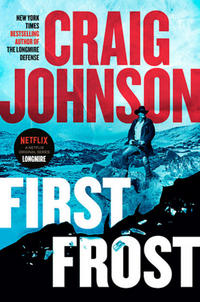
First Frost by Craig Johnson: Walt and Henry Get Their Kicks…

Cover to First Frost by Craig JohnsonFirst Frost

by Craig Johnson

DETAILS:
Series: Walt Longmire, #20
Publisher: Viking
Publication Date: May 28, 2024
Format: Hardcover
Length: 317 pg.
Read Date: June 3-4, 2024
Buy from Bookshop.org Support Indie Bookstores

What’s First Frost About?

This is a dual-timeline novel—which isn’t altogether new for the Longmire books. In the present time, the shootings that ended The Longmire Defense* are being looked at, and Walt’s possibly facing criminal charges.

* I don’t think it’s much of a spoiler to say that. Most Longmire books end with one.

In the other timeline—which gets most of the ink—we watch Walt and Henry try to drive cross-country after graduating college in California so they can report for Basic Training on the East Coast. A road mishap and a bit of bad navigation on Walt’s part result in them getting stuck in a small Arizona town for a few days, where they find some trouble.

Now

On the one hand, I get the antagonism that Walt and Vic show toward the proceedings because it’s instinctual to get defensive when someone’s questioning your actions (and, well, Vic’s antagonistic about a lot). But it seems excessive—Walt’s enough of a believer in doing things The Right Way (in contrast to his grandfather or Lucian, for example), that he should be in favor of this exercise.

That said…it’s clearly motivated by politics and big-money-fueled corruption. So maybe it’s justifiable for them to push back against this. I’m not entirely convinced that the way this stage of the investigation ends is really less corrupt than the way it starts.

Then

It’s 1964 and the first thing we see is Walt and Henry surfing one last time before taking off on their drive to Oklahoma for Henry to see some family and then to their respective bases. Everything that happens in California is vintage Johnson and if he’d maintained that quality, I’d have been very happy.

But once Walt breaks something in their truck when he breaks to avoid a dog in the road (coyote, Henry insists), I think the whole thing goes to pot. Walt thinks something’s hinky in the tiny and sparsely populated town they find themselves in. Rather than just waiting for the truck to get fixed so they can hit the road, he starts asking questions and annoying all the wrong people.

Meanwhile, Henry plays tourist, checking out the abandoned Japanese Internment Camp nearby (which, of course, ends up playing a role in what Walt’s stirring up) and flirting with a local young woman.

It’s not long before people are starting to end up dead and Walt’s life becomes endangered.

So, what did I think about First Frost?

If I think about this as Johnson’s tribute to Route 66 (and, boy howdy, was it one) and a way for him to talk about Japanese Internment Camps, I like this more. If I think about this as a Longmire novel, my regard diminishes. I do frequently enjoy Johnson multitasking—talking about Van Gogh’s murder, the Sturgis rally, Native American Women going missing, and so on, while telling a Longmire story—so that’s not it. I just don’t think the stories were executed as well as Johnson usually does.

Both stories wrapped up too easily—a little too _____ ex machina (I can’t tell you what non-deus entities were involved). At the same time, the 1964 story took a little too long to come to its resolution. I’m not sure how that’s not contradictory, but it’s not (at least in my mind).

I believe the major function of the present storyline was to set-up a future novel or two (see also: the first time Walt and Henry watched Lolo Long’s niece, Jayla, play basketball)—so I could come around to appreciate what Johnson was doing here. But what we saw in First Frost left me wanting.

The 1964 story ultimately suffered from what a lot of prequels do—it’s hard to believe that the Walt and Henry who just finished college act so much like Walt and Henry with their respective military trainings and decades of experience do. I had no problem when we looked at Walt as an MP (in whatever book that was), I think Johnson got it right there, ditto for rookie Walt in The Western Star.

I’m actually not entirely wild about the portrayal of the Cheyenne Nation in the 1964 Story, actually. Almost all of it seemed off—but I think it’s a good thing, it shows that life, experience, and maturation changed Henry.

Obviously, time and re-reads/listens might change what I think about it, but on the whole, this one gets a “not bad” from me. I am curious about the stories I think were set up and think we could be in for some fun there (and a potentially good way to get Walt out of Absaroka County to keep the body count from rising).

Long-time fans will find enough to satisfy them, people curious about the series should start elsewhere.


3.5 Stars

This post contains an affiliate link. If you purchase from it, I will get a small commission at no additional cost to you. As always, the opinions expressed are my own.
Irresponsible Reader Pilcrow Icon

Bad Actors by Mark Pepper: Everyman No More

Cover of Bad Actors by Mark PepperBad Actors

by Mark Pepper

DETAILS:
Series: Matt Spiller, #2
Publication Date: April 18, 2024
Format: eARC
Length: 431 pg.
Read Date: June 4-10, 2024

What’s Bad Actors About?

Matt Spiller, Man Down‘s actor turned cab driver turned vigilante made it to Hollywood. His first feature film is about to drop, he’s on the verge of starring in a premier TV show—all his dreams have come true.

And then his agent from England drops in unannounced—blackmailing Spiller for a significant amount of his earnings.

Then the detective who couldn’t quite put him away in England shows up, wanting to pin the murder of another action star to him.

And a would-be up-and-coming actor starts acting aggressively toward him.

His ex-wife and her new flame are coming to town.

Maybe some of his nightmares are coming true, too.

Spiller being Spiller, there’s really only way way for him to react—and that’s violently.

But before it’s over, there’s going to be a lot more going on than Spiller trying to keep his career and money going on. He’s going to make some powerful enemies and may stop some horrible people from doing some horrible things. But he’s not going to be able to lie down with these pigs and not get dirty himself.

A Manifesto on the Movies

In between the mayhem and hijinks—several people from various backgrounds sound off on the state of movies today. I think they speak for a lot of us when it comes to complaining about violence, spectacle, shallow characters, and more at the cost of story, plot, and craft.

These complaints—coming from Pepper’s characters, and any number of people in the real world—aren’t going to change things. But it’s sure nice to read. Choir members do appreciate being preached to.

From Everyman To . . . ?

So, in Man Down, Matt Spiller was kind of an everyman who found himself in a situation beyond his control and reacted in ways that…well, few everymen would.

In Bad Actors, Spiller is on the verge of a Hollywood career. His first movie is about to be released, and the buzz is pretty strong (particularly after a memorable appearance on a late-night show). He has more money than he knows what to do with.

It’s harder to root for him this time—partially because of his success, but only minimally really. Actually, Spiller doing well after everything he endured is vicariously encouraging. But it’s everything that he does to maintain his new position in life that makes it difficult. Things go up and down—so your estimation of his actions and motivations fluxuate as well (as they may have during Man Down).

This has no effect on the entertainment value of the novel—just your perspective on Spiller.

So, what did I think about Bad Actors?

This is a sequel to Man Down, but there’s also an aspect that makes it more—if you’ve read Pepper’s Veteran Avenue or Man on a Murder Cycle

Do you need to have read Man Down before this? Nope. You learn everything you need to know about Spiller and the rest here. Would it add to the experience? Sure. And I enjoyed Man Down more, so it wouldn’t be the worst idea to pick it up.

As for Bad Actors? It was a heckuva ride. I was less than satisfied with the way that several aspects of the storylines wrapped up—and not merely due to the outlandish nature of them. I still recommend it.

I’m a little unsure how to wrap this up beyond that—so I’m just going to borrow my conclusion from my Man Down post—Bad Actors is a good sequel in that way.

This was a bonkers read—that’s a compliment, in case that wasn’t clear. On the one hand, it’s impossible to predict how Pepper is going to start at Point A and end up anywhere near Point Z, but he does, and when you look back at it, the logic is clear and sound.

I can’t tell you how many times he pulled the rug out from under me (he does the same to Matt almost as often)—sometimes eliciting a laugh, sometimes shock and dismay, sometimes I was so dumbfounded as not to know how to react. [deleted because of the stuff I talked about in the above section]

The humor is dark, the action is frequent and dynamic, with [many] characters that you want to get to know better and see more of. I’m not sure what else to say at this point without giving away everything, so let’s just go with if you’re in the mood for a Mr. Toad’s Wild Ride of a thriller, get your mitts on this one pronto.


3.5 Stars

Irresponsible Reader Pilcrow Icon

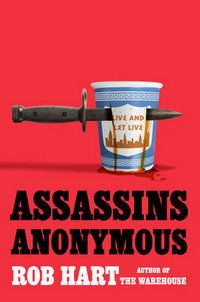
PUB DAY REPOST: Assassins Anonymous by Rob Hart:The Confessions of a Tactical Drone with a Heartbeat and a Dairy Allergy

Assassins AnonymousAssassins Anonymous

by Rob Hart

DETAILS:
Publisher: G.P. Putnam's Sons
Publication Date: June 11, 2024
Format: eARC
Length: 320
Read Date: May 27-29, 2024
Buy from Bookshop.org Support Indie Bookstores

What’s Assassins Anonymous About?

Almost a year ago, Mark walked away from his old life and into a 12-step meeting. It’s been a struggle for him—he’s almost relapsed, he came close to suicide, and he’s struggled every day. But with the support of the other people in his group, his sponsor, and a little orange cat who came into his life at just the right time—Mark is making it, day by day.

Then one day, Mark’s cleaning up after the meeting and he’s attacked by a Russian who moves like a professional killer. Mark fights back—incapacitating the Russian and escaping with a serious—but not-too-serious—wound of his own and a burning question: who sent the Russian? The search for the answer takes Mark (and his cat) around the world—into some very dangerous situations, and almost more temptation for Mark to relapse than he could’ve imagined.

You see, Mark’s 12-step meeting isn’t for Alcoholics Anonymous, Gamblers Anonymous, Narcotics Anonymous, or anything like that. As you’ll guess from the book’s title, it’s Assassins Anonymous. Hitmen, Assassins, Serial Killers, and the like, who are tired of the life, who are tired of killing and want to try to live productive, life-affirming lives. They have to fight old impulses, old habits, old attitudes, they have to abandon adrenaline rushes (which are probably pretty addictive) and all the rest for a quiet life. Mark had been one of the best in the world (or the worst, depending on your perspective)—almost legendary—until he went cold turkey. But someone’s apparently trying to warm up the poultry.*

* That’s a metaphor I really shouldn’t have tried to stretch.

Can Mark discover why someone game for him almost a year after he quit “the life”? Can Mark make them stop without having to throw away all the work he’s done over the last (almost) 12 months?

The Movies

Like many moviegoers, I love a good hit man movie. I can even enjoy a “just okay” hitman movie (sorry, The Whole Ten Yards you don’t qualify as either). Mark, unsurprisingly, isn’t a fan of most of them. Sadly, that’s where most people get their ideas and information about assassins and hitmen from. So by character, actor, or movie title, they’re brought up frequently—usually to Mark’s dismay. He’ll also just compare his life to those movies on occasion. I enjoyed this aspect of the character a lot—particularly one running bit where people kept expecting him to look more like a particular actor.

Other kinds of movies are used throughout the novel, too—they’re a great shorthand way of revealing character. What movies he likes, what movies he refuses to mention liking, and so on are a convenient and efficient way of telling you a lot about Mark. Also, it’s just fun to see characters talk about movies and whatnot—as people like Whedon, Tarantino, and Smith have been showing us.

The 12-steps

As the book started to really focus on—and feature—things like the meetings Mark’s attending, his recovery, and his working the steps, I started to get worried. Primarily because it was early on, and while I understood that Mark was flippant, even a wiseacre—was Hart going to be flip about the 12-steps? That feels like something you shouldn’t touch—like a third rail, a skunk with a hair-trigger, or that Easter Egg you finally found in late June.

But no—the meetings, the steps, the attitude about recovery, and the way the characters interacted about their recovery were dealt with respectfully. Sure, there was a little bit of Mark’s attitude (or similar ones) expressed in the meetings and whatnot—but not about the meetings or the program, just about each other or themselves. (much like I imagine happens in an actual meeting)

If anything, this is practically an advertisement for those kind of programs and the good work they can do. Because this is the heart of the novel—yes, there’s the violence, the suspense, the twists, and whatnot—let’s call them “The Thriller Aspects.” Those aspects are what will draw readers to the book, they’re what’ll keep your attention and get you hooked on it. But Assassins Anonymous isn’t so much about the “Assassins” as it is the struggle, the stumbles, and the victories associated with Recovery. In my book, we should get more of those—particularly honest books about the victories.

So, what did I think about Assassins Anonymous?

Imagine Martin Q. Blank, Jimmy Tudeski, and Frank Moses meeting up and trying to take care of business—non-lethally (I guess that’d be something like the pacifist version of The Expendables), and you’ll have something like this book.

Let’s start with The Thriller Aspects—Hart nailed them. Even—maybe especially—the more outlandish aspects of them (which are really the trickier part to pull off). There’s a confident panache to the novel—as well as most of the characters—that lets you know right away that you’re in good hands and are set for a great ride. Some twists you’ll see coming, and won’t care because of the way he executes them. But also,

The 12-Step aspect—well, see above—another win for Hart.

What about the comedy and narrative voice? Spot on—seriously good. It’d be easy to go overboard on the comedy—or to not use enough of it (we are talking about a bunch of people who have killed many others), but I think Hart hits the balance just right. And Mark’s the kind of guy you can enjoy being stuck in the mind of for 320 pages.

The first chapter gives you everything you need to know about this novel—it’s such a well-written chapter, too. Voice, character, action, comedy. If you read it and aren’t hooked, you’re probably going to feel that way about the rest of it. If that first chapter works for you? Kick back and enjoy.

Sure, this novel is right in my wheelhouse—I’m practically its target demographic incarnate—but I think even if I wasn’t, it would’ve won me over. I strongly encourage you to pick this one up. I can’t tell you what’s keeping me from giving it the final full star, but something is (and since I’ll have to round up almost everywhere I cross-post, I’m not going to lose any sleep over it)—but, boy howdy, you’re in for a great time when you open this one up.

Disclaimer: I received a copy of this book from Putnam Books via NetGalley—thanks to both for this.


4 1/2 Stars

This post contains an affiliate link. If you purchase from it, I will get a small commission at no additional cost to you. As always, the opinions expressed are my own.

Irresponsible Reader Pilcrow Icon

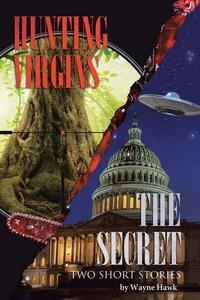
The Secret & Hunting Virgins: Two Short Stories by Wayne Hawk: I Read It So You Don’t Have To

The Secret & Hunting VirginThe Secret & Hunting Virgins:
Two Short Stories

by Wayne Hawk

DETAILS: 
Publisher: Page Publishing
Publication Date: September 10, 2020
Format: Paperback
Length: 80 pg.
Read Date: May 9, 2024

What’s The Secret & Hunting Virgin About?

These are two short stories, sort of linked by protagonists purporting to possess some unique spiritual role/status. They’re thrillers best described as a mix of realism and SF/Fantasy. That’s really all I can think of to link them.

The Secret

This story follows a man who cannot keep a secret as he takes a road trip to visit his father one last time before he dies. At his father’s deathbed, he learns a secret that will change the world. Somehow surviving a hail of bullets that don’t prevent him from learning this secret, he’s instead imprisoned on trumped-up charges and put into solitary confinement (while never explaining why the government doesn’t use one more bullet once there’s a clear shot). Will he be able to outwit the guards and other prison officials to broadcast this secret?

Hunting Virgins

This is both an experiment into how often—and in how many ways—the word “virgin” can be used in a 33-page story as well as the story of a team of hard-partying hazardous-tree removal experts. At some point, their leader has a religious conversion and leaves this profession to start a church on the other side of the U.S.

A decade later, he returns with an offer too good to be true (literally). He recruits his old team—plus his beautiful and virtuous daughter who shouldn’t be anywhere near these louts—to go with him to a portion of Siberia to clear part of a forest heretofore untouched by logging in exchange for a small fortune. Why Russian loggers are incapable of doing this for far less, we’re not told. Nor why any company thinks that logging in an area so difficult to get to makes any sense at all, especially when the expenses incurred to do that are so large.

But maybe their dangerous profession and the well-known hardships of the Siberian climate aren’t the most deadly things that lay in wait for them…

So, what did I think about The Secret & Hunting Virgin?

I honestly can’t tell you which story made me angrier—the plots were disappointing, unoriginal, and somehow nonsensically inexplicable at the same time. The characters were utterly unlikeable at best and contemptible (in an uninteresting way) most of the time. The writing was dry and uncompelling—and the ineptness of the prose was only challenged by its lack of clarity for the least appealing part of it.

The ways that Christian—or pseudo-Christian and near gnostic—ideas are scattered throughout these two stories are just as off-putting as the rest of the elements of this writing. I can’t tell if Hawk is really trying to tell stories with Christian themes* or if he’s just using the trappings of those themes the way that Pierce Brown uses the trappings of the Roman Empire to tell his stories. Either way, he fails.

* I’m using Christian in the broadest and most watered-down possible sense here.

“The Secret” features a couple of people with delusions of grandeur comparing themselves to Apostles to bring the world one of the tiredest ideas this side of Whitley Strieber. I wondered a few times if I’d have liked it more if Hawk hadn’t tried to compress the events into such a short space, but had developed them fully and let them breathe. But I just don’t see any evidence that he’s capable of doing that. He spent more time on this than he should’ve.

“Hunting Virgins” is even worse—these tree-removal experts have the maturity of the main characters of the 80s Porky’s films* and should be trusted with power tools to the same extent. There’s nothing about them that says megacorporations should shower them with money to do anything—and when things start to go wrong for them, there’s nothing about the situation to make the reader care.

* I can’t believe that I remembered these things existed, either. Or that anyone ever used the word “film” to describe them with a straight face.

Why did I finish? I was curious—and the book is crazy short. Also, I spent enough money on this volume that I couldn’t let myself just walk away. I regret the whole thing and hope I’ve convinced you to avoid this experience.


1 Star

Literary Locals logo

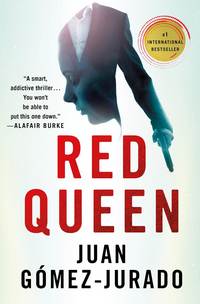
Red Queen by Juan Gómez-Jurado, Nick Caistor (Translator): A Disappointing Thriller

Red QueenRed Queen

by Juan Gómez-Jurado, Nick Caistor (Translator)

DETAILS:
Series: Antonia Scott, #1
Publisher: Minotaur Books
Publication Date: March 14, 2023
Format: Hardcover
Length: 365 pg.
Read Date: April 29-May 1, 2024
Buy from Bookshop.org Support Indie Bookstores

What’s Red Queen About?

So there’s this international crime-fighting organization, with chapters or branches (I don’t remember exactly how or if we’re told) all over the place. They work around law enforcement, frequently preventing them from doing their job, by covering up crimes in order to get the results they’re looking for.

Those results are keeping their benefactors—the megarich and powerful out of the headlines. Yes, they do stop criminals, save lives, and all of that—but there’s something about their M.O. that leaves a lot to be desired. They do have the best of the best—forensic scientists, laboratories, tech, and investigators. One of those is Antonia Scott—her mind works on levels that others don’t.

She’s also dealing with some severe trauma. Her handler brings in a decent police officer who’s facing discipline charges (legitimately, it should be stressed) to try to get her to leave her apartment and help solve some ritualistic crimes. If Jon Gutierrez can do that, the charges against him will go away.

She’s brilliant and offputting. He’s street smart and able to deal with people—if you’re thinking Temperance Brennan and Seely Booth.

So, what did I think about Red Queen?

I actually liked Jon Guitierrez’s character and thought Gómez-Jurado designed him very well—he’s really the bright point in this book.

The whole not-evil-but-not-good secret organization bugged me—their methods, their attitude, the way they treated/trained/recruited their people. I really hope that this series ends with someone destroying them.

It was good enough—it kept me turning the pages, but..just barely. The writing was cliché and stiff—I don’t know if that’s Gómez-Jurado, Caistor, or a combination. The whole thing felt contrived—and yeah, I know, it’s a novel, it’s all contrived. But this seemed like Gómez-Jurado was trying to manufacture a best-seller rather than write a decent book—but what do I know? It’s an international best-seller.

There were some good twists and turns (many predictable), the pacing was pretty well done, and like I said, it kept me turning pages to see what happened next. But I can’t say I was entertained. I’m definitely not coming back for more.


2 1/2 Stars

This post contains an affiliate link. If you purchase from it, I will get a small commission at no additional cost to you. As always, the opinions expressed are my own.
Irresponsible Reader Pilcrow Icon

Assassins Anonymous by Rob Hart:The Confessions of a Tactical Drone with a Heartbeat and a Dairy Allergy

Assassins AnonymousAssassins Anonymous

by Rob Hart

DETAILS:
Publisher: G.P. Putnam's Sons
Publication Date: June 11, 2024
Format: eARC
Length: 320
Read Date: May 27-29, 2024
Buy from Bookshop.org Support Indie Bookstores

What’s Assassins Anonymous About?

Almost a year ago, Mark walked away from his old life and into a 12-step meeting. It’s been a struggle for him—he’s almost relapsed, he came close to suicide, and he’s struggled every day. But with the support of the other people in his group, his sponsor, and a little orange cat who came into his life at just the right time—Mark is making it, day by day.

Then one day, Mark’s cleaning up after the meeting and he’s attacked by a Russian who moves like a professional killer. Mark fights back—incapacitating the Russian and escaping with a serious—but not-too-serious—wound of his own and a burning question: who sent the Russian? The search for the answer takes Mark (and his cat) around the world—into some very dangerous situations, and almost more temptation for Mark to relapse than he could’ve imagined.

You see, Mark’s 12-step meeting isn’t for Alcoholics Anonymous, Gamblers Anonymous, Narcotics Anonymous, or anything like that. As you’ll guess from the book’s title, it’s Assassins Anonymous. Hitmen, Assassins, Serial Killers, and the like, who are tired of the life, who are tired of killing and want to try to live productive, life-affirming lives. They have to fight old impulses, old habits, old attitudes, they have to abandon adrenaline rushes (which are probably pretty addictive) and all the rest for a quiet life. Mark had been one of the best in the world (or the worst, depending on your perspective)—almost legendary—until he went cold turkey. But someone’s apparently trying to warm up the poultry.*

* That’s a metaphor I really shouldn’t have tried to stretch.

Can Mark discover why someone game for him almost a year after he quit “the life”? Can Mark make them stop without having to throw away all the work he’s done over the last (almost) 12 months?

The Movies

Like many moviegoers, I love a good hit man movie. I can even enjoy a “just okay” hitman movie (sorry, The Whole Ten Yards you don’t qualify as either). Mark, unsurprisingly, isn’t a fan of most of them. Sadly, that’s where most people get their ideas and information about assassins and hitmen from. So by character, actor, or movie title, they’re brought up frequently—usually to Mark’s dismay. He’ll also just compare his life to those movies on occasion. I enjoyed this aspect of the character a lot—particularly one running bit where people kept expecting him to look more like a particular actor.

Other kinds of movies are used throughout the novel, too—they’re a great shorthand way of revealing character. What movies he likes, what movies he refuses to mention liking, and so on are a convenient and efficient way of telling you a lot about Mark. Also, it’s just fun to see characters talk about movies and whatnot—as people like Whedon, Tarantino, and Smith have been showing us.

The 12-steps

As the book started to really focus on—and feature—things like the meetings Mark’s attending, his recovery, and his working the steps, I started to get worried. Primarily because it was early on, and while I understood that Mark was flippant, even a wiseacre—was Hart going to be flip about the 12-steps? That feels like something you shouldn’t touch—like a third rail, a skunk with a hair-trigger, or that Easter Egg you finally found in late June.

But no—the meetings, the steps, the attitude about recovery, and the way the characters interacted about their recovery were dealt with respectfully. Sure, there was a little bit of Mark’s attitude (or similar ones) expressed in the meetings and whatnot—but not about the meetings or the program, just about each other or themselves. (much like I imagine happens in an actual meeting)

If anything, this is practically an advertisement for those kind of programs and the good work they can do. Because this is the heart of the novel—yes, there’s the violence, the suspense, the twists, and whatnot—let’s call them “The Thriller Aspects.” Those aspects are what will draw readers to the book, they’re what’ll keep your attention and get you hooked on it. But Assassins Anonymous isn’t so much about the “Assassins” as it is the struggle, the stumbles, and the victories associated with Recovery. In my book, we should get more of those—particularly honest books about the victories.

So, what did I think about Assassins Anonymous?

Imagine Martin Q. Blank, Jimmy Tudeski, and Frank Moses meeting up and trying to take care of business—non-lethally (I guess that’d be something like the pacifist version of The Expendables), and you’ll have something like this book.

Let’s start with The Thriller Aspects—Hart nailed them. Even—maybe especially—the more outlandish aspects of them (which are really the trickier part to pull off). There’s a confident panache to the novel—as well as most of the characters—that lets you know right away that you’re in good hands and are set for a great ride. Some twists you’ll see coming, and won’t care because of the way he executes them. But also,

The 12-Step aspect—well, see above—another win for Hart.

What about the comedy and narrative voice? Spot on—seriously good. It’d be easy to go overboard on the comedy—or to not use enough of it (we are talking about a bunch of people who have killed many others), but I think Hart hits the balance just right. And Mark’s the kind of guy you can enjoy being stuck in the mind of for 320 pages.

The first chapter gives you everything you need to know about this novel—it’s such a well-written chapter, too. Voice, character, action, comedy. If you read it and aren’t hooked, you’re probably going to feel that way about the rest of it. If that first chapter works for you? Kick back and enjoy.

Sure, this novel is right in my wheelhouse—I’m practically its target demographic incarnate—but I think even if I wasn’t, it would’ve won me over. I strongly encourage you to pick this one up. I can’t tell you what’s keeping me from giving it the final full star, but something is (and since I’ll have to round up almost everywhere I cross-post, I’m not going to lose any sleep over it)—but, boy howdy, you’re in for a great time when you open this one up.

Disclaimer: I received a copy of this book from Putnam Books via NetGalley—thanks to both for this.


4 1/2 Stars

This post contains an affiliate link. If you purchase from it, I will get a small commission at no additional cost to you. As always, the opinions expressed are my own.
Irresponsible Reader Pilcrow Icon

Page 11 of 61

Powered by WordPress & Theme by Anders Norén