Tag: Mystery/Detective Fiction/Crime Fiction/Thriller Page 58 of 61

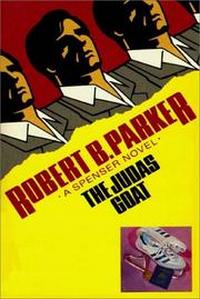
Classic Spenser: The Judas Goat by Robert B. Parker

Classic Spenser

The Judas Goat

The Judas Goat

by Robert B. Parker
Series: Spenser, #5

Paperback, 203 pg.
Dell, 1978

Read: May 29, 2020
Grab a copy from your local indie bookstore!

…I looked at my situation. If they were going to shoot me, there was little to prevent them. Maybe they weren’t going to shoot me, but I couldn’t plan much on that.

“You can’t plan on the enemy’s intentions,” I said. “You have to plan on what he can do, not what he might.”

A boy cleaning the tables looked at me oddly. “Beg pardon, sir?”

“Just remarking on military strategy. Ever do that? Sit around and talk to yourself about military strategy?”

“No, sir.”

“You’re probably wise not to.”

We start with Spenser calling on Hugh Dixon. The word “rich” seems inadequate to express the wealth that Dixon seems to possess. Nowadays, he could probably hire a private security firm to do what he needs—maybe he could’ve in 1978, too. But he’s done his research and has decided to hire Spenser instead because he knows Spenser’s integrity and priorities are what’s kept him “in the minor league.”

We’re given a great description of Dixon:

Full front, his face was accurate enough. It looked the way of face should, but it was like a skillful and uninspired sculpture. There was no motion in the face. No sense that blood flowed beneath it and thoughts evolved behind it. It was all surface, exact, detailed and dead.

Except the eyes. The eyes snarled with life and purpose, or something like that. I didn’t know exactly what then. Now I do.

The eyes snarled with a need for revenge. That’s pretty much all that’s keeping Dixon going. A year before, he, his wife and daughters were in a London restaurant that was bombed. Dixon lived, although he almost died and lost the use of his legs. The rest of his family did not. He wants Spenser to do what the London police have failed to do—find the terrorists responsible and bringing them to justice—either by apprehending them for the police or killing them. Dixon remained conscious during the attack and has detailed descriptions of the personnel involved. Spenser agrees, after insisting that he doesn’t do assassinations—unless forced out of self-defense, he won’t be killing anyone. It’s all okay with Dixon, but you get the clear impression that he’d prefer they died.

Spenser makes travel arrangements (including learning how to bring his gun into London), says goodbye to Susan, and leaves that night. Dixon’s London-based lawyer introduces him to a Scotland Yard inspector who worked the case. There’s a group called Liberty who claimed responsibility for the bombing. They’re small-time, right-wing, and draw their membership from around Europe—they’re likely based in Amsterdam, but that’s conjecture. Which really doesn’t give Spenser much to work on.

So he tries a little something to draw them out. It results in two of them dying and Spenser being shot in the, ahem, “upper thigh.” It also gives Spenser a lead to some others. While he calls Susan to tell her what happened, he also asks her to do him a favor—get word to Hawk that he could use some help (this both relieves and worries Susan, she wants him to have backup, but hates that he needs it).

From here, Spenser and Hawk follow leads for Liberty to Copenhagen and Amsterdam. They even have a brief confrontation with the leader of Liberty, a man named Paul. Paul’s not one of the men directly involved in the death of the Dixons, however. Spenser and Hawk determine that Liberty has something planned for the 1976 Olympics in Montreal, and decide that even though the job is done, they need to stop Paul.

On the one hand, it’s hard to believe that security at the Olympics is as lax as it appears, then again 1976 was a different time. Through a combination of luck and good guessing, there’s a final confrontation with Paul and one of his top associates that ends in a nine-page fistfight between Spenser, Hawk, and a giant of a man named Zachary. This fight blew my preteen/early teen-aged mind when I first read it, and became the standard by which I judged all similar scenes in fiction (there’s one in Lee Child’s Persuader that reminded me of this one—although, Reacher didn’t have anyone fighting on his side).

While there is some deduction at work, this is largely Spenser as vigilante, not as a private investigator. On the one hand, I prefer the P.I. On the other hand, it’s a good story and it demonstrates another side of Spenser that we don’t get to see much of early on. And like the rest of these first twelve, it’s hard for me to engage my critical faculties.

In addition to the globe-trotting and the intense action scenes, we get Spenser’s typical narration when it comes to describing places (one of my favorite elements of each book) and people. Spenser’s wit and compassion both get to shine. It’s just a fun read. The scene that results in his upper thigh wound is one of my favorites in the series—combining humor, tension, and action.

But the thing that struck me the most this time through is that what seems to really interest Parker—more than Spenser, more than this revenge story, or anything else—is Hawk. We met him in the last book, but we didn’t get that much time with him, just a handful of scenes. But he’s all over this novel.

Spenser calling Hawk to come help represents a turning point in the series. It’s not an automatic thing yet, but from here on out, it’s more common for Spenser to call up on Hawk for help than not. The self-sufficient, independent operator develops a real dependence. It’s a real boon for the reader, for as fun as Spenser’s interior monologues are, having him banter with Hawk becomes a reliable highlight. There might be other, earlier, writers who’ve had a relationship like this, but I’m not aware of them (and would like to be). In Spenser and Hawk, we get the template that Elvis Cole and Joe Pike follow, or Patrick Kenzie/Angie Gennaro and Bubba Rugowski, or Walt Longmire and Henry Standing Bear, or Joe Pickett and Nate Romanowski, among others. The outsider, the friend/ally that the mostly lawful protagonist can rely on when there’s a need for something outside the law.

From Promised Land, we know that Hawk and Spenser fought on the same card in their youth; we know he’s stylish (I guess); that he’s respectful of Susan; he’s an enforcer, a leg-breaker, for whoever is paying for him at the moment; and he has some sort of code that reminds Spenser of his (with significant differences in Spenser’s mind, but not so much in Hawk’s).

Here we learn a bit more, he can disappear into a crowd, despite his flashy clothes and is almost infallible when tailing someone. Shortly after arriving in London, the two have some drinks while Spenser catches Hawk up on what’s going on and notes:

He showed no sign that he drunk anything. In fact in the time I’d known Hawk I’d never seen him show a sign of anything. He laughed easily and he was never off balance. But whatever went on inside stayed inside. Or maybe nothing went on inside. Hawk was as impassive and hard as an obsidian carving. Maybe that was what went on inside.

Later, when Spenser is in Boston to update Dixon, he leaves one member of Liberty with Hawk, as they use her as a source of information on the rest of the group. When Susan asks if that’s safe to do, Spenser replies:

“Hawk has no feelings,” I said. “But he has rules. If she fits one of his rules, he’ll treat her very well. If she doesn’t, he’ll treat her any way the mood strikes him.”

“Do you really think he has no feelings?”

“I have never seen any. He’s as good as anyone 1 ever saw at what he does. But he never seems happy or sad or frightened or elated. He never, in the twenty-some years I’ve known him, here and there, has shown any sign of love or compassion. He’s never been nervous. He’s never been mad.”

“Is he as good as you?” Susan was resting her chin on her folded hands and looking at me.

“He might be,” I said. “He might be better.”

“He didn’t kill you last year on Cape Cod when he was supposed to. He must have felt something then.”

“I think he likes me, the way he likes wine, the way he doesn’t like gin. He preferred me to the guy he was working for. He sees me as a version of himself. And, somewhere in there, killing me on the say-so of a guy like Powers was in violation of one of the rules. I don’t know. I wouldn’t have killed him either.”

“Are you a version of him?”

“I got feelings,” I said. “I love.”

“Yes, you do,” Susan said.

Part of this conversation will repeat throughout the series—is Hawk better than Spenser? Are the two versions of each other (this was touched upon already in Promised Land)? Does Hawk feel?

Hawk will contend that the two of them are more similar than Spenser will admit, but in The Judas Goat and in countless other books, he will note that Spenser’s abundance of rules helps him to deny that similarity, over-complicates Spenser’s life, and one day will get him killed. There are times when Spenser agrees to all of that (even the last), but those are the only terms upon which he can live his life, so that’s how it’s going to have to be.

Exciting, amusing, tense, and we get to delve for the first time into the character that’s arguably Parker’s greatest creation. The Judas Goat really has it all. If only so I had an excuse to read this one again, I’m so glad I started this little project this year. It will serve as a decent jumping-on point, for those who want one, and it’s a great spot to return to for long-term fans.


This post contains an affiliate link. If you purchase from it, I will get a small commission at no additional cost to you. As always, opinions are my own.

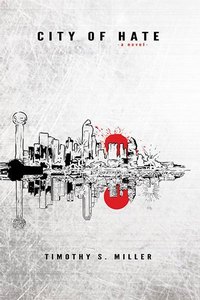
City of Hate by Timothy S. Miller is not a book I should have read, but maybe you should.

City of Hate

City of Hate

by Timothy S. Miller

PDF, 236 pg.
Goliad Media Group, 2020

Read: May 27-30, 2020
Grab a copy from your local indie bookstore!

Usually when a book doesn’t work for me (and frequently when it does), there are problems I can point to—thin characters, bad prose, dull language, plot issues, etc. I don’t particularly enjoy talking about those, but they’re easy enough to write about. I hate talking about books that left me cold and disinterested despite being incredibly well-written.

The publisher’s blurb reads:

Recovering alcoholic, lover of secrets, and quickly approaching middle-age, [Hal] Scott discovered his best friend dead in his downtown Dallas apartment. And all fingers point to Scott as the murderer.

There is a conspiracy under way, and it is tied to a gubernatorial campaign, illicit photographs, and a video that will undermine the election. And more than likely get Hal Scott killed.
The only one Scott can turn to is “Lemon” – the self-proclaimed bastard son of Lee Harvey Oswald. Lemon’s mother owns Conspiracy Books, just blocks away from the old Texas School Book Depository, and she used to dance at the Carousel Club, owned by the notorious Jack Ruby. The FBI, the CIA, and the John Birch Society all want what Lemon has discovered in her mouldering attic. What he found is bigger than them all, and there will be a price to pay for it exposure.

Bank teller Hal Scott seems like an unlikely protagonist in a story of murder, blackmail, and conspiracy theories. Scratch that, he is an unlikely protagonist—I don’t understand why so many characters are drawn to him, rely on him, open up to him, or (the most unlikely) find him to be a threat. But they do. So, you roll with it as he investigates the suicide/murder of a friend and stumbles on to the rest. The resolutions to all the storylines feel incredibly appropriate and fitting—yet I found at least two of them dissatisfying.

Skip this paragraph if you want to avoid spoilers. One of the reasons I don’t see why anyone in Scott’s life would rely on him is that the reader can’t. He’s the worst kind of unreliable narrator—I trust his narration so little that I honestly doubt everything he said. There’s not one word in the blurb above that I can be sure actually ever happened (obviously, I’m speaking in terms of the novel itself, I’m aware that it’s fiction).

I didn’t realize when I read the blurb is that Oswald’s son’s important discovery would’ve been tied to what made his father infamous. That’s on me. I don’t know if I’ve ever been interested in any use of the JFK assassination in fiction—and Miller devoting so much of the novel to it was a major turn-off for me.

I think contemporary noir relies too much on vulgarity, I don’t want to open that can of worms right now, though. I think Miller serves as a prime example of this, and too often comes across as unnecessarily crass. It’s entirely and clearly purposeful. Many writers fall into it out of laziness, I don’t think that’s the case here. I just think it’s wasted effort.

The depictions of addiction—its pull, its effect on the choices (both while using and while clean and sober), the destruction it leaves behind—are the highlight and saving grace of this book. They’re powerful, heart-wrenching, and beautiful (in their own way). There’s an account of suicide that’s so well-written I had to stop reading and simply soak in it for a while after I finished it.

This book comes across as being precisely what the author intended—no mean feat. There’s not a wasted word, not a sentence that doesn’t seem painstakingly crafted. While I can’t recommend this novel, any book that comes across that way isn’t going to get panned by me, either.

There’s a pretty clear theme to my observations—this was not a book written for me. I’m cool with that. It describes most books published, most of which are probably not as well written. There are plenty of people who will feel differently—and should. I hope this book finds its way to their hands.

Disclaimer: I received this eARC from the author via Lori @ TNBBC Publicity in exchange for this post—thanks to both for this, I do appreciate the opportunity (despite what it may read like).

This post contains an affiliate link. If you purchase from it, I will get a small commission at no additional cost to you. As always, opinions are my own.
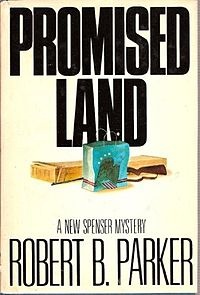
Classic Spenser: Promised Land by Robert B. Parker

Classic Spenser

Promised Land

Promised Land

by Robert B. Parker
Series: Spenser, #4

Mass Market Paperback, 218 pg.
Dell Publishing, 1976

Read: April 30, 2020
Grab a copy from your local indie bookstore!

“Whose picture is on a one-hundred dollar bill?” I said.

“Nelson Rockefeller.” [Susan said]

“Wrong.”

“David Rockefeller?”

“Never mind.”

“Laurence Rockefeller?”

“Where would you like to go to lunch?”

“You shouldn’t have shown me the money. I was going to settle for Ugi’s steak and onion subs. Now I’m thinking about Pier 4.”

“Pier 4 it is…Come on, we’ll go back to my place and suit up.”

“When you get a client,” Susan said, “you galvanize into action, don’t you?”

“Yes, ma’am. I move immediately to the nearest restaurant.”

Harv Shepard’s wife walked out on him and he wants Spenser to find her and bring her home. Spenser agrees to the first part of that—he’ll find her, make sure she’s healthy and under no duress, but he won’t force her to come home. Shepard agrees to that, so Spenser starts digging. It takes him practically no time at all to discover that their relationship wasn’t as good as Shepard insists it was (Shepard doesn’t seem to find his wife leaving home to be a big clue)—and that Pam herself might not be as happy or well-adjusted as she let on.

It doesn’t take Spenser that long at all to find Pam and see that she’s okay. She’s not that interested in coming home, and Spenser’s prepared to let it lie like that. But she soon calls Spenser for help—and like the knight errant he is, Spenser obliges. She’s found herself neck-deep in serious legal problems and it’ll take an ingenious plan to get her out of it while not letting criminals get away with anything.

The trickier part of the equation comes from a man called Hawk.* When Spenser first arrives at Shepard’s house,

Shepard appeared from the door past the stairs. With him was a tall black man with a bald head and high cheekbones. He had on a powder blue leisure suite and a pink silk shirt with a big collar. The shirt was unbuttoned to the waist and the chest and stomach that showed were hard and unadorned as ebony. He took a pair of sunglasses from the breast pocket of the jacket and put them on, he stared at me over their rims until very slowly the lenses covered his eyes and he started at me through them.

* Yeah, I couldn’t resist.

As Spenser soon tells Shepard, Hawk’s presence means that he’s got bigger problems than a missing wife. Shepard denies it, but Spenser believes he’s into a loan shark and/or mobster for a pretty large sum and is behind on payments. It won’t be long until Hawk is hurting Shepard—if not more than that—in order to get this money.

Hawk and Spenser go far back—they used to fight on the same heavyweight card and come into frequent contact in their current occupations. Hawk’s a freelancer and is one of the best in Boston. He’s not a good guy, but he has a code. There’s a mutual respect between the two and Spenser is quick to defend Hawk against Shepard’s racial slurs. Hawk as a character deserves more space than I’m giving him at the moment—but that’s all I can do for now. I’ll probably find a way to give him a few paragraphs in the post about the next book.

So not only does Spenser need to get Pam out of her legal mess, he takes on getting Harv out of his illegal mess. He does so through a complicated set-up assisted by a couple of the funniest cops I remember reading about. It’s a shame that neither of these reappear the way that Healy, Belson and Quirk do (although, it’d be hard to take them seriously). It’s hard to explain, you’ll need to read them for yourselves.

Toward the end of the previous book, Mortal Stakes it looked like Spenser is getting more serious about Susan and less serious about his other dating relationship with Brenda Loring—there’s a reference to Brenda early on in this book*, but by the end, Susan and Spenser are as close to married as they’re ever going to get—essentially pledging monogamy without the legal/religious contract. This is huge for the genre at the time—and bigger for the character.

* Unless I’m mistaken, that’s the last reference to Brenda outside of a short story in the series. [Update: She’s mentioned in the next book, so I read the reference about 5 hours after I published this]

While Spenser tries to extricate the Shepards from the trouble they’ve found themselves in—and hopefully provide them with the opportunity to work on their marriage (at least enough to make a calm decision about its fate), Parker uses the Shepards as well as Susan and Spenser to discuss second-wave feminism in a somewhat abstract fashion, but also in concrete terms as it applies to each of these couples. Parker takes the opportunity to opine a bit on isms and how they tend to swallow the individual—where he prefers to consider such topics (this is assuming that Spenser and Parker align on these ideas, but there’s no reason to suspect they don’t). The reader may not agree with them any of the views they read in these pages, but they’re fairly well reasoned.

In Promised Land, we meet Hawk and Susan and Spenser become permanent (for lack of a better term). These two things are the final pieces to come into place as the foundation for the series—they’ll take a more final form in the next book, but we have them all now. Every other book in the series is built on what’s introduced up to this point and finalized in The Judas Goat. For a series that’s lasted 44 years after the publication of this one, that’s quite the accomplishment.

A significant portion of American Detective Fiction since then will be shaped by this, too—people will be reacting against this set-up or putting their series in a similar vein. Personally, I’ll get to the point (eventually) where Susan stops adding anything to the series. But I’ve yet to tire of Hawk. He may be the kind of guy who should spend the rest of his life behind bars, but he’s also the kind of character than you can’t help but love when he shows up on the page. We’ll revisit Hawk (and his contribution to the series) later, but for now, it’s just good to sit back and enjoy him.

You take all the above, mix them together—and you’ve got a true classic. Parker looks at marriage and feminism—and, of course, honor—while his protagonist matches wits with a mobster. Told with Parker’s trademark style and wit. Few things are as good as that—fewer yet are better.


5 Stars

This post contains an affiliate link. If you purchase from it, I will get a small commission at no additional cost to you. As always, opinions are my own.

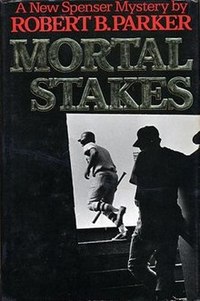
Classic Spenser: Mortal Stakes by Robert B. Parker

Classic Spenser

Mortal Stakes

Mortal Stakes

by Robert B. Parker
Series: Spenser, #3

Mass Market Paperback, 328 pg.
Dell, 1975

Read: March 30, 2020
Grab a copy from your local indie bookstore!


After stumbling onto Spenser: For Hire—I think during season 2 summer re-runs, I headed to my local library and grabbed the earliest in the series they had—Mortal Stakes. This wasn’t the first “adult” novel or mystery that I’d tried, but it was the best. Between Parker’s voice, Spenser’s wit, and the kind of story it told, I was sold and spent the next few months getting my hands on every one of the series I could. Re-reading this one is always like coming home.

Spenser is hired by a Boston Red Sox executive to investigate their best pitcher, Marty Rabb. There’s a hint of a suggestion of a rumor that he’s shaving points on behalf of gamblers, and the executive wants to know if it’s true. If so, he wants to address it quitely, If Rabb’s clean, he wants to know that quietly.

It takes no time at all for Spenser to determine that he is—and why. The bulk of the novel is Spenser’s attempt to learn who is blackmailing Rabb to do this and then to extricate him from their grip before it ruins his career and/or marriage. This is a significant challenge.

Spenser sees a lot of himself in Rabb—they share the same values, sense of honor, sense of play. Spenser will later look into a similar case in Playmates, and he’ll meet a similar athlete—only his sport is College Basketball. Parker will often use clients to shine a light on an aspect of Spenser’s character, usually by way of contrast—but with athletes, it’s because of similarity.

On the expanding Spenser-verse front, we meet New York Madam, Patricia Utley. She’s no “hooker with a heart of gold,” by any means. She’s a businesswoman first and foremost. She does remember where she came from, and can occasionally be counted on to display a bit of sentimentality. She will reappear several times in this series (and will make appearances in related series)—a reliable source of information as well as a resource.

In The Godwulf Manuscript we saw Spenser physically rough up a couple of college kids and verbally push around an older man. Each incident is followed by Spenser berating himself. In a fit of pique following a botched stakeout for the ransom delivery in God Save the Child, Spenser breaks the handle of the rake he was using as a prop and feels so bad that he leaves money to pay for it. Parker goes out of his way to show Spenser’s conscience. Yet in this book, Spenser arranges to outright kill two people. Yes, he’s wracked with guilt—physically ill—but he’s able to justify it to himself. Which mostly works, but he has to go to Susan Silverman to talk things out and convince himself he did the right thing.

This book shows that Spenser is changing. He doesn’t like being alone—he needs to talk some of the difficult things through with Susan. He’s had a couple of dates with Brenda Loring earlier in the book—but he notes she’s good for having fun with, but for serious talk, it has to be Susan. I appreciate the slow growth in the character here.

This isn’t the best Spenser volume—but it’s a very good one. This is the first (of many) extended look at Spenser’s code. We see Spenser wade in deep ethical waters (and doesn’t necessarily come out clean). But most importantly, we see Spenser doing all he can—whether his employer wants him to or not—to dig a couple of people out form a tight spot. Mortal Stakes is Parker at his best and is just a pleasure to read.


5 Stars

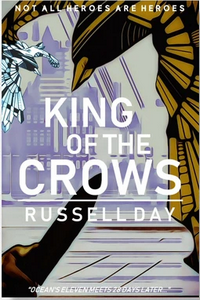
The King of the Crows by Russell Day: Prescient. Gripping. Haunting. Unpredictable. What stories should be.

King of the Crows

King of the Crows

by Russell Day

Kindle Edition, 456 pg.
Fahrenheit Press, 2020

Read: April 28-May 9, 2020

… for me at least, the first week of the Lockdown was the worst.

Knowing it had happened to me. I hadn’t escaped, I wasn’t one of the lucky ones. Lucky to be safe or lucky to be dead. Take your pick. I was neither.

That right there gives you a pretty good idea what kind of light and fluffy read this is going to be.

There are two timelines in this story—the primary focuses on a post-pandemic London, while the other shows what happened to a couple of the characters mid-pandemic (with plenty of material describing what the pandemic was like for others). In the primary timeline, Europe is a disaster—a “wasteland”—and eight years after the Outbreak, it’s beginning to put itself back together. But it’s going to take a long, long time to recover from this. Don’t let the fact that “eight years after” this fictional outbreak is 2028 bother you at all.*

* Good luck with that. I’ll get back to this in a bit.

I’m not going to try to list all the various ways that Day uses to tell this story: I’m certainly going to forget several. So here’s a partial list: here’s a third-person 2028 narrator describing a police investigation, a first-person perspective on the same investigation; a first-person account of that same detective’s life during the Outbreak; selections from a screenplay made about a group of Londoners during the Outbreak; selections from the Outbreak-memoir of one of those Londoners; and third-person narration of the same (N.B.: these three will vary in telling ways); redacted 2028 prison correspondence about the Outbreak; excerpts from scholarly works on aspects of the Outbreak (including a very illuminating work on the slang of the time); graffiti from 2021; internet message boards. Day weaves these together to tell his story, build the world, and help you to understand it. Frequently, I read something from the 2028 timeline, and understood it—only to find a new depth to it several pages later after getting another piece of the puzzle from 2020/2021. It’s hard to juggle that many narrative forms/voices/perspectives/calendars as a reader or a writer—Day pulled it off better than I did (any problems I had following things I attribute to myself, and it was pretty easy to clear out my misunderstanding with a minimum of backtracking*). It definitely helps paint the picture of the scope and variety of effects the sickness had on the world more efficiently than a consistent first- or third-person narrative would be able to.

* This would be easier in hardcopy than on an e-reader in my opinion. But that’s just a guess.

There are times (several of them) when I felt that the characters were getting lost amongst the plot and worldbuilding and sickness. But when I stopped and thought about it—and eventually got to the point where I didn’t have to—I realized I had a pretty solid idea about who these people were and was more invested in them than I expected. I thought there was so much going on that the people were getting hidden, but really, Day’s work was subtle—working in the characters into my subconscious like you give a dog its medicine. Normally, this isn’t something I require (or would like)—and it’s not Day’s usual M. O. (quite the opposite), but I think this approach really fit the novel and the story/world.

“They weren’t zombies,” he says, softly. “Don’t call them zombies.”

No one who was involved in the Outbreak for real uses the zee word.

So exactly what was the sickness?

I remember reading a couple of years ago about these ants that would succumb to a fungus which would short-circuit their brain and make them do certain things before killing them—or something like that, vague memories here. Then there were stories about parasites controlling the host’s actions—both of these stories had their 15 seconds of fame on social media around the same time (I may be messing the details up a little bit, but I’m not writing history here).

In Day’s world, one of these kinds of parasites will reside—asymptomatically, I should stress—in cats, who would pass it on to humans. Skipping the details, the humans would get very sick and then, survivors would maybe succumb to a psychosis that would make them violent. This sickness, HV-Tg (Human Variant-Toxo gondii), in a little more than a year would kill more than 20 million in Europe (at least 33% of France’s population) Et voilà!—an easy to believe pandemic that results in Zombie-like people wandering around.

Now, if one of those who’d “switched” and become violent infected you during an assault, well, you were likely to succumb. There were enough of these (“psychos” or “Gonzos”), and the sickness was so widespread, that the police and military couldn’t keep up, that civilians were forced to take action and defend themselves, their family and neighbors. People quickly forming into gang-like associations for mutual protection. It was a literal kill-or-be-infected (and likely killed) situation.

One such association became known as The Crows or The Kings of the Crows. They developed a legendary status mid-and post-Outbreak—and are the subjects of the memoir and film mentioned above. One of their number who happened to survive (and gain notoriety enough to get a publishing deal for a memoir) is the subject of the 2028 investigation. They survived the worst of the worst in one of the hardest-hit cities. They did so via means and methods that many (including their own) would find deplorable, but under circumstances that not only permitted, but required, those actions.

We also see what happens to an American in Paris for work when the Outbreak reaches the point that International travel is canceled (particularly to the U.S.). Her allies will never be considered the Kings of anything, and the contrast between how she survives to what the Crows do is pretty striking.

In 2028…eh…you know what? You should read that for yourself. I’m going to say something I’ll regret.

The biggest killer in those days wasn’t the disease or the psychos, it was stupidity.

However, it has been pointed out by many historians, logic was one of the first casualties of the Outbreak.

Some of the best moments of this book have nothing to do with advancing the plot, they’re little bits showing what the world of the Gondii-pandemic looks like. The man telling the story about taking his girlfriend to the ER because of a burn—how they were treated, and how she became infected. The soldiers coming back from a Middle East deployment being completely unprepared for what had happened to their home country. The mother and son who traveled with the Crows for awhile.

Ultimately, it’s not the story you think you’re getting…or is it? The marketing tag line is, “Ocean’s Eleven meets 28 Days Later.” It is, all things considered, a good, catchy line. I’m not sure it’s all that accurate a description of the novel (but it’s not inaccurate). What it is, really slides up on you—and when you see it it feels like it was obvious all along (even if you wouldn’t have said that 20 pages earlier). There’s a straightforward crime story at the heart of this novel—it’s just surrounded by so many layers, that you can miss it—there’s the sickness, there’s the horrible social and political context (both mid- and post-Outbreak), there’s what the characters are going through otherwise—and the whole thing is drenched in social commentary about 2020 society, e.g., sexism, economics, medical care.

And that’s not even touching the context we’re reading it in now. I truly wonder what I’d think of this book if I’d read it last Fall. I’d still like it, I’d still be impressed by it—but I don’t know if it would resonate with me the same way. There’s almost nothing about Gondii that’s comparable to COVID-19. But the way that people and governments respond—well, that’s pretty different, too. but if you can’t see what’s going on around us reflected in this novel? You’re not paying attention. That Day appears so prescient says something about his skill and observation (and a lot about Western culture, too).

I can see why people cling to the idea that the Gonzos were trying to tell us something. Something’s out there trying to get a message through: there’s a plan. Compared to the idea that it was all just chance, it’s a comfort of a type. Chance doesn’t care and can’t be appeased and can’t be reasoned with. Chance means it could all happen again.


5 Stars

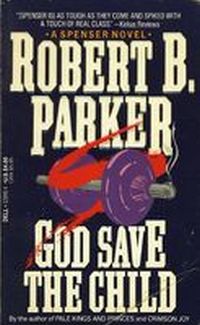
Classic Spenser: God Save the Child by Robert B. Parker

Classic Spenser

God Save the Child

God Save the Child

by Robert B. Parker
Series: Spenser, #2

Mass Market Paperback, 202 pg.
Dell Publishing Co., 1974

Read: February 25, 2020
Grab a copy from your local indie bookstore!

He hunched the chair forward and wrote a check on the edge of my desk with a translucent ballpoint pen. Bartlett Construction was imprinted in the upper left corner of the check—I was going to be a business expense. Deductible. One keg of 8d nails, 500 feet of 2×4 utility grade, one gumshoe, 100 gallons of creosote stain. I took the check without looking at it and slipped it folded into my shirt pocket, casual, like I got them all the time and it was just something to pass along to my broker. Or maybe I’d buy some orchids with it.

A nice bit of description, a bit of wit and a Nero Wolfe reference. Not a bad start.

I’m not certain, but I think this was the first Spenser novel that I purchased, and I’d read a handful before then (my then local library started with book 3). It was a new copy (an extravagance for me then), and justing by the state it’s in, I may have to buy myself a replacement copy after one or two more reads. Actually, it may not survive another whole read (that back cover is holding on by strength of will).

Which is just a long-winded way to say that it’s not like I read this with fresh eyes.

Roger (call him “Rog”) and Marge Bartlett have come to Spenser for help finding their fourteen-year-old son, Kevin, who has seemingly run away from home with the clothes on his back and his pet guinea pig. He’s been gone a week, and the local police haven’t been able to do much. Spenser assures them that unlike the police, the only thing he has to focus on his hunting for Kevin—not breaking up fights, ticketing speeders, arresting drunks, etc.—”Also, maybe I’m smarter than they are.”

During their initial consultation, we see that the couple is also a bit more focused on other things than Kevin. Marge is sure to work in references to her acting and cooking classes, she’s a self-described creative person who has to express it. Rog seems a bit more focused on the bottom line (which he might need to be, since Marge seems to spend money like it’s going out of style). By the end of the book, my impression is that Rog is trying to do the right thing for his family, has some real concern over Kevin, but maybe doesn’t know how to show it. Marge is too self-involved for my taste and doesn’t come across very well (and has some other problems I won’t get into). But when the chips are down, both will selflessly and reflexively react to help their son. Their daughter, Kevin’s younger sister, is practically ignored throughout and I always feel bad for her. We’ll see an echo of this couple (with significant variations) in Promised Land in a couple of months.

The Bartletts live in Smithfield, which a fictionalized version of Lynnfield, MA. There are some pretty good reasons that Parker probably had to change the name in this novel, but as Spenser spends time in almost every novel since in Smithfield, I wonder if he ever regretted it.

Police Chief Trask is this close to being a tough-guy cartoon of a cop. He’s far more concerned with making sure that Spenser knows that he’s running the show than he is in anything Spenser has to say on their initial meeting (and he doesn’t improve much after this). He’s done some checking on Spenser and the two banter a bit about Spenser’s record. Well, Spenser banters and Trask tries to push him around, anyway.

Before Spenser can do too much on his own to find Kevin, a very strange looking ransom note shows up. Which brings the Massachusetts State Police, in the person of Lt. Healy, into things.

Healy I knew of. He was chief investigator for the Essex County DA”s office. There were at least two first-run racketeers I knew who stayed out of Essex County because they didn’t want any truck with him.

Healy said, ‘Didn’t you used to work for the Suffolk County DA once?”

I said, “Yes.”

“Didn’t they fire you for hotdogging?”

“I like to call it inner-directed behavior,” I said.

“I’ll bet you do.” Healy said.

Healy is tough, smart and ethical—and has little respect for Trask. He and Spenser work together pretty well, and Healy will appear or be mentioned in another dozen Spenser novels before making regular appearances in the Jesse Stone books.

From this point, things get strange—the ransom note is just the beginning, and a strange kidnapping will evolve into a murder case, a drugs and prostitution ring, and . . . well, more things. As with The Godwulf Manuscript the climactic fight involves two people who have no business engaging in hand-to-hand combat. Unlike last time, Spenser’s not sidelined for this fight and gets involved as well—it’s one of my favorite fight scenes in the series. Parker shows off his knowledge of and affinity for boxing here. Spenser’s motive for engaging in the fight isn’t necessarily pure, and I kind of like how honest Parker and Spenser both are about that.

As nice as that scene is, that’s not the end of the story—and whatever victory Spenser enjoys, it’s empty. Which is a nod to Spenser’s noir lineage and something that will show up again and again in the series.

While we’re introduced to Spenser in the previous novel, it doesn’t feel quite like a Spenser novel. But God Save the Child does. The same flavor, pacing, and approach to the story that are here are in almost every thing that Parker does with the character from this point forward. The character will evolve from novel to novel, but the series really starts here.

Possibly the biggest reason for that is that it’s in these pages we meet Susan Silverman. She’s the guidance counselor at Smithfield High School and after the Assistant Principal demonstrates that he’s useless for giving Spenser any insight into Kevin, she’s who Spenser turns to. Spenser’s described quite a few women prior to this, but from the first paragraph, Susan’s different.

Susan Silverman wasn’t beautiful. but there was an intangibility about her a physical reality, that made the secretary with the lime-green bosom seem insubstantial. She had should-length black hair and a thin dark Jewish face with prominent cheekbones. Tall, maybe five seven, with black eyes. It was hard to tell her age, but there was a sense about her of intelligent maturity which put her on my side of thirty…When she shook hands with me, I felt something click down the back of my solar plexus.

I said hello without stammering and sat down.

Parker’s not quite as blatant about it as Henry Fielding is about Sophie (for those who’ve been reading my Fridays with the Foundling series), but he’s fairly obvious in the way he portrays Susan in this scene (not to mention the several that follow) that she’s different. Exceptional. She ends up being the love of Spenser’s life and shows up in every book hereafter. But for now, they’re just meeting, but there’s a spark between the two of them and Spenser soon asks her to dinner.

I had just finished washing my hands and face when the doorbell rang. Everything was ready. Ah, Spenser, what a touch. Everything was just right except that I couldn’t seem to find a missing child. Well, nobody’s perfect. I pushed the release button and opened my apartment door. I was wrong. Susan Silverman was perfect.

It took nearly forty years of savior faire to keep from saying “Golly.”…

“Come in,” I said. Very smooth. I didn’t scuff my foot; I didn’t mumble. I stood right up straight when I said it. I don’t think I blushed.

During their date, Susan makes the following observation about Spenser,

So, sticking your nose into things and getting it broken allows you to live life on your own terms, perhaps.

Spenser is impressed with this insight—and it’s a recurring theme for the two of them to talk about for the next few decades—with each other or when Susan tries to explain Spenser to others. The choices he’s made in his life—relational, vocational, lifestyle, what have you—are all about living life on his own terms. There’s a lot to be commended in this approach, and some problems (in two books we meet a more extreme version of someone living this way…but that’s for another day). Another frequent thing that comes up in their conversations appeared for the first time when they met.

“Why do you want to know?” [Susan asks]

“Because it’s there. Because it’s better to know than not to know in my line of work.”

If I had a quarter for every time the two of them said this (sometimes he does the set up), I’d be able to buy my replacement copy of this book.

It’s not just because they say the same things in almost every book (wow, it sounds dull when I put it that way—it’s not, at least not for several years), it’s the effect that Susan has on Spenser that changes the series. It made Spenser stand out from the rest of the genre’s tough guys. I could go on and on about Susan or Susan-and-Spenser, but I’ll hold off on it for now.

As chapter two begins, we’re treated to four long paragraphs (about two pages in my edition) describing the route between Boston and Smithfield, with commentary from Spenser on the scenery, traffic, businesses, etc. that he comes across. This is something that Parker excels at—and doesn’t do nearly often enough (but at least once a book). I’ve never been in that part of the world, I defiantly can’t go to the version of that area that existed in 1974—but I walk away from this description feeling like I know the area.

As far as recurring characters go (other than Healy and Susan), Frank Belson makes a quick appearance, and we meet Henry Cimoli—who runs the Harbor Health Club, Spenser’s gym. Henry’s importance will ebb and flow (as will the frequency of appearances) over the rest of the series, but he’s a constant enough presence that it’s good to meet him for the first time here.

There’s a lot more that could be mined from these pages, but this has gotten too long. I may pick up a strand or two in the future, but we’ll see. God Save the Child seems to be a story about a runaway (or a kidnapping?), but really it’s about a young man struggling to understand his place in the world, parents who aren’t sure how to parent, and a detective starting to change his place in the world. There’s a lot of wit, some good social commentary, some decent detecting, and a great fight scene—all expertly and (seemingly) effortlessly written. That’s a reductionistic way to look at it, but that’s a Spenser novel in a nutshell. I loved revisiting it, and can’t wait to get to the next book.

This post contains an affiliate link. If you purchase from it, I will get a small commission at no additional cost to you. As always, opinions are my own.
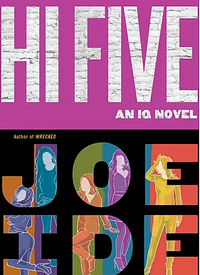
Hi Five by Joe Ide: A Criminal for a Client, an Unreliable Witness, and a Larger Number than Usual that Want Him Dead. IQ has his work cut out for him.

Hi Five

Hi Five

by Joe Ide
Series: IQ, #4

Hardcover, 339 pg.https://www.mulhollandbooks.com/titles/joe-ide/hi-five/9780316509534/
Mulholland Books, 2020

Read: February 10-16, 2020

Grab a copy from your local indie bookstore!


Isaiah has tried to move on after the heartbreak of Wrecked, and has a new girlfriend. This is unfortunate for her—not because IQ is a bad boyfriend or anything—it’s just that when a low-life gun dealer needs Isaiah to investigate something for him, he threatens the poor girl to insure that Isaiah will do it.

What he needs Isaiah to do is clear his daughter of murder. She’s the only witness to the event, but can’t give the police (or our hero) much information about it, despite being in the same room as the murder. Why? Well (and this feels like spoiling something, but it’s on the book jacket), she has Dissociative Identity Disorder (DID)—what we used to call Multiple Personality Disorder—and given the stress and danger presented by a man being shot in her shop, Christina wasn’t “there” for most of what happened. Now, did her father bother mentioning this to Isaiah? Nope. but he thankfully figures that out fairly quickly. So now our intrepid investigator has to look into a murder with an eyewitness/prime suspect who didn’t see anything, and who can’t convince anyone who did see something to say something—and if he doesn’t succeed, someone he cares about will pay the penalty (and he assumes he’ll pay, too).

This is such a fantastic idea for a murder case—it could easily be a sloppily executed idea, but if someone does their homework and does a responsible job depicting DID, this is a wonderful fodder for drama. Please, if there are other examples of mystery writers doing this, fill up the comments with titles. I’d love to read other versions of this—and can’t believe that Ide’s the first to do this.

Most authors would be content to fully develop this idea and run with it for the whole novel. But not Ide. In fact, as interesting as it is, the murder case is not the most interesting thing about Hi Five. I’m pretty sure that’s impressive. To take a concept like that and say, “well, sure, but what’s important is the trouble that Isaiah finds himself in because of the investigation.” That’s bad enough, but Isaiah has recently run afoul of a gang of white supremacists after gang violence has hit someone that Isaiah and Dodson (particularly Dodson) respect and admire.

Oh, and Grace is back.

Ide also finds a way to work in some lighter stories and even a little sweetness. And the book never feels crowded, and everything gets dealt with in the space it needs. Sure, I’d have preferred to spend more time dealing with Christina and her “alters,” but that’s a personal taste thing. I’m a sucker for a good DID story. But what Ide wanted to focus on justifies cutting that storyline some of the space I’d prefer it get.

The tension is high and Isaiah has never seemed more human and fallible (including when he was being waterboarded because of some foolish moves).

Some of the reviews I’ve read about this book seem to think that Ide’s wrapping up the series here. I can see why they’d say that, Hi Five could certainly serve as a fitting end to the series. but it seems to e that Ide has more he wants to say. The way he left things with Isaiah points to a triumphant return. Also, toward the end of the novel, something pretty significant happens to Deondra and I just don’t see Ide leaving things where he did and just walking away—the scene is extraneous unless he’s coming back to follow up on it. I hope I’m reading things right, but if I’m not, this is a solid way to go out.

This is not my favorite of the series, but it is so, so good, that it doesn’t bother me too much. It’s just a pleasure to be back in this prose, in this world, with most of these characters. A great mystery (with a better hook), some great character development, a client you can’t help but loathe—but a subject that you’ll pull for (and want to see more of). Hi Five is just one more proof that Joe Ide is one of the best writers in the genre right now. This is a decent entry to start with, but you’d be better off starting with IQ. But honestly, just grab the nearest book by Ide and enjoy.


4 Stars

2020 Library Love Challenge
This post contains an affiliate link. If you purchase from it, I will get a small commission at no additional cost to you. As always, opinions are my own.
Classic Spenser: The Godwulf Manuscript by Robert B. Parker

Classic Spenser

The Godwulf Manuscript

The Godwulf Manuscript

by Robert B. Parker
Series: Spenser, #1

Mass Market Paperback, 204 pg.
Dell, 1973

Read: January 25-27, 2020

Grab a copy from your local indie bookstore!

Driving back to Boston, I thought about my two retainers in the same week. Maybe I’d buy a yacht. On the other hand maybe it would be better to get the tear in my convertible roof fixed. The tape leaked.

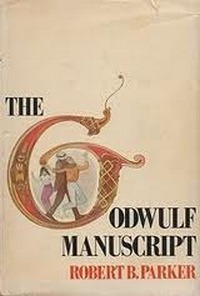
I came to this series about thirteen (possibly fourteen) years late, but to be fair, I would have been thirteen (possibly fourteen) when I started reading it. I wouldn’t have been able to appreciate Spenser without having spent some time with Leroy Brown, Jupiter Jones/Peter Crenshaw/Bob Andrews, Tabitha-Ruth Wexler and others (as I’ve invoked Brown, I hope I remember to draw a line between Sally Kimball and Spenser’s version when I discuss Promised Land). The Godwulf Manuscript wasn’t the first novel I read in the series, I’m going to guess I’d read three or four others before I found this in a used book store. I did find, I now know, a copy with the original cover (as seen above). A year or two later, I loaned it to a friend who proceeded to lose it. I got over it (probably because I didn’t care about things like early editions then) and despite losing that copy, that friend later became my first college roommate, and I didn’t kill him in his sleep for it. Not even once.

That excursus down memory lane means nothing to you, but I put it there in case that friend reads this post. I hope he remembers the Klingon proverb, bortaS bIr jablu’DI’ reH QaQqu’ nay’.

I’ll hold off on talking more about my background with this series for now, but the fact I’ve been reading, and re-reading, and re-re-reading, and re-re-re-reading these books since 1986 (possibly 1987) probably gives you a pretty good idea what I think of them. I could probably write lengthy posts on the first twenty novels in this series without reading them again—but where would be the fun in that? Of the twelve Spenser novels I’ll be revisiting this year, this one is in my bottom two and I’ve read it at least fifteen times, and I don’t see me stopping reading it anytime until I start sleeping the big sleep.

Yeah, that was a purposeful Raymond Chandler allusion. Why? Because this whole novel is a giant Chandler allusion*. From naming his main character after a British poet; to Spener’s attitude, demeanor, voice, etc.; to the opening paragraphs; and so, so much more this whole book screams Parker’s debt to and affection for Raymond Chandler. Spenser as a Shadow of Philip Marlowe will ebb and flow over the years, but I don’t think it’s ever more pronounced than it is in these pages.

* Yeah, there are other influences afoot in these pages, I realize. But Chandler is the primary influence, and this isn’t a dissertation. I don’t have the time to be exhaustive, I have at least 9 other posts I want to complete this week and if I don’t cut a corner or two, I won’t be able to get to them.

So what are these two retainers mentioned above? The first comes from an unnamed university that bears a striking resemblance to Northeastern (Parker’s employer when this was released). An illuminated manuscript has been stolen and is being held for ransom. The problem? (or at least one of them) The University doesn’t have the kind of cash the ‘script-nappers want. They do have a suspect, however, a radical political group on campus: SCACE (Student Committee Against Capitalist Exploitation). Catchy, eh? Spenser starts looking into the group, focusing on a couple of the leaders.

Within a few hours, one of those leaders is dead and another is the prime suspect for the murder. She’d called Spenser for help right after the murder, and he believes her (for compelling reasons you should read for yourself). This leads to the second retainer, her father—a pretty successful capitalist, it should be noted—hires Spenser to clear her for the murder.

The hunt for the manuscript and the murder will end up involving a cult, a couple of very dysfunctional marriages, drug dealing, a couple of hitmen, and a mob boss. Basically, Spenser has his hands full.

While there are many aspects of this novel that Parker will tweak for future installments, there’s a lot that he establishes here that he’ll revisit. Spenser gets fired because of his attitude (as demonstrated by his ignoring—rightly—the University’s insistence that he leave faculty alone), his being fired doesn’t stop him from sticking with the job, however. There’s a shootout in an unpopulated area near Boston*. Spenser cooks a pretty decent meal for himself (not quite Fritz Brenner’s level, but close enough for a guy cooking for one), and proves himself more literate than anyone looking at him would assume. The climactic fight will be echoed in upcoming books, featuring someone who has no business fighting anyone taking on a hardened criminal of sorts solely on the basis of love and desperation. Parker does get away from this, which is good—if only for the sake of variety—but man, I love it every time he uses this.

* My knowledge of Massachusetts geography comes wholly from the novels of Parker, William Tapply and Dennis Lehane, so I can’t be more specific than “unpopulated”.

Spenser physically roughs up a couple of college kids and verbally pushes around an older man. Each incident is followed by Spenser berating himself. This is the kind of thing that you don’t see a whole lot in the hardboiled world before Spenser’s debut. Parker will do a more subtle job in the future of showing that while Spenser will resort to violence when necessary, he doesn’t relish it (except when he knows the recipient is guilty of something) and regrets the act. But here, it’s pretty clear that Parker’s trying to show that Spenser isn’t unfeeling about acts of aggression.

There are things that show up here that will disappear—Spenser sleeps with two different women and is fairly casual about it. He’ll later become a paragon of monogamy, but that’s a couple of years away. Still, he’s less of a player next time we see him. He’s also a bit more antagonistic to most of the police that he encounters than he’ll be in books to come. Some of that is a shift in Spenser, some of that is a growth in the relationships he develops with individual members of BPD.

The main thing that sticks around in the future are some of the characters—we meet people here that Spenser still knows and interacts with on a regular basis. Spenser flirts a lot with the secretary for the head of Campus Security, and we’ll see her later. A reporter for the Campus newspaper gives Spenser a lot of help and information about various people/groups on campus, her name is Iris Milford and when Ace Atkins brought her back in 2015, I may have let out an audible whoop. We meet Spenser’s lawyer, Vince Haller, who not only helps Spenser, but the college student being framed. Haller will eventually disappear from the stage (I realize as I write this), but he’s a frequent presence for a long time to come.

But the three big recurring characters are Lt. Martin Quirk, Sgt. Frank Belson and Joe Broz. Spenser and Belson (a homicide detective) have some history and clearly respect (and even like) each other. Belson’s smart, appears lazy (appears), perpetually has a cheap cigar in his mouth (I think that’s a characteristic in this novel, if not, it will be next time we see him). Belson’s superior is Lt. Quirk. Quirk is a very no-nonsense cop, he’s driven, almost humorless, and has no use for private investigators, but sees a little value in Spenser and begins to trust him a bit over the course of this novel. Joe Broz, on the other hand, couldn’t be less a homicide detective if he tried—you could argue Broz (and his employees) are responsible for the continued careers for a handful of homicide detectives. He’s a crime boss of some notoriety and viciousness. At this point (and for some time to come), he’s the most powerful mobster in Boston (although we will soon meet competition). Spenser will be a thorn in Broz’s side for a long, long time.

It occurs to me that I haven’t described Spenser himself. He’s a former professional boxer (not that good, but he did get his nose broken by someone who was very good); a Korean War vet; a former Massachusetts State Trooper, assigned to the DA’s office in a County that fluctuates depending on Parker’s memory; and now a Private Investigator. He’s very literate, he likes to cook (as I mentioned), he drinks a lot, thinks he’s funnier than anyone else does (except the readers of the novels)—which brings him a lot of grief. We don’t get a lot of insight into it in this novel, but honor’s very important to him and it will influence the way he deals with clients, victims, criminals and everyone else along the way. He’s very much a latter-day knight.

I’m not sure that the mystery is all that clever, but the strength of this book is riding along with Spenser as he goes around annoying people until someone does something that he can catch them at (a strategy he’ll spell out in the future, but follows here). I love the voice, I enjoy the character, and watching him go about his business is a pure joy for me.

I haven’t discussed the action/fight scenes yet, and Parker’s approach to them (particularly in the first 15-20 of the series) has always greatly appealed to me. Parker has to address violence, given his chosen genre–and Spenser is a violent man. But in months to come, we see the character address that in such a way to give us insight into why Parker uses it the way he does (I think). So I’ll put a pin in this for now (also, this is long-winded enough at this point that I’ll take any excuse to wrap things up).

I, obviously, highly recommend this book—but I’ll be the first to say that the second is much better and the fourth and fifth in this series are better yet. You don’t have to start with this one for future books to make sense—in fact, you might appreciate Spenser more if you start later on. But for my money, you’re not likely to find many characters as compelling in contemporary (or at least late-Twentieth Century) hardboiled fiction. For introducing the character to the world/the world to the character of Spenser, The Godwulf Manuscript is well-worth the time. Even if it wasn’t the start of something big, it’s still entertaining enough for me to encourage you to read it.

This post contains an affiliate link. If you purchase from it, I will get a small commission at no additional cost to you. As always, opinions are my own.
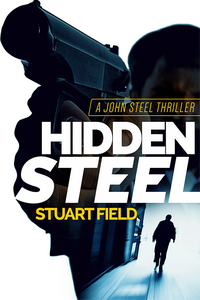
Hidden Steel by Stuart Field: An Ambitious Thriller on Land and Sea


Hidden Steel

Hidden Steel

by Stuart Field
Series: John Steel, #2

Kindle Edition, 618 pg.
Next Chapter, 2019

Read: February 15-17, 2019


It sounds like the first volume of this series has John Steel working closely with a group of detectives from the NYPD, but the sequel has them (ultimately) pursuing the same criminal group from very independent directions—Steel is in Britain and then on a trans-Atlantic cruise ship following leads he uncovered while investigating his family’s death.

Meanwhile, Det. McCall and those she works within Homicide are investigating a serious of suspicious deaths (deaths that would be easily written off as random crimes or accidents). Eventually, the detectives conclude that they are murders, the question then shifts to why these people were killed as much as who did the killing.

Ultimately, as one would guess from the outset, the work that Steel and McCall are doing lead to the same culprits and there is plenty of interaction to satisfy fans between Steel and the team in New York over the course of the novel.

I want to stress that this is one of the most complex and ambitious plots that I’ve read in months. The more you read of this the wider-spread the scope of the action is. I can’t imagine how much planning this took to get all of the parts and pieces to line up just right with each other to produce this—I’m close to using the word audacious to describe the scope of the novel. Once it all starts to come together and the reader can understand all the ways that the criminals were moving to get their schemes rolling, the mind will reel.

Most of this book reads like the novelization of a TV episode/Movie. More often than not, the visuals evoked by the book belong to a visual medium. The way people move, stand dramatically, climb out of this or that, and so on is very screen-inspired. Once I realized this is what’s going on, everything made so much more sense.

I don’t like being this guy, but the number of proofreading problems in this book were very distracting. I don’t remember any words that were spelled incorrectly, but there were repeated instances of similar words being used instead of the correct ones, e.g. “guy’s” instead of “guys,” “he’s” instead of “his,” “draw” rather than “drawer,” and so on. There were scenes/passages that begin the same way they began, a sentence that is a direct contradiction of something mere paragraphs before; commas that serve no function; commas that are missing; unnecessary question marks; and so on. This kind of thing happened so frequently that it drew attention away from the action and I couldn’t focus.

At the end of the day, whatever good I’d want to highlight from the novel was offset by a problem, concern or drawback to either the logic, grammar or word choice. There’s a lot to commend, but the issues suck all my enthusiasm for it away. This is the kind of thing that will truly entertain an audience if it finds one, and I hope for Fields’s sake, it does.


My thanks to damppebbles blog tours for the invitation to participate in this tour and the materials (including a copy of the novel) they provided.

BOOK SPOTLIGHT: Operation Large Scotch: O.L.S. by Bill Flockhart

Today I welcome the Book Tour for Operation Large Scotch: O.L.S. by Bill Flockhart. Along with this spotlight post, I’ll be giving my take on the novel here in a bit. But let’s start by learning a little about this here book, okay?


Book Details:

Book Title: Operation Large Scotch: O.L.S. by Bill Flockhart
Release date: December 11, 2017
Format: Ebook/Paperback
Length: 331 pages

Book Blurb:

Fearing the Good Friday Agreement will effectively end the lifestyle his IRA terrorist cell has enjoyed for years, Michael Caldwell the leader of the 1972 Club (named after the Bloody Sunday Massacre) decides to turn his attention to targeting the UK Government economically. He launches an attack threatening to bomb the Scotch whisky industry unless the British Government pay the terrorists a £20m ransom.

Armitage Brown, Assistant Controller of MI5 is given the task of stopping the terrorist attack but is unable to get any information on the assailants as to how, where and when they are going to deploy their explosives if their demands are not met. He co-ordinates a strategy, using all the emergency services, to thwart the terrorists under the code name ‘Operation Large Scotch.’

Bothe the military and the intelligence services have been guilty of murderous acts going back over the previous eighteen years. John Johnston, a young Ulsterman, living thousands of miles away in South Africa, is determined to get revenge for the killing of his father in Belfast. With the assistance of Mossad, the Israeli Secret Service he releases information that will haunt both the British Military establishment and the terrorists.

Will MI5 succeed in preventing mayhem in various towns around Scotland?

About Bill Flockhart:

Bill Flockhart‘Operation Large Scotch’ is my first book and at my age (71) possibly my last. it reflects on my life in many respects having worked in a distillery in my early working life before digressing into financial services.

My interests are sport (especially golf, swimming and basketball, (the latter through my two sons who played at international level) and current affairs in our ever changing world.

I have always enjoyed a challenge, which producing a book has certainly proved to be, but I would recommend writing to the retired population as it certainly keeps your brain active.

Two years after publishing ‘operation large scotch’ I am delighted to release my second novel ‘She’s Not a Lovely Girl’ which is a sequel to my first book. I only hope it gives everyone the pleasure ‘O.L.S.’ did judging by the favourable reviews it received

Social Networks:

Facebook ~ Pinterest ~ Instagram ~ BookBub ~ LinkedIn

Purchase Links:

Amazon UK ~ Amazon US

My thanks to damppebbles blog tours for the invitation to participate in this tour and the materials (including a copy of the novel) they provided.

Page 58 of 61

Powered by WordPress & Theme by Anders Norén