Tag: Mystery/Detective Fiction/Crime Fiction/Thriller Page 8 of 61

PUB DAY REPOST: Nobody’s Hero by MW Craven: More Shockingly Violent Events in Koenig’s Increasingly Violent Life

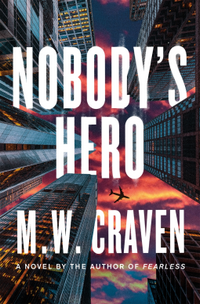
Cover of Nobody's Hero by MW CravenNobody’s Hero

by M.W. Craven

DETAILS:
Series: Ben Koenig, #2
Publisher: Flatiron Books
Publication Date: December 3, 2024
Format: eARC
Length: 416 pg.
Read Date: November 1-4, 2024
Buy from Bookshop.org Support Indie Bookstores

What’s Nobody’s Hero About?

A decade ago, Ben Koenig helped a woman disappear—and to do so in a way that even he (who knew more than anyone else in the world about it) wouldn’t be able to track her. But now, she’s surfaced—as someone responsible for a couple of brazen murders on the streets of London. He and his watcher/minder/handler Jen Draper are tasked with finding her and finding out what made her come into the open.

It takes all of their creative approaches to investigating—and Draper’s security firm’s extensive resources—plus a little luck to get on the path. But will they survive it?

Standing in their was is a team of assassins, criminal police officers, smugglers of various stripes, petty criminals—and bigger ones—and schemes that are truly chilling. Their strengths? The aforementioned creativity and extensive resources, some assistance from a certain Agency, their shared drive, Koenig’s lack of fear, his strange humor and odd trivia.

Obviously, the bad guys are in for trouble.

A Daring Move

Far too often when someone/some group in a novel has a completely innovative, genius, unbelievably original idea, it really isn’t. At best they’re usually clever, but nowhere near as mind-blowing as characters act. Too often, I think authors would be better off alluding to a plan without giving us all the details, and readers have to suspend disbelief to keep going.

For a while, I was worried that Craven had bitten off more than he could chew in revealing all that he did—when it was all shadows, I was really invested. But as the book progressed and we got more and more details about the scheme afoot, the more I realized that this was one of those exceptions that proved the rule. There’s some really ingenious stuff going on here.

I should’ve trusted the mind that brought us The Botanist (as only one example).

Can I promise that every reader is going to have their mind boggled by this? No. But even the cynics or the people who suss it out before the reveal are going to admit that this is atypically clever, and you can absolutely understand why Koenig and Draper have such difficulty with this—and are willing to risk so much to stop it.

The Title

I’m not going to get into it now, but I can imagine that more than one book club is going to spend some fun time speculating about/arguing over who the title is referring to.

I mean, I’ve spent some time speculating about it and arguing with myself over the identity. I figure Craven has multiple characters in mind, actually, rather than just one. But I’m prepared to be wrong about that.

Caveat Lector, or, the Fight Scenes

If you’re like me, and decided at one point or another to not have a meal while watching Bones, at least until the (first) body is taken back to the Lab (the CSIs may have driven viewers to a similar choice), you’re going to want to take a similar approach to the fight scenes in this book. That’s actually an excess of caution, you’re really only going to need it for some. But better be safe than sorry—really.

Now, once you put the meatball sub aside, these fight scenes are really well-written. I think they’re better than those in Fearless. Craven brings the goods in the technical sense/ability to depict things clearly, the impact on the plot, and the overall entertainment value.

So, what did I think about Nobody’s Hero?

This is really one of those books best discussed among people who’ve read it—most of the glowing things I want to say would reveal too much—and you don’t have to read too much of Craven’s work to know it’d be a bad idea to cross him. So what can I say?

Let’s start with this—between Fearless and Nobody’s Hero I read a couple of thrillers with a one-man Army in the Reacher/Koenig/Ash/Ryan/Orphan X etc. mold that soured me on the whole thing, so I started this with a little trepidation. Also, I didn’t know how he’d follow up Fearless and feared a little sophomore slump. It took me very little time to cast all that aside and just have a blast with this—I’m back to my appreciation of the genre, and I don’t know if Craven has the word “slump” in his vocabulary.

Ben Koenig is one of those characters that I hope to spend a lot of time with, there’s just something about him that I really like. It was good to see Jen Draper in action and to see the shift in the relationship between these two from where it was in Fearless and the beginning of this book to the end. They’re a good team.

I don’t know where to put this, but I need to say that between what we see in Nobody’s Hero and some of the Poe series, I really have to wonder what kind of drinking establishments Craven frequents (or I hope, for his sake, used to frequent).

One of the assassins has a…let’s put it generously and vaguely…a quirk. It feels like the kind of thing that Craven stumbled upon at some point in the last 15 years and said, “I need to put this in a book some day.” I’m very glad it did—I’m not convinced that a hitman could become a success with that quirk, really. But Craven uses it so well, that I’m not going to complain. I really enjoyed the way it paid off.

We didn’t get a monologue at the end by an evil mastermind, which still happens even after being made a cliché decades ago—it wasn’t necessary, and what we got instead was so entertaining. It was truly a great change from what was expected.

I don’t know that we need that last reveal—nor does the series—but, I look forward to Craven coming back to it in the future (however far away that future may or may not be).

Action, snark, and some really great twists. There’s a momentum to this that builds and builds and builds as the tension ratchets up in a way that shows you’re in the hands of a Thriller Master. Sure, every decent thriller has that characteristic. But anyone who’s read a couple of thrillers knows the difference between standard-issue momentum and tension and something special. This is the latter, and it ain’t even close.

Do you need to read Fearless before this? No. Will it help a little? Not much, but yes. The important thing is that you read both of them. You won’t want to put it down once you pick it up.

Long live Ben Koenig.

Disclaimer: I received this eARC from Flatiron Books via NetGalley in exchange for this post—thanks to both for this.


4 1/2 Stars

This post contains an affiliate link. If you purchase from it, I will get a small commission at no additional cost to you. As always, the opinions expressed are my own.
Irresponsible Reader Pilcrow Icon

We Solve Murders by Richard Osman: Money Does the Funniest Things to People

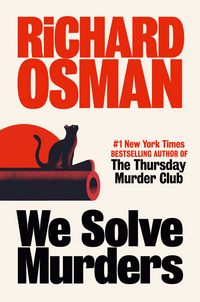
Cover of We Solve Murders by Richard OsmanWe Solve Murders

by Richard Osman

DETAILS:
Series: We Solve Murders, #1
Publisher: Pamela Dorman Books
Publication Date: September 17, 2024
Format: Hardcover
Length: 381
Read Date: November 29-30, 2024

Buy from Bookshop.org Support Indie Bookstores

“If someone does try to shoot me this week, do you have to dive in front of the bullet?”

“That’s the idea,” says Amy, without conviction. “Though that’s mainly in films.”

It’s hard to dive in front of a bullet, in Amy’s experience. They go very fast indeed.

Some Preliminary Thoughts

While I’m always (or almost always) happy for authors to branch out in new directions, to see if they can do something they haven’t before, I’m frequently trepidatious about actually following them. Particularly if all I know is series X and they’re trying something new.

There are authors I’ve come to later in their careers, where they’ve already tried a few things, or authors whose first handful of projects are so different from one another that you know that’s what you’re going to get—something new.

But when you (as a writer, anyway) are known for a series of cozy-adjacent mysteries featuring octogenarians set in one community, step away to try something featuring someone far younger, and with more action and a lot of globe-trotting, you can understand why some readers wouldn’t be sure about stepping out with you. I think it’s fair.

The prologue (which wasn’t called that, probably just so people wouldn’t skip it) was pretty good, and caught my attention. The first chapter was strong, and I enjoyed it. 1.5 pages into chapter two, and I was more than ready to sign on for the rest of the book and was officially okay with Osman taking a break from the Thursday Murder Club (I imagine he’s greatly relieved to hear that).

Steve Wheeler

Probably longer ago than I want to admit, Ken Levine had a great bit on his blog about Sorkin always having a Danny in his shows (I’m sure he wasn’t alone in this observation, but I only remember his). I wonder if Osman needs a Steve in the same way. It doesn’t matter at all. That’s just a thought that struck me partway through, and I can’t shake it off.

So, what’s the deal with this Steve? He’s a retired detective, and it seems like he was a pretty good one before he settled down in a small community with his wife to enjoy that retirement. His wife pushed him into starting a PI agency, “Steve Investigates.” He does small jobs—the occasional marital observance, finding lost pets, seeing who’s messing with trash bins—that sort of thing.

He kept up the agency after his wife’s death, and does a quick patrol of the town twice a day on his way to sit on her favorite bench to enjoy the view and talk to her. Then it’s off to the pub to talk to some friends before going home to watch TV and pet his cat.

He speaks to his son rarely since his wife’s death, but speaks to his daughter-in-law frequently, almost daily.

Amy Wheeler

Amy is that daughter-in-law. She works in close protection and security. She globe-trots to do so, but tries to call Steve daily (unless she’s prevented by work or immanent danger). She’s very much Charlie Fox, with a sense of humor—and a different kind of trauma growing up.

She’s good at what she does, she takes it very seriously. She’s traveling the world and enjoying it—and lives for the adrenaline.

Rosie D’Antonio

Rosie is…a lot. That’s her in a nutshell, really. She’s Amy’s current client, as the book opens. She’s a world-famous author, from a time when that would make someone very rich—and she’s enjoying a career resurgence. She’s the best-selling author in the world, actually—if you don’t count Lee Child.

She’s wealthy, she’s of an uncertain age (and likes it like that), with a lust for life (and men).

She recently erred when she based a character off a certain Russian oligarch and did a very poor job of disguising it—so he’s put a price on her head. Which is where she and Amy got together.

What’s We Solve Murders About Then?

Three clients of Amy’s agency have recently been murdered in similar, ghastly ways. These influencers have little in common (at least on the surface) other than that. One of those murders happens close enough to where Amy and Rosie are staying that Amy goes to investigate (and brings Rosie along to keep her safe until she can arrange for something else).

Things start getting dangerous then—shots are fired, more dead bodies appear, and it’s clear that Amy is the next target on the list. Rosie’s having a blast with this—as long as no one’s firing at her, anyway. But Amy is going to need help from someone she trusts who also has experience in solving murders. So she essentially forces Steve to come and help.

More shots are fired and other attempts are being made at killing Amy. Flights to all over the world are taken in quick succession. Secrets are uncovered. Rosie flirts with many men. And an appreciation of Van Halen comes in far handier than anyone would expect.*

* Words would fail me if I tried to express how much the Van Halen material made me smile.

The Tone/Approach

I hate to dwell on the comparisons between this and his other books, but it seems like something I should talk about. First, this is told in a series of close-third person narratives from multiple perspectives. There’s no first person anywhere, and everything is told in the same typeface. That’s notable (if you ask me, anyway.)

Second, this is more overtly comedic. Clearly, TMC is full of humor, but it’s more of the gentle character-based humor. This is full of funny moments, situations, and lines that are clearly meant to get a laugh or a grin. In my notes I called it jokey, but I’m not sure it goes that far (too often, anyway). I’d compare it to Evanovich/Goldberg’s Fox and O’Hare books, Goldberg’s Ian Ludlow books (but more restrained), or Duncan MacMaster’s mysteries. (all of which are compliments, I want to stress)

But Osman is still Osman and there are plenty of earnest, heart-string-tugging moments, too. Particularly with Steven—talking about his dead wife or even considering his lifestyle and what has led him to his very self-contained life. Amy isn’t that reflective of a character (if anything, she avoids it with action), so we don’t get much of that with her—although the way she avoids thinking gets us to a similar point with her.

So, what did I think about We Solve Murders?

Did my appreciation of the book vary much from the verdict I made in Chapter Two? Well, I ended up liking the novel more than I did back there. Does that count?

This was just so much fun—while I had my reservations and questions before starting, I also had high hopes. The end result was better than those.

Osman can do an action scene pretty well—and keep the comedy going. We don’t have anything particularly drawn out here, but there are bursts. And his ability to create a story with strong momentum and great twists is well-documented.

More importantly—Osman’s gift for characters really shines here. The supporting characters—criminals, witnesses, people the protagonists happen to encounter (whether for a handful of paragraphs or for several chapters), are just golden. To describe the best of them would be to deprive you of your chance to meet them. Once it was clear that Rosie wasn’t just going to be someone we met to establish Amy as a bodyguard, I wondered a little bit about her tagging along. But it didn’t take me too long to fully embrace the character, and now I’m looking forward to seeing her in the future.

I’m not sure that I should’ve made the comparison to Charlie Fox above—you really can think of this as a Charlie Fox book with laughs and be pretty dead on. Others might disagree, but I’ve had the comparison stuck in my head for a couple of hours now and can’t shake it.

I’m not 100% sure the final solution was honest, it felt a little like he cheated to get [redacted] to figure out that the Big Bad was [redacted]. The Big Bad’s accomplice, however, was obvious for longer than it should’ve been to get the characters to suss them out. So, on average, he did okay there. The red herrings were great, and made up for whatever issues I might have had with the solution (but really, give us one more chapter where [redacted] goes over the clues again in their mind or something—actually, just a paragraph before they say “I know who Big Bad is.”)

This was just so good, really. At this point, it’s not quite as good as Osman’s other work—primarily because nothing had the emotional weight that the gang at Cooper’s Chase (which is close enough to Steve’s home to provide hope of the characters brushing up against each other) seems to find in their adventures. But the potential is there for this series to equal it. And, really, considering the tone of this one, that kind of punch might have felt out of place or contrived.

Either way, I strongly recommend this to Osman’s readers or people who’ve never heard of the man/his books. You will have fun, and you will want more. I guarantee that for 99% of you.


4 1/2 Stars

This post contains an affiliate link. If you purchase from it, I will get a small commission at no additional cost to you. As always, the opinions expressed are my own.

Irresponsible Reader Pilcrow Icon

Tooth and Claw by Craig Johnson: Even in The Arctic, Nature’s Red

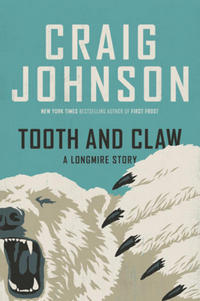
Cover of Tooth and Claw by Craig JohnsonTooth and Claw

by Craig Johnson

DETAILS:
Series: Walt Longmire, #.5
Publisher: Viking
Publication Date: November 19, 2024
Format: Hardcover
Length: 189 pg.
Read Date: November 28, 2024
Buy from Bookshop.org Support Indie Bookstores

What’s Tooth and Claw About?

After his time with the Marines is over, Walt needs to get away from people, society, anything that makes him think of Vietnam and what he witnessed there. He also wants to get away from what he knows–and what fits that description better than Alaska? He takes a job working security on an oil field, replacing someone who’d killed himself.

He also finds himself drinking. A lot. There’s not much to do when he’s not on the job—and you get the impression he can do a lot of it with a little bit of a buzz on.

We encounter Walt in this state as Henry comes up to visit–he’s concerned about what Walt’s doing to himself (as is Walt’s former fiance, Martha). Henry shows up at the end of December, when there are very few hours of daylight each day up by the Arctic Circle.

Henry’s a little bored, truth be told, so when Walt finds the opportunity to take him along on a quick research trip to help keep a scientist safe they go.

The day trip doesn’t go the way they expect (naturally). Instead, the friends find danger, a blizzard, a large polar bear (even by polar bear standards), a ghost ship, and some garden-variety human evil.

So, what did I think about Tooth and Claw?

This quick novella was fine. Walt and Henry against nature—weather and animal—isn’t exactly new territory, but Alaska isn’t what we’re used to seeing from them. It makes Wyoming look crowded. It’s a bit more extreme than we’re used to for them.

Add in a bunch of people we don’t know and a ship out of legend, and you’ve got something even better. There’s a potential supernatural element here–and the story works either way you approach that element.

It’s not a perfect read. The criminal activity seemed a bit perfunctory—and really didn’t add much to the novella, I might have appreciated the novella more without it. I don’t know that Johnson sold Walt’s drinking as being as much of a problem as Henry and a couple of others made it out to be.

But for what it is—a quick thrill-ride and a look at young-Walt, it’s good. There are some entertaining moments, it’s good to see these two in another environment. There’s at least one character I’d like to run into again.

It’s not a must-read for Longmire fans or the best introduction to the characters—but it’ll please longtime fans and should whet the appetites of new readers for the full novels. That’s good enough, right?


3 Stars

This post contains an affiliate link. If you purchase from it, I will get a small commission at no additional cost to you. As always, the opinions expressed are my own.

Irresponsible Reader Pilcrow Icon

Bullet Points about Spook Street by Mick Herron: All the Exciting Stuff Happens Around River

Cover of Spook Street by Mick HerronSpook Street

by Mick Herron

DETAILS:
Series: Slough House,  #4
Publisher: Soho Crime
Publication Date: December 12, 2017
Format: Paperback
Length: 307 pg.
Read Date: October 18-29, 2024
Buy from Bookshop.org Support Indie Bookstores

“You want me to issue a shoot-to-kill order.”

“Well there’s no point shooting to wound. People would only get hurt.”

What’s the Back Cover of Spook Street Say?

What happens when an old spook loses his mind? Does the Service have a retirement home for those who know too many secrets but don’t remember they’re secret? Or does someone take care of the senile spy for good? These are the paranoid concerns of David Cartwright, a Cold War-era operative and one-time head of MI5 who is sliding into dementia, and questions his grandson, River, must figure out answers to now that the spy who raised him has started to forget to wear pants.

But River, himself an agent at Slough House, MI5’s outpost for disgraced spies, has other things to worry about. A bomb has detonated in the middle of a busy shopping center and killed forty innocent civilians. The “slow horses” of Slough House must figure out who is behind this act of terror before the situation escalates.

Things I’m Not Going to Develop into Paragraphs:

(I just don’t have the time or energy)
bullet Louisa makes a friend! A non-Slough House friend, it should be stressed. Which is great—and will hopefully help her deal with the events of Dead Lions. Sure, I pretty much like everything about Louisa, but this worked really well.
bullet This: “What happens when an old spook loses his mind? Does the Service have a retirement home for those who know too many secrets but don’t remember they’re secret?” Yeah, it could be phrased a bit more skillfully, but really—what is done in these situations (I have to assume more and more of these happen all the time)
bullet This book is really all about the power behind the throne. Sure, all the attention is on the leader (of whatever), but being the guy behind them—almost all of the power, but with almost none of the accountability or scrutiny, you can get a lot done. And you can direct the person at the top with just the right kind of pressure or incentive.
bullet Yes, the “Slow Horses” are, by design (of both Herron and MI-5) disposable, and impermanent. But some are pretty much irreplaceable, as the poor woman who is brought in to fill Catherine Standish’s shoes learns.
bullet Everything we learned about David Cartwright and his activities seems realistic. It’s chilling and troubling in so many ways. He deserves to be called OB. Or just B.
bullet Back to the impermanent idea. Herron shows us that he’s in the same league as authors like George R.R. Martin when it comes to the mortality of characters. I both admire that and am angered by it.
bullet Roderick Ho…what can I say about him? At the beginning of the book, I couldn’t believe what I was reading about him—it was far more hard to believe than any of the outlandish things we’ve seen Jackson Lamb’s team encounter. By the end, it all made sense. And I might have felt pity for the guy (although he makes it hard)
bullet Herron’s prose is so delicious. It’s mirthful without actually being funny (and only occasionally jokey). It’s so well crafted, it’s…I can’t put it into words. I just love reading him.

They were south of the river, half a mile from the Thames, near one of those busy junctions which rely on the self-preservation instincts of the drivers using it; ether a shining example of new-age civic theory, or an old-fashioned failure of town planning. On one of its corners sat a church; on another, earth-moving monsters re-enacted the Battle of the Bulge behind hoardings which shivered with each impact. A tube station squatted on a third, its familiar brick-and-tile facade more than usually grubby in the drizzle. There was a lot of construction work nearby, buildings wrapped in plastic sheeting, some of it gaudily muralled with visions of a bright new future: the gleaming glass, the pristine paving, the straight white lines of premises yet-to-be. Meanwhile, the surviving shops were the usual array of bookmakers, convenience stores and coffee bars, many of them crouching behind scaffolding, and some of them book-ending alleyways which would be either dead-ends where wheelie-bins congregated, or short-cuts to the labyrinth of darker streets beyond. Once upon a time Charles Dickens wandered this area, doubtless taking notes. Nowadays the local citizenry’s stories were recorded by closed-circuit TV, which had less time for sentimental endings.

So, what did I think about Spook Street?

Once again, I couldn’t stop asking myself why I am so behind in reading these? Why do I take breaks of months and months between them? Everything about this series is great.

I’m just happy the whole time I’m reading one of these books—despite the fact that the events are harrowing, the characters are generally despicable, and what the books suggest about humanity and Western security services (UK’s in particular, but I can only imagine they function pretty similarly to the rest) doesn’t fill one with optimism or confidence.

Spook Street is a solid winner from the horrible incident the book started with to the closing comforting paragraphs and all points in between. Herron planted more seeds than is typical for future installments—and I can’t decide which I want to see first (on second thought, I want to see the Roddy Ho stuff come back to haunt him/Slough House as soon as is humanly possible).

If you’re not reading these books—at my snail-like pace or at a rational pace—you are missing out.


4 1/2 Stars

This post contains an affiliate link. If you purchase from it, I will get a small commission at no additional cost to you. As always, the opinions expressed are my own.

Irresponsible Reader Pilcrow Icon

Nobody’s Hero by MW Craven: More Shockingly Violent Events in Koenig’s Increasingly Violent Life

Cover of Nobody's Hero by MW CravenNobody’s Hero

by M.W. Craven

DETAILS:
Series: Ben Koenig, #2
Publisher: Flatiron Books
Publication Date: December 3, 2024
Format: eARC
Length: 416 pg.
Read Date: November 1-4, 2024
Buy from Bookshop.org Support Indie Bookstores

What’s Nobody’s Hero About?

A decade ago, Ben Koenig helped a woman disappear—and to do so in a way that even he (who knew more than anyone else in the world about it) wouldn’t be able to track her. But now, she’s surfaced—as someone responsible for a couple of brazen murders on the streets of London. He and his watcher/minder/handler Jen Draper are tasked with finding her and finding out what made her come into the open.

It takes all of their creative approaches to investigating—and Draper’s security firm’s extensive resources—plus a little luck to get on the path. But will they survive it?

Standing in their was is a team of assassins, criminal police officers, smugglers of various stripes, petty criminals—and bigger ones—and schemes that are truly chilling. Their strengths? The aforementioned creativity and extensive resources, some assistance from a certain Agency, their shared drive, Koenig’s lack of fear, his strange humor and odd trivia.

Obviously, the bad guys are in for trouble.

A Daring Move

Far too often when someone/some group in a novel has a completely innovative, genius, unbelievably original idea, it really isn’t. At best they’re usually clever, but nowhere near as mind-blowing as characters act. Too often, I think authors would be better off alluding to a plan without giving us all the details, and readers have to suspend disbelief to keep going.

For a while, I was worried that Craven had bitten off more than he could chew in revealing all that he did—when it was all shadows, I was really invested. But as the book progressed and we got more and more details about the scheme afoot, the more I realized that this was one of those exceptions that proved the rule. There’s some really ingenious stuff going on here.

I should’ve trusted the mind that brought us The Botanist (as only one example).

Can I promise that every reader is going to have their mind boggled by this? No. But even the cynics or the people who suss it out before the reveal are going to admit that this is atypically clever, and you can absolutely understand why Koenig and Draper have such difficulty with this—and are willing to risk so much to stop it.

The Title

I’m not going to get into it now, but I can imagine that more than one book club is going to spend some fun time speculating about/arguing over who the title is referring to.

I mean, I’ve spent some time speculating about it and arguing with myself over the identity. I figure Craven has multiple characters in mind, actually, rather than just one. But I’m prepared to be wrong about that.

Caveat Lector, or, the Fight Scenes

If you’re like me, and decided at one point or another to not have a meal while watching Bones, at least until the (first) body is taken back to the Lab (the CSIs may have driven viewers to a similar choice), you’re going to want to take a similar approach to the fight scenes in this book. That’s actually an excess of caution, you’re really only going to need it for some. But better be safe than sorry—really.

Now, once you put the meatball sub aside, these fight scenes are really well-written. I think they’re better than those in Fearless. Craven brings the goods in the technical sense/ability to depict things clearly, the impact on the plot, and the overall entertainment value.

So, what did I think about Nobody’s Hero?

This is really one of those books best discussed among people who’ve read it—most of the glowing things I want to say would reveal too much—and you don’t have to read too much of Craven’s work to know it’d be a bad idea to cross him. So what can I say?

Let’s start with this—between Fearless and Nobody’s Hero I read a couple of thrillers with a one-man Army in the Reacher/Koenig/Ash/Ryan/Orphan X etc. mold that soured me on the whole thing, so I started this with a little trepidation. Also, I didn’t know how he’d follow up Fearless and feared a little sophomore slump. It took me very little time to cast all that aside and just have a blast with this—I’m back to my appreciation of the genre, and I don’t know if Craven has the word “slump” in his vocabulary.

Ben Koenig is one of those characters that I hope to spend a lot of time with, there’s just something about him that I really like. It was good to see Jen Draper in action and to see the shift in the relationship between these two from where it was in Fearless and the beginning of this book to the end. They’re a good team.

I don’t know where to put this, but I need to say that between what we see in Nobody’s Hero and some of the Poe series, I really have to wonder what kind of drinking establishments Craven frequents (or I hope, for his sake, used to frequent).

One of the assassins has a…let’s put it generously and vaguely…a quirk. It feels like the kind of thing that Craven stumbled upon at some point in the last 15 years and said, “I need to put this in a book some day.” I’m very glad it did—I’m not convinced that a hitman could become a success with that quirk, really. But Craven uses it so well, that I’m not going to complain. I really enjoyed the way it paid off.

We didn’t get a monologue at the end by an evil mastermind, which still happens even after being made a cliché decades ago—it wasn’t necessary, and what we got instead was so entertaining. It was truly a great change from what was expected.

I don’t know that we need that last reveal—nor does the series—but, I look forward to Craven coming back to it in the future (however far away that future may or may not be).

Action, snark, and some really great twists. There’s a momentum to this that builds and builds and builds as the tension ratchets up in a way that shows you’re in the hands of a Thriller Master. Sure, every decent thriller has that characteristic. But anyone who’s read a couple of thrillers knows the difference between standard-issue momentum and tension and something special. This is the latter, and it ain’t even close.

Do you need to read Fearless before this? No. Will it help a little? Not much, but yes. The important thing is that you read both of them. You won’t want to put it down once you pick it up.

Long live Ben Koenig.

Disclaimer: I received this eARC from Flatiron Books via NetGalley in exchange for this post—thanks to both for this.


4 1/2 Stars

This post contains an affiliate link. If you purchase from it, I will get a small commission at no additional cost to you. As always, the opinions expressed are my own.
Irresponsible Reader Pilcrow Icon

Douglas Adams on Presidents

This one is a bit more cynical–okay, very much more cynical–than the last quotation I shared. It still seemed appropriate for today.

Zaphod BeeblebroxThe major problem—one of the major problems, for there are several—one of the many major problems with governing people is that of whom you get to do it; or rather of who manages to get people to let them do it to them.

To summarise: it is a well-known fact that those people who most want to rule people are, ipso facto, those least suited to do it. To summarise the summary: anyone who is capable of getting themselves made President should on no account be allowed to do the job. To summarise the summary of the summary: people are a problem.

—Douglas Adams
from The Restaurant at the End of the Universe


That nifty drawing of Zaphod was drawn by Terry Cooper.

Archie Goodwin on Voting

For the 3 of you who are unaware, it’s Election Day in the U.S., so I thought I’d share this little bit from Archie Goodwin to commemorate it.

Archie GoodwinThe most interesting incident Tuesday morning was my walking to a building on Thirty-fourth Street to enter a booth and push levers on a voting machine. I have never understood why anybody passes up that bargain. It doesn’t cost a cent, and for that couple of minutes, you’re the star of the show, with top billing. It’s the only way that really counts for you to say I’m it, I’m the one that decides what’s going to happen and who’s going to make it happen. It’s the only time I really feel important and know I have a right to. Wonderful. Sometimes the feeling lasts all the way home if somebody doesn’t bump me.

–Archie Goodwin
from A Family Affair

PUB DAY REPOST: A New Lease on Death by Olivia Blacke: A Charming New Odd Couple of Amateur Sleuths

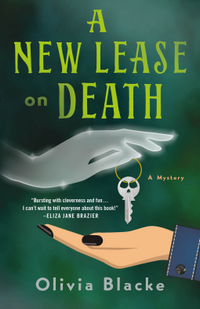
Cover of A New Lease on Death by Olivia BlackeA New Lease on Death

by Olivia Blacke

DETAILS:
Series: Ruby and Cordelia Mysteries, #1
Publisher: Minotaur Books
Publication Date: October 29, 2024
Format: eARC
Length: 336 pgs.
Read Date: October 11-15, 2024
Buy from Bookshop.org Support Indie Bookstores

Ruby

Ruby is a young twentysomething-ish woman*, new to Boston, having moved there following a bad breakup. She’s left the comforts of home and family to start again and prove to herself (and probably her ex) that she can do it on her own. She’s generally optimistic, talks to herself, is a bit overwhelmed with everything but she still has a cheerful personality—which is reflected in everything from the way she dresses to the way she looks at life. Despite Winter in Boston, which really isn’t treating her well, that is.

* Just before scheduling this post, I remembered that Ruby can’t spend time in bars. So, she’s a really young twentysomething-ish. I could probably look it up, but that’s good enough.

She’s jobless, but looking, and is getting close to the desperation point. But she’s not going to quit until she has to.

She shares her apartment with a woman who is very different than her, and their communication…well, it’s lousy. And not just because Ruby’s killed all but one of her houseplants.

Cordelia

Cordelia is noticeably older. Not truly grumpy, but optimistic and bubbly are definitely not things she’s been called (or would want to be called). She’s maybe not a huge success, but she does well enough that she’s not worried about money or comfort (there’s more to it than that, but I’ll let you read it for yourself). She likes to stay home in the evenings and read.

And drink. And drink some more. I don’t know if she’s technically an alcoholic (a functional one, for what it’s worth) or if she’s just a heavy drinker. It’s probably an academic question, really.

Cordelia doesn’t have much of a social life, she gets along with her coworkers—none of whom know that up until recently she’d been having an extended affair with their very married boss.

She doesn’t understand Ruby’s optimism, her approach to life/job hunting, resents what she’s doing to her houseplants, and just doesn’t know how to get through to her at all.

A large part of that stems from the fact that Cordelia was found dead a few months ago, and is now a ghost who likes staying in her former apartment while she gets a handle on the whole afterlife thing. Ruby, is (I should’ve said earlier, but I just assume it) very much alive and was more than happy to move into an already furnished apartment.

What’s A New Lease on Death About?

The book opens with Cordelia trying to talk the brand-new ghost of their neighbor through the opening minutes of his afterlife. He’d been murdered just outside their building and he is not taking the whole experience very well.

In one of the early attempts at actual communication between the roomies, Ruby gets the idea that Cordelia is trying to tell her they should investigate the murder like someone on one of the True Crime podcasts she’s a huge fan of. Cordelia was actually trying to keep Ruby as far as she could from all that, and seemed more than ready to accept the police’s rushed theories.

Before you know it, these two had become much more than people…entities?…sharing an apartment, they were a semi-functional team on the hunt for a killer.

The Ghostly Brass Tacks

This isn’t a book steeped in magic, supernatural creatures, and other things common in Urban Fantasy or even other supernatural mysteries I’ve talked about here. The Supernatural (at least in this book) is limited to ghosts who linger around—and not many do. We’re not really told why, but Cordelia has a theory.

It’s not easy to help someone when you’re incorporeal, invisible, and unable to make yourself heard. It’s also hard to “lean on” or assist someone if you’re not all that sure is actually around, or off doing their own thing.

And honestly, that’s just the beginning of their problems.

Blacke paints a picture of Claudia’s reality, her state, her learning curve, and her abilities to interact with the physical world and people in a way that absolutely makes sense, is consistent, well thought-out, and believable. It’s truly impressive—and darn entertaining—to watch Claudia try to be Ruby’s partner through all this.

It’s strong to say there’s a relationship between these two, but there is.

So, what did I think about A New Lease on Death?

In brief—this is everything I hoped it would be (well, I wanted a few more jokes, but I got over that). I bought in right away to everything—Blacke made that really easy—and both the plot and characters kept me fully engaged. I was faster than the pair on a thing or two (nothing applicable to this case, but what appears to be the next one), but didn’t get to the solution to the mystery until about the same time as Ruby and Cordelia.

It’s both a fun and well-executed novel and a solid introduction to a world and series (it’s at least a duology, I just don’t know how many books Blacke/Minotaur Books have in mind). There’s not a huge cast of characters that we can expect to see again—but there are some. We’ll see some of Ruby’s coworkers, I’m sure (eep—minor spoiler, she finds some kind of job); there are some figures we’ll see from the apartment building; and there’s one ghost I expect Cordelia to learn a bit more from. But it’s essentially a cast of two—and that’s more than enough to fuel this book and series.

In a step in a new direction for Blacke, this isn’t a cozy mystery—or so Blacke’s website says. And it’s true, I suppose—largely depending on how strictly you define “cozy.” But almost every cozy reader will embrace the storytelling. Blacke’s fans, in particular, will be fine with this after a little adjustment, and will likely embrace it without much trouble.

It’s not as lighthearted, warm, fuzzy, and pun-filled as The Record Shop Mysteries were. There’s little in here that’s outright funny—although you’ll smile most of the time, and the book is rarely dark. Tonally, it’s close to Darynda Jones’ mysteries, Janet Evanovich, and Lee Goldberg’s Eve Ronin (although all of those contain more jokes).

What Blacke carries over from the Record Shop Mysteries is her charm. You will like these two women right away. You’ll look for signs of friendship, camaraderie, and understanding between the two—and be pleased when you find them (and when you don’t have to look anymore).

This is the fourth book by Blacke that I’ve read, and it’s the fourth book of hers that I enjoyed. But she’s displaying a greater skill when it comes to writing, plotting, and character here than she has before. I think that’s a function of subject/subgenre rather than skill or anything. I’ve liked her books before, but this impressed me in a way the others haven’t. I don’t think it’s me comparing the two series—because I honestly want her to circle back soon to the environs of Sip & Spin Records (as little as I expect it). It’s just this is a better canvas for her to display more of her talent.

If you’ve tried her earlier material, you’ll see what I mean. If you haven’t, just realize I was dancing around a point—and maybe landed near it.

Regardless—this is a fun odd couple/buddy cop outing featuring amateur sleuths (so, yeah “buddy cop” isn’t technically right, but you know what I’m saying) with a side order of supernatural woowoo. The solution to the mystery is satisfying and fitting—and the conclusion of the novel launches into the next novel/series. What’s not to like? Very little. I’m already eagerly awaiting the next volume. I feel like there’s something I’m not saying, but I can’t figure out what it is. So I’ll just leave it at this point.

I’m looking forward to the next book, I expect almost everyone who reads A New Lease on Death will find themselves in the same boat. And I really hope many people come aboard—like you. Yes, you. Pick this one up.

Disclaimer: I received a copy of this book from St. Martin’s Press via NetGalley—thanks to both for this.


4 Stars

This post contains an affiliate link. If you purchase from it, I will get a small commission at no additional cost to you. As always, the opinions expressed are my own.

Irresponsible Reader Pilcrow Icon

A New Lease on Death by Olivia Blacke: A Charming New Odd Couple of Amateur Sleuths

Cover of A New Lease on Death by Olivia BlackeA New Lease on Death

by Olivia Blacke

DETAILS:
Series: Ruby and Cordelia Mysteries, #1
Publisher: Minotaur Books
Publication Date: October 29, 2024
Format: eARC
Length: 336 pgs.
Read Date: October 11-15, 2024
Buy from Bookshop.org Support Indie Bookstores

Ruby

Ruby is a young twentysomething-ish woman*, new to Boston, having moved there following a bad breakup. She’s left the comforts of home and family to start again and prove to herself (and probably her ex) that she can do it on her own. She’s generally optimistic, talks to herself, is a bit overwhelmed with everything but she still has a cheerful personality—which is reflected in everything from the way she dresses to the way she looks at life. Despite Winter in Boston, which really isn’t treating her well, that is.

* Just before scheduling this post, I remembered that Ruby can’t spend time in bars. So, she’s a really young twentysomething-ish. I could probably look it up, but that’s good enough.

She’s jobless, but looking, and is getting close to the desperation point. But she’s not going to quit until she has to.

She shares her apartment with a woman who is very different than her, and their communication…well, it’s lousy. And not just because Ruby’s killed all but one of her houseplants.

Cordelia

Cordelia is noticeably older. Not truly grumpy, but optimistic and bubbly are definitely not things she’s been called (or would want to be called). She’s maybe not a huge success, but she does well enough that she’s not worried about money or comfort (there’s more to it than that, but I’ll let you read it for yourself). She likes to stay home in the evenings and read.

And drink. And drink some more. I don’t know if she’s technically an alcoholic (a functional one, for what it’s worth) or if she’s just a heavy drinker. It’s probably an academic question, really.

Cordelia doesn’t have much of a social life, she gets along with her coworkers—none of whom know that up until recently she’d been having an extended affair with their very married boss.

She doesn’t understand Ruby’s optimism, her approach to life/job hunting, resents what she’s doing to her houseplants, and just doesn’t know how to get through to her at all.

A large part of that stems from the fact that Cordelia was found dead a few months ago, and is now a ghost who likes staying in her former apartment while she gets a handle on the whole afterlife thing. Ruby, is (I should’ve said earlier, but I just assume it) very much alive and was more than happy to move into an already furnished apartment.

What’s A New Lease on Death About?

The book opens with Cordelia trying to talk the brand-new ghost of their neighbor through the opening minutes of his afterlife. He’d been murdered just outside their building and he is not taking the whole experience very well.

In one of the early attempts at actual communication between the roomies, Ruby gets the idea that Cordelia is trying to tell her they should investigate the murder like someone on one of the True Crime podcasts she’s a huge fan of. Cordelia was actually trying to keep Ruby as far as she could from all that, and seemed more than ready to accept the police’s rushed theories.

Before you know it, these two had become much more than people…entities?…sharing an apartment, they were a semi-functional team on the hunt for a killer.

The Ghostly Brass Tacks

This isn’t a book steeped in magic, supernatural creatures, and other things common in Urban Fantasy or even other supernatural mysteries I’ve talked about here. The Supernatural (at least in this book) is limited to ghosts who linger around—and not many do. We’re not really told why, but Cordelia has a theory.

It’s not easy to help someone when you’re incorporeal, invisible, and unable to make yourself heard. It’s also hard to “lean on” or assist someone if you’re not all that sure is actually around, or off doing their own thing.

And honestly, that’s just the beginning of their problems.

Blacke paints a picture of Claudia’s reality, her state, her learning curve, and her abilities to interact with the physical world and people in a way that absolutely makes sense, is consistent, well thought-out, and believable. It’s truly impressive—and darn entertaining—to watch Claudia try to be Ruby’s partner through all this.

It’s strong to say there’s a relationship between these two, but there is.

So, what did I think about A New Lease on Death?

In brief—this is everything I hoped it would be (well, I wanted a few more jokes, but I got over that). I bought in right away to everything—Blacke made that really easy—and both the plot and characters kept me fully engaged. I was faster than the pair on a thing or two (nothing applicable to this case, but what appears to be the next one), but didn’t get to the solution to the mystery until about the same time as Ruby and Cordelia.

It’s both a fun and well-executed novel and a solid introduction to a world and series (it’s at least a duology, I just don’t know how many books Blacke/Minotaur Books have in mind). There’s not a huge cast of characters that we can expect to see again—but there are some. We’ll see some of Ruby’s coworkers, I’m sure (eep—minor spoiler, she finds some kind of job); there are some figures we’ll see from the apartment building; and there’s one ghost I expect Cordelia to learn a bit more from. But it’s essentially a cast of two—and that’s more than enough to fuel this book and series.

In a step in a new direction for Blacke, this isn’t a cozy mystery—or so Blacke’s website says. And it’s true, I suppose—largely depending on how strictly you define “cozy.” But almost every cozy reader will embrace the storytelling. Blacke’s fans, in particular, will be fine with this after a little adjustment, and will likely embrace it without much trouble.

It’s not as lighthearted, warm, fuzzy, and pun-filled as The Record Shop Mysteries were. There’s little in here that’s outright funny—although you’ll smile most of the time, and the book is rarely dark. Tonally, it’s close to Darynda Jones’ mysteries, Janet Evanovich, and Lee Goldberg’s Eve Ronin (although all of those contain more jokes).

What Blacke carries over from the Record Shop Mysteries is her charm. You will like these two women right away. You’ll look for signs of friendship, camaraderie, and understanding between the two—and be pleased when you find them (and when you don’t have to look anymore).

This is the fourth book by Blacke that I’ve read, and it’s the fourth book of hers that I enjoyed. But she’s displaying a greater skill when it comes to writing, plotting, and character here than she has before. I think that’s a function of subject/subgenre rather than skill or anything. I’ve liked her books before, but this impressed me in a way the others haven’t. I don’t think it’s me comparing the two series—because I honestly want her to circle back soon to the environs of Sip & Spin Records (as little as I expect it). It’s just this is a better canvas for her to display more of her talent.

If you’ve tried her earlier material, you’ll see what I mean. If you haven’t, just realize I was dancing around a point—and maybe landed near it.

Regardless—this is a fun odd couple/buddy cop outing featuring amateur sleuths (so, yeah “buddy cop” isn’t technically right, but you know what I’m saying) with a side order of supernatural woowoo. The solution to the mystery is satisfying and fitting—and the conclusion of the novel launches into the next novel/series. What’s not to like? Very little. I’m already eagerly awaiting the next volume. I feel like there’s something I’m not saying, but I can’t figure out what it is. So I’ll just leave it at this point.

I’m looking forward to the next book, I expect almost everyone who reads A New Lease on Death will find themselves in the same boat. And I really hope many people come aboard—like you. Yes, you. Pick this one up.

Disclaimer: I received a copy of this book from St. Martin’s Press via NetGalley—thanks to both for this.


4 Stars

This post contains an affiliate link. If you purchase from it, I will get a small commission at no additional cost to you. As always, the opinions expressed are my own.
Irresponsible Reader Pilcrow Icon

A Few More Quick Questions With…Steven Max Russo

This morning I brought you my (overdue) take on Steven Max Russo’s third novel, The Debt Collector, and now I’m very pleased to bring you a few questions about the book with the author.


Last time we talked, you stressed how you were a pantser and many things about the books I asked about just came about as you were writing. But I have to wonder—that striking visual that opens The Debt Collector—did you sit down with that in mind, or did it come up later and put it in during revisions?
That’s a very perceptive question. With my first two novels, Thieves and The Dead Don’t Sleep, the prologues were both written after the novels were pretty much completed. I wanted something vivid and dramatic at the very beginning to draw the reader in. But that wasn’t the case with The Debt Collector.

When I was in college, I was driving through town when I witnessed a young man walk nonchalantly out of liquor store wearing nothing but his underpants – tighty-whities as I recall. It was early afternoon on a warm and sunny spring day. He was carrying what appeared to be a bottle of vodka in one hand and his wallet in the other. It wasn’t a robbery or anything nefarious. No alarms or people screaming or any commotion whatsoever, just a young guy in his underpants walking out of a store in the middle of the day. When I began writing what turned into the The Debt Collector, I just started typing one evening and that memory from my youth of the young guy in his underpants walking out of the store popped into my head and I built the story from there.
Great story…

Along the same lines—with this book, did you have a vague idea for the plot, or did you start with Abigail and/or Hector and create a story for them?
I had no idea of a plot or any characters beyond the opening scene with Abigail and Hector. The story simply emerged as I began writing. When I write, I often feel like I’m just following my characters around in a parallel universe or watching them in something like an old-time newsreel that runs in my head and I simply write what I see and hear. I often feel more like a reporter than a fiction author. I know that sounds strange, but that’s how it feels.

Do you see some sort of line between your protagonists? Are their common traits? Is there some sort of progression between Skooley/Esmeralda, Frank/Bill, and Abigail/Hector?
I’m not really sure how to answer this. I strive to make all of my characters relatable and believable. Their environments and their history and their circumstances are different than those of most people and that obviously affects their world view, but once you learn a little about the individuals, you can at least recognize if not understand their motivations from their unique perspectives. And I guess there are some common traits in my characters, but heck, you can say that about most people. As for any progression of the pairings mentioned in your question, I don’t really see any. Each relationship between the characters is different – Skooley and Esmeralda start as reluctant partners and then evolve into lethal adversaries; Frank and Bill have a warm, familial relationship as uncle and nephew that gets somewhat tested under stress; and Abigail and Hector are basically strangers who develop a friendship and bond under unique circumstances.

Going back to the pantser idea, there are so many little clues, little tidbits tying elements of this novel together—things you may gloss over early on that come back in a satisfying way.
A big part of writing is reading what you wrote – and then re-writing, re-reading, and re-writing over and over (and over) again. Once the main story is established and I have an idea for what I think will make for a satisfying ending, then I go back, re-read (again), and drop in those little clues and tidbits where I think they work best to lead the reader along, help raise the stakes, and/or tie things together.

There are a few characters I’d like to ask you about, but I can’t think of a way to do so without spoiling something (next time—first time?—you’re in Idaho, I’ll buy you a drink and ask), so I’ll let you decide who to talk about? Is there a supporting/minor character that surprised you as you wrote this, that you ended up enjoying more than you expected? Maybe someone that you expected would be around for a scene or two to move the story along and then ended up being a major player?
I think the character in The Debt Collector that surprised me the most was Gino, the mobster who befriends Abby. He’s tough, fearless, smarter than he gives himself credit for, can be empathetic yet follows orders much like a soldier doing what he is ordered to do regardless of his own feelings about what he is doing. Gino is someone who I think could have been successful (and happier) in any number of careers outside of crime, yet probably fell into the life early on and feels trapped in it. He is not college-educated, but I wouldn’t be surprised if he secretly read deeply about issues or topics that he found interesting. He is better than his circumstances and I believe somewhat troubled by his job, but doesn’t feel deep down that he deserves better. I get the feeling that he is neat and tidy, likes literature and art and philosophy and cooking yet can’t really share those interests with others in his circle. He likes and admires Abagail, yet wouldn’t hesitate to take her out if he were ordered to by his boss. I didn’t plan on Gino emerging as a major character until I wrote that scene of he and Albert meeting Abby for the first time in the motel parking lot. I really liked the interaction between the two characters. After that, he just sort or wormed his way into my brain and he kept coming up in the story. He’s the type of character I love; definitely a “bad” guy, but there are also things about him that make him both honorable and endearing in an odd sort of way.

There’s a game we play around here, called “Online Bookstore Algorithm”. What are 3-5 books whose readers may like The Debt Collector?
I’m not very good at picking books for Online Bookstore Algorithm – so I’d rather pick authors. I think if you enjoy the writing styles and books of authors like Elmore Leonard, John Sandford, S.A. Cosby, Lou Berney, and Jordan Harper, then you may like my writing.
I’d co-sign Leonard, Cosby, and Harper. I’ll have to check out the others.

In our last interview, you said you had two other novels underway at that point. Are those finished, or have you moved on to something else? Do you know when we should expect something—and what’s it going to look like?
I am actually working on several new novels (one is a sequel to The Debt Collector) and I’ve written a few short stories. At some point I’d like to put together a collection of my short fiction, but the truth is I don’t have a solid timeline on any of those projects.
Oooh, a sequel? Sign me up!!

well, sign me up for any of those, but really the sequel.

Thanks for your time—and thanks for this read, I enjoyed it and hope you have plenty of success with it!


A Few Quick Questions

Page 8 of 61

Powered by WordPress & Theme by Anders Norén