Tag: Non-Fiction Page 29 of 31

Trumped! by Peter Davidson

Trumped!TRUMPED! Beyond Politically Correct: What You Would Say if You Had the Guts

by Peter Davidson

Kindle Edition, 116 pg.
Sweet Memories Publishing, 2016

Read: July 12, 2016


Let’s get this straight: this is not about being politically incorrect, it’s an instructional guide to being a boor, a lout, a cad . . .

I kept thinking: if I read on, I’ll get the joke, I’ll see the satire. But nope. Didn’t happen. It’s a shoddily written, cliché-ridden situational guide to being “brutally honest.”

I typically try to be thorough with these posts (especially if I’m not crazy about the book, if only to justify my problems and the time I spent reading it), but I’m not going to bother with this one. The only reason I didn’t toss this in a corner is that I didn’t think my Kindle could take it. Every second I spent reading it was a waste, it ruined my day plowing through this. I if read something as bad as this again in 2016, I may just shut this site down.

Disclaimer: I received this book from the author in exchange for this post.

—–

1 Star

Yes, Please (Audiobook) by Amy Poehler

Yes PleaseYes, Please

by Amy Poehler (Writer, Narrator),
with Carol Burnett, Seth Meyers, Mike Schur, Eileen Poehler, William Poehler, Patrick Stewart, Kathleen Turner

Unabridged Audiobook, 7 hrs and 31 mins
HarperAudio, 2014

Read: May 19 – 20, 2016


Amy Poehler’s memoir-ish, Yes Please has been on my “get around to it” to it list for quite a while, but I never seemed to until I started this whole audiobook at work experiment. I picked such a good one to start with, I’m actually glad I didn’t read it first.

Poehler interweaves comedy bits with the story of her life and career, starting with her early experiences in comedy and childhood friends, moving onto her start in improv and then on to SNL and Parks and Rec. Even when she’s being serious, she can’t help but be funny — while talking about her divorce, death, Haitian orphans, etc. you want that. She talks a lot about her two sons and sounds like a loving and devoted mother (if a bit twisted).

In addition to this, she talks a good deal about how to deal with the inner voice telling young(er) women (and, I assume, older) that they’re not perfect, that their physical appearance needs to be different or they’re not that worthwhile. As I listened to this, I wanted to play it for my daughter. When she talked about sex and drugs (not that much on the former, but enough), I lost a bit of that desire, but I still might.

It’s not just Poehler’s authorial voice that makes this work so well — it’s her actual voice, too. Poehler saying these wise words, confessing the details, sharing the stories herself, and not just some hired gun (as capable as they might be) elevates the project. Bringing in Patrick Stewart to read silly poems, Kathleen Turner to do the occasional line, her parents, Meyers to reminisce, Schur to read a list of alternate candidates for Leslie Knope’s name and talk about Parks and Recreation in general — were great moves, and a blast to listen to. I’m curious what those sections are like if you just read them, but probably not enough to go try. The last chapter is a recording of a live reading she did, the audience reaction and her playing to them added just the right touch.

I can’t believe I’m saying this, but don’t read the book. Listen to the audio. It’s just that good. Heartfelt, funny, and inspirational (and did I mention funny?) — it’s everything you want from Amy Poehler (shy of another season of Parks and Rec).

—–

4 Stars

No Problem, Mr. Walt by Walt Hackman

Reposting this in honor of the book launch tomorrow. This’d make a great Father’s Day gift, for those looking for something that’s not a tie. . .

No Problem, Mr. WaltNo Problem, Mr. Walt: A Memoir of Loss, Building a Boat, Rebuilding a Life, & Discovering China

by Walt Hackman
ARC
Publish Authority, 2016
Read: February 18 – 26, 2016

Walt Hackman led an interesting life — sometimes, too interesting. At the age of 55, while trying to decide how to move forward from some major life changes and recover from a great tragedy, he decides to fulfill a long-held dream and move onto a boat. The question was only: what kind of boat?

He decides on a Chinese Junk. And then proceeds to figure out how to get one built for him — not a replica, not a used Junk — but an authentic, Chinese, made they way they’ve been made for centuries, built just for him.

As mid-life crises go, it’s a lot more creative and original than a red Porsche. *

The process was long, involved, troubled, and confusing. Which is works out well for the reader, because it makes for an interesting story for Walt to tell. He walks us through the process involving banks, embassies, multi-national shipping, translators (professional and not), engineers, trans-pacific flights, and a whole lot of tea.

But it’s not just a story about getting his Junk built — it’s a story about Hackman learning how to get things done in China, what he learned about the culture, and how he applied that. For me, this was the most appealing part (really, as interesting as it was, the boat portion of his tale was pretty straightforward).

Hackman did a lot of research into Chinese culture and history — and shares that with his reader. You could get a quick and dirty understanding of Chinese history just by reading the little his chapter introductions. But it’s not just about the big things like the Great Wall, the history of Chinese shipbuilding, various leaders, and whatnot — he talks about culture — the need to make sure everyone saves face in a discussion (and how to ensure that), and even Chinese singing and fighting (??) crickets — which are sometimes kept as pets, in tiny little boxes.

It wouldn’t be a book about international travel, business, and misunderstandings without some travel horror stories — but wow, he had some doozies. Which is probably why those kind of stories are so ubiquitous, they’re great bits of temporary drama that everyone can relate to. They’re also great reinforcement for those of us who aren’t that into travel to stay home.

Second only to travel horrors, are stories about food when it comes to narratives about other countries/cultures. Hackman described both restaurant and home-cooked meals. He gave a lot of detail about home-cooking — both by his Chinese-American friend and her family in China. Also, thanks to an encounter Hackman had walking around and talking to strangers, I learned more about the traditional way to prepare duck than I ever wanted/needed to know.

Most of us have seen enough travel shows, documentaries, etc. about China to get the idea just how foreign a land it is to Western eyes (even The Drew Carey Show sufficiently demonstrated that), and Hackman’s descriptions helped reinforce that. But more effective was his bringing things like coming home to the aftermath of the L. A. Riots (that he had no idea were happening) demonstrated the contrast with his time in China and underlined how otherworldly it can be over there (although in the age of 24-hour news cycles and smartphones, that might not be as stark now.).

It’d be easy to expect this book to be an exploration of Hackman’s dealing with the emotional and familial hardships in his life — but nope. It’s just what it promises: a story about a man trying to get a boat built. That other stuff happens, you can tell, but that’s not what this book is about — part of me would’ve like to see how his construction project helped him find the distance or whatever he needed — but I just found it refreshing that he didn’t use this story as an excuse to deal with all that in print.

Actually, now that I think of it — that’s pretty typical of Hackman — he doesn’t share his thought process (by and large) with the reader. We don’t really get an explanation for his choice of Chinese Junk, just that after some thought, he picked that. We see the results of his thinking, we see some of what his research (both via book and being around the culture) have taught him — but we get almost nothing of the process. Now, that’s a strange approach for this kind of book (at least by current standards), but it works.

The book’s subtitle is: “Building a Boat, Rebuilding a Life, & Discovering China.” Well, Walt Hackman does all three, but we really only get to see two of those. Building his boat and discovering China are enough to carry the book, and allow him to do the rebuilding. This is not the kind of book I normally read, but when Hackman contacted me about reading an ARC, something about it made me sign on — and I’m glad I did. It’s a fascinating book and an easy, rewarding read. Give it a shot, I think you’ll be pleasantly surprised.

Disclaimer: I was provided an Advance Reader Copy in exchange for an honest review – I still might end up getting a hard copy, just so I can have that cover to look at easily (can’t tell much from that thumbnail, but it’s great – click through to the website and check it out).

* I’m not trying to make light of everything Hackman was going for, his crises were a lot worse than most.

—–

3.5 Stars

Ideas and Inspiration for Fantasy and Science Fiction Writers by James Hutchings

Ideas and Inspiration for Fantasy and Science Fiction WritersIdeas and Inspiration for Fantasy and Science Fiction Writers

by James Hutchings

Kindle Edition, 453 pg.
2016


You know what this book could’ve used? An introduction. Just something to ground the reader in the books intention, design, scope . . . something. It just dives in, you flip from the Table of Contents to the first entry.

The only way you know what the book is for is to have read the description from Goodreads/ebook seller:

If you want to spark new ideas for worlds, plots or characters, you want Ideas and Inspiration for Fantasy and Science Fiction Writers. Medicinal corpses, the jargons of thieves and carnies, Nazi UFOs, the colonization of space and green children from nowhere are only a few of the topics covered. This sourcebook is for all writers of fantasy or science fiction–whether novels, short stories, games, or any other form of storytelling.

The afterword touches on it a little, but who wants that at the end of a book?

Smoother writing, maybe a touch of personality to the writing would’ve been a plus, too.

It’s not something you can read cover-to-cover, it’s a resource book that you can consult, or flip through. I’m pretty sure I’ve read almost all of it over the course of a couple of weeks. It sparked an idea or two (not that I have time for them), but that’s about it.

I guess, this book set out to do what it intended, is thorough, easy to read, so . . . 3 stars? Next time you’re trying to prepare for NaNoWriMo or a Creative Writing course, give it a thumb-through.

Disclaimer: This book was provided to me by the author in exchange for an honest review.

—–

3 Stars

Guest Post: This Changes Everything: Capitalism vs. The Climate by Naomi Klein

Marjorie Thelen, an author I talked about last month asked if I’d be interested in guest reviews, and sent this one along — which is great, because I’ve just been too busy this week to come up with a post for today. Hope you enjoy it — and be sure to stop by her page and look at her books, would you? Thanks, Marjorie!

Oh yeah, probably obvious, but the opinions expressed in this post are all Marjorie’s, and do not necessarily reflect mine.

This Changes EverythingThis Changes Everything: Capitalism vs. The Climate

by Naomi Klein

Paperback, 532 pg.
Simon & Schuster, 2015


If you think you are not responsible for combatting global warming, think again. You better read this book. It has “radicalized” me into becoming an environmental activist.

With notes and acknowledgements this book is 532 pages (paperback) and jammed packed with information, facts, and opinion. Naomi Klein makes the compelling case that unfettered capitalism as a way of life is destroying the environment and is a big contributor to global warming. The faster we-the-people regulate large corporations, particularly the extractive industries like oil and mining, the better chance we have of reversing climate change. She outlines case after case after case of the harm the oil industry has done to the environment. Extreme extraction like fracking is especially harmful to land, water, and people. If you haven’t heard of the earthquakes in Oklahoma caused by fracking, you are living in a vacuum.

Our church book study group read the book, it is on the recommended reading list for the Episcopal Diocese of Eastern Oregon, and it has top reviews from a number of organizations and individuals. I had to make a tremendous effort to read the book, because in the first two sections, Klein paints a pretty dismal picture. Her writing is dense with fact and opinion. She is often repetitive but she gets her points across with facts. In part one she outlines how free market fundamentalism helped overheat the planet in a chapter by that name. She gives extensive coverage to the climate deniers, to scientists who think creating clouds will cool the planet, to the environmental groups she calls Big Green, some of whom, as it turns out, are in bed with Big Oil. In chapter seven she tells us that there are no messiahs, that the green billionaires won’t save us. She beats up on Richard Branson, the airline magnate, at length and points out that even though he talks a good green game, he and other green billionaires don’t follow through on their promises.

Klein gets more hopeful in part three with the chapter on the new climate warriors, who are ordinary citizens blockading the advance of the extractive industries. She sees hope in the Blockadia movement and gives examples of the development of the movement, like the protest to stop the Keystone XL pipeline. She says that extraction and refining has always required sacrifice zones and usually it is the underrepresented and poor who pay the price. “Through various feats of denialism and racism, it was possible for privileged people in North America and Europe to mentally cordon off these unlucky places as hinterlands, wastelands, nowheres . . . . the people reaping the bulk of the benefits of extractivism pretend not to see the costs of that comfort so long as the sacrifice zones are kept safely out of view.” (p. 311) Throughout the book she does not mince words.

She applauds the effort of Indigenous peoples to prevent tar sand development, open pit mines, fracking, and pipelines from destroying their lands and livelihoods. White people are glad to see this push back from the Indigenous people, but they can’t think that Indigenous people can carry on the fight by themselves. Everyone has to join in. Ironically, we now need the Indigenous on “our” side, whereas their concerns and battles were invisible to us before.

Klein advocates much more regulation of the extractive industries, read here Big Oil, Big Coal, Big Copper, think the development of the Pebble Mine in Briscoe Bay in Alaska. I don’t see that in today’s political climate more government regulation is in the cards, but I’d be happy if someone proves me wrong.

And when we keep oil in the ground we affect the love affair that American have with their trucks and SUVs. When are we going to stop buying them and go to more fuel-efficient vehicles? It would also affect plastics and related industries. When will the American consumer stop buying products that are not environmentally friendly? The consumer price index is a huge indicator of the health of our economy and what happens if and when Americans stop consuming so much? There are far-reaching implications of what Klein proposes in combatting global warming, and time is of the essence.

The divestment movement is another way to combat contributors to climate change. Institutions, colleges, organizations can divest in the stock of these companies that they hold. This is making headlines now. International laws and moratoriums can prevent and rollback expansion of carbon polluters. (p. 353). Some of the groups involved in the new wave of anti-fossil fuel activism are Food & Water Watch, 350.org, Greenpeace, Rainforest Action Network and Friends of the Earth. “It is this corroded state of our political systems that is fast turning Blockadia into a grassroots pro-democracy movement.” (p. 361) Needless to say, Klein is not kind to political systems controlled by big industry.

Klein says that filling out surveys, signing petitions, and giving money isn’t enough. We have to get out on the front lines and demonstrate, let our voices be heard. She says if you think that someone else is going to fight to combat climate change and things will turn out fine, you are wrong. (I was in this group.) We-the-people are responsible and have to make our voices heard. In our book study group, we asked ourselves what can we do, a small group in a small, rural town. We decided to start by showing the DVD documentary of This Changes Everything to raise awareness. I have ordered the DVD, and we will have a showing and discussion of it at our Senior Center and invite the public. Many people are simply not aware of the direness of the global warming situation. Through education we might create more activists.

“The task is to articulate not just an alternative set of policy proposals but an alternative worldview to rival the one at the heart of the ecological crisis — embedded in interdependence rather than hyper-individualism, reciprocity rather than dominance, and cooperation rather than hierarchy. This is required not only to create a political context to dramatically lower emissions, but also to help us cope with the disasters we can no longer avoid.” (p. 462)

If you are concerned about the future for your children, grandchildren and great-grandchildren and planet Earth, you must read this book and take up the cause of combatting climate change.


No Problem, Mr. Walt by Walt Hackman

No Problem, Mr. WaltNo Problem, Mr. Walt: A Memoir of Loss, Building a Boat, Rebuilding a Life, & Discovering China

by Walt Hackman

ARC
Publish Authority, 2016
Read: February 18 – 26, 2016

Walt Hackman led an interesting life — sometimes, too interesting. At the age of 55, while trying to decide how to move forward from some major life changes and recover from a great tragedy, he decides to fulfill a long-held dream and move onto a boat. The question was only: what kind of boat?

He decides on a Chinese Junk. And then proceeds to figure out how to get one built for him — not a replica, not a used Junk — but an authentic, Chinese, made they way they’ve been made for centuries, built just for him.

As mid-life crises go, it’s a lot more creative and original than a red Porsche. *

The process was long, involved, troubled, and confusing. Which is works out well for the reader, because it makes for an interesting story for Walt to tell. He walks us through the process involving banks, embassies, multi-national shipping, translators (professional and not), engineers, trans-pacific flights, and a whole lot of tea.

But it’s not just a story about getting his Junk built — it’s a story about Hackman learning how to get things done in China, what he learned about the culture, and how he applied that. For me, this was the most appealing part (really, as interesting as it was, the boat portion of his tale was pretty straightforward).

Hackman did a lot of research into Chinese culture and history — and shares that with his reader. You could get a quick and dirty understanding of Chinese history just by reading the little his chapter introductions. But it’s not just about the big things like the Great Wall, the history of Chinese shipbuilding, various leaders, and whatnot — he talks about culture — the need to make sure everyone saves face in a discussion (and how to ensure that), and even Chinese singing and fighting (??) crickets — which are sometimes kept as pets, in tiny little boxes.

It wouldn’t be a book about international travel, business, and misunderstandings without some travel horror stories — but wow, he had some doozies. Which is probably why those kind of stories are so ubiquitous, they’re great bits of temporary drama that everyone can relate to. They’re also great reinforcement for those of us who aren’t that into travel to stay home.

Second only to travel horrors, are stories about food when it comes to narratives about other countries/cultures. Hackman described both restaurant and home-cooked meals. He gave a lot of detail about home-cooking — both by his Chinese-American friend and her family in China. Also, thanks to an encounter Hackman had walking around and talking to strangers, I learned more about the traditional way to prepare duck than I ever wanted/needed to know.

Most of us have seen enough travel shows, documentaries, etc. about China to get the idea just how foreign a land it is to Western eyes (even The Drew Carey Show sufficiently demonstrated that), and Hackman’s descriptions helped reinforce that. But more effective was his bringing things like coming home to the aftermath of the L. A. Riots (that he had no idea were happening) demonstrated the contrast with his time in China and underlined how otherworldly it can be over there (although in the age of 24-hour news cycles and smartphones, that might not be as stark now.).

It’d be easy to expect this book to be an exploration of Hackman’s dealing with the emotional and familial hardships in his life — but nope. It’s just what it promises: a story about a man trying to get a boat built. That other stuff happens, you can tell, but that’s not what this book is about — part of me would’ve like to see how his construction project helped him find the distance or whatever he needed — but I just found it refreshing that he didn’t use this story as an excuse to deal with all that in print.

Actually, now that I think of it — that’s pretty typical of Hackman — he doesn’t share his thought process (by and large) with the reader. We don’t really get an explanation for his choice of Chinese Junk, just that after some thought, he picked that. We see the results of his thinking, we see some of what his research (both via book and being around the culture) have taught him — but we get almost nothing of the process. Now, that’s a strange approach for this kind of book (at least by current standards), but it works.

The book’s subtitle is: “Building a Boat, Rebuilding a Life, & Discovering China.” Well, Walt Hackman does all three, but we really only get to see two of those. Building his boat and discovering China are enough to carry the book, and allow him to do the rebuilding. This is not the kind of book I normally read, but when Hackman contacted me about reading an ARC, something about it made me sign on — and I’m glad I did. It’s a fascinating book and an easy, rewarding read. Give it a shot, I think you’ll be pleasantly surprised.

Disclaimer: I was provided an Advance Reader Copy in exchange for an honest review – I still might end up getting a hard copy, just so I can have that cover to look at easily (can’t tell much from that thumbnail, but it’s great – click through to the website and check it out).

* I’m not trying to make light of everything Hackman was going for, his crises were a lot worse than most.

—–

3.5 Stars

Thing Explainer by Randall Munroe

Thing ExplainerThing Explainer: Complicated Stuff in Simple Words

by Randall Munroe

Hardcover, 64 pg.

Houghton Mifflin Harcourt, 2015


I’m not sure what to say about this beyond just regurgitating the Publisher’s Description. If that’s not enough to make you want to pick this up for at least a glance, I don’t think I could say anything that will.

But, quickly, the idea behind the book is that using drawings/diagrams and the 1,000 most commonly used words to explain how various and sundry things work — from ball-point pens to the Large Hadron Collider, and many points in between and beyond.

The artwork is like what you see on xkcd, the humor is similar — more broadly appealing (I think), however. The material is educational. That’s about it in a nutshell. I guess I should state that the artwork isn’t like the stick figure comics, it’s the incredibly detailed diagrams that show up at other times.

To give you a taste, some of the entries I found most educational/interesting/amusing were: Shape Checker (padlock); Bags of Stuff Inside You (internal organs); Hand Computer (smart phone); Stuff You Touch to Fly a Sky Boat (airplane cockpit). From Cover to Cover (literally) Munroe’s drawings will be teaching you a little more about how things work.

This is not a sit down and read cover-to-cover kind of book, period. It’s a grab it every now and then, flip through until you get to a page or two (or six) that you haven’t read, or one you have and want to re-read. I’m just leaving this around for my kids (and myself) to pick up from time to time. I wish I could’ve got a picture of the expression on my youngest’s face just now as he was reading through the book, I could’ve not said a word and simply posted it — I’m not sure how much he understood, but he was fascinated. I’d gladly buy a sequel — actually, I could probably use one.

—–

4 Stars

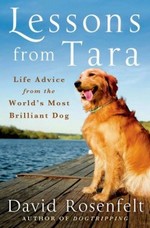
Lessons from Tara by David Rosenfelt

Lessons from TaraLessons from Tara: Life Advice from the World’s Most Brilliant Dog

by David Rosenfelt

Hardcover, 227 pg.
St. Martin’s Press, 2015

Read: January 23 – 25, 2016


One of my resolutions this year was to read more Non-Fiction — I’m going to try for 1 a month, in addition to “whenever I see something that catches my eye.” So, I marched up to the New Release shelf at the Library and started browsing — hope sinking fast, a whole lot of diet, productivity and political books. Ugh. Just not in the mood, then I got to the 600’s and David Rosenfelt’s name jumped out at me. Had to do it, Rosenfelt talking about Tara (the inspiration for Andy Carpenter’s dog) might be cheating a little, but it was good enough.

I was expecting a little Marley & Me-ish type story about the Rosenfelts and Tara. I couldn’t have been more wrong — thankfully (this meant I sniffled far less than I would’ve otherwise). This is a collection of short (no more than 5 pages), mostly humorous, essays about their life and work with Rescue Dogs. Tara is mentioned frequently, as the work they do with Rescue Dogs was inspired by her, but she’s not the focus of this book. It’s their entire menagerie, those they’ve rescued that aren’t part of their pack, the humans they’ve worked with — and even a few they decidedly haven’t — and the lessons Rosenfelt has learned from them.

While every chapter has a joke or two, some are pretty serious — Rosenfelt talks earnestly about the way people treat dogs — particularly older dogs. The focus of The Tara Foundation is on older/senior dogs who aren’t that likely to be adopted from shelters. I know that he’s made me rethink what dogs I look at when we go to adopt next.

Fans of the Andy Carpenter series will be happy to hear that Andy’s voice is Rosenfelt’s — the book at times feels like an Andy Carpenter book without all the muss and fuss of a plot, murder, or trial. I laughed, I chuckled, I learned a thing or two, and I even got misty more than I wanted to. All in all a really strong read. If you’re a dog lover, or just someone who likes to read good things, find some time for this one.

—–

4 Stars

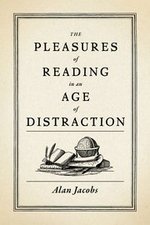
The Pleasures of Reading in an Age of Distraction by Alan Jacobs

The Pleasures of Reading in an Age of DistractionThe Pleasures of Reading in an Age of Distraction

by Alan Jacobs

Hardcover, 150 pg.
Oxford University Press, USA, 2011

Read: December 21 – 25, 2015

A while back my teenage son drifted into the room where I was reading, tilting his head to catch the title of the book in my hands. It was that venerable classic How to Read a Book, by Mortimer Adler and Charles van Doren. “Oh man, he said, “I had to read that in school last year. Maybe I learned something about how to read a book, but after that I never wanted to read a book again.”

Oh, I hear ya, brother! I endured Adler/van Doren for a graduate-level course and thought it was one of the most pointless books I’d ever read. Now, Jacobs finds more profit in the tome than I do, but he’s clearly not a fan.

The book starts with a call to read what you want, reading based on whim, rather than thinking of it as a self-improvement program (which it is, in a way, but it doesn’t have to be followed like one). In fact, Alden, Harold Bloom, etc. turn

reading into the intellectual equivalent of eating organic greens. . . That sort of thing is not reading at all, but what C. S. Lewis once called “social and ethical hygiene.”

Instead, Jacobs calls for people to:

Read what gives you delight–at least most of the time–and so without shame. And even if you are that rare sort of person who is delighted chiefly by what some people call Great Books, don’t make them your steady intellectual diet, any more than you would eat at the most elegant of restaurants every day.

Jacobs is a Professor of the Humanities at Baylor University, and author of many books and articles on books, reading, and authors. He’s one of those guys I’ve seen the name of everywhere, and associated with insight, but if push came to shove, I couldn’t tell you why. But now he’s the professor I wish I had (nothing against most of the early ’90s English department at the University of Idaho, most).

Reading on a whim doesn’t mean you can’t stretch yourself, read above your comfort level, or to better yourself — but you do it because it interests you, because you want to (and when you want to), rather than subjecting yourself to someone’s checklist.

After that, Jacobs moves into trying to understand how reading works, how it captures so many imaginations — and sure, he cites some studies that explain how we take black marks on paper and make them ideas in our head, at some point even the professionals have to stop and say, “it just works.” (but Jacob puts it better).

We also get discussion about the “iron-clad Law of Diminishing Returns” regarding rereading too soon (and yet, why we should reread). An interesting defense of/encouragement of fanfic. I was surprised, quite surprised, at his advocacy for e-Readers — I fully expected him to be solidly Dead Tree Edition Only, whoops — I don’t use my Kindle the way he does, but I can see where it’d work for him (or Nook, either). Why a lot of the doomsayers about the state of reading/publishing are wrong.

But mostly this is advice and guidance for the reader trying to recapture the same joy that he had before (or never had), encouragement for the active reader to keep at it, the person who still can’t get poetry, etc., etc.

I can’t resist another quotation. Towards the end of the book, he talks about the joy of finding a book by Serendipity:

serendipity is the near relation of Whim; each stands against the Plan.

Plan once appealed to me, but I have grown to be a natural worshiper of Serendipity and Whim; I can try to serve other gods, but my heart is never in it. I truly think I would rather read an indifferent book on a lark than a fine one according to schedule and plan.

Charmingly written, full of allusions (that most of us can get even without reading the works), witticisms and research — a book to entertain and edify. This one really speaks to me as a reader — it’s practically a mission statement for this blog. I expect I’ll come back to this one soon (maybe even annually). Still, for this time, I’m rating it 4-Stars, though I expect it’s a 5-Star book. I think it’s because I read it in 2-5 page spurts (one of those weeks, y’know?) after I got to page 70. Which doesn’t do the thing any favors. Towards the end of the book, Jacobs says:

All books want our attention, but not all of them want the same kind of attention.

I didn’t give this the right kind, and I’ll regret that for awhile.

If you like this blog, you’ll dig this book.

—–

Big Thanks to Aman Mittal for pointing me to this book — I haven’t read his take on it in a couple of months, so I don’t know how much we agree, but I know his post made me look for the book.

—–

4 Stars

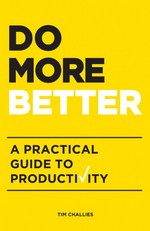
Do More Better by Tim Challies

Do More BetterDo More Better: A Practical Guide to Productivity

by Tim Challies

PDF, 114 pg.
Cruciform Press, 2015
Read: December 11 – 12, 2015


Abraham Lincoln reportedly said about someone’s book, ” People who like this sort of thing will find this the sort of thing they like.” If it were chronologically possible, he might have been talking about Do More Better. I am not the person who likes this sort of thing, but I have profited from reading some productivity-improvement books — this does not fit into that category. Could it help some people? I don’t see why not, but there’s a lot of people who won’t see their lives fitting into his mold (count me as one of them).

But honestly? I was turned off by the book before he started the practical section. I’m not going to give a detailed analysis, this isn’t the type of blog to do that, but I can give a thumbnail.

The first few chapters, the theory, or groundwork for his productivity guidelines are pretty questionable. Despite Challies’ proof-texting, I’m not convinced that any apostle or prophet encouraged anything along these lines (you could make the case that Solomon’s Proverbs could be used to these ends, not that I see Challies appealing to them). It looks so much like the kind of schemes we Americans (and, I suppose, Canadians) like — if I just do X, Y and Z, I can be whatever I want to be. If I eat all my veggies, especially the gross tasting ones, I can grow up big and strong. If I implement Method Q with Style R and Teaching S on a consistent basis, I’ll have well-adjusted, successful kids. And so on.

Chapter 5 on are so programmatic, so specific to his own scheme, that it’s restrictive (I’m sure he’d argue these aren’t hard-and-fast rules, only guidelines, but to implement them as he suggests, you’d pretty much have to treat them as hard and fast for however long it takes to set them as habits). I’d spend so much time for the first few weeks with his book in one hand and my Galaxy Note in the other, just making sure I was doing what I was supposed to be doing as far as my Tasks, Calendar and Information were concerned — even before my weekly Reviews. How would I get anything else done? Good question. As an example — I’ve been an Evernote junkie for 4 years now (this was composed on Evernote), but to use it the way he wants me to would take a focused readjustment.

Lastly, this is the kind of book that can only be produced in the affluent West. More than one author/speaker has talked about “The Cave Test” when it comes to evaluating worship “styles” — if it can be duplicated in a cave while meeting in secret, it’s fitting for Christians. While reading this, I wondered just how many countries (or parts thereof) in this world, where practicing Challies’ principles would be possible. The fact that a large percentage of the Church could not (and has not) been able to think in these terms — much less put this into practice — says a lot about their role in the Christian life.

I suppose I should say something about the writing — it’s certainly competent, clear and succinct. But it’s not at all interesting. Can you write about productivity/time management/etc. in an interesting, even entertaining fashion? Sure — see Chris Hardwick’s The Nerdist Way (not at all Rated G) as one example — but that’s not saying you have to. I don’t need to be entertained every second of the day, but if you want me to stay with a book (even a short one), you need to be more interesting than my microwave’s Instruction Manual. This was just so bland it was hard to keep focused.

I’m not suggesting that no one read this book, if reading the product description makes you think it could help you, I’m not going to argue. But I’m certainly not going to to suggest anyone go out and grab a copy — or even to borrow one. Do I think it’d be better if he removed his purported theological underpinnings from this? Yes. I’m also convinced it wouldn’t make a lick of difference to Chapters 5-10 in application (which speaks volumes).

—–

I received this book from the kind people of Cruciform Press for this review, I hope they don’t regret it.

—–

1 1/2 Stars

Page 29 of 31

Powered by WordPress & Theme by Anders Norén