Tag: Non-Fiction Page 30 of 31

Messy Grace by Caleb Kaltenbach

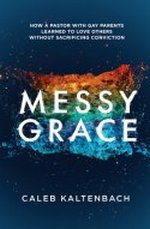
Messy GraceMessy Grace: How a Pastor with Gay Parents Learned to Love Others Without Sacrificing Conviction

by Caleb Kaltenbach
Trade Paperback, 203 pg.
WaterBrook Press, 2015
Read: December 6, 2015

Straight off, I could tell Mr. Kaltenbach and I approach things very differently. There is a looseness to his language that I can’t tolerate on theological matters — I, like the noted Richard Rogers, serve a precise God*, and it gives me hives to read people who don’t — though I readily acknowledge (and lament) that he’s speaking in the Evangelical Vernacular. By page 5, I was grimacing at his phraseology. Particularly his use of “messy” and it’s connection to grace, and his insistence that there’s a “tension” between grace and truth — but I’ll return to that in a bit.

The first few chapters outline the problems between the perceived (and, sadly, sometimes real) destructive attitudes of Christians towards LGBT people and the perceived (and, sadly, sometimes real) combative stances and attitudes of LGBT people towards Christians. Kaltenbach illustrated this with episodes from his own childhood and what he’s seen in the pastorate. Sadly, he’s too impressed with generalizing from his autobiography (it’s not a totally improper strategy, but Kaltenbach doesn’t bring in anything to buttress his arguments). He also displays an over-reliance on platitudes and catch-phrases. Worst of all, he’s good at using stereotypes and generalizations when calling for those he’s stereotyping/generalizing to stop stereotyping and using generalizations about LGBT people.

I admit I was thoroughly annoyed with him by the time I got to chapter 6, when he (largely and temporarily) put aside the anecdotes and actually got around to explaining the Scriptural view on the topic at hand by brief glances at various texts, responses to critics, and so on. Could this chapter have been better? His explanations less open to criticism by theological opponents? Yes. That said, it was pretty good — and a very good introduction to the ideas he offered (his “More Reading” list at the end of the book contains much that would do a better job on this point).

I have several reservations and problems with Kaltenbach doctrinally and theologically. Actually, despite frequent use of the word “grace,” I’m not sure what he means by the term, but I’m pretty sure it’s not what the biblical writers mean by χαρις. In a fallen world, plagued by sin (a term Kaltenbach avoids), the favor of God, the goodwill of God towards undeserving sinners because of Christ’s work on their behalf (my quick and dirty definition of grace) will be messy, it will be found in messy situations with messy people — because there are no other kinds of people. Calling grace “messy” is like saying it’s “undeserved.” There is no other kind. Kaltenbach also spends a good deal of time talking about a tension between grace and truth, and I don’t see that where he locates it in the Scriptural witness, or anywhere else. In fact, throughout the Old and New Testaments, the two go hand in hand.

Both his dependence upon the Pericope Adulterae (John 7:53-8:11) for his approach to those who differ from him and his indictment of Imprecatory Psalms make me worry about his view of scripture. I can’t help but wonder, built on such an unstable foundation, how much of Kaltenbach’s arguments can stand.

That said, from Chapter 6 on, there is little I flat-out disagreed with — the differences ranged from minor quibbles to exceptions — but he said nothing that I’d say was entirely wrong or baseless, and I could appreciate what he said and where he was coming from. Both his understanding of the biblical teaching on sex, and the way that Christians should interact with, think about, and treat those with whom they disagree on sensitive issues is commendable and spot-on. As this is the point of the book, however sloppily he goes about it, I have to like that.

It’s a good 101 book (maybe a 080?), but one should grab his “More Reading” list and work through it — Champagne Butterfield’s book would be the best to start with if you like the memoir aspect of this book.

* If you’re unfamiliar with the story, see DeYoung’s quotation of Packer here.

—–

I received this book from the ever-so-nice people at Blogging for Books for this review.

—–

3 Stars

You’re Never Weird on the Internet (Almost) by Felicia Day

You're Never Weird on the Internet (Almost)You’re Never Weird on the Internet (Almost)

by Felicia Day
Hardcover, 258 pg.

Touchstone, 2015

Read: November 2, 2015


There is, a certain degree of difficulty in evaluating a memoir or autobiography, you can’t really critique the plot — “I just didn’t find the protagonist all that believable here,” “sure, things like that just happen…” You’re limited to writing ability/style and what’s contained in the volume (or what’s left out).

So let me start with my minor gripe: I’d have liked a little more information on The Guild — what we got was great, but we barely got any information/impressions on her castmates, the stories, anything beyond the process of getting the first episodes made and then securing the means to make the rest. Even more, I’d have loved more about her work on Buffy, Dr. Horrible, Eureka, and Supernatural which barely got a mention. I get that the book isn’t about that kind of thing — and I can appreciate that. But, I’d have liked to see that kind of thing (and I expect I’m not alone).

So what is the book about? It’s about Felicia Day — how the things in her life made her who she is. So yes, there’s a lot about The Guild, and what the process of making it did to her. Not too much about the other projects, sadly. But while reading it, I didn’t give it much thought beyond muttering to myself, “Oh, come on, we’re just skipping ____?”

Weighed against all the things about this book that really work, that’s really minor (but apparently takes me two paragraphs to explain). If you’re a fan of Felicia Day’s, you know that persona she’s established (I’m not saying it’s not primarily genuine, but she’s careful to keep it consistent). That persona shines forth in every sentence in this book. It’s hard, really hard not to hear Day’s voice in your head as you read this — at a certain point, I stopped trying because why should I? It’s fun hearing things in her voice — most of her readers are reading the book because they enjoy her — that’s why they got the book.

She talks about her mother’s unique approach to homeschooling (“for hippie reasons, not God reasons”), the various and sundry artistic endeavors she tried as a kid/teen — singing, dancing, acting, violin, and more, her college experience, her early acting days, discovering her writing/producing/creative mojo — and most importantly, discovering video games and the Internet.

This, and more, told in her indelible, inimitable, charming style, makes this book a winner — and a real laugh-out-loud read. Also, this book is noteworthy for the most mentions of Ross Perot in any book I’ve read this century. That really has nothing to do with anything, but it’s such strange distinguishing mark, I felt it had to be mentioned.

—–

4 Stars

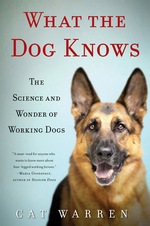
What the Dog Knows: The Science and Wonder of Working Dogs by Cat Warren

What the Dog KnowsWhat the Dog Knows: The Science and Wonder of Working Dogs

by Cat Warren

Hardcover, 280 pg.
Touchstone, 2013
Read: May 7 – 15, 2015

People are smart, just like dogs.

Seriously, how do you not like a book that contains that line?

Honestly, the only reason I gave this book a second glance — okay, a first glance — is that Robert Crais blurbed the paperback edition and it showed up on his Facebook page. It seemed kind of interesting, but I wasn’t sure — then I noticed that Spencer Quinn also wrote a blurb. And if two of my favorite mystery novelists (who have a thing for dogs) tell me the book is good, it must be.*

They were right — Warren was a journalist, is now a professor, and knows her way around a sentence. She clearly cares about the subject and has invested a lot of time and effort into getting to know it, her style is engaging and charming (I was chuckling within a couple of pages), and she doesn’t mind showing her own failings and weaknesses.

The history and science of dogs/other animals being used for their sense of smell, is probably the most fascinating part of this book, but it’d be really easy for the material to be too dry to bother with — Warren’s voice keeps that from happening. I think it’s terrific that at the end of the day, no one knows what it is about the smell of the human body that dogs sense — she’ll explain it better than me, but that’s the kernel the story. I just really enjoy it when the best and the brightest have to shrug and say, “I don’t know.” The chapter she spends on the future of dogs and/or digital replacements is good for similar reasons. Actually, I could just keep listing little facts/factoids/ideas here, but I don’t want to steal Warren’s thunder.

The best part of the book — the part that I found most interesting, and most frustratingly small — is the Warren’s story about getting Solo, discovering he had just too much energy and personality, and needing to find an outlet for it all. Which is followed by the trials and tribulations of a newbie cadaver dog handler and her pup-in-training, growing into a capable working dog. Anyone who has a dog lover as a Facebook friend knows just how easy it is for someone’s stories about their dog to get to the point where you can’t stand to hear another**. Somehow, Warren avoids this totally — not an easy feat. It probably helps that dog does far more fascinating things than just hiking through the woods or chasing a ball.

The stories about the others — her friends, colleagues, teachers, etc. — round out the book. It’s not just about Warren and Solo, it’s not just about the military/police efforts with training animals — it’s about dedicated volunteers, K-9 officers and dogs all over the country (and the world) making a difference. In places and ways you wouldn’t expect. Really? Sending in one guy and his dogs into Vietnam decades later to search for POW/MIA? Also, seeing how different dogs act differently, yet get the same job done was mind-boggling. Especially for dogs trained together/by the same person, you’d think they’d act similarly.

I imagine it’s to spotlight the work of others, to not brag about Solo too much, to talk about things that she and her dog haven’t done/seen/smelled — or whatever reason there is, I wanted more Solo. A lot more. I have no problem with the rest of the book, it’s just that there’s not enough Solo (or Coda).

Fascinating, entertaining, and educational — can’t ask for much more than that.

—–

* Yes, I’m aware there are flaws in the thinking there.
** Of course, your friends don’t have dogs as cool as mine. Let me tell you a little bit about her . . .

—–

4 Stars

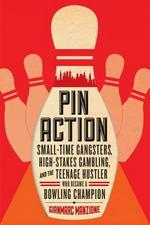
Pin Action: Small-Time Gangsters, High-Stakes Gambling, and the Teenage Hustler Who Became a Bowling Champion by Gianmarc Manzione

Pin ActionPin Action: Small-Time Gangsters, High-Stakes Gambling, and the Teenage Hustler Who Became a Bowling Champion

by Gianmarc Manzione

Hardcover, 336 pg.
Pegasus Books, 2014
Read: March 4 – 5, 2015
This is just not that good.

It started off promising, there’s a confidence to the writing, it’s a world I know nothing about — so I could learn a lot, it starts with a whole bunch of colorful characters, and Manzione’s passion for the subject is evident and real. But it didn’t take long for me to see that the confidence isn’t necessarily deserved, the cast wasn’t being used well, and I wasn’t going to learn all that much (at least not right away, it turned out), and while he cared a lot — I just didn’t. Eventually, around the half-way point, the book found its way and became tolerable — but, by then it was too late — Manzione had already lost me.

The first few chapters are a hodgepodge of stories about the “Action Bowling” scene in and around NYC in the 1960s. They center around wunderkind Ernie Schlegel, but Manzione spreads the wealth — telling stories about several bowlers of similar aptitudes at the time. But really, these chapters aren’t a stories of bowling, they’re stories about small-time gangsters (see the subtitle) — think of some of the small anecdotes in Wiseguy, told without Pileggi’s style. The bowling’s just an excuse for criminal and/or stupid behavior.

The last half of the book is all about Schlegel’s professional career — from the rocky start, to accomplished (but not championship heyday), to the last bits of glory. This is the best part of the book, no doubt about it. But Manzione has difficulty maintaining the story line, keeping the narrative tension going, and basically becomes rabid fanboy (I’ve got no beef with rabid fanboys, readers of this blog know I can go that way myself — but it didn’t fit here)

The greatest weakness of this book has to be the writing. Manzione has a tendency to “nest” stories in other stories that in other stories worse than Inception. It’d be pretty easy to lose track of the ball when he’s doing this. He frequently seems to operate on the philosophy: never use one sentence when you could use three instead. Throughout there’s an overuse/over-reliance on superlatives. And lastly, I’m not sure how many Ali/Frazier metaphors one book can take (but it’s less than this one tries)

One unexpected pleasure for me was that as a long-time listener to The Nerdist podcast, it was fun reading so much about Billy Hardwick.

Just can’t recommend this one, it wasn’t horrible, but I’m sure there are better books about professional (or gambling-enhanced amateur) bowling out there for anyone who’s looking for that.

—–

2 Stars

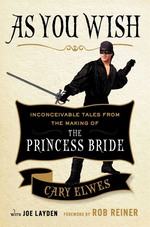
As You Wish: Inconceivable Tales from the Making of The Princess Bride by Cary Elwes with Joe Layden

As You Wish: Inconceivable Tales from the Making of The Princess BrideAs You Wish: Inconceivable Tales from the Making of The Princess Bride

by Cary Elwes with Joe Layden

Hardcover, 259 pg.
Touchstone, 2014
Read: December 31, 2014
I’m not the world’s biggest Cary Elwes fan — I’ve never not enjoyed him, but I’ve never sat down and said “I should find an Elwes movie to watch” or “oh, Elwes is in that movie/show? Gotta watch it now.” So when I saw this book on the shelves, I thought “how nice for him that he wrote a memoir,” and since he was in his Dread Pirate Roberts getup that he’s not one of those actors who’s running from the one thing that made them “big.” But I had no real interest in reading it — enough so that I didn’t even read the subtitle, which probably would’ve piqued my interest.

So it wasn’t until he was a guest on Kevin Pollak’s Chat Show that I learned anything about the book (audio version is here, the video version is here and either would be well-worth your time) and decided I really wanted to read this book.

This is also one of the biggest reasons not to read the book — Elwes tells about half the stories in the book during the interview. And hearing him tell them, clearly enjoy the memories, and do pretty good impressions and entertaining voices while doing so is more enjoyable than reading them after the fact.

Still, I’m glad I read the book — there are plenty of other stories about the making of that wonderful movie, some details he doesn’t give of the stories he did — and some bits from interviews that Elwes and/or the writer working with him did with the cast, director, writer and producer. I laughed out loud at one of the new stories, and enjoyed many of the others.

It’s clear that Elwes loved making this movie and the way it’s become a favorite of so many. There are some funny stories (most of them), some interesting behind the scenes stuff, and some perspective on his fellow cast members.

Particularly, this book reads as a mini-tribute to Andre the Giant. If there’s a good biography of him, I should track it down, the man had a fascinating life. This book needs to be read for the story of Andre the Giant farting during filming alone — I promise that it will make your inner-8-year-old boy laugh (even if you’re a grown woman who didn’t realize you had an inner-8-year-old boy).

Not the best book I’ve ever read about making a film, but probably the warmest. A very pleasant read, and I’d really recommend it to fans of The Princess Bride. I’ve got to find the time to watch the movie now…and maybe re-read the book, too.

—–

4 Stars

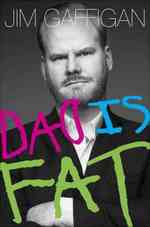
Dad is Fat by Jim Gaffigan

Dad Is Fat

by Jim Gaffigan

Published May 7th 2013 by Crown Archetype
Read: July 19 – 22, 2014

It’s been years — almost decades since I last read a book by a stand-up comedian. I used to love them — you get their act, usually expanded — if not, at least more of it then you got to see on TV in Idaho. If you were familiar enough with the comedian, it was almost automatic to hear their voice in your head as you read. Always liked them, just ran out of time/money.

But I’ve been feeling the pull towards Jim Gaffigan’s Dad is Fat for awhile now, so when Blogging for Books offered me a copy, I jumped on it. Which was a good move on my part — this is a funny book.

Not a a surprise, I realize. Still, it is good to see that he can transfer his humor to the page (you can never be sure). A good deal of the material — but not all — is adapted from his stand-up, and that’s funny enough. But the rest is just as good — if not better, because it’s fresher and in a different medium, so he can do other kinds of humor. I laughed out loud more than a few times, and had to resist reading the entire thing to whoever happened to be near-by.

But frequently, Gaffigan sets the jokes aside to talk about being a parent, the choices that women and men make to do that — how so many don’t understand why people do that. He defends the choices his family made to have kids, to have as many as they have, and to have home births. He doesn’t stop joking as he does this, but they do take a back seat to what he’s talking about though (while serving as the proverbial spoonful of sugar to help). These points are where the book is the strongest, he doesn’t attack those who disagree, rather he says this is what they’ve decided to do, let them follow their own convictions and stay out of their way. Which doesn’t seem so much to ask, but we all know better. He takes a simple, commonsense approach to this stuff — he doesn’t get too esoteric or philosophical, just a simple, pragmatic “this is what we did, and it works for us.” My esteem for he and his wife/writing partner increased after reading this book.

They’re short essays, and I wouldn’t recommended reading too many of them in one sitting — just a few at a time to keep it fresh and funny.

If anyone in the world actually remembered the book, I’d compare this to Paul Reiser’s Babyhood but from a different angle. It has a similar mix of humor and sentiment on the same topic. Dad is Fat has a lot of laughs, some warming of the heart, and so many lines that I want to quote, I’d cross into copyright infringement if I tried. Give it a whirl, even if you don’t have kids, you’ll probably enjoy this.


Note:I received this book for free from Blogging for Books for this review. Which was generous and cool of them, but didn’t impact what I said about the book.

—–

4 Stars

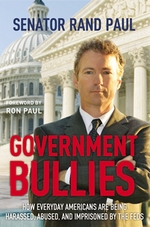
Dusted Off: Government Bullies: Americans Arrested, Abused, and Terrorized by Rand Paul

Government Bullies: Americans Arrested, Abused, and TerrorizedGovernment Bullies: Americans Arrested, Abused, and Terrorized

by Rand Paul

Hardcover, 272 pg.
Center Street, 2012
Read: October 16 – 29, 2012

Great read. This book angered me, made me want to change the world, and filled me with despair–certain that things’ll only get worse. Frequently within the same paragraph (if not the same sentence). These tales of bureaucracy run amok should (and likely will) cause any freedom-loving patriot’s blood run cold.

I can see where a lot of people would get tired of Paul bringing himself into the book as often as he does–as a candidate or Senator. But honestly, it’s only as Senator/candidate that Paul gets this information, gets this perspective. Besides, he’s got to look toward re-election and this is part of his work earning that.

—–

4 Stars

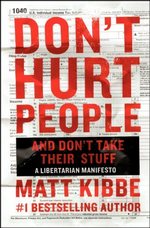
Don’t Hurt People and Don’t Take Their Stuff: A Libertarian Manifesto by Matt Kibbe

Don't Hurt People and Don't Take Their Stuff: A Libertarian ManifestoDon’t Hurt People and Don’t Take Their Stuff: A Libertarian Manifesto

by Matt Kibbe

Hardcover, 272 pg.
William Morrow, 2014
Read: June 19 – 20, 2014

FreedomWorks’ Matt Kibbe has produced a very accessible, very readable libertarian manifesto. A rallying cry for a grassroots movement of concerned citizens. He focuses on 6 Rules for Liberty, emphasizing 1 & 2:

Rules for Liberty:
1. Don’t hurt people.
2. Don’t take people’s stuff.
3. Take Responsibility.
4. Work for it.
5. Mind your own business.
6. Fight the power.

With these as a starting point, he critiques many aspects of the U. S. Government (current and recent administrations of both parties) as it currently operates. Kibbe is positive about (a few) politicians on both sides of the aisle, but he’s mostly negative about the overwhelming majority. Sure, he’s more positive about Liberty-leaning Republicans than anyone else currently in Washington, but at the end of the day, he wants to replace both parties.

Compared to a lot of Libertarian/Libertarian-ish books that I’ve read, this is pretty light reading. He jokes, he drops pop culture references, he’s not all that cranky, he writes with conviction and hope. He drops lines like:

Music and freedom just seem to go together, just like the word “bacon” belongs in any sentence that includes the phrase “proper meal.” I can’t prove it, but you just know that it’s true.

One chapter features a simulated round table between Sen. Rand Paul, Sen. Mike Lee, Sen. Ted Cruz, Rep. Justin Amash, Rep Thomas Massie, and Rep. David Schweikert — based on interviews he conducted with each individually. Yes, a real round table would’ve been better, but this was probably easier to pull off. But seeing the way that these men were similar, yet distinct, was good to see. Kibbe’s not promoting a monolithic libertarian view, there’s room for differences based on a shared commitment to the 6 Rules.

It seems so strange that a book on politics is as dependent on a classic rock album (Rush’s 2112, which I should really try to listen to one day) as one of my favorite SF novels of recent years, but — hey, it works. I don’t think this book will convince anyone to become a Libertarian. But it does present a case for the philosophy, it will serve as a good introduction for those who are curious. In contrast to many of his peers — who come across as cranks or kooks — Kibbe comes across as someone with conviction, someone of principle, while still remaining rational.

I remember debating Chris Matthews, the guy on MSNBC’s Hardball, once at an event in Aspen. I was making a (surely profound) point, and Matthews abruptly interrupted. He does that. “I know, I know,” he said. “I read Ayn Rand in high school. I used to believe that stuff, too, but then I grew up.” Maybe he didn’t know he was parroting his favorite president, Barack Obama.
I’ve heard this so many times. I’m sure you have, too. . . Grow up. Play ball. Get in line.
Well, I don’t want to “grow up.” I don’t want to if growing up means abandoning the principle that individuals matter, that you shouldn’t hurt people or take their stuff. I don’t want to give up on values that have gotten me down the road of life this far. I won’t “grow up,” if that means not seeking ideals, taking chances, and taking responsibility for my own failures. I don’t want to compromise, at least not on the things that really matter. I don’t want to split the difference on someone else’s bad idea, and then pat myself on the back for “getting something done.”
I have no plans to fall in line.
I do the best that I can, and I belong to a community of many millions of people who seem to agree with me on the things that really matter.

—–

4 Stars

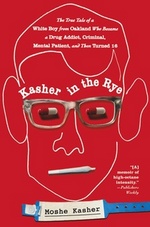
Dusted Off: Kasher in the Rye: The True Tale … by Mose Kasher

Kasher in the Rye: The True Tale of a White Boy from Oakland Who Became a Drug Addict, Criminal, Mental Patient, and Then Turned 16Kasher in the Rye: The True Tale of a White Boy from Oakland Who Became a Drug Addict, Criminal, Mental Patient, and Then Turned 16

by Moshe Kasher
Hardcover, 303 pg.
Grand Central Publishing, 2012
Read: June 1-3, 2012

This book about the descent of a very young man into delinquency and addiction (and his eventual recovery) in just about any other hands could’ve been maudlin, sappy, trite or overly-sentimental. But Kasher’s skill shows itself in being honest and articulate while being able to joke about the tragic events described.

That doesn’t mean he’s making light of anything or glorifying in the problems. But it does seem to allow him some distance from the horror so he can talk about it.

This is a heartbreaking work, eye-opening, educational, incredibly relatable, occasionally laugh-out-loud funny. Great, great book.

—–

5 Stars

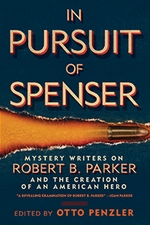
Dusted Off: In Pursuit of Spenser, Otto Penzler, ed.

In Pursuit of Spenser: Mystery Writers on Robert B. Parker and the Creation of an American HeroIn Pursuit of Spenser: Mystery Writers on Robert B. Parker and the Creation of an American Hero

by Otto Penzler
Paperback, 247 pg.
Smart Pop, 2012

I loved this book.

It has been years since I’ve read a festschrift–and this is the only one I’ve read that wasn’t about a figure in the Presbyterian/Reformed tradition. I’d forgotten how nice they can be.

It was like hanging out with a bunch of articulate friends talking about our dearly departed friend/mentor/idol. Insightful, occasionally moving, occasionally factually wrong (extreme fanboy alert)–a great tribute to Dr. Parker.

—–

5 Stars

Page 30 of 31

Powered by WordPress & Theme by Anders Norén