Tag: Reading Page 1 of 2

Books about Books and the People Who Love Them

Updated 8/9/2025

Saturday was National Book Lovers Day (yes, around here, that’s just another way of saying it’s a day that ends in “ay,” except it’s a National thing). I’m not sure that “Lover” is the best way to describe me—buying, reading, and surrounding myself with books is just who I am. “One does not love breathing,” as Miss Jean Louise Finch, said.

Or in the words of Patrick Rothfuss, “I always read. You know how sharks have to keep swimming or they die? I’m like that. If I stop reading, I die.”

Scout and Rothfuss are likely overstating things—or maybe not, but they can give that impression. So maybe it’s safer to call ourselves book lovers, eh?

I’ve been meaning to post something about National Book Lover’s Day for years now, but I’ve never really known what to say. But it occurred to me (as I was saying that) that I could put together a handy-dandy list of books that show love to books, either about talking about books or those who write, read, sell, or loan them.

This isn’t necessarily a complete list, in fact, I’m sure it’s not. I did a quick survey of the 5200 plus posts I have here) to compile this list in two days in 2024, plus a little bit of time adding books since then. But it’s a pretty thorough one—I’ll get this in better shape by next year.

(Probably…Maybe…We’ll see.)
Books about Books and the People Who Love Them

(Links will take you to my post featuring the book.)

NonFiction

Fiction

  • A Rare Book of Cunning Device (Audiobook) by Ben Aaronovitch, Kobna Holdbrook-Smith—a fun, short, installment in the Rivers of London that finds Peter and some friends in the basement of the British Library (which sounds like a great place to visit for someone like me) tracking down a magical book.
  • What You are Looking for Is in the Library by Michiko Aoyam—a series of short stories depicting people struggling through various stages in life being helped by a wise librarian (almost magically so) directing them to just the right book to lead them to improve their lives.
  • The Book That No One Wanted to Read by Richard Ayoade, Tor Freeman, Jarvis Cocker, Lydia Fox—a book written by a book (making it far different than a book written by a person) about a book that no one wanted to read and how to help it. That’s a lousy description, so let me just say—you need to read it.
  • No Two Persons by Erica Bauermeister—a series of short stories follows the path of a book from its writing, to finding an agent, to the audiobook narrator, and the impact it makes on the lives of those who encounter it in various forms.
  • The Book of Doors by Gareth Brown—A bookstore clerk finds herself in a world of magic and wonder (and danger) thanks to impossible books.
  • The Finlay Donovan series by Elle Cosimano—a romantic-thriller writer’s conversation with her agent is overheard and misunderstood leading to her being hired as a hitman. Hilarity, danger, and amateur crime-solving ensues as she and her live-in nanny try to stay out of trouble.
  • I Cheerfully Refuse by Leif Enge—in a largely (and proudly) post-literate postapocalytpic society, one rare book brings turmoil to a community and family. (there’s a lot of other things going on, too–but that’s the core)
  • The Hero Interviews by Andi Ewington—a young man goes off to research a book into what makes a hero by interviewing all sorts of stock (and some not-so-stock) Fantasy Characters
  • The Thursday Next books by Jasper Fforde—I’ve only read two of these (and I don’t know that I’ll read more, which is a commentary on me, more than the books), but they’re a strange and often delightful series about a literary detective who can travel in time, space, and into books.
  • The Ian Ludlow thrillers by Lee Goldberg—follow a thriller writer whose life keeps getting turned upside down when the plots of his novels keep coming to life as various and sundry criminals and terrorists borrow his ideas.
  • Ban This Book (Audiobook) by Alan Gratz, Bahni Turpin (Narrator)—an elementary school girl, upset that she can’t borrow her favorite book from the school library anymore, begins a lending library from her school locker featuring several books the school administration has decided don’t belong in the library.
  • Summer Hours at the Robbers Library by Sue Halpern, read by: Josh Bloomberg, Dara Rosenberg, Allyson Ryan—I can’t sum up this book about found-families in a small-town library beyond this inadequate try.
  • My Lady Jane (Audiobook) by Cynthia Hand, Brodi Ashton, Jodi Meadows, Katherine Kellgren—Within this YA/Supernatural novel that re-writes Lady Jane Grey’s life, we get a love letter to books — and Jane is the representative book lover par excellence (though she could like poetry and novels a bit more)—there’s a treasure trove of quotations about reading, books, and related topics in these pages.
  • The Hawthorne and Horowitz Mysteries by Anthony Horowitz—These books feature a fictional and somewhat hapless Anthony Horowitz being hired to follow a consulting detective on some cases and write about Hawthorne’s successes (because Hawthorne needs the extra money).
  • How I Became a Famous Novelist by Steve Hely—a hilarious, over-the-top (yet probably really tamer than reality) satire about the publishing industry and the selling/making of books.
  • The Door-to-Door Bookstore by Carsten Henn, read by: Raphael Corkhill, translated by Melody Shaw—Schmaltzy but earnest story about an older man connecting people with just the right books
  • The Library Murders by M.R. Mackenzie—a twisty murder mystery that includes a sincere and heartfelt tribute to Library workers and the value of their service.
  • The Jake Mooney books by Duncan MacMasterHack, Hacked, and Hacker (that I really need to write a post about) tell the story of a ghost writer who keeps finding himself in situations where he has to solve murders and try to keep from becoming the next victim. Funny, action-filled, mysteries
  • Namaste Mart Confidential by Andrew Miller—a would-be novelist and his stand-up comedian roommate/coworker serve as unlicensed P.I.s when they’re not working at a supermarket.
  • Lula Dean’s Little Library of Banned Books by Kirsten Miller—this is a sanctimonious and shallow book (IMNSHO), but the message about the value and importance of all books—particularly those that people might want to ban—rings clear.
  • Jane and Dan at the End of the World by Colleen Oakley—a not very successful writer finds herself stuck in the middle of a hostage situation that closely resembles her own book—if she could just convince her husband of that fact, they might beable to get out of the situation.
  • The Awful Truth About the Sushing Prize by Marco Ocram—a mystery novel featuring a best-selling author who can create reality by what he writes (it’s more nuanced than that, but it’s close).
  • According to Mark by H. B. O’Neill—a man suffers a breakdown and is visited by Mark Twain’s ghost who convinces him to kill himself.
  • Man on a Murder Cycle by Mark Pepper—a past-his-prime author, struggling to recapture his former success, steals the work of a dead author. And then people start being killed in ways depicted in that book, making him the prime suspect. And then things get weird.
  • I Will Judge You by Your Bookshelf by Grant Snider—brilliant comic strips about books, writing, reading, and the like
  • Everyone in My Family Has Killed Someone/Everyone on the Train
  • How to Write a Novel by Melanie Sumner—the sweet (and clever) story of a 12-year-old would-be novelist in her attempt to write a novel that will sell enough to allow her mom to quit her job and take care of her family.
  • The Bookish Life of Nina Hill by Abbi Waxman—one of my favorite novels from the past five years is about a bookseller and reader discovering a family, making new friends, falling in love, and basically finding life outside of her books (but never without them)
  • The Storied Life of A.J. Fikry by Gabrielle Zevin, read by: Scott Brick—a sweet rom-com about a small-town bookseller finding love.

Irresponsible Reader Pilcrow Icon

Image by Hermann Traub from Pixabay

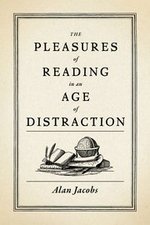
REPOSTING: The Pleasures of Reading in an Age of Distraction by Alan Jacobs

Earlier this year, I re-read three books by Alan Jacobs in what he styles as a trilogy of sorts (my paraphrase), with the intention of writing new, longer, posts about them all–or maybe one mega-post about all three. Neither of those happened, and I’m pretty sure it’s not going to happen this year–as much as they deserve it. But I still wanted to reflect on them a bit and call your attention to them. So, I’m just going to repost what I’ve said before–which, yes, means two posts about this book. I like all of this, except the rating–what was I thinking?


The Pleasures of Reading in an Age of DistractionThe Pleasures of Reading in an Age of Distraction

by Alan Jacobs

Hardcover, 150 pg.
Oxford University Press, USA, 2011

Read: December 21 – 25, 2015

A while back my teenage son drifted into the room where I was reading, tilting his head to catch the title of the book in my hands. It was that venerable classic How to Read a Book, by Mortimer Adler and Charles van Doren. “Oh man, he said, “I had to read that in school last year. Maybe I learned something about how to read a book, but after that I never wanted to read a book again.”

Oh, I hear ya, brother! I endured Adler/van Doren for a graduate-level course and thought it was one of the most pointless books I’d ever read. Now, Jacobs finds more profit in the tome than I do, but he’s clearly not a fan.

The book starts with a call to read what you want, reading based on whim, rather than thinking of it as a self-improvement program (which it is, in a way, but it doesn’t have to be followed like one). In fact, Alden, Harold Bloom, etc. turn

reading into the intellectual equivalent of eating organic greens. . . That sort of thing is not reading at all, but what C. S. Lewis once called “social and ethical hygiene.”

Instead, Jacobs calls for people to:

Read what gives you delight–at least most of the time–and so without shame. And even if you are that rare sort of person who is delighted chiefly by what some people call Great Books, don’t make them your steady intellectual diet, any more than you would eat at the most elegant of restaurants every day.

Jacobs is a Professor of the Humanities at Baylor University, and author of many books and articles on books, reading, and authors. He’s one of those guys I’ve seen the name of everywhere, and associated with insight, but if push came to shove, I couldn’t tell you why. But now he’s the professor I wish I had (nothing against most of the early ’90s English department at the University of Idaho, most).

Reading on a whim doesn’t mean you can’t stretch yourself, read above your comfort level, or to better yourself — but you do it because it interests you, because you want to (and when you want to), rather than subjecting yourself to someone’s checklist.

After that, Jacobs moves into trying to understand how reading works, how it captures so many imaginations — and sure, he cites some studies that explain how we take black marks on paper and make them ideas in our head, at some point even the professionals have to stop and say, “it just works.” (but Jacob puts it better).

We also get discussion about the “iron-clad Law of Diminishing Returns” regarding rereading too soon (and yet, why we should reread). An interesting defense of/encouragement of fanfic. I was surprised, quite surprised, at his advocacy for e-Readers — I fully expected him to be solidly Dead Tree Edition Only, whoops — I don’t use my Kindle the way he does, but I can see where it’d work for him (or Nook, either). Why a lot of the doomsayers about the state of reading/publishing are wrong.

But mostly this is advice and guidance for the reader trying to recapture the same joy that he had before (or never had), encouragement for the active reader to keep at it, the person who still can’t get poetry, etc., etc.

I can’t resist another quotation. Towards the end of the book, he talks about the joy of finding a book by Serendipity:

serendipity is the near relation of Whim; each stands against the Plan.

Plan once appealed to me, but I have grown to be a natural worshiper of Serendipity and Whim; I can try to serve other gods, but my heart is never in it. I truly think I would rather read an indifferent book on a lark than a fine one according to schedule and plan.

Charmingly written, full of allusions (that most of us can get even without reading the works), witticisms and research — a book to entertain and edify. This one really speaks to me as a reader — it’s practically a mission statement for this blog. I expect I’ll come back to this one soon (maybe even annually). Still, for this time, I’m rating it 4-Stars, though I expect it’s a 5-Star book. I think it’s because I read it in 2-5 page spurts (one of those weeks, y’know?) after I got to page 70. Which doesn’t do the thing any favors. Towards the end of the book, Jacobs says:

All books want our attention, but not all of them want the same kind of attention.

I didn’t give this the right kind, and I’ll regret that for awhile.

If you like this blog, you’ll dig this book.

—–

Big Thanks to Aman Mittal for pointing me to this book — I haven’t read his take on it in a couple of months, so I don’t know how much we agree, but I know his post made me look for the book.

—–

4 Stars

Books about Books and the People Who Love Them

Today is National Book Lovers Day (yes, around here, that’s just another way of saying it’s a day that ends in “ay,” except it’s a National thing). I’m not sure that “Lover” is the best way to describe me—buying, reading, and surrounding myself with books is just who I am. “One does not love breathing,” as Miss Jean Louise Finch, said.

Or in the words of Patrick Rothfuss, “I always read. You know how sharks have to keep swimming or they die? I’m like that. If I stop reading, I die.”

Scout and Rothfuss are likely overstating things—or maybe not, but they can give that impression. So maybe it’s safer to call ourselves book lovers, eh?

Anyway, as I said the other day, I’ve been meaning to post something about National Book Lover’s Day for years now, but I’ve never really known what to say. But it occured to me (as I was saying that) that I could put together a handy-dandy list of books that show love to books either about talking about books or those who write, read, sell, or loan them.

This isn’t necessarily a complete list, in fact, I’m sure it’s not. I did a quick survey of the 5200 plus posts I have here) to compile this list in the last two days. But it’s a pretty thorough one—I’ll get this in better shape by next year.

(Probably…Maybe…We’ll see.)

Books about Books and the People Who Love Them

(Links will take you to my post featuring the book.)

NonFiction

Fiction

Irresponsible Reader Pilcrow Icon

Image by Hermann Traub from Pixabay
Reposting Just ‘Cuz: Classically Cool—Let’s Talk Classics!

I’m having one of those weeks, and was struggling to get something posted today. Then Witty & Sarcastic Book Club retweeted this old post, Classically Cool- Let’s Talk Classics!. Which reminded me of this one that I haven’t posted in a while. I’ve brushed it up a bit, but not much because again…one of those weeks.


Last week, Witty and Sarcastic Bookclub posted Classically Cool- Let’s Talk Classics!, and it got me a-thinkin’, what Classics would I mention as faves?

Dickens doesn’t do anything for me, ditto for the overwhelming amount of Shakespeare I’ve read, Hawthorne makes me angry, I don’t get Melville’s appeal (but I also kind of do…I just don’t want to put in the effort)…but by and large “The Classics” (aka the Canon) are Classics for a reason (not because some nameless, faceless group of (now-)Dead, White Males exercised hegemonic powers to impose their tastes, either).

Still, there are some favorites:

Starting with The Oresteia (for chronology’s sake), this is the only existing example we have of a Greek dramatic trilogy. This series showing the fall-out of the Trojan War for Agamemnon and his family/kingdom and is pretty impressive.

Call me silly, but Beowulf has always really worked for me. I don’t know how to rank the various translations, I’ve read a handful and don’t think I ever knew a single translator’s name. I’ve meant to try the Haney translation since it came out, but haven’t gotten to it yet—the same goes for Tolkein’s. From about the same time (a little later, I believe, but I’m not going to check because if I start researching this post, it’ll never get finished) is The Dream of the Rood, a handly evangelistic tool (one of the better-written ones) in Old English.

Moving ahead a couple of centuries (I’ll pick up the pace, don’t worry, the post won’t be that long) and we get Gawain and the Green Knight, which is fun, exciting and teaches a great lesson. Similarly, we have that poet’s Pearl, Patience, and Purity. I don’t remember much about the latter two, beyond that I liked them, but the Pearl—a tale of a father mourning a dead child and being comforted/challenged in a dream to devotion—is one of the more moving works I can remember ever reading.

Unlike the last couple of times I posted this, I’ve actually now read The History of Tom Jones, a Foundling by Henry Fielding, and narrated my way through the book over a year + (I broke it into small chunks and then posted about every chapter or two as I read through it to keep it after several aborted attempts since 1995). It’s funny and tense, (entirely too long), the satire and commentary (both straight on and obliquely) are fantastic. I really wish I’d read it 3 or 4 times by this point in my life.

I can’t remember the titles for most of the Robert Burns poems I’ve read—”A Red, Red Rose” and “To a Mouse, on Turning Her Up in Her Nest With the Plough, November, 1785” (one of the best titles in history) are the exceptions—but most of them were pretty good. And I’m not a poetry guy.

Skipping a few centuries and we get to Alexandre Dumas’ The Three Musketeers. If all you know is the story from movies, you’re in for a treat when you actually read this thing. I’ve read it a few times, and each time, I’m caught off-guard at how fast-moving it really is, how entertaining and exciting it can be. It’s not a classic by any stretch of the imagination, but I feel compelled at this point to mention that the book about Dumas’ father, The Black Count: Glory, Revolution, Betrayal, and the Real Count of Monte Cristo by Tom Reiss is a must-read for any fan of Dumas.

I don’t remember how Ivanhoe by Sir Walter Scott ended up on my bookshelf (I think whatever relative took me to the bookstore said I could get something silly and trashy (in their view) if I got a Classic, too). But a few years later, I finally got around to reading it at about the same time that another kid in my class (we were High School sophomores) was reading it—both of us talked about how it was pretty good, but too much work. Until we got to a point somewhere in the middle (he got there a day before I did, I think) and something clicked—maybe we’d read enough of it that we could really get what was going on, maybe Scott got into a different gear, I’m not sure—and it became just about the most satisfying thing I’d read up to that point in my life.

Jane Eyre by Charlotte Brontë is one of my favorite books, probably belonging in the Top 3. Go ahead and roll your eyes at the idea of me saying that about a romance novel, that just means you’ve misread the book. This tale about integrity, about staying true to what one holds dear, what one believes, and to what is right despite everything and everyone around you is exciting, inspiring, fantastically written, and so-memorable. And, yeah, there’s a nice love story to go along with that 🙂

Speaking of love stories, we now get to my favorite, Edmond Rostand’s Cyrano de Bergerac. I steadfastly refuse to learn anything about the actual figure, because I don’t want anything to ruin this for me. When I first read the play in junior high, I considered the best parts the lead-up to the duel in Act I, and Christian’s trying to pick a fight with Cyrano the next day. Now I know the best parts are Christian’s realization in Act IV and Cyrano’s reaction to it and then, of course, Cyrano’s death (I’m fighting the impulse to go read that now instead of finishing this post). And don’t get me started about how this play’s balcony scene leaves any other romantic balcony scene in the dust. Something I’ve noticed, though, as I age, is that I’m appreciating different Scenes and Acts than I used to .

I can’t pass up an opportunity to praise, The Adventures of Huckleberry Finn, Mark Twain’s tour de force. Satire, social commentary, general goofiness, and some real heart. This book has it all.

I’m not sure that Ambrose Bierce’s The Devil’s Dictionary is technically a “Classic.” But I’m counting it as one. It’s hilarious, it’s incisive, it’s a great time for those who like to subtly (and not-so-subtly) play with words. Yeah, it’s cynical—but it’s idealistic, too (as the best cynics are). If you haven’t sampled it yet, what’s wrong with you? I just bought a new, pretty-looking hardcover of it that I cannot wait to read.

I feel strange dubbing anything from the Twentieth Century as a Classic, so I won’t talk much about The Old Man and the Sea, The Great Gatsby, Winesburg, Ohio, or Our Town (the best way short of having a dog die to make me cry is get me to read/watch Act III). But I do feel safe mentioning To Kill a Mockingbird by Harper Lee, the ground-breaking, thought-shaping, moving, inspiring, and (frequently) just plain fun look at a childhood in the South.

When I started this, I figured I’d get 4-5 paragraphs out of the idea. I guess I overshot a little. Anyway, that’s what came to mind when I read W&S’ post—maybe other works would come to mind if I did this another time, but for now, those are my favorite Classics. What about you?

How Has Book Blogging Changed the Way I Read? (Blogiversary ruminations)

This was originally published for my 8th Blogiversary, and I liked it enough that I figured it was worth reposting today. There’s some unfortunate overlap with other posts from today, but I’m feeling self-indulgent enough to do it anyway.


I started this thing on May 29, 2013, with no real idea of what I was doing—or getting myself into. At this point, I’m still not sure what I’m doing. But, I’m apparently doing it for a while.

A few months ago, one of the blogger prompt/meme things asked “How has book blogging changed the way you read?” As per my norm, I over-thought it and didn’t get around to writing anything for that particular day/week’s prompt. But that question has lingered in the back of my mind. So here are some thoughts about it—I’d have preferred to polish this some more. But I’m pretty sure if I polished/reworked this to the extend I want, there’s no way it’d go up today. It might be ready for my 9th Blogiversary (almost certainly my 10th).

How Has Book Blogging Changed the Way I Read?

I think about what I’m going to read more

I decide to read a book largely by whim (or I picked a book in a series or by an author months/years/decades ago by whim and have to keep going), but the question of when is given thought. But it’s kind of the same thing—did I just read something in a similar genre? Do I have time due to library due dates, blog tour, publication date?

Pros: Thinking about reading is almost as good as actually reading, and I generally enjoy the thinking.
Cons: I feel a little silly when I think about how much effort I put into this. Also, I can slip into spending too much time on this to the neglect of other things—like a youtube hole. I’m not talking about hours or anything. But I can spend a ridiculous amount of time on it. Deciding what to put for the “What are You Going to Read Next” part of a WWW Wednesday post can easily take 3-5x longer than assembling the post itself.

I’m better informed about selecting what I read

I almost never go into a book blind anymore—I know something about the book, the author, or the publisher. Someone—not an algorithm—has done something to bring it to my attention.

Pros:  Forewarned is forearmed, right?
Cons: Even before the pandemic eliminated this possibility, it’s been forever since I just browsed my library’s New Release shelf (or any other shelf) just to see if something caught my eye. I’ve stumbled onto real gems that way.

I think about what I read more

The origin story of this blog focuses on this point. I used to just read constantly, one book from the next, and would barely give what I read any thought. Just put one book down and pick up the next. It bugged me, but I couldn’t do much about it. My family would only put up with so much book talk from me—my eldest was a young teen when I started this and my youngest was in early elementary school, just not the right ages to talk about most of what I read, and my wife did/does listen to me prattle on, but even her eyes glaze over at a point. So writing about every (or almost every) book I read helped me stop, think about, consider, evaluate, and spend more time in each book.

I should note that there are now four people in “Real Life” I can chat with about books—which is nice. Thanks, Paul, Nicole, Tony, and Adrianne.

Pros: I stopped feeling like I was short-changing myself and the effort the authors put into what I read. Sure, I’d think about what I read a little, but not much—at least not enough to satisfy myself. I know I’m getting a lot more out of what I read.

I read more widely

Sure, if you look at my genre breakdowns, it may not look like it. But from my point of view, I’m reading a greater variety of things than I think I would’ve. For example, I can’t imagine I’d have heard of, much less purchased from, 95% of the indie presses/authors I follow now. That goes for a lot of non-indie authors, too. This goes along with the being better informed—I’m reading other readers’ blogs/tweets and whatnot, and people I’ve never heard of are asking me to read their stuff (I’m still getting used to this idea, and that’s been happening for 7 years). Sub-genres, perspectives, settings, you name it—there’s a greater variety to my menu. (even bigger if I throw in the “I should get into that one day” list)

I re-read less

I have a hard time spending time with a book unless I can think of something to do with it for the blog. Which means fewer re-reads. No one wants to read bi-annual posts about Some Buried Caesar by Rex Stout—and I probably can’t find things to say about it every few months.

Pros: I’m sure there are some.
Cons: I miss re-reading. I’d do it because I love the world, the characters, the author, whatever. And I like revisiting them. I like getting to know them better, understanding more, finding details I’d missed and/or forgotten. It used to be when I got sick, I’d grab a random Nero Wolfe book for some comfort to go along with the chicken soup, but I haven’t done that in, well at least 6 years (hmmm, that’s 2 Wolfe references on this point, I think my subconscious is trying to tell me something).

The best part

When I actually get to the reading. When I get the couple of minutes-a few hours to read, all of the above stops mattering. I don’t think about blogging, I don’t think about my reading schedule, or any of the other paraphernalia. I’m just lost in a book, I’m really no different than the seven-year-old kid on his first out-of-state road trip with his parents who didn’t realize how mind-numbingly dull riding in a car would be so didn’t bring anything to read. He ended up complaining so much that his parents stopped, bought a couple of books at a grocery store, and shut him up for the next week or so as he read the two books—Encyclopedia Brown: Boy Detective and Sugar Creek Gang: Screams in the Night*—multiple times, perfectly content to be lost in the worlds created by Donald J. Sobol and Paul Hutchens**, while his family was having fun in this one***.

At the end of the day, that’s what counts, right?

* More than four decades later I still have both of those books.
** Mysteries and a thriller. Pretty easy to see the effect of that on me, isn’t it?
*** Make no mistake, when we got to Disneyland, Universal Studios, etc.—I put the books down and had fun. Even I’m not that strange.

Reposting Just ‘Cuz: Classically Cool—Let’s Talk Classics!

One day, I’ll update this, if for no other reason than I’ve actually finished The History of Tom Jones, a Foundling. But today is not that day. Still, I liked this post and could use a break from composing something new.


Last week, Witty and Sarcastic Bookclub posted Classically Cool- Let’s Talk Classics!, and it got me a-thinkin’, what Classics would I mention as faves?

Dickens doesn’t do anything for me, ditto for the overwhelming amount of Shakespeare I’ve read, Hawthorne makes me angry, I don’t get Melville’s appeal (but I also kind of do…I just don’t want to put in the effort)…but by and large “The Classics” (aka the Canon) are Classics for a reason (not because some nameless, faceless group of (now-)Dead, White Males exercised hegemonic powers to impose their tastes, either).

Still, there are some favorites:

Starting with The Oresteia (for chronology’s sake), this is the only existing example we have of a Greek dramatic trilogy. This series showing the fall-out of the Trojan War for Agamemnon and his family/kingdom and is pretty impressive.

Call me silly, but Beowulf has always really worked for me. I don’t know how to rank the various translations, I’ve read a handful and don’t think I ever knew a single translator’s name. I’ve meant to try the Haney translation since it came out, but haven’t gotten to it yet—the same goes for Tolkein’s. From about the same time (a little later, I believe, but I’m not going to check because if I start researching this post, it’ll never get finished) is The Dream of the Rood, a handly evangelistic tool (one of the better-written ones) in Old English.

Moving ahead a couple of centuries (I’ll pick up the pace, don’t worry, the post won’t be that long) and we get Gawain and the Green Knight, which is fun, exciting and teaches a great lesson. Similarly, we have that poet’s Pearl, Patience, and Purity. I don’t remember much about the latter two, beyond that I liked them, but the Pearl—a tale of a father mourning a dead child and being comforted/challenged in a dream to devotion—is one of the more moving works I can remember ever reading.

I want to throw in Tom Jones (technically, The History of Tom Jones, a Foundling) by Henry Fielding here, but I’ve never actually completed it. Which says more about my patience and how distracted I can get than the book—which is an impressive work. I’ve gotta get around to actually finishing it at some point.

I can’t remember the titles for most of the Robert Burns poems I’ve read—”A Red, Red Rose” and “To a Mouse, on Turning Her Up in Her Nest With the Plough, November, 1785” (one of the best titles in history) are the exceptions—but most of them were pretty good. And I’m not a poetry guy.

Skipping a few centuries and we get to Alexandre Dumas’ The Three Musketeers. If all you know is the story from movies, you’re in for a treat when you actually read this thing. I’ve read it a few times, and each time, I’m caught off-guard at how fast-moving it really is, how entertaining and exciting it can be. It’s not a classic by any stretch of the imagination, but I feel compelled at this point to mention that the book about Dumas’ father, The Black Count: Glory, Revolution, Betrayal, and the Real Count of Monte Cristo by Tom Reiss is a must-read for any fan of Dumas.

I don’t remember how Ivanhoe by Sir Walter Scott ended up on my bookshelf (I think whatever relative took me to the bookstore said I could get something silly and trashy (in their view) if I got a Classic, too). But a few years later, I finally got around to reading it at about the same time that another kid in my class (we were High School sophomores) was reading it—both of us talked about how it was pretty good, but too much work. Until we got to a point somewhere in the middle (he got there a day before I did, I think) and something clicked—maybe we’d read enough of it that we could really get what was going on, maybe Scott got into a different gear, I’m not sure—and it became just about the most satisfying thing I’d read up to that point in my life.

Jane Eyre by Charlotte Brontë is one of my favorite books, probably belonging in the Top 3. Go ahead and roll your eyes at the idea of me saying that about a romance novel, that just means you’ve misread the book. This tale about integrity, about staying true to what one holds dear, what one believes, and to what is right despite everything and everyone around you is exciting, inspiring, fantastically written, and so-memorable. And, yeah, there’s a nice love story to go along with that 🙂

Speaking of love stories, we now get to my favorite, Edmond Rostand’s Cyrano de Bergerac. I steadfastly refuse to learn anything about the actual figure, because I don’t want anything to ruin this for me. When I first read the play in junior high, I considered the best parts the lead-up to the duel in Act I, and Christian’s trying to pick a fight with Cyrano the next day. Now I know the best parts are Christian’s realization in Act IV and Cyrano’s reaction to it and then, of course, Cyrano’s death (I’m fighting the impulse to go read that now instead of finishing this post). And don’t get me started about how this play’s balcony scene leaves any other romantic balcony scene in the dust.

I can’t pass up an opportunity to praise, The Adventures of Huckleberry Finn, Mark Twain’s tour de force. Satire, social commentary, general goofiness, and some real heart. This book has it all.

I’m not sure that Ambrose Bierce’s The Devil’s Dictdionary is technically a “Classic.” But I’m counting it as one. It’s hilarious, it’s incisive, it’s a great time for those who like to subtly (and not-so-subtly) play with words. Yeah, it’s cynical—but it’s idealistic, too (as the best cynics are). If you haven’t sampled it yet, what’s wrong with you?

I feel strange dubbing anything from the Twentieth Century as a Classic, so I won’t talk much about The Old Man and the Sea, The Great Gatsby, Winesburg, Ohio or Our Town (the best way short of having a dog die to make me cry is get me to read/watch Act III). But I do feel safe mentioning To Kill a Mockingbird by Harper Lee, the ground-breaking, thought-shaping, moving, inspiring, and (frequently) just plain fun look at a childhood in the south.

When I started this, I figured I’d get 4-5 paragraphs out of the idea. I guess I overshot a little. Anyway, that’s what came to mind when I read W&S’ post—maybe other works would come to mind if I did this another time, but for now, those are my favorite Classics. What about you?

How Has Book Blogging Changed the Way I Read? (Blogiversary ruminations)

I started this thing on May 29, 2013, with no real idea of what I was doing—or getting myself into. At this point, I’m still not sure what I’m doing. But, I’m apparently doing it for a while.

A few months ago, one of the blogger prompt/meme things asked “How has book blogging changed the way you read?” As per my norm, I over-thought it and didn’t get around to writing anything for that particular day/week’s prompt. But that question has lingered in the back of my mind. So here are some thoughts about it—I’d have preferred to polish this some more. But I’m pretty sure if I polished/reworked this to the extend I want, there’s no way it’d go up today. It might be ready for my 9th Blogiversary (almost certainly my 10th).

How Has Book Blogging Changed the Way I Read?

I think about what I’m going to read more

I decide to read a book largely by whim (or I picked a book in a series or by an author months/years/decades ago by whim and have to keep going), but the question of when is given thought. But it’s kind of the same thing—did I just read something in a similar genre? Do I have time due to library due dates, blog tour, publication date?

Pros: Thinking about reading is almost as good as actually reading, and I generally enjoy the thinking.
Cons: I feel a little silly when I think about how much effort I put into this. Also, I can slip into spending too much time on this to the neglect of other things—like a youtube hole. I’m not talking about hours or anything. But I can spend a ridiculous amount of time on it. Deciding what to put for the “What are You Going to Read Next” part of a WWW Wednesday post can easily take 3-5x longer than assembling the post itself.

I’m better informed about selecting what I read

I almost never go into a book blind anymore—I know something about the book, the author, or the publisher. Someone—not an algorithm—has done something to bring it to my attention.

Pros:  Forewarned is forearmed, right?
Cons: Even before the pandemic eliminated this possibility, it’s been forever since I just browsed my library’s New Release shelf (or any other shelf) just to see if something caught my eye. I’ve stumbled onto real gems that way.

I think about what I read more

The origin story of this blog focuses on this point. I used to just read constantly, one book from the next, and would barely give what I read any thought. Just put one book down and pick up the next. It bugged me, but I couldn’t do much about it. My family would only put up with so much book talk from me—my eldest was a young teen when I started this and my youngest was in early elementary school, just not the right ages to talk about most of what I read, and my wife did/does listen to me prattle on, but even her eyes glaze over at a point. So writing about every (or almost every) book I read helped me stop, think about, consider, evaluate, and spend more time in each book.

I should note that there are now four people in “Real Life” I can chat with about books—which is nice. Thanks, Paul, Nicole, Tony, and Adrianne.

Pros: I stopped feeling like I was short-changing myself and the effort the authors put into what I read. Sure, I’d think about what I read a little, but not much—at least not enough to satisfy myself. I know I’m getting a lot more out of what I read.

I read more widely

Sure, if you look at my genre breakdowns, it may not look like it. But from my point of view, I’m reading a greater variety of things than I think I would’ve. For example, I can’t imagine I’d have heard of, much less purchased from, 95% of the indie presses/authors I follow now. That goes for a lot of non-indie authors, too. This goes along with the being better informed—I’m reading other readers’ blogs/tweets and whatnot, and people I’ve never heard of are asking me to read their stuff (I’m still getting used to this idea, and that’s been happening for 7 years). Sub-genres, perspectives, settings, you name it—there’s a greater variety to my menu. (even bigger if I throw in the “I should get into that one day” list)

I re-read less

I have a hard time spending time with a book unless I can think of something to do with it for the blog. Which means fewer re-reads. No one wants to read bi-annual posts about Some Buried Caesar by Rex Stout—and I probably can’t find things to say about it every few months.

Pros: I’m sure there are some.
Cons: I miss re-reading. I’d do it because I love the world, the characters, the author, whatever. And I like revisiting them. I like getting to know them better, understanding more, finding details I’d missed and/or forgotten. It used to be when I got sick, I’d grab a random Nero Wolfe book for some comfort to go along with the chicken soup, but I haven’t done that in, well at least 6 years (hmmm, that’s 2 Wolfe references on this point, I think my subconscious is trying to tell me something).

The best part

When I actually get to the reading. When I get the couple of minutes-a few hours to read, all of the above stops mattering. I don’t think about blogging, I don’t think about my reading schedule, or any of the other paraphernalia. I’m just lost in a book, I’m really no different than the seven-year-old kid on his first out-of-state road trip with his parents who didn’t realize how mind-numbingly dull riding in a car would be so didn’t bring anything to read. He ended up complaining so much that his parents stopped, bought a couple of books at a grocery store, and shut him up for the next week or so as he read the two books—Encyclopedia Brown: Boy Detective and Sugar Creek Gang: Screams in the Night*—multiple times, perfectly content to be lost in the worlds created by Donald J. Sobol and Paul Hutchens**, while his family was having fun in this one***.

At the end of the day, that’s what counts, right?

* More than four decades later I still have both of those books.
** Mysteries and a thriller. Pretty easy to see the effect of that on me, isn’t it?
*** Make no mistake, when we got to Disneyland, Universal Studios, etc.—I put the books down and had fun. Even I’m not that strange.

Miscellaneous Meanderings while Waiting for the Dryer to Finish.

I knew I should’ve banked one of the posts I wrote this weekend to post today, but I felt energetic enough that I didn’t need to.

Cut to the end of a good, but energy-tapping day, and I have two posts that I tried to push out and got a good paragraph done on each before abandoning both for now and nothing to post. I’m hoping I can get one of those done tomorrow, but I’m not sure I can count on it. Bah.

Nevertheless, it was a good day for being a Reader, if not a Blogger. I was hoping I’d finish Matthew Dick’s Twenty-one Truths About Love this evening. I clearly estimated poorly—I finished it before work.

Barely. I apparently was so into the ending that I turned off the alarm that’s supposed to keep me from being so into a book that I get to work late without noticing I’d done so. I still made it into the office on time, but without any cushion. It was just that good.

Probably wouldn’t have worked out too well, “Sorry I’m late, boss. I was in the parking lot getting misty-eyed over a novel.”

The downside of finishing a book 9 hours earlier than you’d expected is, of course, I had nothing to read the rest of the day (2 breaks and lunch). I downloaded an ARC onto my phone and got through the day without having to actually talk to people during my downtime. But it did mess up my plans (moved up reading that ARC by 2 weeks), So once again, I’ve put off reading Hacked by Duncan MacMaster for the 43rd time (or so) since it came out in August. And then there’s the joy of reading on a tiny screen…but that a whine for another day.

So I tell all that for no real reason, just something to say that doesn’t take a lot of editing. But I got an important lesson/reminder from this—there are books out there that are so good you won’t notice your phone making a loud and obnoxious sound, chosen specifically so that you have to pay attention to it, and those’re what I’m supposed to be focusing on—the rest of the stuff around my reading/blogging isn’t.

Hopefully you’re reading something about as good—just be sure to get to work on time.

Classically Cool—Let’s Talk Classics!

Last week, Witty and Sarcastic Bookclub posted Classically Cool- Let’s Talk Classics!, and it got me a-thinkin’, what Classics would I mention as faves?

Dickens doesn’t do anything for me, ditto for the overwhelming amount of Shakespeare I’ve read, Hawthorne makes me angry, I don’t get Melville’s appeal (but I also kind of do…I just don’t want to put in the effort)…but by and large “The Classics” (aka the Canon) are Classics for a reason (not because some nameless, faceless group of (now-)Dead, White Males exercised hegemonic powers to impose their tastes, either).

Still, there are some favorites:

Starting with The Oresteia (for chronology’s sake), this is the only existing example we have of a Greek dramatic trilogy. This series showing the fall-out of the Trojan War for Agamemnon and his family/kingdom and is pretty impressive.

Call me silly, but Beowulf has always really worked for me. I don’t know how to rank the various translations, I’ve read a handful and don’t think I ever knew a single translator’s name. I’ve meant to try the Haney translation since it came out, but haven’t gotten to it yet—the same goes for Tolkein’s. From about the same time (a little later, I believe, but I’m not going to check because if I start researching this post, it’ll never get finished) is The Dream of the Rood, a handly evangelistic tool (one of the better written ones) in Old English.

Moving ahead a couple of centuries (I’ll pick up the pace, don’t worry, the post won’t be that long) and we get Gawain and the Green Knight, which is fun, exciting and teaches a great lesson. Similarly, we have that poet’s Pearl, Patience, and Purity. I don’t remember much about the latter two, beyond that I liked them, but the Pearl—a tale of a father mourning a dead child and being comforted/challenged in a dream to devotion—is one of the more moving works I can remember ever reading.

I want to throw in Tom Jones (technically, The History of Tom Jones, a Foundling) by Henry Fielding here, but I’ve never actually completed it. Which says more about my patience and how distracted I can get than the book—which is an impressive work. I’ve gotta get around to actually finishing it at some point.

I can’t remember the titles for most of the Robert Burns poems I’ve read—”A Red, Red Rose” and “To a Mouse, on Turning Her Up in Her Nest With the Plough, November, 1785” (one of the best titles in history) are the exceptions—but most of them were pretty good. And I’m not a poetry guy.

Skipping a few centuries and we get to Alexandre Dumas’ The Three Musketeers. If all you know is the story from movies, you’re in for a treat when you actually read this thing. I’ve read it a few times, and each time, I’m caught off-guard at how fast-moving it really is, how entertaining and exciting it can be. It’s not a classic by any stretch of the imagination, but I feel compelled at this point to mention that the book about Dumas’ father, The Black Count: Glory, Revolution, Betrayal, and the Real Count of Monte Cristo by Tom Reiss is a must-read for any fan of Dumas.

I don’t remember how Ivanhoe by Sir Walter Scott ended up on my bookshelf (I think whatever relative took me to the bookstore said I could get something silly and trashy (in their view) if I got a Classic, too). But a few years later, I finally got around to reading it at about the same time that another kid in my class (we were High School sophomores) was reading it—both of us talked about how it was pretty good, but too much work. Until we got to a point somewhere in the middle (he got there a day before I did, I think) and something clicked—maybe we’d read enough of it that we could really get what was going on, maybe Scott got into a different gear, I’m not sure—and it became just about the most satisfying thing I’d read up to that point in my life.

Jane Eyre by Charlotte Brontë is one of my favorite books, probably belonging in the Top 3. Go ahead and roll your eyes at the idea of me saying that about a romance novel, that just means you’ve misread the book. This tale about integrity, about staying true to what one holds dear, what one believes and to what is right despite everything and everyone around you is exciting, inspiring, fantastically-written, and so-memorable. And, yeah, there’s a nice love story to go along with that 🙂

Speaking of love stories, we now get to my favorite, Edmond Rostand’s Cyrano de Bergerac. I steadfastly refuse to learn anything about the actual figure, because I don’t want anything to ruin this for me. When I first read the play in junior high, I considered the best parts the lead-up to the duel in Act I, and Christian’s trying to pick a fight with Cyrano the next day. Now I know the best parts are Christian’s realization in Act IV and Cyrano’s reaction to it and then, of course, Cyrano’s death (I’m fighting the impulse to go read that now instead of finishing this post). And don’t get me started about how this play’s balcony scene leaves any other romantic balcony scene in the dust.

I can’t pass up an opportunity to praise, The Adventures of Huckleberry Finn, Mark Twain’s tour de force. Satire, social commentary, general goofiness and some real heart. This book has it all.

I’m not sure that Ambrose Bierce’s The Devil’s Dictdionary is technically a “Classic.” But I’m counting it as one. It’s hilarious, it’s incisive, it’s a great time for those who like to subtly (and not-so-subtly) play with words. Yeah, it’s cynical—but it’s idealistic, too (as the best cynics are). If you haven’t sampled it yet, what’s wrong with you?

I feel strange dubbing anything from the Twentieth Century as a Classic, so I won’t talk much about The Old Man and the Sea, The Great Gatsby, Winesburg, Ohio or Our Town (the best way short of having a dog die to make me cry is get me to read/watch Act III). But I do feel safe mentioning To Kill a Mockingbird by Harper Lee, the ground-breaking, thought-shaping, moving, inspiring, and (frequently) just plain fun look at a childhood in the south.

When I started this, I figured I’d get 4-5 paragraphs out of the idea. I guess I overshot a little. Anyway, that’s what came to mind when I read W&S’ post—maybe other works would come to mind if I did this another time, but for now, those are my favorite Classics. What about you?

D.E.A.R. Day (Drop Everything And Read)

Today is the 103rd anniversary of Beverly Cleary’s birth, and drawing inspiration from Ramona Quimby some years ago, a group of people started commemorating her birth with a focus on families reading together. Which is just a cool idea. There’s a pretty good website with details and activities here.

I don’t really know if I can get my family to come together and read as a family anymore — but I can at least encourage them all to do it on their own. But for those of you who have younger kids (or more compliant teenagers), take a half-hour today and read together.

If you’re like me, or single, or just not into spending time with your family — it’s still a decent way to spend 30 minutes.

Just Drop Everything And Read

Page 1 of 2

Powered by WordPress & Theme by Anders Norén