Tag: Reread Project Page 6 of 8

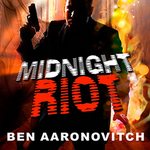
Midnight Riot (Audiobook) by Ben Aaronovitch, Kobna Holdbrook-Smith

Midnight Riot (Audiobook) Midnight Riot

by Ben Aaronovitch, Kobna Holdbrook-Smith (Narrator)
Series: The Rivers of London, #1

Unabridged Audiobook, 9 hrs., 57 min.
Tantor Media, 2012
Read: October 11 – 14, 2016


The best part about listening to this was being reminded just how good this novel was — sure, I remember liking it a lot (if for no other reason than I’ve read five more plus a collection of comics), but I didn’t remember it being this good.

Briefly — in this we’re introduced to a probationary constable named Peter Grant who’s approached by an odd witness to an odder (and disturbing) murder. What makes the witness odd? Well, he’s been dead for a couple of centuries. Soon thereafter, Peter’s meets a Chief Inspector who happens to be the last wizard in England. Peter’s transferred to his unit (doubling the size), taken on as an apprentice and thrust into a type of policing he wouldn’t have believed existed a week ago.

The investigation into this murder turns into an investigation for several murders — and a few other assorted crimes. Which, of course, involves diving into the history of London and brokering peace between competing river deities. That old yarn. It’s a great mix of magic and police work, basic Latin and advanced bureaucracy.

Holdbrook-Smith did a fine job with the narration, very engaging, often compelling — capturing the feel of the novel in just the way that everyone wants in an audiobook. I’d be more than happy to hear more from him.

It’s dark, it’s funny, it’s pretty complex — and, in retrospect, — does a much better job laying the foundation for the series than I’d remembered. A good amount of wonder and action combined.

—–

4 Stars

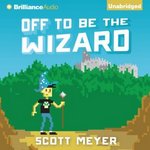
Off to be the Wizard (Audiobook) by Scott Meyer, Luke Daniels

Off to be the Wizard Off to be the Wizard

by Scott Meyer, Luke Daniels (Narrator)
Series: Magic 2.0, #1

Unabridged Audiobook, 10 hrs, 15 min.
Brilliance Audio, 2014
Read: August 8 – 16, 2016


I’m just going to steal most of what I said about the book before and add a little bit at the end about the audiobook — and Daniels in particular.

The first thing Martin always did when he found some new data file was to search for his own name. It may seem egocentric, but Martin wasn’t worried about that. He had spent a lot of time thinking about himself, and had come to the conclusion that he was definitely not self-absorbed.

There’s a great temptation — and frequently a rush — when discussing an amusing/funny book in SF or Fantasy to compare it with, well — the name rhymes with Schmouglas Schmadams — this can be damning, because almost nothing can live up to it. So I’m going to resist even saying the name. If anything, I think you could say this was reminiscent of Schmon Schmalzi — only funnier.

Martin Banks is the rather unimpressive hero here — a college dropout, living in a poorly-furnished apartment, working in “a cubicle farm, . . . a fluorescent-lighted, beige-walled abattoir for the human spirit where he had to spend most of his time,” and doing some minor hacking on the weekends, just to amuse himself. He stumbles upon a way to manipulate reality, to change things just a little bit here and there around him. Being human, it takes very little time before he begins using that ability in a way to draw the attention of the Federal Authorities. Which is not all that comfortable, so he heads off to England in the Middle Ages where he figures he can do okay for himself, living as a wizard using these abilities.

That’s when things start to get really entertaining (and I had no complaints up to this point). Anything more I say on this front is a horrible spoiler, so we’ll just leave it with really entertaining.

This is a coming of age tale — and, as it’s about a Millennial, it’s a delayed-coming-of-age story. But Martin’s not one of those protagonists that you have to see mature before you like him — you connect with him right away (or you’re probably wasting your time reading on). He definitely doesn’t mature in your typical way, which is part of the fun. I can’t help comparing Martin to Wesley Chu’s Roen Tan. But without the stakes that Roen had to deal with (and a nicer mentor).

Most of the characters we get to know are met after Martin’s time jump — so don’t worry if you find everyone in 2012 a little shallow and undeveloped. They are, but other people won’t be.

There are several things in the book that won’t hold up to much scrutiny — like his ability to get a smartphone signal in Dover, England in 1150. Adapt the advice Joel and the ‘bots used to give us, “just repeat to yourself . . . you should really just relax.” It’s worth it.

The book is just littered with wit — from the extended jokes, the funny visuals, or little asides like: “The fact that wristwatches weren’t invented yet made it difficult to look impatient, but he managed.” On nearly every page, there’s something to make you chuckle or laugh — or at least grin. I laughed enough that it was annoying to my family — not that I cared, mind you. But it’s not just a yuk-fest, there’s a well-written story here, in a great world with some characters you want to spend time with.

Daniels scores again here — his performance didn’t really remind me of his work on the Iron Druid Chronciles, which, I have to admit I was a little worried about. I got a kick out of his voice choices for Martin and Jimmy in particular — Martin’s voice when he got excited was perfect. I’m not sure I liked his choice of voice for Philip — it reminded me too much of Douglas Reynholm from The IT Crowd (I’m probably the only person on Earth who hears that, so take it with a grain of salt), and I never got used to it. But I loved everything else he did, so who cares, right? If anything, Daniels’ narration helped the material (not that it needed it).

Meyer’s writing holds up to a second-read, even jokes/situations I knew were coming worked pretty well — more than well, actually, judging by my laughter. I enjoyed it as much the second time through as the first, so that’s a pretty good sign.

—–

4 Stars

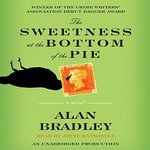
The Sweetness at the Bottom of the Pie (Audiobook) by Alan Bradley, Jayne Entwistle

The Sweetness at the Bottom of the Pie The Sweetness at the Bottom of the Pie

by Alan Bradley, Jayne Entwistle (Narrator)
Series: Flavia de Luce, #1

Unabridged Audiobook, 10 hrs
Random House Audio, 2009
Read: June 2 – 6 ,2016


This is going to be one of those quick ones where I mostly quote myself:

Our 11-year-old hero (no, this is not a kid’s book [not that there’s anything inappropriate for anyone who’s made it through Rowling here]) is a budding, self-taught, chemist with a curious mind and a stubborn streak a mile wide. Her family life is a mess — but in a charming, amusing, English countryside way — but our plucky gal has managed to get through it pretty much intact and for the better.

So when she discovers a body on her lawn, yet the police shoo her away from the crime scene and dismiss her, she starts her own investigation. She’s helped early on by a fact or two the police didn’t obtain from her, and some that she kept to herself out of spite. Her father’s arrest for the murder just adds fuel to her fire and becomes determined not only to solve the case before the police but to make them eat a good-sized helping of crow.

Probably not much of a spoiler to say that’s exactly what she does, because the book’s not about that foregone conclusion, but in watching Flavia do that while making less-than-flattering observations about her older sisters.

This second time through, I did appreciate the way this whole thing was constructed — particularly the mystery and the reveal — but also the character moments. I also found the stamp minutiae a little more interesting (but wow, did it take a long time to get through!). I did think there was more of the inspector in this one, but that’s just my memory failing me.

Entwistle was really solid in her narration — I honestly can’t imagine that anyone else could’ve pulled it off. Well, maybe Yeardley Smith, if she can do British accents. Entwistle captures the spark that makes Flavia Flavia, the wit, the spirit, the naĂ¯vetĂ©; and does a fine job with the rest of the cast of characters, as well.

All in all, a fine audiobook rendering of a fun crime novel. Strongly recommended.

—–

3.5 Stars

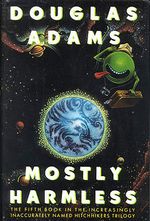
Reread Project: Mostly Harmless by Douglas Adams

Mostly HarmlessMostly Harmless

by Douglas Adams
Series: The Hitchhiker’s Guide to the Galaxy Trilogy, #5

Hardcover, 278 pg.
Harmony Books, 1992

Read: July 7 – 12, 2016

1 Stars

I was dreading this one — typically, like X-Men: The Last Stand, or The Highlander sequels, I prefer to pretend this doesn’t exist. It’s the only one of the series that I haven’t bought my son, and I don’t plan on changing that. Which doesn’t mean I couldn’t be won over — after 4 or 5 tries, Dirk Gently’s Holistic Detective Agency finally clicked with me, I keep hoping this will.

But it didn’t this time (I think my 5th reading).

Which is not to say there aren’t some parts that don’t deserve to be celebrated — almost everything Ford does (for example) is great. There’s a little bit with Trillian, a bit of Tricia McMillan (no, really, I meant to list those separately) and a smidgen of the Arthur material that’s okay. But not much. Don’t get me started on Random.

There’s some really clever bits here and there, some great lines — and some bits that are clearly attempts to recapture the spirit/zaniness of the earlier books, but without the heart. The narrative as a whole (after such a huge leap forward with So Long) was worthless, the story didn’t work. And the ending? Flummery. It was like Adams was just trying to get away from the series and put it in his rearview mirror. Which I get, I absolutely understand, he wanted to do something other than just crank out another Hitchhiker’s after another after another. But this was not the way to do it.

Just avoid this one, don’t bother. But if you think I’m wrong — tell me why! I’d love to be convinced that Adams couldn’t write a bad book.

—–

1 Star

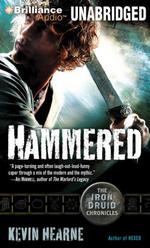
Hammered (Audiobook) by Kevin Hearne, Luke Daniels

Hammered Hammered

by Kevin Hearne, Luke Daniels (Narrator)
Series: The Iron Druid Chronicles, #3

Unabridged Audiobook, 9 hrs, 40 min.
Brilliance Audio, 2011

Read: July 25 – 26, 2016


This one is my least favorite in the series (I think, I’m pretty sure, anyway) — Atticus is held to promises he made in the last book, which brings him into contact with the Norse pantheon — particularly Thor — and knocks over the dominoes that will change the lives of Atticus, Granuaile, and Oberon forever. This book prevents the Iron Druid Chronicles from being a Dresden Files-Light series, which I’m glad for.

But it just doesn’t work that well for me. Oh, I could point to passages that are stirring, well-written, thoughtful and so on — some of Hearne’s best action scenes are here. He’s got some great character work going on, too (Perun was one of my favorites from the start). I just think Hearne could’ve done better.

Some of Hearne’s funniest material is in this book — Atticus’ internal monologue where he replaces the angel/devil on your shoulder with a Spock and Kirk combo, the stuff about American beer, Oberon’s extended rant about Bacon Lattes from Starbucks. Just great. Sadly, the story surrounding all that just doesn’t hold up too well.

Still, a less-good Iron Druid book is still pretty good. It’s like an iffy pizza. It’s still pizza đŸ™‚

Luke Daniels solidified his place as my favorite Audiobook narrator with this one — I laughed out loud at and loved his Ratatoskr. I don’t think I mentioned in the last book how much I appreciated his Coyote (and if I did, it bears repeating). His accent work was good — just everything. He even elevated the slow part of the book — the sitting-around-the-campfire, telling-stories-about-what-a-jackwagon-Thor-is chapters.

Not my favorite, but for who it introduces, what it sets up — and for the completest in me — worth your time. It’s probably a victim of Hearne’s rush to finish the trilogy to fulfill his very quick publishing contract. Which just means it gets better from here.

—–

3.5 Stars

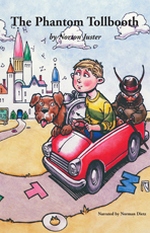
The Phantom Tollbooth (Audiobook) by Norton Juster, Norman Dietz

The Phantom Tollbooth The Phantom Tollbooth

by Norton Juster, Norman Dietz (Narrator)

Unabridged Audiobook, 5 hrs, 20 min.
Recorded Books, LLC., 1993

Read: August 1, 2016

4 Stars

I needed something to listen to at work a couple of weeks back, and the only thing I could find from the library’s collection was the audio version of the children’s classic, The Phantom Tollbooth. It’s been a few years since I read this with my kids, so I figured it was worth a shot. The story of bored (and boring) Milo receiving a magic Tollbooth that transports him to a magic kingdom where he goes on an adventure to restore Rhyme and Reason to their rightful places has long been a favorite of mine.

It wasn’t a bad use of time, but was a little disappointing. A lot of the word play needs to be read, not heard — having to over-pronounce the “h” in “whether man” to make it the joke land just doesn’t work. I could list other examples, but that’ll do.

Still, most of the magic is there, you still get the overall feel of the book, the strange adventure that Milo, Tock and the Humbug have is intact, it’s just missing some of the details.

Really, any version of The Phantom Tollbooth that doesn’t feature the art of Jules Feiffer is missing something — even the cover of this one was done by someone else! Thankfully, I remembered what most of the pictures looked like and could supply them in the right spot. But it’s just not the same.

Basically, I guess I’m saying any audio-only production of this novel is hobbled out of the gate. Which is nothing against Norman Dietz’s work — he did fine, nothing spectacular, but nothing detrimental, either. Good, capable, entertaining narration — but it’s just a bad book to try to do this with, I think. (that said, apparently David Hyde Pierce did an audiobook recording of it, too — and I will grab that if I can).

If you’ve read it before — this will scratch the re-read itch if you have it. It might be a good way to entertain the kids on a road trip. But this shouldn’t be anyone’s initial exposure to the story — get the book. Really. I’m giving it 4 Stars for sentiment’s sake — and Juster’s words/story.

—–

4 Stars

Where’d You Go, Bernadette (Audiobook) by Maria Semple , Kathleen Wilhoite

Where'd You Go, BernadetteWhere’d You Go, Bernadette

by Maria Semple, Kathleen Wilhoite (Narrator)

Unabridged Audiobook, 9 hrs and 39 mins
Hachette Audio, 2012
Read: June 10 – 13, 2016


For whatever reason, when I talked about this book last time, it had been months after I read it, and I could’ve done better. I’m not sure that I’ll fix that now, but you never know . . .

First thing you’ve got to know about this book is that it’s funny. Flat out funny. Some of it may not come across that way when you read it, actually, I think it’d be pretty easy to think this is a serious novel about a disturbed or tragic woman. But you’d be wrong to think that (and probably wouldn’t like the book at all).

Sure, it’s clear that something went wrong with Bernadette in the past, and that she’s still dealing (or, better, not dealing) with it. But that doesn’t stop things from being hilarious as she struggles with leaving the house, fighting with the neighbor ladies/moms from school.

Her daughter, Bee, is great. She’s a tribute to brainy-daughters everywhere — her understanding of and devotion to her mom is what humanizes Bernadette. After her mother goes missing, she compiles emails, articles, and other documents from a variety of sources to explain the last few months and put everything into context. I wasn’t sure this aspect of it would translate into audiobook — or be understandable. It was perfect. More on that in a moment.

The story is compelling, heartwarming, and funny (more funny the second time around, it turns out). It’s one of my favorite books from the last few years. Either version is well worth the time.

What made me give this a higher rating this time? Well, I had a clearer idea about the whole thing and could just enjoy the ride. But mostly, it was Kathleen Wilhoite (and boy did I ever feel stupid for not recognizing her voice once I googled the name). The accents, the voices, the emotions, the mirth — the heart and soul — she put into her performance blew me away and made the whole thing more compelling than Semple did (which is saying something). Again, that she was able to take the strange format of the book and make it easy to track with the various “sources” Bee used. Really, just a great audio performance.

—–

4 1/2 Stars

Hexed (Audiobook) by Kevin Hearne, Luke Daniels

HexedHexed (Audiobook)

by Kevin Hearne, Luke Daniels (Narrator)
Series: The Iron Druid Chronicles, #2

Unabridged Audiobook, 8 hours and 52 minutes
Brilliance Audio, 2011

Read: June 21 – 22, 2016

This takes place just 3 weeks after Hounded and the dust is still settling. The target on Atticus is bigger than before — funny what a reputation as a god-killer will do to a guy, from attacks to pleas for help, more people than ever want to know where he is.

Last time, I summed up the book with this:

Atticus finds himself in even more trouble–this time there’s a very nasty coven that wants to come in and take over the Tempe area–and their first step will be eliminating all other magic practitioners.

So our hero has to suck up his prejudice against witches and team up with the very same group that threatened him last time out to defend the home turf and maybe even clean up some long unfinished business.

which pretty much holds up.

The couple of additions I’d make are that I loved Coyote, and had totally forgotten that he appeared so early in the series. I miss Mr. Semerdjian — and while I understand why Hearne took the steps he did to prevent us from getting the nosy neighbor in every book, I sort of regret it after getting reacquainted with the character. Another thing that I’d forgotten about, but really enjoyed (probably more than I should’ve) is the scene where Atticus has to go all Three Stooges with the policemen and his camouflaging of his sword, some baseball bats and himself. Seriously funny, while juvenile, stuff.

Speaking of funny, it’s dangerous to listen to these at work — there were at least two times that Oberon’s commentary made me laugh out loud. Thankfully, none of the people who work next to me were at their desks either time, or I’d have gotten a few looks. Just a warning to anyone thinking of it — you may look silly.

Luke Daniels delivers again — he’s so good at this that I’m thinking of shopping for something by him just to hear him read. The only complaint I have is that his Mr. Semerdjian sounds too much like a high-pitched Oberon. Which is just weird, and probably not something that either character would enjoy. Daniels’ Coyote, and the speech patterns Atticus adopts while talking with him are fantastic.

A great edition of a solid sequel.

—–

4 Stars

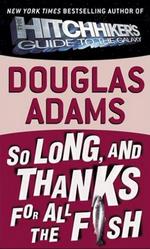
Reread Project: So Long, and Thanks For All The Fish by Douglas Adams

So Long, and Thanks For All The FishSo Long, and Thanks For All The Fish

by Douglas Adams
Series: The Hitchhiker’s Guide to the Galaxy Trilogy, #4

Mass Market Paperback, 214 pg.
Del Rey, 1999
Read: June 14, 2016

Arthur had a swordfish steak and said it made him angry. He grabbed a passing waitress by the arm and berated her.

“Why’s this fish so bloody good?” he demanded, angrily.

“Please excuse my friend,” said Fenchurch to the startled waitress. “I think he’s having a nice day at last.”

I’ve said it before, I’ll say it again: this is my favorite Douglas Adams novel. Sure, The Hitchhiker’s Guide is fantastic and I love it and you can make a strong case that at least one of the Dirk Gently novels is his best (I expect I’ll be doing so in a couple of months) — but this is the one that does it for me.

Unlike the previous three, there is an actual narrative here — it’s not a collection of scenes, jokes, and vignettes loosely tied together. Arthur Dent arrives on Earth (no, really) after traipsing from one end of the galaxy to the next; from the end of the universe, to the beginnings of life on Earth; basically all throughout time and space (sadly, without the blue box). And now he’s trying to re-acclimate to life at home. Which has somehow not been destroyed, neither has his house. In fact, everything’s pretty much like it was before.

Just with everyone convinced that the Vogon Constructor Fleet was a CIA-induced Mass Hallucination. Not everyone believes it, but most do. Two people who don’t believe that are a man named Wonko the Sane and Fenchurch. Both of whom are pretty cool characters.

I’ll skip Wonko, because the name says everything. Fenchurch, on the other hand, is perfect. She’s everything that Trillian never got the chance to be (except in the semi-disastrous final chapters of Life, the Universe, and Everything. She’s funny, smart, sexy — just what Arthur needs. I’d happily read a book just about her.

There’s a mention of Zaphod — briefly — but that’s it. So the zaniness fell into Ford’s capable lap. I’ve always liked Ford better, anyway. And he’s able (as always) to pull off the zaniness, the comedy, the . . . everything without being quite the obnoxious twit that Zaphod is.

Ford’s his usual delusional, clueless, charming, drunken self.

Here was something that Ford felt he could speak about with authority.

“Life,” he said, “is like a grapefruit.”

“Er, how so?”

Well, it’s sort of orangy-yellow and dimpled on the outside, wet and squidgy the middle. It’s got pips inside, too. Oh, and some people have half a one for breakfast.”

“Is there anyone else out there I can talk to?”

Arthur comes out of this one looking pretty good, too. He’s not whining, he’s not just getting pulled around by his dressing gown wherever whim strikes Ford (or Zaphod). He’s mature, capable, witty. He sees a problem or two and solves them (even if one of those problems is just “who was that girl I almost met the other day”?). He’s almost a wholly different guy when he’s home. Which makes him a lot like the rest of us — which is sort of the point of Arthur since we first met him.

One of the highlights of the last book was the section about flying, I’m pretty sure I said that. The section here about flying is better — Arthur teaching Fenchurch, Arthur remembering how to do it in the first place — and then the two of them flying around. It’s just about perfect.

And, of course, there are little bits like:

Of course, one never has the slightest notion what size or shape different species are going to turn out to be, but if you were to take the findings of the latest Mid-Galactic Census report as any kind of accurate guide to statistical averages you would probably guess that the craft would hold about six people, and you would be right.

You’d probably guessed that anyway. The Census report, like most such surveys, had cost an awful lot of money and told nobody anything they didn’t already know — except that every single person in the Galaxy had 2.4 legs and owned a hyena. Since this was clearly not true the whole thing eventually had to be scrapped.

    There’s a few things I’d love to go on and on about, but no one wants to read me gushing and gushing and gushing, so here are the assorted highlights:

  • The zig at the end of the Prologue.
  • Arthur’s biscuit/train station story. Seriously, I just love this.
  • Rob Mckenna
  • Wonko the Sane naming the world The Asylum and his house Outside the Asylum.
  • Wonko the Sane’s name.
  • All the California jokes. Clearly, he’d been vacationing there too much.
  • The whole thing about the lizard government and democracy is both funny and relevant.
  • Chapter 25 is just dandy.

The last chapter or two are a little weak, pretty close to the older books in tone and style. But they work, they are tied into the narrative and star Marvin. So who’s going to complain? Not me.

Really, I’ve got nothing but positive things to say about this. I love it. One of the easiest 5-star ratings I’ve ever given.

—–

5 Stars

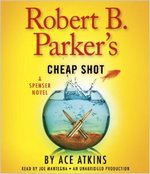
Cheap Shot (Audiobook) by Ace Atkins, Joe Mantegna

Cheap Shot (Audiobook)Robert B. Parker’s Cheap Shot

by Ace Atkins, Joe Mantegna (Narrator)
Series: Spenser, #42

Unabridged Audio, 7 Hours and 30 Minutes

Random House Audio, 2014
Read: June 7 – 9, 2016


This is a very mixed bag of an audiobook. I loved the novel 3 years ago, and enjoyed reliving it. But man, the narration was just not my thing. But I’ll get back to that in a bit.

I stand by pretty much everything that I said 3 years ago (although, I seem to have missed/underrated one plot point last time — I totally bought it this time). Here’s some of what I said before that still applies:

On the one hand, this is not Atkins’ best Spenser. But it’s the one that feels like Parker more than the rest (make of that what you will). The banter, the poking around and stirring things up until you get a break, the fisticuffs, the donuts, the gun fight, the needling of underworld players, and so on — he captures Parker’s voice and pacing better here than he’d managed before (yet doesn’t come across as pastiche). Spenser’s sniffing around the big money and big boys (and a few men) in sports, which serve as a good place for Spenser to reflect how men are to act. Parker did this Mortal Stakes and Playmates (and to lesser extents elsewhere — like Early Autumn), and Atkins is able to do that here (arguably he does so with a subtlety that Parker didn’t achieve).

Kinjo Heywood’s a fun character — slightly more grounded than Mortal Stakes‘ Marty Rabb, far more mature and grounded than Playmates‘ Dwayne Woodcock. One advantage Heywood has is his son, Akira (who’s plenty of fun on his own) — he has someone to provide a good example to, and he strives to. Heywood also seems to have thought ore about life and how one should live it. Marty seemed to think only about Linda (his wife) and baseball, Dwayne was all about his girlfriend (Chantel) and basketball, too — but with less self-examination, it’s just that’s all he had the chance to think about (although Chantel would see that changed, and his horizons broadened if she had anything to say about it). Heywood’s got a kid, he’s been through a divorce, and is fully aware of his place in the limelight (including social media) and his own shortcomings. This alone saves the book from being a reworking of Parker.

I should add that Sixkill has a lot of perspective here (with the assistance of Atkins’ own background in football) — he was close to Heywood’s level, and if he’d made one or two better choices, he would’ve been at this level. He has a better idea what’s going on in Heywood’s mind than Spenser and his brief stint in the boxing world would.

The book begins with Spenser doing bodyguard duty — and as always (Stardust, Looking For Rachel Wallace, A Savage Place, Rough Weather) things don’t go well. You’d think people’d stop hiring him for this kind of work. Spenser turns to investigating — and unearthing lie after lie from his client — while getting Hawk and Sixkill to pitch in on the bodyguard front.

In addition to the main characters, Hawk, Susan, Sixkill, Tony Marcus, and so on; Atkins continues to show a command and familiarity with the impressive gallery of supporting characters in the Spenser-verse. And the new characters fit into the ‘verse just fine, nothing that Parker wouldn’t have created.

Not only did Atkins give us a good story this time, he appeared to be planting and/or watering seeds for future books at the same time — something Parker never bothered with, but I’m glad to see.

About the only thing I’d like to add on this front is that I think I liked the story more this time around.

So much for the lovefest. I just didn’t like Mantegna’s work. I know, I know — he’s done many, many of the Spenser Audiobooks; Parker loved his work with Spenser (even getting him cast in those semi-regrettable movies); and he’s Joe bleepin’ Mantegna. Still, it didn’t work for me. When he was reading the narrative parts — Spenser describing what he was doing, what he was seeing, etc., even making smart aleck asides — I dug it. He did a perfectly entertaining job — maybe even more.

But the strength of Parker’s work was his dialogue, and Mantegna fell flat (at best) on this front. Spenser sounds like Fat Tony, which just should not be. Ever. Kinjo sounds like a stereotypical old blues man, not a young NFL linebacker. Hawk sounds like a slightly younger blues man. And don’t get me started on Zee. That was just embarrassing. Most of the other characters were pretty poorly done, as well. And when the book is so reliant on dialogue, so reliant on the charm of the characters, that missing with just about all of them hurts.

So, like I said, great writing, mediocre (when not disappointing) narration. Please note this rating is for the Audiobook — the whole experience, the narration as well as the writing — still love the book, and would recommend the novel in a heartbeat. This? Eh. It was entertaining enough, but that’s it. Still, any time with Spenser is time well spent.

—–

3 Stars

Page 6 of 8

Powered by WordPress & Theme by Anders Norén