Tag: Rex Stout Page 1 of 2

My Favorite Non-Fiction Books of 2025

Covers of Algospeak, Class Clown, Food for Thought, Enshittification, Everything Is Tuberculosis, Killer Conversations with Rex Stout and John McAleer, Pronoun Trouble, How to Stand Up to a Dictator, and Robert E. Lee and Me, next to an image of an anthropomorphized Pilcrow and the words 'My Favorites of 2025 Non-Fiction'
My 2025 Wrap-up continues and now we’re on to the Non-Fiction list. While I liked a number of works that didn’t make this list, I felt strange calling them a “favorite.” These are the ones that stuck with me through the year; the ones I cited in conversation; that I thought about when reading something else or watching something on TV. Yeah, there’s some overlap between this list and the audiobook list from yesterday—lately, most Non-Fiction books I work through are in audiobook format. So it makes sense, even if it makes this post seem like an echo.

As always, I only put books that I’ve read for the first time on this list. I don’t typically return to NF books (outside of looking up things for one or three points), but occasionally I do—for example, The Pleasures of Reading in an Age of Distraction by Alan Jacobs would get a permanent spot on this list, were it not for this rule.

(in alphabetical order by author)
Cover of Algospeak by Adam AleksicAlgospeak:
How Social Media Is Transforming the Future of Language

by Adam Aleksic

My original post
Language in general—but English particularly—is a constantly-changing thing, and these changes are happening faster and faster all the time. Algospeak is a great look at the hows and whys of a lot of the current evolutionary processes. It is about more than language—it’s also about how the Internet changes the way we think and express ourselves in general. And therefore, how society changes (which leads to Internet changes, and other circle-of-life things).

Aleksic has obvious expertise and passion for the subject (look at just one of his videos). He’s also active in these areas. It’s a great read, informative and entertaining. Hard to ask for more.
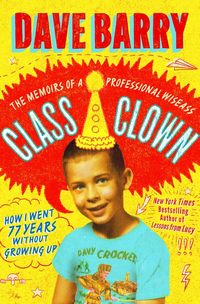

Cover of Class Clown by Dave BarryClass Clown: The Memoirs of a Professional Wiseass—How I Went 77 Years Without Growing Up

by Dave Barry

My original post
It comes as no surprise to any that I loved a Dave Barry book. It takes something pretty lackluster by him to get that reaction (and he doesn’t do that often–but I can prove it if you want). But this is something else–it’s insightful, it’s touching, it’s (seemingly) honest, and human. It’s a look at his childhood, his professional humorist origin story, and then scattered accounts of some of the very strange things that his profession has let him do.

I don’t say this about many authors–but I really don’t know that I’ve wondered anything about Barry’s personal life. But now that I know? I am more than happy to get some understanding about it. Does it necessarily help me understand his work better? No (but we’ll see the next time I take up his work, I guess). But it makes me like Barry the person a bit more.


Cover of Food for Thought by Alton BrownFood for Thought: Essays and Ruminations

by Alton Brown

Like any good fan of a TV show/personality, I like to know how they got started, how the show was developed, etc. Brown talks about how he got into food education media–and it’s not really how you’d expect. How he moved on from Good Eats to other things. There’s some great stuff about his education. But perhaps the most rewarding portion of the book is his musing and observations on the place of food/eating to human society (writ large or on an individual level).

Really, there’s so little to not appreciate from this book. Alton Brown has spent decades thinking and writing about food. This is the result of all that.


Cover of Enshittification by Cory DoctorowEnshittification: Why Everything Suddenly Got Worse and What to Do About It

by Cory Doctorow

I don’t know how to talk about Doctorow’s screed against Big Tech, the policies that led to these platforms that have taken over the internet and made it less-good than it used to be. Even that sentence is not a great way to talk about the book. The book wowed me. I wouldn’t say it radicalized me on some of this, but I sort of wish it did. The Ressa book below really struck me as a giant proof for Doctorow’s case (good idea to read the two of them around the same time). It’s a great–and terrifying–read.


Cover of Everything Is Tuberculosis by John GreenEverything Is Tuberculosis: The History and Persistence of Our Deadliest Infection

by John Green

I never imagined I would appreciate a book about an infectious disease. And despite all the good things I heard about this book, I didn’t rush to pick it up. But I’m so glad I did.

First of all, you could probably pick any number of things to use in place of Tuberculosis to trace human history, seemingly at major turning points and shaping societal developments. Say…bread, or writing, or…I dunno this is a sentence I regret starting. But from a certain point of view–you can buy the theory posited at the beginning of this book, that Tuberculosis shaped human history.

Green talks about the treatments that have been tried (and failed), the way it impacted population sizes, the devastation it’s left in it’s wake, and how things are going in the battle against the disease now. Interwoven with these is the story of one particular patient in Sierra Leone that Green met years ago. We follow his personal struggle–ups, downs, way downs, and more.

Green can relate these facts–even the bleak ones–in an engaging way that will stick with the reader. But then he drives it home and makes it gets you emotionally involved through the patient’s story.

You just can’t help but being taken in by the book and it’ll leave a lasting impression.


Cover of Killer Conversations with Rex Stout and John McAleerKiller Conversations with Rex Stout and John McAleer

My original post
Granted, there is a very limited audience for this kind of thing. But for that audience (and I’m part of it), this is catnip.

These snippets of conversations between Rex Stout and his biographer and friend are just wonderful. Quick back and forths on any number of topics–life, death, love, reputation, writing, Stout’s characters, his career, and more–it’s fun to read. It’s fun to think about. You’ll wish you were half as clever as Stout.
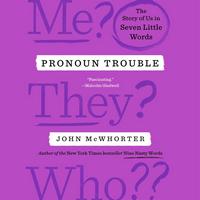

Cover of Pronoun Trouble by John McWhorterPronoun Trouble: The Story of Us in Seven Little Words

by John McWhorter

So, sure–this looks like it’s nothing but a screed on one side or the other about the problem we’re having with third-person pronouns the a socio-political front in English. And, yes, it is about that, (but only from a linguistic point of view), but there’s more to it. There’s also that pesky second-person plural.

Like in his book, Nine Nasty Words, McWhorter gives a quick look at the history of English pronouns one at a time–looking at various forms, usages, spellings, and assorted trivia. When appropriate, the then talks about some of the contemporary challenges and controversies with them.

Completely entertaining–McWhorter’s a great narrator–and very educating. I heartily commend this to you (no matter what you think of using “they” for the third-person singular).


Cover of How to Stand Up to a Dictator by Maria RessaHow to Stand Up to a Dictator: The Fight for Our Future

by Maria Ressa, read by Maria Ressa & Rebecca Mozo

Maria Ressa’s story is fascinating. It’s just that simple. I mean, you rarely find a Nobel Peace Prize recipient without an interesting backstory of some sort.

Like I said above, when you add this to Doctorow’s book and you see how everything he said is entirely possible and how it can work against someone.

There’s, of course, more than just Ressa’s story and struggles reflected here. There’s a call to action, a call to do the necessary work, and a call to hope, when it comes to oppressive governments or platforms.


Cover of Are Women Human by Dorothy L. SayersAre Women Human?

by Dorothy L. Sayers

These are two essays by Sayers on the subject of women in society–with a particular look at academia. They are pointed, clear, and witty.

I’m not sure what else to say, really.


Cover of Robert E. Lee and Me by Ty SeiduleRobert E. Lee and Me:
A Southerner’s Reckoning with the Myth of the Lost Cause

by Ty Seidule

My original post

This is a powerful read. This very-Southern, Lost Cause adherent, West Point history professor starts looking at what he’d been raised believing, and the systemic racism of the culture he’d been raised in. The book then recounts example after example after example of the racism everywhere and the excuses made for covering up the treason of the Confederacy everywhere, including the U.S. Army–the army he left and fought against.

I thought Seifert made a compelling case in an engaging read that will stick with you for a long time.



When Archie Met Lily

“I’ll show you the phone.” It was a voice behind me, and I turned. The girl in yellow slacks was there close. I realized with surprise that her head came clear to my chin or above, and she was blonde but not at all faded, and her dark blue eyes were not quite open, and one corner of her lips was up with her smile.

“Come on, Escamillo,” she said, “I’ll show you the phone.”

I told her, “Much obliged,” and started off with her.

She brushed against me as we walked and said, “I’m Lily Rowan.”

“Nice name.” I grinned down at. her. “I’m Escamillo Goodwin.”

According to Some Buried Caesar, 87 years ago today, Archie Goodwin—one of my top 5 All-Time Favorite Characters—met the only woman who could keep his attention for more than a few months, Lily Rowan. Lily shows up several times in the Nero Wolfe/Archie Goodwin series and threatens to steal every scene she appears in (and frequently succeeds). Check out this post from Today in Mystery Fiction for the details—one of my favorite scenes, from one of my favorite books in possibly my favorite series—(I think I have 3 or 4 copies of it), so I had to say something.

Besides, it’s not like I have a long list of dates associated with fictional events to commemorate (but I really should work on one).

How they met 87 years ago, when Archie’s only in his mid-30s today, is beyond me. But Math was never my strong suit, I’m sure it makes sense, Charlie Epps could probably explain it to me.

Regardless, it’s a great exchange—the first of many between the two. Lily will go on to have great scenes with Mr. Wolfe, as well–one of the more memorable happens at a crucial point in In the Best Families where she does something that no one else does in the Wolfe/Archie books.

Why does she call him Escamillo? (a nickname she never drops, I should add). Well, a couple of pages before that exchange of names, Wolfe and Archie were crossing a field between the road (and their disabled car) and a nearby house, and well…

“Stop! Don’t move!”

I stopped dead, with [Wolfe] beside me. I thought he had discovered something psychological about the bird on the fence, but he said without looking at me, “Stand perfectly still. Move your head slowly, very slowly, to the right.”

For an instant I thought the nut with the gun had something contagious and Wolfe had caught it, but I did as I was told, and there was the second surprise. Off maybe 200 feet to the right, walking slowly toward us with his head up, was a bull bigger than I had supposed bulls came. He was dark red with white patches, with a big white triangle on his face, and he was walking easy and slow, wiggling his head a little as if he was nervous, or as if he was trying to shake a fly off of his horns. Of a sudden he stopped and stood, looking at us with his neck curved.

I heard Wolfe’s voice, not loud, at the back of my head, “It would be better if that fool would quit yelling. Do you know the technique of bulls? Did you ever see a bull fight?”

I moved my lips enough to get it out: “No, sir.”

Wolfe grunted. “Stand still. You moved your finger then, and his neck muscles tightened. How fast can you run?”

“I can beat that bull to that fence. Don’t think I can’t. But you can’t.”

“I know very well I can’t. Twenty years ago I was an athlete. This almost convinces me . .. but that can wait. Ah, he’s pawing. His head’s down. If he should start… it’s that confounded yelling. Now… back off slowly, away from me. Keep facing him. When you are 10 feet from me, swerve toward the fence. He will begin to move when you do. As long as he follows slowly, keep backing and facing him. When he starts his rush, turn and run—”

I never got a chance to follow directions. I didn’t move, and I’m sure Wolfe didn’t, so it must have been our friend on the fence—maybe he jumped off into the pasture. Anyhow, the bull curved his neck and started on the jump; and if it was the other guy he was headed for, that didn’t help any, because we were in line with him and we came first. He started the way an avalanche ends. Possibly if we had stood still he would have passed by, about 3 feet to my right, but either it was asking too much of human nature to expect me to stand there, or I’m not human. I have since maintained that it flashed through my mind that if I moved it would attract him to me and away from Nero Wolfe, but there’s no use continuing that argument here. There’s no question but what I moved, without any preliminary backing, And there’s no question, whoever he started for originally, about his being attracted by my movement, I could hear him behind me. I could damn near feel him, Also I was dimly aware of shouts and a blotch of something red above the fence near the spot I was aimed at, There it was—the fence. I didn’t do any braking for it, but took it at full speed, doing a vault with my hands reaching for its top, and one of my hands missed and I tumbled, landing flat on the other side, sprawling and rolling, I sat up and panted and heard a voice above me:

“Beautiful! I wouldn’t have missed that for anything.”

I looked up and saw two girls, one in a white dress and red jacket, the other in a yellow shirt and slacks. I snarled at them, “Shall I do it again?”

Irresponsible Reader Pilcrow Icon

Killer Conversations with Rex Stout and John McAleer: Ridiculously Fun (and insightful, too, if you’re into that sort of thing)

Cover of Killer Conversations with Rex Stout and John McAleerKiller Conversations

with Rex Stout, John McAleer

DETAILS:
Publisher: Andrew McAleer
Publication Date: March 30, 2025
Format: eBook
Length: 91 pgs.
Read Date: May 21, 2025

How Does the Publisher Describe Killer Conversations?

Rex Stout: Killer Conversations (formerly Royal Decree) is a must read for aficionados of detective fiction. Here Edgar winner John McAleer shares some of his most memorable conversations with Nero Wolfe creator Rex Stout. Featuring an updated Introduction by crime fiction icon William G. Tapply and an Afterword by Grand Master Edward D. Hoch, Killer Conversations is an essential collectors’ volume. These in-person discussions with Stout were compiled to inform and gratify, in Stout’s own words, the millions of Rex Stout fans who would be putting these questions to him as if he were alive answering his mail from Wolfe’s West 35th Street Brownstone. Hailed by CBS as the “American Conan Doyle,” in Killer Conversations Stout discusses, among other things, his writingcraft, the Wolfe mysteries, plotting methods, characterization, the modern detective story, his service aboard President Teddy Roosevelt’s yacht, and offers his appraisal of crime fiction icons such as—Agatha Christie, Georges Simenon, G. K. Chesterton, and more. Killer Conversations will keep mystery fans glued to their chair till midnight chimes the hour. And why not, isn’t that what a Stout mystery does?

(the only problem with this blurb is the bit about midnight chimes the hour…the only way most people would be reading this until midnight is if they started at 11:20p.m.)

Some of My Favorite Responses

This is a great collection of pithy takes on everything outlined above—and Stout was great at them. I have to share some to give you a little taste (and because I just had to share some). I won’t cite all the best ones here—but I’m tempted to.

McAleer: When you were writing for the pulps, between nineteen twelve and nineteen seventeen, did you see yourself as a hack writer or as an aspiring young writer on his way to the top?

Stout: I have never regarded myself as this or that. I have been too busy being myself to bother about regarding myself.

McAleer: I know a writer who, before beginning a book, separates a ream of paper into unequal piles of twenty-three, thirty-seven, forty, twenty-seven, and so forth, because he knows in advance how many pages will go into each chapter. How does that strike you?

Stout: He isn’t a writer, he’s a puzzle fiend. Revolting.

McAleer: You’ve said you’d rather have written Alice in Wonderland than any other book in English written in the last century. Why?

Stout: I could write pages about it and they would have to be well written. While giving glorious entertainment in the form of playful nonsense, it does the best job in the English language of exposing our greatest fallacy, that man is a rational animal. A couple of instances out of many: The Queen’s “Off with their heads” shows that the greatest danger of unlimited power is not that it can act by malice but that it can act on whim. The shifting of places at the Mad Hatter’s tea party shows that if all of the members of a group wish to make a change it is not true that they should change in unison in the same direction. To do this right would take hours.

McAleer: Yet you hold Hammett in high regard?

Stout: Certainly. He was better than Chandler, though to read the critics you wouldn’t think so. In fact, The Glass Key is better than anything Hemingway ever wrote. . .Hemingway never grew out of adolescence. His scope and depth stayed shallow because he had no idea what women are for.

McAleer: Inspector Cramer is called “Fergus” Cramer in Where There’s a Will. Later, in The Silent Speaker, his initials are given as “L. T. C.”. How do you explain this discrepancy?

Stout: No significance. Laziness. I didn’t bother to check whether he already had a first name. Of course all discrepancies in the Nero Wolfe stories are Archie Goodwin’s fault.

So, what did I think about Killer Conversations?

Some of the answers Stout gives are deep. Several are flip. He doesn’t always use more than one word (really, would a little elaboration of killed him?) All are just fun to read.

This is a Lay’s Potato Chip kind of read—I bet you can’t read just on Question and Answer. You have to keep going—you might be able to make yourself stop because of something, but you won’t want to. It’s just too much fun to keep going.

Also? This is clearly going to be re-readable (I almost slipped into a re-read while putting this post together).

Ultimately, the question you want to ask yourself about this book is this: Do I want to learn more about Rex Stout? If the answer is yes, you’re going to have a blast with this. If you don’t—why have you read this far? You might appreciate someone talking about obscure authors and classics of the mystery genre. But you’re probably not going to be that engaged.

Me? I loved it. The two cover life, death, love, reputation, writing, Stout’s characters, his career, a little bit about people in his life, and more. If this book was three times as long—I’d say the same thing.

Irresponsible Reader Pilcrow Icon

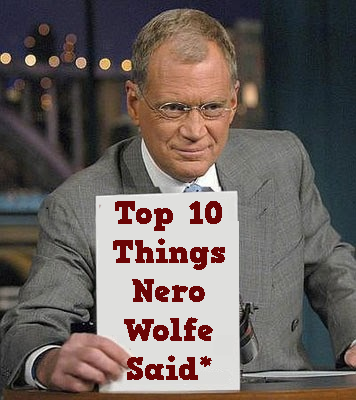
Top Ten Tuesday: Top 10 Things Nero Wolfe Said*


The topic for this week’s Top Ten Tuesdays is the Top Ten Things Characters Have Said

If I took that too loosely, I’d spend weeks trying to narrow this down. So I decided to limit it to one character–Nero Wolfe. He’s easily the most quotable character I can think of (with the possible exception of Archie Goodwin, who narrates the Wolfe books). But I didn’t have time to do a thorough job of that, either. But I was able to cobble together a decent collection of quotations. Give me a year, and I’ll come up with something more definitive (or I’ll have a selection of 90+ items and will freeze up in trying to whittle it down).

But first,

Who is Nero Wolfe?

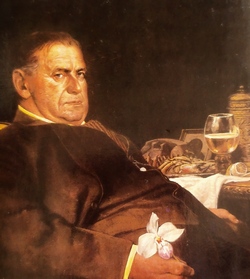
Nero Wolfe Back CoversNero Wolfe, fictional American private detective, the eccentric protagonist of 46 mystery stories by Rex Stout. Wolfe was introduced in Fer-de-Lance (1934).

A man of expansive appetites and sophisticated tastes, Wolfe is corpulent and moody. Detesting mechanized vehicles and disdaining most humans, he is averse to leaving his home for business reasons; he assigns the physical investigations of murders to his associate and friend Archie Goodwin and manages to solve his mysteries without leaving his own confines. Another of Wolfe’s associates is his private chef, Fritz Brenner, who also works as Wolfe’s butler and handyman. Wolfe’s interest in food is equaled only by his passion for orchids: with the aid of Theodore Horstman, he nurtures some 10,000 orchid plants in his rooftop garden.

by: The Editors of Encyclopaedia Britannica. "Nero Wolfe". Encyclopedia Britannica, 15 Oct. 2012, https://www.britannica.com/topic/Nero-Wolfe. Accessed 3 March 2025.

Top Ten Things Nero Wolfe Said* That I Can Think of Without Re-Reading the Corpus

10

To me the relationship of host and guest is sacred. The guest is a jewel resting on the cushion of hospitality.

9

…with the quarry within reach, the purpose fixed, and the weapon in hand, it will often require up to eight or ten minutes to kill a fly, whereas the average murder, I would guess, consumes ten or fifteen seconds at the outside.

8

Man’s brain, enlarged fortuitously, invented words in an ambitious attempt to learn how to think, only to have them usurped by his emotions. But we still try.

7

Since I entered this room you have made nothing but mistakes. You were without courtesy, which was offensive. You made a statement contrary to fact, which was stupid. You confused conjecture with knowledge, which was disingenuous.

6

I carry this fat to insulate my feelings. They got too strong for me once or twice and I had that idea. If I had stayed lean and kept moving around I would have been dead long ago…I used to be idiotically romantic. I still am, but I’ve got it in hand.

5

Maintaining integrity as a private detective is difficult; to preserve it for the hundred thousand words of a book would be impossible for me, as it has been for so many others. Nothing corrupts a man so deeply as writing a book; the myriad temptations are overwhelming.

4

I love to make a mistake, it is my only assurance that I cannot reasonably be expected to assume the burden of omniscience.

3

Sir, I would not enter a taxicab for a chance to solve the Sphinx’s deepest riddles with all the Nile’s cargo for my reward! Good God. A taxicab…You observe my bulk. I am not immovable, but my flesh has a constitutional reluctance to sudden, violent, or sustained displacement.

2

[Dina Laszio] leaned back. “Marko told me once, long ago, that you don’t like women.”

Wolfe shook his head. “I can only say, nonsense again. I couldn’t rise to that impudence. Not like women? They are astounding and successful animals. For reasons of convenience, I merely preserve an appearance of immunity which I developed some years ago under the pressure of necessity. I confess to a specific animus toward you. Marko Vukcic is my friend; you were his wife; and you deserted him. I don’t like you.”

1

I understand the technique of eccentricity; it would be futile for a man to labor at establishing a reputation for oddity if he were ready at the slightest provocation to revert to normal action.

Irresponsible Reader Pilcrow Icon

Douglas Adams on Presidents

This one is a bit more cynical–okay, very much more cynical–than the last quotation I shared. It still seemed appropriate for today.

Zaphod BeeblebroxThe major problem—one of the major problems, for there are several—one of the many major problems with governing people is that of whom you get to do it; or rather of who manages to get people to let them do it to them.

To summarise: it is a well-known fact that those people who most want to rule people are, ipso facto, those least suited to do it. To summarise the summary: anyone who is capable of getting themselves made President should on no account be allowed to do the job. To summarise the summary of the summary: people are a problem.

—Douglas Adams
from The Restaurant at the End of the Universe


That nifty drawing of Zaphod was drawn by Terry Cooper.

Archie Goodwin on Voting

For the 3 of you who are unaware, it’s Election Day in the U.S., so I thought I’d share this little bit from Archie Goodwin to commemorate it.

Archie GoodwinThe most interesting incident Tuesday morning was my walking to a building on Thirty-fourth Street to enter a booth and push levers on a voting machine. I have never understood why anybody passes up that bargain. It doesn’t cost a cent, and for that couple of minutes, you’re the star of the show, with top billing. It’s the only way that really counts for you to say I’m it, I’m the one that decides what’s going to happen and who’s going to make it happen. It’s the only time I really feel important and know I have a right to. Wonderful. Sometimes the feeling lasts all the way home if somebody doesn’t bump me.

–Archie Goodwin
from A Family Affair

Archie Goodwin on Voting

It’s Election Day in the U.S. tomorrow, so I thought I’d share this little bit from Archie Goodwin to commemorate it.

Archie GoodwinThe most interesting incident Tuesday morning was my walking to a building on Thirty-fourth Street to enter a booth and push levers on a voting machine. I have never understood why anybody passes up that bargain. It doesn’t cost a cent, and for that couple of minutes, you’re the star of the show, with top billing. It’s the only way that really counts for you to say I’m it, I’m the one that decides what’s going to happen and who’s going to make it happen. It’s the only time I really feel important and know I have a right to. Wonderful. Sometimes the feeling lasts all the way home if somebody doesn’t bump me.

–Archie Goodwin
from A Family Affair

Happy Birthday, Archie!

My nearly annual tribute to one of my favorite fictional characters (if not my all-time favorite). I’ve got to do an overhaul to this soon, but it is slightly updated and tweaked from two years ago.

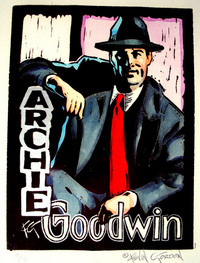
Archie GoodwinOn Oct. 23* in Chillicothe, Ohio**, Archie Goodwin entered this world—no doubt with a smile for the pretty nurses—and American detective literature was never the same. He’s the narrator (and, I’d argue protagonist) of the questionably named Nero Wolfe mysteries. While the eccentric and overweight genius might be what brings people to the series, it’s Archie’s wit, attitude, and snappy narrative voice that brings people back.

* About 34 years ago, no matter what year it is that you read this.
** Although, in Too Many Women, we read: “Your father’s name is James Arner Goodwin, and you were born in Canton, Ohio, in nineteen-fourteen. Your mother’s maiden name was Leslie. You have two brothers and two sisters.” Stout claims that the PI who looked into Archie got it wrong.

When my aunt first gave me a Nero Wolfe book to read, she sold me on the Wolfe character, but when I read it, I wasn’t so sure that I liked the guy. But his assistant? He was cool. Sure, it didn’t take me long to get into Wolfe, but Archie’s always been my favorite. Since I was in Middle School, if I was suffering a slump of any kind (reading, emotional, physical), time with Archie Goodwin could get me out of it. There were a few years that when I got sick, I’d grab a Nero Wolfe novel to help me get through it (along with the Vitamin C and Chicken Noodle soup), and you can’t tell me it didn’t work. Noted critic Jacques Barzun says it well:

If he had done nothing more than to create Archie Goodwin, Rex Stout would deserve the gratitude of whatever assessors watch over the prosperity of American literature. For surely Archie is one of the folk heroes in which the modern American temper can see itself transfigured. Archie is the lineal descendant of Huck Finn.

While Archie’s about as far from a teetotaler as you can get, to commemorate his birthday, I’m toasting him in one of the ways I think he’d appreciate most—by raising a glass of milk in his honor.

Who was Archie? Archie summed up his life like this:

Born in Ohio. Public high school, pretty good at geometry and football, graduated with honor but no honors. Went to college two weeks, decided it was childish, came to New York and got a job guarding a pier, shot and killed two men and was fired, was recommended to Nero Wolfe for a chore he wanted done, did it, was offered a full-time job by Mr. Wolfe, took it, still have it.” (Fourth of July Picnic)

Long may he keep it. Just what was he employed by Wolfe to do? In The Black Mountain he answers the statement, “I thought you was a private eye” with:

I don’t like the way you say it, but I am. Also, I am an accountant, an amanuensis, and a cocklebur. Eight to five you never heard the word amanuensis and you never saw a cocklebur.

In The Red Box, he says

I know pretty well what my field is. Aside from my primary function as the thorn in the seat of Wolfe’s chair to keep him from going to sleep and waking up only for meals, I’m chiefly cut out for two things: to jump and grab something before the other guy can get his paws on it, and to collect pieces of the puzzle for Wolfe to work on.

In Too Many Women, he’s a bit more concise and describes himself as the:

heart, liver, lungs and gizzard of the private detective business of Nero Wolfe, Wolfe being merely the brains

In Poison a la Carte (and echoed in Bullet for One and If Death Ever Slept), he describes his job as:

[Wolfe’s] assistant detective and man Friday, Saturday, Sunday, Monday, Tuesday, Wednesday, and Thursday

In Black Orchids, he reacts to an insult:

…her cheap crack about me being a ten-cent Clark Gable, which was ridiculous. He simpers, to begin with, and to end with no one can say I resemble a movie actor, and if they did it would be more apt to be Gary Cooper than Clark Gable.

Over at The Thrilling Detective, he’s described this way:

If Goodwin hadn’t gone to work for Wolfe, he’d certainly have his own agency by now (and temporarily does, in one novel). Far more of a traditional eye, Goodwin is a tough, handsome guy with a photographic memory, a .32 under his well-tailored suit (and sometimes an extra .38 in his overcoat pocket), and a well-developed appreciation for the ladies. And, in the opinion of more than a few cops, officials and stuffed-shirt executives, a mouth that ought to be nailed shut permanently. (Wolfe isn’t immune either–part of Goodwin’s job, as he sees it, is needling the fat man into taking cases, if only to make sure the bills get covered.) He’s not the deductive genius that Wolfe is, but a smart and tenacious op with a good right hook, and a decent and personable man. Most of all, in his narration of the books, he’s a helluva storyteller; it’s his view of the world, and his interaction with Wolfe, that keeps us coming back for each new mystery.

Archie’s Corner at The Wolfe Pack has more details..

I’m not the only Archie fan out there:

  • Someone pointed me at this post, The Wit and Wisdom of Archie Goodwin. There’s some really good stuff here that I was tempted to steal, instead, I’ll just point you at it.
  • Robert Crais himself when writing an introduction to a Before Midnight reprint, devoted it to paying tribute to Archie—one of the few pieces of anything written that I can say I agree with jot and tittle.

In case you’re wondering if this post was simply an excuse to go through some collections of Archie Goodwin quotations, you wouldn’t be totally wrong…he’s one of the fictional characters I like spending time with most in this world—he’s the literary equivalent of comfort food. So just a couple more great lines I’ve quoted here before:

I would appreciate it if they would call a halt on all their devoted efforts to find a way to abolish war or eliminate disease or run trains with atoms or extend the span of human life to a couple of centuries, and everybody concentrate for a while on how to wake me up in the morning without my resenting it. It may be that a bevy of beautiful maidens in pure silk yellow very sheer gowns, barefooted, singing “Oh, What a Beautiful Morning” and scattering rose petals over me would do the trick, but I’d have to try it.

I looked at the wall clock. It said two minutes to four. I looked at my wrist watch. It said one minute to four. In spite of the discrepancy, it seemed safe to conclude that it would soon be four o’clock.

I shook my head. “You’re flattering me, Inspector. I don’t arouse passions like that. It’s my intellect women like. I inspire them to read good books, but I doubt if I could inspire even Lizzie Borden to murder.”

She turned back to me, graceful as a big cat, and stood there straight and proud, not quite smiling, her warm dark eyes as curious as if she had never seen a man before. I knew damn well I ought to say something, but what? The only thing to say was ‘Will you marry me?’ but that wouldn’t do because the idea of her washing dishes or darning socks was preposterous.

“Indeed,” I said. That was Nero Wolfe’s word, and I never used it except in moments of stress, and it severely annoyed me when I caught myself using it, because when I look in a mirror I prefer to see me as is, with no skin grafted from anybody else’s hide, even Nero Wolfe’s.

If you like Anglo-Saxon, I belched. If you fancy Latin, I eructed. No matter which, I had known that Wolfe and Inspector Cramer would have to put up with it that evening, because that is always a part of my reaction to sauerkraut. I don’t glory in it or go for a record, but neither do I fight it back. I want to be liked just for myself.

When a hippopotamus is peevish it’s a lot of peeve.

Among the kinds of men I have a prejudice against are the ones named Eugene. There’s no use asking me why, because I admit it’s a prejudice. It may be that when I was a in kindergarten out in Ohio a man named Eugene stole candy from me, but if so I have forgotten all about it. For all practical purposes, it is merely one face of my complex character that I do not like men named Eugene.

It was nothing new for Wolfe to take steps, either on his own, or with one or more of the operatives we used, without burdening my mind with it. His stated reason was that I worked better if I thought it all depended on me. His actual reason was that he loved to have a curtain go up revealing him balancing a live seal on his nose.

It helps a lot, with two people as much together as he and I were, if they understand each other. He understood that I was too strong-minded to add another word unless he told me to, and I understood that he was too pigheaded to tell me to.

I always belong wherever I am.

Nero Wolfe on Taxes

I can’t tell you when this became a (largely) annual thing for me to post, but it was on a blog that pre-existed this one. As always, seems like a good day to post it.

Nero Wolfe Back CoversA man condemning the income tax because of the annoyance it gives him or the expense it puts him to is merely a dog baring its teeth, and he forfeits the privileges of civilized discourse. But it is permissible to criticize it on other and impersonal grounds. A government, like an individual, spends money for any or all of three reasons: because it needs to, because it wants to, or simply because it has it to spend. The last is much the shabbiest. It is arguable, if not manifest, that a substantial proportion of this great spring flood of billions pouring into the Treasury will in effect get spent for that last shabby reason.

–Nero Wolfe
from And Be a Villain

Happy Birthday, Archie!

My annual tribute to one of my favorite fictional characters (if not my all-time favorite). I’ve got to do an overhaul to this soon, but it is slightly updated and tweaked from last year.

On Oct. 23* in Chillicothe, Ohio, Archie Goodwin entered this world—no doubt with a smile for the pretty nurses—and American detective literature was never the same. He’s the narrator (and, I’d argue protagonist) of the questionably named Nero Wolfe mysteries. While the eccentric and overweight genius might be what brings people to the series, it’s Archie’s wit, attitude, and snappy narrative voice that brings people’s back.

* About 34 years ago, no matter what year it is that you read this.

When my aunt first gave me a Nero Wolfe book to read, she sold me on the Wolfe character, but when I read it, I wasn’t so sure that I liked the guy. But his assistant? He was cool. Sure, it didn’t take me long to get into Wolfe, but Archie’s always been my favorite. Since I was in Middle School, if I was suffering a slump of any kind (reading, emotional, physical), time with Archie Goodwin could get me out of it. There were a few years that when I got sick, I’d grab a Nero Wolfe novel to help me get through it (along with the Vitamin C and Chicken Noodle soup), and you can’t tell me it didn’t work. Noted critic Jacques Barzun says it well:

If he had done nothing more than to create Archie Goodwin, Rex Stout would deserve the gratitude of whatever assessors watch over the prosperity of American literature. For surely Archie is one of the folk heroes in which the modern American temper can see itself transfigured. Archie is the lineal descendant of Huck Finn.

While Archie’s about as far from a teetotaler as you can get, to commemorate his birthday, I’m toasting him in one of the ways I think he’d appreciate most—by raising a glass of milk in his honor.

Who was Archie? Archie summed up his life like this:

Born in Ohio. Public high school, pretty good at geometry and football, graduated with honor but no honors. Went to college two weeks, decided it was childish, came to New York and got a job guarding a pier, shot and killed two men and was fired, was recommended to Nero Wolfe for a chore he wanted done, did it, was offered a full-time job by Mr. Wolfe, took it, still have it.” (Fourth of July Picnic)

Long may he keep it. Just what was he employed by Wolfe to do? In The Black Mountain he answers the statement, “I thought you was a private eye” with:

I don’t like the way you say it, but I am. Also, I am an accountant, an amanuensis, and a cocklebur. Eight to five you never heard the word amanuensis and you never saw a cocklebur.

In The Red Box, he says

I know pretty well what my field is. Aside from my primary function as the thorn in the seat of Wolfe’s chair to keep him from going to sleep and waking up only for meals, I’m chiefly cut out for two things: to jump and grab something before the other guy can get his paws on it, and to collect pieces of the puzzle for Wolfe to work on.

In Too Many Women, he’s a bit more concise and describes himself as the:

heart, liver, lungs and gizzard of the private detective business of Nero Wolfe, Wolfe being merely the brains

In Black Orchids, he reacts to an insult:

…her cheap crack about me being a ten-cent Clark Gable, which was ridiculous. He simpers, to begin with, and to end with no one can say I resemble a movie actor, and if they did it would be more apt to be Gary Cooper than Clark Gable.

Over at The Thrilling Detective, he’s described this way:

If Goodwin hadn’t gone to work for Wolfe, he’d certainly have his own agency by now (and temporarily does, in one novel). Far more of the traditional eye, Goodwin is a tough, handsome guy with a photographic memory, a .32 under his well-tailored suit (and sometimes an extra .38 in his overcoat pocket), and a well-developed appreciation for the ladies. And, in the opinion of more than a few cops, officials and stuffed-shirt executives, a mouth that ought to be nailed shut permanently. (Wolfe isn’t immune either – part of Goodwin’s job, as he sees it, is needling the fat man into taking cases, if only to make sure the bills get covered.) He’s not the deductive genius that Wolfe is, but a smart and tenacious op with a good right hook, and a decent and personable man. Most of all, in his narration of the books, he’s a helluva storyteller; it’s his view of the world, and his interaction with Wolfe, that keeps us coming back for each new mystery.

The Archie Goodwin FAQ is less succinct but does a good job of laying out the facts.

I’m not the only Archie fan out there:

  • Someone pointed me at this post, The Wit and Wisdom of Archie Goodwin. There’s some really good stuff here that I was tempted to steal, instead, I’ll just point you at it.
  • Robert Crais himself when writing an introduction to a Before Midnight reprint, devoted it to paying tribute to Archie—one of the few pieces of anything written that I can say I agree with jot and tittle.

In case you’re wondering if this post was simply an excuse to go through some collections of Archie Goodwin quotations, you wouldn’t be totally wrong…he’s one of the fictional characters I like spending time with most in this world—he’s the literary equivalent of comfort food. So just a couple more great lines I’ve quoted here before:

I would appreciate it if they would call a halt on all their devoted efforts to find a way to abolish war or eliminate disease or run trains with atoms or extend the span of human life to a couple of centuries, and everybody concentrate for a while on how to wake me up in the morning without my resenting it. It may be that a bevy of beautiful maidens in pure silk yellow very sheer gowns, barefooted, singing “Oh, What a Beautiful Morning” and scattering rose petals over me would do the trick, but I’d have to try it.

I looked at the wall clock. It said two minutes to four. I looked at my wrist watch. It said one minute to four. In spite of the discrepancy, it seemed safe to conclude that it would soon be four o’clock.

Description:I shook my head. “You’re flattering me, Inspector. I don’t arouse passions like that. It’s my intellect women like. I inspire them to read good books, but I doubt if I could inspire even Lizzie Borden to murder.”

She turned back to me, graceful as a big cat, and stood there straight and proud, not quite smiling, her warm dark eyes as curious as if she had never seen a man before. I knew damn well I ought to say something, but what? The only thing to say was ‘Will you marry me?’ but that wouldn’t do because the idea of her washing dishes or darning socks was preposterous.

“Indeed,” I said. That was Nero Wolfe’s word, and I never used it except in moments of stress, and it severely annoyed me when I caught myself using it, because when I look in a mirror I prefer to see me as is, with no skin grafted from anybody else’s hide, even Nero Wolfe’s.

If you like Anglo-Saxon, I belched. If you fancy Latin, I eructed. No matter which, I had known that Wolfe and Inspector Cramer would have to put up with it that evening, because that is always a part of my reaction to sauerkraut. I don’t glory in it or go for a record, but neither do I fight it back. I want to be liked just for myself.

When a hippopotamus is peevish it’s a lot of peeve.

It was nothing new for Wolfe to take steps, either on his own, or with one or more of the operatives we used, without burdening my mind with it. His stated reason was that I worked better if I thought it all depended on me. His actual reason was that he loved to have a curtain go up revealing him balancing a live seal on his nose.

It helps a lot, with two people as much together as he and I were, if they understand each other. He understood that I was too strong-minded to add another word unless he told me to, and I understood that he was too pigheaded to tell me to.

I always belong wherever I am.

Page 1 of 2

Powered by WordPress & Theme by Anders Norén