I don’t know what to say about these books—I’m not the target audience for these, and I’m not sure exactly why I tried any of them. But something about them caught my attention and I had a blast with them all. I don’t have a full post about any of them in me, but I have a few things to say. As usual, the point of these quick takes posts is to catch up on my “To Write About” stack—emphasizing pithiness, not thoroughness.
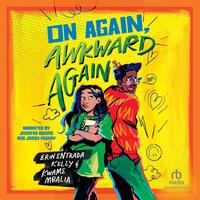 On Again, Awkward Again
by Erin Entrada Kelly & Kwame Mbalia, read by Jennifer Aquino & James Fouhey
DETAILS:
Publisher: Recorded Books, Inc.
Publication Date: April 15, 2025
Format: Unabridged Audiobook
Length: 6 hrs., 48 min.
Read Date: September 17-18, 2025
(the official blurb)
It delivers on the premise precisely. It’s sort of a variation on Rowell’s Elenor & Park, but done in a way that probably won’t get anyone annoyed by the depictions of the various ethnicities depicted.
Two geeky kids (in their own ways) who see beyond the geekiness to the great person (not ignoring it, but embracing it and the person exhibiting it). They’re drawn to each other, enjoy each other, and you can’t help but hope for a Happily Ever After (or at least a Happily-‘Til-Graduation).
The narration was great. I really loved the way they brought the characters to life.


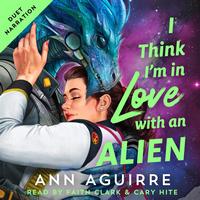 I Think I’m in Love with an Alien
by Ann Aguirre, read by Faith Clark & Cary Hite
DETAILS:
Publisher: Penguin Random House Audio Publishing Group
Publication Date: June 17, 2025
Format: Unabridged Audiobook
Length: 10 hrs., 47 min.
Read Date: July 31-August 5, 2025
(the official blurb)
I’ve read some pretty good UF by Aguirre, and some good SF by her, too (and would’ve finished the series if I hadn’t had trouble finding a book or two at the library). But they were pretty serious—so seeing a Rom-Com with her name on it intrigued me. A Rom-Com with this premise even more so. An alien stranded on Earth meets some friends in an online chat room, develops a crush for one of them, and then they arrange to meet at a con. She’s a bit of a geek, who has a pretty sizable crush on him. Things spark at the con, just as you expect and…
I really liked our female main character and their friends. The alien intrigued me—and I did like him, but I think the narrator kept me from liking him as much as I should’ve—which is odd, because I think he nailed the character.
The story ends up not being as predictable as you’d expect, but it’s sweet. The found-family part of it is terrific. The romance will win you over. There are two occasions that it gets too steamy for me—but I really am a prude about that kind of thing (especially in an audiobook where I can’t just skim a few paragraphs to get past it), and it’s really not that bad (I don’t think).
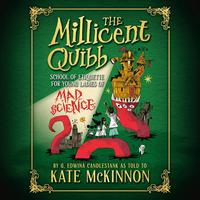 The Millicent Quibb School of Etiquette for Young Ladies of Mad Science
by Kate McKinnon, read by Kate McKinnon & Emily Lynne (Narrator)
DETAILS:
Series: The Millicent Quibb School of Etiquette for Young Ladies of Mad Science, Book #1
Publisher: Hachette Audio
Publication Date: October 1, 2024
Format: Unabridged Audiobook
Length: 4 hr., 54 min.
Read Date: July 18-21, 2025
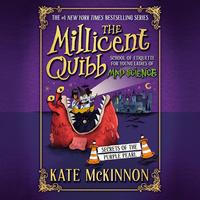 Secrets of the Purple Pearl
by Kate McKinnon, read by Kate McKinnon & Emily Lynne (Narrator)
DETAILS:
Series: The Millicent Quibb School of Etiquette for Young Ladies of Mad Science, Book #2
Publisher: Hachette Audio
Publication Date:  September 30, 2025
Format: Unabridged Audiobook
Length: 4 hrs., 42 min.
Read Date: October 3-9, 2025
(the official blurb of Book #1) and (the official blurb of Book #2)
Would I enjoy these in print? Yeah—especially the illustrations. But the performance by McKinnon & Lynne make these things you have to listen to. And likely re-listen to.
These are silly, silly, silly adventure novels about three sisters (orphaned and living with unpleasant and demanding relatives) who wind up at The Millicent Quibb School of Etiquette because they can’t manage to stay in other schools without being disruptive (by being themselves, not by being disruptive). Sure, their aunt may not truly understand the nature of this school—but that works for the sister’s benefit.
Quibb introduces them to a world of pizza, self-expression, curiosity, mystery, danger—and the chance to save the world from mad scientists.
I cannot say enough good things about these books. The plots are insane, the texts are ridiculous, and the jokes are a great balance of silly enough for children but clever enough for adults. They’re perfect for young or young-at-heart readers (or people who want to be young-at-heart, you will be in that condition while reading them).

 I Hope This Finds You Well
by Natalie Sue, read by Nasim Pedrad
DETAILS:
Publisher: William Morrow
Publication Date: May 21, 2024
Format: Unabridged Audiobooki
Length: 12 hrs., 3 min.
Read Date: November 21-25, 2024
(the official blurb)
The entire setup for this book makes utterly no sense—and is likely technologically impossible. Suck it up, pretend it can happen. Once that’s done, you can bask in this feel-good, self-improvement story about love, people who shouldn’t interact anyone in public (without a lot of therapy), and friendship.
Jolene’s parents (and the mother’s social circle) are fantastic and add both comedy and heart.
Is the book predictable? Yes, but Natalie Sue may not time events/reveals the way you expect. Does the predictability matter? Nope. It’s the ride. And man, it was a fun one. Dynamite narration, too.
 Back After This
by Linda Holmes
DETAILS:
Publisher: Penguin Random House Audio Publishing Group
Publication Date: February 25, 2025
Format: Unabridged Audiobook
Length: 9 hrs .,12 min.
Read Date: April 30-May 2, 2025
(the official blurb)
I could copy the last paragraph for this one and be done (although I think Holmes times pretty much everything the way you’d expect). But it’s not just about the sweet love story.
Nor is it just about the fantastic dog character (but, yeah, that’s part of it).
It’s the personal/professional journey that Cecily takes and where she lands at the end that really sells this book for me.