Tag: Science Fiction Page 21 of 39

Yet More Quick Questions with . . . Nick Kolakowski

Man…this is the third time I’ve got to pick Nick Kolakowski’s brain (the first and the second, for you completists). I can’t believe he keeps coming back for more — but when I get great answers like these, I’ve gotta keep asking, you know? Do read the others if you’re wanting to learn more about him in general — I stuck to Maxine Unleashes Doomsday (I posted about it earlier today, in case you missed that) this time.

Hope you enjoy!

Did you set out to write Science Fiction or is that something that came about as you started the project?
I’ve always wanted to write a dystopian novel, but all my early attempts were ignoble failures; they were Diet Cormac McCarthy, pastiches of “The Road” that were just retreads of what everyone else was trying to do. It’s only when I mashed the concept onto a noir framework that it started to work for me—a heist novel was the grounding that I needed, even if the target of that heist, in this post-apocalyptic context, is really, really weird.
What were some of the new challenges (and/or freedoms) compared to your earlier works given this setting/genre?
I’ve never written a book that covers the whole scope of someone’s life. Any novel comes with its share of continuity challenges; even if the timeframe is really short (i.e., a few hours or days), you need to keep all of your pieces and characters aligned and consistent. But keeping the details of a character’s life aligned across decades can prove much more difficult—did this happen to her left or right arm when she was a teenager, etc.

In terms of freedoms, though, you can create an incredible character arc if you have that kind of super-expansive timeframe to play with. There’s a real poignancy to tracing someone’s life from their teenagehood to the very end, especially if the country is radically changing around them at the same time.

What came first—the story or Maxine? Is that your typical approach, or does it vary from project to project?
Maxine came first: I had a vision of a badass woman, bitter and chain-smoking but refusing to give up no matter what life threw at her. From there, I wanted a story that put her in worse and worse circumstances. What happens to someone who loses everything? What’s left?

In terms of actual writing, this book started in the middle. Then I wrote Maxine’s childhood and teenage-dom. Then I stalled for about a year because I couldn’t think of where to take her from there; it was only when I came up with the broader framework—of academics discussing her life and her impact on society—that I figured out where to take everything.

In this book, Preacher reminded me a lot of Main Bad Guy’s Walker—but a very different take on the character type. Is 2019 your Year of the Aging Badass, or is that just a coincidence?  I’m having a hard time not asking a spoiler-laden question about him, so let me take the easy way out – what would a prospective reader want to know about Maxine’s very disfunctional paternal figure?
That was a coincidence, but now that you mention it… yeah, Preacher and Walker are brothers of a type! I didn’t mean it that way; Preacher made his first appearance in my head circa 2014, while Walker emerged around 2017-18, when I was writing “Main Bad Guy.”

Not to spoil too much, but Preacher isn’t the badass that Maxine thinks. He’s ultra-tough, and he deserves his fearsome reputation in the ruined part of the world where Maxine and her family lives. But his weaknesses—and frankly, his lies—eventually force Maxine to step up. The thing about badasses like Preacher and Walker, they can serve as crutches for your main character; at some point, you need to neuter them or take them away if your protagonist is truly going to move on and grow.

Are you far enough into your next book to talk about it – are you sticking with SF, going back to Crime Fiction, or trying your hand at something like Wizards?
Haha! Noir-ish wizards would be pretty cool, although I’m sure someone has already covered that arena already. Up next is actually the sequel to “Boise Longpig Hunting Club,” so it’s back to crime fiction (and Idaho!). The as-yet-untitled sequel is actually giving me a bit of trouble, because I’m trying to ratchet up the tension as tightly as possible on Jake and Frankie, my two main characters (and siblings). They survived some insane crap in the first book, so I have to figure out a way to make things even crazier.
Thanks for your time—and thanks for introducing me to Maxine
Thank you! I love her. I hope readers will, too.

Maxine Unleashes Doomsday by Nick Kolakowski: Kolakowski Gets His Crime Fiction Chocolate in this SF Peanut Butter

This is one of those books that I’m uber-excited about, yet I don’t think I do a good enough job at explaining why I am. It’s just good.

 Maxine Unleashes Doomsday

Maxine Unleashes Doomsday

by Nick Kolakowski

eARC, 274 pg.
Down & Out Books, 2019

Read: October 29-31, 2019

“You know the trick to surviving? The one thing you got to do?”

“What’s that?” Maxine asked.

“You got to treat every day like an adventure. Like it’s fun, or a challenge, even when everything’s crappy. Especially when it’s crappy. Because otherwise, it’s all going to crush you.”

“I feel like I spent my whole life being crushed.”

“Well, that’s your fault. A normal job, trying to live a normal life, it’s just inviting people to stomp you. And they do.”

“Yeah.”

“But at least in my line of work, sometimes you get to stomp back…”

In case the author’s name looks familiar to you, yeah, you’ve seen me use it a few times this year—3 novellas, 1 short fiction collection, and now this novel, Maxine Unleashes Doomsday. It occurs to me now, that he was the first author I read this year, and he did a pretty good job setting the tone for 2019’s reading. This book is his first step out of Crime Fiction and into Science Fiction—dystopian SF, to be precise (that really should be obvious to anyone familiar with him, I don’t think he’s got a utopian novel in him).

That said, there’s enough of a Crime Fiction flavor to this SF novel, that fans of either genre will have enough of their drug of choice to be satisfied.

This is set in the near-future, at various points along the fall of the US/Western Civilization. While there are plenty of other characters to keep an eye on, our focus throughout is on Maxine. After a rocky start to life with a drug-addicted mother, and an unsuccessful academic career (although she tried for a little bit), she tries to follow her uncle’s example and become a criminal. She has some success in that, but a large failure resulted in life-threatening injuries to a friend and the loss of one of her arms. Following that, she tries to live a non-criminal life, she gets a job, settles down with a guy and has a kid. But her heart’s not in it, and she ends up dabbling in thievery. At some point, she abandons that life and sets her eyes on a criminal career.

Maxine is one of my favorite characters this year—she’s flawed (not as flawed as she thinks), she’s a fighter (not as good as she thinks), self-destructive, optimistic, and driven. She takes a lot of (metaphorical and literal) punches, and while she may not get up right away after them, she doesn’t stop moving forward. Ever. I love reading characters like that.

Her uncle, who goes by Preacher, is one of the most significant criminals in the New York area—and has some cops dedicated to taking him down, and any number of civilians supporting him. Off and on throughout her childhood, Preacher tried to get Maxine’s mother to leave her addictions behind to provide for and care for her kids. Between his power and influence on the one hand, and being just about the only adult to look out for her and her brother, it’s no wonder that Maxine will want to be part of his life. Readers of Kolakowski’s Main Bad Guy will enjoy playing a compare/contrast game with Preacher and Walker.

There are a number of other characters that greatly influence Maxine’s life and desires, but none so much as her uncle. And to get into them would just push this post beyond the length I want (and would end up spoiling stuff to really talk about).

By and large, this is the story of Maxine’s journey from a struggling public school student to being a wanted criminal (and beyond). But that’s not everything that’s going on. For the first chapter, you get the impression you’ll be reading a book about rival groups fighting for supplies in mid-apocalyptic New York. But then you’ll realize that’s not it at all, it’s a story about how Maxine became the tenacious gun-fighter and would-be criminal mastermind that she is. Eventually you discover that yeah, both of those are true, but Kolakowski’s really writing a different story—and boy howdy, you feel pretty clever when you suss it out, and it’s such a brilliant way of telling this story that you don’t mind being wrong about what the book is trying to accomplish. But even then, you won’t really understand everything until the last line of the book (I’m not sure I actually pumped my fist when I read it, but I probably thought about it pretty hard).

Yes, it’s a pretty violent book (this too, should really be obvious to anyone familiar with Kolakowsi), but most of the truly horrible stuff happens “off-screen,” making it a lot easier to take. The prose moves quickly and assuredly, the writing is sone with a strong sense of style and savoir faire. Frankly, it’s too lively and enjoyable to keep the most readers who aren’t into gunfights, etc. from being turned off by the violence.

It’s a well-realized dystopia, one that’s easier to imagine happening than say, Panem. Kolakowski does a wonderful job of littering this book with little details that tell you so much about the world his characters live in and entertain the reader. Hitting both of those notes regularly is a difficult task. For example:

“Someday I want to go to California,” Michelle told Maxine. “Did you know it used to be a state?”

and

This far north, the concept of local government grew teeth and claws. If you stuck to the highway, you would cross into territory controlled largely by the New York Giants, which had expanded beyond its origin as one of the nation’s most consistently mediocre sports teams to control a big swath of towns northeast of Buffalo.

One of the conceits of the book is that the material is a result of an academic study about Maxine. It’s one of the best moves that Kolakowski makes in this book (and it’s full of great moves). Don’t skim over these notes, you’ll be rewarded for your attention.

Oh, I should warn you: This book might put you off popcorn for a while. I’m just saying…

Rob Hart wrote one of the endorsements for this: “Take one of Richard Stark’s Parker novels and throw it in the blender with DVDs of Mad Max and The Warriors. Guess what? You just broke your blender. Find solace in this book, which is what you should have done in the first place.” I repeat that for a couple of reasons—1. I love the last two sentences. 2. He’s right, and says everything in 4 sentences that I tried to above. You should listen to one of us. Kolakowski has outdone himself with this one, it was a pleasure from end to end. You really need to read it.

Disclaimer: I was provided a copy of this novel by the author in exchange for this post and my honest opinion. My opinions are my own, and weren’t influenced by this.


4 1/2 Stars
LetsReadIndie Reading Challenge

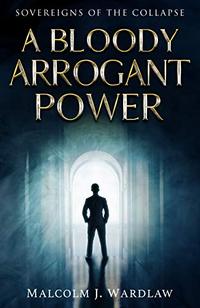
A Few Quick Questions With…Malcolm J. Wardlaw

A little bit ago, I blogged about A Bloody Arrogant Power, and now it’s time for a quick Q&A with the author, Malcolm J. Wardlaw.

Tell us about your road to publication — was your plan/dream always to become a novelist and your education/other jobs were just to get you to this point, or was this a later-in-life desire?
I am a natural-born scribbler. That said, I studied engineering at university (and later business administration) and have spent my working life to date in big-name corporations. Why? Because it has brought me a good living, and the work interested me. My writing has developed rather slowly, and in fits and starts. Being a “pantser” has pros and cons. I finished lots of drafts, but could never work out how to raise them above the level of scribbles. Oddly enough, it was the toughest nightmare of an engineering project that gave me the necessary determination to apply the same relentless force to my writing: to stick at editing and rewriting and rewriting and rewriting until eventually I was closing in on something presentable. It has taken a long time.
I don’t want to ask “where do you get your ideas?” But out of all the ideas floating around in your head, why’d you latch onto this one — what was it about these characters, this idea that drove you to commit months/years to it?
My objective in Sovereigns of the Collapse is to dramatize how the world will settle after systemic financial collapse. The collapse is inherent within the model of debt-fueled infinite growth on a finite planet. However, it proceeds more like a glacier than an avalanche, due to the flexibility of our affable, liberal-democratic traditions. I would judge its starting point as the decoupling of the US dollar from gold in 1971, although you need to look carefully to see the signs. The politics required to avoid final collapse appear so unlikely, at least at present, that I expect it to run its course within my lifetime (I can reasonably expect to live at least to 2050). The resulting world is still orderly, people go about their daily lives, there are Haves and there are Have-nots. The big difference is that the value system of this society is virtually the inverse of ours.
What kinds of research went into the construction of this concept and the world? What was the thing you came across in your planning that you loved, but ultimately couldn’t figure out how to use? (assuming there was one).
I would not say I consciously sat down to complete a research program. This theme has been an obsession for the best part of twenty years. Early drafts failed repeatedly. This stimulated my curiosity. I read more. I imagined more, and this fed my curiosity further. I would describe my “research” as haphazard, but these explorations did eventually identify a series of processes that eventually culminate in the Glorious Resolution.
In the writing of A Bloody Arrogant Power, what was the biggest surprise about the writing itself? Either, “I can’t believe X is so easy!” or “If I had known Y was going to be so hard, I’d have skipped this and watched more TV”.
Definitely the latter. Had I known just how frustrating it would be to shape the story I wanted, I would not have had the courage to sit down and write Page 1. Ignorance served me well! But it was a crucial learning experience. I am now engaged in writing Book 3 of the series (Book 2 The Night of Blind Ambition is now published on Amazon). This has followed several months of free-writing ideas every day, picking out the promising leads and working them further to construct a summary of just a couple of pages. In this way, the writing has a general sense of direction, whilst still leaving plenty of room for white-water scribbling (pantsing). The best ideas I have ever had only came after I consciously threw myself into the unknown. Hopefully I have at last found a sensible balance between writing-by-numbers and pure pants.
What’s the one (or two) book/movie/show in the last 5 years that made you say, “I wish I’d written that.”?
I have never had this feeling. What I will say is this (considering my whole life, not just the last five years). If there is one book that overwhelming impressed me, and inspired me across years of dead ends and futility, it was Nineteen Eighty-Four. Dr Zhivago, One Day in the Life of Ivan Denisovich and Madame Bovary also deeply impressed me.
Thanks for your time—and thanks for A Bloody Arrogant Power, I enjoyed it, and hope you have plenty of success with it. I’m looking forward to seeing what happens after that ending!

A Bloody Arrogant Power by Malcolm J. Wardlaw: One of the Darkest Dystopias I Remember, with Just a Hint of Light

A Bloody Arrogant Power

A Bloody Arrogant Power

by Malcolm J. Wardlaw
Series: Sovereigns of the Collapse, #1

Kindle Edition, 232 pg.
Plutonic Books Ltd, 2019

Read: October 3-7, 2019


When Wardlaw approached me about reading this book he described it as ” My best effort is to say it is ‘Nineteen Eighty-Four meets Downton Abbey’, although I’m not sure that is really all that helpful.” He’s right—it’s a good effort, and it’s not all that helpful. But it’s close—A Bloody Arrogant Power doesn’t have any of the kind of stories you’d find in Downton, but a dystopian Lady Mary and Mr. Carson could absolutely exist in this world. I’m not sure that’s more helpful than Wardlaw’s pitch, but I think it gets closer.

It’s 2106, and we’re a couple of generations past the societal collapse and the first attempt at rebuilding Western Society—or at least English Society (not really sure what happened in the rest of the world, assuming something did). There are some hints at what led to the economic and political collapse (I think the former precipitated the latter), but what we mostly see are the systems that arose to replace them and how they were designed to ensure the mistakes of the past weren’t repeated (in what’s dubbed “The Glorious Resolution”).

One of the things that developed was the idea that each parcel of land could support X amount of human life. Each year those ruling each territory would have to balance out their resources and the population—eliminating the “surplus” to keep things moving, “discharging them to the public drains.” True to form, to keep people from thinking about this too much, it’s always about the surplus population, never about people, individuals, etc.—no, it’s the dehumanized “surplus.” The most disturbing part of this idea is that the whole of England seems to think this way—it’s not until the last 10% of the book that anyone seems to have a problem with this. I certainly don’t want to suggest that it’s a problem with the book that this is the case, it’s not surprising at all that an entire nation (if not the world) will temporarily buy into a horrible idea to the degree that no one thinks of objecting to it. I can absolutely accept a world where people are officially deemed as “surplus” and disposed of accordingly. In fact, there are those who’ve been warning us about being on that slippery slope. It’s just depressing to see that idea so prevalent. I don’t know if Wardlaw intended readers to fixate on this, but I sure did. It permeated so much of the book and horrified me at each brush with the idea.

On the whole, the infodumps he uses to explain the world to his readers are done very well—he never overwhelms or bogs down the story with them. We get a little here, a little there, scattered throughout. I do think Wardlaw could’ve been a little closer to overwhelming in the beginning—I had to read a little too far into the book before I really had an idea how things worked here (and I’m not convinced I sussed it all out correctly). It’s clear that Wardlaw did a fantastic job creating this world, I just wish he’d done a better job showing it to the reader so we could appreciate it.

The protagonist, Donald Aldingford, is a barrister. He’s not one of the ruling class—but he’s adjacent to it. He gets to see a lot of what goes on behind the scenes in the government and is on the cusp of moving up in society to a position of distinction and honor. Then a few things happen that threaten to derail this.

First, he meets a younger woman who is about as far from privilege as you can get. There’s something about her that appeals to Donald. Secondly, she brings news of his brother. Donald’s spent years pretending he doesn’t exist—in fact, there are few people who are aware Donald has a brother. He’s in legal trouble that seems impossible to fix and there’s a growing chance that this association will become public knowledge and the scandal will probably ruin Donald’s career and family. Thirdly, a reform group is gaining momentum, and there are rumors flying about a Revolution coming.

None of the characters that we spend much time with are in the forefront of the reform party, but they are in the general orbit of that. I like this approach to things, we’re not dealing with Katniss or Tris here—we’re dealing with someone from Katniss’ town, or one of the students that rallied behind Tris—that kind of thing. So we can see what’s going on, but we don’t have to be in the thick of it.

While that’s a nice touch, the characters all could’ve used a little more work. I think it’s largely a space/time issue—there’s so much being established and happening in this book, that Wardlaw doesn’t get a chance to round out the characters—they’re all close (except for the sovereign that Donald spends most of his professional life serving—he might as well be twirling a mustache and tying people to railway tracks), but I never felt like I knew enough about them to care if they survived. It’s an understandable problem given what he set out to accomplish in this book, but it is a problem.

I liked A Bloody Arrogant Power—just not as much as I wanted to. It’s a wonderfully conceived novel—the execution could use a little more work, though. It’s one of the best worlds I can remember (narratively speaking, not literally) in dystopian fiction lately. I expect in future books (there are a couple planned) that Wardlaw won’t have to spend so much time establishing the world/culture and he can just jump into what the characters are doing, who they are and how can they make their way in the world. He sets the stage for some intriguing sequels, too. I really do want to know what happens after the rather abrupt ending and will be watching for the book.

Disclaimer: I received a copy of this novel from the author in exchange for this post, but as always, my opinions remain my own.


3 Stars

LetsReadIndie Reading Challenge

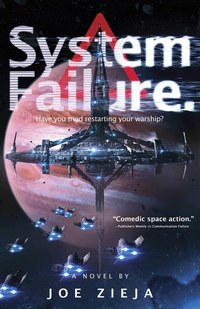
System Failure by Joe Zieja: The Epic Failure Trilogy Concludes with a Big Success

System Failure

System Failure

by Joe Zieja
Series: Epic Failure, #3

Paperback, 417 pg.
Saga Press, 2019

Read: October 1-2, 2019

“You are literally placing the fate of the galaxy in my hands.” [Rogers] thought for a moment. “Again. You need to stop doing this.”

Every author closing out a series—a trilogy or something longer running—has a daunting task (not that stand-alones or duology’s aren’t daunting themselves, but it seems easier to me). They have to tell a self-contained story; weaving in the character and story arcs that have been percolating since the first book; resolve the new and old arcs; leave the characters in a place that readers will find satisfying; and provide some sort of ending to all of that to leave everyone in a place where you can move onto the next thing. For writers like Joe Zieja there’s an additional challenge—you have to make the whole thing funny.

Thankfully, Zieja does all of that very, very well.

Rogers’ fleet (including the Thelicosans) arrive at the home base for the Free Systems to meet with their High Command. Fully aware that the only military commander that’s had any kind of success with this new enemy is Captain Rogers, he’s named the head of the Joint Force tasked with preventing Snaggardirs from destroying the galaxy.

They also realize that the only way Rogers has had any kind of success is by throwing out all the rule books—including The Art of War II: Now In Space by Sun Tzu Jr. So they tell him to do just that. They don’t care how ridiculous or uneducated his plans are, as long as they get the job done. Snaggardirs has given the Free Systems a very limited time to acquiesce or face the destruction of the galaxy. And they seem to be able to pull that off.

So with help from a very unexpected source, Rogers reaches out to the same space pirates we haven’t seen since the disastrous opening to Mechanical Failure and also is forced to accept help from a Thelicosan practitioner of something that’s a combination of horoscopes and astrophysics (you’ll have to read the book to understand it). These, um, unconventional tools are added to the rag-tag bunch that has come to help Rogers in a last-ditch effort to save reality as we know it.

As usual, Rogers is the focus. He’s been on a journey of personal growth since we first met him—despite his best intentions, it should be stressed. He really comes a long way just in these pages and it’s pretty cool to see.

Of course, I can’t go without talking about Deet—the droid that Rogers assembled from junk. He’s also on a journey of personal growth—just a different kind. In addition to trying to understand how to justify and explain his existence, he’s trying to learn to empathize, as well as lie convincingly (or at all), and he continues to improve his [EXPLETIVE] swearing. He does get better at it and made me laugh out loud several times (both in his successes and failures). There was one misstep that he made, and I re-read that sentence a few times to figure out what he may be trying to say. Naturally, after I gave up and moved on, I learned that no one understood what he was going for.

I should add a little something about Tunger. I found him amusing in Mechanical Failure, but I thought he was overused (and became a little annoying). In Communication Failure, I stopped finding him all that entertaining, mostly trying. Which is how he started in System Failure. But he soon became a very cool character and one of the real strengths of the book. He really might be the best thing that Zieja did throughout the series.

It seems like a bonus to me—not at all the kind of thing one expects from a book like this—we’re given an antagonist that the reader can almost sympathize with. Yes, their methods and strategies are wrong and harmful to innocents. But you can’t help but understand why a people would set off in this direction. I can’t imagine anyone reading about their plight will start hoping for a failure for Rogers and the rest, don’t get me wrong. But you just might see where the Jupiterians are coming from.

There’s a key acronym in the book that a. is fitting, b. is funny, c. took me far too long to get. Once I stopped feeling stupid, I realized it was a great example of this being one of those books where even if you don’t get the jokes, the book holds up as a story well enough that you won’t even notice there are jokes you don’t get until later.

There’s one figure with access to the top of Snaggardirs who isn’t on board with their destroying the galaxy plan. So they set out to sabotage it by helping Rogers. Their scheme was pretty clever, but with one giant flaw. Which made their sacrifice sad—and their attempts at success very funny. It’s a good mix for the reader (a pathetic one for the character).

I’m not sure it’s entirely fair (and I don’t mean to disparage any of the books I’m about to mention in any way), but while reading this, I couldn’t help but compare this to two other humorous series and their conclusions. I hate to compare any comedic SF to The Hitchhiker’s Trilogy, but how do you not? This series never got as funny as the best of Hitchhiker’s (maybe a couple of times it got pretty close, though), but it was a cohesive and believable story, populated with better characters and a solid ending — unlike Adams repeated attempts at a conclusion that never really felt satisfying. Similarly, Epic Failure trilogy went out strong, with its strongest material still working, unlike The Tales of Pell which went a little off-course in the final volume and didn’t stick the landing the way that System Failure managed to do.

Zieja successfully called back to elements of the first book (some I’d forgotten about, some I thought had fully served their purpose) and built on the developments of the second to give this volume a bit more heft and greater stakes. Then he added a great story new to this novel and wrapped up everything in a satisfying and definitive way. All while making me chortle, chuckle, grin and occasionally laugh. Who can ask for [EXPLETIVE] more? I don’t know what Zieja has planned next, but sign me up for whatever it is.


4 Stars
Humor Reading Challenge 2019

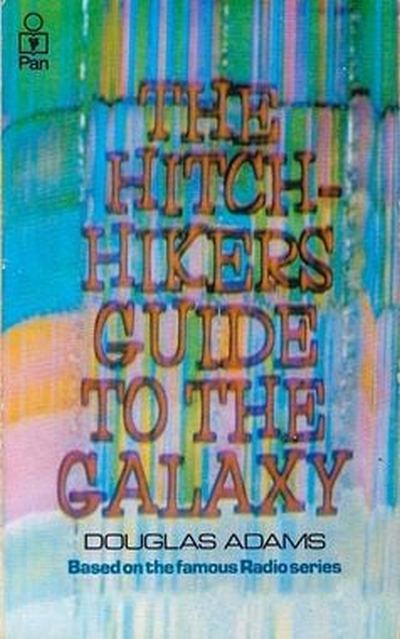
A Couple of Thoughts on the 40th Anniversary of The Hitchhiker’s Guide to the Galaxy

The first Hitchhiker’s Guide to the Galaxy book was published 40 years ago on October 12, 1979.

Just a couple of thoughts in response to this…I don’t want to blather on. (if you want to see me blather on about the series, click here).

bullet 40 Years? Wow. Sure, a lot of it is dated, but most of it feels so fresh that he could’ve written it within the last year or two.
bullet Yeah, that’s the original cover—that’s a long way from the smiling planet logo I’m used to seeing (and have tattooed on my arm).
bullet On a related note, someone—multiple someones, actually—thought that cover was a good idea.
bullet 40 years later, it’s still the benchmark. How many works from that era are still that important? (maybe some cinema)
bullet Okay, that’s actually all I’ve got—it’s just cool to note big anniversaries like this. So, now we have.

Have you read this series? Got any thoughts/memories to share?

Opening Lines—System Failure by Joe Zieja

Head & Shoulders used to tell us that, “You never get a second chance to make a first impression.” That’s true for wearing dark shirts, and it’s especially true for books. Sometimes the characters will hook the reader, sometimes the premise, sometimes it’s just knowing the author—but nothing beats a great opening for getting a reader to commit. This is one of the better openings I’ve read recently. I’m sure we can all relate to it.

Lucinda Hiri was pretty sure taking over the galaxy hadn’t been in the job description when she was offered this intern position six months ago. Then again, it wasn’t impossible. The Snaggardir corporation’s paperwork was notoriously long and detailed, vetted by droves of lawyers at every level of approval to make sure that the language had all the right loopholes in all the right places. Lucinda supposed that somewhere on page 356 there could have been a small asterisk that said “in the event a nascent people rise up after two hundred years of secret collusion, you will be required to take detailed notes at their strategy meetings.”

It had seemed like a dream come true at the time. Sal Snaggardir and his family’s company were arguably the most powerful economic force in the galaxy. The possibilities for her career as a businesswoman were endless. Not liking interning at some space technology company on Urp, where she would likely move laterally for the entirety of her disappointing, coffee-supported life. Snaggardir’s was the place to make it big.

In retrospect, though Lucinda should have noticed that Mr. Snaggardir was trying to conceal just how big his company had gotten. Subsidiary corporations literally thousands of banks all across the galaxy holding funds under different names, and that nondisclosure agreement she signed threatening to eradicate her family line if she ever told anyone anything about the company. The legal department said that was boilerplate, and, really, what did she know? She was just a thirty-year-old unpaid intern with three advanced degrees in business arts.

from System Failure by Joe Zieja

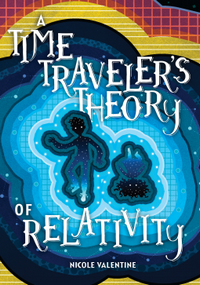
Pub Day Repost: A Time Traveler’s Theory of Relativity by Nicole Valentine: A Captivating MG Mix of Science and Magic

A Time Traveler's Theory of Relativity

A Time Traveler’s Theory of Relativity

by Nicole Valentine

eARC, 352 pg.
Carolrhoda Books, 2019

Read: August 27, 2019


Finn Firth is on the verge of turning 13, and is convinced his father will forget his birthday. Which is troubling to him, but really, it’s the least of his troubles. When they were three, his twin sister drowned (and he’s always felt this absence, and is sure everyone around him does, too). He’s not that close with his father, and his mother left home a few months ago, with no warning and no one has heard from her since. Also, his best (only?) friend, Gabi, has been spending less time with him and more time with new friends—the kind that would bully him. He’s also a huge science nerd, the kind of twelve-year-old who reads (and re-reads) Richard Feynman and Carl Sagan for entertainment. The fact that he’s an outsider, that he’s not like the other kids at school is what drives him (like so many) to science, to something he can make sense of and put himself/his trouble in perspective.

So imagine his surprise when his grandmother informs him that she’s a time traveler, actually, all the women in his family have been and are. It’s not just his family, there are people throughout the world capable of this. Some in his family are more powerful than others, most can only travel to the past—one could only travel to the past but during her lifetime—his grandmother and mother are among the few that can travel forward in time. His mother, he’s told, didn’t leave his father and him. Finn’s dad has been reassuring him that “she just needs some time,” and well, that seems to be the case after all. She’s stuck somewhere, unable to come back—but she’s created a way for Finn to come and get her (despite being a boy).

Time travel is impossible, Finn knows—and even if it weren’t, the kind of travel his grandmother describes sounds more magical than scientific. He tells his grandmother this, in fact. But—I won’t get into how, it should be read in context—he’s given some pretty convincing proof.

Now there are those who don’t think Finn should be doing anything regarding time travel, and that no one should be tracking down his mother. And they’re seemingly willing to take some extreme measures to stop him. He and Gabi set out on an adventure to evade these others and get to his mother’s portal. Finn’s ill-prepared for what lies ahead, but he doesn’t care. Between brains and sheer determination (and largely it’s the latter), he’s going to find his mom.

What he never stops to ask is: what else will he find?

This is a fun little read—Finn and Gabi are well-developed characters, his various family members are interestingly and distinctively drawn, the writing is crisp and brisk—once things get going, they stay going, and it’s easy to get swept up in it The best is the mix of science and . . . however you end up describing the time travel. For a book directed toward the 9-14 set, the science (time travel, chaos theory, multi-world theory, etc.) is presented plainly and without condescension. That last point, in particular, resonated with me.

The heart of this book is found in two concepts—the power of individual choice, and the importance of kindness in spite of everything. Lessons good to be absorbed by the target audience, as well as the rest of us.

I really enjoyed this book and heartily recommend it. One thing, though, kept running through my mind as I read it. As much as I enjoyed A Time Traveler’s Theory of Relativity, when I was 8-13, I would’ve loved it (probably when I was 14 and 15, too—I just wouldn’t admit to liking a book written for younger people at that time). It’s the kind of book that I would’ve been checking out of the library every two or three months. Get this for yourself and enjoy it, get this for your kid for them to obsess over.

Disclaimer: I received this eARC from Carolrhoda Books via NetGalley in exchange for this post—thanks to both for this opportunity.


3.5 Stars

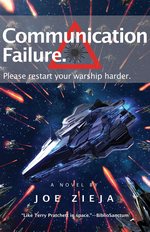
Reposting Just Cuz: Communication Failure by Joe Zieja

Communication FailureCommunication Failure

by Joe Zieja
Series: Epic Failure, #2

ARC, 325 pg.
Saga Press, 2017

Read: October 31 – November 2, 2017


So, Captain Rogers has escaped with his life after saving the 331st Meridian Fleet from a takeover from almost all the droids on board, now he’s been made acting admiral and is faced with a potentially bigger threat: the Thelicosan fleet — the very fleet that Rogers’ ships are to keep on their side of the border — has informed him that they are about to invade. Given the size of the fleets facing off, this is an invasion that will not go well for the 331st.

So how is this would-be con-man, former engineer, and current CO going to survive this? He hasn’t the foggiest idea.

Clearly, for those who read Mechanical Failure (and those who haven’t have made a mistake that they need to rectify soon), whatever solution he comes up with is going to rely heavily on Deet and the Space Marines (the Viking/Captain Alsinbury and Sergeant Malin in particular) will be heavily involved. Malin has taken it upon herself to help Rogers learn some self-defense (even if that’s primarily various ways to duck), the Viking is questioning every decision her new CO is making, and Deet is continuing his exploration into human behavior/consciousness (he’s exploring philosophy and spirituality at the moment — which is pretty distracting). Basically, if Rogers is looking for a lot of support from them, he’s going to be disappointed.

It turns out that the Thelicosans didn’t intend to send that message at all, what they were supposed to communicate was very different, actually. But before Rogers and his counterpart can find a way to de-escalate the situation, shots are fired, milk is spilled, and events start to spiral out of control. Which isn’t to say that everyone is doomed and that war is inevitable, it’s just going to take some work to keep it from happening. There are forces, groups, entities — whatever you want to call them — hawkish individuals who are working behind the scenes to keep these cultures at odds with each other, hopefully spilling over into something catastrophic. Which is something too many of us are familiar with, I fear — and something that someone with Zieja’s military background is likely more familiar with. The Thelicosans and Meridians discover who these people are — and how they are attempting to manipulate the fleets — and the big question is how successful they’ll be.

We focus on three Thelicosans, but spend almost as much time on their flagship (The Limiter) as we do the Meridian flagship (Flagship). Grand Marshall Alandra Keffoule is the commander of the border fleet — at one time, she was a star in the special forces, and now she’s been assigned to the border fleet as a last chance. She fully intends on taking full advantage of this opportunity to make history and restore herself to her position of prominence in the military. Her deputy, Commodore Zergan, has fought alongside her since the special forces days and is now trying to help her rebuild her reputation. Secretary Vilia Quinn is the liaison between the Thelicosan government and the fleet. Quinn’s development through the book is a lot of fun to watch — and is probably a bigger surprise to her than it is to the reader, which just makes it better. Thelicosan culture is saturated in science and math, and is full of rituals that are incredibly binding and incredibly difficult for outsiders to understand. In many ways, the culture is hard to swallow — how a society develops along those lines seems impossible. But if you just accept that this is the way their society functions, it ends up working and stays consistent (and entertaining).

Lieutenant Lieutenant Nolan “Flash” “Chillster” “Snake” “Blade” Fisk, the best pilot the 331st has is a great addition to the cast — yeah, he’s probably the most cartoonish, least grounded, character in Rogers’ fleet — but man, he’s a lot of fun (and I think it’s pretty clear that Zieja enjoys writing him). think Ace Rimmer (what a guy!), but dumber. Mechanical Failure‘s most cartoonish character, Tunger, is back — the would-be spy/should-be zookeeper finds himself in the thick of things and is well-used (as a character) and is well-suited to his activities. Basically, I put up with him in the last book, and enjoyed him here. I’d like to talk more about Deet and the other characters here — I’ve barely said anything about Rogers (he develops in some ways no one would’ve expected) — but I can’t without ruining anything, so let’s just say that everyone you enjoyed in the previous installment you’ll continue to enjoy for the same reasons.

Mechanical Failure didn’t feature a lot of world-building outside life on the ship. Zieja takes care of that this time — we get a look at the political situation between the various governments, and the history behind the four powers. Which isn’t to say that we’re drowning in details like George R. R. Martin would give us, it’s still breezy and fast-paced. Still, there’s a handle you can grab on to, some context for the kind of madness that Rogers finds himself in the middle of.

One of my personal criteria for judging books that are heavy on the humor in the midst of the SF or mystery or fantasy story is judging what the book would be like without the jokes. The Hitchhiker’s Trilogy, for example, would fall apart in seconds (and few rival me for their devotion to that series). Magic 2.0 would hold up pretty well, on the other hand. The Epic Failure series would be another one that would hold up without the jokes. I’m not saying it’d be a masterpiece of SF, but the story would flow, there’d be enough intrigue and action to keep readers turning pages. However, you leave the humor, the jokes and the general whackiness in the books and they’re elevated to must-reads.

There are too many puns (technically, more than 1 qualifies for that), there’s a series of jokes about the space version of The Art of War that you’d think would get old very quickly, but doesn’t — at all; and Rogers has a couple of bridge officers that make the pilot Flash seem subtle. Somehow, Zieja makes all this excess work — I thought the humor worked wonderfully here, and I think it’ll hold up under repeated readings.

I thoroughly enjoyed this book and can’t wait to see where Zieja takes us next.

Disclaimer: I received this book ARC from the author, and I can’t thank him enough for it, but my opinion is my own and wasn’t really influenced by that act (other than giving me something to have an opinion about).

—–

4 Stars

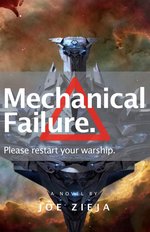
Reposting Just Cuz: Mechanical Failure by Joe Zieja

Oddly tired today, so I can’t get my post for 9/17 finished. So, I’ll dig up a couple of blasts from the past in honor of volume 3 of the Epic Failure trilogy’s release today. There are a few sentences here that I wish I could rewrite, but oh, well…This is one of the funniest books I’ve read in years, and I can’t wait to dive into System Failure.

Mechanical FailureMechanical Failure

by Joe Zieja
Series: Epic Failure, #1

Hardcover, 343 pg.
Saga Press, 2016

Read: August 17 – 18, 2016

No duty was too great that R. Wilson Rogers couldn’t find a way to shirk it.

This is the essence of R. Wilson Rogers (don’t ask what the R. stands for) compressed into one sentence — an engineer for the Galactic Navy during the longest peacetime in Galactic Memory. As a result of all the peace, there’s not a whole lot for a Naval ship to do — nor for the men assigned to it. So, Rogers and his fellow crew members got up to a lot of nonsense — drinking, gambling and worse. Eventually, Rogers finds himself leaving under less than auspicious circumstances. Not long after that, under even less auspicious circumstances (which I’ll leave for you to read about and chuckle over) he finds himself back on the appropriately named Flagship which has transformed in his brief absence in to a serious-minded place, full of random inspections, wartime preparations (despite centuries of peace), and odd assignments.

Before long, Rogers finds himself getting promotions, leading a group of battle droids, and seriously considering suicide and desertion (favoring the the latter, I assure you) — and that’s when things really start to get interesting.

This is pretty decent Military SF with a twist of humor, a dollop of irony, a pinch of satire, and so on — I don’t want to compare it to Adams. But I’ll compare it to a mix of Scalzi, Harry Harrison, Jack Campbell, Grant Naylor and Peter David. There’s a sense of play, even when he’s not going for the comedy, which makes the whole thing fun to read.

Best ‘droid since Marvin, best malfunctioning human personality software since Marvin (or Lore — but not as creepy or murderous), funniest ‘droids since Kryten. I could keep those comparisons going — essentially, I really liked all of the Droids on Flagship (especially Deet). The CO that reminded me of some sort of hybrid between the pointy-haired boss and Douglas Reynholm is great comic relief, but there’s more to him than that.

Honestly, I could go on and on, Zieja assembled a great cast of characters — real enough that you can like them, outlandish enough that you don’t take them terribly seriously. Not just the obviously comedic characters either, there are a few “straight (wo)men” characters scattered throughout, keeping the rest grounded. Rogers is the best of the bunch — there’s a little personal growth to him (no one’s more surprised and dismayed by that than him), I enjoyed seeing that come out. I liked how despite himself he learns to set aside prejudices, take things seriously, and even act a little heroically. I as amused by (and occasionally disturbed by) his attraction to/fascination with the Amazonian Marine Captain. Rogers’ way of looking at the world is pretty relatable (I’m not saying that he’s the kind of guy you spend time with, he’s the guy you want to spend time with), and he’ll win you to his side pretty quickly.

One thing that I really appreciated was the respect that Zieja showed to the military personnel throughout this — too often everyone (with a maximum of a couple of exceptions) in a book like this is depicted as a moron — think of Richard Hooker’s classic for a moment. It’s just one example, but it’s a good one. You’ve got Jones, the Painless Pole, Hawkeye, Trapper, Duke, and a couple of nurses here and there who are competent, if not great, doctors. Who else? Everyone else is a “regular Army” schmuck ho shouldn’t be allowed in an operating theater or near anything where life and death decisions come into play.

Zieja doesn’t play it this way — these Navy and Marine men and women (with one or two exceptions, because there are always exceptions) are treated as competent, equipped and dedicated people whose greatest problem is that they have nothing to do, so things get a little loopy from time to time. But you give then an enemy, you give them a goal, you give them some way to target their talents and energy — good things happen. Even the really incompetent turn out to be quite competent when put in the right spot, doing what they’re good at (even if that’s not what they want to be good at). Problems are solved, crises averted, and enemies thwarted. That’s just not seen often enough, and I appreciate Zieja doing that.

That doesn’t mean he can’t find ways to make fun of the dedicated, the competent, and equipped — but he doesn’t make them into buffoons to do so (mostly).

I knew that I was going to like this book by page 3, I was audibly chuckling by page 4. The rest was just gravy. I laughed, chortled, and grinned my way through this — practically from beginning to end. The story as pretty good, the story plus the comedy made this gold. If I could think of stronger words to use to endorse this, I’d probably slap them here. But I can’t — just get your hands on this one. Meanwhile, I’m already looking forward to the sequel.

Disclaimer: I received a copy of this from the Publisher in exchange for my honest comments on it — sorry for the delay, I greatly appreciate the book.

—–

4 Stars

Page 21 of 39

Powered by WordPress & Theme by Anders Norén