Tag: SF Page 16 of 30

Top 5 Saturday: Trilogies


The Top 5 Saturday weekly meme was created by Amanda at Devouring Books.

Rules!

  • Share your top 5 books of the current topic—these can be books that you want to read, have read and loved, have read and hated, you can do it any way you want.
  • Tag the original post (This one!)
  • Tag 5 people (I probably won’t do this bit, play along if you want)

This week’s topic is: Trilogies. I immediately wrote down three of these, and then thought a bit and came up with 8 more. I whittled those down to five—the ones that had the biggest impact on me/my development as a reader. I left a lot of good candidates out, but at the end of the day, these are the biggies for me. I’ve read them all multiple times (except #4, honestly—only read that twice), and would gladly do so again tomorrow (well, okay, in three weeks, am too busy in the meantime).


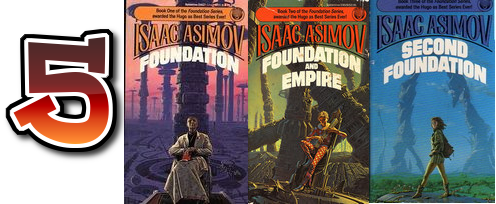
The Foundation Trilogy
by
Isaac Asimov

Hari Seldon, uber-mathematician, creates a new science combining mathematics and social sciences to predict (and shape) how humanity will react to the imminent fall of the Galactic Empire. He uses this science to come up with a way to shape the future, helping humanity survive the challenges on their way. I read this sooo many times in high school—for years it served as the ruler by which I judged all SF. Also, other than his Black Widowers mysteries, my favorite works by Asimov.

Yeah, there were a couple of sequels (not nearly as good) and other related works, but these were a trilogy for so many years, I have no problem ignoring the others.


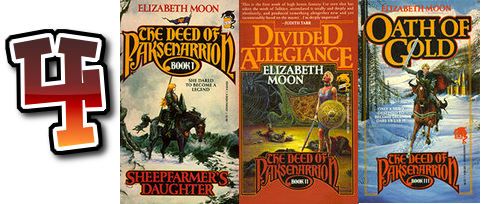
The Deed of Paksenarrion
by
Elizabeth Moon

Wow. This is just…wow. Rather than submit to the arranged marriage her father has planned, Paksenarrion, takes off and joins the army. Eventually is trained and recognized as a Paladin. A fantastic hero’s journey that I wish I remembered more of. I remember being blown away by it and hating that the trilogy ended.


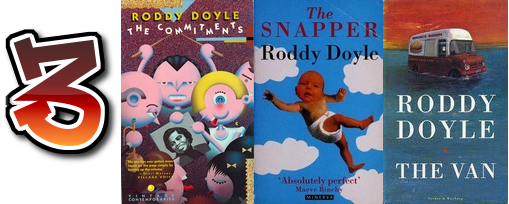
The Barrytown Trilogy
by
Roddy Doyle

Can I talk about these in less than 1500 words? These books focus on the Rabbitte family in Dublin. The first chronicles the oldest son’s attempts to launch his career as the manager of The Commitments, the second is about the very unplanned pregnancy of the eldest daughter (and her father’s struggle to accept it—followed by his outrageous pride for the kid), and the last focuses on the father’s attempt to provide for his family after he becomes unemployed by opening a chip van (a precursor to today’s food truck obsession). They’re all as funny as you could hope, full of hope, sadness, and love. I’m getting excited just by writing this snipped about them.


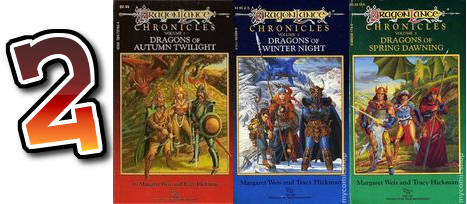
The Dragonlance Chronicles
by
Margaret Weis and Tracy Hickman

Dragons of Autumn Twilight, Dragons of Winter Night, and Dragons of Spring Dawning were my obsession in eighth grade—one I shared with as many people as I could. I’m pretty sure the fantasy I respond to today is the fruit of these books. And I’m totally okay with that. Say what you will about the quality of these, they hold a special place in my heart (right above the cockles, near the blockage on the right)


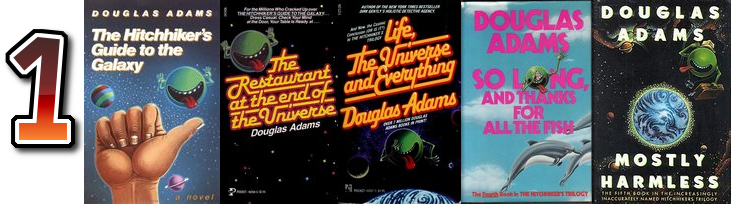
The Hitchhiker’s Guide to the Galaxy Trilogy
by
Douglas Adams

Was there any doubt? I can’t stop talking about Adams/This Trilogy (see my Annual Towel Day posts, for example). From the moment I read the first chapter (three or four times before I moved on to Chapter 2) to the point when I heard the radio series to getting the planet icon tattooed on my arm to today and all points between. This Trilogy has been at or near the top of my list, and will stay there for a long time to come.

I maybe should’ve added Colfer’s 6th volume, but…I decided to go old school.

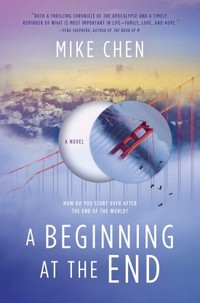
A Beginning At The End by Mike Chen: Love, Uh, Finds a Way in this Optimistic Dystopian Novel

A Beginning At The End

A Beginning At The End

by Mike Chen

Hardcover, 391 pg.
Mira Books, 2020

Read: January 28-February 4, 2020
Grab a copy from your local indie bookstore!

“Mommy’s not coming home.”

“No! Mama now! Want Mama!” Desperation had taken over the child’s face, eyes pooling With the Whiplash turn of raw emotions. She tossed the plastic spoon across the prison-cell-turned-living-space, her voice ramping up in volume and intensity. His arms wrapped around his daughter, even though she punched at his thigh in frustration; he held her as if she was the last thing in the world.

Rob blinked as the realization came to him. She was.

His home, his old life was gone. His parents and brother, killed by MGS. Their friends, their community, scattered and ravaged. And now Elena gone too.

Sunny was all he had left.

Well, I really painted myself into a corner with my In Medias Res post about this book a couple of weeks ago. I’m not sure what else there is to say! Oops.

I was more right than I was wrong about where Chen was taking some of the story—but while I had the destination correct the route he took totally caught me off-guard (and it was so good!). The parts of the story I was wrong about, however. I could not have been further off the mark if I’d tried. Both of those results are so satisfying to me, Chen nailed the nuts and bolts bits of plotting—conclusions that seem right and expected (and earned) while being very unexpected.

While Chen knows how to plot a book, characters are his strength (see also Here and Now and Then).
I could absolutely see where Moira was coming from and understood (and applauded) what she did to change her life. I felt like I got Krista’s pain and the way she reacted to her mother and uncle made sense to me (I’m not sure she was fair to her college boyfriend, even if he should’ve known better than to do what he did). And Sunny should win over even the most jaded reader. But Rob? The way Chen wrote him made me empathize with Rob to a degree that I wasn’t prepared for. That sentence I quoted above, “She was,” just about broke me.

I assume that other readers will gravitate to other characters (and Moira is probably my favorite in the novel), and they should. But Rob is going to stick around in my subconscious for a while.

All of this happens against the backdrop of a world trying to recover from a global pandemic that wiped out an unimaginable number of people. Sure, other apocalyptic scenarios seem worse (zombies, whatever lead to Panem, the First-through-Fifth Waves, etc.)—but what makes this scenario chilling is just how possible it really seems. And I’m not just saying that with one of my sister’s kids dealing with being quarantined in Asia around the time I read this.

Nevertheless, Chen’s novel is optimistic. Human beings, human society, human families prevail. Like Dr. Ian Malcolm famously said, “Life, Uh, Finds a Way.” So does humanity in Chen’s world.

Like all good Science Fiction, this is more about our present than it is our future. In a survivor’s group, Rob has a lot to say about living in fear with the source of the past hanging over is and letting the two dictate our lives. Without trying I could think of a dozen ways that could be applied to pre-apocalyptic Americans (who knows how large the number would be with some effort).

There’s more I feel like I should say, if only just to flesh out some of what I’ve put down—but at this point, I think I’ve said enough about this book over the two posts, so I’m going to stop here (so much for that corner I painted myself into). I want to do 400-600 words on the title alone (many of which would be devoted to the indefinite article).

A Beginning at The End is the kind of SF that should appeal to SF readers. It’s the kind of SF that should make non-SF readers (including those antagonistic to genre fiction) think there’s something to the genre after all. Because this isn’t “just” a SF novel. It’s a novel about humans being very human, with hopes, fears, loves, joys, sorrows, failures, and successes—it just happens to be set in a post-apocalyptic future. Chen’s first novel was among the best I read in 2019. I fully expect that this will be among the best I read in 2020. I’m going to jump on whatever Chen has coming in 2021 without bothering to note the title or even skim the blurb. He’s earned an auto-read from me for at least the next two novels.


4 1/2 Stars

2020 Library Love Challenge

This post contains an affiliate link. If you purchase from it, I will get a small commission at no additional cost to you. As always, opinions are my own.

In Medias Res: A Beginning At The End by Mike Chen

As the title implies, I’m in the middle of this book, so this is not a review, just some thoughts mid-way through.

—–

A Beginning At The End

by Mike Chen

Book Blurb:

Six years after a global pandemic wiped out most of the planet’s population, the survivors are rebuilding the country, split between self-governing cities, hippie communes and wasteland gangs.

In postapocalyptic San Francisco, former pop star Moira has created a new identity to finally escape her past—until her domineering father launches a sweeping public search to track her down. Desperate for a fresh start herself, jaded event planner Krista navigates the world on behalf of those too traumatized to go outside, determined to help everyone move on—even if they don’t want to. Rob survived the catastrophe with his daughter, Sunny, but lost his wife. When strict government rules threaten to separate parent and child, Rob needs to prove himself worthy in the city’s eyes by connecting with people again.

Krista, Moira, Rob and Sunny are brought together by circumstance, and their lives begin to twine together. But when reports of another outbreak throw the fragile society into panic, the friends are forced to finally face everything that came before—and everything they still stand to lose. Because sometimes having one person is enough to keep the world going.

I’m a couple of chapters shy of the halfway point, but I’m pretty excited about this book and want to get something out there about it—also, I have to take a break because I forgot about a book tour I have next week, and I really should read that book first.

So, like last year’s Here and Now and Then, Chen uses SF trappings to tell the kind of story that you don’t normally associate with Science Fiction (especially if you’re an anti-genre fiction snob).

I’m a chapter or two past a Speed Dating scene. On the one hand, it’s like every other Speed Dating scene you’ve seen from TV or the movies and/or read before. On the other hand, this is after most of the population of the earth is gone and people are trying to rebuild a facsimile of their lives in the midst of tragedy, so you’ve got the awkwardness, the insanity of the whole speed dating thing, and people dealing with unspeakable trauma at the same time. Chen makes this feel incredibly familiar and incredibly alien (yet relatable) at the same time, mildly humorous and miserable, tinged with hope and despair. And that’s just one scene. The book is full of stuff like this.

At its core (I think), this is a novel about how our past defines us, even after the apocalypse. Two characters here want to redefine themselves from the pre-pandemic lives, and somehow still can’t (at least not totally). Two characters need to redefine themselves from their post-pandemic past, and can’t seem to find the will to. It’ll take no time at all before you’re invested in these characters—you’ll want what the former two want, and hope that the latter two can somehow make things work.

Also, you’ll find you have some pretty strong feelings about Moira’s father. And they won’t be at all positive. But that’s all I’m going to say about that.

I have a few ideas where the stories are going/may end up, yet I’m reasonably certain that Chen’s ideas are better. Regardless, these are all building toward a satisfying pay-off or three. Maybe late next week I’ll have a chance to talk about this more, but for now, let me say I’m digging this and expect that about 80% of the people who read this blog on a semi-regular basis will, too.

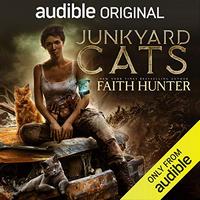
Junkyard Cats by Faith Hunter, Khristine Hvam: Hunter tries SF with Predictably Entertaining Results

Junkyard Cats

Junkyard Cats

by Faith Hunter, Khristine Hvam (Narrator)
Series: Shining Smith, #1

Audiobook, 5 hrs., 2 min.
Audible Original, 2020

Read: January 3-6, 2020


Faith Hunter dips her toe into SF with this Audible Original, and leaves quite an impression. The distinctive Hutner-flair is there, with science-y stuff replacing the magic stuff. It works pretty well.

Shining Smith is a veteran, of a handful of things, really. This takes place in the near-future, following a World War and another one (called the Final War in an act of aspirational nomenclature, I assume). She lives in/runs a scrapyard left to her by her father with a few cats and another vet recovering from trauma.

Shining deals on both sides of the law through intermediaries—no one knows her or who she is beyond those. It’s a perfectly safe environment.

Not a nice one, not a fulfilling one, but a safe one. And in her world, that’s asking a lot.

Until one day, one of her intermediaries shows up at her scrapyard dead. And then a very strong suspect for killing him shows up. And things get worse from there.

The action scenes are cool—filled with all the kinds of things that the best SF action scenes are filled with. The future-tech is cool, completely foreign to reality, yet it seems like the kind of thing that would emerge from our current tech.

I liked Shining, we don’t get to know her much. She’s such the riddle, wrapped in a mystery, inside an enigma, that it’s hard to get a real handle on her—but we get enough to root for her and want to know her better. Her compatriots are intriguing—as well-rounded as characters can get in this limited space where everyone is lying to each other about who and what they are.

There were a couple of SF-brand/tech names (like The Tyrell Corporation or tricorder) that I really couldn’t understand what Hvam was saying. Against the spirit of an “Audible Original,” but I’d like to read this so I could get a handle on those things. Which isn’t saying that Hvam didn’t do a great job—as per usual, her narration is top-notch.

My only complaint (outside of the tech words I couldn’t decipher), is the brevity, we get the good story, but we don’t get any depth—it’s like it’s designed to make you want more. Hey, wait a second . . .

A fun action-packed story that’ll whet your appetite for more. This is a glimpse into a cool world and I love what Hunter has created here. Yeah, I’m only going with 3 Stars for this. There’s a lot of potential in this world and with these characters—if Hunter returns to this? I can easily see this becoming a favorite series. It’s fine as a stand-alone, and it doesn’t demand a series/sequel but I think to really appreciate everything she set-up here, we need a little more. I’m not sure that makes sense, but…it’s what I can do.


3 Stars

My Favorite Non-Crime Fiction of 2019

Like last year, while trying to come up with a Top 10 this year, I ran into a small problem (at least for me). Crime/Thriller/Mystery novels made up approximately half of the novels I read this year and therefore dominated the candidates. So, I decided to split them into 2 lists—one for Crime Fiction and one for Everything Else. Not the catchiest title, I grant you, but you get what you pay for.

These are my favorites, the things that have stuck with me in a way others haven’t—not necessarily the best things I read (but there’s a good deal of overlap, too). But these ten entertained me or grabbed me emotionally unlike the rest.

Anyway…I say this every year, but . . . Most people do this in mid-December or so, but a few years ago (before this blog), the best novel I read that year was also the last. Ever since then, I just can’t pull the trigger until January 1. Also, none of these are re-reads, I can’t have everyone losing to books that I’ve loved for 2 decades that I happened to have read this year.

Enough blather…on to the list.

(in alphabetical order by author)

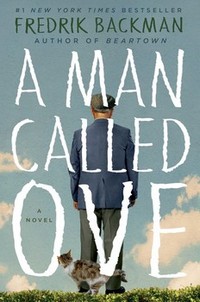
A Man Called OveA Man Called Ove

by Fredrik Backman, Henning Koch (Translator)

My original post
I’ve been telling myself every year since 2016 that I was going to read all of Backman’s novels after falling in love with his My Grandmother Asked Me to Tell You She’s Sorry. The closest I got was last year when I read his first novel, A Man Called Ove (and nothing else). It’s enough to make me resolve to read more of them, and soon. The story of an old, grumpy widower befriending (against his will, I should stress) a pretty diverse group of his neighbors. It’s more than that thumbnail, but I’m trying to be brief. The story was fairly predictable, but there’s something about the way that Backman put it together that makes it perfect. And even the things you see coming will get you misty (if not elicit actual tears).

5 Stars

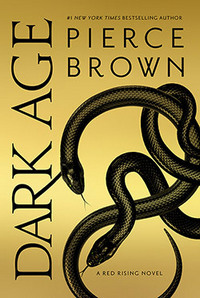
Dark AgeDark Age

by Pierce Brown

My original post
When I started reading this, I was figuring that Pierce Brown’s Red Rising Saga was on the downward trend. Boy, was I wrong. Dark Age showed me that time after time after time after time . . . Entertaining, occasionally amusing, stress-inducing, heart-wrenching, flat-out captivating. It was brutal and beautiful and I can’t believe I doubted Brown for a minute.

5 Stars

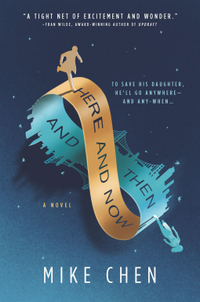
Here and Now and ThenHere and Now and Then

by Mike Chen

My original post
One of the best Time Travel stories I’ve ever read, but it’s so much more—it’s about fatherhood, it’s about love, it’s about friendship. Heart, soul, laughs, and heartbreak—I don’t know what else you want out of a time travel story. Or any story, really. Characters you can like (even when they do things you don’t like), characters you want to know better, characters you want to hang out with after the story (or during it, just not during the major plot point times), and a great plotline.

4 1/2 Stars

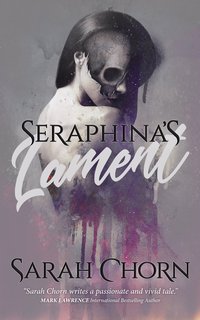
Seraphina's LamentSeraphina’s Lament

by Sarah Chorn

My original post
Chorn’s prose is as beautiful as her world is dark and disturbing. This Fantasy depicts a culture’s collapse and promises the rebirth of a world, but getting there is rough. Time and time again while reading this book, I was struck by how unique, how unusual this experience was. As different as fantasy novels tend to be from each other, by and large, most of them feel the same as you read it (I guess that’s true of all genres). But I kept coming back to how unusual this feels compared to other fantasies I’ve read. The experience of reading Seraphina’s Lament isn’t something I’ll forget any time soon.

4 1/2 Stars

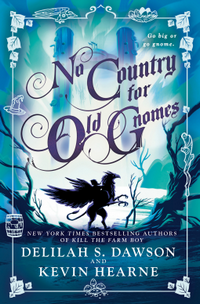
No Country for Old GnomesNo Country for Old Gnomes

by Delilah S. Dawson and Kevin Hearne

My original post
Having established their off-kilter world, strong voice, and approach to the stories of Pell, Dawson and Hearne have come back to play in it. The result is superior in every way that I can think of. I lost track of how many times I said to myself while reading something along the lines of, “how did they improve things this much?” These books are noted (as I’ve focused on) for their comedy—but they’re about a lot more than comedy. The battle scenes are exciting. The emotional themes and reactions are genuine and unforced. And tragedy hits hard. It’s easy to forget in the middle of inspiring moments or humorous aftermaths of battle that these kind of novels involve death and other forms of loss—and when you do forget, you are open to getting your heart punched.

(but mostly you laugh)

4 1/2 Stars

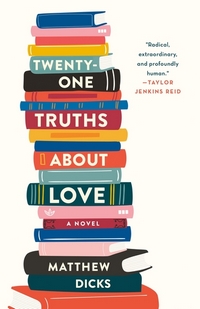
Twenty-one Truths About LoveTwenty-one Truths About Love

by Matthew Dicks

My original post
It’s an unconventionally told story about a man figuring out how to be a businessman, husband, and father in some extreme circumstances. The lists are the star of the show, but it’s the heart behind them that made this novel a winner.

5 Stars

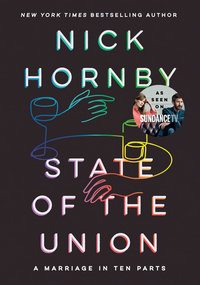
State of the UnionState of the Union: A Marriage in Ten Parts

by Nick Hornby

My original post
This series of brief conversations held between a married couple just before their marriage counseling sessions. At the end of the day, this is exactly what you want from a Nick Hornby book (except the length—I wanted more, always): funny, heartfelt, charming, (seemingly) effortless, and makes you feel a wide range of emotions without feeling manipulated. I loved it, I think you will, too.

4 1/2 Stars

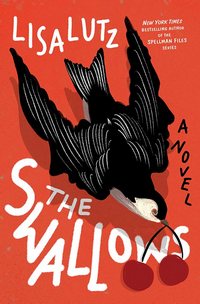
The SwallowsThe Swallows

by Lisa Lutz

My original post
This is not my favorite Lutz novel, but I think it’s her best. It has a very different kind of humor than we got in The Spellman Files, but it’s probably as funny as Lutz has been since the third book in that series—but deadly serious, nonetheless. Lutz puts on a clinic for naturally shifting tone and using that to highlight the important stories she’s telling. From the funny and dark beginning to the perfect and bitingly ominous last three paragraphs The Swallows is a winner. Timely and appropriate, but using tropes and themes that are familiar to readers everywhere, Lutz has given us a thrilling novel for our day—provocative, entertaining, and haunting. This is one of those books that probably hews really close to things that could or have happened and you’re better off hoping are fictional.

5 Stars

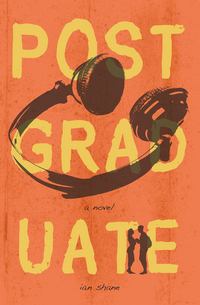
PostgraduatePostgraduate

by Ian Shane

My original post
This has the general feel of Hornby, Tropper, Norman, Weiner, Russo (in his lighter moments), Perrotta, etc. The writing is engaging, catchy, welcoming. Shane writes in a way that you like reading his prose—no matter what’s happening. It’s pleasant and charming with moments of not-quite-brilliance, but close enough. Shane’s style doesn’t draw attention to itself, if anything, it deflects it. It’s not flashy, but it’s good. The protagonist feels like an old friend, the world is comfortable and relaxing to be in (I should stress about 87.3 percent of what I know about radio comes from this book, so it’s not that). This belongs in the same discussion with the best of Hornby and Tropper—it’s exactly the kind of thing I hope to read when I’m not reading a “genre” novel (I hate that phrase, but I don’t know what else to put there).

4 1/2 Stars

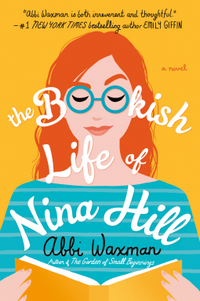
The Bookish Life of Nina HillThe Bookish Life of Nina Hill

by Abbi Waxman

My original post
This is a novel filled with readers, book nerds and the people who like (and love) them. There’s a nice story of a woman learning to overcome her anxieties to embrace new people in her life and heart with a sweet love story tagged on to it. Your mileage may vary, obviously, but I can’t imagine a world where anyone who reads my blog not enjoying this novel and protagonist. It’s charming, witty, funny, touching, heart-string-tugging, and generally entertaining. This is the only book on this particular list that I know would’ve found a place on a top ten that included Crime Novels as well, few things made me as happy in 2019 as this book did for a few hours (and in fleeting moments since then as I reflect on it).

5 Stars

Books that almost made the list (links to my original posts): Not Famous by Matthew Hanover, Circle of the Moon by Faith Hunter, Maxine Unleashes Doomsday by Nick Kolakowski, In an Absent Dream by Seanan McGuire, The Rosie Result by Graeme Simsion, and Lingering by Melissa Simonson

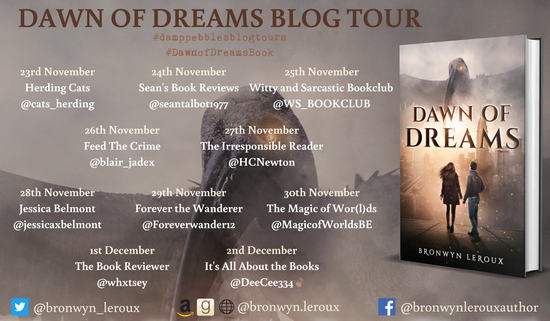
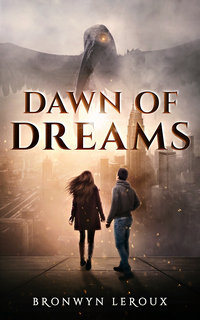
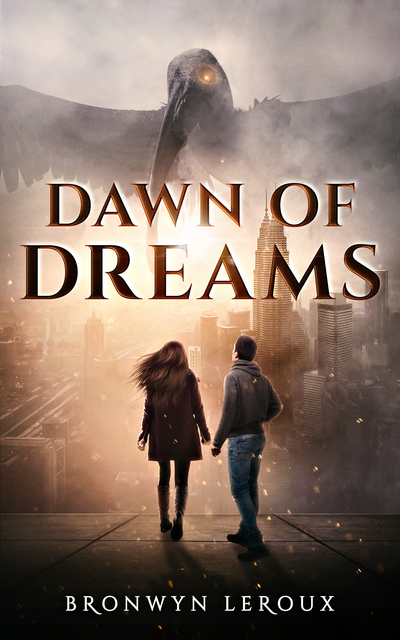
Dawn of Dreams by Bronwyn Leroux: Preventing an Apocalypse in this Futuristic Fantasy

Dawn of Dreams

Dawn of Dreams

by Bronwyn Leroux
Series: Destiny, #1

Kindle Edition, 298 pg.
2017

Read: November 22-25, 2019


Jaden is out hiking with his friends on a mountain near their home during a school break. Suddenly, Jaden sees a large, monstrous, hard-to-describe bird-like creature. The rest of the group seems oblivious, and Jaden begins spending a lot of effort to convince himself he’s seeing things. Even taking bonus trips to the same point, and trying to record his sightings. The videos show nothing, but the way they show nothing convinces Jaden that he’s on to something.

Which really isn’t that reassuring. Why can’t anyone else see this beast? Why can’t the video show it?

Shortly after this, he meets Kayla, a new girl in the neighborhood. They’re hanging out at a park when the creature shows up, and not only can she see it—she’s been having similar experiences to Jaden. It’s somewhat reassuring that there’s someone else out there seeing it—but the questions keep piling up

It’s not long before they begin to see there are other similarities in their lives—clearly, there’s some sort of connection that goes back generations in both of their families. Throw in some artifacts—and other creatures that only Kayla and Jaden can see, and the questions pile up faster than the answers can keep pace with.

In a matter of days, their lives are no longer the same and the challenges that await them personally are so beyond anything they’d previously thought possible or likely.

Jaden is almost too perfect—smart; a real technical wizard (beyond his years and peers it seems); at least moderately popular; humble; a supportive and understanding child/grandchild; very athletic and annoyingly good at video games (just ask his friends). I’m not sure we saw a single weakness to him—despite that, I found myself liking the kid.

Kayla’s a bit more realistic—she’s clever, too; athletic, really into video games; but she’s not as good (at anything) as Jaden. She has skills that he doesn’t, thankfully. She’s had a harder life, you can sense, but don’t get all the details about. She’s easier to believe as a character, but I’d like to get a few more details about her past.

Jaden’s old friends—and Kayla’s new ones—aren’t around enough for us to get more than a vague sense about. But their families are involved a lot more than your typical YA families are—this is a pleasant change, but Leroux still spends a frustrating amount of time with the parents (mothers, to be specific) hinting at things going on in their lives rather than coming out and just telling the reader (whether or not the duo learns anything ) what’s going on.

The realities the pair discover and are exposed to are interesting, and I’d really like to see what Leroux has planned for them in the future. All the magical/otherworldly/unusual creatures they (and the reader) meet are well-designed and executed.

A couple of things I’m not sure about—first of which is the pacing. The book feels like it’s all set-up. All the conflict, all the challenge is in the future—Dawn of Dreams is just setting the stage for the series as a whole. I’m only guessing here, but my gut says I’d be more satisfied if books 1 and 2 in this series were combined into one, lengthier volume. Imagine if Tolkein had stopped The Fellowship of the Ring after the Council of Elrond and then started a second book for the trip through the Misty Mountains and the rest. I didn’t really have a problem with the slow pace, until the book ended and I was left wondering why I didn’t get more.

I’m not sure what’s gained by having this set in 2073 instead of the present day. I’m not saying there was a problem with it—I liked the slightly advanced version of the world, I’m just not sure I get the point of putting things there. I’m also not sure where this took place—there’s no reference to local flora or fauna, or even just a geographic place name.

Neither of these points really changed what I thought about the book, they just left me wondering more than I should have. There were some things that bothered me.

Leroux likes her adjectives. She more than likes them—she overloads the text with them (either especially at the beginning as she introduces the characters and world—or I got used to it as the book progressed). I appreciate her attempt to paint a picture with words, but it frequently felt to me like she’d never use one adjective if she could use three instead. Her adverb use is almost as bad at times, but it’s not as pronounced.

Beyond that, I’m not crazy about a lot of her word choices. In her attempt to vary her vocabulary, she often ended up grabbing the wrong word for a situation. I’m not talking malapropisms. But words that mean almost what she’s clearly going for, but aren’t quite right. Almost like Joey Tribbiani’s use of a thesaurus when composing a letter of recommendation. The result too frequently proved a stumbling block to the story. It’s like if your radio was tuned to 98.8 FM when the station is 98.7—you get a pretty good signal and can hear everything, but occasionally you get too much static with your music, ruining the song.

I don’t like bringing up those two points, because there’s a real earnestness to the novel. It’s not that Leroux is being negligent or careless in her writing, on the contrary, I think she’s trying too hard and ends up getting in her way. If she’d dial back on the effort a bit, focusing more energy on the plot and characters, I think the book would be more successful.

I liked the story, I thought the characters were fine—and I definitely want to spend more time with them. I’m just not crazy about the writing—which is a fairly important component of a book. So I can’t recommend this as heartily as I want to.


3 Stars


My thanks to damppebbles blog tours for the invitation to participate in this tour and the materials (including a copy of the novel) they provided.

BOOK SPOTLIGHT: Dawn of Dreams by Bronwyn Leroux (AND KINDLE GIVEAWAY)

Today I welcome the Book Tour for the YA SF&F Dawn of Dreams by Bronwyn Leroux. Along with this spotlight post, I’ll be giving my take on the novel here in a bit. Be sure to check out the Kindle Giveaway at the bottom of this post. But let’s start by learning a little about this here book, okay?


Book Details:

Book Title: Dawn of Dreams by Bronwyn Leroux
Release date: July 25, 2017
Format: Paperback/Ebook
Length: 298 pages

Book Blurb:

Lost family heirlooms. Sinister mutants. An ancient book hiding legendary secrets. Such mythical things should not exist in the futuristic world of 2073.

Yet, this reality is forced on two strangers. Jaden and Kayla are blissfully unaware their world is about to be invaded. When a relentless, age-old force casts them together, the shocking truth is revealed. They are hunted by the hideous, malevolent monster prowling their community. Worse, it’s invisible to everyone but them.

Forced down a dark and dangerous path, the pair discover their stalker isn’t the only thing they have in common. As they quest for solutions while trying to survive, their unique abilities surface. They team up with other-worldy allies. After deciphering an enchanted tool, they get their first answer. But knowledge comes at a price.

In a world on the verge of destruction, can Jaden and Kayla solve the puzzles and find a way to save it, all while trying to make sense of this inexplicable connection they feel for each other?

About Bronwyn Leroux:

Bronwyn LerouxBorn near the famed gold mines of South Africa (where dwarves are sure to prowl), it was the perfect place for Bronwyn to begin her adventures. They took her to another province, her Prince Charming and finally, half a world away to the dark palace of San Francisco. While the majestic Golden Gate Bridge and its Bay views were spectacular, the magical pull of the Colorado Rockies was irresistible. Bronwyn’s family set off to explore yet again. Finding a sanctuary at last, this is Bronwyn’s perfect place to create alternative universes. Here, her mind can roam and explore and she can conjure up fantastical books for young adults.

Follow her at https://bronwynleroux.com or https://www.facebook.com/AuthorBronwynLeroux/

Social Networks:

Twitter ~ Facebook ~ Website ~ Instagram

Purchase Links:

Amazon UK ~ Amazon US ~ Kobo ~ Nook

Kindle Giveaway:

For your chance to win a an 8GB Black Kindle Fire 7 with Alexa, click here.

Terms and Conditions: Giveaway starts November 23rd and ends at midnight MST on December 2nd 2019. Entries are open to all ages and countries. You will be asked to provide your email address which will subscribe you to Bronwyn Leroux’s mailing list. You can unsubscribe at any time. Bronwyn Leroux will contact the winner via email on December 4th. The winner will also be announced via Bronwyn Leroux’s social media channels. There is no cash alternative.

My thanks to damppebbles blog tours for the invitation to participate in this tour and the materials (including a copy of the novel) they provided.

Yet More Quick Questions with . . . Nick Kolakowski

Man…this is the third time I’ve got to pick Nick Kolakowski’s brain (the first and the second, for you completists). I can’t believe he keeps coming back for more — but when I get great answers like these, I’ve gotta keep asking, you know? Do read the others if you’re wanting to learn more about him in general — I stuck to Maxine Unleashes Doomsday (I posted about it earlier today, in case you missed that) this time.

Hope you enjoy!

Did you set out to write Science Fiction or is that something that came about as you started the project?
I’ve always wanted to write a dystopian novel, but all my early attempts were ignoble failures; they were Diet Cormac McCarthy, pastiches of “The Road” that were just retreads of what everyone else was trying to do. It’s only when I mashed the concept onto a noir framework that it started to work for me—a heist novel was the grounding that I needed, even if the target of that heist, in this post-apocalyptic context, is really, really weird.
What were some of the new challenges (and/or freedoms) compared to your earlier works given this setting/genre?
I’ve never written a book that covers the whole scope of someone’s life. Any novel comes with its share of continuity challenges; even if the timeframe is really short (i.e., a few hours or days), you need to keep all of your pieces and characters aligned and consistent. But keeping the details of a character’s life aligned across decades can prove much more difficult—did this happen to her left or right arm when she was a teenager, etc.

In terms of freedoms, though, you can create an incredible character arc if you have that kind of super-expansive timeframe to play with. There’s a real poignancy to tracing someone’s life from their teenagehood to the very end, especially if the country is radically changing around them at the same time.

What came first—the story or Maxine? Is that your typical approach, or does it vary from project to project?
Maxine came first: I had a vision of a badass woman, bitter and chain-smoking but refusing to give up no matter what life threw at her. From there, I wanted a story that put her in worse and worse circumstances. What happens to someone who loses everything? What’s left?

In terms of actual writing, this book started in the middle. Then I wrote Maxine’s childhood and teenage-dom. Then I stalled for about a year because I couldn’t think of where to take her from there; it was only when I came up with the broader framework—of academics discussing her life and her impact on society—that I figured out where to take everything.

In this book, Preacher reminded me a lot of Main Bad Guy’s Walker—but a very different take on the character type. Is 2019 your Year of the Aging Badass, or is that just a coincidence?  I’m having a hard time not asking a spoiler-laden question about him, so let me take the easy way out – what would a prospective reader want to know about Maxine’s very disfunctional paternal figure?
That was a coincidence, but now that you mention it… yeah, Preacher and Walker are brothers of a type! I didn’t mean it that way; Preacher made his first appearance in my head circa 2014, while Walker emerged around 2017-18, when I was writing “Main Bad Guy.”

Not to spoil too much, but Preacher isn’t the badass that Maxine thinks. He’s ultra-tough, and he deserves his fearsome reputation in the ruined part of the world where Maxine and her family lives. But his weaknesses—and frankly, his lies—eventually force Maxine to step up. The thing about badasses like Preacher and Walker, they can serve as crutches for your main character; at some point, you need to neuter them or take them away if your protagonist is truly going to move on and grow.

Are you far enough into your next book to talk about it – are you sticking with SF, going back to Crime Fiction, or trying your hand at something like Wizards?
Haha! Noir-ish wizards would be pretty cool, although I’m sure someone has already covered that arena already. Up next is actually the sequel to “Boise Longpig Hunting Club,” so it’s back to crime fiction (and Idaho!). The as-yet-untitled sequel is actually giving me a bit of trouble, because I’m trying to ratchet up the tension as tightly as possible on Jake and Frankie, my two main characters (and siblings). They survived some insane crap in the first book, so I have to figure out a way to make things even crazier.
Thanks for your time—and thanks for introducing me to Maxine
Thank you! I love her. I hope readers will, too.

Maxine Unleashes Doomsday by Nick Kolakowski: Kolakowski Gets His Crime Fiction Chocolate in this SF Peanut Butter

This is one of those books that I’m uber-excited about, yet I don’t think I do a good enough job at explaining why I am. It’s just good.

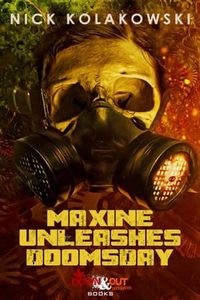
 Maxine Unleashes Doomsday

Maxine Unleashes Doomsday

by Nick Kolakowski

eARC, 274 pg.
Down & Out Books, 2019

Read: October 29-31, 2019

“You know the trick to surviving? The one thing you got to do?”

“What’s that?” Maxine asked.

“You got to treat every day like an adventure. Like it’s fun, or a challenge, even when everything’s crappy. Especially when it’s crappy. Because otherwise, it’s all going to crush you.”

“I feel like I spent my whole life being crushed.”

“Well, that’s your fault. A normal job, trying to live a normal life, it’s just inviting people to stomp you. And they do.”

“Yeah.”

“But at least in my line of work, sometimes you get to stomp back…”

In case the author’s name looks familiar to you, yeah, you’ve seen me use it a few times this year—3 novellas, 1 short fiction collection, and now this novel, Maxine Unleashes Doomsday. It occurs to me now, that he was the first author I read this year, and he did a pretty good job setting the tone for 2019’s reading. This book is his first step out of Crime Fiction and into Science Fiction—dystopian SF, to be precise (that really should be obvious to anyone familiar with him, I don’t think he’s got a utopian novel in him).

That said, there’s enough of a Crime Fiction flavor to this SF novel, that fans of either genre will have enough of their drug of choice to be satisfied.

This is set in the near-future, at various points along the fall of the US/Western Civilization. While there are plenty of other characters to keep an eye on, our focus throughout is on Maxine. After a rocky start to life with a drug-addicted mother, and an unsuccessful academic career (although she tried for a little bit), she tries to follow her uncle’s example and become a criminal. She has some success in that, but a large failure resulted in life-threatening injuries to a friend and the loss of one of her arms. Following that, she tries to live a non-criminal life, she gets a job, settles down with a guy and has a kid. But her heart’s not in it, and she ends up dabbling in thievery. At some point, she abandons that life and sets her eyes on a criminal career.

Maxine is one of my favorite characters this year—she’s flawed (not as flawed as she thinks), she’s a fighter (not as good as she thinks), self-destructive, optimistic, and driven. She takes a lot of (metaphorical and literal) punches, and while she may not get up right away after them, she doesn’t stop moving forward. Ever. I love reading characters like that.

Her uncle, who goes by Preacher, is one of the most significant criminals in the New York area—and has some cops dedicated to taking him down, and any number of civilians supporting him. Off and on throughout her childhood, Preacher tried to get Maxine’s mother to leave her addictions behind to provide for and care for her kids. Between his power and influence on the one hand, and being just about the only adult to look out for her and her brother, it’s no wonder that Maxine will want to be part of his life. Readers of Kolakowski’s Main Bad Guy will enjoy playing a compare/contrast game with Preacher and Walker.

There are a number of other characters that greatly influence Maxine’s life and desires, but none so much as her uncle. And to get into them would just push this post beyond the length I want (and would end up spoiling stuff to really talk about).

By and large, this is the story of Maxine’s journey from a struggling public school student to being a wanted criminal (and beyond). But that’s not everything that’s going on. For the first chapter, you get the impression you’ll be reading a book about rival groups fighting for supplies in mid-apocalyptic New York. But then you’ll realize that’s not it at all, it’s a story about how Maxine became the tenacious gun-fighter and would-be criminal mastermind that she is. Eventually you discover that yeah, both of those are true, but Kolakowski’s really writing a different story—and boy howdy, you feel pretty clever when you suss it out, and it’s such a brilliant way of telling this story that you don’t mind being wrong about what the book is trying to accomplish. But even then, you won’t really understand everything until the last line of the book (I’m not sure I actually pumped my fist when I read it, but I probably thought about it pretty hard).

Yes, it’s a pretty violent book (this too, should really be obvious to anyone familiar with Kolakowsi), but most of the truly horrible stuff happens “off-screen,” making it a lot easier to take. The prose moves quickly and assuredly, the writing is sone with a strong sense of style and savoir faire. Frankly, it’s too lively and enjoyable to keep the most readers who aren’t into gunfights, etc. from being turned off by the violence.

It’s a well-realized dystopia, one that’s easier to imagine happening than say, Panem. Kolakowski does a wonderful job of littering this book with little details that tell you so much about the world his characters live in and entertain the reader. Hitting both of those notes regularly is a difficult task. For example:

“Someday I want to go to California,” Michelle told Maxine. “Did you know it used to be a state?”

and

This far north, the concept of local government grew teeth and claws. If you stuck to the highway, you would cross into territory controlled largely by the New York Giants, which had expanded beyond its origin as one of the nation’s most consistently mediocre sports teams to control a big swath of towns northeast of Buffalo.

One of the conceits of the book is that the material is a result of an academic study about Maxine. It’s one of the best moves that Kolakowski makes in this book (and it’s full of great moves). Don’t skim over these notes, you’ll be rewarded for your attention.

Oh, I should warn you: This book might put you off popcorn for a while. I’m just saying…

Rob Hart wrote one of the endorsements for this: “Take one of Richard Stark’s Parker novels and throw it in the blender with DVDs of Mad Max and The Warriors. Guess what? You just broke your blender. Find solace in this book, which is what you should have done in the first place.” I repeat that for a couple of reasons—1. I love the last two sentences. 2. He’s right, and says everything in 4 sentences that I tried to above. You should listen to one of us. Kolakowski has outdone himself with this one, it was a pleasure from end to end. You really need to read it.

Disclaimer: I was provided a copy of this novel by the author in exchange for this post and my honest opinion. My opinions are my own, and weren’t influenced by this.


4 1/2 Stars
LetsReadIndie Reading Challenge

System Failure by Joe Zieja: The Epic Failure Trilogy Concludes with a Big Success

System Failure

System Failure

by Joe Zieja
Series: Epic Failure, #3

Paperback, 417 pg.
Saga Press, 2019

Read: October 1-2, 2019

“You are literally placing the fate of the galaxy in my hands.” [Rogers] thought for a moment. “Again. You need to stop doing this.”

Every author closing out a series—a trilogy or something longer running—has a daunting task (not that stand-alones or duology’s aren’t daunting themselves, but it seems easier to me). They have to tell a self-contained story; weaving in the character and story arcs that have been percolating since the first book; resolve the new and old arcs; leave the characters in a place that readers will find satisfying; and provide some sort of ending to all of that to leave everyone in a place where you can move onto the next thing. For writers like Joe Zieja there’s an additional challenge—you have to make the whole thing funny.

Thankfully, Zieja does all of that very, very well.

Rogers’ fleet (including the Thelicosans) arrive at the home base for the Free Systems to meet with their High Command. Fully aware that the only military commander that’s had any kind of success with this new enemy is Captain Rogers, he’s named the head of the Joint Force tasked with preventing Snaggardirs from destroying the galaxy.

They also realize that the only way Rogers has had any kind of success is by throwing out all the rule books—including The Art of War II: Now In Space by Sun Tzu Jr. So they tell him to do just that. They don’t care how ridiculous or uneducated his plans are, as long as they get the job done. Snaggardirs has given the Free Systems a very limited time to acquiesce or face the destruction of the galaxy. And they seem to be able to pull that off.

So with help from a very unexpected source, Rogers reaches out to the same space pirates we haven’t seen since the disastrous opening to Mechanical Failure and also is forced to accept help from a Thelicosan practitioner of something that’s a combination of horoscopes and astrophysics (you’ll have to read the book to understand it). These, um, unconventional tools are added to the rag-tag bunch that has come to help Rogers in a last-ditch effort to save reality as we know it.

As usual, Rogers is the focus. He’s been on a journey of personal growth since we first met him—despite his best intentions, it should be stressed. He really comes a long way just in these pages and it’s pretty cool to see.

Of course, I can’t go without talking about Deet—the droid that Rogers assembled from junk. He’s also on a journey of personal growth—just a different kind. In addition to trying to understand how to justify and explain his existence, he’s trying to learn to empathize, as well as lie convincingly (or at all), and he continues to improve his [EXPLETIVE] swearing. He does get better at it and made me laugh out loud several times (both in his successes and failures). There was one misstep that he made, and I re-read that sentence a few times to figure out what he may be trying to say. Naturally, after I gave up and moved on, I learned that no one understood what he was going for.

I should add a little something about Tunger. I found him amusing in Mechanical Failure, but I thought he was overused (and became a little annoying). In Communication Failure, I stopped finding him all that entertaining, mostly trying. Which is how he started in System Failure. But he soon became a very cool character and one of the real strengths of the book. He really might be the best thing that Zieja did throughout the series.

It seems like a bonus to me—not at all the kind of thing one expects from a book like this—we’re given an antagonist that the reader can almost sympathize with. Yes, their methods and strategies are wrong and harmful to innocents. But you can’t help but understand why a people would set off in this direction. I can’t imagine anyone reading about their plight will start hoping for a failure for Rogers and the rest, don’t get me wrong. But you just might see where the Jupiterians are coming from.

There’s a key acronym in the book that a. is fitting, b. is funny, c. took me far too long to get. Once I stopped feeling stupid, I realized it was a great example of this being one of those books where even if you don’t get the jokes, the book holds up as a story well enough that you won’t even notice there are jokes you don’t get until later.

There’s one figure with access to the top of Snaggardirs who isn’t on board with their destroying the galaxy plan. So they set out to sabotage it by helping Rogers. Their scheme was pretty clever, but with one giant flaw. Which made their sacrifice sad—and their attempts at success very funny. It’s a good mix for the reader (a pathetic one for the character).

I’m not sure it’s entirely fair (and I don’t mean to disparage any of the books I’m about to mention in any way), but while reading this, I couldn’t help but compare this to two other humorous series and their conclusions. I hate to compare any comedic SF to The Hitchhiker’s Trilogy, but how do you not? This series never got as funny as the best of Hitchhiker’s (maybe a couple of times it got pretty close, though), but it was a cohesive and believable story, populated with better characters and a solid ending — unlike Adams repeated attempts at a conclusion that never really felt satisfying. Similarly, Epic Failure trilogy went out strong, with its strongest material still working, unlike The Tales of Pell which went a little off-course in the final volume and didn’t stick the landing the way that System Failure managed to do.

Zieja successfully called back to elements of the first book (some I’d forgotten about, some I thought had fully served their purpose) and built on the developments of the second to give this volume a bit more heft and greater stakes. Then he added a great story new to this novel and wrapped up everything in a satisfying and definitive way. All while making me chortle, chuckle, grin and occasionally laugh. Who can ask for [EXPLETIVE] more? I don’t know what Zieja has planned next, but sign me up for whatever it is.


4 Stars
Humor Reading Challenge 2019

Page 16 of 30

Powered by WordPress & Theme by Anders Norén