Tag: SF Page 20 of 30

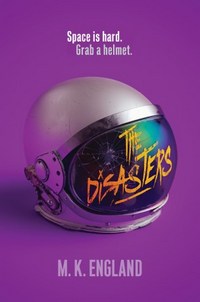
The Disasters by M. K. England: Some Fun YA Popcorn SF

The DisastersThe Disasters

by M. K. England


Hardcover, 352 pg.
HarperTeen, 2018

Read: January 29 – 30, 2019

           We sit in silence while al-Rihla, the jewel of the colonies, gradually takes over more and more of the viewport. It looks exactly like it did on the pages of my textbooks, only so much more. I let my eyes linger for a moment, taking in green continents outlined in rich red sand and huge, intensely blue oceans that glitter below. I know we’re in a life-or-death situation, but it’s hard not to be overwhelmed by the view. I can see why all the antiexploration crap went away once a few humans actually got out here. Who could look at all this and not want it? It’s bizarre–I’ve only seen Earth from space once, and I was busy trying not to die at the time. Now I’m looking down on a completely different planet, in person, in space, while flying a ship I stole.

I’m actually here. This is all I’ve ever wanted, though I didn’t get it in the way I wanted.

And in a few painfully long minutes, I’ll find out whether I get to live to see the other seven colony worlds one day, or if I get to die in a dramatic crash and kill all my new friends instead.

Fantastic.

Nax Hall is a would-be pilot, would-be space colonizer, and would-be anything but a failure in the eyes of his family. Sadly, after a day at the Ellis Station Academy (the only way to achieve two of those goals, and his best shot at the third), he’s been cut from the program. He’s not the only one — three others have been, too. As they wait for the shuttle to take them back to Earth, a terrorist group of some kind attacks the Academy. With a little luck, the expelled students escape in the shuttle that was destined to take them to Earth.

But they quickly realize that space fighters won’t allow the ship to land on Earth where they can alert the authorities about what happened at the Academy — so they have to hyperjump (or whatever it’s called in this world — I already took the book back to the library and can’t check) to colonial space. They quickly learn that the terrorists have used their escape as a means to frame them for the atrocities committed at the Academy and they now are on the run from the same authorities they were hoping to help them.

Thankfully, between the four of them, they have an almost perfect crew — a pilot, a diplomat, a medic and a technician/copilot. They soon find themselves aligned with a computer expert with ties to black-market entities that can help them spread the word about what happened at the Academy and what it might mean for the future of Earth’s space colonies. These five plucky teens are all that stands between humanity and widespread destruction.

England has a gift for action scenes — they were energetic, dynamic and enough to sink your teeth into. Nax’s flying, in general or in combat, was the highlight of the book for me. I could’ve used a little more of it, even though that would have been gratuitous. I’m not above gratuity in the right place. There’s a strong sense of fun in the narrative — despite being up against impossible odds, these kids are living their dream (just not in the way they wanted, as Nax put it in the quotation above). There’s a good deal of bonhomie between the makeshift crew, which builds gradually over the book to the point where they’re a tight bunch of friends at the end. This sense of fun is grounded by the dangers they face and the costs they’re paying, just enough to keep this from being a romp.

The characters aren’t that complex, although England makes a couple of attempts at it. Their backstories are interesting, to the degree that she explores them (which isn’t much). We get enough of Nax’s crewmates’ backstories to explain their presence on the ship, but not much more. We get plenty about Nax in bits and pieces — which is good enough, he’s the star of the show (and should be). The bad guys aren’t much more than stock villains, mostly a faceless group or two conspiring to do evil things. That’s fine with me, this isn’t the kind of book that promises complex opponents with compelling reasons for their activities, mustache-twirlers with lots of henchmen are good enough.

Here’s my major complaint with the book — the politics. Don’t get me wrong, I’m not saying that politics shouldn’t enter into fiction. Particularly Science Fiction. I’d prefer to see more of it — at least more diversity in political views, too much of the politics in SF is so culturally homogeneous one could easily believe no other opinions existed. But before I get gong on that line, let me get back to The Disasters. The politics and societal struggles of the late 22nd Century are apparently identical to those of 2018. Now, I’m not suggesting that Earth’s culture should have worked everything out and the struggles of today will be a distant memory — but they should’ve changed somewhat. The way these problems are seen, expressed and argued about should be different. England just comes across lazy in her approach to these ideas. It’d be like someone writing about Irish cops in 2019 Boston the same way people wrote about them in 1850.

Thankfully, while it flavors much of the book, the characters don’t spend that much time actively discussing it, so it’s easy to forget about. What you’re left with is popcorn fun. A bunch of underdog kids, rejects from society (while really being exceptional), find themselves in a place to save the world (more than 8 of them, technically). There’s some good action — again, the flight scenes are great — a couple of chuckles, and a solid ending. It’s a couple of hours of escapist entertainment when it’s at its best (which is pretty often).

—–

3 Stars
2019 Library Love Challenge

Pub Day Repost: Here and Now and Then by Mike Chen: A Dad. A Daughter. And Time Travel. (Kleenex may be required)

When I really love a book and don’t know how to express it, I tend to ramble. Case in point:

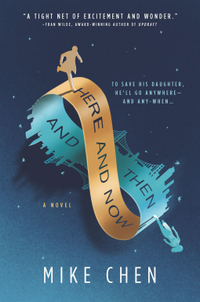
Here and Now and ThenHere and Now and Then

by Mike Chen

eARC, 336 pg.
Mira Books, 2019

Read: January 15 – 16, 2019

You can have fun with a son
But you gotta be a father to a girl

That’s Rodgers and Oscar Hammerstein, not Mike Chen — but the spirit of the book is in that second line, so I’m going to use it. I found myself singing those lines a lot while thinking about the book. If you’re a father to a daughter, you will love this book. I don’t think it’s necessary to appreciate the book — non-parents, mothers, people with sons should still be able to see how good it is and to empathize with the characters. But I can’t imagine any Father of a Daughter won’t see themselves (and Daddy’s Little Princess) in these pages.

In the past, I’ve said something about not really liking non-Doctor Who Time Travel stories. I’m starting to think it’s because I haven’t been reading the right kind of Time Travel stories. In the last year (give or take), I’ve read and loved four Time Travel novels — All Our Wrong Todays by Elan Mastai, Just One Damned Thing After Another by Jodi Taylor, Paradox Bound by Peter Clines, and now Here and Now and Then by Mike Chen. In all of them, the tropes of Time Travel are honored — while played with a little bit — but are really just excuses to tell very real emotional stories about some pretty great characters. Which is what Who does best, too, now that I think about it. So maybe for me, Time Travel has to be a means to an end, not the end itself.

Maybe I should leave the introspection for another time, and just get on with talking about the book, eh? My point was supposed to be that, like Matsai, Taylor and Clines, Mike Chen has surprised and excited me beyond expectations and hopes.

The day I started (and fell in love with) this book, I tried to explain it briefly to someone. I did so in a way that was clearly reductionistic (because, that’s what you do in a couple of sentences), spot on, and yet horribly inaccurate — all at the same time. Here’s what I said: It’s a gender-flipped Outlander, except the protagonist goes to the future instead of the past, and they use science-y stuff to the Time Travel instead of magic-y stuff.

Kin (pronounced /ˈkēn/) is, or was — or will be — a Secret Agent for the Temporal Corruption Bureau in 2142. He came back to 1996 to prevent a Twenty-Second Century criminal from altering the timeline for their own profit — and did so. But things went wrong in carrying out the mission and he was unable to be returned to his time. So he got stuck in 1996 for a bit. For him, it was 18 years. For the TCB it was a couple of weeks. For Kin, he had to give up hope of rescue, get a job — and then he fell in love, got married and had a kid. He has a nice life — he’s a success in IT for a video game company, he’s a pretty decent amateur chef and is working on trying out for a reality show for home chefs, his wife is great, and his daughter is, too. Miranda’s fourteen, a soccer star, wicked smart, a SF nerd and loves her parents.

Then his partner Markus shows up to bring him back to their time — Kin’s largely forgotten his former, er, past, er…other life and has really become a resident of 2014 (this is explained in science-y wibbly wobbly, timey wimey terms that actually make sense in context), so Markus has to take him by force. Once he’s back to his future, Kin starts remembering his life — his job, his hobbies, his utter ineptitude in the kitchen — and his fiancé (Markus’ sister). But it doesn’t come back to him immediately, and he has to work at it.

One thing he can’t do, is let go of his Twenty-First Century life, and he schemes for ways to remain a part of Miranda’s life. For awhile, this works — but only for a while. The instant it starts, every reader knows that Kin won’t be able to fly under the radar forever and he gets found out. It turns out that what he’s doing risks the future — but the only fix the TCB has in mind will mean Miranda’s death. While Kin can understand their decision, there’s no way he can let that happen to his daughter.

I don’t think I’ve said (much) more than the publisher’s blurb — but I can’t say much more without spoiling. And trust me, Chen’s version is much better than mine would be.

Kin is a great character — he’s thoughtful, skilled, smart — and human. He makes a lot of mistakes, his judgement is shaky (not just when it comes to Miranda, either) — but he tries to do the right thing. His loved ones — in all eras — are people you can believe are in his life and you can see why he cares for them, and you do too — because of Kin. That’s all I’m going to say about the other characters because I can’t talk about any of them without ruining something.

The world of 2142 is just about perfect — it’s different than 2014, but there are straight lines connecting it all. It’s the little changes that make it right — often Kin’s perspective allows us to see it. Like the offhand way he mentions to someone that temperatures are 5 degrees lower in 2014. Or the way he reacts to a recreation of 21st Century fast food. There are things about Mars that are just tossed off in conversation without explanation that clearly mean humans are doing something on the surface of the planet. Don’t ask me what — Chen doesn’t say. It even took me seeing him use the phrase a couple of times before I realized what it meant. But once I did, I got very excited about how he pulled it off. There are many subtle details like these that really make this a believable read.

The story and the writing are imaginative and playful — you will smile a lot while reading this. But the instant that Markus shows up and says it’s time to go, you just know that your heart is going to get broken in these pages. And you will be right. Thankfully, Chen will give you almost as many reasons to be happy — some small, some big. It’d have been very easy to make this maudlin or depressing. He could’ve also make this a playful romp. Chen instead walks the tightrope between the extremes in a performance worthy of Philippe Petit. The pages fly by, I really couldn’t believe how quickly I read this — part of it was because I just had to find out what happened to Kin, Miranda and the rest — but part of it was Chen’s writing. Despite hitting you with all that he hits you with, it’s very (and at times, deceptively) easy to read.

(this next paragraph could get a bit spoiler-y. But not really, just in vague sentiments, no particulars…Still, skip if you want)
This worked for me on just about every level and on just about every front — it checked all of my boxes and did just about every superlative thing I can think of. But the ending — I loved the ending, don’t get me wrong — just felt a little too easy. Things worked a little too well. Which the fanboy in me loves, but . . . I dunno, the book was filled with twists and struggles and challenges and the in the last three or four chapters everything was a little too easily overcome — and even the challenges melted away. And yes, I cheered, but I wanted Kin and everyone to have to work a little harder for my cheers. So, I’m docking this 1/2 star. (which is easy to do because on Goodreads/Amazon/NetGalley I have to round up, because they won’t accept half-stars, so the ratings average still gets to stay high).

Heart, soul, laughs, and heartbreak — I don’t know what else you want out of a time travel story. Or any story, really. Characters you can like (even when they do things you don’t like), characters you want to know better, characters you want to hang out with after the story (or during it, just not during the major plot point times), and a great plotline. This book is about as good as it gets. Grab your copy now while I start eagerly anticipating Chen’s next book.

Disclaimer: I received this eARC from HARLEQUIN – MIRA via NetGalley in exchange for this post — thanks to both for this. These are my own honest — and hopefully not convoluted — thoughts and opinions.

—–

4 1/2 Stars

Here and Now and Then by Mike Chen: A Dad. A Daughter. And Time Travel. (Kleenex may be required)

When I really love a book and don’t know how to express it, I tend to ramble. Case in point:

Here and Now and ThenHere and Now and Then

by Mike Chen


eARC, 336 pg.
Mira Books, 2019

Read: January 15 – 16, 2019

You can have fun with a son
But you gotta be a father to a girl

That’s Rodgers and Oscar Hammerstein, not Mike Chen — but the spirit of the book is in that second line, so I’m going to use it. I found myself singing those lines a lot while thinking about the book. If you’re a father to a daughter, you will love this book. I don’t think it’s necessary to appreciate the book — non-parents, mothers, people with sons should still be able to see how good it is and to empathize with the characters. But I can’t imagine any Father of a Daughter won’t see themselves (and Daddy’s Little Princess) in these pages.

In the past, I’ve said something about not really liking non-Doctor Who Time Travel stories. I’m starting to think it’s because I haven’t been reading the right kind of Time Travel stories. In the last year (give or take), I’ve read and loved four Time Travel novels — All Our Wrong Todays by Elan Mastai, Just One Damned Thing After Another by Jodi Taylor, Paradox Bound by Peter Clines, and now Here and Now and Then by Mike Chen. In all of them, the tropes of Time Travel are honored — while played with a little bit — but are really just excuses to tell very real emotional stories about some pretty great characters. Which is what Who does best, too, now that I think about it. So maybe for me, Time Travel has to be a means to an end, not the end itself.

Maybe I should leave the introspection for another time, and just get on with talking about the book, eh? My point was supposed to be that, like Matsai, Taylor and Clines, Mike Chen has surprised and excited me beyond expectations and hopes.

The day I started (and fell in love with) this book, I tried to explain it briefly to someone. I did so in a way that was clearly reductionistic (because, that’s what you do in a couple of sentences), spot on, and yet horribly inaccurate — all at the same time. Here’s what I said: It’s a gender-flipped Outlander, except the protagonist goes to the future instead of the past, and they use science-y stuff to the Time Travel instead of magic-y stuff.

Kin (pronounced /ˈkēn/) is, or was — or will be — a Secret Agent for the Temporal Corruption Bureau in 2142. He came back to 1996 to prevent a Twenty-Second Century criminal from altering the timeline for their own profit — and did so. But things went wrong in carrying out the mission and he was unable to be returned to his time. So he got stuck in 1996 for a bit. For him, it was 18 years. For the TCB it was a couple of weeks. For Kin, he had to give up hope of rescue, get a job — and then he fell in love, got married and had a kid. He has a nice life — he’s a success in IT for a video game company, he’s a pretty decent amateur chef and is working on trying out for a reality show for home chefs, his wife is great, and his daughter is, too. Miranda’s fourteen, a soccer star, wicked smart, a SF nerd and loves her parents.

Then his partner Markus shows up to bring him back to their time — Kin’s largely forgotten his former, er, past, er…other life and has really become a resident of 2014 (this is explained in science-y wibbly wobbly, timey wimey terms that actually make sense in context), so Markus has to take him by force. Once he’s back to his future, Kin starts remembering his life — his job, his hobbies, his utter ineptitude in the kitchen — and his fiancé (Markus’ sister). But it doesn’t come back to him immediately, and he has to work at it.

One thing he can’t do, is let go of his Twenty-First Century life, and he schemes for ways to remain a part of Miranda’s life. For awhile, this works — but only for a while. The instant it starts, every reader knows that Kin won’t be able to fly under the radar forever and he gets found out. It turns out that what he’s doing risks the future — but the only fix the TCB has in mind will mean Miranda’s death. While Kin can understand their decision, there’s no way he can let that happen to his daughter.

I don’t think I’ve said (much) more than the publisher’s blurb — but I can’t say much more without spoiling. And trust me, Chen’s version is much better than mine would be.

Kin is a great character — he’s thoughtful, skilled, smart — and human. He makes a lot of mistakes, his judgement is shaky (not just when it comes to Miranda, either) — but he tries to do the right thing. His loved ones — in all eras — are people you can believe are in his life and you can see why he cares for them, and you do too — because of Kin. That’s all I’m going to say about the other characters because I can’t talk about any of them without ruining something.

The world of 2142 is just about perfect — it’s different than 2014, but there are straight lines connecting it all. It’s the little changes that make it right — often Kin’s perspective allows us to see it. Like the offhand way he mentions to someone that temperatures are 5 degrees lower in 2014. Or the way he reacts to a recreation of 21st Century fast food. There are things about Mars that are just tossed off in conversation without explanation that clearly mean humans are doing something on the surface of the planet. Don’t ask me what — Chen doesn’t say. It even took me seeing him use the phrase a couple of times before I realized what it meant. But once I did, I got very excited about how he pulled it off. There are many subtle details like these that really make this a believable read.

The story and the writing are imaginative and playful — you will smile a lot while reading this. But the instant that Markus shows up and says it’s time to go, you just know that your heart is going to get broken in these pages. And you will be right. Thankfully, Chen will give you almost as many reasons to be happy — some small, some big. It’d have been very easy to make this maudlin or depressing. He could’ve also make this a playful romp. Chen instead walks the tightrope between the extremes in a performance worthy of Philippe Petit. The pages fly by, I really couldn’t believe how quickly I read this — part of it was because I just had to find out what happened to Kin, Miranda and the rest — but part of it was Chen’s writing. Despite hitting you with all that he hits you with, it’s very (and at times, deceptively) easy to read.

(this next paragraph could get a bit spoiler-y. But not really, just in vague sentiments, no particulars…Still, skip if you want)
This worked for me on just about every level and on just about every front — it checked all of my boxes and did just about every superlative thing I can think of. But the ending — I loved the ending, don’t get me wrong — just felt a little too easy. Things worked a little too well. Which the fanboy in me loves, but . . . I dunno, the book was filled with twists and struggles and challenges and the in the last three or four chapters everything was a little too easily overcome — and even the challenges melted away. And yes, I cheered, but I wanted Kin and everyone to have to work a little harder for my cheers. So, I’m docking this 1/2 star. (which is easy to do because on Goodreads/Amazon/NetGalley I have to round up, because they won’t accept half-stars, so the ratings average still gets to stay high).

Heart, soul, laughs, and heartbreak — I don’t know what else you want out of a time travel story. Or any story, really. Characters you can like (even when they do things you don’t like), characters you want to know better, characters you want to hang out with after the story (or during it, just not during the major plot point times), and a great plotline. This book is about as good as it gets. Grab your copy now while I start eagerly anticipating Chen’s next book.

Disclaimer: I received this eARC from HARLEQUIN – MIRA via NetGalley in exchange for this post — thanks to both for this. These are my own honest — and hopefully not convoluted — thoughts and opinions.

—–

4 1/2 Stars

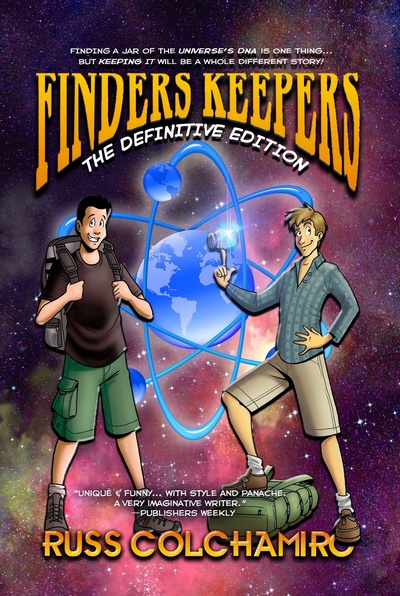
Finders Keepers: The Definitive Edition by Russ Colchamiro: A Very Strange SF Romp

Finders Keepers: The Definitive EditionFinders Keepers: The Definitive Edition

by Russ Colchamiro
Series: Finders Keepers, #1

Kindle Edition, 310 pg.
Crazy 8 Press, 2018

Read: January 4 – 7, 2019


This is a very strange ride. That might be the most important thing to take away from my experience with this book. Strange is good, strange is unique, strange is the kind of thing you can only read here (well, you can read strange SF in other places, too, but they won’t be this kind of strange).

That doesn’t tell you a lot, though, does it? This is the story of two twenty-something guys (one from the US, one from New Zealand) backpacking their way around Europe. It’s the story of a young woman, an artist trying to escape from something, and her life-changing interactions with those two guys. It’s also the story of a young couple, trying to better their station in life, who might have taken on a job they shouldn’t have — and their tragic blunder in the middle of carrying out that job which just might ruin their lives. There’s also the woman whose ambition and slip-of-judgement that has led to her fall into disrepute and her loyal assistant as they try to stage a comeback. Oh, yeah, and there’s Ira and Howard — a dolphin and a whale — who are basically the sea mammal answer to Cheech and Chong.

Jason’s waiting tables at a small restaurant, putting off getting a teaching job, because he’s just not ready to take that step, when one of his customers inspires him to head to Europe for a while. This was a huge mistake — he’s unprepared for anything, the fact that he’s not robbed blind by the first slightly crooked person he meets in any country is a wonder. He eventually runs into Theo Barnes, who’s only a moderately better traveler. He’s on a quest — the exact nature of which I’ll leave to you — but Ira and Howard gave him some pretty specific directions. Primarily, these two do what backpacking twenty-something males do: the drink a lot, they chase girls, the drink some more, they get lost in Europe, and drink to excess.

I’m going to pass on explaining how the others I mentioned get into the story — there’s a lot of complicated explanation — that makes perfect sense in Colchamiro’s narration, but wouldn’t quite work in my summary. But most of the other people in the book aren’t human — they’re a different form of life who are responsible, in one way or another, for the construction of Galaxies, Star Systems and Planets — most notably, they’re all involved in the creation of our solar system. And all of them have done something horribly wrong (inadvertently or otherwise) and all are in the middle of crazy, elaborate plans to regain their status. Colchamiro tells us about their falls and their various efforts to fix things while we watch Jason and Theo binge drink their way around Europe.

I’m honestly not sure if that paragraph made much sense — I bet if you’ve read the book, it does.

What surprised me about the book wasn’t the strange antics these pairs got into — but that Colchamiro works a lot of heart and some pretty serious emotional arcs into the zaniness. He does so in a way that doesn’t seem forced, it doesn’t seem like he’s taking a break from the outrageous actions to have a heartfelt moment, or anything — but he seamlessly merges personal growth, insight or complex emotions into the same scenes as a talking dolphin or biker gang interrupting a son introducing his girlfriend to his mother.

There was a time back in the 90’s or so where it seemed that not a week could go by without someone on a sit-com ask the clarifying question: “Did you mean funny ‘ha ha,’ for funny ‘peculiar/strange/odd’?” I thought of that frequently while reading this book — and once I abandoned the idea of this book being “funny ‘ha-ha,'” and instead embraced the strange, the absurd, the idiosyncratic peculiarity of Finders Keepers, I enjoyed it a lot more. I’m not saying that there aren’t funny moments, and it’s definitely not a serious work — it’s a fun, goofy, and strange SF adventure, which we need more of. I just don’t think I laughed or chuckled all that much.

That said, do I encourage you to read it? Oh yeah. Am I curious about what the next two installments of this trilogy might bring? Oh yeah. And I fully intend on finding out as soon as I can. I wager if you spend some time with this particular batch of oddballs you’ll be as curious as I am — yet pleased that you spent this much time with them. It’s a great mix of heart, oddball characters, youthful indiscretions, and wisdom that time and suffering can only bring — all in one goofy adventure.

—–

3.5 Stars

My thanks to iREAD Book Tours for the invitation to participate in this tour and the materials they provided, including a copy of the novel.

BOOK SPOTLIGHT: Finders Keepers: The Definitive Edition by Russ Colchamiro

Today I welcome the Book Tour for the very strange Finders Keepers: The Definitive Edition by Russ Colchamiro. Along with this spotlight post, I’ll be posting a Q&A with the author (he came back for another round — the third author to do so!) and then I’ll be giving my take on the novel. Sounds like plenty of material to get to — let’s jump in. Don’t forget to enter the giveaway at the bottom of this post.

Book Details:

Book Title: Finders Keepers: The Definitive Edition by Russ Colchamiro
Publisher: Crazy 8 Press
Release date: October 17, 2018
Format: Paperback/ebook
Length: 310 pages
Genre: Sci-Fi/Fantasy
Content Rating: PG-13 + M (A few f-bombs, and mild sex scenes + some casual drinking/pot smoking)

Book Blurb:

In the spirit of The Good Place, Bill & Ted’s Excellent Adventure, and The Hitchhiker’s Guide to the Galaxy, author Russ Colchamiro has gone back to the future to deliver his wildest, funniest novel yet–the updated Sci-Fi/Fantasy tale Finders Keepers: The Definitive Edition.

When a jar containing the Universe’s DNA falls from Eternity, bumbling backpackers Jason and Theo find their loyalties–and sanity!–put to the test. Unaware that a motley crew from another realm is chasing them across the globe to retrieve that radioactive vessel, these intrepid new friends are forced to contend with passion, responsibility, and their own mortality–and the fate of the Solar System, which hangs in the balance.

Traversing Europe, New Zealand, and the backbone of Eternity, Finders Keepers: The Definitive Edition ultimately asks one simple question: Is the life you’re living the life you actually want . . . or does the Universe have more to offer than you can possibly imagine?

Book Trailer

About Russ Colchamiro:

Russ ColchamiroRuss Colchamiro is the author of the rollicking space opera, Crossline, the zany SF/F backpacking comedy series Finders Keepers, Genius de Milo, and Astropalooza, and is editor of the SF anthology Love, Murder & Mayhem, all with Crazy 8 Press.

Russ lives in New Jersey with his wife, two children, and crazy dog, Simon, who may in fact be an alien himself.

Russ has also contributed to several other anthologies, including Tales of the Crimson Keep, Pangaea, Altered States of the Union, Camelot 13, TV Gods 2, They Keep Killing Glenn, and Brave New Girls. Russ is repped by The Zack Company.

Russ Colchamiro’s Social Media:

Website ~ Twitter ~ Facebook ~ Instagram

Purchase Links for Finders Keepers: The Definitive Edition:

Amazon ~ Barnes & Noble
Playster ~ Kobo ~ 24symbols
Add to Goodreads

Enter the Giveaway:

a Rafflecopter giveaway

https://widget-prime.rafflecopter.com/launch.js

If the nifty Rafflecopter isn’t working for you, just click here.

My thanks to iREAD Book Tours for the invitation to participate in this tour and the materials they provided.

My Favorite Non-Crime Fiction of 2018

When I was trying to come up with a Top 10 this year, I ran into a small problem (at least for me). With 44 percent of my fiction, Crime/Thriller/Mystery novels so dominated the candidates, it’s like I read nothing else. So, I decided to split them into 2 lists — one for Crime Fiction and one for Everything Else. Not the catchiest title, I grant you, but you get what you pay for.

I do think I read some books that were technically superior than some of these — but they didn’t entertain me, or grab me emotionally the way these did. And I kinda feel bad about leaving them off. But only kind of. These are my favorites, the things that have stuck with me in a way others haven’t — not the best things I read (but there’s a good deal of overlap, too). I know I read books that are worse, too — I don’t feel bad about leaving them off.

Anyway…I say this every year, but . . . Most people do this in mid-December or so, but a few years ago (before this blog), the best novel I read that year was also the last. Ever since then, I just can’t pull the trigger until January 1. Also, none of these are re-reads, I can’t have everyone losing to my re-reading books that I’ve loved for 2 decades.

Enough blather…on to the list.

(in alphabetical order by author)

Lies SleepingLies Sleeping

by Ben Aaronovitch

My original post
I’ve read all the comics (at least collected in paperback), listened to all the audiobooks, read the books at least once . . . I’m a Rivers of London/Peter Grant fan. Period. Which means two things — 1. I’m in the bag already for this series and 2. When I say that this is the best of the bunch, I know what I’m talking about. Aaronovitch writes fantastic Urban Fantasy and this is his best yet. The series has been building to this for a while, and I honestly don’t know what to expect next. Great fight/action scenes, some genuine laughs, some solid emotional moments . . . this has it all. Everything you’ve come to expect and more.

—–

5 Stars

The Fairies of SadievilleThe Fairies of Sadieville

by Alex Bledsoe

My original post
I was very excited about this book when Bledsoe announced it was the last Tufa novel. Then I never wanted it to come out — I didn’t want to say goodbye to this wonderful world he’d created. But if I have to — this is how the series should’ve gone out. It’s the best installment since the first novel — we get almost every question we had about the Tufa answered (including ones you didn’t realize you had), along with a great story. It’s just special and I’m glad I got to read this magical series.

—–

5 Stars

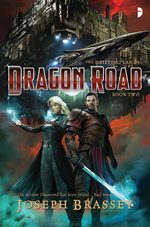
Dragon RoadDragon Road

by Joseph Brassey

I haven’t been able to get a post written about this — I’m not sure why. It’s superior in almost every way to the wonderful Skyfarer — the idea behind the caravan, the scope of the ship and it’s culture are more than you might think anyone has done before. A fantasy novel about wizards and warriors (and warrior wizards) in a SF setting. I had a blast reading this and I think you will, too.

—–

4 1/2 Stars

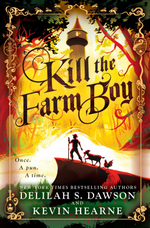
Kill the Farm BoyKill the Farm Boy

by Delilah S. Dawson and Kevin Hearne

My original post
Probably the best comedic/parody/satire fantasy since Peter David’s Sir Apropos of Nothing. The characters are fun, well-developed and pretty strange. This is a great fantasy story, it’s a great bunch of laughs, but there’s real humans and real human reactions — it’s not all laughs but enough of it is that you won’t have to work hard to thoroughly enjoy the book.

—–

4 Stars

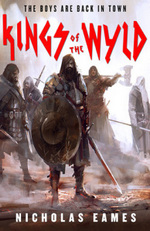
Kings of the WyldKings of the Wyld

by Nicholas Eames
Like Dragon Road, I’ve been trying to write a post about this book for months. An epic story about brotherhood, about family, about heroism, about integrity — but at its core, it’s a story about Clay Cooper. Clay’s a good man trying to stay one. He worked really hard to get to where he is, but he has to get back on the road to help his friends’ daughter. It’s a fantastic concept and set up, with an even better follow-through by Eames. Possibly the best book I read last year — and I don’t say that lightly.

—–

5 Stars

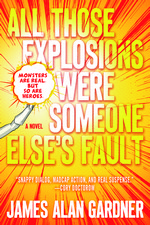
All Those Explosions Were Someone Else's FaultAll Those Explosions Were Someone Else’s Fault

by James Alan Gardner

My original post
A Superhero story, a SF story, an Urban Fantasy, a story about friendship and destiny told with just enough of a light touch to fool yourself into this being a comedy. From the great title, all the way through to the end this book delivers.

—–

4 Stars

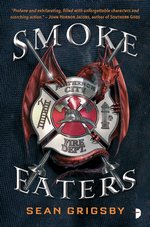
Smoke EatersSmoke Eaters

by Sean Grigsby

My original post
I started my original post about the book like this: Really, the case for you (or anyone) reading this book is simply and convincingly made in 13 words:

Firefighters vs. Dragons in an Urban Fantasy novel set in a futuristic dystopia.

That could’ve been my entire post, and it’s all I’m going to say now.

—–

4 1/2 Stars

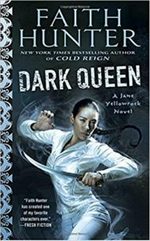
Dark QueenDark Queen

by Faith Hunter

My original post
This could have been the series finale and I’d have been satisfied. I’m thrilled that it’s not. Hunter’s been building to this for a few books now — and it absolutely pays off the work she’s been doing. Better yet, there’s something else she’s been building toward that doesn’t get the attention it needed — and it’s devastating. The series will be different from here on out. Hunter’s as good as the genre has, and this book demonstrates it.

—–

5 Stars

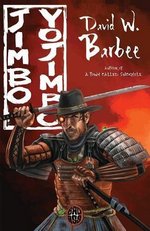
Jimbo YojimboJimbo Yojimbo

by David W. Barbee

My original post
I don’t have words for this. I really don’t know how to say anything about this book — especially not in a paragraph. Click on the original post and know that even then I fail to do the book justice. It’s strange, gross, funny, exciting and thrilling.

—–

4 Stars

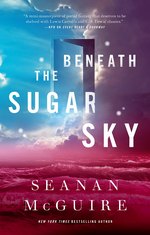
Beneath the Sugar SkyBeneath the Sugar Sky

by Seanan McGuire

My original post
As much as I appreciate McGuire’s Toby Daye, Indexing and InCryptid series, her Wayward Children books are possibly the best things she’d done. This allows us to spend time with characters I didn’t think we’d see again and the family — and world — of my favorite character in the series. It’s like McGuire wrote this one specifically for me. But it’s okay for you to read it, too. I’m generous like that.

—–

5 Stars

My Favorite 2018 (Fictional) Dogs

In one of the lightest moments of Robert B. Parker’s Valediction (just before one of the darker), Spenser describes his reservation about the first two Star Wars movies: “No horses . . . I don’t like a movie without horses.” After watching Return of the Jedi, he comments that it was a silly movie, but “Horses would have saved it.” Which makes me wonder what he’d have thought about The Last Jedi. Horses aren’t my thing, it’s dogs. I’m not quite as bad as Spenser is about them — I like books without dogs. But occasionally a good dog would save a book for me — or make a good book even better. I got to thinking about this a few weeks back when I realized just how many books I’d read last year that featured great dogs — and then I counted those books and couldn’t believe it. I tried to stick to 10 (because that’s de rigueur), but I failed. I also tried to leave it with books that I read for the first time in 2018 — but I couldn’t cut two of my re-reads.

So, here are my favorite dogs from 2018 — they added something to their novels that made me like them more, usually they played big roles in the books (but not always).

(in alphabetical order by author)

  • Edgar from The Puppet Show by M. W. Craven (my post about the book) — Edgar has a pretty small role in the book, really. But there’s something about him that made me like Washington Poe a little more — and he made Tilly Bradshaw pretty happy, and that makes Edgar a winner in my book.
  • Kenji from Smoke Eaters by Sean Grigsby (my post about the book) — The moment that Grigsby introduced Kenji to the novel, it locked in my appreciation for it. I’m not sure I can explain it, but the added detail of robot dogs — at once a trivial notion, and yet it says so much about the culture Cole Brannigan lives in. Also, he was a pretty fun dog.
  • Rutherford from The TV Detective by Simon Hall (my post about the book) — Dan Groves’ German Shepherd is a great character. He provides Dan with companionship, a sounding board, a reason to leave the house — a way to bond with the ladies. Dan just felt more like a real person with Rutherford in his life. Yeah, he’s never integral to the plot (at least in the first two books of the series), but the books wouldn’t work quite as well without him.
  • Oberon from Scourged by Kevin Hearne (my post about the book) — Everyone’s favorite Irish Wolfhound doesn’t get to do much in this book, because Atticus is so focused on keeping him safe (as he should be). But when he’s “on screen,” he makes it count. He brings almost all of the laughs and has one of the best ideas in the novel.
  • Mouse from Brief Cases by Jim Butcher (my post about the book) — From the moment we read, “My name is Mouse and I am a Good Dog. Everyone says so,” a good novella becomes a great one. As the series has progressed, Mouse consistently (and increasingly) steals scenes from his friend, Harry Dresden, and anyone else who might be around. But here where we get a story (in part) from his perspective, Mouse takes the scene stealing to a whole new level. He’s brave, he’s wise, he’s scary, he’s loyal — he’s a very good dog.
  • Ruffin from Wrecked by Joe Ide (my post about the book) — Without Isaiah Quintabe’s dog opening up conversation between IQ and Grace, most of this book wouldn’t have happened — so it’s good for Grace’s sake that Ruffin was around. And that case is made even more from the way that Ruffin is a support for Grace. He also is a fantastic guard dog and saves lives. His presence is a great addition to this book.
  • Dog from An Obvious Fact by Craig Johnson (my post about the book) — I might have been able to talk myself into ignoring re-reads if I hadn’t listened to this audiobook (or any of the series, come to think of it) last year — or if Dog had been around in last year’s novel. Dog’s a looming presence, sometimes comic relief (or at least a mood-lightener), sometimes a force of nature. Dog probably gets to do more for Walt in this book — he helps Walt capture some, he attacks others, just being around acts as a deterrent for many who’d want to make things rough on Walt. Walt couldn’t ask for a better partner.
  • Trogdor from The Frame-Up by Meghan Scott Molin (my post about the book) — Honestly, Trogdor probably has the least impact on the book than any of the dogs on this list. But, come on, a Corgi names Trodgor? The idea is cute enough to justify inclusion here. He’s a good pet, a fitting companion for MG — not unlike Dan’s Rutherford. He just adds a little something to the mix that helps ground and flesh-out his human companion.
  • Mingus from The Drifter by Nicholas Petrie (my post about the book) — Like Trogdor, a great name. Like Mouse and Dog, a great weapon. He’s really a combination of the two of them (just lacking Mouse’s magical nature). He’s vital in many different ways to the plot and the safety of those we readers care about. Petrie made a good move when he added this beast of a dog to the novel.
  • Chet from Dog On It by Spencer Quinn (my posts about Chet) — If I couldn’t cut Dog, I couldn’t cut Chet. Listening to this audiobook (my 4th or 5th time through the novel, I believe) reminded me how much I love and miss Chet — and how eager I am for his return this year. This Police Academy reject is almost as good a detective as his partner, Bernie, is. Chet will make you laugh, he’ll warm your heart, he’ll make you want a dog of your own (actually, all of these dogs will)
  • Zoey from Deck the Hounds by David Rosenfelt (my post about the book) — how do I not invoke Tara when discussing an Andy Carpenter book? Good question. It’s Zoey that brings Andy into the story, it’s Zoey that helps Don to cope with his own issues, it’s Zoey that defends Don and saves him (in many ways). Sure, Tara’s the best dog in New Jersey, but Zoey comes close to challenging her status in this book.
  • Lopside from Voyage of the Dogs by Greg van Eekhout (my post about the book) — It almost feels like cheating to bring in a dog from a novel about dogs — conversely, it’s hard to limit it to just one dog from this book. But Lopside the Barkonaut would demand a place here if he was the only dog among a bunch of humans — or if he was surrounded by more dogs. He’s brave, he’s self-sacrificing, he’s a hero. He’ll charm you and get you to rooting for these abandoned canines in record time.

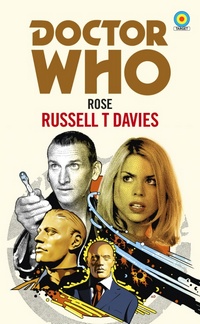
Doctor Who: Rose by Russell T. Davies: It All Starts with — and Comes Back to — Rose

Doctor Who: RoseDoctor Who: Rose

by Russell T. Davies
Series: Doctor Who

Paperback, 197 pg.
BBC Books, 2018
Read: December 31, 2018

She ran into a cavern.

She ran into a vault.

She ran into a cathedral.

She ran into a huge space, a vast dome, with the Doctor standing at its centre, the grinning lord of an impossible realm.

It was like being plunged underwater, the sudden pressure in her head, and Rose thought, simply, No! and ran back out again.

Into the yard. The same old yard. With headless Mickey still chopping away at the fire door.

She looked back at the blue box. She’d left the door open and she could see, in the gap between door and jamb, that huge, strange space reaching far beyond, With the Doctor somehow in the distance, a small figure, a good twenty metres away and yet within a box that stood beside her, no deeper than a metre in itself.

I think that was the moment in 2006 that sealed the deal for many of us — Doctor Who was back. My kids (who were at the perfect age to be introduced to the show) loved that moment, but I don’t think they were sold until The End of the World the next week. But I was in from the time Rose Tyler stepped into the TARDIS — and (not at all surprisingly) her creator, Russell T. Davies, captured the moment perfectly in his novelization of the episode.

It’s more than just a novelization, Davies is able to take a lot of things that happened or developed later in the show’s run and weave them into this adventure (or at least set the stage for them) while he’s fleshing out a lot of things that he couldn’t get into the episode. We got a very nice glimpse of Doctors past and future (even post-Jodie Whittaker), and a very character-appropriate appearance from a future companion that made me chuckle audibly (that moment was worth half of what I paid for the book)

The prologue adds weight and context to the disaster of Rose’s store being destroyed (which is pretty easy to miss). Davies also does a great job at showing that Mickey isn’t just the loser that Rose is shackled with, but he’s someone worthy of her time and devotion. We eventually got to see some of that in the show — but it was about the same time that Mickey left. Here we see it from the start.

But the most important part of the book — like the episode itself — was Rose (it’s right there in the title). Davies probably knows her better than anyone, and is able to use that knowledge to flesh out the character, to helps us see (and not just assume) what’s going on in Rose’s mind. We see her loneliness, her sense of being incomplete, how she needs something more than working at a shop or being with Mickey can give her. Seeing Rose embrace her capabilities and end up as sure and certain as she is later. This depth was most welcome and made me miss Ms. Tyler even more.

I needed a quick, fun read after some pretty heavy reads — and the BBCAmerica Doctor Who marathon had me nostalgic already. So I’m glad I had this handy, it fit the bill precisely. It was a pleasant blast from the past with plenty of bonus nuance and detail from the man who brought us the new era of The Doctor. If you’re a Whovian who’s never tried one of these Target books — this would be a great place to start. If you’re no stranger to them, you know how good they can be. This is just that.

—–

3.5 Stars

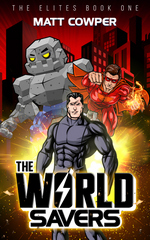
The World Savers by Matt Cowper: A Bang-Up Start to a new Super-Hero Series

The World SaversThe World Savers

by Matt Cowper
Series: The Elites, #1

Kindle Edition, 257 pg.
2018
Read: December 11 – 12, 2018

There are going to be a lot of comparisons in this to Marvel/DC characters. This isn’t saying Cowper’s being derivative — nor is he ripping any character off. These are well-known and established types — he’s not doing anything that Ben Edlund didn’t do in The Tick, or Bendis in Powers, or Kirkman in Invincible — etc. I’m just going to say something like “Slab is a Thing-like character” so I don’t have to write three sentences to describe the Thing.

Beverly Gillespie (an Amanda Waller-esque character), the Secretary for Superhuman Affairs, is re-assembling the legendary team, The Elites. Enough time has gone by since they disbanded (for very good reasons) that the government wants to start them up again — under new leadership. Nightstriker — a very Batman/CW’s Arrow -type of guy. He’s driven, he’s obsessive, he’s seemingly incorruptible, and doesn’t play well with others and is pretty paranoid. Which is what attracts Waller — she wants someone who’ll go out of his way to keep the team’s integrity.

It takes some doing, but Nightstriker relents and selects a few people to join the new group — none of them are the crème de la crème, Nightstriker considers them misfits, actually. But misfits that he thinks can work well together and be a strong Gestalt-y greater than the sum of its parts entity. No sooner have they assembled, than their home base, Z City, is under attack. I’ll leave this vague, but essentially these opponents are Occupy Wall Street with a cult-like flavor, following a would-be world conqueror, with everyone within the group possessing some sort of metahuman abilities. So The Elites have to stop this group from destroying the city (or at least the financial and governmental structures), while learning to function as a team.

The book is told through the points of view of Nightstriker and a member of his Elites, Blaze. Nightstriker’s a strong take on the type — you know him pretty well almost instantly.You get his motivation, his way of doing things and can understand his paranoia about reforming this team. He sees himself as not just Team Leader, but Mentor/Coach to his team — but he has a lot to learn about being a Team Player as well as a Leader.

Blaze is a high schooler struggling with Biology tests while he goes around fighting crime in a Human Torch-ish way (with shades of Firestorm, too). He’s eager, he’s naive, he’s a little reckless, he has a sense of fun that’s outweighed by a sense of responsibility. He’s so wet behind the ears that it threatens to put out his fire. But he’s smart (probably smarter than he realizes) and has nothing but potential. Nightstriker sees all of that (and probably more), and sees similar qualities in the other recruits. I really enjoyed his chapters — the Nightstriker point of view is what the DC movies are (at their best), Blaze’s are Marvel movies. The two together make a powerful combination.

Metal Girl doesn’t have point-of-view chapters, but we learn a lot about her — her origin story, what makes her tick, etc. She’s sort of a Vision/Red Tornado/Metamorpho cocktail. That description can only work once you’ve read the book — it’ll click when you do. I really dug her as a character and can’t wait to see what Cowper has in store for her development.

There are two members of The Elites that are under-served — which isn’t too much of a complaint, there’s a lot of plates spinning in these pages and to try to fit in more of these two probably would be counter-productive. First is Buckshot — think the Green Arrow or Hawkeye, but with guns (it’s been too long since I’ve read anything with him in it, but maybe that makes him Arsenal-like) with a Western-motif about him and a talk-radio conservative world-view — I like him, but think Cowper overplayed some of his characteristics (just a little bit). The other one is Slab — he’s a Thing-type character, who really isn’t that much like Ben Grimm — although they’re similar. There’s something about this guy — as much as I enjoyed the rest of the cast, it wouldn’t surprise me at all if Slab becomes the heart and soul of the team — and maybe the guy who really comes through at the very end to land the coup de grâce in the finale. Maybe it’s just me, but I like Slab enough that if you told me that Cowper was releasing a novella starring him today, you’d be reading my review about it tomorrow.

There’s plenty of solid super-hero action with a much larger cast of characters than you expect going in — much larger than I’ve told you about, too. The best thing about the opponents of The Elites (I hesitate to call them villains — although it’s appropriate for at least some of them) is that there’s some merit to their cause, enough that at least some of the super-heroes fighting them have to consider their actions. The world seems awfully black-and-white at the beginning, but by the end there’s a lot of gray.

This takes place in the same world as Cowper’s Johnny Wagner, Godlike PI books, but it feels rather different. And it should — one’s a PI novel with super-hero overtones, the other’s a straight-forward super-hero book. I enjoyed the first of those books (and really should’ve read the second by now), but Double Lives took awhile to win me over. The World Savers had me by the end of the first chapter. Don’t ask me what the difference was, I couldn’t tell you. But it’s there.

Great action, great characters (with room to develop and signs that they will), a world teeming with possibilities, this is a strong intro to a series that could turn out to be great (it could also turn out to be simply really good — I’d be okay with that, too). This is a planned trilogy, and I’d pony up the cash for the next two installments right now if I could, I’m eager to see where Cowper takes these characters next (I have a small wish list, but I expect he has better plans).

Disclaimer: I received a copy of this book from the author in exchange for my post and my honest opinions.

They Promised Me the Gun Wasn’t Loaded by James Alan Gardner: The Newest Canadian Super-Heroes are Back in Action

 They Promised Me the Gun Wasn't Loaded They Promised Me the Gun Wasn’t Loaded

by James Alan Gardner
Series: The Dark vs. Spark, #2

Paperback, 350 pg.
Tor Books, 2018

Read: November 26 – 27, 2018

When I read the first book in the series, All Those Explosions Were Someone Else’s Fault, back in January, I said “the sequel can’t get here fast enough.” I didn’t quite expect to be reading it 11 months later, but I’m okay with that.

It’s just a couple of weeks after the events of the previous book, and the newly formed team of superheroes has gone home for Christmas break. Now with just a few days before classes start up again, the team is coming back. In the last book we focused on Kim/Zircon, this time our protagonist is her roommate/teammate Jools/Ninety Nine.

Jools doesn’t even make it out of the airport before she’s dealing with the police and a powerful Darkling — and maybe a powerful Spark artifact.

(Quick reminder: In this world there are two super-powered groups: the Darks/Darklings and the Sparks. The Darks are all the supernatural-types you can think of (and some you can’t): vampires, weres, etc. The Sparks are Super-Heroes and the like (although some have gone astray))

Jools, with a little help from her friends, gets out of that mess — only to find herself signed up for more.

Soon, in an effort to keep this artifact from falling into the wrong hands — Jools finds herself cut off from her friends and in the secret-hideout with a very maverick group of Sparks — a modern-day Robin Hood and his Merry Men. This gives her an opportunity to watch other Sparks in action, to see how they live and think — and come up with some ways to evaluate her new lifestyle. Also, there’s a lot of fighting and nifty tech to read about.

I wasn’t crazy about how little time we got with the rest of the team because of this, but I think in the long run, it’ll work for the strength of the series. And when we get the team together again, it’s even better to see than it was before.

Again, I had a blast with this book. Gardner’s world is ripe with story-telling possibilities and I’m enjoying watching him develop these characters and this world. Jools is a great character — a solid combination of vulnerable and snarky, unwise and ridiculously intelligent — you’ll probably end up with her as your favorite character in the series (at least until book 3). Go grab this (and the other one, too) now.

—–

4 Stars
2018 Library Love Challenge

Page 20 of 30

Powered by WordPress & Theme by Anders Norén