Tag: SF Page 28 of 30

Guest Post: 5 Books about Time by Michael Landweber


I’m a little obsessed about the concept of time in my writing. My first book, We, was about a man who travels back in time only to get stuck as a parasite inside the head of his seven-year-old self. In my latest novel, time stops completely, except for one 17-year-old kid. I suppose the recurring theme is that we have no control over time, even when it gets a little bit wonky. In honor of my obsession, I have created a list of five time-related books (or more precisely that have the word “time” in the title) that I’ve enjoyed over the years.

1) The Time Machine by H.G. Wells
The one that started it all. The original time travel story. Without it, there never would have been Timecop. Seriously though, it is a little hard to imagine that we’d have more than a century of time travel related books, movies, TV shows, etc. if Wells hadn’t had the idea that a time machine was the way to travel to different eras. Of course, unlike most modern time travel fiction, which focuses on the ways that traveling through time can change the present, purposefully or not, Wells had his protagonist travel into the far future where he encountered a parable about class and society. Still, the guy coined the phrase “time machine.” That’s pretty cool.

2) A Wrinkle in Time by Madeleine L’Engle
We don’t need no stinking time machine. In L’Engle’s classic children’s book series, the characters travel through space by “wrinkling time” by means of the tesseract. Most writers now call it a wormhole. No vehicle required. That freed a lot of writers to just zap characters from place to place without tricking out a Delorean. The book also is about how children can save the world without the help of the adults around them, particularly parents. Hello, Harry Potter!

3) A Tale for the Time Being by Ruth Ozeki
OK, this one has the least to do with manipulating time though it is a story about how past family narratives can help soothe present pain. A young woman in Tokyo considers suicide, but researching the stories of her feminist Buddhist nun great-grandmother and her disgraced WWII pilot great-uncle lead her to some surprising revelations about herself.

4) Time’s Arrow by Martin Amis
Amis uses a unique device to write about the horrors of the Holocaust. The narrator is a consciousness inside the head of a former Nazi who is now living a new life in America. But the story is told in reverse chronological order. Time in the book literally runs backward, so we start with the war criminal as an old man and travel unavoidably to his horrific past. It is an unusual and difficult book that allows the reader a new window into understanding the inconceivable cruelty that people are capable of.

5) Time Bandits
OK, I’m totally cheating here. Time Bandits is a movie. But it also happens to be my favorite movie. And it is about traveling through time. So there. One of Terry Gilliam’s earliest films, this one follows a young boy who falls in with a group of dwarfs who previously worked for the Supreme Being until they stole the Big Guy’s map of time holes and decided to use it to steal from the rich throughout history. That only begins to describe how gloriously messed up this movie is.

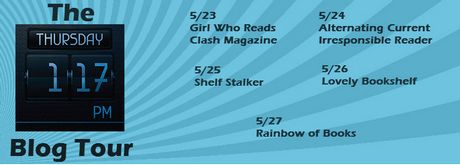
Thursday, 1:17 PM Book Tour

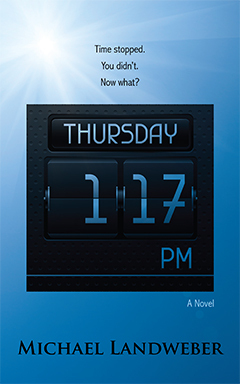
Thursday, 1:17 PMTime stopped. You didn’t. Now what?

Duck is 17. He will never be 18.

Tomorrow is his birthday. It will never be tomorrow.

Time stopped at 1:17 p.m. on a beautiful Thursday afternoon in Washington, DC. Duck is the only person moving in a world where all other living beings have been frozen into statues in an endless diorama. Duck was already in limbo, having lost his mother to cancer and his father to mental illness.

Now, faced with the unimaginable, he approaches his dilemma with the eye of an anthropologist and the heart of a teenager trying to do the right thing under the strangest of circumstances. Ultimately, he realizes that while he doesn’t understand the boundaries between friendship and love, that uncertain territory may be the key to restarting the world.

Trade Paperback – Available now
Publisher: Coffeetown Press
ISBN13: 9781603813570
208 pages

Coming up: We’ve got a Guest Post from Michael Landweber, a Q & A with him, too — and finally, my $.02 about the book. Come back and check these posts out (the links will work when the posts go up) — or just go get the book. Whatever.

Ideas and Inspiration for Fantasy and Science Fiction Writers by James Hutchings

Ideas and Inspiration for Fantasy and Science Fiction WritersIdeas and Inspiration for Fantasy and Science Fiction Writers

by James Hutchings

Kindle Edition, 453 pg.
2016


You know what this book could’ve used? An introduction. Just something to ground the reader in the books intention, design, scope . . . something. It just dives in, you flip from the Table of Contents to the first entry.

The only way you know what the book is for is to have read the description from Goodreads/ebook seller:

If you want to spark new ideas for worlds, plots or characters, you want Ideas and Inspiration for Fantasy and Science Fiction Writers. Medicinal corpses, the jargons of thieves and carnies, Nazi UFOs, the colonization of space and green children from nowhere are only a few of the topics covered. This sourcebook is for all writers of fantasy or science fiction–whether novels, short stories, games, or any other form of storytelling.

The afterword touches on it a little, but who wants that at the end of a book?

Smoother writing, maybe a touch of personality to the writing would’ve been a plus, too.

It’s not something you can read cover-to-cover, it’s a resource book that you can consult, or flip through. I’m pretty sure I’ve read almost all of it over the course of a couple of weeks. It sparked an idea or two (not that I have time for them), but that’s about it.

I guess, this book set out to do what it intended, is thorough, easy to read, so . . . 3 stars? Next time you’re trying to prepare for NaNoWriMo or a Creative Writing course, give it a thumb-through.

Disclaimer: This book was provided to me by the author in exchange for an honest review.

—–

3 Stars

Calamity by Brandon Sanderson

CalamityCalamity

by Brandon Sanderson
Series: The Reckoners, #3

Hardcover, 417 pg.
Delacorte Press, 2016

Read: March 30 – April 2, 2016

There was more connectivity between city-states in the Fractured States than I’d once assumed. Perhaps the Epics could have survived without any kind of infrastructure, but they tended to want subjects to rule. What good was it to be an all-powerful force of destruction and fury if you didn’t have peasants to murder now and then? Unfortunately peasants had to eat, or they’d go and die before you got a chance to murder them.

That meant building up some kind of structure in your city, finding some kind of product you could trade. Cities that could produce a surplus of food could trade for power cells, weapons or luxuries. I found that satisfying. When they’d first appeared, the Epics had wantonly destroyed anything and everything, ruining the national infrastructure. Now they were forced to bring it all back, becoming administrators.

Life was so unfair. You couldn’t both destroy everything around you and live like a king.

I really enjoyed Steelheart, the first novel in this trilogy — and Firefight was a lot of fun, if not as good — it wasn’t anything serious, weighty, or bogged-down with teenage drama. Just a fun story about super-powered individuals ruling over a post-apocalyptic dystopia and the non-super-powered rebels trying to take them down. So, how’d Brandon Sanderson wrap things up? In a very mixed bag — an ending that was honest, consistent, and fitting for the series, but one I really didn’t care for.

Which is going to take some explanation.

David’s voice is as friendly, upbeat, and nerdy in the way that charmed me in the beginning. Even weighted down with added burdens and losses, he’s hung onto his core personality. His metaphors are as painful as ever — his ability to get his teammates to go along with the biggest of hare-brained schemes is intact and still astounding.

I wanted answers. They were probably here somewhere. Maybe I’d find them behind that group of robotic war drones that were extending their gun arms from behind the freezers in front of me.

Oh.

But he isn’t the same kid we met on the streets of Newcago — he’s lost his drive for revenge, it’s evolved into something else (and/or been revealed or better understood to be something else). He’s not out for blood, not out for simply overthrowing the Epics. He still wants to stop them, to restore rule to non-Epics and free them from the tyranny they’re under. But it’s because of wrong and right, for deeper reasons, purer motives.

He’s not the only one who’s changed and grown — Megan, the love of his life and former foe, has greater understanding of herself and her powers, she’s gaining more and more control of both. Part of it is self-acceptance, part of it is David’s faith in her. Either way, she’s a more entertaining character — and a less threatening force (at least as far as The Reckoners are concerned).

Thanks to their travel and experience, David and the others have a better understanding of how the world works (see the above quotation for a hint) — and some of the Epics have had to make adjustments, if for no other reason to keep their subjects alive and working. From a surprising source, we learn how the Reckoners tech works — as do they — and it’s pretty odd (and interesting). Not only that — the source of Calamity, the source of the Epics’ powers is revealed. You really can’t ask for more than that.

Well, actually you can — one of the other things that comes out of the growth and development of David (and the rest) over the series, and especially over this book, are some underlying themes that come out. They’ve been there since the beginning if you knew how to look, but here, Sanderson makes them explicit. I really appreciated them as they surfaced — I’m not sure that a lot of the YA crowd that this is targeted for would as much as I did, but many would. The last scene is pretty heartwarming, really — something I wouldn’t have expected at pretty much any point in the series (and has nothing to do with romance, for the record).

So why am I lukewarm about this? While the execution was consistent, the tone was right on-pitch and Sanderson didn’t cheat anywhere along the way to the series conclusion, I just didn’t like it. I didn’t like the explanation given for the source of the powers. I didn’t like the way the last half of the book played out (mostly everything after the last battle with the Prof, really — so less than half, but the groundwork was laid at about the 50% mark). Sanderson told the story he wanted to, in a way that made sense to the rest of the series, and he never copped out or went for high drama over being true to his story. So I can’t judge it too harshly. I just didn’t care for the way it played out. Which pretty much just means that Sanderson wrote the ending he wanted and not the one I wanted. Sure, I think it’s tacky, but you can add that to the very long list of things that he didn’t ask me.

I wasn’t wowed, wasn’t thrilled with things in the end. But I really can’t complain about any of it. Fans of — or at least readers of — the series should check out the conclusion, just to get the closure it brings. Hopefully, you’ll get more out of it than I did.

—–

3 Stars

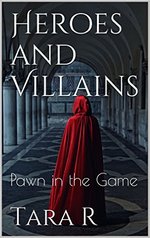
Heroes and Villains: Pawn in the Game by Tara R

Heroes and Villains: Pawn in the Game Heroes and Villains: Pawn in the Game

by Tara R
Series: Heroes and Villains, #1

Kindle, 243 pg.
2015

Read: March 26 – 27, 2016


I’m not really sure where to start with this, to tell you the truth. Tara R has put a lot of effort into this, there’s clearly an ambitious story she’s wanting to tell. Sadly, she’s not the kind of writer (yet?) who can pull it off.

She has a hard enough time pulling off basic grammar, punctuation and vocabulary, much less a consistent voice and created culture. I’d given up on this thing by the end of chapter three, but was willing (and eager) for her to win me back — it’s been done before. It’s been done in the last week, but this novel just isn’t capable of it.

I’d try to describe the book a little, but I’m not sure I can — it’s a dystopian fantasy, a world full of despots using their subjects as cannon fodder. There’s magic, to a degree, there’s widespread suffering and abuse, there’s an idealistic revolutionary or two — but no golden age to hearken back to. Just an idea (with no observable origin) that the world could be better. But there’s no one on this world that’s ever seen a better world, so why they’d think there is one is beyond me.

That said, various people — royalty and commoners both, have senses of humor, moments of joy and joking, and even non-royals get dressed in tuxedos (because what epic fantasy doesn’t have guys in tuxes?). In fact, for a dytopian world, it frequently doesn’t seem that bad — except for the people talking about how horrible it is all the time. Again, there’s no basis for them to think so given that this is the way the world has always worked.

The various governmental entities, secret societies, and would-be insurrections just don’t make sense. Their operation isn’t coherent (nor do they fit the setting), their goals are confusing — and then you get the totally out of the blue and bizarre lecture on DNA and I just gave up. This is a barely educated society, and sure, our protagonist is founding secret schools all over the place, but it’s a mighty big leap to go from an agrarian-based culture in a near-constant state of war with only underground schools to people casually discussing genetic manipulation.

Could I have tried harder to understand everything? Maybe — but I was really searching for something to hold on to, I tried pretty hard. But other than curiosity, there was no reason to — there’s not a single character interesting enough to keep you going, to make you care whether they live, die, or are never mentioned again in any way by the author.

It is simply, and perhaps too bluntly, a disappointing mess.

I’m giving it two stars because I didn’t actively hate it. Also, I do think that there’s something buried deep down here that’s worth looking at, and I really do think that in Tara R’s mind, this all makes sense — she’s clearly put the time and thought into it. But she just did not get that to the page. If you’re willing to put in the work, you might find the nuggets. But I wouldn’t recommend spending your time on it, it’s just not worth it.

Disclaimer: I was provided with a copy of this by the author in exchange for an honest review, she hopefully doesn’t regret that exchange too much.

—–

2 Stars

The Shootout Solution (Audiobook) by Michael R. Underwood, Mary Robinette Kowal

The Shootout SolutionThe Shootout Solution

by Michael R. Underwood, Mary Robinette Kowal
(Narrator)
Series: Genrenauts, Episode 1

Unabridged Audiobook, 3 hours and 25 minutes
Macmillan Audio, 2015
Read: March 23, 2016


I thoroughly enjoyed the story about Leah Tang’s introduction to the wonderful and crazy world of the Genrenauts — and it’s sequel — when I read it last November. When heading out for a road trip, I figured it’d be a good distraction from the road for my wife, son and I. It’s a fun story, filled with characters you want to root for on an adventure that we all would like to take. I mean seriously, a rocketship ride to the Old West? Sign me up.

For me, this time it was a little easier to grasp the explanations given for what the team is up to — the new reality (better, realities) that Leah finds herself in this time out. Partially because I already knew it, partially because I find that kind of thing easier to digest when I hear it (so why don’t I listen to more audiobooks?)

On the whole, I was really impressed with Kowal’s narration. My wife and I weren’t crazy about her characterization of King — the voice was hard to understand, I really didn’t think it matched the description Underwood gave. I had virtually no other complaints — and in fact, really enjoyed her work. It was a little hard for me to deal with the fact that it took nearly three-and-a-half hours to get through, I’m used to spending a lot less time with Underwood’s works (most of them, anyway). But I did appreciate being forced to soak in the world, think about things a bit more than I would have on my own.

I was hoping we’d get through the second installment as well, but we weren’t able to squeeze that in. I’m curious what Kowall did with some of the characters we meet there, and hope I can figure out a time to get to it soon.

If you liked the novella — or if you think you’d like the book, but haven’t gotten around to grabbing it, the audiobook is well worth the small investment of time and money.

—–

4 Stars

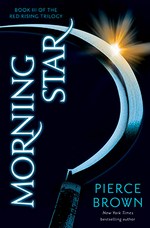
Morning Star by Pierce Brown

Morning StarMorning Star

by Pierce Brown
Series: Red Rising, #3

Hardcover, 518 pg.
Del Rey, 2016

Read: February 24 – March 3, 2016

“There is no pain. Only joy,” they chant, deep in the embrace of the god’s bread. Sefi begins the war bellow. Her voice higher than Ragnar’s. Her two wing-sisters join her. Then their wing-sisters, until dozens fill the com with their song, giving me a sense of grandeur as my mind tells my body to flee. This is why the Obsidians chant. Not to sow terror. But to feel brave, to feel kinship, instead of isolation and fear.

Sweat drips down my spine.

Fear is not real.

Holiday deactivates her safety.

“Njar la tagag . . . ”

My razor goes rigid.

PulseWeapon shudders and whines, priming.

Body trembles. Mouth full of ashes. Wear the mask. Hide the man. Feel nothing. See everything. Move and kill. Move and kill. I am not a man. They are not men.

The chanting swells. . . “Syn tir rjyka!”

Fear is not real.

If you’re watching, Eo, it’s time to close your eyes.

The Reaper has come. And he’s brought hell with him.

And when The Reaper, Darrow of Lykos, says he’s brought hell with him, you’d best believe it.

With books that come later in a series — especially with the last volume — there are huge expectations and hopes. Sometimes the book’s a disappointment; sometimes it’s as good as you hoped — every now and then, it’s better than you’d hoped. And then there are the times you get something like Morning Star. I want to avoid hyperbole, and I don’t want to over-sell, so let me just say that Pierce Brown delivered. I’m not sure how to talk about this book — one of my most anticipated reads of 2016 — other than to say it did not disappoint in the slightest, and if it doesn’t find its way to my favorite reads of 2016, I’d be flummoxed (although that would mean we have an unbelievably good 9 months ahead).

We pick up about a year after Golden Son — well, that’s not true. We start off with one of those aggravating teases for events later in the book before starting the actual story. If I’m going to complain about it in Freedom’s Child a couple of weeks ago, I’d better complain about it here. Thankfully, it’s a brief tease and you can forget it quickly because Chapter 1 doesn’t wait too long to get to the brutality that this series is so capable of bringing, making you forget about trivial things like bad ways to start a novel. I’m not going to get into the plot — if you’re curious, start with Red Rising and catch up. If you’ve read one or two of these books, I just want to assure you that you should grab this.

Red Rising was like the love child of Ender’s Game and The Hunger Games hopped up on amphetamines, steroids and too much Red Bull. Golden Sun was a roller coaster of stomach-lurching twists and turns and shattered hopes. Morning Star has elements of both, but it also reads like a series of climatic scenes from epic novels and movies stacked on top of one another — Jackson’s The Lord of The Rings + Gladiator + The Patriot + a few more things like that on the day that Michael settles all family business. Somehow, Brown keeps the tension mounting from chapter to chapter, in a way that every battle, every encounter feels like it could be the novel’s climax. Yet when the actual climax happens you’re not prepared.

Having been trained by Golden Son, I spent a lot of time expecting a betrayal, waiting for the sucker punch I knew was coming. But it wasn’t that kind of book* — it was a book of hard choices — even compromises (the good kind) — of people doing the right thing, to the best of their understanding. Not always the best for themselves, but the best for their principles, their loved ones, their people. Family — biological family, extended family, found family — is a major theme throughout. It shouldn’t be surprising considering that this all started with a husband and wife, but when you think of The Red Rising Trilogy, family isn’t one of the first words that come to mind. Well, after you read this, it might be.

Lieutenant Commander Worf, son of Mogh, would’ve approved of so much of the action here (on both sides). The pages dripped with honor and nobility (in both classic and more modern understandings of the concepts). Despite it being a mainstay in fiction, I have a hard time buying the concept of noble deaths, but man . . . there’s one roughly midway through the that got me in just the right way. The dying was a little more protracted than Brown’s typical practice, giving him time to do more with it narratively. It was such a good piece of writing (even if all the individual elements in the scene were cliché), it’s one of the most effective parts of the series. Once it starts, you know what’s happening, you know how the effects of it will play out, but it still works. It’s like the da da da dummm at the beginning of the 5th — everyone knows it, but if an orchestra does it right? It’s powerful stuff.

Like a good general — Brown’s always a few steps ahead of the reader, well, me. As before, he surprised me all the time. There were a couple of times that I came close to seeing his play — technically — but his actual move was so much better than I’d guessed, I might as well have been moving checkers around his chess board.

Before I came across the section I quoted in my opening, I was going to use:

Now I remember hate.

I’m glad I didn’t. Morning Star isn’t about that. After Golden Son (or after Eo’s death), that’s what you expect: Darrow going all John Wick/Beatrix Kiddo/Frank Castle, but that’s not what the book is. Darrow is much more than a vengeance-machine. He’s more than rage, more than hatred — he’s full of both, no mistake. But that’s not all that’s driving him.

And because there’s more to him, the book — the series — is elevated to something beyond a great SF/Action romp. When Darrow, his friends and/or his army say something, do something to send a message, more often than not, it’s inspiring, at the very least, stirring. In the end, Darrow’s mission isn’t about destroying the Golds (although there is plenty of destruction), it’s something more.

The question is, can he fulfill this mission? What would that look like? It is so close to the final page when you get the actual answers to those (and all the other) questions you have.

Oh yeah, and Brown made me laugh out loud once. There were heartwarming moments, moments of joy, moments of awe. In the midst of the chaos, the violence, the destruction, and all the blood? Rays of humanity everywhere.

Simply put, this is the perfect conclusion for this fantastic series. I can’t think of a more fitting way for Brown to have concluded things. If you liked Red Rising and Golden Son, you’ll love this.


* Which isn’t to say that there aren’t gut punches.

—–

5 Stars

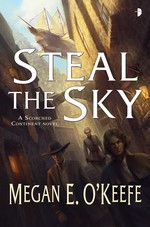
Steal the Sky by Megan E. O’Keefe

Steal the SkySteal the Sky

by Megan E. O’Keefe
Series: The Scorched Continent, #1

Mass Market Paperback, 439 pg.
Angry Robot, 2016

Read: February 20 – 23, 2016
It’s both overly-simplistic and inaccurate to describe Steal the Sky as The Gentlemen Bastards in the Firefly ‘Verse. But it’s not completely wrong.

I’m not sure I can defend that, but I tell you this: read the book and you’ll probably agree. I’m going to try to reference those other works as little as I can, because the book is more than just a combination of their DNA, but I’m going to have to a couple of times. There’s also a smattering of Steampunk-ish elements, some Epic Fantasy-like things, and a dash of The Stainless Steel Rat. You know how Data downplayed his violin playing as a combination of all those various artists, and Picard and Crusher (I think it was her, anyway) telling him that he’s the one who took all those various characteristics and made it his own? That’s what O’Keefe did here, and I hate to minimize what she did by just referencing these other works — but in the interest of brevity, you pretty much have to. I, frankly can’t wait to see in future books what other ingredients she puts in her secret sauce.

But before then, we have to step onto the Scorch, an unforgiving continent, to be sure.

What is it with SF novels and mining? Everywhere I turn lately, there are people slaving away (literally) in mines — Pierce Brown’s Darrow (and the rest of the Reds); almost everyone on Josi Russel’s Minea; and countless people in Aransa and the rest of the Scorched Continent. Really, it wouldn’t surprise me to see Raylan Givens and Boyd Crowder’s descendants digging for spaceship fuel next year on FX. One reason that you see them everywhere is that it’s really effective — you read “miner” and you see poor workers, toiling in unsafe conditions, who are very likely being taken advantage of. If that’s not grounds for compelling drama, well — did you not get where Katniss Everdeen was from?

Like on Minea, there’s a special kind of person who can find the precious resource, called Sel. Sel-sensitives — no matter what their social class, family, or other abilities — go work in the mines (well, a very few become pilots). They can find Sel, they can manipulate Sel, they are the key to getting it out of the planet and into their ships (as an aside, Sel seems to be somewhat renewable, which is nice). The last things the government wants is turmoil — and the thing they want most are Sel-sensitives who can do more than get Sel out of the ground.

The Scorched Continent looks and acts like something from the Old West (at least as we know it from movies, TV, etc.) small communities, mostly poor, with some nobility with a lot of on the “have” side of the equation. Which is where Detan Honding comes in — he’s the black sheep of the oldest of the noble houses, a small-time con man staying one step above starvation and another step ahead of the law (I’m about to break into “Street Rat” from Aladdin, so I’m going to stop). Along for the ride is his long-suffering ship’s pilot, friend, and resident voice of reason (probably the only one who keeps him from getting carried away), Tibs.

The two find themselves in Aransa, a larger city with a big mine. Detan and Tibs are known in some quarters of the city, most notably by the Captain of the Watch, Ripke Leshe, who wants them out of town. But has a unique business proposal first . . .

This is getting too long — let’s leave things there, with some people left for you to meet. And you want to, trust me. Including the villains — both petty and Big Bads (especially the Bigger Bads that you don’t think of that way at first).

O’Keefe has created a great world, with a robust culture, a specialized vocabulary, its own technology, politics and whatnot. There’s a whole invaders taking exploiting indigenous/traditional cultures thing that’s also going on — but O’Keefe doesn’t spend too much time on it, just gives us a quick glance of that — but it looks like future books will explore this more. So I’ll just leave it there, but I’m pretty curious about the whole thing. Speaking of local customs — anytime people talk about Walking the Black — put aside anything you may be snacking on.

Now, since I (and many others) have invoked The Gentlemen Bastards and Firefly, I should say that both of those have a sense of fun — a sense of play — that’s really not that present in Steal the Sky. You get the impression that maybe (probably) whatever happened before this did, though. This book is mostly like the part of Lynch’s work where play time is over and Locke is going for vengeance, not just a payday. Which is not to say that isn’t fun — there are plenty of laughs, jokes, witty rejoinders and whatnot — I’d love to quote some, but the amount of context it’d take for the you to get the joke would kill this. This novel doesn’t have the joie de vivre that the other works do, but it could.

One more Firefly reference and I’m done — towards the end, when things look pretty dire for some of our characters — you get the impression that O’Keefe spent a lot of time wondering just what happened to River while at The Academy, and a few people here would probably find themselves capable of swapping notes with Ms. Tam.

There’s excitement, piracy, politics, thievery, general mischief, subterfuge, revenge, friendship, loyalty in this story — told in a great world, with hints of more worlds to come (as well as more to learn about this one). People are going to be talking about this one for a while, I think. I am, at least.

—–

4 Stars

Guardians Launch Day!

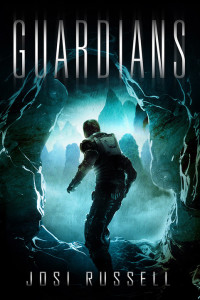
GuardiansTuesday, I blogged about the book, Guardians by Josi Russell — which I really enjoyed, and today is the release day.

The publisher, Future House Publishing, has this to say:

Buckle up for another great adventure with Josi Russell. and the sequel to her #1 best-selling Caretaker in her newest book, Guardians. While exploring Minea, Ethan and part of his crew crash-land and must navigate their way through a maze of tunnels with danger at every turn. Above ground, the others prepare for an unexpected battle. Can these self-appointed guardians bring hope of survival to Minea? Cancel your plans for this weekend, or better yet tell your friends to join you, as you fight with the guardians in the battle of Minea.

To kick-off the release, Future House has a few things you should take note of:

  1. There’s a sale on both Guardians and its predecessor, Caretaker. Just $0.99 until Feb. 17th. (I’m taking advantage of the Caretaker sale here in a minute or two.)
  2. They’re sponsoring a Goodreads giveaway for Guardians — enter by the 15th.
  3. They also have a drawing going on for an autographed copy of Guardians or the new audiobook of Caretaker. Check out details on that here.

There are more details about the book, the giveaways, and all that on the book’s Launch Page — be sure to check it out.

Guardians by Josi Russell

Be sure to watch the blog over the next day or two for more about this book as Release Day approaches — giveaways, sales, etc.!

GuardiansGuardians

by Josi Russell
Series: Caretaker Chronicles Book 2

Kindle Edition, 394 pg.
Future House Publishing, 2015

Read: February 4 – 9, 2016

Note: I threw MG/YA in as a category here, because while the book isn’t marketed for them — and the main characters are adults — there is absolutely nothing here that a 5th grader on up couldn’t enjoy. I’d have read this when I was that age.

I did one of those wild and crazy things with this book — throwing caution to the wind in a daredevil-like fashion — I read the second book in a series without reading the first book. Gasp!

Recklessness, no? It’s the kind of nutty thing I used to do all the time in my youth, but haven’t really done lately, so I figured I’d give it a try. Yes, there’s some history (between the characters, and actual history) that I didn’t really understand and some jargon that I didn’t get right off the bat because I hadn’t read Caretaker but with context, I got the jargon (pretty much, anyway), could piece together the history just enough to get by, so I didn’t feel like I was at a disadvantage for not having experience with the series. I can say with a degree of certainty now, though, that I’m going to get to it pretty soon.

The action takes place on the planet Minea, which on paper, is run by the United Earth Government, but really is run by four Corporations and most of the populace lives in their company towns — which, not surprisingly, act like company towns pretty much always have. What do the people who live on Minea do? Well, mostly, they mine (get it? Minea? What do you want, they’re miners, not cartographers), and then there are shopkeepers, mechanics, doctors, etc. that support the miners. What they mine is this ore called Yyinum, which is this universe’s equivalent of a Dilithium crystal — it’s what enables their fastest ships to travel the galaxy — unlike Dilithium, it seems to run out and the ships need to refuel. There’s only one place it can be found — Minea.

But things aren’t going so well, for the residents of Minea. Yyinum is getting harder and harder to find; there’s a blight on the crops they’re growing; some sort of plant is growing everywhere (like a mutant Space Kudzu or something); and a new, fatal disease is cropping up. Oh, yeah, and an unidentified alien space ship is orbiting the planet and no one knows why or what it’s intentions are.

That’s the overview, but if we zoom in for a closeup, we have a great cast to look at. We’ve got Ethan (who must’ve had a wild time in the last book), a government official (which means almost nothing in the company towns) who’s sent on a survey mission and goes missing in uncharted — and very dangerous — area, with a crew of surveyors that don’t like him. This is the heart of the book — but not the most important part. There’s Marcos Saras, the on-planet head of his father’s mining company, trying to win daddy’s approval and make a profit at all costs (the two are probably the same thing). There’s Kaia — the biggest reason I want to read Caretaker is so I can better understand her — a brilliant engineer in a losing battle with her body. Her father, the Admiral in charge of defending the planet — which is typically easier than it is once the aliens show up (natch) — we don’t spend as much time with him as you’d expect. And then there’s Aria — Ethan’s wife, who is spurred to action after his disappearance (and after Saras’ company gives up the search quickly) — she continues the search, studies the Taim (the Space Kudzu), and tries to do something about the blight and disease (and a whole bunch of other things. If any one person understands what’s going on on Minea, it’s her. I’d say pay attention to her, but it’s impossible not to. Mix in a whole lot of secondary characters (some of which could carry more than they’re given) that add color, flavor, and a dash of romance.

The ending — especially the denouement — felt a little rushed, like the author was up against a deadline and just needed to finish things — but they got the job done, and didn’t seem incomplete. To be fair, if she spent a little more time with both of them, I might be sitting her accusing her of stretching things out to make a word count.

The world-building was solid. The storylines? I’m in, because even the predictable bits are done in a way to keep them interesting. You’ve read most of these storylines before — maybe even all of them. But there are two elements that make this one stand out from others. The first is the way that Russell combines these storylines, weaves them together, and her weaving various characters through multiple storylines.

The second reason is what really makes me want to read the other book — and whatever Russell puts out next — the characters. I like these people, and even the one’s I’m not crazy about are one recognizable as people, not stock characters or anything (with an exception or two). About halfway through reading this my family and I finally got the chance to watch Ridley Scott’s adaptation of The Martian, *THE MARTIAN NOVEL SPOILERS TO FOLLOW* now the junior high school science nerd in me is ashamed of this, but there’s a lot of what Mark Watney said that I didn’t completely understand in Weir’s book. But it didn’t matter, because for a few days there, Mark Watney was one of my best friends. If things had gone a certain way in the book, I can tell you, I’d have been a wreck. *THE MARTIAN NOVEL SPOILERS OVER* Now, I followed 97% of this novel better than Weir’s book, but at the same time, it almost didn’t matter what was going on, I was into this because of the characters. The humanity with which she imbues the people, the aliens, and…well…some other things. That’s the difference between this book and any number of SF novels out there.

I knew I was hooked, not just enjoying the book but was hooked, when the thing that happened about halfway through Chapter 31 made me excited and got me smiling (even if it was a pretty obvious thing that the reader was waiting for Ethan and the rest of the humans to learn). Read the book and that’ll make sense. Probably.

I’m not sure when I realized this, far later than I should’ve — there was almost no violence (except when the aliens and human military got going — and even then it was pretty PG), there was no sex or “adult” language to speak of. Thanks for that, Josi Russell, what a pleasant change. On the other hand, I’m sure I ever needed the image of Minean cockroaches — the size of an adult hand, mind you — at all, and especially not crawling over the bodies of those killed in an accident. Shudder

A good SF tale with a lot of heart, and some characters you’ll care about. That’s a great way to spend a few hours.

Disclaimer: I received my copy of Guardians from the friendly people over at Future House Publishing in exchange for an honest review.

—–

3.5 Stars

Page 28 of 30

Powered by WordPress & Theme by Anders Norén