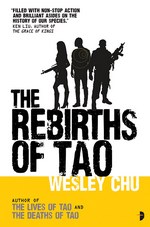
by Wesley Chu
Series: Tao Trilogy, #3Mass Market Paperback, 506 pg.
Angry Robot Books, 2015
Read: June 15 – 20, 2015 That was satisfying.
Really, that’s about all I have to say about this one. But let’s see if I can’t expand a bit. Overall, I enjoyed The Lives more than this, and this one engaged me more throughout than The Deaths did, but The Rebirths brought the Tao Trilogy to a satisfying conclusion, wrapping up what needed to be wrapped up, dealing with all the arcs that needed to be concluded and generally leaving things in a place where we can say goodbye to these characters (not that we necessarily want to, but we can) — oh, and was a solid SF adventure in its own right.
One personal note, a large part of the action takes place in Ontario, Oregon. Most people reading this book aren’t going to think much about that at all, but I grew up about 10 minutes away from Ontario — so I thought that was pretty cool. On the other hand, now I know how Bostonians feel when reading Robert B. Parker or Dennis Lehane, or a life-long Chicago resident when reading Jim Butcher. The geography is bad, and if you wanted to buy a nicer car, you wouldn’t bother driving to Boise, you’d get the same car (probably cheaper) in Ontario.
But that matters so little to the book as a whole, that those four sentences are at least two too many.
So, anyway, this book (like The Deaths) takes place a few years after we’d left Roen and the rest. His son, Cameron, is a teenager — with all the stubbornness, rebellion, and hormone-addled fun that entails. Of course, his rebellion takes the form of wanting to join in the war against the Genjix, while his parents do all they can to steer him away.
It’s safe to say that very few (if any) of the Quasing are happy with Jill’s little revelation at the end of The Deaths — Genjix or Prophus — which puts them in the same boat as humanity. Governments all over the world are attempting to hunt down any and all Quasing. Which hasn’t done any favors for the Prophus, but at least seems to have hurt the Genjix effort more.
Which is not to say they’re down for the count by any means. Enzo, the Adonis, is still out there strutting like a peacock and working to bring about the end of humanity. We finally get to see the Genjix plan in full, and I’ve got to say, reading about their plan for re-making Earth makes me really glad that this is fiction.
Right?
So, we’ve got the Ontario storyline — which looks like a pretty routine mission for Roen and Marcos (yeah, not quite Felix & Oscar, but close enough), until it gets bad. And then worse. There’s a conflict in the leadership of the Genjix (so nice to see that even some of them don’t like Enzo). And then there’s a major breach in security which leaves the rest of our Prophus friends on the run — our focus is on Cameron, but not exclusively here. I was a little surprised how Chu concluded the Ontario storyline — which is what made it effective, really. These three threads, ultimately, naturally, converged into one big battle — like the two books before.
Once again, what Chu did with Roen between the books isn’t exactly what one expects, but it fits his character. Ditto for Jill. We didn’t know Cameron enough for me to say. Tao? Sure — Tao’s the same, being centuries old helps him stay consistent. When it comes to the machinery of the Genjix, Prophus and the US Government (and/or everyone else) — things didn’t go the way I figured they would following The Deaths — but I think I liked it more that way. It’s because of the fallout from Jill’s revelation that most of the character changes happened the way they did. Chu really was effective here.
There are some great fight scenes, if that’s your kind of thing (and if it’s not, why are you reading these books?). The final scene is as epic — yet personal — as you want from the end of a third book in a trilogy. Part of that battle are back-to-back hand-to-hand combat scenes featuring an Adonis vessel and people near and dear to us. By this point, I had no idea what Chu was going to give us and I was hanging on every hit. I’m so glad that Chu sprinkles so much humor through these books — after these fights were over, I needed the joke that followed.
It may not work for everyone, but I really liked where everything was left off. Particularly for Enzo.
A really solid novel, a satisfying conclusion — making the Tao trilogy a keeper. I’m very much looking forward to what Chu’s got in store next.
—–



 Corsair