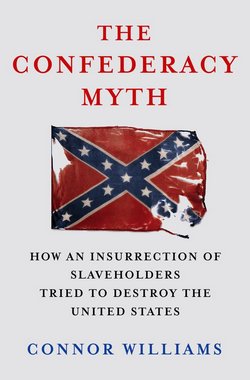
 The Confederacy Myth:
How an Insurrection of Slaveholders Tried to Destroy the United States
DETAILS:
Publisher: St. Martin's Press
Publication Date: October 13, 2026
Format: eARC
Length: 288 pg.
Read Date: September 29-October 8, 2026


What’s The Confederacy Myth About?
I’ve been struggling to find a concise way to describe this book without being too oversimplified or too detailed. Then, as I was starting this post, I noticed a couple of things on Williams’s website that helped. The last time it was updated, when he was just starting to write this book, the title was going to be Our Domestic Enemy: The Confederate Insurrection and the Civil War that Saved Our Nation, which gives a slightly different flavor than the final title. He describes the book as “leapfrogging back over a hundred and fifty years of sentimentalized stories and takes readers back to the causes, courses, and consequences of the Confederate insurrection, centering us squarely in the actions and writings of the American people as they fought the bloodiest war in our nation’s history.”
That’s a really nice way to put it. Williams tackles some of the myths about the Confederacy and the insurrection it started that have captured the imagination of many, looking at the data, the statements of people both in the USA and in the rebellion, and the results to help us see with a clear vision that the reason “the United States prevailed in the Civil War: five out of six Americans resisted the Confederate insurgency and instead put everything on the line to fight for democracy…our Republic.” (from the Publisher’s description).
The Book’s Argument
Williams, standing on things said by Lincoln, Douglas, various newspapers (loyal to the US and not), other government officials, and leaders of the rebellion, focuses on seeing the war as just that: a rebellion. One that fomented for decades—with some surprising support from within the U.S. government.
He shows how the slave states didn’t care for states’ rights before Lincoln’s inauguration—in fact, they used the federal government to override the laws of “free” states with the Fugitive Slave Act; how the would-be government of the C.S.A. didn’t believe in succession from it, making their effort to leave the U.S.A. more than a little hypocritical (as well as illegal and unconstitutional); how the insurrection was largely armed through stolen weapons and was outfought throughout the conflict. Yes, they did some major damage, but it was never a serious military (or economic) threat to the government.
Williams is also clear about the sound strategies of the U.S. Army in the West, as well as the struggles in the East (for too long). He’s not hagiographic about Lincoln or anyone else, but does emphasize the overarching goals of those loyal to the Constitution and freedom.
Why did I pick this up? Why did I keep reading?
I picked this up because I was hoping for a brief book countering the “Lost Cause” kind of thinking—and got it.
But I got so much more. On the one hand, who really thinks we need an apologetic for the U.S. in the 1860s? But that’s what this is—it’s not so much contra-Lost Cause as pro-America (which carries the former with it).
Just that slight difference of angle makes all the difference.
So, what did I think about The Confederacy Myth?
This was hard to read—especially as it covers the years pre-Ft. Sumter. Don’t get me wrong—I was well aware of all the problems that existed around slavery and the machinations of politicians around it. But in the years since I did any semi-serious reading on it, my memory had gotten too fuzzy. The United States really had fallen short of its ideals, and the politicians/courts weren’t helping much with the way they treated that issue.
Once we get to the chapters post-Sumter, it becomes easier to read, in a way. It becomes a us vs. them (or U.S. vs. Them) story, one that’s familiar. But Williams’s recounting doesn’t allow for romanticizing or glamorizing the insurrection along the way.
We don’t get a lot of post-Appomattox material, but we do get some—and can see how things might have been different (and might not have been), had Lincoln not been assassinated. It’s good to see a Congress that takes its job seriously and made sure that Andrew Johnson wasn’t able to make too much of a mess of Reconstruction and was able to move civil rights forward (not enough, but that’s a story for another time).
The number of things I highlighted and made notes about…if this were a hard copy, I’d probably have increased the weight by 50%. There’s just so much gold to be mined here.
This is a solid work, full of things we need to remember and consider today. It’s definitely going down as one of my favorites of the year and one I’ll recommend for a long time to come.
Disclaimer: I received this eARC from St. Martin’s Press via NetGalley—my thanks to both for this. This post contains my honest opinion about a book I chose to read.
This post contains an affiliate link. If you purchase from it, I will get a small commission at no additional cost to you. As always, the opinions expressed are my own.