

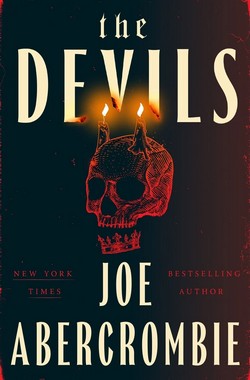
 The Devils
by Abercrombie
DETAILS:
Series: The Devils, #1
Publisher: Tor Books
Publication Date: May 13, 2025
Format: Hardcover
Length: 560 pgs.
Read Date: June 3-8, 2026


“The missions assigned to the Chapel of the Holy Expediency are like the members of the congregation–each awful in its own special way.”
What’s The Devils About?
So a monk is called to the Sacred City and is given a new assignment, to serve the Chapel of the Holy Expediency. This particular congregation is given special missions for The Church, typically of the supernatural variety. Oh, I should mention that the congregation is made up of a necromancer, a vampire, an elf, a warrior who is cursed to remain alive, and so on. The monk that “leads” the missions seems to be a rotating door, with few surviving long (Brother Diaz doesn’t really grasp this until he’s been on his first mission for a bit).
This is kind of a Suicide Squad of a congregation–sent to deal with the biggest threats facing The Church and the Western kingdoms. Although it could be argued that Amanda Waller’s penalty for disobedience is kinder–definitely quicker–than the Pope’s. Oh, right–when the members of the congregation are sent on a mission, a binding is placed on them to keep them on-task. The discipline that binding imposes is…disturbing.
The mission that this book centers around is taking a certain street thief to Troy. This thief, it turns out, is a long-lost princess and the rightful Empress of the Eastern Kingdom. The Chapel of the Holy Expediency is to escort her to Troy and get her enthroned safely, in the hopes that she’ll be more amenable to negotiations with the West than others there happen to be. She has several new-to-her family members who want her stopped (permanently) so they can get the crown, so it won’t be easy.
The Alternate History of it All
Ignoring the fact that vampires, elves, necromancers, and so on exist, this is very much our world. With a few differences–Troy won that particular war and is a dominant city in the region (poor Constantinople), Carthage is the dominant Western culture/city (even after its “fall”), and a few other things that I’ll leave you to find.
I (or someone with greater focus and better historical knowledge) could write an entire post or two about the Alternate History that Abercrombie creates here. This is a 1400s (or was it 1300s) Europe that is recognizable—but not. There are so many small, small details that he tweaks that have giant repercussions.
There’s an argument to be made that Abercrombie went too far with his Alternate version of the Church. The Western Church looks very much like our Western Church of the time, as does the Eastern Church. The schism between the two was similar, too. But there are significant differences—God’s Daughter was sent to Earth and was executed on the wheel. In addition to differences about the understanding of the Trinity (the third member of which was never mentioned), there’s a difference in the makeup of the clergy—only male priests or either male and female? Also, the Pope is a female.
And so on—there are other differences between our Church(es) and this book’s—but I’ll leave at that. For me, it became clear that not only is this a Fantasy world that looks a lot like ours, but isn’t. It’s a religion that looks a lot like ours, but really isn’t—in much the same way that the church of The First Law, A Song of Ice and Fire, or The Gentleman Bastards aren’t ours. If you can accept those—you should have no problem with this one.
Why did I pick this up? Why did I keep reading?
I heard an interview or two with Abercrombie around the time this was released last year—before the first interview was over, I was more than ready to buy it. And I did—I just didn’t have time to get to it. And once I learned our Fantasy Book Club was going to be discussing it in June, I stopped trying and just waited.
Why did I stick with it? It was funny, intriguing, engaging…and all the other glowing things I’m probably going to say in the last section. You could ignore all that and just focus on the Alternate History of it all, and would find enough to keep going.
I can’t understand why someone wouldn’t keep going once they picked it up (although I’m sure it’s happened—tastes differ).
What does this book tell us about humanity?
“Tell me… the elves. Are they really as bad as they say?”
“I have come to think . . . that they are no worse than men.” Jakob took a long breath. “So . . . yes.”
Everyone we meet, and I mean everyone–if even for a half-page–is in some ways a monster. Or a devil, if you want to get titular about it. There’s not a single white hat to be found anywhere. Some hats come in shades of gray, with very dark patches–piebald, I guess.
This is a recurrent theme–recurrent seems to be putting it mildly. Think of Spidey’s “With Great Power…”–especially in some of the movie versions. You just get beat over the head with it. By the time we get to that quotation above, Jakob’s line lost a little of its punch because any semi-conscious reader would’ve come to the same conclusion.
But also–and this is the important thing–there’s hope for everyone to tame their monster, to mend their ways, to get their devil to repent. We see examples of that throughout the book–some in small ways, some larger. It’s nice to see that this isn’t completely bleak.
So, what did I think about The Devils?
You can stack your doubts high before. You can polish your regrets up after. But while the fight’s on, your purpose must be pure. Kill the enemy. Don’t die yourself.
It was better than I expected—and I had high expectations. Premise; tone; characters; humor; execution of the premise; fight scenes; setting up the series/sequel; satisfying turns in the story; twists you couldn’t (but arguably should’ve seen coming); twists you sort of expected but still rocked you when they came up; fight scenes; fun twists on fantasy races; cool magic; cool magic in fight scenes…check, check, check, check, and check. (Okay, I left out some checks there, but you get the point).
Abercrombie has well demonstrated his ability to give his readers a good battle scene. Granted, I haven’t read everything he’s written, so I could be disproven here. But I think he went above and beyond his standard. If only for length. I read one review that said the final battle went on for 80 pages. I didn’t go back to check, but that sounds right. And even if that writer was wrong–zowie, the fact that he could write that and be close to right says a lot about the sequence. And it was so, so good.
Abercrombie’s twisted brand of humor is on full display here–there’s plenty of low-brow jokes (the binding the Pope puts on the congregation has, um, intense intestinal feedback for those who attempt to stray from the task), some clever dialogue, some character moments that make you laugh out loud, and…a few other types of humor that I can’t remember.
The book club discussion about this book was one of the more united conversations that I’ve been around for in the meetings:
Person 1: “What did you think about X?”
Person 2: “Oh, X was so great because Y.”
Person 3: “Not only Y, but Z and W!”
Person 2: “Oh….right, W! And the way that W led to V? Come on…”
Person 4: “And then the joke that was there about U?”
[general chuckling]
Repeat that for about an hour. I mean, it’s a generally supportive and non-confrontational group in the first place. But this meeting was a love-fest. There was more picking at bits of beloved Legends and Lattes for crying out loud.
And honestly, I could go on and on along those lines. But no one wants to read that…and I’m not sure when I could get myself to stop. So, I’ll just try to sum it up here: if you’re a fantasy reader who loves a little snark, a good deal of violence, and fantastic characters, you want to read The Devils. End of story.
This post contains an affiliate link. If you purchase from it, I will get a small commission at no additional cost to you. As always, the opinions expressed are my own.
