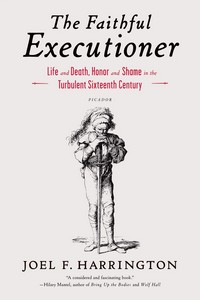
The Faithful Executioner:
Life and Death, Honor and Shame in the Turbulent Sixteenth Century
by Joel F. Harrington, read by James Gillies
DETAILS:
Publisher: Novel Audio
Publication Date: October 24, 2017
Format: Unabridged Audiobook
Length: 9 hrs., 39 min.
Read Date: December 4-8, 2025


What Does the Publisher Say About The Faithful Executioner?
Based on the rare and until now overlooked journal of a Renaissance-era executioner, the noted historian Joel F. Harrington’s The Faithful Executioner takes us deep inside the alien world and thinking of Meister Frantz Schmidt of Nuremberg, who, during forty-five years as a professional executioner, personally put to death 394 individuals and tortured, flogged, or disfigured many hundreds more. But the picture that emerges of Schmidt from his personal papers is not that of a monster. Could a man who routinely practiced such cruelty also be insightful, compassionate—even progressive?
In The Faithful Executioner, Harrington vividly re-creates a life filled with stark contrasts, from the young apprentice’s rigorous training under his executioner father to the adult Meister Frantz’s juggling of familial duties with his work in the torture chamber and at the scaffold. With him we encounter brutal highwaymen, charming swindlers, and tragic unwed mothers accused of infanticide, as well as patrician senators, godly chaplains, and corrupt prison guards. Harrington teases out the hidden meanings and drama of Schmidt’s journal, uncovering a touching tale of inherited shame and attempted redemption for the social pariah and his children.
The Faithful Executioner offers not just the compelling firsthand perspective of a professional torturer and killer, but testimony of one man’s lifelong struggle to reconcile his bloody craft with his deep religious faith. The biography of an ordinary man struggling for his soul, this groundbreaking book also offers an unparalleled panoramic view of Europe on the cusp of modernity, a society riven by violent conflict at all levels and encumbered by paranoia, superstition, and abuses of power. Thanks to an extraordinary historical source and its gifted interpreter, we recognize far more of ourselves than we might have expected in this intimate portrait of a professional killer from a faraway world.
How’s the Narration?
Gillies was fine. I did wonder a bit about why a British narrator was used, especially when Harrington brings up his own U.S. citizenship at least once. It’s not a big deal.
He also didn’t pronounce the Lutheran theologian Philip Melanchthon’s name in a way I’ve never heard before—and that threw me out of things for a moment.
Other than that, I had no substantive complaints. I don’t know that he wowed me, but he didn’t detract from the material.
So, what did I think about The Faithful Executioner?
One thing that should be remembered that the description doesn’t mention is that Executioners in that day were also healers—as a result of their training and experience in their primary profession, they understood human anatomy to a degree that most people didn’t, so they augmented their income by helping heal others.
It’s interesting little tid-bits like that that’ll keep you reading. But not for trivia, for the history.
Okay, this didn’t resonate with me the way it did with my friends who read this. I didn’t get as invested in Frantz’s story as Lawrence did.
That said, I was fascinated by this. The history of the era. The cultural/political shifts going on—and how that impacted his life/profession were my focus. I could’ve read a lot more about the “criminal justice system” (as much as there was one) described. Well, I like to think I could’ve—but I really needed it tied to Frantz’s story for me to actually stick with it.
And honestly, that’s basically it—I was only mildly interested in Frantz. It was the changing context around him that got me. I do find that strange—I really would’ve thought I cared about the guy and his poor family (don’t get me wrong, it’s not like I didn’t care—but not much—also, I found what the author said about the life of two of his children at the end strangely heartening). But the history—culture, penology, politics, health care, criminology? That material was just great.
The story of one man is gripping (and really, the stuff of novels), as is the look at humans at the time—if you’re looking for either (possibly both), you’re going to relish this book and are going to be so glad that Harrington stumbled onto these journals to bring them to us.
This post contains an affiliate link. If you purchase from it, I will get a small commission at no additional cost to you. As always, the opinions expressed are my own.