Tag: Urban Fantasy Page 21 of 44

Catch-Up Quick Takes: Skeleton Key by Anthony Horowitz, Simon Prebble; Deadly Assessments by Drew Hayes, Kirby Heyborne

The point of these quick takes posts to catch up on my “To Write About” stack—emphasizing pithiness, not thoroughness.

Skeleton Key

Skeleton Key

by Anthony Horowitz, Simon Prebble (Narrator)
Series: Alex Rider, #3
Unabridged Audiobook, 6 hrs., 57 min.
Recorded Books, 2013
Read: August 21-24, 2020
Grab a copy from your local indie bookstore!

(the official blurb)
So for two books now, we get this outline: Alex does something gusty and dangerous, which transitions into him taking on a case for MI-6 that’s as risky as you could want.

This time he runs afoul of a Chinese criminal organization at Wimbledon before he’s loaned out to the CIA who really needs a teen to sell a couple of agents as a family unit, out for vacation near the Caribbean. They’re actually hunting for a nuclear weapon and some ex-Soviets wishing for a comeback for the USSR.

I honestly found his antics around Wimbledon and that more interesting than the main story, but it wasn’t bad. Silly fun stuff that undoubtedly works better for the target audience (MG readers of a decade ago) than me, but it’s good enough for me to keep going.

3 Stars

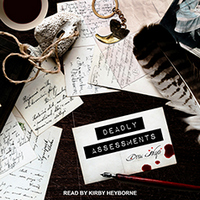
Deadly Assessments

Deadly Assessments

by Drew Hayes, Kirby Heyborne (Narrator)
Series: Fred, The Vampire Accountant, #5
Unabridged Audiobook, 9 hrs., 9 min.
Tantor Audio, 2018
Read: August 5-6, 2020
Grab a copy from your local indie bookstore!

(the official blurb)
Hayes is really getting better at bringing books together as a novel. Still, it’s basically four serialized short stories pretending to be a novel, but this one was a whole lot closer to being a whole.

While Krystal is off doing something to get her released from her prior engagement (Fae contracts aren’t that easy to break), Fred gets a visit from the ruling Council for vampires to see if he and his clan are up to snuff. While they’re at it, their representative is going to fill Fred in on all the stuff he should’ve learned from his sire.

Stuff ensues. Fred learns a lot but doesn’t change fundamentally. He’s still the same mild-mannered guy, even if he’s determined he’s going to have to be a bit more. There’s some really good stuff about his ex-employee, Alfred, coming into his own.

This light UF series keeps getting better.
3.5 Stars

2020 Library Love Challenge
This post contains affiliate links. If you purchase from any of them, I will get a small commission at no additional cost to you. As always, opinions are my own.

Tales from the Folly by Ben Aaronovitch: Entertaining Quick Dips into the Rivers of London

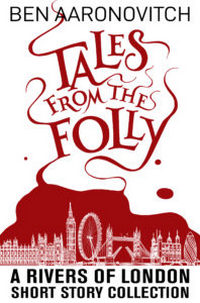
Tales from the Folly

Tales from the Folly: A Rivers of London Short Story Collection

by Ben Aaronovitch
Series: The Rivers of London

Kindle Edition, 139 pg.
JABberwocky Literary Agency, Inc., 2020

Read: August 1-3, 2020


If asked, I’d have thought I posted about this book weeks ago, so imagine my surprise this past weekend when I saw this title still on my “To Be Written” list when I was checking for something else. Better late than never…

What are the Tales from the Folly?

The subtitle pretty much gives it away, really. These are shorter works set in the Rivers of London series. The Folly is the unofficial name for the recognized British magical organization, following in the first formal study of magic made by Sir Isaac Newton (no known relation, but that doesn’t stop me from claiming him as an uncle), it’s currently formally organized as the Special Assessment Unit of the Metropolitan Police. The Folly is also the nickname for their headquarters. Either use works for this collection.

There are seven short stores (or one novella and six short stories) told from Peter Grant’s perspective—just like the series. Then there are four stories from the point of view of other characters in the series and three “moments” (Aaronovitch’s term for “something that is more of a mood than a story, something that will last a page or two and conjure an atmosphere).

Peter Grant Stories

Obviously, this is Peter’s series (at least so far…), so he gets the bulk of the space. Most of these take place around the time of the first few books in the series, but at different stages of Peter’s development. I enjoyed them all and most of them are good enough to justify the purchase price on their own.

I can’t put my finger on why, exactly, but the first story “The Home Crowd Advantage” is my favorite. It’s about a French practitioner who got up to no good during the 1948 London Games who revisits the scene of the crime in 2012 when rookie apprentice Peter Grant is the only one around to deal with him.

The last entry in this section is the novella, A Rare Book of Cunning Device that I talked about when it was released as an Audible Original in 2017. It’s rare for me to go from hearing a work to reading it, so it was interesting that way. I enjoyed it just as much this time around, but I think Holdbrook-Smith’s voice is a better one for this series than whatever is echoing around in my skull.

Everyone Else

The fact that Aaronovitch is able to tell stories outside of Peter’s perspective shows the strength of the series in my book, he’s built the world and the characters out enough that they can carry the weight of a narrative for at least a little bit.

We get a story from the perspective of one of the Rivers, one from Abigail’s perspective that will warm the cockles of your heart (and maybe make you a little sad for a bit), a nice one featuring Vanessa Sommer from Germany (making me hope we get back to Germany for another novel soon), the answer about what happened to the River Lugg after Foxglove Summer. Then there are the moments, one featuring Nightengale, one with Reynolds and one with Sommer’s pal Tobias Winter years before The October Man

So, what did I think about Tales from the Folly?

That’s easy, I thought it was great. I’d buy volume 2 tomorrow, and volume 3 next month. If Aaronovitch wrote that quickly, anyway. They’re like the comic series in a way—a nice way to spend some time in this universe without having to put in the time of a novel.

The collection covered the gamut of emotions and types of story typical of the series with Aaronovitch’s evident charm and skill. It’s a must for every Rivers of London fan.


4 Stars

Pub Day Repost: Ink & Sigil by Kevin Hearne: This Atypical UF is full of Action and Laughs (and Deadly Raisins)

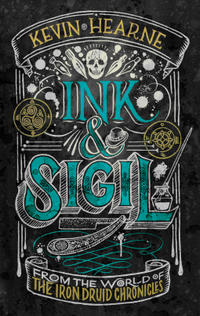
Ink & Sigil

Ink & Sigil

by Kevin Hearne
Series: Ink & Sigil, #1

eARC, 336 pg.
Del Rey , 2020

Read: August 12-14, 2020
Grab a copy from your local indie bookstore!


The biggest challenge to writing about this book is choosing what not to talk about, I really feel like I could go on and on and on about it. Then the pendulum swings to the point I don’t say much at all…

What’s Ink & Sigil About?

Aloysius MacBharrais is a Sigil Agent—one of five on the Earth. They’re tasked with preserving the various treaties that supernatural creatures had set up throughout the world to keep the peace and govern the activities of the various pantheons on the mortal plane. They’ve been equipped with the barest magical tools necessary to get the job done—largely by Brighid of the Tuatha Dé Dannan to make up for the work that her Druid wasn’t doing when he was hiding for centuries on end.* Thre’s more to it, but that’ll work for starters.

* See everything that Atticus O’Sullivan was doing before the first of the Iron Druid Chronicles.

Al has horrible luck when it comes to apprentices, they keep falling prey to accidental death. The most recent is Gordie, who died after choking on a raisin scone. Before I get into things, can I say how wonderful it is to have a magic-user—even an apprentice—die by such mundane means (and you have never, I mean ever, come across this many jokes about raisins or scones in your life)? As Al goes to Gordie’s house to clean up all traces of his magic tools, he discovers that Gordie’s been up to some pretty dark and criminal stuff right under his nose.

This book takes Al and his associates around Scotland and even to the U.S. finding out just what Gordie was into and trying to set it right.

A New Kind of UF

There are outliers, but largely, Urban Fantasy series deal in variations on a theme—I’m not complaining, I’m into most of them. But basically, you’ve got a wizard (or something like that), a vampire, and/or a werewolf doing a P.I./Private Security/Hunter thing. There are different kinds of magic users, or vampire types, or were-species, but really, that’s about it. Lately, some variations have come from using different kinds of protagonists, like whatever Nell Ingram is or…(I had another example when I started this paragraph), but you get the point.

Here our variation comes in the type of mage—he uses sigils, particular designs in particular (and strange) inks which give a temporary effect to the bearer or beholder. Also, Al’s an elderly Scot who wears a derby and has an immaculately-styled mustache. He’s about as far from the grizzled hero in a leather jacket/trenchcoat as you can get. Outside of supporting characters or Marley Jacobs from A Key, an Egg, an Unfortunate Remark, you don’t see that (outside of characters who are supernaturally old, but appear young) .

Al’s associates aren’t standard either, but I’m going to resist using 3-4 paragraphs talking about them. I’m just going to say I enjoyed them all and can’t wait to spend more time with them.

Iron Druid Tie-in

As indicated above, this takes place in the same universe as The Iron Druid Chronicles, sometime after Scourged and contains references to some of the series’ events and characters. Al himself shows up in a short story in Besieged as a minor character.

There’s a brief appearance by Atticus and Oberon, and a longer one with Brighid. Both were a lot of fun, and the Atticus one was pretty sweet. I enjoyed seeing Brighid from someone else’s point of view. The door is open for more IDC characters to show up, but it’s not necessary, which I appreciate.

You do not have to have read the IDC to get into this, and not catching all the allusions/references/cross-overs will not diminish anything for you. It’s a spin-off, but isn’t dependent on the original.

Did Hearne Regret this Choice?

Al’s a Glaswegian and most of the book takes place in and around Glasgow. Hearne made the choice to write all the dialogue (and even Al’s first-person narration) in the dialect. Most authors wouldn’t have gone this far, and I have to wonder how often Hearne questioned this choice as he wrote—talk about making things hard on yourself. I enjoyed it—and it really helped me “hear” Al and everyone.

So, what did I think about Ink & Sigil?

While the IDC contained more than it’s share of laughs (and even The Seven Kennings had amusing moments), this seemed like a better merging of jokes and story. It feels like a natural outgrowth of The Tales of Pell (but not as humor-focused as those). For sheer enjoyment value, this was fantastic.

The story was pretty strong, too. But a lot of space was devoted to introducing us to this particular corner of the world and the cast of characters. I’d like to see what Hearne does with a novel where he doesn’t have to do that.

The world is familiar, yet Hearne’s doing something new in it. The characters are just not what you’re used to seeing in the genre. The plot was great—and speaks clearly to our current situation. And I laughed a lot. There’s little to complain about here and a lot to commend. I had a blast and I think most readers will, too. I can’t wait for the sequel.

Disclaimer: I received this eARC from Random House Publishing Group – Ballantine via NetGalley in exchange for this post—thanks to both for this.


4 1/2 Stars

20 Books of Summer

Ink & Sigil by Kevin Hearne: This Atypical UF is full of Action and Laughs (and Deadly Raisins)

Ink & Sigil

Ink & Sigil

by Kevin Hearne
Series: Ink & Sigil, #1

eARC, 336 pg.
Del Rey, 2020

Read: August 12-14, 2020
Grab a copy from your local indie bookstore!


The biggest challenge to writing about this book is choosing what not to talk about, I really feel like I could go on and on and on about it. Then the pendulum swings to the point I don’t say much at all…

What’s Ink & Sigil About?

Aloysius MacBharrais is a Sigil Agent—one of five on the Earth. They’re tasked with preserving the various treaties that supernatural creatures had set up throughout the world to keep the peace and govern the activities of the various pantheons on the mortal plane. They’ve been equipped with the barest magical tools necessary to get the job done—largely by Brighid of the Tuatha Dé Dannan to make up for the work that her Druid wasn’t doing when he was hiding for centuries on end.* There’s more to it, but that’ll work for starters.

* See everything that Atticus O’Sullivan was doing before the first of the Iron Druid Chronicles.

Al has horrible luck when it comes to apprentices, they keep falling prey to accidental death. The most recent is Gordie, who died after choking on a raisin scone. Before I get into things, can I say how wonderful it is to have a magic-user—even an apprentice—die by such mundane means (and you have never, I mean ever, come across this many jokes about raisins or scones in your life)? As Al goes to Gordie’s house to clean up all traces of his magic tools, he discovers that Gordie’s been up to some pretty dark and criminal stuff right under his nose.

This book takes Al and his associates around Scotland and even to the U.S. finding out just what Gordie was into and trying to set it right.

A New Kind of UF

There are outliers, but largely, Urban Fantasy series deal in variations on a theme—I’m not complaining, I’m into most of them. But basically, you’ve got a wizard (or something like that), a vampire, and/or a werewolf doing a P.I./Private Security/Hunter thing. There are different kinds of magic users, or vampire types, or were-species, but really, that’s about it. Lately, some variations have come from using different kinds of protagonists, like whatever Nell Ingram is or…(I had another example when I started this paragraph), but you get the point.

Here our variation comes in the type of mage—he uses sigils, particular designs in particular (and strange) inks which give a temporary effect to the bearer or beholder. Also, Al’s an elderly Scot who wears a derby and has an immaculately-styled mustache. He’s about as far from the grizzled hero in a leather jacket/trenchcoat as you can get. Outside of supporting characters or Marley Jacobs from A Key, an Egg, an Unfortunate Remark, you don’t see that (outside of characters who are supernaturally old, but appear young) .

Al’s associates aren’t standard either, but I’m going to resist using 3-4 paragraphs talking about them. I’m just going to say I enjoyed them all and can’t wait to spend more time with them.

Iron Druid Tie-in

As indicated above, this takes place in the same universe as The Iron Druid Chronicles, sometime after Scourged and contains references to some of the series’ events and characters. Al himself shows up in a short story in Besieged as a minor character.

There’s a brief appearance by Atticus and Oberon, and a longer one with Brighid. Both were a lot of fun, and the Atticus one was pretty sweet. I enjoyed seeing Brighid from someone else’s point of view. The door is open for more IDC characters to show up, but it’s not necessary, which I appreciate.

You do not have to have read the IDC to get into this, and not catching all the allusions/references/cross-overs will not diminish anything for you. It’s a spin-off, but isn’t dependent on the original.

Did Hearne Regret this Choice?

Al’s a Glaswegian and most of the book takes place in and around Glasgow. Hearne made the choice to write all the dialogue (and even Al’s first-person narration) in the dialect. Most authors wouldn’t have gone this far, and I have to wonder how often Hearne questioned this choice as he wrote—talk about making things hard on yourself. I enjoyed it—and it really helped me “hear” Al and everyone.

So, what did I think about Ink & Sigil?

While the IDC contained more than it’s share of laughs (and even The Seven Kennings had amusing moments), this seemed like a better merging of jokes and story. It feels like a natural outgrowth of The Tales of Pell (but not as humor-focused as those). For sheer enjoyment value, this was fantastic.

The story was pretty strong, too. But a lot of space was devoted to introducing us to this particular corner of the world and the cast of characters. I’d like to see what Hearne does with a novel where he doesn’t have to do that.

The world is familiar, yet Hearne’s doing something new in it. The characters are just not what you’re used to seeing in the genre. The plot was great—and speaks clearly to our current situation. And I laughed a lot. There’s little to complain about here and a lot to commend. I had a blast and I think most readers will, too. I can’t wait for the sequel.

Disclaimer: I received this eARC from Random House Publishing Group – Ballantine via NetGalley in exchange for this post—thanks to both for this.


4 1/2 Stars

20 Books of Summer

Imaginary Numbers by Seanan McGuire: The Most Exciting Mathematician This Side of Charlie Eppes and Dr. Larry Fleinhardt

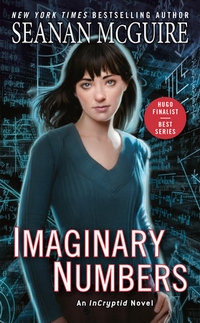
Imaginary Numbers

Imaginary Numbers

by Seanan McGuire
Series: InCryptid, #9

Mass Market Paperback, 365 pg.
DAW Books, 2020

Read: June 16-19, 2020
Grab a copy from your local indie bookstore!

What’s Imaginary Numbers About?

The Price’s cousin, Sarah, the Johrlac (aka “cuckoo”) adopted by the family years ago and last really seen in Midnight Blue-Light Special—but mentioned in almost/every book since—has finally recovered from the events of that book (5 years ago, in the series chronology), or at least recovered enough to travel on her own. She’s still not at 100% (and is further from it than anyone but Sarah realizes).

She flies out to Portland to reconnect with the family out there, and while she does reconnect with the Prices, she also finds herself connecting to a bunch of other cuckoos. Which is something that the species just doesn’t do—these telepathic apex predators have developed in such a way that they can’t share territory for long at all. So the fact that you have a group of them working together spells trouble for Sarah and any cryptozoologists trying to keep the peace between the species (and, in this case, to preserve a spot for every species that isn’t a Johrlac to live).

That’s a little brief, but I don’t know how else to be.

Imaginary Numbers’ Place in the Series

It’s been five years in series’ time, seven years and seven novels in our timeline, since we spent any real time with Sarah. I remember really liking her as a character for the first two books and couldn’t believe McGuire would do what she did to her so soon out of the gate for the series. But over the years, as she’s been largely “off screen” recovering, I’ve pretty much forgotten everything about her and what made her click for me as a character. I remembered enough to understand what a big deal it was for Sarah and Artie to see each other and to be say all they needed to say. But beyond that…it’d just been too long for me. Maybe if I’d re-read Midnight Blue-Light Special recently (or ever), this wouldn’t have been a problem.

This is our fourth narrator (fourth plus? There’s a lot of this book not narrated by Sarah) in this series, and like most fans, I’ve embraced that as a feature and as a strength. But this one feels more like a sequel to the Annie books (the previous three novels) than we usually get with a narrator switch. There’s a direct connection between the events of Verity’s Chaos Choreography and Annie’s Magic for Nothing, and all the other books show an awareness of the others. But the cast from <‘b>That Ain’t Witchcraft is present and accounted for here, and Imaginary Numbers is happening in its shadow. This isn’t good bad or indifferent, it just gives this book a different vibe than I’m used to in this series.

And the way this ends is pretty different, too—McGuire hasn’t given us a cliffhanger (this is a pretty complete story, thankfully) before. It’s a good one, but, again, not something I’m used to in these books.

One of the advantages of the way this series is set up is that it can do things like this—each book, or each “set” of books*, can take on a different flavor, a different way of approaching the story, a different way to fit in the series, a different way to end a book. While all being part of a larger, overarching story. But there are some dangers with this approach, too. And right now I’m not sure what to think of the Sarah set’s approach.

* The initial “Verity” set, the “Alex” set, then the three “Annie”s and now, two (at least) “Sarah”s, I’m not sure how to group the Verity novel between the Alex and Annie sets.

Hail, Aeslin Mice!

There was much rejoicing here (and I’m betting among all fans) that the Aeslin Mice were back in these pages. If we took nothing else from their absence in the last two books, it’s just how important they are for the telling of these stories—they’re far more than comic relief (although they are that), and for me, the best emotional moments of this particular novel came from them.

So, what did I think about Imaginary Numbers?

I liked it, but not as much as I expected to, not as much as I wanted to. There was just so much space devoted to getting everyone caught up with Sarah (and reminding us who she was/what happened to her). Then another big chunk explaining Jorlacs—and then there was another exposition dump when the Johrlacs explained what was going on to Sarah (and then another chunk when it was explained to the Prices). Just so much talking that it felt like the story got pushed out of the way.

Based on the way this ended, I’m not sure I can actually say what I thought about the book. I might have to wait until the end of Calculated Risks. Still, I enjoyed it. I like this world, I like the characters. McGurie writes a good book, and is probably incapable of writing anything but.


3.5 Stars

20 Books of Summer

This post contains an affiliate link. If you purchase from it, I will get a small commission at no additional cost to you. As always, opinions are my own.


Pub Day Repost: Spells for the Dead by Faith Hunter: Nell and Her Team Face a New Type of Deadly Threat

Spells for the Dead

Spells for the Dead

by Faith Hunter
Series: Soulwood, #5

eARC, 384 pg.
Ace, 2020

Read: July 13, 2020

What’s Spells for the Dead About?

PsyLED is called to the home of a country music superstar to investigate some mysterious deaths—the and her band had recently returned from a pretty successful tour and now many of them are dead and several of those who aren’t are in desperate need of First Responders to act quickly.

Sadly, no First Responder is equipped to cope with whatever happened to them, much less recognize and understand it. That goes for people later to the scene, including PsyLED. However, under the direction of T. Laine, their witch, they’re able to makes some guesses about treatment. Nell, Occam and Lainie focus on documenting everything they can as well as beginning preliminary interviews.

One of the first things they determine is that a witch was not behind this attack. Sadly, they reach this conclusion too late to prevent a local sheriff, with the aid of a less than ethical senior FBI agent, to lock up the band member who is a witch. Their logic is impeccable—paranatural crime, arrest the nearest paranatural. This anti-paranatural tendency shows up frequently among the humans in this book—particularly when it comes to witches. I appreciated the way that Lainie dealt with it (both in her more honest and then in her more politic approaches). Our trio being joined by their upline boss, Ayatas FireWind, helps in this manner somewhat (both because of his rank, and FireWind’s general demeanor).

On a semi-related note, you would think that people who believe/proclaim very loudly that lycans, witches, vampires, and so one are horrible monsters that want to kill all humans would be a little more circumspect when they’re around. Maybe it’s just me, but if I thought someone wanted to rip my limbs off and snack on them, I would go out of my way to not antagonize them.

Anyway, the team’s focus here is a little split—on the one hand, they need to both identify the type of magic behind the attack and continue to find better ways to treat those fighting off the effects; and on the other, figure out who had the motive and/or means to carry it out. Neither goal was really that easy.

So That’s the Main Story, What Else is Going On?

As with all books in this series, as much as this is about the PsyLED team, it’s really about Nell Ingram, her integration into the world outside the cult she left, even as she continues to deal with it and her family. God’s Glory Church really doesn’t factor heavily in this book, but it’s always in the back of her mind, shaping (either directly or in reaction to it) how she reacts to things.

There is a pretty intense moment related to the Church, but it has more to do with Nell’s family, than the Church itself. Nell doesn’t yet have full custody of Mud, but everyone’s pretty much acting as if she does. Mud’s continuing to settle in and push Nell in ways she wasn’t prepared for. Which is just fun. Both Nell and Mud are having to deal with their very pregnant sister, Esther. Esther’s pregnancy is causing her powers (and flowers) to come forward, and unlike her sisters, she’s not that interested in them. It’s a nice contrast—and it provides Mud with some great opportunities for growth.

On the work side, the team’s recent successes—particularly as the only predominately non-human team in PsyLED—are causing the Agency to make some changes to the way the Agency works—and this is going to spill over onto the team. By and large, the changes look positive and will provide good opportunities for the various members of the team. However, Nell doesn’t like change—doubly so when it applies to those things in her life she holds most dear. And since we read all this from her perspective, it’s hard to look objectively at all this.

If we’re looking at the Venn Diagram of Nell’s families (natural and found), the overlap is Occam. I’ve always loved this relationship, and now that they’re openly seeing each other and professing love? Occam’s so good, saying all the right things, doing all the right things, he’s practically a Gary Stu/Marty Stu. That “practically” there is important—Hunter’s written him in such a way over these few books that he comes across as earnest in all this, he’s not perfect, he’s just really close to perfect for Nell. They’re just fun together.

As for Nell herself? She’s continuing to work on herself, her approach to life. She makes some wise decisions and actions with her relationship with FireWind. She makes some great leaps with the relationship (if you can call it that) with the Vampire Tree. And we get some of the most solid information on just what kind of paranatural creature Nell is (watching her stifle her curiosity on this front to focus on the case was a great moment). Basically, Spells for the Dead contains more of that sure and steady, organic character development that’s been the hallmark of this series.

So what did I think about Spells for the Dead?

One of my favorite parts of these books is Nell’s reactions to new-to-her foods. We don’t see her introduced to anything here, but we still get to see her relish a few things she wasn’t exposed to for most of her life—Krispy Kreme donuts and pizza. This is actually kind of a good way to think about most of this book—unlike the previous books (particularly the first two), we’re not seeing Nell experience much that’s new here—mostly she’s living in this new world, rather than figuring things out. Hunter has established her world, has set up the characters, creatures, overarching conflicts, and whatnot. Now she gets to play with that world.

This means (at least for me, and at least for this book), that without the earth-shattering reveals, the Big Moments in Nell’s (or other characters’) life, the book has less of an impact on me. Spells for the Dead is just as good as the rest of the series has been, it just doesn’t hit me the same way. Which leads to a slightly lower rating. Hunter’s plotting, writing, and characters are still top-notch, it just didn’t blow me away. I got to spend some time with some really good friends—and I’m so happy I did—but it was comfortable, not exploratory. I trust that won’t always be the case, and that Hunter will certainly do things in this series that will cause my jaw to drop, but sometimes it’s simply going to be a really good/great novel instead of a fantastic one. Still making it one of the best series I follow.

I really got into this case—it wasn’t as fraught as some of the previous ones were, but it was interesting and unexpected. The side stories did everything they needed to. Spells for the Dead just solidifies the Soulwood books as one of the best UF series going.


4 Stars


My thanks to Let’s Talk! Promotions for the invitation to participate in this tour and the materials (including the book via NetGalley and Berkley Publishing Group) they provided.

Peace Talks by Jim Butcher: Family Complicates Everything

Peace Talks

Peace Talks

by Jim Butcher
Series: The Dresden Files, #16

Hardcover, 340 pg.
Ace, 2020

Read: July 15-17, 2020
Grab a copy from your local indie bookstore!

Ever since the Red Court had taken my daughter, I’d been reeling from one disaster to the next, surviving. This entire situation was just one more entropy barrage hitting my life, forcing me to scramble once again, maybe getting me killed. (Again. Technically.)

Things were different now. I was a part of Maggie’s life. And she might need me to walk her down an aisle one day.

Maybe it was time I started getting ahead of this stuff.

Maybe it was time to get serious.

What’s Peace Talks About?

So, as per usual, there are a lot of balls in the air here—Harry has to juggle getting used to being an active and involved father, there’s a budding romance, there are his duties as a Warden, his duties as Winter’s Knight, his duties as Warden of Demonreach, and then…Thomas is in all sorts of trouble, there’s a threat to remove Harry from the White Council of Wizards, there’s something brewing with Chicago P.D., and then Baron Marcone is hosting a convocation of the Unseelie Accord signatories—requested by the Fomor—to hash out differences.

And that’s what I can say without spoiling anything.

Now, since their appearance, the Fomor have been a fantastic antagonist for everyone—really. I think even the Denarians pale in comparison to the threat they pose to humanity. So this meeting is a major happening—and promises to go very, very ugly. Which is why Carlos shows up to enlist Harry to help provide security and be an emissary to Winter. Mab wants Harry there as her Knight and—here’s the kicker—to help fulfill a debt by granting two favors (no questions asked) to Laura Wraith during the summit.

There’s just so, so much that can go wrong. And much of it does. And then other, worse, things happen. At one point*, I thought about closing the book and walking away—probably following Mr. Tribbiani’s example and putting it in the freezer. Skin Game would make a good, albeit inadvertent, series finale.

* If you’re curious, it’s around the time that Murphy starts to do something brave, foolish, short-sighted, and entirely in-character with a saw.

In the midst of all this—Harry does what he normally does. He tries to save the day, and along the way take care of those most important to him. Maybe the order there should be reversed, for accuracy’s sake.

Underneath a lot of the issues he’s facing are family issues, and they all complicate every other bit of what Harry’s up to in this book. Harry’s never really had much of a family, and while he’s pretty used to dealing with a brother now. His relationship with his grandfather, Ebenezer McCoy, could use some work (we get an idea how much work is needed in this book), and it’s clear that he’s new to the fatherhood thing. But when you combine the three? Harry’s just not ready for that. Particularly when you throw in some conflict between members of his family. This alone may be Harry’s greatest challenge. These things distract him, they sap his emotional and mental energy, they stop him from thinking clearly—and they give him a reason to keep going and to make sure that no one can hurt those he loves.

There’s one major clue to the myriad problems that he’s facing, one big question that he’s not asking…and if I’m right about this, Battle Ground is going to be worse than expected.

Two characters noted for their wisdom and approach to life even more than they are for their power and abilities to fight (which are significant enough to take note of), give Harry some advice partway through the book. I hope, hope that Battle Ground ends with him taking that advice. I fear he won’t, and that his choice will make his life a lot harder.

What about the Characters?

There are just so, so many here. Almost every regular is at least name-dropped, if they don’t actually put in an appearance (although I can come up with a list that of those that aren’t mentioned without much effort). And I don’t want to ruin anything for any reader that hasn’t had the chance yet. I enjoyed seeing unexpected faces—even when their presence boded ill—and the expected faces were good to see, too. (Although, I really could’ve lived without seeing Red Cap again)

The effects from a lot of what happened in the short stories from Brief Cases show up in these pages—to an extent that I don’t remember from Side Jobs. I hope everyone’s had the time to read Brief Cases, because he doesn’t explain a lot of those things. I loved that.

I miss Bob.

And then there’s stuff like this:

Home, like love, hate, war, and peace, is one of those words that is so important that it doesn’t need more than one syllable. Home is part of the fabric of who humans are. Doesn’t matter if you’re a vampire or a wizard or a secretary or a schoolteacher; you have to have a home, even if only in principle—there has to be a zero point from which you can make comparisons to everything else. Home tends to be it.

That can be a good thing, to help you stay oriented in a very confusing world. If you don’t know where your feet are planted, you’ve got no way to know where you’re heading when you start taking steps. It can be a bad thing, when you run into something so different from home that it scares you and makes you angry. That’s also part of being human.

But there’s a deeper meaning to home. Something simpler, more primal.

It’s where you eat the best food because other predators can’t take it from you very easily there.

It’s where you and your mate are the most intimate.

It’s where you raise your children, safe against a world that can do horrible things to them.

It’s where you sleep, safe.

It’s where you relax.

It’s where you dream.

Home is where you embrace the present and plan the future.

It’s where the books are.

And more than anything else, it’s where you build that world that you want.

When Butcher, via Dresden, says this kind of thing—where he taps into something universal (or close enough) about humanity. Something that will resonate with every reader. Butcher’s ability to capture these thoughts and feelings, to put the ineffable into concrete terms like that is ultimately what draws readers to him more than his flawed heroes, snappy dialogue, and action does.

(and then three pages later, he has someone utter some pablum about the nature and power of faith that reminds me that as much as I love this guy, he’s not perfect)

There are a couple of other things I wanted to talk about, but I can’t figure out how to work them in, so I’ll pass on them for the moment—this is getting too long. It’s time to wrap up.

So what did I think about Peace Talks?

While reading this, I had to keep stopping to remind myself to treat this as just another book. To try to think of this as merely the next book in a beloved series (just a little delayed). I wanted to treat this as An Event. We’ve waited so long for this*, you’ve got the whole 20th Anniversary of The Dresden Files thing, the fact that this novel was originally so big they had to split it into two, and everything we know/anticipate/fear about what’s about to happen thanks to the story, “Christmas Eve”—it’s really hard to keep it all in perspective. There’s a real sense in which it’s difficult, if not impossible, to live up to the hype—and that’s not really fair. As An Event, I think it falls a little short (but maybe if we think of Peace Talks/Battle Ground as the Event, maybe it won’t). But as the sixteenth novel is this beloved series? It delivers. It made me happy.

* And I get Butcher’s explanation for that, but it does tend to raise expectations.

Peace Talks is everything the Dresden fan wants—it’s packed with action, the cracks are wise, the choices are hard, the victories are Pyrrhic (and small), the (many) enemies are daunting, and the stakes really don’t get higher. While it clearly started life as the beginning of a longer book, Peace Talks is a complete novel, it doesn’t end on a cliffhanger—but, I tell you what, if we didn’t have a hard release date on Battle Ground I don’t imagine the fan-base would be quiet. In the meantime, I’m spending the next 71 days with bated breath.


5 Stars

This post contains an affiliate link. If you purchase from it, I will get a small commission at no additional cost to you. As always, opinions are my own.

Spells for the Dead by Faith Hunter: Nell and Her Team Face a New Type of Deadly Threat

Spells for the Dead

Spells for the Dead

by Faith Hunter
Series: Soulwood, #5

eARC, 384 pg.
Ace, 2020

Read: July 13, 2020

What’s Spells for the Dead About?

PsyLED is called to the home of a country music superstar to investigate some mysterious deaths—the and her band had recently returned from a pretty successful tour and now many of them are dead and several of those who aren’t are in desperate need of First Responders to act quickly.

Sadly, no First Responder is equipped to cope with whatever happened to them, much less recognize and understand it. That goes for people later to the scene, including PsyLED. However, under the direction of T. Laine, their witch, they’re able to makes some guesses about treatment. Nell, Occam and Lainie focus on documenting everything they can as well as beginning preliminary interviews.

One of the first things they determine is that a witch was not behind this attack. Sadly, they reach this conclusion too late to prevent a local sheriff, with the aid of a less than ethical senior FBI agent, to lock up the band member who is a witch. Their logic is impeccable—paranatural crime, arrest the nearest paranatural. This anti-paranatural tendency shows up frequently among the humans in this book—particularly when it comes to witches. I appreciated the way that Lainie dealt with it (both in her more honest and then in her more politic approaches). Our trio being joined by their upline boss, Ayatas FireWind, helps in this manner somewhat (both because of his rank, and FireWind’s general demeanor).

On a semi-related note, you would think that people who believe/proclaim very loudly that lycans, witches, vampires, and so one are horrible monsters that want to kill all humans would be a little more circumspect when they’re around. Maybe it’s just me, but if I thought someone wanted to rip my limbs off and snack on them, I would go out of my way to not antagonize them.

Anyway, the team’s focus here is a little split—on the one hand, they need to both identify the type of magic behind the attack and continue to find better ways to treat those fighting off the effects; and on the other, figure out who had the motive and/or means to carry it out. Neither goal was really that easy.

So That’s the Main Story, What Else is Going On?

As with all books in this series, as much as this is about the PsyLED team, it’s really about Nell Ingram, her integration into the world outside the cult she left, even as she continues to deal with it and her family. God’s Glory Church really doesn’t factor heavily in this book, but it’s always in the back of her mind, shaping (either directly or in reaction to it) how she reacts to things.

There is a pretty intense moment related to the Church, but it has more to do with Nell’s family, than the Church itself. Nell doesn’t yet have full custody of Mud, but everyone’s pretty much acting as if she does. Mud’s continuing to settle in and push Nell in ways she wasn’t prepared for. Which is just fun. Both Nell and Mud are having to deal with their very pregnant sister, Esther. Esther’s pregnancy is causing her powers (and flowers) to come forward, and unlike her sisters, she’s not that interested in them. It’s a nice contrast—and it provides Mud with some great opportunities for growth.

On the work side, the team’s recent successes—particularly as the only predominately non-human team in PsyLED—are causing the Agency to make some changes to the way the Agency works—and this is going to spill over onto the team. By and large, the changes look positive and will provide good opportunities for the various members of the team. However, Nell doesn’t like change—doubly so when it applies to those things in her life she holds most dear. And since we read all this from her perspective, it’s hard to look objectively at all this.

If we’re looking at the Venn Diagram of Nell’s families (natural and found), the overlap is Occam. I’ve always loved this relationship, and now that they’re openly seeing each other and professing love? Occam’s so good, saying all the right things, doing all the right things, he’s practically a Gary Stu/Marty Stu. That “practically” there is important—Hunter’s written him in such a way over these few books that he comes across as earnest in all this, he’s not perfect, he’s just really close to perfect for Nell. They’re just fun together.

As for Nell herself? She’s continuing to work on herself, her approach to life. She makes some wise decisions and actions with her relationship with FireWind. She makes some great leaps with the relationship (if you can call it that) with the Vampire Tree. And we get some of the most solid information on just what kind of paranatural creature Nell is (watching her stifle her curiosity on this front to focus on the case was a great moment). Basically, Spells for the Dead contains more of that sure and steady, organic character development that’s been the hallmark of this series.

So what did I think about Spells for the Dead?

One of my favorite parts of these books is Nell’s reactions to new-to-her foods. We don’t see her introduced to anything here, but we still get to see her relish a few things she wasn’t exposed to for most of her life—Krispy Kreme donuts and pizza. This is actually kind of a good way to think about most of this book—unlike the previous books (particularly the first two), we’re not seeing Nell experience much that’s new here—mostly she’s living in this new world, rather than figuring things out. Hunter has established her world, has set up the characters, creatures, overarching conflicts, and whatnot. Now she gets to play with that world.

This means (at least for me, and at least for this book), that without the earth-shattering reveals, the Big Moments in Nell’s (or other characters’) life, the book has less of an impact on me. Spells for the Dead is just as good as the rest of the series has been, it just doesn’t hit me the same way. Which leads to a slightly lower rating. Hunter’s plotting, writing, and characters are still top-notch, it just didn’t blow me away. I got to spend some time with some really good friends—and I’m so happy I did—but it was comfortable, not exploratory. I trust that won’t always be the case, and that Hunter will certainly do things in this series that will cause my jaw to drop, but sometimes it’s simply going to be a really good/great novel instead of a fantastic one. Still making it one of the best series I follow.

I really got into this case—it wasn’t as fraught as some of the previous ones were, but it was interesting and unexpected. The side stories did everything they needed to. Spells for the Dead just solidifies the Soulwood books as one of the best UF series going.


4 Stars


My thanks to Let’s Talk! Promotions for the invitation to participate in this tour and the materials (including the book via NetGalley and Berkley Publishing Group) they provided.

EXCERPT from Spells for the Dead by Faith Hunter: The Crime Scene

from Chapter One of Spells for the Dead by Faith Hunter

The potted vampire tree was a new addition to my evidence arsenal. I had no idea what English it understood, but I’d taken to talking to it anyway. Plants that were talked to in a kind tone of voice were happy plants. And since the vampire tree species had recently (probably, most certainly) eaten one of my enemies, I tried to be polite. I didn’t want it to get mad. I placed the small crate on the passenger seat and locked up.

Scanning the grounds, I walked to the side door, where the body had come from, taking in the scenery behind the house and down the low slope of the hill. There were covered training rings, trails, outbuildings, several pastures, a mechanical horse walker, horse gear, and a barn that was bigger than my house. The horses that were hanging over the fences were muscular and sassy, with slightly dished faces, as if they had some Arabian in the genetic mix. The yearlings and mares with this year’s foals appeared to be in one pasture, with geldings pastured separately.

Close to the barn, a bright red bay horse, bigger than the others, stood posed in a paddock, the breeze flinging his black mane and tail. He had black stockings and hooves, and a peculiar lightning-shaped white blaze on his face. He pawed the dirt and circled, prancing, posturing, tail held high. He reared and kicked, showing off. This was a stallion, the only intact male horse I had seen on the property so far. He snorted and burst into a tight, circling run, his mane and tail flying, neck arched, as if he was showing off. He blew a breath of delight and alpha-male satisfaction and tossed his head, the odd facial blaze seeming to flicker like flames. I didn’t have to know anything about fancy horses to know this one was expensive.

Farther away from the house were a huge white metal shed with three fifteen-foot-tall garage-type doors and a big circular drive. Parked in front of the one open garage door was a forty-foot-long, solid black recreational vehicle with multiple dual wheels, a matching black transport trailer hitched to it. Through the windows in the closed shed doors I could see two more trailers. Big ones. To the side of the RV storage building was a long, very fancy horse trailer. Just looking at the vehicles made me think seven figures several times over.

Dang. Being a country-singing megastar made good money.


Read the rest in Spells for the Dead by Faith Hunter to see what happens from here..


My thanks to Let’s Talk! Promotions for the invitation to participate in this tour and the materials (including the book via NetGalley and Berkley Publishing Group) they provided.

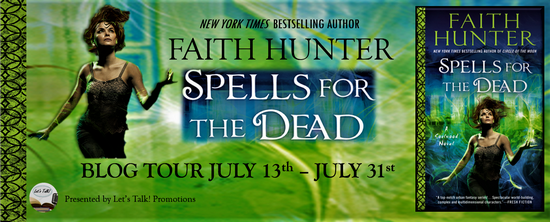
BOOK SPOTLIGHT (and Giveaway): Spells for the Dead by Faith Hunter

Today I’m very pleased to welcome the Book Tour for the next Soulwood novel, Spells for the Dead by Faith Hunter. Along with this spotlight post, I have a tantalizing excerpt to share. Then, I’ll be giving my take on the novel a little later. Those links’ll work when the posts go live in an hour or two.

Oh, and don’t forget to scroll down to the bottom of this post to enter a Giveaway for a cool prize.
>

Book Details:

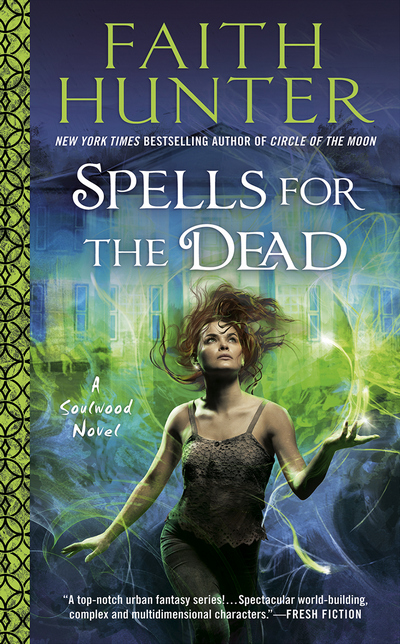
Book Title: Spells for the Dead by Faith Hunter
Publisher: Ace Books
Release date: July 28, 2020
Format: Paperback/ebook
Length: 384 pages
ISBN: 9780399587962

Book Blurb:

Nell Ingram faces a dark craft known as death magic in the newest pulse-pounding paranormal procedural in the New York Times bestselling Soulwood series.

Nell Ingram is a rookie PsyLed agent, using the powers she can channel from deep within the earth to solve paranormal crimes. Together with her team, she’s taken on the darkest magic and the direst foes. But she’ll need to tap into every ounce of power she has for her newest case.

Nell is called to the Tennessee mansion of a country music star and finds a disturbing scene—dead bodies rapidly decaying before everyone’s eyes. The witch on her team, T. Laine, knows this can only be one thing: death magic, a rare type of craft used to steal life forces. PsyLed needs to find this lethal killer fast. But when a paranormal-hating FBI agent tries to derail the investigation, they find themselves under attack from all sides.

About Faith Hunter:

Faith HunterFaith Hunter is the award-winning New York Times and USAToday bestselling author of the Jane Yellowrock, Soulwood, Rogue Mage, and Junkyard Cats series. In addition, she has edited several anthologies and co-authored the Rogue Mage RPG. She is the coauthor and author of 16 thrillers under pen names Gary Hunter and Gwen Hunter. Altogether she has 40+ books and dozens of short stories in print and is juggling multiple projects.

She sold her first book in 1989 and hasn’t stopped writing since.

Faith collects orchids and animal skulls, loves thunderstorms, and writes. She likes to cook soup, bake bread, garden, and kayak Class II & III whitewater rivers. She edits the occasional anthology and drinks a lot of tea. Some days she’s a lady. Some days she ain’t.

Find Faith online at:

Website ~ Facebook (official) ~ Facebook ~ Twitter ~

Yellowrock Securities website ~ Gwen Hunter website

Giveaway!

Enter to win some fabulous prizes! Giveaway is open to US residents only.

  • $25 Amazon or B&N e-giftcard
  • 3” wide armband
  • 1.5” narrow armband


a Rafflecopter giveaway

(in case the Rafflecopter widget doesn’t appear, just click here)

My thanks to Let’s Talk! Promotions for the invitation to participate in this tour and the materials (including the book via NetGalley and Berkley Publishing Group) they provided.

Page 21 of 44

Powered by WordPress & Theme by Anders Norén