Tag: Vincent Chu

Nice Places by Vincent Chu: Traveling Far So Easily

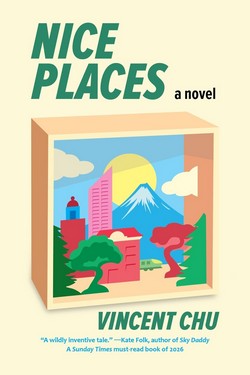
Cover of Nice Places by Vincent ChuNice Places

by Vincent Chu

DETAILS:
Publisher: Forest Avenue Press
Publication Date: June 2, 2026
Format: eARC
Length: 296 pg.
Read Date: May 11-14, 2026
Buy from Bookshop.org Support Indie Bookstores

What’s Nice Places About?

When we meet Georgie, he’s about to quit his job—but his boss fires him first. It was a mutual thing, really.

Georgie has a plan—he’s going to take a year and travel the world. He got a job right out of high school and has spent more than a decade at the company—he wants to grab some of that life experience so many people grab in their late teens/early twenties. He’s knocked off course from that attempt before he makes his first flight—and stumbles into something stranger.

He meets a mixed media artist named Ant. She’s working on her M.A. and is in search of a thesis project. Some silly thing that Georgie tries inspires her—and the two concoct a crazy plan that will suit Georgie’s quest for an experience and her thesis.

Odd times ensue. And a friendship develops between the two of them that will alter the courses of their lives.

Why did I pick this up? Why did I keep reading?

Picked it up because Chu asked me nicely, and because I had fond (and vague) memories of a short story collection.

I stuck with it for two reasons—once you get into Chu’s writing, you don’t want to leave until it’s done. Chu doesn’t have a flashy style, or snappy dialogue, or a tight pace (this book would be ruined by any of those, these are not critiques)—but his writing is solid, appealing, and will carry you along without drawing attention to itself.

The other is the character and his little project; I just needed to see where it went. The relationship between Georgie and Ant—and the difficult way to characterize it—is probably more of a driving force for me.

What does this book tell us about humanity?

It’s tricky to tackle this question because that’s one of the points of the book, and to really answer it would involve ruining the book.

But I can talk about some of the things it focuses on thematically. Chu explores the idea of experiences and how we need them. Particularly shared vs. solitary experiences. The “shared” aspect comes out a lot—sometimes it’s just two or three people, sometimes it’s a family, or a group of acquaintances. Sometimes it’s something as large and vague as “the Internet reacted to X.”

You may not find yourself resonating or agreeing with everything that Georgie and Ant conclude—or any of the other points of view they encounter along the way—but you’ll enjoy the experience of thinking about them.

So, what did I think about Nice Places?

I’m not wholly pleased by the way this book ends up—but outside of a Wayne’s World-esque “mega Happy Ending,” I’m not sure I would be. But I get what Chu did, and it’s both more fitting and narratively satisfying than what I think I wanted. Note, you should not read into my comment that this has a nasty or unhappy ending—just not a “mega Happy” one.

In the beginning of the novel, I didn’t get Georgie at all, and progressed only because I trusted Chu—I was mildly amused by some of what happened to him, and then around the time his whole plan was derailed, I got hooked. By the time his ridiculous plan was hatched, I was fully invested. And that stuck with me for most of the book. What Georgie and Ant went through together was just great, and I’d have happily read another 50-70 pages of it. I admit that there was a period toward the end where Georgie seemed to wallow in ennui and depression, and I had a hard time caring at that point—his ennui was contagious. But once he re-engaged, so did I.

I’m going to avoid saying much about Ant. But almost everything the book has to say comes from her (or in reaction to her), and as a character, she’s drawn in such a way that you’re primed and eager to hear her. So well done.

The other characters are drawn just as deeply as they’re required to be—and not one bit more. But they come in and out of the story so well that you see them as deeply constructed. I wouldn’t have minded more time with some of them, but I was satisfied.

I think I got so hung up on the bigger themes and ideas (at least in my head) that I haven’t done a great job of describing just how fun the book was (with the exception of the whole ennui bit I mentioned above). It was a very enjoyable read, it just got me thinking so much that I haven’t been able to focus on the Georgie’s goofy plot (and I was rooting for it the whole time).

This whole novel was so unexpected, so creative—it’s one of those books that you just can’t guess what provoked Chu to write it, what might have inspired him. I really don’t care, I’m just glad he did.

Disclaimer: I received this eARC from the author in exchange for this post, which contains my honest opinion.

This post contains an affiliate link. If you purchase from it, I will get a small commission at no additional cost to you. As always, the opinions expressed are my own.
Irresponsible Reader Pilcrow Icon

Pub Day Repost: Like a Champion by Vincent Chu

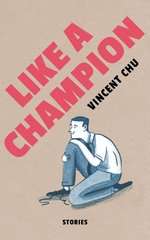
Like a ChampionLike a Champion

by Vincent Chu
eARC, 238 pg.
7.13 Books, 2018
Read: January 31 – February 2, 2018

The man across from Henriette read a book. It was a very big book, a Hunger Games or Game of Thrones kind, with a sword and flame and chess piece on the cover. Dean had never read such a big book. The man was on the very last page and Dean felt guilty suddenly for spying on him during this personal moment, but he did not stop. It was not often, he reasoned, that he would get the opportunity to observe another person at the exact moment they finished a book, a big one at that. But, after the last page, the man, without so much as a satisfied nod or pensive stare, shut the thing and immediately put in his iPhone buds. This disappointed Dean.

That’s just one of any number of paragraphs throughout these stories that don’t advance the plot, reveal or describe much in the way of character — but man, the little bit of flavor they add to the story makes it worth it. And don’t you just want to shake the man who finished the book by the shoulders and ask what is wrong with him? The guy appears for one paragraph, and I have a strong reaction to him. With short stories, you don’t typically get to do that kind of thing the way you can with novels, because every word has to count — and typically, that’s what Vincent Chu does, but every now and then, he stretches a bit. Typically, like the best short fiction writers, Chu gets his bang for his buck when it comes to his words — tight, economical prose that strikes just the right tone each time.

But I’m getting ahead of myself. Like a Champion is a collection of eighteen short stories featuring all sorts of people — underdogs in one sense or another — getting a taste of victory. Some of this victory is very short-lived, some is quite Pyrrhic, but it’s there. The stories are varied in tone, in voice, in setting, in types of character — and that’s such a strength. Some will make you smile, some laugh, some are sad, some are tragic, some are somber, all are incredibly human.

There’s a lot I could talk about — if I could, I’d spend a few hundred words on “Squirrels”, the fourth story in the collection. I don’t know why, but that one sealed me appreciation for this book, and it stands out as a high point for me. There’s just something about it that worked for me, the same kind of thing that lead me to write three papers for three separate courses in college about one Updike short story. There were a couple of other stories that I could point to that were as as outstanding, but I’ll stick with “Squirrels” — a story about one man’s childhood basketball triumph in the midst of defeat — because I enjoyed it more.

With one exception (at least one that I noticed, I might have missed others), these are independent of each other. The two stories that are connected are so different in tone and subject matter that it takes you by surprise when you notice the connection — but it really works (and the connection is of a lesser importance, that not much changes if you don’t make the connection). It was a nice little touch, I would’ve liked a part three, however.

I’m not crazy about Chu’s depiction of older characters. Maybe if I only got one of the stories in this collection featuring an older character — I wouldn’t have commented. Or if I took a few more days to read this than I did, it wouldn’t have stood out to me as much, but when you get the same note or two being played so often with elderly characters it sticks out.

I don’t usually spend much time talking about the publisher of the books I post about, but when it comes to some indie presses, I should. A couple of months ago, I know I posted a link to a profile of 7.13 Books in a Saturday Miscellany, and before that I talked about another short story collection they put out. And come to think of it, I have one more book from them on my schedule in the coming weeks. If Like a Champion is indicative of what they are publishing (and it seems to be), there’s something in the water there, folks, keep an eye out for their books.

Like with every collection — be it full of short stories, essays, poems — there are some in this collection that don’t work for me — two because I didn’t get what he was going for; a couple that I’m pretty sure I got what he was going for, and just didn’t care for it. And I’m very sure that many people will get those I didn’t and will like the ones I didn’t care for — and even dislike the stories that I enjoyed, and maybe even someone’s nuts enough to not care for the ones that filled me with joy. There’s enough variety in these to appeal to all sorts of tastes — and that’s a compliment, Chu’s nothing if not versatile. But on the whole, this is a great collection of short stories, full of compassion, humanity, and talent. You’d do well to grab this one.

Note: I received a copy of this eARC in exchange for my honest opinions as expressed above.

—–

4 Stars

Like a Champion by Vincent Chu

Like a ChampionLike a Champion

by Vincent Chu

eARC, 238 pg.
7.13 Books, 2018

Read: January 31 – February 2, 2018

The man across from Henriette read a book. It was a very big book, a Hunger Games or Game of Thrones kind, with a sword and flame and chess piece on the cover. Dean had never read such a big book. The man was on the very last page and Dean felt guilty suddenly for spying on him during this personal moment, but he did not stop. It was not often, he reasoned, that he would get the opportunity to observe another person at the exact moment they finished a book, a big one at that. But, after the last page, the man, without so much as a satisfied nod or pensive stare, shut the thing and immediately put in his iPhone buds. This disappointed Dean.

That’s just one of any number of paragraphs throughout these stories that don’t advance the plot, reveal or describe much in the way of character — but man, the little bit of flavor they add to the story makes it worth it. And don’t you just want to shake the man who finished the book by the shoulders and ask what is wrong with him? The guy appears for one paragraph, and I have a strong reaction to him. With short stories, you don’t typically get to do that kind of thing the way you can with novels, because every word has to count — and typically, that’s what Vincent Chu does, but every now and then, he stretches a bit. Typically, like the best short fiction writers, Chu gets his bang for his buck when it comes to his words — tight, economical prose that strikes just the right tone each time.

But I’m getting ahead of myself. Like a Champion is a collection of eighteen short stories featuring all sorts of people — underdogs in one sense or another — getting a taste of victory. Some of this victory is very short-lived, some is quite Pyrrhic, but it’s there. The stories are varied in tone, in voice, in setting, in types of character — and that’s such a strength. Some will make you smile, some laugh, some are sad, some are tragic, some are somber, all are incredibly human.

There’s a lot I could talk about — if I could, I’d spend a few hundred words on “Squirrels”, the fourth story in the collection. I don’t know why, but that one sealed me appreciation for this book, and it stands out as a high point for me. There’s just something about it that worked for me, the same kind of thing that lead me to write three papers for three separate courses in college about one Updike short story. There were a couple of other stories that I could point to that were as as outstanding, but I’ll stick with “Squirrels” — a story about one man’s childhood basketball triumph in the midst of defeat — because I enjoyed it more.

With one exception (at least one that I noticed, I might have missed others), these are independent of each other. The two stories that are connected are so different in tone and subject matter that it takes you by surprise when you notice the connection — but it really works (and the connection is of a lesser importance, that not much changes if you don’t make the connection). It was a nice little touch, I would’ve liked a part three, however.

I’m not crazy about Chu’s depiction of older characters. Maybe if I only got one of the stories in this collection featuring an older character — I wouldn’t have commented. Or if I took a few more days to read this than I did, it wouldn’t have stood out to me as much, but when you get the same note or two being played so often with elderly characters it sticks out.

I don’t usually spend much time talking about the publisher of the books I post about, but when it comes to some indie presses, I should. A couple of months ago, I know I posted a link to a profile of 7.13 Books in a Saturday Miscellany, and before that I talked about another short story collection they put out. And come to think of it, I have one more book from them on my schedule in the coming weeks. If Like a Champion is indicative of what they are publishing (and it seems to be), there’s something in the water there, folks, keep an eye out for their books.

Like with every collection — be it full of short stories, essays, poems — there are some in this collection that don’t work for me — two because I didn’t get what he was going for; a couple that I’m pretty sure I got what he was going for, and just didn’t care for it. And I’m very sure that many people will get those I didn’t and will like the ones I didn’t care for — and even dislike the stories that I enjoyed, and maybe even someone’s nuts enough to not care for the ones that filled me with joy. There’s enough variety in these to appeal to all sorts of tastes — and that’s a compliment, Chu’s nothing if not versatile. But on the whole, this is a great collection of short stories, full of compassion, humanity, and talent. You’d do well to grab this one.

Note: I received a copy of this eARC in exchange for my honest opinions as expressed above.

—–
4 Stars

Powered by WordPress & Theme by Anders Norén