Tag: YA/MG Page 14 of 24

Catch-Up Quick Takes on Audiobooks of This is Where I Leave You, When You Reach Me, How Not to Die Alone, The Right Stuff

Trying to clear the decks here with these quick takes on Audiobooks, like I indicated I would be doing yesterday (which also helps from the deep dive I took on Hands Up yesterday, too).
—
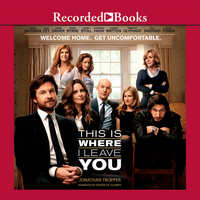
This is Where I Leave YouThis is Where I Leave You

by Jonathan Tropper, Ramón de Ocampo (Narrator)
Unabridged Audiobook, 10 hrs., 17 mins
Recorded Books, 2009
Read: October 9-10, 2019

(the official blurb)
This is not my favorite Tropper novel—but it’s a really good one, and I get why this is his most successful and the only one that’s actually been adapted as a movie (or anything).

From the hilarious (and painful in many senses) opening to the heights of hope, the lows of sorrow, the uncomfortable nature of sitting shiva with estranged family, oh, and the obligatory Tropper awkward fight scene, this is a heartfelt, funny, and entertaining read (or, listen, in this case)

de Ocampo does a better job than I’d anticipated anyone doing with this—he captures Judd’s anger, heartbreak, grief and everything else. He also gets the other characters—including some of the more difficult ones (Phillip, Tracy, Alice). I was really impressed with him, and am a little tempted to get a Wimpy Kid audiobook just to see how he does with that.

4 1/2 Stars


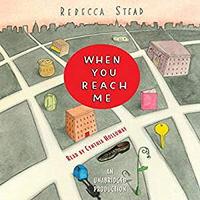
When You Reach MeWhen You Reach Me

by Rebecca Stead, Cynthia Holloway (Narrator)
Unabridged Audiobook, 4 hrs., 19 mins.
Listening Library, 2019
Read: October 29, 2019

(the official blurb)
I didn’t realize this was an MG novel when I grabbed it—I thought it was YA—it wouldn’t have made much of a difference, it just would’ve been good to know what I was getting into.

Miranda is in 6th Grade, has one friend (who has just decided not to be friends anymore), and is obsessed with A Wrinkle in Time. Her mom is a paralegal and is dating a lawyer in her firm. It’s the late 70’s and latch-key kids are becoming more common, but not as much as they will be.

As Miranda tries to find new people to connect with, she receives odd messages about needing to write a thorough and completely true account of something that’s about to happen. She’ll know the thing when it happens. Totally normal, right?

There’s some time travel, there’s some personal growth, there’s some tribute to L’Engle’s novel. It’s a charming little work, really. Sure, I could see most of it coming from miles away, but that’s because I’m a few decades older than the audience, not because Stead didn’t know what she was doing.

Holloway does a fine job, too. Capturing the bouncing emotions just right. I dug it, upper MG readers probably will, too (L’Engle fans are shoo-ins).

3.5 Stars


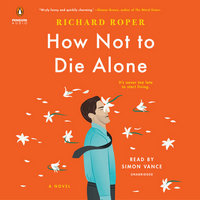
How Not to Die AloneHow Not to Die Alone

by Richard Roper, Simon Vance (Narrator)
Unabridged Audiobook, 8 hrs., 52 mins.
Penguin Audio, 2019
Read: October 14-16, 2019

(the official blurb)
The concept for this novel feels like something that’d happen to George Costanza, but what makes this novel work is that Roper makes Andrew a believable, sympathetic human being—not the dumpster fire of a person that George was. It’s utterly preposterous, really. But you can’t help but believe it happening (and can likely see yourself doing something similar).

I’ve seen repeated—almost ubiquitous—comparisons to Eleanor Oliphant is Completely Fine. And I get that, and can kind of agree with it. I found the character and story in this novel better than Ms. Oliphant or her life. Although that book seems much more plausible. (and I quickly decided not to care).

Andrew’s friendship with Peggy is wonderful, I wish we had more time with them working/hanging out. Peggy’s a great character on her own—and if Roper were to write one of those ridiculous “same story just from someone else’s POV” sequels, I’d have to cast aside my prejudice against those so I could spend more time with her.

Vance gives one of those audiobook narrations that convinces you there’s no other way for the book to sound—if you read the text version, the voice in your head would have to be Vance. And if you’d never heard of him before, that’s okay, because your subconscious would invent a voice just like his.

Moving, amusing, hopeful. Great job.

4 Stars


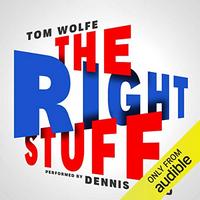
The Right StuffThe Right Stuff

by Tom Wolfe, Dennis Quaid (Narrator)
Unabridged Audiobook, 15 hrs., 42 mins.
Audible Studios, 2018
Read: October 29-30, 2019

(the official blurb)
I read this book about 2-3 times a year from Middle School to the first or second year of college, and haven’t been able to do it since (I’ve tried off and on). But when Audible had a sale on this earlier in the year, I had to give it a shot. Especially with one of the stars of the remarkable movie adaptation doing the narration.

Now an audiobook of Wolfe is a tricky proposition (at best). Wolfe’s a master stylist. But so much of it (to me anyway) is how the words are on the page. His idiosyncratic capitalization, punctuation, visual rhythms . . . it’s all about how the text shows up in the book. But Quaid gets close enough. So I was able to fully enjoy and immerse myself in this story about the early years of the US/USSR Space Race—the test pilots around Yeager’s feat and then transitioning into the Mercury Program and a little beyond.

Wolfe educates and then entertains with the way he tells the story, editorializes about the events and people, and captures the essence of the various people involved. Listening to this brought me back to the first time I read this book and reminded me why I fell in love with Wolfe.

Quaid did the near-impossible here, he got as close to humanly possible to capturing Wolfe’s style, sensibilities and je ne sais quoi. He didn’t quite get it, but I can’t imagine anyone doing better. It’s probably one of my favorite audiobook performances to date. I’m going to go out on a limb here and say that Quaid guy just might have a future in show biz.

4 Stars

2019 Library Love Challenge

Look Both Ways by Jason Reynolds: A School Bus Falls from the Sky but More Interesting/Important Things are Going On

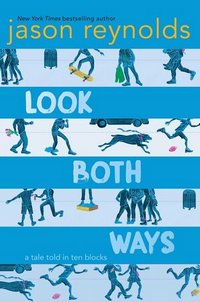
Look Both Ways

Look Both Ways: A Tale Told in Ten Blocks

by Jason Reynolds

Hardcover, 188 pg.
Atheneum/Caitlyn Dlouhy Books, 2019

Read: October 31, 2019

A school bus is many things.

A school bus is a substitute for a limousine. More class. A school bus is a classroom with a substitute teacher. A school bus is the students’ version of a teachers’ lounge. A school bus is the principal’s desk. A school bus is the nurse’s cot. A school bus is an office with all the phones ringing. A school bus is a command center. A school bus is a pillow fort that rolls. A school bus is a tank reshaped—hot dogs and baloney are the same meat. A school bus is a science lab—hot dogs and baloney are the same meat. A school bus is a safe zone. A school bus is a war zone. A school bus is a concert hall. A school bus is a food court. A school bus is a court of law, all judges, all jury.

This is a novel—sort of. It’s a short story collection—sort of. It’s a hybrid of the two like Winesburg, Ohio was. I can’t tell you how often I thought about Sherwood Anderson’s book while I read this.

A lot happens right after school lets out for the day—particularly on the way home. The last gasp of socialization for many before the reality of home, chores, family, homework, game systems, etc. take over. Jason Reynolds gives us the stories of ten individuals/friend-groups on the way between school and home (some take interesting detours, too). There’s drama, comedy, romance, tension, action, and . . . some things that defy explanation.

There’s no overarching theme or plot, just these ten stories, so it’s hard to encapsulate this much. I can’t even say some characters stand out more than others because they all do.

This is one of those YA books that I wish didn’t have that tag, because too many non-young adults are going to ignore this because of that label. Yes, the book is written for the YA crowd, but non-YA readers will appreciate this just as much (if they let themselves read it).

No two stories/chapters are the same in tone, voice, or character. Some are pretty straightforward, some get a bit more unconventional in structure. But through it all, they’re well-written stories. While none of the chapters will affect the way things go in others, there are layers of interconnectedness (leading to some chapters giving some nuance or new understanding to things you’ve already read).

While I enjoyed some of the chapters more than others, there wasn’t a dud in the bunch—and it’s not often I say that about short story collections. All of them tapped into something that you can probably relate to today—if you can’t, you certainly could have when you were a young adolescent. It’s a truly impressive collection.

I don’t know what else to say at this point, so I’ll stop—bring this one home, get your teens to read it, too. It’s funny, it’s poignant, it’s touching, it’s inspiring—and it’s a fun read during it all.


3.5 Stars

2019 Library Love Challenge

Opening Lines: Look Both Ways

We all know we’re not supposed to judge a book by its cover (yet, publishing companies spend big bucks on cover design/art) (also, this has a great cover). But, the opening sentence(s)/paragraph(s) are fair game. So, when I stumble on a good opening (or remember one and pull it off the shelves), I’ll throw it up here. Dare you not to read the rest of the book.

from Look Both Ways: A Tale Told in Ten Blocks by Jayson Reynolds:

This story was going to begin like all the best stories. With a school bus falling from the sky.

But no one saw it happen. No one heard anything. So instead, this story will begin like all the . . . good ones.

With boogers.

“If you don’t get all them nasty, half-baked goblins out your nose, 1 promise I’m not walking home with you. I’m not playln’.” Jasmine Jordan said this like she said most things—with her whole body. Like the words weren’t just coming out of her mouth but were also rolling down her spine. She said it like she meant it.

The only thing better than that first paragraph is the third. And I can already see Jasmine as clear as day.

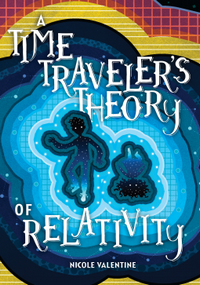
Pub Day Repost: A Time Traveler’s Theory of Relativity by Nicole Valentine: A Captivating MG Mix of Science and Magic

A Time Traveler's Theory of Relativity

A Time Traveler’s Theory of Relativity

by Nicole Valentine

eARC, 352 pg.
Carolrhoda Books, 2019

Read: August 27, 2019


Finn Firth is on the verge of turning 13, and is convinced his father will forget his birthday. Which is troubling to him, but really, it’s the least of his troubles. When they were three, his twin sister drowned (and he’s always felt this absence, and is sure everyone around him does, too). He’s not that close with his father, and his mother left home a few months ago, with no warning and no one has heard from her since. Also, his best (only?) friend, Gabi, has been spending less time with him and more time with new friends—the kind that would bully him. He’s also a huge science nerd, the kind of twelve-year-old who reads (and re-reads) Richard Feynman and Carl Sagan for entertainment. The fact that he’s an outsider, that he’s not like the other kids at school is what drives him (like so many) to science, to something he can make sense of and put himself/his trouble in perspective.

So imagine his surprise when his grandmother informs him that she’s a time traveler, actually, all the women in his family have been and are. It’s not just his family, there are people throughout the world capable of this. Some in his family are more powerful than others, most can only travel to the past—one could only travel to the past but during her lifetime—his grandmother and mother are among the few that can travel forward in time. His mother, he’s told, didn’t leave his father and him. Finn’s dad has been reassuring him that “she just needs some time,” and well, that seems to be the case after all. She’s stuck somewhere, unable to come back—but she’s created a way for Finn to come and get her (despite being a boy).

Time travel is impossible, Finn knows—and even if it weren’t, the kind of travel his grandmother describes sounds more magical than scientific. He tells his grandmother this, in fact. But—I won’t get into how, it should be read in context—he’s given some pretty convincing proof.

Now there are those who don’t think Finn should be doing anything regarding time travel, and that no one should be tracking down his mother. And they’re seemingly willing to take some extreme measures to stop him. He and Gabi set out on an adventure to evade these others and get to his mother’s portal. Finn’s ill-prepared for what lies ahead, but he doesn’t care. Between brains and sheer determination (and largely it’s the latter), he’s going to find his mom.

What he never stops to ask is: what else will he find?

This is a fun little read—Finn and Gabi are well-developed characters, his various family members are interestingly and distinctively drawn, the writing is crisp and brisk—once things get going, they stay going, and it’s easy to get swept up in it The best is the mix of science and . . . however you end up describing the time travel. For a book directed toward the 9-14 set, the science (time travel, chaos theory, multi-world theory, etc.) is presented plainly and without condescension. That last point, in particular, resonated with me.

The heart of this book is found in two concepts—the power of individual choice, and the importance of kindness in spite of everything. Lessons good to be absorbed by the target audience, as well as the rest of us.

I really enjoyed this book and heartily recommend it. One thing, though, kept running through my mind as I read it. As much as I enjoyed A Time Traveler’s Theory of Relativity, when I was 8-13, I would’ve loved it (probably when I was 14 and 15, too—I just wouldn’t admit to liking a book written for younger people at that time). It’s the kind of book that I would’ve been checking out of the library every two or three months. Get this for yourself and enjoy it, get this for your kid for them to obsess over.

Disclaimer: I received this eARC from Carolrhoda Books via NetGalley in exchange for this post—thanks to both for this opportunity.


3.5 Stars

A Time Traveler’s Theory of Relativity by Nicole Valentine: A Captivating MG Mix of Science and Magic

A Time Traveler's Theory of RelativityA Time Traveler’s Theory of Relativity

by Nicole Valentine

eARC, 352 pg.
Carolrhoda Books, 2019

Read: August 27, 2019

Finn Firth is on the verge of turning 13, and is convinced his father will forget his birthday. Which is troubling to him, but really, it’s the least of his troubles. When they were three, his twin sister drowned (and he’s always felt this absence, and is sure everyone around him does, too). He’s not that close with his father, and his mother left home a few months ago, with no warning and no one has heard from her since. Also, his best (only?) friend, Gabi, has been spending less time with him and more time with new friends—the kind that would bully him. He’s also a huge science nerd, the kind of twelve-year-old who reads (and re-reads) Richard Feynman and Carl Sagan for entertainment. The fact that he’s an outsider, that he’s not like the other kids at school is what drives him (like so many) to science, to something he can make sense of and put himself/his trouble in perspective.

So imagine his surprise when his grandmother informs him that she’s a time traveler, actually, all the women in his family have been and are. It’s not just his family, there are people throughout the world capable of this. Some in his family are more powerful than others, most can only travel to the past—one could only travel to the past but during her lifetime—his grandmother and mother are among the few that can travel forward in time. His mother, he’s told, didn’t leave his father and him. Finn’s dad has been reassuring him that “she just needs some time,” and well, that seems to be the case after all. She’s stuck somewhere, unable to come back—but she’s created a way for Finn to come and get her (despite being a boy).

Time travel is impossible, Finn knows—and even if it weren’t, the kind of travel his grandmother describes sounds more magical than scientific. He tells his grandmother this, in fact. But—I won’t get into how, it should be read in context—he’s given some pretty convincing proof.

Now there are those who don’t think Finn should be doing anything regarding time travel, and that no one should be tracking down his mother. And they’re seemingly willing to take some extreme measures to stop him. He and Gabi set out on an adventure to evade these others and get to his mother’s portal. Finn’s ill-prepared for what lies ahead, but he doesn’t care. Between brains and sheer determination (and largely it’s the latter), he’s going to find his mom.

What he never stops to ask is: what else will he find?

This is a fun little read—Finn and Gabi are well-developed characters, his various family members are interestingly and distinctively drawn, the writing is crisp and brisk—once things get going, they stay going, and it’s easy to get swept up in it The best is the mix of science and . . . however you end up describing the time travel. For a book directed toward the 9-14 set, the science (time travel, chaos theory, multi-world theory, etc.) is presented plainly and without condescension. That last point, in particular, resonated with me.

The heart of this book is found in two concepts—the power of individual choice, and the importance of kindness in spite of everything. Lessons good to be absorbed by the target audience, as well as the rest of us.

I really enjoyed this book and heartily recommend it. One thing, though, kept running through my mind as I read it. As much as I enjoyed A Time Traveler’s Theory of Relativity, when I was 8-13, I would’ve loved it (probably when I was 14 and 15, too—I just wouldn’t admit to liking a book written for younger people at that time). It’s the kind of book that I would’ve been checking out of the library every two or three months. Get this for yourself and enjoy it, get this for your kid for them to obsess over.

Disclaimer: I received this eARC from Carolrhoda Books via NetGalley in exchange for this post—thanks to both for this opportunity.

—–

3.5 Stars

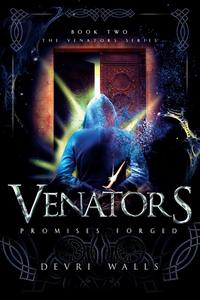
Venators: Promises Forged by Devri Walls: Out of the Frying Pan and into the . . . Clutches of a Life Siphoning Fae?

Venators: Promises ForgedVenators: Promises Forged

by Devri Walls
Series: Venators, #2


Paperback, 428 pg.
Brown Books Publishing Group, 2019

Read: May 3 – 7, 2019

I’m about a month late with this one — every time I sat down to write it, I decided I wanted to chew on things a bit more (and then I arranged to do a Q&A with the author in conjunction with the post and so I bought myself some time to let things stew while she found time to get the answers done). Now that I have her answers in my inbox, I have no excuse to put this off. So, despite some of my thoughts still being half-baked, here we go…

And yes, that was one very convoluted series of food metaphors. That really doesn’t inspire a lot of confidence in this post, does it?

So the ending of the previous book (Venators: Magic Unleashed) focused on a dragon being unleashed by the series’ (apparent) Big Bad, the sorceress Zio. Not surprisingly, the series central characters survived the encounter. This book starts with a quick recap of that survival from the point of view of Zio — which is a great way to get the reader back into the moment and build on their understanding of what happened and Zio.

We quickly return to our Earthlings, Grey and Rune and the aftermath of their unauthorized excursion to rescue humans from a werewolf pack, which culminated in the aforementioned dragon attack. Rune’s proving to be a quick study of Council politics and was able to turn things to their advantage and buy them some leniency from the Council. The ways the two humans respond to and interact with Council members is pretty interesting and I suspect will be one of the more interesting developments from this point forward in the series. I suspect the Venator abilities that make these two the warriors they are in this world are in play with Rune’s politicking — no one mentions mental acuity when talking about Venator abilities, but maybe they should. Watching Rune play the games (both successfully and less-so) that the various Council members throw her way is probably my favorite part of the character.

And she has to do a lot of politicking and game playing here, because her co-Venator and friend Grey has found himself in quite the pickle. After their ordeal with the werewolves, the two Earthlings’ need for training was even more apparent. They get just a little of it (a good, promising start) before getting momentarily side-tracked. Before they get a chance to build on that, Grey is lured into the one place the two have been told they absolutely cannot go. Because forbidding people from going somewhere always works out (how many Hogwarts students stayed out of the forest? How long did Belle stay out of the West Wing? Even the Federation had to know that forbidding landing on Talos IV wouldn’t work for long).

Grey has found himself in the clutches of a powerful Fae, Feena. Feena will spend days/weeks/years sucking the life out of her prisoners to feed her own magics. Given that Grey is more powerful than your typical Eonian, you know she’ll drag it out as long as possible. It’s a torturous experience for Grey, but he does what he can to resist and fight back. On the one hand, watching him stupidly and blindly put himself in this situation was maddening. But after that, watching Grey endure what he has to and struggle in response is pretty cool. As much as I appreciate Rune’s playing politics, I enjoy watching Grey in action.

So the book boils down to this — can Rune get permission to run a rescue mission — or at the very least, find a window in which she can pull off another unauthorized mission? Can Grey survive long enough for the cavalry to arrive? Assuming they do, how can Grey be rescued and the Venators get back to their training without causing a diplomatic incident that will shake up everything?

The actions of the Venators’ guides, teachers, allies confuse me. They’ve got these two kids in a world they clearly don’t understand, with abilities they don’t understand and then expect them to react appropriately in new situations. Even worse, all of them are keeping things from Grey and Rune — telling them half-truths, deflecting legitimate questions and delaying explanations. It’s maddening. It’s bad enough that the Council, who are clearly only using these two for their own ends do that, but the people who supposedly are looking to them to change the world? A little honesty, being a little forthcoming, helping them to avoid the minefields they keep running into rather than saying “oh, you shouldn’t have done that” — it would make it a lot easier for this reader to stomach them.

The Council? I need to see more of them. I have little patience for them as individuals or as an entity at the moment, but as individuals and as an entity there’s great potential for something interesting to happen. Feena’s a good villain — she’s not worth several books, but for one novel? She’s a good opponent. The Fae? It’s simple — any universe, any world, any author — when it comes to Fae politics, Fae dealings with other Fae, Fae dealings with non-Fae? It’s complicated, tricky and messy. It’s good to know you can count on something.

So much is happening in a very short period of time, it’s hard to know what kind of impact the events are having on anyone — it’s been less than two weeks since these two jumped into this world, leaving St. Louis behind. It’s hard for them — or a reader — to really take it all in. We do know that already both Venators are changing because of their abilities (as well as the experiences in this new world) — both are self-aware enough to see how it’s happening (at least in part) and are both resisting and embracing the changes. Both are, naturally, deluded about how easy it will be to resist this kind of thing — denial’s not just a river on Earth.

I’m enjoying these books — I do hope that under the new publisher, they’re able to come out pretty regularly, it’ll help sustain my interest (and, I’m guessing, the reading public’s). I know that Walls has several more books planned, so it makes it okay that I’m still on the fence about the series as a whole — there’s a lot of potential to the series and these characters and she has time to help them reach their potential. There are aspects of the books (the prospective — and lingering — romantic entanglements, for example) that I’m withholding an opinion on until more happens. And I’m not sure if I should appreciate how little we’re getting with Zio and Rune’s brother, or if it should annoy me. Is Walls building suspense, or is she simply being obfuscatory? I’m hoping that after Book 3, I’ll be more settled with my expectations about these books — I know I’m enjoying them, I’m just not sure if I should wait on them getting better.

An interesting world, great characters (even if they frustrate me), good action — and a fast moving plot. This YA fantasy is a crowd pleaser, I’m sure of that — you should join the crowd.

—–

3.5 Stars
LetsReadIndie Reading Challenge

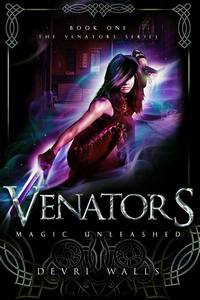
Venators: Magic Unleashed by Devri Walls: Welcome to Eon in this Promising YA Fantasy Introduction

Venators: Magic UnleashedVenators: Magic Unleashed

by Devri Walls
Series: Venators, #1

Paperback, 354 pg.
Brown Books Publishing Group, 2018
Read: April 17 – 18, 2019

Back in 2016, I read and blogged about Venators: Through the Arch, which was later picked up by a new publisher, given a re-write, a spiffy new cover, and was re-born as Venators: Magic Unleashed. I haven’t read that old post in a long time, and won’t until I finish with this one, I’m only linking out of habit. I hate to say it, but I remember very little about the original version of this book beyond a vague grasp of the plot outline, some vague notions of characters and an overall positive regard. Oh, and a strong interest in volume two. This revamped version is stronger, with some of the rough edges smoothed out, and strengths sharpened. Brown Books and Walls made good use of the relaunch. But let’s set aside the comparisons and focus on Magic Unleashed.

This is a portal fantasy about a world called Eon, populated by humans, elves, vampires, werewolves, elves, dragons, etc. There are connections between Earth and Eon, allowing travel between the two — although they’re not as strong as they once were. It turns out some humans from Earth have a certain invulnerability to the kinds of magic employed by the various races (like a werewolf or vampire bite, but not, say, an invulnerability to a werewolf tearing off their head). Thee humans also have other enhanced physical attributes allowing them to go toe-to-toe in combat with members of these races. Which has made these humans a powerful force for good, and a potentially tyrannical force as well. Eon’s known more of the latter lately, which has led to a lack of recruitment.

But now, society’s on the verge of collapse into chaos, warring tribes trying to wipe out other races in a fight for dominance, and the end of law. So some people have taken it upon themselves to reintroduce these humans, Venators, to Eon. Enter Tate, a warrior who is convinced that Venators are the key to Eon’s survival — he’s been to Earth before, and now returns to bring back some people he observed then. Six years ago, he encountered a young teen named Grey Malteer — who was forever changed by their brief encounter. Now in college, Grey is about as well-read in the lore of the supernatural and weird as is possible for someone to be while stuck on Earth and not being known as a crackpot (although he’s regarded as pretty eccentric, probably well on his way to crack-pot status).

An acquaintance of his from childhood, now attending the same college, Rune Jenkins is repulsed by the same things that Grey is focused on (while also drawn to them). Rune is totally unprepared to accept that the supernatural is anything but wild fiction until she’s attacked by goblins and rescued by a large blue man (the aforementioned Tate). Which really can only make her a believer — or drive her to some sort of psychotic break. Thankfully, she goes with the former. Tate brings Rune and Grey into Eon and sets before them the calling of Venator.

To oversimplify things: from here out, the two are introduced to this world, the beings that populate it, the political realities that govern it (and see them only as pawns), and they begin to embrace their new identities, while engaging in a brief battle or two. While Rune and Grey are introduced to all this, so is the reader — and it’s clearly the point of this book — to bring the reader and these two into Eon, give us all a taste of what’s to come and help us get to know the players. There is a clear plotline and definite story here — don’t get me wrong — but the major function is to provide a foundation for things to come.

The book would have to be a lot longer to serve as anything other than an introduction — the ruling council alone is made up of enough characters we’d need a few more chapters to really get to know them and their goals — although they can be summed up in lust for power and influence for themselves and their race to the possible detriment of every other council member/race. Then you throw in Tate; his allies (however temporary) the vampire Veridia and the shapeshifter Beltran; the two humans; and the council’s enemy, Zio — and really, you’ve got enough players that you really can only skim the surface within 354 pages.

We get to know Grey and Rune enough to see they’re well-developed and three-dimensional, and many of the rest show signs of being that developed, but we don’t get to see that fully displayed — but we see enough to know that given the opportunity, the characters will be easily fleshed out. One thing I noted in particular while reading this is just how many seeds Walls planted in the characters and situations to come back to in future installments. This foundation is built in such a way that several books can be built on it — it’s really impressive to note.

Yes, this is written for the YA market, so there’s a bit more action than others might use. There’s a focus on certain kinds of emotional beats, and that sort of thing. But it’s more of an accent to the storytelling than other writers would’ve made it. For some reason, Mercedes Lackey’s Hunter series and Brandon Mull’s Beyonders Trilogy come to mind as I think about similar series — but the YA-ness of both of those comes through more strongly than it does with this book.

Book Two, Venators: Promises Forged releases today, and I’m hoping to start it in a day or two — I’m looking forward to seeing how Walls takes all these ideas, characters, and potential and develops them. This is a good starting point, and what comes next can’t help but be better when she can focus more on exploring the world she’s created and shown us rather than just establishing it here. This is a good book and I do encourage people to read it, but its foundational nature should be borne in mind.

—–

3.5 Stars

LetsReadIndie Reading Challenge

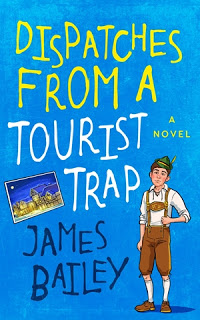
Dispatches from a Tourist Trap by James Bailey: Jason’s Woes Follow (and Grow) in his new Small Town

Dispatches from a Tourist TrapDispatches from a Tourist Trap

by James Bailey

Series: The Jason Van Otterloo Trilogy, Book 2

Kindle Edition, 253 pg.
2019
Read: April 1, 2019

Sometimes lately I feel like life is a chess match, and no matter how hard I look at the board I can’t see the next move. Or maybe I think I see it, but really I don’t. Like my pawn is sitting there, all ready to put the other king in check, and somehow my queen gets swiped and two moves later I’ve lost the game and my pawn is still waiting there, impotent and useless.

So Jason mother’s Janice continues her bad decisions when it comes to men — she leaves her husband for a new guy, who happens to be the dentist she’s started working for. We met him in The First World Problems of Jason Van Otterloo, and they clearly didn’t waste time resuming whatever it was they had back in high school. Janice has moved herself and Jason to her parents’ house, enrolled Jason in a school filled with very friendly people, and tried to move on with her life.

Jason realizes full-well that his choices are a life with his grandparents and a much smaller school, hours away from his friends and girlfriend; or life with Rob, near them. As much as he doesn’t want to be in Icicle Flats, he knows it’s the better choice available. But he complains the whole time about it — this is good for readers, Jason complaining makes for an entertaining read. This time, he’s not just complaining in emails, he’s set up a blog, too. I was wondering how the blog was going to work instead of the emails — it’s actually a really good move, allowing Jason to tell longer stories without the emails being too long.

Which is good — because he has long stories to tell this time. There’s a literature club he’s involved with at school that’s discussing books that ruffle the feathers of many, which leads to all sorts of trouble. There’s a flirtation with pirate radio. A camping trip that is fantastic to read about (and probably not a lot of fun to live through). A disastrous experiment with eBay. And basically, a bucket-load of culture shock. Also, after a few short weeks of dating, Jason’s first real relationship becomes a long-distance one. High school relationships are bad enough, throwing in a few hour bus-ride into things is just asking for trouble. So yeah, between emails and his blog — he’s got a lot to write about, and his friends have a lot to respond to. Somehow, they make it through the school year more or less intact.

Jason feels incredibly authentic — immature, self-centered, irresponsible, but he’s got his moments. He can put others before himself, do the right thing because it’s right — not to stay out of trouble; But man, he can be frustrating the rest of the time. There were a lot of opportunities along the way here for him to be a better friend, a much better boyfriend, son and grandson; and he missed almost all of them. He comes through when necessary, don’t get me wrong and he’s not a bad guy — I just wish he’d grow up a bit faster. Which again, means that Bailey has nailed his characterization, this his how people his age should be.

I’m less than thrilled with Bailey’s approach to religious characters in these two books. I’m not questioning that there are people like the characters he depicts running around everywhere and that the situations would’ve played out a lot like they did here (but some of it pushed believability). I just would like a small indication that there were some sincere people trying to do the right thing in the middle of all this.

Having talked about The First World Problems of Jason Van Otterloo just two weeks ago, it feels hard to talk about this book beyond some of the plot changes — this feels like the same book, just with new problems. Which is pretty much the point, right? I still like Jason (as frustrating as he can be), his girlfriend is fantastic, I want good things to happen to Drew. Jason’s already complicated life is about to get a lot worse, which should prove very entertaining for the rest of us. A strong follow-up in this series.

—–

3.5 Stars
LetsReadIndie Reading Challenge

A Few Quick Questions With…James Bailey

I’ve had some really good Q&A’s this year — which is entirely due to those providing the A’s. Here’s one of the crème de la crème. Now I wrote about James Bailey’s book, The First World Problems of Jason Van Otterloo a week or so ago, but I didn’t have time to read and post about the sequel by today, its release date. So instead, I’ve got this little back-and-forth with the author to celebrate the release of Dispatches from a Tourist Trap. I’ll try to get something written about it by the end of this week, but I know better than to promise anything.

So sit back and enjoy this before you go to buy the book, which should have downloaded to my Kindle this morning. I’m going to go verify that as you read Bailey’s thoughtful and funny contributions below.

Most authors have dozens of ideas bouncing around their craniums at once — what was it about this idea that made you say, “Yup — this is the one for me.”? What came first, the choice to go for a YA story instead of your adult novels or the story idea?
I have so many Chapter 1’s on my computer it’s not even funny, so, yeah, I have ideas bouncing around all the time. Some of them never get any further than a few notes jotted down on a scrap of paper. The idea for Jason came to me while re-reading The Secret Diary of Adrian Mole, Aged 13 3/4 . I thought it would be fun to try something like that, but more modern. I went with email instead of a diary. I got the image for his parents from my neighbors, who are probably closer to Rob and Janice than most people would want their parents to be. They are prone to fighting, occasionally physically, in their driveway. Any time we see a police car in the neighborhood, we almost expect to see it stop in front of their house. As for Jason, I wanted a likeable (if sometimes mildly self-centered) protagonist. On my last novel, Sorry I Wasn’t What You Needed, I started with the concept of a borderline asshole for the main character. He was definitely selfish, sometimes worse. One of my beta readers tabbed him a sociopath. I did soften him a little after that. I wasn’t quite aiming for sociopath. And I think he grew enough by the end that readers wouldn’t throw stuff at him if they met him on the street. But for First World Problems I wanted someone more likeable, and hopefully Jason comes across as a decent kid.

As for the YA angle, I’m not always even sure what counts as YA. I suspect most YA books are read by adults at least as much or more than they are by teens. Is it the protagonist being young, dealing with teen trials and tribulations, or is it the reader being young? Is Nick Hornby’s Slam a YA book? (One of my favorite Hornby novels, btw.) For me, when I read something that falls under the YA umbrella there’s often a nostalgia factor in there somewhere, and sometimes a “man, I’m glad I don’t have to relive all that again” factor. But when you look back on your life, there’s something about those high school years, as good or bad as they were, that never fades. Most of us will remember life as a 14-18 year old much more distinctly than we will life as a 24-28 year old or 34-38 year old, etc. It’s a formative period. Still, once I finish off the series, I’ll probably go back to writing “adult” books. (Though when you say it like that, it sounds like adult films, which have a seriously different meaning.)

I honestly laughed out loud there. Also, I have to confess — I’ve never read Slam. I bought it when it came out, my wife read and enjoyed it. But the Hardcover is sitting on my shelf. I really need to.

Anyway, why did you choose to go with an Epistolary book? What are the specific challenges that come with it — are there specific benefits?

As mentioned in the first answer, I was riffing off Adrian Mole a little when I started this project. The first couple of drafts were all Jason. I didn’t work in replies from the other characters until later. A friend who read an early draft said it was hard to get a feel for anyone else’s personality as it was. I’m really glad I changed course, because it definitely allowed them each to show more of who they are. Drew, especially, but Gina as well. Want a challenge? How about telling your brain to ignore all the spell-checker issues when writing her responses. While I was editing the rest of the book to make sure the spelling and grammar was correct, I had to keep making hers worse. She was fun to write. I only hope everyone can decipher what she said.
Ugh! I meant to talk about Gina’s grammar and spelling — how could I forget about that? It was so nice to read intentional misspellings and atrocious sentences. I’ve read too much of both lately in theoretially edited works.

Why 2003? Why not something more current — or further back? (Feel free to mock any of my rambling about the time)

You answered this one yourself in your review, almost exactly. I had to freeze it back in a time period when it was still realistic that guys like Jason and Drew wouldn’t have had phones. If I had set this in 2018, everything would have been in texts. That would be horrible. As it is, it still requires a minor suspension of disbelief that they would write in complete sentences, but then again, they’re intellectual fellows. I could have gone a little further back in time, but not much beyond the mid-90s. Earlier than that and email would have been a stretch for the opposite reason.
I’ve often heard that writers, or artists in general, will forget hundreds of positive reviews but always remember the negative — what’s the worst thing that someone’s said about one of your books, and has it altered your approach to future books?
I now have a 1-star review on Amazon for each of my four books. Fortunately, those are the minority. I’m not sure about the “worst,” but I do have a stupidest. A guy gave my first book, The Greatest Show on Dirt, a 1-star review. All he said was, “not about baseball. Its a dumb story about people who work at a baseball stadium,” That’s it. Well, there’s a lot of baseball in the book. Not sure what he was looking for. But here’s the kicker. He’s also the guy who left a one-star review on my second book, Nine Bucks a Pound. For that one he said, “only started it. Not very good.” He posted both reviews on the same day. My question for him would be, if you didn’t like one, why’d you bother with the other? But you can’t respond to reviewers. There’s nothing to gain from it and a lot to lose. You have to just try to tune the negative ones out. Not always easy. Then again, if most of the reviews for a book are 4 or 5 stars, and someone posts a 1 star review, to me that says more about them than it does the author or the book.

And try to find a book on Amazon that everyone liked. My favorite novel of all time, A Confederacy of Dunces, has 221 1-star reviews. That book is brilliant. It’s hilarious, creative, the characters jump off the page. How in the world that all came together in one man’s mind just amazes me. But 221 people hated it enough to rip it on Amazon. When I see people saying “This isn’t funny,” about Ignatius J. Reilly, that tells me all I need to know about them. They have no sense of humor, whatsoever.

What’s the one (or two) book/movie/show in the last 5 years that made you say, “I wish I’d written that.”?
If I thought hard enough about this, I’m sure I could come up with a handful, but the first thing that pops into my head is a book called Dinosaurs and Prime Numbers, by Tom Moran. And while I might wish I had written it, if I’m honest there’s no way I could have. It’s just too zany. It’s about a time traveling detective named Walton Cumberfield, who has to solve the mystery of why an old man broke into his house after Walton beats him to death with a Guinness Book of World Records (2008 edition). It’s a bit silly at times, and if you hate puns you might struggle with it, but it’s clever, creative, and fun. Walton reminded me in some ways of Ignatius J. Reilly (two Confederacy of Dunces references in one Q&A; is that a record?). There was a second book in the series, called A Debt to the Universe, that was enjoyable, but not quite as good.

I’ve loved time-travel movies and books since I saw Back to the Future when I was 15. I’ve toyed around with some ideas for writing one myself, but I haven’t quite hit on the right storyline yet. Maybe someday.

You care to give the elevator pitch for Book Two of the Trilogy? (and maybe a hint about Book Three, if you can)
Okay, I’m hardly kidding when I say it’s easier to write a book than it is to write a blurb about that book. I’ve finally finished rewriting the one that’s going to go up on Amazon, and you’re asking for an elevator pitch, which to me connotes something even shorter, so I’m going to hack it down slightly here. If you want the fuller version, you can find it up on Amazon (the book is available now for pre-order). Anyway, here’s my elevator pitch version:

Thanks to his parents’ separation, Jason is starting his sophomore year of high school in tiny Icicle Flats, a quaint Bavarian-themed mountain village three hours east of Seattle. This town has barely changed since Janice grew up there, and she’s only going back because she has a new boyfriend, who is also her new boss.

Leaving his friends is hard, but the worst part is leaving Sian, right when things were getting good. In between visits, they exchange a lot of email and phone calls, but long-distance relationships are always challenging, especially for someone like Jason who forever seems to be digging himself into a hole. Fortunately, Drew is just an email away. If only Jason would ever heed his advice.

Jason joins an after-school book club, where he hooks up with a couple of other students who love to push boundaries. Mayhem ensues, involving the school board, the town Christmas parade, and a pirate radio station. Who ever said life in a small novelty town would be dull?

As for Book 3, I haven’t started writing it yet, but I do have some ideas. Jason’s family will expand when Rob gets remarried and a new bundle of joy appears. Fortunately for his little brother, his stepmother is a competent adult, which brings the grand total to one in Jason’s circle. His relationship with Sian will be strained once more when she heads off to Ireland as an exchange student. Jason will learn how to drive. And Rob may see a UFO. For now, I’m envisioning the book covering the summer before his junior year (picking up where Book 2 leaves off) and running through the school year. But there’s a lot TBD at this stage.

Thanks for your time — and thanks for introducing me to Jason Van Otterloo.
And thank you, for your time and the opportunity to reach some new readers.

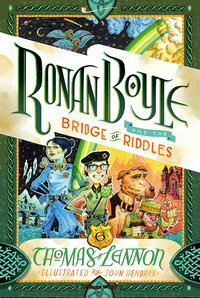
Ronan Boyle and the Bridge of Riddles by Thomas Lennon, John Hendrix: A Young Irish Police Officer Takes on Leprechauns and other sorts of faerie folk.

Ronan Boyle and the Bridge of RiddlesRonan Boyle and the Bridge of Riddles

by Thomas Lennon, John Hendrix (Illustrator)
Series: Ronan Boyle, #1

Hardcover, 286 pg.
Amulet Books, 2019
Read: March 20 – 22, 2019

I didn’t tell Captain Fearnly that I was joining the garda as part of a plot to exonerate my parents and find a four-thousand-year-old mummy — and there is no place to enter this type of thing in the online application, so I just kept it to myself.

Last year, when Thomas Lennon was a guest on Kevin Pollak’s Chat Show #371, they spent some time talking about this book. I knew I had to give it a shot almost immediately. When I got home and found it on Goodreads, I was a little disappointed to find out it was for the MG crowd — I didn’t get that impression at all from his description (I may have missed something while driving). Still, I put it on the “To Read” list and kept an eye out for its publication. It still sounded like a good time.

And boy, oh, boy it was.

Ronan Boyle is a young man who watched his parents get arrested (in the middle of a family game night) and put into prison. They’re academics, and were found guilty of selling antiquities that belonged to the Irish government. As noted above, Ronan joined the Irish police as an intern, primarily as a way to . Until one night when he was recruited to help dealing with a leprechaun (he was the only one the right size to get where the leprechaun was keeping something). He did well enough with that assignment that he was immediately recruited for Garda Special Unit of Tir Na Nog — the supernatural division.

We follow Ronan through his training — imagine Hogwarts summarized in a hundred pages or so (although this is a shorter course of training) — what he and his fellow cadets (including a girl who thought she was a log for most of her life, and a medium-sized bear that may or may not have been a fellow cadet) go through is unlike any training program you’ve seen or read about. Yet it’s familiar enough that it feels comfortable. Then we see Ronan and his compatriots begin their garda careers in earnest.

Meanwhile, Ronan makes a little progress with the investigation to clear his parents. He also makes friends — from multiple species — and decides that he really likes berets. He’s a very unlikely hero — not terribly coordinated, skinny, as physically un-intimidating as you can possibly imagine with poor eyesight. He also has a strange obsession with Dame Judi Dench (not that Dench isn’t worth obsessing over, it’s just not someone many teen boys fixate on)

All in all, an entertaining story steeped in Irish lore, myth and culture — all very well-researched and lovingly told. I’d probably recommend it just on these grounds.

But it’s the way that Lennon tells this story that seals the deal. His voice is chatty, whimsical and infectious. The imagery, language, and overall feel is hilarious. Yes, I’d recommend the book just on the characters/plot. But I’d also recommend it for voice and style alone. For example:

It was a mysterious garda officer named Pat Finch, whose ghoulish face is so crisscrossed with bright red veins that it looks like a map of hell drawn by a monk in a medieval lunatic asylum. Pat Finch looks like what a heart attack would look like if it could walk around eating fish-and-chips and saying terrible things about Roscommon Football Club’s starting lineup.

“There’s a leprechaun navy?”

“Yes. Probably the least reliable fighting force in the known world,” replied the captain. “The leprechaun navy is basically a heavily armed musical-theater troupe with two boats.”

If you know Thomas Lennon as a performer, you’ll be able to “hear” significant portions in his voice. I think I saw that he does the audiobook, which is good — because otherwise, you’d have to find someone who can do a decent impression of him to really pull off the cadence and rhythms of the text.

Oh, you must read the footnotes. All of them. They’re the best use of fictional footnotes since Lutz’ The Spellman Files or Bazell’s Beat the Reaper — except these are MG appropriate.

Hendrix’s illustrations fit the mood perfectly. Intricate, goofy, and skillful. They’re not essential, but they add a very welcome touch to the text.

This is ideal for MG readers who like early Riordan, but wouldn’t mind a bit more silliness and an Irish focus. Or for those who liked Derek Landy’s Skulduggery Pleasant books. If you don’t know what I’m talking about, ignore that (or go read them after you read this). It’s just a fun, goofy read with a touch of adventure. Perfect for MG readers or adults who don’t mind reading MG if it’s well-done. This is. At the end of the day, you need to pick up a copy just so you can read the back cover blurbs by Weird Al and Patton Oswalt, really. Of course, then you’ll want to read the thing based on what they say. So just save yourself the effort and get it.

The ending sets up at least one sequel and you can bet that I’ll be waiting for it.

—–

3.5 Stars
2019 Library Love Challenge

✔ A book set in a country you’d like to visit

Page 14 of 24

Powered by WordPress & Theme by Anders Norén