Month: May 2017

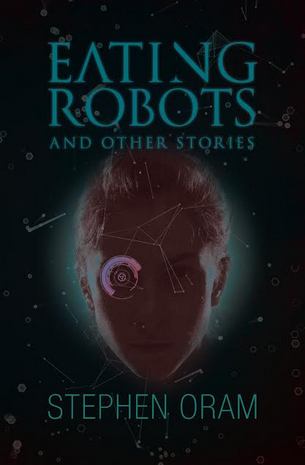
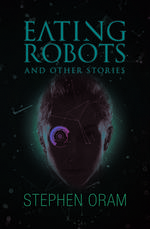
Eating Robots by Stephen Oram Book Tour

Welcome to our Book Tour stop for Eating Robots. Along with this blurb about the book, my take on it will be along in an hour or so (the link’ll work when the post goes live).

Book Details:

Book Title:  Eating Robots and Other Stories
Author: Stephen Oram
Category: Science Fiction, 107 pages
Publisher: SilverWood Books
Release date: May 31, 2017

Book Description:

The future is bright…or is it?

Step into a high-tech vision of the future with the author of Quantum Confessions and Fluence, Stephen Oram.

Featuring health-monitoring mirrors, tele-empathic romances and limb-repossessing bailiffs, Eating Robots explores the collision of utopian dreams and twisted realities in a world where humanity and technology are becoming ever more intertwined.

Sometimes funny, often unsettling, and always with a word of warning, these thirty sci-fi shorts will stay with you long after you’ve turned the final page.


Buy the Book

Goodreads  Amazon India  Amazon US

Meet the Author:

Stephen Oram writes thought provoking stories that mix science fiction with social comment, mainly in a recognisable near-future. He is the Author in Residence at Virtual Futures’, Stephen Oramonce described as the ‘Glastonbury of cyberculture’. He has collaborated with scientists and future-tech people to write short stories that create debate about potential futures, most recently with the Human Brain Project and Bristol Robotics Laboratory as part of the Bristol Literature Festival.

As a teenager he was heavily influenced by the ethos of punk. In his early twenties he embraced the squatter scene and was part of a religious cult, briefly. He did some computer stuff in what became London’s silicon roundabout and is now a civil servant with a gentle attraction to anarchism.

He has two published novels – Quantum Confessions and Fluence – and several shorter pieces.

Website

Facebook

Twitter

Goodreads

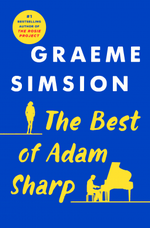
Pub Day Repost: The Best of Adam Sharp by Graeme Simsion

The Best of Adam SharpThe Best of Adam Sharp

by Graeme Simsion
eARC, 352 pg.
St. Martin’s Press, 2017
Read: April 17 – 18, 2017

If my life prior to February 15, 2012, had been a song, it might have been “Hey Jude,” a simple piano tune, taking my sad and sorry adolescence and making it better. In the middle, it would pick up—better and better— for a few moments foreshadowing something extraordinary. And then: just na-na-na-na, over and over, pleasant enough, but mainly because it evoked what had gone before.

That’s the first paragraph, and I’m betting 80% of reviewers will be quoting that — how can you not? You get a sense of Adam, his musical taste, how much music means to him/the way he thinks — and you get the novel’s mood. In the next few pages, you get an idea what Adam’s life is like in February 2012 — his relationship, his relationship with his mother, the nostalgia (and maybe more) he feels towards a country he lived in while he was young and his first great (greatest?) love.

Then we end the introduction with this paragraph that pushes us into the novel:

No matter now. I would soon have more immediate matters to occupy my mind. Later that day, as I continued my engagement with the past, scouring the Internet for music trivia in the hope of a moment of appreciation at the pub quiz, a cosmic DJ—perhaps the ghost of my father—would lift the needle on the na-na-na-nas of “Hey Jude,”say, “Nothing new happening here,”and turn it to the flip side.

“Revolution.”

On the flip side is an email from The One Who Got Away (“got” isn’t necessarily the best term — “slipped away”, “blindly walked away from”, “made the greatest mistake of your life with” — come closer). Angelina was a night-time soap actress that Adam had an affair with while he lived in Australia while working on a contract job in 1989. Over the next couple of chapters Adam reminisces about his time with Angelina — it’s a heckuva love story. It’s an even better doomed-love story since we all know it’s coming to an end, and he’s able to tell it that way.

This email is the first communication she’s attempted since she informed Adam that she was getting married before he had a chance to come back.

We also get a compressed history of Adam and Claire (his might-as-well-be wife), their 15+ year relationship — the ups, downs, and obvious commitment. Even if the romance is largely gone, there’s something strong under-girding their bond. Right? Maybe? Probably? And I do mean compressed — their decade and change is given less space than the few months Angelina and Adam have. We also see what’s going on in the Spring of 2012 with their relationship, and how this new email correspondence fits in with Adam’s life.

Part II of the book is focused on what happens when Adam and Angelina reconnect in person for a few days months later. Which is really all I can say about that. Well, it takes almost the same amount of space as the first part (ecopy, so I can’t do page counts, so these are just estimates) — so it’s obviously a lot more detailed.

I loved Part I — totally. The feel of it, seeing the changes for the better that Adam goes through thanks to the confidence boost that emailing Angelina gives him. Watching his relationship with Claire improve at the same time. All the while enjoying the 1989 story, too, sharing that feeling of nostalgia and more with him. It’s just so well done.

But Part II? I had serious problems with. I cannot detail them without ruining the book for you all. But people just don’t act the way most (if not all) of our primary characters do here. There are just too many psychological, emotional, spiritual and moral problems with what happens, how people react (both in the heat of the moment and in the cool light of day) — people, real people, just can’t do this and survive in any meaningful fashion.

We also do meet Angelina’s husband, Charlie, and I have so many conflicting opinions about him — on the one hand he appears to be good guy, generous, gracious (and other positive adjectives that don’t start with “g”) . . . but he’s dishonest with everyone (possibly including himself), manipulative, cold, calculating . . . I want to state that he’s not physically or mentally abusive, because my description of him almost sounds like it. Things would be less murky if he was.

Angelina is equally troubling — both in how she acts toward Charlie, her children and Adam. I’m not incredibly certain that I’m pleased with the way she treats herself (or if she’s true to her chosen vocation or character). I can understand a lot of how Adam comports himself, but at some point, I needed him to call the whole thing off (anyone else could’ve, but it wasn’t in their character at the moment).

The whole thing at the point became the car wreck you pass by on the Interstate and try to not gawk at.

I can’t find the exact quotation, but Nora Ephron said something about Sleepless in Seattle not being a love story, but a story about movie love (Rosie O’Donnell’s character says something similar in the film). About the only way I can handle huge portions of this book is thinking of it in similar terms — Part II isn’t about actual love, romance/commitment between two human beings — but it’s about love in fiction, romance/commitment between two fictional characters. If I think of Adam and Angelina (and Charlie and Claire) as actual people, I feel a mix of pity and repugnance for all involved (well, no repugnance for one of them, but I’ll leave it at that) — along with a strong desire to get a pastor and/or psychologist to their doorsteps. But if I think of them as fictional characters — which, I guess is what they are, as much as one doesn’t like to admit that — I can feel that revulsion and sympathy and just hope that they’re able to have decent lives.

But the writing? Simsion’s craft here is what kept me going through my distaste — and what’s going to compel me to give it a higher rating than I initially thought I would. Everything I thought/hoped he was capable of after The Rosie Project is on full display here — and, honestly, Adam Sharp is probably a better novel than it’s predecessors. Yes, there are comic moments, but this isn’t as funny as the Rosie books, so don’t look for a similar experience. But the emotional palate is richer, more varied — deeper.

The use of music throughout — as Adam’s refuge and outlet, the way that he bonds with people, and the songs used for various purposes — is just dynamite. Well, almost dynamite — Cher’s “Walking in Memphis” rather than Marc Cohn’s? Really? (both in the playlist and novel) One of the problems with musicians in novels who write their own material (Alex Bledsoe’s Tufa, Andy Abramowitz’s Tremble, Hornby’s Tucker Crowe, etc.) who use other’s songs, is that you have to imagine the music, imagine the skill, imagine the feeling. But with Adam (or Doyle’s The Commitments) you can take a shortcut through that and know exactly what feelings, sounds, rhythms, and so on are to be conjured up (Simsion gives us the exact album version sometimes so we can’t get it wrong). I’m sure there are articles to be written about the music here and how it serves, propels, shapes the plot — but I don’t have that kind of time.

Oh, I can’t forget to mention — the official playlist for this is killer. I wish I’d have had an Internet connection available while I was reading it, I’m sure it’d have been a bonus. It’s definitely helping while I write — but there’s some good stuff there for just good listening.

I was genuinely excited to read this book — while I wasn’t especially taken with The Rosie Effect, I loved The Rosie Project — I’m pretty sure it made my Top 10 that year, and I recommended it to everyone I could think of online and in person. So when a new book by Simsion was announced — and not another Rosie book — I preordered it, and jumped on the opportunity when I saw it on NetGalley. And then that Introduction hooked me hard. Part I was wonderful. But man . . . I just couldn’t handle Part II. Which leaves me in a pickle when it comes to this post, you know?

I admired this book more than I enjoyed it — though I need to stress I really enjoyed parts of it. I’d love to heartily recommend this, I wish I could — but I can only do so with reservations. There’s so much I object to going on in these pages that I can’t, while I can respect Simsion’s work — and I know this book achieved everything he wanted. I’ll give it 4 Stars on merit, not my own enjoyment.

Disclaimer: I received this eARC from St. Martin’s Press via NetGalley in exchange for this post — thanks to both for this.
N.B.: As this was an ARC, any quotations above may be changed in the published work — I will endeavor to verify them as soon as possible.

—–

4 Stars

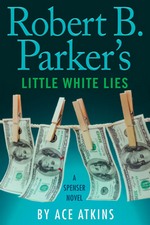
Pub Day Repost: Robert B. Parker’s Little White Lies by Ace Atkins

Really, all I want to say about this book is: “Yes! Atkins did it again — it’s just so good, folks. Long-time fans’ll love it, new readers will likely see the appeal of the series. A lot of fun with a great ending!” But that seems a little surface-y and is just bad writing. But really, that’s everything I’ve got to say.

Little White LiesRobert B. Parker’s Little White Lies

by Ace Atkins
Series: Spenser, #45eARC, 320 pg.
G.P. Putnam’s Sons, 2017
Read: March 16 – 17, 2017

Pearl and I were off to Central Square . Her long brown ears blew in the wind as we drove along Memorial Drive against the Charles. Rowers rowed, joggers jogged, and bench sitters sat. It was midSeptember and air had turned crisp. The leaves had already started to turn red and gold, shining in Technicolor upon the still water.

I debated about what quotation I’d open with — I went with this Parker-esque (and Atkins-esque) description. Little White Lies is one of the better of Atkins run on this series, because (like here) he did something that feels like something Parker would’ve written, but not quite what he’d have said (the more I think about it, the less I think that Parker’d have said “bench sitters sat”).

Actually, that’s true of the other quotation I almost used, too:

I nodded , adding water to the new coffeemaker sitting atop my file cabinet. I’d recently upgraded from Mr. Coffee to one of those machines that used pre-measured plastic cups. I placed my mug under the filter, clamped down the lid, and returned to my desk. Demonic hissing sounds echoed in my office. Where have you gone, Joe DiMaggio?

This is Atkins sixth Spenser novel, and you’d think he’s got enough of a track record that I could stop comparing him to Parker. Well, you’d be wrong — I can’t stop. This, like most of Atkins’ work on this series, is so reminiscent of early Parker novels that it makes some of the latter Parkers look more like they were written by a hired gun. Still, I’m going to try to keep it to a minimum because it doesn’t seem fair to keep doing.

Susan has sent one of her clients to Spenser for some help that she can’t provide. Connie Kelly had been dating someone she met online, invested in one of his real estate deals — and he vanished, taking the money with him. Could Spenser track him down and get her cash back? Sure, he says. It doesn’t take long for the investigation to show that he owes plenty of people money — a couple of months rent here, hundreds of thousands of dollar there.

Here’s the fun part: M. Brooks Welles, the deadbeat in question, is a silver-haired, silver-tongued mainstay on cable news. He’s former CIA, and an expert on military and national security issues — one of those that producers call on regularly when they need a talking head. Why’s a guy like that flaking out on real estate deals? Spenser knows something fishier than expected is going on — which takes him into a world of mercenaries, gun deals, and the ATF.

Then someone tries to kill him. A couple of times. And the book stops feeling like a semi-light adventure, poking fun at the blowhards on cable TV and the state of American Journalism, and how we shouldn’t trust as many people who have cameras pointed at them as we do. Things take on a different tone, bodies start piling up, and a darkness slips in to the book. This also brings in Belson and his new boss — who’s still not a fan of Spenser. About the same time, Connie starts to waver in her conviction that she wants her money back and Welles punished. Spenser, naturally, doesn’t care and plows ahead. Hawk is able to connect Spenser with some mercenaries that travel in the same circles as Welles and the chase is on. Eventually, the action moves from Boston and its environs to Georgia. Which means that Teddy Sapp is going to make an appearance.

All the characters were great — I would’ve liked some more time with some of Welles’ co-conspirators in Boston, I think it’d have helped round out our picture of his crimes. But it’s a minor complaint. We also got plenty of interaction with his Georgia-based colleagues. Even the characters that show up for a page or two as witnesses to the crimes were interesting — it’s the little things like those that add so much. It was nice to see Teddy Sapp again, too. He was the best part of Hugger Mugger (faint praise, I realize). The Hawk material was very good — maybe Atkins’ best use of the character yet.

I fully expect that people are going to spend a lot of time talking about the ending — it didn’t feel like a Parker ending. That said, it felt like an ending that pre-A Catskill Eagle Parker might have tried. It was satisfying, don’t misunderstand, it’s just not the kind of ending that Parker employed. Honestly, there were two other perfectly acceptable places to end the book — and if not for the progress bar at the bottom of my screen, I might have believed that thee ending was earlier and equally strong.

Now, because Atkins and the Parker estate aren’t stupid, there are certain characters that you just know are safe, no matter what shenanigans that they’ve let Atkins and Coleman get away with when it comes to killing off long-term supporting characters. But there was a definite feeling of peril when it comes to [name redacted] and [name redacted]. Sure I knew they’d live to be read about another day, but I wondered how healthy they’d be in the meantime.

This is sharply written, as usual. Atkins knows what he’s doing (in this series or anything else) — a great mix of character moments and plot. Spenser’s voice is strong — as are the voices of the other regulars. It was just a pleasure to read through and through. Let me leave you with one more snippet that is could’ve come from an early-80’s Spenser just as easily today’s, a voice like this is enough reason to read the book — the rest is just gravy (and there’s plenty of gravy):

I returned with sore legs back to my seat on the steps. I spent the next fifteen minutes watching women of all ages, sizes, and colors walk past me. I liked the way most women walked. I liked the way they dressed. And talked and smelled. I was pretty damn sure I was a fan of women in general. Did this make me a sexist or a feminist? Or somewhere in between.

Disclaimer: I received this eARC from Putnam Books via NetGalley in exchange for this post — thanks to both for this.
N.B.: As this was an ARC, any quotations above may be changed in the published work — I will endeavor to verify them as soon as possible.

—–

4 1/2 Stars

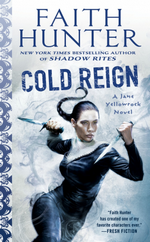
Pub Day Repost: Cold Reign by Faith Hunter

Cold ReignCold Reign

by Faith Hunter
Series: Jane Yellowrock, #11

eARC, 384 pg.
Ace, 2017

Read: March 6 – 9, 2017


Lee Child (and others, I’m sure) has said something along the lines of the key to writing a long-running series is that in each book you give the readers exactly the same thing, only different. Here in book 11 of the Jane Yellowrock series, that’s exactly what Faith Hunter has delivered — Jane Yellowrock up to her neck in revenant vampires, schemes within schemes within schemes, and dealing with the Big Cat that shares her body — but in a new way, with different (yet the same) schemers, a different kind of revenant, and new challenges and revelations about her Beast.

The tricky part of this is coming up with something to say . . . I mean really, the fact that I’m still reading the series 11 books in pretty much demonstrates that I’m a fan and that I’m predisposed to like this — both in its sameness and differentness. I like spending time with Jane and the rest (particularly Eli, Alex and Bruiser), seeing her navigate through this wold, and beating people up/taking out vampires. The “same” stuff is as good as always (maybe even a little better), so what about the “different” stuff?

There’s a lot to cover on that front, actually — I can’t cover it all, that’s Hunter’s job (and she’s so much better at it). But I can do a little. This book takes place sometime after Curse on the Land (yay, multi-series continuity!), and long enough after Shadow Rites that Jane’s started to come to terms with her expanded household and all that it entails (please note the use of the word, “started” — I’m not sure she’s quite finished even at the end of this one). But that’s just the beginning. There are a handful of revenants popping up — but they’re not the kind that Jane is used to dealing with. And their presence might be signalling something significant.

The Youngers have evolved somewhat — Alex is maturing, and even getting out of the house a little — but he’s still the same dude. Eli — wow, we see so many sides of him here that we hadn’t before (maybe saw hints of, but not like this), I loved every bit of the Eli material here — and man, did he make me laugh. He also made me get a little bleary eyed at one point — something I couldn’t ever imagine that I’d say.

Beast does something that I don’t think we’ve seen before — she has something going on that she’s keeping from Jane. There’s something she knows, maybe something she did, that she’s blocked Jane’s knowledge of . That’s scary — kinda cool — but mostly scary. The repercussions of Beast doing things without the human part of her knowing, there’s a couple of books right thee.

Naturally, the biggest differences come from growth and changes to Jane herself — at one point, she says

My life was so weird I scarcely recognized it.

The only reason readers can recognize it is that we’ve followed the series — if someone made the strange decision to read Skinwalker and then jump to Cold Reign, I bet they’d barely recognize the protagonist. The changes in her abilities, her shifting (but not totally shifted) feelings towards vampires and their practices, her love life, her friends, her understanding of her past, etc., etc. — she’s come a long way, mostly for the good, I think. There’s even a sentence I identified in my notes as “possibly the sweetest, sappiest thing to come out of Jane’s narration.” I decided not to include it here, but fans will gush over it. I just know it.

None of that means that when it comes time for bringing the pain that Jane’s not up to it — in fact, thanks to recent events, she’s better at it than ever. Her use of the Gray Between (which is bordering on being over-used), is improved here — she’s able to handle it better and uses it to her great advantage. Yeah, she might be not be that recognizable, but she’s a better character for it.

The core of this book — plotwise, anyway — comes back to the looming summit with the European Vampires, while Leo continues preparing for it, some things start happening that make he and his Enforcers begin to think that maybe the EVs are already in New Orleans and doing what they can to undermine him before anything official happens. Hunter, like many authors, has really taken advantage of the long-lived nature of vampires and how they’ll use that for long-range planning. In Cold Reign we see that used very well — as I mentioned before, there’s a new kind of revenant running around New Orleans — and there’s no good explanation for how that’s happening (there’s a pretty diabolical explanation, however). This brings us back to the first time Jane stuck her toe in the water of Leo Pellisier’s plans, and the early defenses against insurgents that Jane mounted on his behalf. Plots and schemes that we thought we were done with (if only because the plotters and schemers were no more), are brought back up and put into a new light in a very convincing manner. If Hunter said that she’d been planning these moves since book 2 or so, I’d believe her — I’d also believe her if she said that she needed something for this book and took advantage of some of material from her early books. Either way, she does a very clever job of it.

There’s a little bit of Soulwood in Cold Reign. We get a mention or two of Nell Ingram. Rick LaFleur is around doing PsyLED stuff — without the rest of his team, sadly. Soul is seen a few times, but doesn’t do much (but what she does is pretty cool).

I’ve long enjoyed Jane’s calorie-rich dietary needs and the abandon with which she dives into her food — and I think I’ve noted with both books, how fun it is to watch Nell Ingram sample junk food. But I think in Cold Reign, Best trumps them both — she eats her first taco. And I found it delightful, really, literally laughing out loud. I’ve decided that what Hunter’s fans need is a Food Network-style show featuring Jane, Nell and Beast trying various foods — I’d just love it.

The ending came a little quicker than I expected (possibly was confused thanks to the Soulwood preview at the end tweaking the percentage — but even without that, it seemed sudden). Which isn’t a bad thing, and probably says more about me than anything about the book — maybe I just wasn’t ready to say “see ya later” to Clan Yellowrock yet. Without spoiling much, there wasn’t a lot of resolution here — there was enough — but not as much as you might expect. The threat to Leo is still out there, and Jane et al. have their work cut out for them to prevent a European Vampire takeover.

Another winning tale of Vampire Politics, New Orleans weather, Magic, Big Cats and blood — lots and lots of blood. At this point, I’m not sure Hunter can do anything wrong with this series — and I hope she doesn’t prove me wrong anytime soon. Get your orders in now folks so you can dive on it on May 2.

Disclaimer: I received this eARC from Berkley Publishing Group via NetGalley in exchange for this post — thanks to both for this.
N.B.: As this was an ARC, any quotations above may be changed in the published work — I will endeavor to verify them as soon as possible.

—–

4 1/2 Stars

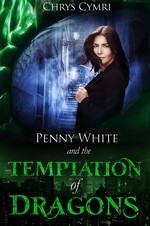
The Temptation of Dragons by Chrys Cymri

The Temptation of DragonsThe Temptation of Dragons

by Chrys Cymri
Series: Penny White, #1

Kindle Edition, 232 pg.
2016

Read: April 24 – 26, 2017


Penny White, an Anglican priest of a small town who seems to be working on becoming a functional alcoholic, is driving home one night when she feels her car hit something. She stops to investigate and comes across a dragon who claims to be dying and requests last rites. Without thinking, she gives them, gets home without further incident and goes to sleep. By the next morning, she’s convinced herself it didn’t happen.

Until the next day, when her bishop asks her to take a role in ministering to magical creatures like dragons, unicorns, vampires, and more in a parallel reality to ours. Being a pretty big fan of SF/F, she jumps at the chance, and ends up ministering in both worlds. A gryphon named Morey is assigned to live with her and help her navigate between the two worlds (and other reasons). Actually, his name isn’t Morey — it’s something long and fairly unpronounceable because it’s Welsh — in the magic reality, everyone speaks Welsh.

I really dug Penny — I could understand her emotional arc and thought it was dealt with in a pretty solid way (I’m a little worried about the semi-triangle thing set up here, and hope it doesn’t get too overplayed in future books). But a big part of Penny’s character — and what helps her adjust to this new life — is her SF/F fandom. I share most of her tastes (including her love for the Seventh Doctor and Ace). Morey was another strong character, and I appreciated that there was a pretty strong theologically conservative voice sympathetically portrayed in this book — I didn’t expect to find myself agreeing with a gryphon’s theology more than with a human’s (a clause I never thought I’d write) — even if there was a patronizing explanation offered by one character (and seemingly shared by others) for his stances. His emotional arc was just great.

The rest of the characters were almost as engaging as these — human or not, they were people. Many of them need more time to be developed, but given the constraints of this one novel, I didn’t think many of them got short-changed.

I thought the plot was pretty strong, and I did quite enjoy it — particularly Penny’s search for balance between her two callings, Penny and Morey’s bonding, and Penny’s family life. But the books isn’t that much about the plot — this is primarily about the characters and relationships throughout. This was more about setting up the series, introducing the characters, species, and worlds — all of which Cymri did very capably. But the book’s core was in the character moments, the characters themselves and this very interesting world that we’re starting to learn about.

This is a comparison that won’t mean much to most of my readers, I imagine — but for those who get when I’m saying, you’ll understand this book. This book reminded me of reading the early volumes of Christopher Stasheff’s Oathbound Wizard series — I think it’s more than intelligent, articulate fantasy monsters and an Anglican/Roman Catholic approach to faith, the sacraments and the world, but that’s part of it. Mostly, it’s the warmth, confidence and charm in these pages that lured me in and kept me interested.

This is truly a lot of fun, give it a shot.
Disclaimer: I received this book from the author in exchange for this post — thanks so much for this. Sorry it took so long.

—–

3 Stars

April 2017 Report

Not as successful as March — in number of things read, or in the quality — there were some things I really didn’t cotton to (which took me longer to read than I prefer). Thankfully, there were a couple of standouts, and a couple of very nice reads, even if I didn’t go ga-ga over them.

So, here’s what happened here in April.
Books/Novels/Novellas Read/Listened to:

Still Reading:

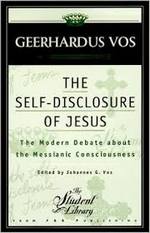
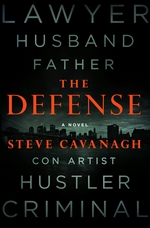
A Biblical-Theological Introduction to the Old Testament The Self-Disclosure of Jesus The Defense

Reviews (or whatever you call my posts) Posted:

How was your month?

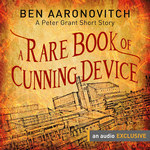
A Rare Book of Cunning Device (Audiobook) by Ben Aaronovitch, Kobna Holdbrook-Smith

A Rare Book Of Cunning DeviceA Rare Book Of Cunning Device

by Ben Aaronovitch, Kobna Holdbrook-Smith (Narrator)
Series: The Rivers of London, #5.6
Unabridged Audiobook, 29 min.
Audible Studios, 2017

Read: April 28, 2017


This is an audio-only release (for now anyway) about Peter (and Toby) go looking for a poltergeist in the stacks of the basements of The British Library. Harold Postmartin was hanging out at the Folly when Peter got the case, and wouldn’t let him shrug it off for awhile, so he got to do a little field-work, too.

It was fun to see Postmartin in action and learn a bit more about him. Peter and Toby were their usual entertaining selves. The Librarian (who’s name I can’t remember, sorry), was fun — the tie-in with Peter’s family was, nice too. The Library (in both fact-based and clearly UF ways) was an interesting place, and I can easily see the need for Peter to return there on another case.

Holdbrook-Smith is just fun to listen to, if I heard another couple of books in this series, I’d probably hear him in my head for any future Peter Grant/Rivers of London books. Top-notch stuff there.

I gripe too much about short stories being to short, so I’ll try not to here. This was a complete story, but it very easily could’ve gone on — in fact when the file ended, I pretty much thought that my headphones ran out of juice. It was good enough to satisfy, but not so good that I can’t grumble about it being short. This was fun, and though I’m not sure how giving a story away works to earn money for a library charity, I’ll trust that it does some how and hope that it meets with plenty of success.

—–

3 Stars

Page 4 of 4

Powered by WordPress & Theme by Anders Norén