Month: May 2017 Page 3 of 4

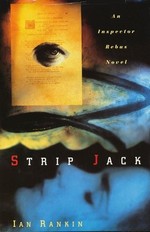
Strip Jack by Ian Rankin

Strip JackStrip Jack

by Ian Rankin
Series: John Rebus, #4

Hardcover, 206 pg.
St. Martin’s Press, 1992

Read: May 3 – 4, 2017


This is the one — the book that finally sold me on the John Rebus series (I say “finally” as if it’s been a years’ long effort, not just book 4). Everything worked for me here.

Rebus is trying to track down a rare book thief, and puts as much effort into that as you’d imagine most fictional detectives putting into it. Thankfully, it doesn’t eat up so much of his time that he can’t accompany others from his station — including Chief Superintendent “Farmer” Watson — on a raid of a brothel in a pretty nice part of town. Most of the men can’t believe they’re doing this raid, Rebus is chief among them. But, an order is an order, so they suit up and go in. While there, Brian Holmes finds a pretty popular MP in a room with one of the “employees.”

This is MP is named Gregor Jack — his background is pretty similar to Rebus’ and the detective has always admired him (at least his public persona), and something just doesn’t feel right about the way things went down with the raid and Jack’s involvement (and exposure), so he starts checking in on Jack at home. There’s something strange going on with Jack’s wife, Elizabeth — she’s not at home, and Jack doesn’t know if she even knows about the headlines about the raid and ensuing controversy. Rebus finds it a bit odd that someone like him would know so little about his wife’s whereabouts, between his curiosity and interest in the MP, he starts poking around a bit — which turns out to be fortuitous later on.

The ensuing mystery is pretty good — especially when it becomes Rebus vs. the higher-ups as they narrow the list of suspects. I liked Rebus’ method this time a little more than the previous books, it’s a bit more methodical (even when he’s mostly going with his gut, there’s still thinking behind it). Could the mystery-solving — and the novel as a whole — be a bit meatier? Yeah, but it’s not to sketchy on details. I just think that the Rebus novels would be better if they were Bosch-length.

In the previous books, I thought there were a couple of passages that were so well written that they lifted the quality of the whole book. I didn’t come across anything in particular like that, not that the writing was bad, but there wasn’t anything that jumped out at me. One very nice touch — not in the language, but in the idea and how it worked — was when Rebus was interviewing one of the Jacks’ old friends in a mental hospital and the friend asks Rebus to touch the ground for him, since that’s something he doesn’t get to do any more. When Rebus does this, and when he tells the friend about it later — just perfect.

I really would’ve liked more time with Gregor Jack and his staff — I liked the interactions between Rebus and each of them, but it’d have been hard to pull off. Most of the rest of the suspect pool weren’t terribly interesting. The friend in the hospital, isn’t really a suspect (for obvious reasons), but he does give some insight into the case — he was a well-written character and I liked the way that Rankin was able to work him into the story in a couple of ways.

Holmes reminds me of Luther‘s DS Justin Ripley (although I imagine Holmes as taller — not sure there’s a reason for that) — I like the fact that he’s sticking around, I expected him to vanish after his first appearance. I don’t know if he and his girlfriend will stick around, but I’m enjoying him as an errand boy/accomplice/hindrance for Rebus. He’s not the only returning face — Gill Templer is a pretty significant factor in the off-the-clock Rebus story, which primarily centers around his growing (yet, I expect, doomed) relationship with a doctor.

Oh, I should mention that Rebus does find the book thief (with book obsessed readers like we have on this blog, you have to assure people that the books are okay), and it (naturally) has plays a role in the novel’s greater story.

This tale of the determined and dogged detective who keeps on trying, even when he has no reason to, really worked for me — clicked every one of my procedural buttons. I hope Rankin delivers more like this book.

—–

4 Stars
2017 Library Love Challenge

Saturday Miscellany – 5/13/2017

Man, I don’t know why I’ve been so quiet lately. I’ve been trying to finish posts this week, but haven’t managed to get anything ready to publish. Which is bad, because I have a backlog of things that I’m very excited to talk about, and I can only do so much at a time.

In the meantime, I did manage to cobble together a list of odds ‘n ends over the week about books and reading that caught my eye. You’ve probably seen some/most/all of them, but just in case:

Lastly, I’d like to say hi and welcome to Abinotronix, martyn james, and Jeyran Main for following the blog this week.

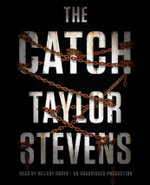
The Catch (Audiobook) by Taylor Stevens, Hilary Huber

The CatchThe Catch (Audiobook)

by Taylor Stevens, Hillary Huber (Narrator)
Series: Vanessa Michael Munroe, #4

Unabridged Audiobook, 13 hrs., 35 min.
Random House Audio, 2014

Read: April 4 – 10, 2017


After the events of The Doll, Michael had to hit the road. She bounced around a little, before landing in Djibouti — doing some small time work for a security company. She’s forced into working guard duty on a ship bound for Kenya — which turns out to be a gun-smuggling vessel that’s attacked by Somali pirates. Michael being Michael, after determining that she couldn’t prevail on her own, she gets off the boat, taking the captain with her.

This sets her off on a solo adventure — she makes phone contact with Miles a couple of times, briefly, but he’s really not a factor here. It’s Michael, her wits, her skills and a couple of allies she makes along the way that will try to rescue the ship, her fellow guards and the captain from the pirates and a crew of Russians with an unhealthy focus on the captain.

This novel pushes Michael to her physical limits — but pretty much leaves her psychologically undamaged. She has to prove herself to both herself and her allies here. She doesn’t have the resources she usually has, she doesn’t have the backup readers are used to her having, and she’s more out of her depth than usual (she almost seemed more in control of things in as a captive in The Doll).

I really enjoyed this — knowing that Miles wasn’t going to be in this too much, I wasn’t as interested as I could’ve been (I didn’t realize how much of a draw he was for me). But Michael on her own actually worked for me — and I liked seeing her having to scramble to survive.

Huber did a great job as usual — handling several accents with (seeming, I’m sure) ease, while maintaining both the emotions of Michael and the tension and suspense of the novel’s action.

Another satisfying entry in the series.

—–

3 Stars

Pub Day Repost: Nearly Nero by Loren D. Estleman

Nearly NeroNearly Nero: The Adventures of Claudius Lyon, the Man Who Would Be Wolfe

by Loren D. Estleman
eARC, 192 pg.
Tyrus Books, 2017
Read: March 24 – 30, 2017

I’ve heard about the stories in this volume for years, but have never tracked one down before — and then a whole collection of them show up on NetGalley! How could I not request it? I’m so glad this book exists so that those of us who don’t get the magazines, etc. that publish short mystery fiction can have them (and even those who do have access to those magazines, etc. can have them in one handy volume).

Anyway, here’s the setup: Claudius Lyon is a huge fan of Nero Wolfe — he reads every one of the reports that Archie Goodwin’s literary agent Rex Stout publishes. He’s such a fan that he wants to be Wolfe (like the guys dressing up in Batsuits in The Dark Knight Rises) — he’s fat, fairly clever, and wealthy enough not to need to work and still indulge himself. He renovates his townhouse to include a greenhouse, an elevator, and a first floor floorplan that pretty much matches Wolfe’s. He hires a private chef — a kosher chef of dubious quality (not that Lyon needs to eat kosher, it’s just what Gus can cook), changes his name to something that approximates his hero’s and hires a “man of action,” Arnie Woodbine. Arnie’s an ex-con, small-time crook who doesn’t mind (too much) putting up with his looney boss for a steady paycheck and meals.

The number of ways that Lyon isn’t Wolfe is pretty large and I won’t spoil your fun in discovering them. Now, Lyon’s unlicensed as a PI, so he can’t take on paying clients — but he occasionally gets people who will take him up on his free services. He’s decent at solving puzzles and low-priority mysteries (not that he doesn’t find his way into something bigger on occasion). Once he gets a client (non-paying, Arnie’d have me stress), he goes through whatever steps he needs to figure it out (including his own version of Wolfe’s lip movement and sending Arnie on fact-finding missions), and goes to some lengths to assemble some sort of audience for his reveal. I can’t help smiling as I think about it, really.

The whole thing is a tongue-in-cheek tribute to the Nero Wolfe/Rex Stout — recognizing the brilliance of the Stout’s work (how can you not?), while poking fun at it. Lyon’s really a goofy character and Woodbine is great at pointing that out — while begrudgingly admitting that he gets things right every now and then. There’s a lot of fun to be had in the story telling — the mysteries aren’t all that much to get excited about, it’s in watching Lyon stumble through his cases that the entertainment is found. Well, that and Woodbine’s commentary.

Not unlike many of the Wolfe stories (particularly the short stories).

I wouldn’t recommend reading more than two of these stories in a sitting, I think they work best as solo shots. It’s a difficult call, because I typically wanted to go on for one more. Also, I’m not sure how enjoyable these’d be for non-Wolfe readers — but then again, I think a lot of the humor would hold up and it might entice a reader to learn more about Lyon’s idol. And anything that gets people to read Rex Stout’s Nero Wolfe novels is a good thing.

But for readers of Stout’s Wolfe novels? This is a must read. He’s not trying and failing to recapture Stout’s magic (see Goldsborough post-The Bloodied Ivy), he’s intentionally missing and yet somehow getting a little of it. I really enjoyed this book and can easily see me re-reading it a handful of times.

Disclaimer: I received this eARC from Adams Media via NetGalley in exchange for this post — thanks to both for this.

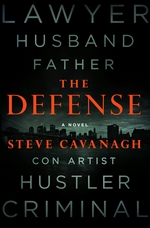
The Defense by Steve Cavanagh

The DefenseThe Defense

by Steve Cavanagh
Series: Eddie Flynn, #1

Hardcover, 306 pg.
Flatiron Books, 2016

Read: April 28 – May 1, 2017


Eddie Flynn is a con artist who went legit — mostly. There’s a lot of call in his new life for the skills he developed in his old. He’d been pretty successful until a horrible outcome tied to his last case sent Eddie around the bend — he’d vowed never to get back into the courtroom. He just couldn’t handle anything like what had happened again. Until the head of the Russian mob in New York is up on murder charges.

So what brings Eddie back to defending accused criminals? Well, it’s that old story that we’ve all heard a million times — he’s abducted by the Russian mafia, had a bomb thrown on to him and the only way that keeps that from blowing up is his continued compliance — but that’s not all: Eddie’s daughter has also been kidnapped and his being held hostage. All Eddie has to do is keep the case going long enough for the Prosecution to bring out its big witness from protective custody so that the bomb Eddie’s carrying can be used to kill the witness.

Not a plan Eddie’s crazy about, but it’s not like anyone consulted him. He dives into the defense like his life depends on it (oh, wait . . . ), and comes to a couple of conclusions: 1. He and his daughter are not going to live, no matter what the kidnappers said — unless he pulls a rabbit out of a hat; 2. there’s something strange going on with the case that just doesn’t make any sense; 3. there’s something strange going on with his client’s men; and 4. he just might know how to win the case without anyone having to be blown up.

While we see Eddie’s efforts to defend his client and to get freedom for himself and his daughter, we also get flashbacks to the calamity of the previous year, Eddie’s childhood and criminal career, his relationship with his daughter and more. Cavanagh handles the balancing act between the background and the ongoing action well — the past informing and shaping the present, while keeping things tense for the now. How Cavanagh pulls that off in 300 pages, I’ll never know. And it is tense throughout — Eddie barely gets a chance to breathe, it’s a good thing he has a lifetime of thinking quickly on his feet, or there’d be no hope for him.

I liked Eddie almost immediately — you have to, or you’re not going to enjoy this book. He’s one part Mickey Haller, one part Andy Carpenter, one part Nicholas Fox — a slick, clever and tough lawyer, basically. His friends were interesting and his opponents were just what you want in antagonists. There was real threat, real peril throughout, yet you always knew that Eddie Flynn had a trick or five up his sleeve.

The last chapter felt more like the wrap-up of a stand-alone thriller than it did the first novel in a series. Not that it precluded further adventures, it just didn’t point to them the way series generally do, but clearly Cavanagh didn’t let that stop him — book 3 comes out in a couple of weeks. I’m looking forward to spending more time with Eddie soon, myself.

—–

3.5 Stars

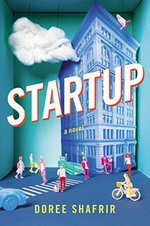
Startup by Doree Shafrir

StartupStartup

by Doree Shafrir

eARC, 304 pg.
Little, Brown and Company, 2017

Read: May 2, 2017


It’s hard to give a thumbnail pitch for this book — my gut wants to compare it to Coupland’s Microserfs, just because I liked that so much. But it’s more like a feminist Po Bronson’s The First $20 Million Is Always the Hardest, I think. It’s been about 20 years since I read that, and my memory is more than fuzzy on the details. It’s about web/app-based companies in New York and the strange (especially to outsiders) culture that surrounds them. You don’t have to know a lot about tech — or venture capitalism — to appreciate this, however. You just have to know about people.

Because at the end of the day, this book isn’t really about startup culture, apps or technology — it’s about people. There are 5 central characters — and a couple that hover around central — to this book, and yes, they’re all involved with startups, but that’s just where they happen to be. You could set this novel in the Wall Street culture of the mid 80’s and not have to change much about it at all, because the relationships, the people are what matter — not the industries/subcultures they’re in.

You’ve got Mack McAllister — the driving force and face of TakeOff — an app promoting mindfulness, happiness and productivity; he seems pretty harmless (initially, anyway), but gets reckless with money and sloppy with interpersonal issues — when that starts to snowball out of control, he then crosses the line into something worse. Isabel is in charge of Engagement and Marketing for TakeOff, she had a little thing with Mack awhile ago, but has started to see someone else recently. Sabrina works for Isabel, is ten years her senior, but has just got back in the workforce after having kids — she’s got some money problems and a husband that seems to be checked out of the relationship and parenting. His name is Dan, and he’s an editor for a Tech News website — he’s pretty oblivious to a lot, really (like his wife’s problems) and the crush he has on one of his reporters (actually, he may be very aware of that, come to think of it). Her name is Katya, the child of Russian immigrants — a hungry reporter, trying to figure out just how to make it in the world where journalism is judged by quantifiable results (views, shares, retweets). Katya needs a break, and stumbles upon a story about Mack — and Isabel — and this could be the thing to solidify her position at the news site.

That’s all you really need to know going in — actually, I knew far less, so that’s more than you need to know. You take those people and their goals, their problems — but ’em in a blender and this book comes out. It’s pretty easy to see how — the part that isn’t obvious is how Shafrir accomplishes this. She does it by: 1. making these all very relatable characters, with strengths and weaknesses; 2. by making even the villains of the piece not that villain-y (I’m not saying, for example, that Mack is a paragon of virtue — he does some horrible things, but he never sets out to be horrible, he just ends up that way); 3. by making the heroes of the piece not all that heroic — just people trying to do (and keep) their jobs, while not screwing up the rest of their life.

I love the fact that Sabrina and Katya are both pretty serious grammar Nazis who find themselves in jobs where they have to do so much that violates grammar — it’s a nice touch, and I enjoyed their reactions to poor grammar. Similarly, Katya’s attitude toward smoking is a lot of fun to read about — but not really something you want to inculcate to kids, or even see in someone in real life.

This is Shafrir’s first novel, but she’s been writing for forever — most notably as an online journalist. She knows the world she’s depicting, she’s lived it and wrote about it — this is just a barely fictionalized version of her reality, so it reeks of authenticity. I have no doubt I could find people very much like her main characters without trying very hard if I put myself in the right cities. She’s not so close to this world that she can’t comment on it, nor is she so close to it that she’s bitter, nasty and cynical about it.

There’s a very slow build to this book — around the 40% mark, I noticed that while I was enjoying the book, appreciating the writing, and so on — I wasn’t really “hooked” by it, I wasn’t invested in any of the characters, which I thought was odd. So, I resolved to make note of when it happened, to see if it was an event, or a development with a character or whatever that prompted it. By the time I hit 80%, the hook was set (it happened well before then, but don’t ask me where), but there wasn’t anything that I could point to that did it. Just slowly but surely, these people and their individual struggles wormed their way into my subconscious. Which is a great way for a book to be — not that I mind those that hook you from the start, or those that a have a big, dramatic moment that grabs you — but those that gradually get you without you noticing.

The ending sneaks up on you — I really didn’t realize the novel ended when it did — I got to the words “Acknowledgements” on the next page before I realized that the book had ended. I really liked the way it ended (once I figured out it happened), even if I found the last sentence annoying. I still do, actually — but I see what she was going for and she achieved it. But I still would’ve liked a few more pages to follow that last sentence.

I can’t help feeling like I should have a lot more to say about this book — but I can’t figure out how to do so without giving everything away. So I’d better leave it by saying that I really liked these people, Shafrir’s writing, and the way she told a story. Startup was honest, heart-felt, compassionate, and real — this debut is as strong as it is winning. I hope to read more from Shafrir in the future.

—–

4 Stars

Disclaimer: I received this eARC from Little, Brown and Company via NetGalley in exchange for this post — thanks to both for this.

Saturday Miscellany – 5/6/2017

Odds ‘n ends over the week about books and reading that caught my eye. You’ve probably seen some/most/all of them, but just in case:

    A Book-ish Related Podcast Episode you might want to give a listen:

  • The Once and Future Podcast Ep. 152: Seanan McGuire/Mira Grant was very interesting — two of my faves on one episode.

    This Week’s New Releases I’m Excited About and/or You’ll Probably See Here Soon:

  • Robert B. Parker’s Little White Lies by Ace Atkins — one of Atkins’ best Spenser novels, my blog post on it
  • Cold Reign by Faith Hunter — Jane Yellowrock’s latest really rocked. Read my take on it.
  • The Dark Prophecy by Rick Riordan — the 2nd installment of the Apollo’s search for redemption.
  • The Best of Adam Sharp by Graeme Simsion — I had serious problems with this one, as you can read here, but there’s no denying that Simsion can write a compelling character (or two).
  • Tune Up by Joe Klinger — Klinger was the 2nd author I interviewed, and his answers remain one of my favorites. I’ve had the predecessor to this sitting on my Kindle for over a year. Hopefully having this one on the Kindle, too, will get me moving.

Lastly, I’d like to say hi and welcome to J. A. Allen for following the blog this week.

Wrath of an Angry God by Gibson Michaels – DNF

Wrath of an Angry GodWrath of an Angry God

by Gibson Michaels
Series: The Sentience Trilogy, #3<

Kindle Edition, 340 pg.
Arc Flash Publishing, 2015
Read: March 4 – 5, 2017


I’m posting this because: 1. I didn’t want to look like I was abandoning this series on a whim. 2. If I’m going to say that I’m going to finish books that authors give me, I’d better have a reason for not sticking with that.

I’m not posting this because I want to trash Mr. Michaels or his work. I am curious about what happens at the end of this series — I’ve read about 978 pages of it, and on the whole, have enjoyed it.

So why am I not finishing this? Because frankly, I don’t care what the justification you give (and I can think of several), raping your wife for her own good (at best) or to get her to conform to cultural norms (at worse) is just not something I’m going to read.

Is Everyone Hanging Out Without Me? and Why Not Me? (Audiobooks) by Mindy Kaling

Is Everyone Hanging Out Without Me?Is Everyone Hanging Out Without Me? (And Other Concerns)

by Mindy Kaling (with B. J. Novak, Michael Schur & Brenda Withers)
Unabridged Audiobook, 4 hrs. and 37 mins.
Random House Audio, 2011

Read: April 15, 2017

Why Not Me?Why Not Me?

by Mindy Kaling (with Mindy Kaling , Greg Daniels , B. J. Novak)
Unabridged Audiobook, 4 hrs. and 57 mins.
Random House Audio, 2015

Read: April 21 – 22, 2017

These are technically two books — and you can identify different themes in each, but really, they could be one book, so let’s talk about them at the same time. These are collections of humorous essays — some autobiographical, some not — from the pen of writer/actress Mindy Kaling. Is Everyone Hanging Out Without Me? covers her childhood and early career, while Why Not Me? focuses on more adult concerns, and her post-The Office career.

I thought the stories about her personal life and career entertaining, and well-told. But the other essays tended to be more creative and more amusing. But I found myself grinning or chuckling throughout. I’ve liked her before, but these books made me a fan.

My gut tells me that this is too brief, and I should say more — but I’m not sure what to get into. If you’re a fan of her TV work, or like intelligent and funny women (who can write), these are good reads.

Kaling is, naturally, the best narrator possible for these books — and probably many others (really, think Stephanie Plum as read by Kaling!). I think I liked the performance she gave for Is Everyone a little more, it felt less practiced? More energetic? I’m really not sure, but I wondered several times while listening to Why Not Me? why I didn’t like her narration as much. I could ‘t put my finger on it — but, it doesn’t matter, she was great with both. Just slightly less great.

Funny, heart-felt, maybe a little inspiring — these essays hit the spot.

—–

3 Stars

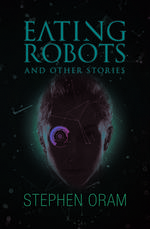
Eating Robots by Stephen Oram

this is going to be short, because I found myself saying the same thing over and over

Eating RobotsEating Robots and Other Stories

by Stephen Oram

eARC, 107 pg.
SilverWood Books, 2017

Read: April 27 – 29, 2017


I flipped through my thesaurus to find some decent synonyms for imaginative, because I need a few to talk about this collection. Didn’t find any that I liked, alas — this collection needs me to say something more than imaginative, just to avoid being dull and repetitive.

These stories are short — it’s not fair to call most of these stories, they’re more like scenes. Hints of a story, character studies, maybe hints of a scene — and on the one hand you can see most to of these happening in other parts of the same world — but they don’t have to, there could be a 30 different future realities represented here.

These are almost entirely too short. Some of the character moments are great — but even they don’t satisfy. The longer stories (there are not that many of them) barely seemed long enough to be a decent story — and they were good. There is a strong Twilight Zone feel to almost every plot and circumstance in the book — updated, like Rod Serling for the 21st Century.

I can not say it enough — Oram can write. He’s got a great imagination, and a mind for Science Fiction. But between the length and his approach, I just couldn’t get into any of the stories, I couldn’t care about anyone or anything in this book. I respect these stories, but I didn’t like any of them. I can easily see me being alone in that, though, if someone came along and told me that this was one of the best collections they read this year, I’d understand. I wouldn’t agree, but I could see where they were coming from. I hope Oram finds his audience (or that they find him), sadly, I’m not part of it.

I received a copy of this book from b00k r3vi3w Tours in return for this post. Thanks!

—–

3 Stars

Page 3 of 4

Powered by WordPress & Theme by Anders Norén