Month: October 2019 Page 2 of 6

Saturday Miscellany—10/26/19

So I saw a pretty decent bump in traffic this week thanks to The Write Reads featuring one of my posts as their Review of the Day, if you’re reading this because of them–hi! Thanks for stopping by. I’ve been meaning to say this for a few weeks now, but I keep forgetting—if you’re not following The Write Reads feeds on Twitter/Facebook/Instagram, you really should be. Their Post/Review of the Days are some of the best reading you’ll see from Book Bloggers out there. Sure, you’ll end up having too much to read (either posts or the books they talk about), but it’s worth it.

Anyway, here are the odds ‘n ends over the week about books and reading that caught my eye. You’ve probably seen some/most/all of them (especially if you follow The Write Reads), but just in case:

    This Week’s New Releases I’m Excited About and/or You’ll Probably See Here Soon — or, if I had more time, I’d get to (the last four of these fit into this category. I can’t see finding the time for them, but I bet it’d be worth it):

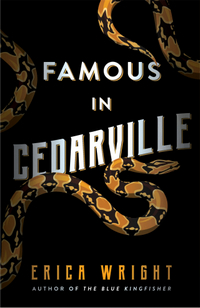
  • Famous in Cedarville by Erica Wright—a small-town mystery that leads to Hollywood in all it’s glory and vice. My post about the book.
  • The Night Fire by Michael Connelly—Bosch. Ballard. Haller. ‘Nuff said. I have 2.6 books to go before I get to this one. Yeah, I’m counting down already.
  • The Girl with No Face by M. H. Boroson—an Urban Fantasy set in 19th Century San Francisco’s Chinatown? Fantastic idea.
  • Ghoster by Jason Arnop—I’ve seen this title a lot this week, this social media satire/thriller looks like a good way to spend some time.
  • From Hell to Breakfast by Meghan Tifft—I’m not even going to try to summarize this one—click the link read more and get as tempted as I am.
  • Lifestyles of Gods and Monsters by Emily Roberson—Percy Jackson meets Reality TV?

Lastly, I’d like to say hi and extend a warm welcome to Anthony Day Grandin, Donald Wilson, lisasbooksgemsandtarot (say that five times fast), Adrianna and Scarlett Backus for following the blog this week. Don’t be a stranger, and use that comment box, would you?
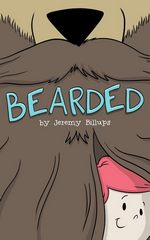
Reposting: Bearded by Jeremy Billups: A Charming Picture Book about a Bearded Bear

Local Artist, Picture Book Writer and All-Around Good Guy, Jeremy Billups’ third book is scheduled to release today. It’s called Bearded Too, the sequel to this here book. I’ll post about Too soon, but in the meantime, here’s a look back at Bearded.

Bearded

by Jeremy Billups
Hardcover, 34 pg.
Billups Creative, LLC, 2015
Read: September 5, 2018
Picture books about bears are everywhere—I have a hard time believing many kids get out of the picture book stage without exposure to at least 4 of them (and that’s before they’re at the Pooh or Paddington stage). But how many of those bears have been bearded?



Enter Jeremy Billups and his little book.

This is the story of a little red-haired girl (no, not that one) traveling the world with her bearded bear, having all sorts of adventures and meeting a bunch of different animals. There really isn’t a lesson, moral or much of a plot—just a bunch of quick looks at the pair. A few quick lines and a picture on each pair of pages.

The art is simple and arresting. They just pop off the page—this is one of those times I wish I had the necessary vocabulary to describe why I like the drawings, but I don’t. I bought a print of what turns out to be page 16 before I even picked up the book to flip through. I’ve bought a handful of prints this year, and it’s my absolute favorite—I like it even more now that I’ve read the book. Also, If you ever see a better picture of someone making buffalo wings, I’ll eat my hat.

Oh, and the endorsements on the back cover are a lot of fun. If that doesn’t convince you to try it out, I can’t imagine what will.

Great art, cute story, fun rhymes—everything you want in a picture book. Even better—animals with beards are the best animals that aren’t dogs. This is a charming little book that’s sure to please.

—–

4 Stars

GUEST POST: The Ultimate Print On Demand Guide for Nonfiction Authors by Bennett R. Coles

I linked to this piece this past Saturday, but it’s good enough to deserve a little focus. It’s directed toward Nonfiction Authors, but you novelists can profit from this, too.


Prior to the development of high-speed, print-on-demand digital presses, the only way to produce print runs cost-effectively was using the more traditional offset presses. But the only way to get low costs per unit was to commit to a high volume of books per print run.

Now, when it came to authors with an existing following and sales history from previous books, print runs were quite easy to predict. But when it came to new authors, this printing technology resulted in a huge waste of book stock, as publishers were required to print too many copies without having clear sales forecasts.

With the popularity of the nascent self-publishing industry in the early to mid-90s, as well as the increased profile of smaller indie presses, equipment manufacturers realized that a new solution was needed. Today, digital technology has improved to the point of being able to produce high-quality images that are cost-effective at low volumes and nearly indistinguishable from the quality standards of offset printing.

The Ultimate Print On Demand Guide for Nonfiction Authors


Bennett R. ColesBennett R. Coles is an award-winning author of six books published through Harper Collins (NY) and Titan Publishing Group (UK). He is also the publisher at Promontory Press and the founder/CEO of Cascadia Author Services, a boutique full-service firm that specializes in premium author services specifically designed for busy professionals.

A Few Quick Questions With…Malcolm J. Wardlaw

A little bit ago, I blogged about A Bloody Arrogant Power, and now it’s time for a quick Q&A with the author, Malcolm J. Wardlaw.

Tell us about your road to publication — was your plan/dream always to become a novelist and your education/other jobs were just to get you to this point, or was this a later-in-life desire?
I am a natural-born scribbler. That said, I studied engineering at university (and later business administration) and have spent my working life to date in big-name corporations. Why? Because it has brought me a good living, and the work interested me. My writing has developed rather slowly, and in fits and starts. Being a “pantser” has pros and cons. I finished lots of drafts, but could never work out how to raise them above the level of scribbles. Oddly enough, it was the toughest nightmare of an engineering project that gave me the necessary determination to apply the same relentless force to my writing: to stick at editing and rewriting and rewriting and rewriting until eventually I was closing in on something presentable. It has taken a long time.
I don’t want to ask “where do you get your ideas?” But out of all the ideas floating around in your head, why’d you latch onto this one — what was it about these characters, this idea that drove you to commit months/years to it?
My objective in Sovereigns of the Collapse is to dramatize how the world will settle after systemic financial collapse. The collapse is inherent within the model of debt-fueled infinite growth on a finite planet. However, it proceeds more like a glacier than an avalanche, due to the flexibility of our affable, liberal-democratic traditions. I would judge its starting point as the decoupling of the US dollar from gold in 1971, although you need to look carefully to see the signs. The politics required to avoid final collapse appear so unlikely, at least at present, that I expect it to run its course within my lifetime (I can reasonably expect to live at least to 2050). The resulting world is still orderly, people go about their daily lives, there are Haves and there are Have-nots. The big difference is that the value system of this society is virtually the inverse of ours.
What kinds of research went into the construction of this concept and the world? What was the thing you came across in your planning that you loved, but ultimately couldn’t figure out how to use? (assuming there was one).
I would not say I consciously sat down to complete a research program. This theme has been an obsession for the best part of twenty years. Early drafts failed repeatedly. This stimulated my curiosity. I read more. I imagined more, and this fed my curiosity further. I would describe my “research” as haphazard, but these explorations did eventually identify a series of processes that eventually culminate in the Glorious Resolution.
In the writing of A Bloody Arrogant Power, what was the biggest surprise about the writing itself? Either, “I can’t believe X is so easy!” or “If I had known Y was going to be so hard, I’d have skipped this and watched more TV”.
Definitely the latter. Had I known just how frustrating it would be to shape the story I wanted, I would not have had the courage to sit down and write Page 1. Ignorance served me well! But it was a crucial learning experience. I am now engaged in writing Book 3 of the series (Book 2 The Night of Blind Ambition is now published on Amazon). This has followed several months of free-writing ideas every day, picking out the promising leads and working them further to construct a summary of just a couple of pages. In this way, the writing has a general sense of direction, whilst still leaving plenty of room for white-water scribbling (pantsing). The best ideas I have ever had only came after I consciously threw myself into the unknown. Hopefully I have at last found a sensible balance between writing-by-numbers and pure pants.
What’s the one (or two) book/movie/show in the last 5 years that made you say, “I wish I’d written that.”?
I have never had this feeling. What I will say is this (considering my whole life, not just the last five years). If there is one book that overwhelming impressed me, and inspired me across years of dead ends and futility, it was Nineteen Eighty-Four. Dr Zhivago, One Day in the Life of Ivan Denisovich and Madame Bovary also deeply impressed me.
Thanks for your time—and thanks for A Bloody Arrogant Power, I enjoyed it, and hope you have plenty of success with it. I’m looking forward to seeing what happens after that ending!

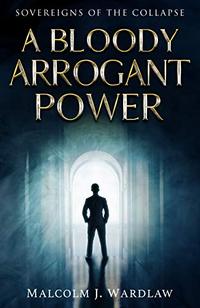
A Bloody Arrogant Power by Malcolm J. Wardlaw: One of the Darkest Dystopias I Remember, with Just a Hint of Light

A Bloody Arrogant Power

A Bloody Arrogant Power

by Malcolm J. Wardlaw
Series: Sovereigns of the Collapse, #1

Kindle Edition, 232 pg.
Plutonic Books Ltd, 2019

Read: October 3-7, 2019


When Wardlaw approached me about reading this book he described it as ” My best effort is to say it is ‘Nineteen Eighty-Four meets Downton Abbey’, although I’m not sure that is really all that helpful.” He’s right—it’s a good effort, and it’s not all that helpful. But it’s close—A Bloody Arrogant Power doesn’t have any of the kind of stories you’d find in Downton, but a dystopian Lady Mary and Mr. Carson could absolutely exist in this world. I’m not sure that’s more helpful than Wardlaw’s pitch, but I think it gets closer.

It’s 2106, and we’re a couple of generations past the societal collapse and the first attempt at rebuilding Western Society—or at least English Society (not really sure what happened in the rest of the world, assuming something did). There are some hints at what led to the economic and political collapse (I think the former precipitated the latter), but what we mostly see are the systems that arose to replace them and how they were designed to ensure the mistakes of the past weren’t repeated (in what’s dubbed “The Glorious Resolution”).

One of the things that developed was the idea that each parcel of land could support X amount of human life. Each year those ruling each territory would have to balance out their resources and the population—eliminating the “surplus” to keep things moving, “discharging them to the public drains.” True to form, to keep people from thinking about this too much, it’s always about the surplus population, never about people, individuals, etc.—no, it’s the dehumanized “surplus.” The most disturbing part of this idea is that the whole of England seems to think this way—it’s not until the last 10% of the book that anyone seems to have a problem with this. I certainly don’t want to suggest that it’s a problem with the book that this is the case, it’s not surprising at all that an entire nation (if not the world) will temporarily buy into a horrible idea to the degree that no one thinks of objecting to it. I can absolutely accept a world where people are officially deemed as “surplus” and disposed of accordingly. In fact, there are those who’ve been warning us about being on that slippery slope. It’s just depressing to see that idea so prevalent. I don’t know if Wardlaw intended readers to fixate on this, but I sure did. It permeated so much of the book and horrified me at each brush with the idea.

On the whole, the infodumps he uses to explain the world to his readers are done very well—he never overwhelms or bogs down the story with them. We get a little here, a little there, scattered throughout. I do think Wardlaw could’ve been a little closer to overwhelming in the beginning—I had to read a little too far into the book before I really had an idea how things worked here (and I’m not convinced I sussed it all out correctly). It’s clear that Wardlaw did a fantastic job creating this world, I just wish he’d done a better job showing it to the reader so we could appreciate it.

The protagonist, Donald Aldingford, is a barrister. He’s not one of the ruling class—but he’s adjacent to it. He gets to see a lot of what goes on behind the scenes in the government and is on the cusp of moving up in society to a position of distinction and honor. Then a few things happen that threaten to derail this.

First, he meets a younger woman who is about as far from privilege as you can get. There’s something about her that appeals to Donald. Secondly, she brings news of his brother. Donald’s spent years pretending he doesn’t exist—in fact, there are few people who are aware Donald has a brother. He’s in legal trouble that seems impossible to fix and there’s a growing chance that this association will become public knowledge and the scandal will probably ruin Donald’s career and family. Thirdly, a reform group is gaining momentum, and there are rumors flying about a Revolution coming.

None of the characters that we spend much time with are in the forefront of the reform party, but they are in the general orbit of that. I like this approach to things, we’re not dealing with Katniss or Tris here—we’re dealing with someone from Katniss’ town, or one of the students that rallied behind Tris—that kind of thing. So we can see what’s going on, but we don’t have to be in the thick of it.

While that’s a nice touch, the characters all could’ve used a little more work. I think it’s largely a space/time issue—there’s so much being established and happening in this book, that Wardlaw doesn’t get a chance to round out the characters—they’re all close (except for the sovereign that Donald spends most of his professional life serving—he might as well be twirling a mustache and tying people to railway tracks), but I never felt like I knew enough about them to care if they survived. It’s an understandable problem given what he set out to accomplish in this book, but it is a problem.

I liked A Bloody Arrogant Power—just not as much as I wanted to. It’s a wonderfully conceived novel—the execution could use a little more work, though. It’s one of the best worlds I can remember (narratively speaking, not literally) in dystopian fiction lately. I expect in future books (there are a couple planned) that Wardlaw won’t have to spend so much time establishing the world/culture and he can just jump into what the characters are doing, who they are and how can they make their way in the world. He sets the stage for some intriguing sequels, too. I really do want to know what happens after the rather abrupt ending and will be watching for the book.

Disclaimer: I received a copy of this novel from the author in exchange for this post, but as always, my opinions remain my own.


3 Stars

LetsReadIndie Reading Challenge

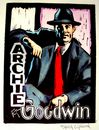
Happy Birthday, Archie!

My annual tribute to one of my favorite fictional characters (if not my all-time favorite). I’ve got to do an overhaul to this soon, but it is slightly updated and tweaed from last year.

On Oct 23 in Chillicothe, Ohio, Archie Goodwin entered this world—no doubt with a smile for the pretty nurses—and American detective literature was never the same.

I’m toasting him in one of the ways I think he’d appreciate most—by raising a glass of milk in his honor.

Who was Archie? Archie summed up his life thusly:

Born in Ohio. Public high school, pretty good at geometry and football, graduated with honor but no honors. Went to college two weeks, decided it was childish, came to New York and got a job guarding a pier, shot and killed two men and was fired, was recommended to Nero Wolfe for a chore he wanted done, did it, was offered a full-time job by Mr. Wolfe, took it, still have it.” (Fourth of July Picnic)

Long may he keep it. Just what was he employed by Wolfe to do? In The Black Mountain he answers the statement, “I thought you was a private eye” with:

I don’t like the way you say it, but I am. Also I am an accountant, an amanuensis, and a cocklebur. Eight to five you never heard the word amanuensis and you never saw a cocklebur.

In The Red Box, he says

I know pretty well what my field is. Aside from my primary function as the thorn in the seat of Wolfe’s chair to keep him from going to sleep and waking up only for meals, I’m chiefly cut out for two things: to jump and grab something before the other guy can get his paws on it, and to collect pieces of the puzzle for Wolfe to work on.

In Black Orchids, he reacts to an insult:

…her cheap crack about me being a ten-cent Clark Gable, which was ridiculous. He simpers, to begin with, and to end with no one can say I resemble a movie actor, and if they did it would be more apt to be Gary Cooper than Clark Gable.

I’m not the only Archie fan out there:

  • A few months back, someone pointed me at this post, The Wit and Wisdom of Archie Goodwin. There’s some really good stuff here that I was tempted to steal, instead, I’ll just point you at it.
  • Robert Crais himself when writing an introduction to a Before Midnight reprint, devoted it to paying tribute to Archie—one of the few pieces of anything written that I can say I agree with jot and tittle.

In case you’re wondering if this post was simply an excuse to go through some collections of Archie Goodwin quotations, you wouldn’t be totally wrong…he’s one of the fictional characters I like spending time with most in this world–he’s the literary equivalent of comfort food. So just a couple more great lines I’ve quoted here before:

I would appreciate it if they would call a halt on all their devoted efforts to find a way to abolish war or eliminate disease or run trains with atoms or extend the span of human life to a couple of centuries, and everybody concentrate for a while on how to wake me up in the morning without my resenting it. It may be that a bevy of beautiful maidens in pure silk yellow very sheer gowns, barefooted, singing “Oh, What a Beautiful Morning” and scattering rose petals over me would do the trick, but I’d have to try it.

I looked at the wall clock. It said two minutes to four. I looked at my wrist watch. It said one minute to four. In spite of the discrepancy it seemed safe to conclude that it would soon be four o’clock.

Description:I shook my head. “You’re flattering me, Inspector. I don’t arouse passions like that. It’s my intellect women like. I inspire them to read good books, but I doubt if I could inspire even Lizzie Borden to murder.”

She turned back to me, graceful as a big cat, and stood there straight and proud, not quite smiling, her warm dark eyes as curious as if she had never seen a man before. I knew damn well I ought to say something, but what? The only thing to say was ‘Will you marry me?’ but that wouldn’t do because the idea of her washing dishes or darning socks was preposterous.

“Indeed,” I said. That was Nero Wolfe’s word, and I never used it except in moments of stress, and it severely annoyed me when I caught myself using it, because when I look in a mirror I prefer to see me as is, with no skin grafted from anybody else’s hide, even Nero Wolfe’s.

If you like Anglo-Saxon, I belched. If you fancy Latin, I eructed. No matter which, I had known that Wolfe and Inspector Cramer would have to put up with it that evening, because that is always a part of my reaction to sauerkraut. I don’t glory in it or go for a record, but neither do I fight it back. I want to be liked just for myself.

When a hippopotamus is peevish it’s a lot of peeve.

It was nothing new for Wolfe to take steps, either on his own, or with one or more of the operatives we used, without burdening my mind with it. His stated reason was that I worked better if I thought it all depended on me. His actual reason was that he loved to have a curtain go up revealing him balancing a live seal on his nose.

It helps a lot, with two people as much together as he and I were, if they understand each other. He understood that I was too strong-minded to add another word unless he told me to, and I understood that he was too pigheaded to tell me to.

I always belong wherever I am.

WWW Wednesday, 23-October-2019

Welcome to WWW Wednesday!

This meme was formerly hosted by MizB at A Daily Rhythm and revived on Taking on a World of Words — and shown to me by Aurore-Anne-Chehoke at Diary-of-a-black-city-girl.

The Three Ws are:

What are you currently reading?
What did you recently finish reading?
What do you think you’ll read next?

Easy enough, right?

What are you currently reading?

Today I started the audiobook of Side Jobs by Jim Butcher and James Marsters (Narrator) and I’m a little over half finished with Taffy Brodesser-Akner’s Fleishman Is in Trouble.

What did you recently finish reading?

Yesterday I finished Open Season by C. J. Box, David Chandler (Narrator) on audio and Monday I finished Because Internet: Understanding the New Rules of Language by Gretchen McCulloch.

What do you think you’ll read next?

My next book will be the eARC of Shattered Bonds by Faith Hunter—I’ve been wanting to dive into this for weeks, but my Book Tour stop is next week, and I would’ve had a hard time putting off talking about it after I read it.

Hit me with your Three W’s in the comments! (no, really, do it!)

In Medias Res: Fleishman Is in Trouble by Taffy Brodesser-Akner

As the title implies, I’m in the middle of this book, so this is not a review, just some thoughts mid-way through.

—–

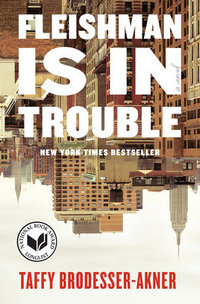
Fleishman Is in TroubleFleishman Is in Trouble

by Taffy Brodesser-Akner

This is going to be a tough one to write about when I finish, unless the last half is significantly different than the first (a possibility I’m open to).

It’s not the writing. The prose is delightful, there are turns of phrase that I’ve stopped to re-read. Brodesser-Akner has a sharp wit and an equally sharp eye for observation/social commentary.

But man, I’m just not enjoying this book at all. I don’t like the protagonist (I admire the lessons he gives his residents at the hospital)—and he’s easily the most likable character in the book. I can’t tell you the number of times I’ve almost DNF’d this.

Here’s why I’m sticking with it—I’m curious. Partially to see what the fuss is about (if I can). But more than that, I’m curious about the ending—I’ve heard it’s a killer. And there are two things I want to see where Brodesser-Akner is going with (we might get the answers to all 3 simultaneously). I may not enjoy the book but she’s doing everything right to get me to keep reading. Still, I’m afraid this is going to end up being in The Best of Adam Sharp or The Heart of Henry Quantum territory, however–well-written books that I only remember suffering through.

Has anyone out there read this thing? Any encouragement for me?

Pub Day Post: Famous in Cedarville by Erica Wright: Small Town Life and Hollywood Glamour Collide in this Mystery

Famous in Cedarville

Famous in Cedarville

by Erica Wright

eARC, 320 pg.
Polis Books, 2019

Read: October 16, 2019


Reading this book made me think of that overused 90’s-era sitcom line: Who are you, and what have you done with Erica Wright? Famous in Cedarville and its protagonist, Samson Delaware are so far removed from Kat Stone and her world, it’s hard to believe they come from the same mind. That said, as much as I want to see more of Kat Stone, if Wright’s going to give us more like this? I won’t complain too loudly.

I’m getting ahead of myself, we should start with the beginning when Samson Delaware joins some fellow citizens of Cedarville, TN to carry the body of Barbara Lace from her home. Lace left her small town home at a young age to pursue fame and fortune in Hollywood. She found it, too—she wasn’t a superstar, she didn’t reach the heights of fame or craft; but she was someone that people all over the country knew. And the only person from Cedarville that anyone not from the area knew was alive. After decades in California, she retired from film and television and basically became a recluse.

Delaware is a carpenter and probably the area’s antiques expert. He appraises pieces, advises buyers, in addition to buying and restoring pieces to sell. While in Lace’s home, he can’t help himself from looking around more than he ought. While it’s nowhere near his expertise, something doesn’t seem right about the scene to him, and he starts to think that Lace didn’t die peacefully in her sleep.

A few days later, Lace’s personal assistant is murdered (no ambiguity about that one), leading Delaware to step up his unofficial investigation—which soon becomes official, as the local authority (note the singular, Cedarville is just that small) and State investigators are both stymied. The sheriff is desperate enough to grant official status to anyone who can help.

Looking into Lace’s murder takes Delaware on a journey through time and space—the key to it has to be in Lace’s past (she saw so few people recently, it has to be in the past). And Lace’s past is in Los Angeles, so Delaware heads out to L.A. to do some footwork and talk to those who knew the actress during her heyday (and after it, too).

Delaware’s own investigation pulls double duty—not only will it hopefully bring the community some answers about their favorite daughter, but it also distracts him from the all-consuming grief following his wife’s death. More than once, he has to wrestle with the question of whether he’s pursuing justice for justice’s sake or if it’s because it helps him not deal with his wife’s death.

As its protagonist looks into a by-gone era of film, the novel takes on the feel and atmosphere of that era while retaining a feeling of fresh and contemporary. Don’t ask me how Wright does that, but it’s great to see it done. Beyond that, there’s a depth to the emotion and characters that you don’t see every day. It’d be easy to argue that Delaware coming to grips (in whatever way he does) to his current state, how he got there and where he’s going is more important to the novel than showing what happened to Lace and her assistant (it’d be easy to argue against it, too, but that’s my point).

I’m not doing a good job describing how different this book comes across—not just from Wright’s previous work, but from most of what’s out there in the genre at the moment. Hopefully, others can articulate it—I’m confident any reader will feel what I’m getting at.

There were two distinct “What the —!?!” moments (there are a few more surprises, but two that you won’t forget soon). One of which, technically, is the result of Wright cheating. But it’s such a cool development and Wright reveals it so deftly that I couldn’t complain. The other one was completely honest and caught me completely flat-footed. Far from clearing everything up, both of these added layers and complexity to this already intricate plot.

A complex mystery, rich characters (I don’t have time to talk about Lace’s long-time agent or the people of Cedarville), a nostalgic yet timely feeling novel that looks to Hollywood’s glamorous past and the very human, very real present. Wright knocks this one out of the park and will earn herself some new fans with this one.

Disclaimer: I received this eARC from Polis Books via NetGalley in exchange for this post—thanks to both for this.


4 Stars

Answer Me This (A Quick Poll)

I’ve been wondering lately, assuming you follow this blog on a semi-regular basis, how do you find out about new posts? If you see this post, and don’t follow this blog, what would you find the most useful?

Hope you participate!

Well, pfui. I guess the poll didn’t get embeded like I thought it would….back to the drawing board.

Page 2 of 6

Powered by WordPress & Theme by Anders Norén