Month: September 2023 Page 1 of 6

Saturday Miscellany—9/30/23

In the back of my mind since the Mid-Year Freak Out tag back in July how strange it is that I hadn’t been moved to tears by a book in a while. Richard Osman’s new one took care of that for me yesterday*, so now I can focus on other things in the back of my mind. Like, what stupid jokes am I going to make in my Festivus post this year or something equally important.

* Big ol’ jerk creating characters that you can’t help but care about.

Thursday, I attended Rediscovered Bookshop‘s latest Grown-Up Book Fair at White Dog Brewery, and showed remarkable restraint (but still walked away with some gems)—today, I get to go to the Boise Library!’s Comic Arts Festival, which is always a good time. That’s a lot of people-ing in just a few days, but a lot of bookish (and other) goodness, too. If you’re one of the handful of readers I have in this area, you should definitely come by. If you’re not in the area, I hope you have some bookish goodness to get up to (even if it’s just sitting in a comfortable spot with a good read)

Odds ‘n ends about books and reading that caught my eye this week. You’ve probably seen some/most/all of them, but just in case:
bullet Spenser at 50: The Evolution of Robert B. Parker’s Iconic Character—How did I not think to spend the year celebrating this anniversary?
bullet From one legend of Mystery Fiction to a couple of others: Lee Goldberg in Conversation with Michael Connelly—a great video from a recent event in Agoura Hills
bullet Five Enduring Reasons to Love the Mass Market Paperback—agreed. I’d love for a resurgence of this format (as would my overburdened shelves)
bullet The Coolest Bookshelves from Our Contest: We’ve asked for the best shelfies, and you delivered—Electric Lit got some nifty submissions to a recent contest
bullet Are the Dragons in Fourth Wing Better than in Game of Thrones?—These are the kind of vital debates that need to be had. (even though I’m pretty sure I hadn’t heard of Fourth Wing until The Orangutan Librarian talked about it)
bullet What Do You Think About Books Marketed Solely on Vibes and Tropes?
bullet Why I Love Middle-Grade Books
bullet Three Middle Grade Fantasy Series You Should Read—Over at FanFiAddict, Matt Pittman picks three great series. I’d have picked two of these myself had I tackled the question—not sure I’d have gone with The Wingfeather Saga myself, but I can’t argue against it.
bullet Interview with a Second Grader: Hidden Gems—an interview about books with Jodie’s 2nd Grader. The fact that this leads off with a dragon book says something about the household, I think (something good, I stress. Also, completely un-surprising.)
bullet I linked to this earlier in the week, but I’m going to share it again. On My Radar: September 2023—Celeste’s month-end wrap-ups are a great way to catch up on things you should’ve read earlier.

This Week’s New Releases that I’m Excited About and/or You’ll Probably See Here Soon:
bullet The Running Grave by “Robert Galbraith”—Robin goes undercover in a cult to help rescue their client’s son. I haven’t seen anyone up in arms about this release, which is a bit odd. Maybe since the target is a cult this time? I’m just excited that this is under 1K pages (not by much, but at the rate this series was going, I was expecting to injure my back)
bullet The Chalice of the Gods by Rick Riordan—Percy Jackson is gearing up to go to college—but he and his friends have to deal with new challenges from Mount Olympus first. I’d stepped away from Riordan recently, but new Percy adventures just might get me to reverse course.

All I want is peace, love, understanding and a library bigger than the Grand Canyon

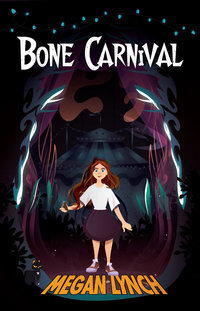
Bone Carnival by Megan Lynch: Mysterious and Spooky, (Almost) Altogether Ooky

Bone CarnivalBone Carnival

by Megan Lynch

DETAILS:
Publisher: Orange Blossom Publishing
Publication Date: October 31, 2023
Format: PDF
Length: 224 pg.
Read Date: September 27-28, 2023
Buy from Bookshop.org Support Indie Bookstores

What’s Bone Carnival About?

Mia Wallace’s parents are professors who’ve taken temporary posts at a university in Rome and have brought the twelve-year-old and her older brother, Enzo, with them. Enzo speaks a little Italian and is fairly independent as 17-year-olds tend to be, but Mia has only a small handful of phrases and is as dependent on her parents as a preteen is forced to be, so her options for the time are pretty limited.

Mia has a reputation (largely earned) for being a troublemaker, a teller of tall tales, and overall ne’er-do-well. It doesn’t seem like she’s leaving a lot of friends behind in the States, and she’s not expecting to change that in Rome, no matter how many resolutions she makes about reform. There’s a girl her age, Grace, who might be a candidate for friendship, but they don’t get off to a good start. Still, Grace’s mother is a colleague of Mia’s mother, so they’re likely to end up spending time together.

There’s a stray cat who lives near their apartment that Mia has started to spend time with. On the first day that their parents have to go to work, Mia slips out of the classroom she, Enzo, and Grace are stuck in all day to go get something from a nearby bakery (her excuse is that Grace hasn’t eaten breakfast and her stomach is too loud). On the way to the cafe, Mila sees “her” cat and follows it. Unbeknownst to her, Grace has followed Mia.

The cat leads them to a street carnival—there’s something about it that both unnerves Mia and appeals to her, too (she can’t describe what elicits either reaction). Grace is more unnerved than anything, but can’t get Mia to leave. There are shades of Pleasure Island (from Disney’s version of Pinocchio) to the carnival—but without the anarchy and transformation into a beast of burden. Honestly, I think what Mia’s in for is worse—but you can decide for yourself.

During part of a puppet show (which is probably not what made me think of Pinocchio), Grace volunteers to participate. She’s awarded a bone of a sorcerer to carry around in a velvet pouch. Supposedly, this will bring her good luck for a day—a lifetime’s worth of good luck in a day.

Grace doesn’t like any of this, and Mia’s a little creeped out by the idea of a finger (no matter that it’s surely just a prop). So they throw it in a nearby dumpster.

Before she knows it good things are starting to happen to the pair—and, yup, the pouch is tied around Mia’s neck. What has she gotten the two of them into? And what’s the fine print?

The Worst Parents in the World?

A tricky thing that authors have to address when it comes to kids and adventure novels is how to get the parents out of the way to let the kids have an adventure. Are they dead? Are they away from home/the kid is away from home? Are they missing/kidnapped? Or do the kids sneak off—and then why do they do that and how do the parents not notice? Once that’s dealt with, and how, then the reader can settle in and see what the kid gets up to.

Lynch solves this by giving Mia (and to a lesser extent, Grace) some of the worst parents around, who largely are unaware of what Mia is up to. I’m resisting the impulse to list off all their faults, deficiencies, and sins here—you really need to see them for yourself to draw your own conclusions. I’m typically inclined to see the parent’s/guardian’s perspective and to cut them some slack–I can defend (half-heartedly, I admit) Uncle Vernon and Aunt Petunia, for example. But I’ve got nothing for Mia’s parents. I quickly decided that it wasn’t just Mia’s perspective, either. At a quick glance, half of my notes about this book involve what miserable excuses for parents these two are.

Obviously, parents who abuse, exploit, and/or deprive their children are worse than these parents. Mia, Ezra, and Grace are fed, educated, clothed, and so on. They’re even cared about and for in some manner. But…

The actual trauma they’re inflicting, the emotional abuse they aren’t knowingly inflicting, and the long-term trust issues they’re creating for their children are real, even if they’re unaware they’re doing it (or, worse, unconcerned about it). For the longest time, I’ve considered Betty Draper to be the worst parent I’ve seen in fiction. Mia’s parents (particularly her mother) gives her a run for her money.

So, what did I think about Bone Carnival?

I started off quite unimpressed with Mia and was hoping this book was going to be about her getting her comeuppance and/or growing up. I was more than a little afraid I was going to have to endure 200 pages of an insufferable protagonist’s antics. There is some growing up involved, thankfully, but I think there’s a healthy dose of the reader understanding Mia better, too. It doesn’t take too long (sometime before the carnival, for sure) for the reader to learn more about Mia and she becomes a bit more than just an irritating character. Once the carnival appears—definitely before it disappears, you’ll become invested in her and what happens.

There were several times I thought I saw Lynch heading toward a moral, or a cheesy personal transformation on someone’s part to give everyone a happy ending. She did not do that, thankfully. She dodged both of those things every time it looked likely, and I was relieved and impressed each time. I’m not saying what kind of ending we get, but I do want to assure you that there’s character development and growth—but it’s earned and deserved, and not saccharine in any way. And yes, I do think readers can/should take away life lessons (especially parents in a “don’t be like this” way)—but it’s not what you might expect, and not in a “Here’s a Message for You” kind of way.

It has been years since I’ve been this worried about the stakes in an MG novel—not just the stakes, but the potential life and death (fictional) outcomes for the characters involved. It’s been even longer since an author introduced them as effectively (Riordan and Mull came close—and even killed characters, but I don’t think they made me as apprehensive as Lynch). I could probably point to a few YA books that don’t do it as well as Lynch did. I remember occasionally stumbling across a book that did this when I was this age—John Bellairs for example—but it seems harder to find now*. This is in that neck of the woods.

* Maybe I just need to read better MG books.

This book really spooked me, and was disturbing in all the right ways—the character development was believable (not easy given the short time frame depicted), and I thought the characters as a whole were believable and well-drawn. It might be too much for some MG readers—so parents should exercise discretion*. Although I honestly think it’d be good for some readers to read a book that’s too much for them, it’s a great way to create an appreciation for a certain kind of story.

* Parents should be doing that all of the time, come to think of it.

My main point about Bone Carnival is this: It should be read by many. Maybe even you.

Disclaimer: I received this ARC from Tonya Spitler Orange Blossom Publishing in exchange for this post and my honest opinion—thanks to both for this.


4 Stars

This post contains an affiliate link. If you purchase from it, I will get a small commission at no additional cost to you. As always, the opinions expressed are my own.
Irresponsible Reader Pilcrow Icon

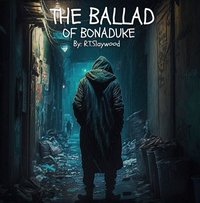
The Ballad of Bonaduke—Episode 36: Roadside Assistance by R. T. Slaywood: Don’t Make Him Angry, You Wouldn’t Like Him When He’s Angry


The Ballad of BonadukeThe Ballad of Bonaduke—
Episode 36: Roadside Assistance

by R.T. Slaywood

DETAILS:
Series: The Ballad of Bonaduke, #36
Format: Kindle Vella Story
Read Date: September 29, 2023

A part of me, the grifter, knew it was a trick. That the face twisted in pain was a mask that was stolen from my memories…But it didn’t matter. The part of me that wished and longed to see her alive one last time won the moment he changed his face.

The Story So Far…

A drunken Michael Bonaduke decides to use a grift (with maybe some sort of magic/magic-like “help”) to win on a scratch-off lottery ticket so he has money to buy more to drink. He pulls off whatever he did, gets his money and some booze and stumbles off into the darkness to drink himself into oblivion so he can start again the next day. He’s hit by dark memories (probably what’s driving him to the drinking) of fire, pleading, and screaming. There’s going to be a price to pay for his grift, and he’s trying to be ready.

He’s abducted by some representatives of a mysterious group who subject him to a test—if he passes, everything will be explained to him (and hopefully the reader, too). He passes—and is brought somewhere for answers, or maybe training, or maybe another test. Time will tell (or things are going to get really annoying). Answers aren’t quick to come—but the mysteries and questions keep piling up.

Things get hairy and Bonaduke leaves and finds himself back in the neighborhood he started from. He takes refuge in a homeless encampment shortly before a police raid. He’s apprehended and finds himself an interrogation room and shortly escapes after using his grift (but with results he didn’t quite intend). He finds himself by a group of squatters who seem to have strapped a woman to a chair for reasons that can’t be good. He attempts to rescue her before he even realizes what he’s doing, and seems to have succeeded—well, the two of them got away from the group anyway—breathing but bruised. They make their way to a fast-food taco joint and Bonaduke really needs to refuel to keep going. He tries, but fails to get food because he keeps passing out. Thankfully, the clerk is the same guy from the liquor store and he both recognizes him and gives him first aid. The woman (Zero) wakes up and shows some abilities of her on as she helps them escape from her captors who’ve tracked her down. One thing leads to another—Zero and Bonaduke’s magics don’t mix well (at least until they understand what each other can do?), and they end up in a video-game race against the squatters in a tricked-out version of Eric (the clerk’s) car. Note, I said video-game race, not a video-game-style race. They’re actually in one. When dumped back into reality, he’s surrounded by bruised and broken bodies (of people and cars).

What’s Roadside Assistance About?

So…yeah. Bonaduke is looking at his beloved’s face. He knows it’s not her–but, oh, he wants it to be. This sets off a flashback for him (and the reader) surrounding Francine’s death.

Once he’s able to wrest his mind back to the present, Bonaduke lets his anger out–the anger about having to deal with this again, anger for his own role in her death, and anger about who knows what else. The results promise not to be pretty, but it’ll be the next episode before we know exactly what all that might be.

So, what did I think about Roadside Assistance?

We run, once again, into my biggest problem with this story. Part of it has to do with the brief episodic nature that it’s told in, and part of it is Slaywood’s style. I wonder how this would read as a novel/novella, then I’d know for sure. Frequently episodes like this one feel like a half-developed outline more than a narrative. This is seen best when Bonaduke uses his grift, but it’s also in the flashback (although I think that’s more purposeful, so I’m not complaining)–it seems to me that Slaywood is trying for the text come across as mysterious or enigmatic, but lands as abstruse, incomplete, and unclear.

That said, Slaywood’s really able to convey Bonaduke’s grief and anger here–this is the most honest emotional reaction we’ve seen from him, and the power of it clear. It’s probably the closest the reader’s really been able to come to understand Bonaduke yet.

A mixed bag, to be sure, but one that pushes the reader on to the next episode.


3 Stars

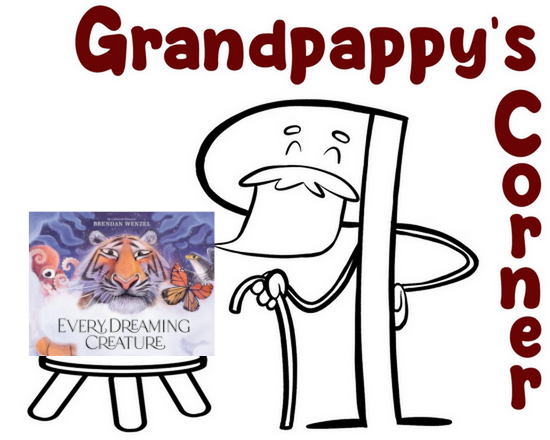
Grandpappy’s Corner: Every Dreaming Creature by Brendan Wenzel: This Book Is So Soft and Comfy It Could Be a Pillow

Grandpappy's Corner Every Dreaming Creature

Every Dreaming Creature

by Brendan Wenzel

DETAILS:
Publisher: Little, Brown Books for Young Readers
Publication Date: September 26, 2023
Format: Hardcover
Length: 40 pg.
Read Date: September 28, 2023
Buy from Bookshop.org Support Indie Bookstores

I had a dream I was a sleeping salamander.
All the world was safe, snug spaces and a warm, wet blanket of decaying leaves.
Secrets from the soil tickling my hands and soft belly.

What’s Every Dreaming Creature About?

That’s how the book opens—and that “safe, snug spaces”, “warm, wet blanket” and “secrets from the soil” won me over. The “I” there slips from dreaming they’re a salamander, to an octopus, to animal after animal—elephant, falcon, chameleon, and so many others.

There’s no sense or narrative arc to the transitions—like a good dream—but it all works in the moment, sure, why not go from salamander to octopus? (again, like a good dream). The book gives you just enough of an idea of the dream before it goes off to another transition.

Then the morning breaks, the “I” goes out to play before starting the sequence again.

Let’s Talk about the Art for a Minute

Like with most books like this, it’s the art that caught my attention.

Okay, not true. My attention was grabbed by the bookstore owner eagerly pointing at it and telling me that it was new and describing the book. But after that, it was the art.

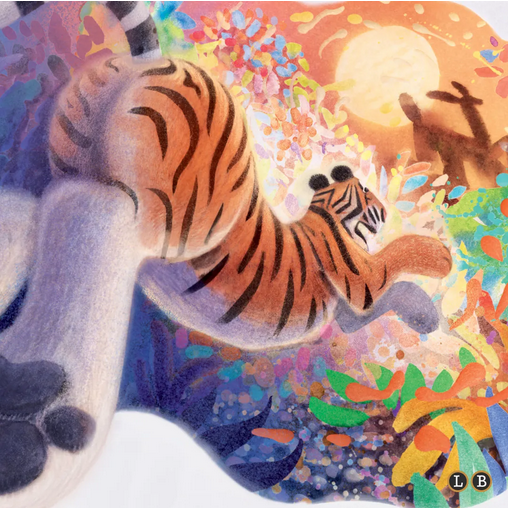
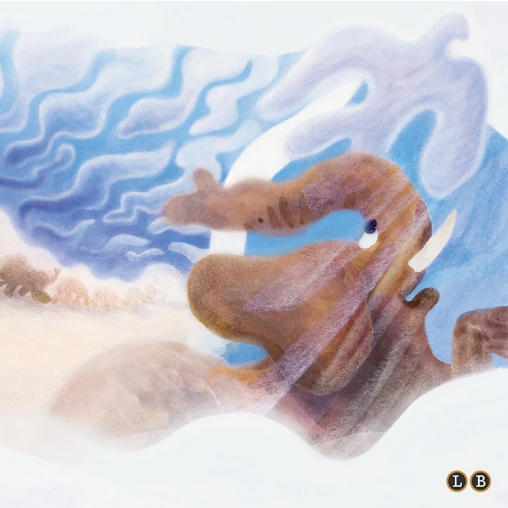
You might as well be looking a photographs or films shot through cotton, they’re so fuzzy and soft. It’s hard to describe, really—but it’s comfy and cozy, and you might as well be looking at warm blankets and downy pillows. I really felt like I was snuggling up with it. Two of the pictures of that salamander in particular (and I could use almost every animal described) looked like they could’ve been made from felt—like they were something that Jim Henson worked on.

Here are a couple of samples. Tell me you can’t practically feel the fuzzy tiger for…(there are more to be found on the Publisher’s page)
Every Dreaming Creature Sample 1
Every Dreaming Creature Sample 2

How is it to Read Aloud?

There’s something about this book’s subject, art, and prose that almost requires you to read this in a quiet, hushed tone—not quite a whisper, a little louder, but not much.

Without noticing, you’ll be reading quietly like you’re trying to put someone to sleep. Even if there are no children around and you’re just sitting down to read a couple of lines as a sample. (my dog looked a little dozy as I wrapped up, or at least I’m going to pretend that’s true).

So, what did I think about Every Dreaming Creature?

I came for the art, I stayed for the prose, and the…not quite story. But the atmosphere? The ideas? Eh…whatever the prose is trying to get across.

This is about as close to perfect as you’re going to get for a “snuggle-up with the grandchild and help them slip off to Dreamland” book. It won me over, I think it will win you—and whatever child/grandchild/amped-up lab mix you’re reading to, too.

I’ve never heard of Wenzel before, but I imagine I’ll be grabbing more of his books soon.


4 Stars

This post contains an affiliate link. If you purchase from it, I will get a small commission at no additional cost to you. As always, the opinions expressed are my own.
Grandpappy Icon

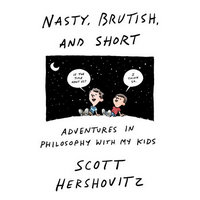
Nasty, Brutish, and Short (Audiobook) by Scott Hershovitz: Who Needs Calvin and Hobbes When We Have Rex and Hank?

Nasty, Brutish, and ShortNasty, Brutish, and Short:
Adventures in Philosophy with My Kids

by Scott Hershovitz

DETAILS:
Publisher: Penguin Audio
Publication Date: May 3, 2022
Format: Unabridged Audiobook
Length: 9 hrs., 31 min.
Read Date: September 21-25, 2023
Buy from Bookshop.org Support Indie Bookstores

What’s Nasty, Brutish, and Short About?

The official description is:

Some of the best philosophers in the world gather in surprising places—preschools and playgrounds. They debate questions about metaphysics and morality, even though they’ve never heard the words and perhaps can’t even tie their shoes. They’re kids. And as Scott Hershovitz shows in this delightful debut, they’re astoundingly good philosophers.

Hershovitz has two young sons, Rex and Hank. From the time they could talk, he noticed that they raised philosophical questions and were determined to answer them. They re-created ancient arguments. And they advanced entirely new ones. That’s not unusual, Hershovitz says. Every kid is a philosopher.

Following an agenda set by Rex and Hank, Hershovitz takes us on a fun romp through classic and contemporary philosophy, powered by questions like, Does Hank have the right to drink soda? When is it okay to swear? and, Does the number six exist? Hershovitz and his boys take on more weighty issues too. They explore punishment, authority, sex, gender, race, the nature of truth and knowledge, and the existence of God. Along the way, they get help from professional philosophers, famous and obscure. And they show that all of us have a lot to learn from listening to kids—and thinking with them.

Hershovitz calls on us to support kids in their philosophical adventures. But more than that, he challenges us to join them so that we can become better, more discerning thinkers and recapture some of the wonder kids have at the world.

The book is broken down into three sections: “Making Sense of Morality” (covering ideas like Rights, Revenge, Punishment, Authority, and Language); “Making Sense of Ourselves” (surely non-controversial chapters covering “Sex, Gender, and Sports”; and “Race and Responsibility”); and “Making Sense of the World” (Knowledge, Truth, Mind, Infinity, and God—the easy bits of philosophy). While discussing these, Hershovitz will describe the idea(s) he’s focusing on—or the aspects of them, to be more specific; he’ll then illustrate them with questions from or discussions with his sons; give us a brief history of philosophy on the topic; and then his personal take on them. Usually with more input from his sons along the way.

How was the Narration?

Hershovitz was fantastic. If he gets tired of the whole professor/philosopher gig, he could have a new career in audiobook narration. I can only imagine that his classes are great to sit through.

He delivered the material that in the wrong hands could’ve come across as super-dry, or really jokey and kept it engaging, entertaining, and informative—with a little bit of the persuasiveness needed to keep someone listening to a book about philosophy.

I was quite impressed.

So, what did I think about Nasty, Brutish, and Short?

Oh, I have some serious issues with some of the philosophy here. The chapter on “God” (to the surprise of few who read this blog regularly) really bothered me—but it did underline the importance of Special Revelation to go with General Revelation.

The Conclusion, “How to Raise a Philosopher,” was fantastic. Truly some of the best parenting advice I’ve heard/read in ages (and I don’t even need that any more and I still found myself taking notes). For raising more than just philosophers.

Sure, I disagreed with some of his conclusions—but I loved hearing the way Hershovitz thought through the ideas he was proposing and/or discussing, the way he dealt with his kids and their questions, I appreciated the way he explained concepts both basic and complex in a way that non-philosophers could understand, and he managed to be entertaining all along. Some of his witticisms did cause me to react audibly. There’s a good deal of so-called common sense mixed in with the profound as well—always nice to see for a layman like myself.

This book is a strange alchemy of parenting advice (even if largely given by example rather than by precept), Philosophy 101, and humor. It works so well that it’s hard to explain. I can only hope there’s a sequel or three as Hank and Rex age.

All in all, I heartily recommend this for parents, people who want to get a start in philosophy but aren’t sure where (and don’t want to admit that to anyone), and others. The print version might be nice for easy reference, but the audiobook format is a real winner.


3.5 Stars

This post contains an affiliate link. If you purchase from it, I will get a small commission at no additional cost to you. As always, the opinions expressed are my own.
Irresponsible Reader Pilcrow Icon

WWW Wednesday, September 27, 2023

While I know that “Thirty Days hath September,” when Celeste posted her end-of-month On My Radar yesterday, I had a moment of minor panic. I might forego sleep for the next few days to tick a couple more things off of my to-do list (although, “catch up on sleep” and “enjoy a nice nap” are on that list)

I think I had a more amusing idea when I started that paragraph, but got lost along the way. I hate when that happens. So pretend I was funny there and we’ll move on to the WWW Wednesday, okay?

This meme was formerly hosted by MizB at A Daily Rhythm and revived on Taking on a World of Words—and shown to me by Aurore-Anne-Chehoke at Diary-of-a-black-city-girl.

The Three Ws are:

What are you currently reading?
What did you recently finish reading?
What do you think you’ll read next?

Easy enough, right?

What are you currently reading?

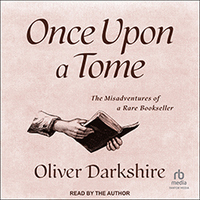
I just started Bone Carnival by Megan Lynch, and I’m listening to Once Upon a Tome by Oliver Darkshire on audiobook.

Bone CarnivalBlank SpaceOnce Upon a Tome

What did you recently finish reading?

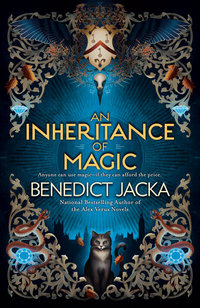
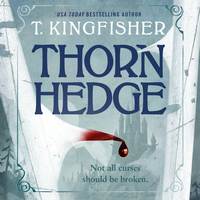
I just finished Benedict Jacka’s An Inheritance of Magic, the first book in my new favorite Urban Fantasy series, and the creepy fairy tale, Thornhedge by T. Kingfisher, Jennifer Blom (Narrator) on audio.

An Inheritance of MagicBlank SpaceThornhedge

What do you think you’ll read next?

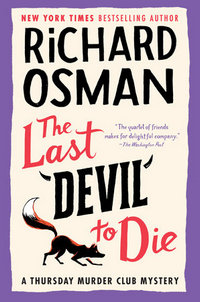
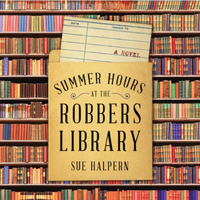
My next book should be the much-anticipated The Last Devil to Die by Richard Osman and my next audiobook should be Summer Hours at the Robbers Library by Sue Halpern, Narrated by Josh Bloomberg, Dara Rosenberg, and Allyson Ryan. I’m apparently in a books about books mood.

The Last Devil to DieBlank SpaceSummer Hours at the Robbers Library

What books are you ending September with?

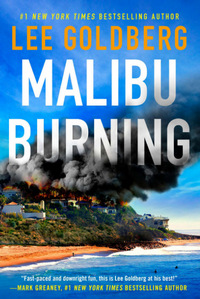
Malibu Burning by Lee Goldberg: Two Great Tastes That Taste Great Together

Malibu BurningMalibu Burning

by Lee Goldberg

DETAILS:
Series: Sharpe & Walker, Book 1
Publisher: Thomas & Mercer
Publication Date: September 1, 2023
Format: eBook
Length: 304 pg.
Read Date: September 12-13, 2023
Buy from Bookshop.org Support Indie Bookstores

Walker thought, police work for Sharpe was an intellectual pursuit, a mind game, analyzing the clues to get to the bad guy. It wasn’t about the chase. It was about being smarter than his quarry and everybody else.

For Walker, police work was all about the hunt, and the risk that came with it. As long as he was wearing a badge and carrying a gun, there was no way to truly mitigate the risk that came with a job in law enforcement, which was something Carly either didn’t understand or didn’t want to.

What’s Malibu Burning About?

There are essentially two stories in this novel charging full-steam ahead until they inevitably collide. The first is a heist story—with a good revenge motivation in addition to the “let’s steal gobs and gobs of money” angle. The second is about an unlikely partnership between an experienced arson investigator and a rookie investigator (but former US Marshal, so he’s not that green and has habits to unlearn). It’s not a spoiler for me to say that these stories will converge—for one, what’s the point of them not? Secondly, that’s not the way Goldberg works—there’s no way his robbers aren’t going to be chased by some cops.

The Robbers

Let’s start off, like the novel does, with Danny Cole. If you’re familiar with Goldberg’s oeuvre, think of Nick Fox—only not as outlandish, and you’re pretty much there. If you’re not that familiar, Cole is a con man/thief—he has a few specialists (hackers, hitters, etc.) that he works with to pull off his heists and con jobs.

In the beginning of the book, we see him alllllmost get away with something—and if he hadn’t been forced into a good deed,* he just might have. Instead, he’s arrested, tried, and convicted. He gets his lawyer to push for him to serve his time in one of the convict firefighters’ programs. He spends years fighting fires for the State, forming bonds with others on the front lines, and starting to begrudge the state for how they treat those convicts. Also, he gets to case a few luxury homes while serving his time.

* How much was Cole trying to do a good deed and how much was him trying to avoid being charged with a more serious crime is up for debate—and Cole’s lawyer is ready for that debate.

One of his teammates dies because of State policies and one of those luxury homeowners throwing his money and power around. When his sentence is complete, Cole sets out to get revenge on the convict firefighter system, and that homeowner—all the while enriching himself. I mean, the money’s right there, he might as well. To do so, he and his team have to pull off one of the most audacious—and destructive—heists imaginable. The fact that his plan is actually feasible frightens me more than any horror or serial killer novel ever has.

The Cops

“You’ve shot seventeen men.”

“Is that a lot?”
“I’ve never shot anybody in over twenty years in the department.”

That was hard for Walker to believe. “Not even a little?”

“Is it possible to shoot someone only a little?”

“I’m working on it,” Walker said.

Let’s turn our attention to the good guys now.

Los Angeles County Sheriff’s Detective Walter Sharpe is a detective in his fifties—he’s got plenty of experience and is good at his job. He’s not so great with people—particularly those he works with. He’s rarely satisfied with the easy answer, and will find reasons to think arson when no one else does (he’s also good at finding “accident” when the easy explanation points to arson). It’s not (just) that he’s a contrarian, he just cares more about evidence and understanding fire than anything else. This also applies to firefighters.

“Aren’t firefighters the experts on fire?”

“They are the experts on water.”

Pesky firefighters with all that water, washing away evidence. What are their priorities? Saving lives and buildings? In the end, Sharpe says:

Firefighters are the best friends an arsonist can have.

Against his will, Sharpe has been assigned a new partner. One with zero experience in investigating arson—he’s going to have to build him from the ground up. Former US Marshal Andrew Walker’s wife is pregnant and she’s put her foot down—his job is too dangerous, he needs to decide—her or the job. So instead of chasing down criminals (like Danny Cole), he’s now on the safer end of law enforcement—coming along after the crime is committed.

If you ever wondered what TV’s Raylan Givens would be if he prioritized Winona and Willa over Boyd Crowder, you’d get something a lot like Walker. Incidentally, Carly Walker is an entertaining character, and while I doubt the series will ever focus on her too much, I look forward to spending more time with her. The scenes between the couple feature an interaction that we don’t see a lot in Goldberg.

Anyway, Walker has a lot to learn about arson investigation, and Sharpe is just the right guy to teach him. They get along well enough, but both can see that their styles and personalities don’t necessarily mesh. The above glimpse of their first conversation illustrates some of that. But the higher-ups have spoken, so they work a couple of open and shut investigations together. Then they look around the starting point of a couple of wildfires in the area so Sharpe can show his trainee what to look for and what a natural/accidental fire looks like.

But between Walker asking beginning-investigator questions and some of Sharpe’s observations…these wildfires start to look planned. But why would someone put so many lives and so much property at stake?

So, what did I think about Malibu Burning?

Sharpe took out his phone. “Ill start with the front seat and the body, you shoot everything else. With your camera, not your gun.”

“That’s obvious.”

“Maybe to most people,” Sharpe said. “I’m not convinced it’s true for you.”

Oh, I just had so much fun with this. I realize it’s not that shocking for me to say about a Lee Goldberg book—but when he writes things like this, how am I supposed to react differently?

Danny Cole is such a great character—I don’t know if I could take a frequent diet of him and his antics, but a prequel or two to this with him? Shut up and take my money. Between the (arguable) good deeds he performs and the targets of his cons, it’s hard to see him as a real villain—yes, he seems to commit more felonies by breakfast than most people do all day, but in a Robin Hood sort of way.

Then again…when you think of what he does in this book, and the collateral damage he (seemingly) unthinkingly inflicts, it’s hard to maintain any kind of sympathy.

His targets are harder to work up any kind of sympathy or empathy for. Some are criminals, some are just…rich, entitled slimeballs. It is so satisfying to see bad things happen to them. Another target is the convict firefighting system—assuming Goldberg matched the realities of the system to what it promises the participants (and there’s no reason to think he doesn’t come close), something there needs to be addressed.

But the real star of the show is the partnership between Sharpe and Walker—they’re interesting enough characters on their own, sure—but watching them start to figure out how to work together is the best part of the book. I hope Goldberg doesn’t rush (I don’t think he will, because he’s a better writer than that, but I just want to say it)

Also, arson investigation is one of those things that long-running series dip into from time to time, but I don’t remember seeing a series try to tackle that regularly. I felt like I learned so much just from watching Sharpe work a scene and explain things to Walker. It was like watching Gideon Oliver explain something to John Lau or whatever local law enforcement officer he was dazzling. I’ll read that kind of thing any time.

So, great characters—on both sides of the law—an atypical angle for a procedural, interesting ethical questions, a mismatched partnership that will provide dividends both comedically and narratively for a good while to come, and Goldberg’s knack for making almost anything entertaining? What’s not to like about Malibu Burning? Go get it now, so you can say you got in on the ground floor.

The next book in this series is going to be a cross-over with Eve Ronin, apparently. It’s bound to happen—they all work for the same Sheriff’s Department, after all—might as well get to it early. It’s going to be great—if only to see Sharpe and Duncan together, that dynamic is going to be fun to see.


4 Stars

This post contains an affiliate link. If you purchase from it, I will get a small commission at no additional cost to you. As always, the opinions expressed are my own.

Irresponsible Reader Pilcrow Icon

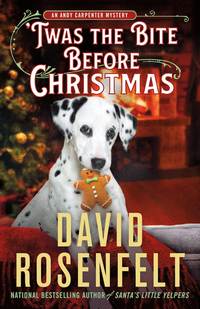
‘Twas the Bite Before Christmas by David Rosenfelt: All Through the Courthouse, Andy Carpenter Was Stirring

'Twas the Bite Before Christmas‘Twas the Bite Before Christmas

by David Rosenfelt

DETAILS:
Andy Carpenter, #28
Publisher: Minotaur Books
Publication Date: October 10, 2023
Format: eARC
Length: 304 pg.
Read Date: September 20-21, 2023
Buy from Bookshop.org Support Indie Bookstores

What’s ‘Twas the Bite Before Christmas About?

On the night of the Tara Foundation’s holiday party, Andy’s friend Pete Stanton, of the homicide department, calls him to ask Andy to bring one of his volunteers outside, so the police don’t have to cause a scene. Andy does so and immediately steps into the role of the volunteer’s attorney. He doesn’t know Derek Moore very well, but he likes Derek—and Derek’s dogs (more importantly), and wants to protect him at least until they both know what’s going on.

Andy quickly learns something about Derek—as he’s arrested, it’s revealed that his real name is Robert Klaster. Up until a couple of years ago, Bobby was in a gang in South Jersey. It was growing more and more violent, up to the point that Bobby was the wheelman for a murder. He went to the cops and turned in the men he drove—after their conviction, the state witness protection program moved him to Patterson with a new name.

Bobby’s made the most of this second chance and has become an upstanding citizen and moderately successful business owner—in addition to a great dog shelter volunteer. But now one of the leaders of his old gang has been killed in Patterson, and a tip led Stanton’s men straight to Bobby—with just enough evidence for them to make an arrest. The case is strong, but not air-tight. The question in front of Andy is can he take advantage of the weaknesses while finding the real killer?

And just why would someone bother setting Bobby up now?

The Recurring Cast

Almost the whole (and continually expanding) cast of regulars is around. Edna’s traveling, but we still get a couple of jokes about her work habits. Eddie shows up, but barely gets any dialogue—and not one sports cliché!—I really enjoyed those (see also: Sam’s song-talking), but the rest are about in their typical form.

Which is important—as much as these books are about the mystery/mysteries surrounding Andy’s case, it’s Andy and the crew we come back to spend time with. Including Tara, Sebastian, and Hunter—Sebastian particularly has some good moments in this book.

I do wonder if the supporting cast is getting too large, which is why Edna and Eddie get barely more than mentions. This makes sense, and it’d be good for Rosenfelt to rotate some of these in and out from book to book. It’d be better than cutting any of these for whatever reason—and better than just a token mention.

That said, Rosenfelt gave us some more than typical reflection on members of the cast. It was good to see Andy explain the specialization of work in his firm and for Andy to bring up the ethics of what he gets Sam to do in his narration. Cory’s been good about that in the companion series, but it’s not that frequent in this series.

I’m not sure if I had a point when I started this section, it’s basically turned into “assorted thoughts on the use of the supporting characters.” So let’s see if I can summarize my take on them for this novel—I enjoyed seeing them all, and am glad we got to spend time with them. I do wonder, however, if more judicious use of some of them per book rather than all of them each time, would be a better experience for the reader.

The Holiday-ness of It

So, this is the holiday-themed release for the series this year, as the title and cover image tell you. Very little in the book tells you that, however.

We don’t even get the typical (and always enjoyable) rant about Laurie’s months-long commemoration of Christmas. He gives a compressed version, but it’s not the same. In its place, we get Andy’s extended (and not favorable) review of egg nog. There are a few references to Christmas and a couple of the following holidays—but it’s not focused on too much. Honestly, we spend more time on Ricky’s soccer-fandom* than on any Federal or religious holiday.

* That was great to read about. Poor Andy. I get the same feeling when my kids prefer other SF franchises to Star Trek.

Do I care? Nope. I’ll take any excuse to hang with Andy and the gang. But I figure since it’s part of the theme of the book I should nod in it’s direction.

So, what did I think about ‘Twas the Bite Before Christmas?

This has nothing to do with anything, but Andy references the case in Flop Dead Gorgeous at one point in the book. It’s been a long time since he’s mentioned a previous case (outside of Willie Miller’s, which gets mentioned from time to time). It’s a nice touch to keep the series building on itself.

There were a couple of other things that stood out to me about this book compared to the rest of the series: Bobby’s about as close to an unsympathetic client as Rosenfelt gives us anymore (maybe ever—this is the twenty-eighth book in the series, I don’t remember the client in every one). And it’s good that Rosenfelt gives us some characters that are hard to root for—although a reformed criminal is pretty easy to root for, come to think of it.

Secondly, Andy slips up (at least in his mind, although Laurie disagrees) and it leads to some tragic consequences. Now, no one’s out there thinking that Andy’s infallible by any means, but it’s rare that a move on his part has such an obvious negative consequence. I’m not suggesting that we need to see major mistakes from our hero in every novel—but it’s good to see that just because Andy Carpenter gets involved, not everything is going to be sunshine and roses.

That said, he’s definitely at the point where I have to wonder why the DA keeps taking Andy’s clients to trial—when will they learn? Also, Pete sounds far too convinced that Andy’s client is guilty, you’d think he, in particular, would have more faith in his friend. This is a question countless readers have asked about Hamilton Burger and Lt. Tragg, as well, and the answer is simply: we wouldn’t get to see Andy or Perry Mason do their thing otherwise.

‘Twas the Bite Before Christmas delivered just what I expected—a good time with characters I enjoy, a clever whodunit, some fun moments with fictional dogs, and a satisfying resolution. Rosenfelt delivers that and more—there’s a sweet bonus moment to the resolution that adds a little holiday glow to the book (that works equally well in mid-September as it will closer to the holiday, or at any point in the calendar year that you happen to read this in). You’d do well to pick it up, whether you’re new to the series or a die-hard fan.

Disclaimer: I received this eARC from St. Martin’s Press via NetGalley in exchange for this post—thanks to both for this.


4 Stars

This post contains an affiliate link. If you purchase from it, I will get a small commission at no additional cost to you. As always, the opinions expressed are my own.
Irresponsible Reader Pilcrow Icon

Opening Lines: Nasty, Brutish, and Short by Scott Hershovitz

We all know we’re not supposed to judge a book by its cover (yet, publishing companies spend big bucks on cover design/art and we all do judge them that way). But, the opening sentence(s)/paragraph(s) are fair game. So, when I stumble on a good opening (or remember one and pull it off the shelves), I like to throw it up here. This one grabbed me with the voice and the humor–this was not going to be your typical book about philosophy.

from Nasty, Brutish, and Short: Adventures in Philosophy with My Kids by Scott Hershovitz:

“I nee a philosopher.” Hank was standing in the bathroom, half-naked.

“What?” Julie asked.

“I nee a philosopher.”

“Did you rinse?”

“I nee a philosopher,” Hank said, getting more agitated.

“You need to rinse. Go back to the sink.”

“I nee a philosopher!” Hank demanded.

“Scott!” Julie shouted. “Hank needs a philosopher.”

I am a philosopher. And no one has ever needed me. I rushed to the bathroom. “Hank, Hank! I’m a philosopher. What do you need?”

He looked puzzled. “You are not a philosopher,” he said sharply.

“Hank, I am a philosopher. That’s my job. What’s bothering you?”

He opened his mouth but didn’t say anything. “Hank, what’s bothering you?”

“DER’S FOMETHING FUCK IN MY FEETH.”

A flosser. Hank needed a flosser—one of those forked pieces of plastic with dental floss strung across it. In retrospect, that makes sense. A flosser is something you could need, especially if you are two and your purpose in life is to pack landfills with cheap pieces of plastic that provided a temporary diversion. A philosopher is not something that people need. People like to point that out to philosophers.

Opening Lines Logo

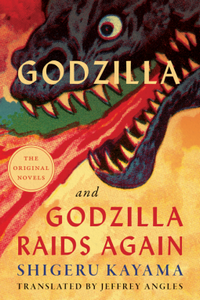
Godzilla and Godzilla Raids Again by Shigeru Kayama, Jeffrey Angles (Translator): Obliterating Everything, Incinerate a Renegade

Godzilla and Godzilla Raids AgainGodzilla and Godzilla Raids Again

by Shigeru Kayama, Jeffrey Angles (Translator)

DETAILS:
Publisher: University of Minnesota Press
Publication Date: October 03, 2023
Format: eARC
Length: 256 pg.
Read Date:  September 18-20, 2023

Buy from Bookshop.org Support Indie Bookstores

The Background of Godzilla and Godzilla Raids Again

The movie producer, Tomoyuki Tanaka, brought some ideas (largely adopted from a Ray Bradbury story) to the novelist, Shigeru Kayama, and asked him to turn them into a story for a film. This story, in turn, was developed into a screenplay by Ishirō Honda and Takeo Murata (the director and assistant director) and became the movie Godzilla.

Godzilla was such a success that Tanaka had Kayama come up with a follow-up story, that became Godzilla Raids Again (although Godzilla Counterattacks is a better translation, that’s not what the movie’s title was originally titled in English).

About that time, Kayama was done with the movies and what they were doing to his idea about the monster—but he was helping to launch a series of books for young adult readers and adapted his original ideas for the movies into novellas for that series. These novellas came out around the time of the second movie’s release. Now, they’re being translated into English for the first time.

What’s Godzilla About?

The testing of some nuclear weapons in the Pacific Ocean has disturbed a long-dormant dinosaur/monster. Not only is it now awake, it may have mutated by the bomb(s). Angry and confused, it stumbles onto the Japanese islands and wreaks havoc on the people and cities it encounters.

The beast kills and destroys multitudes and seems invincible to every weapon that the nation has access to. But one scientist has been developing a new kind of weapon, that he doesn’t trust any government to have access to—but he might be forced to unveil it to stop Godzilla.

What’s Godzilla Raids Again About?

It was theorized when Godzilla showed up in the first novella that he might not be the sole monster/dinosaur/kaiju to have been awakened by the tests. A pair of pilots* working for a fishing company stumble upon another Godzilla on an island near Japan—while they’re trying to escape from that Godzilla, it’s attacked by another monster/dinosaur/kaiju, later identified as an Anguirus. The two pilots manage to escape following the fight between the two monsters.

* One of those pilots is named Kobayashi, and any good Star Trek fan knows bad things are about to happen as soon as that name is seen.

They rush back to warn the Anti-Godzilla Task Force who begin to strategize a defense against the monster—they cannot access the same weapon used last time, so they’re going to have to come up with something better, and quickly.

The Supplementary Materials

In addition to the novellas, the book has some additional material—the first (and most useful) is an Afterword, “Translating an Icon,” by the translator (obviously). These 30± pages contained answers to almost every question I had while reading—including a few things that I think would’ve been helpful knowing going into the book (the relation of the novellas to the films, the extent of Kayama’s involvement with the creation of Godzilla, why he published the novellas, etc.).

But there’s a lot of information that I’m glad I didn’t know going in—the critique of the U.S. nuclear testing, why it had to be so subtle, why the films didn’t include it as much as the novellas did, where (and why, sometimes) the films and novellas diverge, and the meaning of some of the more emotional moments. There were points where it was clear that something important or meaningful had happened, but I wasn’t sure exactly what it was—Angles helped a lot.

I guess what I’m trying to say is that in a perfect world (at least perfect for me), we’d have gotten a foreword as well the afterword—but like just about every writer out there, Angles wasn’t writing to satisfy my whims. And as an Afterword, he could really get into spoilers and things it’s best to have explained after the text.

The whole thing was so interesting I could’ve easily read something twice the length (and something tells me that Angles could’ve done that without much effort, it was probably harder for him to leave out ideas and details). The part I enjoyed the most was his discussion of a few translation issues, for example, the excessive (for a contemporary English reader, anyway) use of onomatopoeias throughout the book—but particularly in the battle scenes, or scenes when Godzilla is angry and taking it out on human structures and devices. Those pages read like the Batman TV series from 1966—full of Bams, Pows, and the like. And Angles describes how he cut many of them by translating them somewhat differently. He also discussed how he chose to spell the roars of Godzilla and Anguirus, and I really enjoyed that.

There were some things that he wanted to do a more accurate job of translating, but given the history fans have with the films, etc. he chose to stay consistent with the films, so he wouldn’t have to fend off accusations of bad work from those fans. I absolutely get why he’d make that choice, and feel so bad for him that he had to make it.

I’d noticed that there was a Glossary of Names, Places, and Ideas at the end of the book, but completely forgot to use it while reading the novellas. I don’t know that using it would’ve helped me too much during the reading—almost always the context was clear enough to get the meaning across. But reading it afterward helped clarify a thing or two, but by and large, those were minor details that not knowing them didn’t detract much from the text. The things I really needed (and some I could’ve guessed at) were in the handful of footnotes throughout the novellas. The Glossary was pretty interesting to read, I should note.

So, what did I think about Godzilla and Godzilla Raids Again?

Before I get into this, I want to take a moment to say how cool it was to get to read a book about Godzilla. From the time I can remember this monster has been something I’ve been aware of in some way. The old movies, cartoons about him (and his goofy nephew, Godzooky), the toys, the newer movies, and everything in between. He’s just been one of the coolest creatures in my pop culture awareness—there’ve been few times that I’ve clicked on “Request” so hard on NetGalley. Now, I do have to admit, it’s been decades since I watched the original films—I’m much more familiar with the Gamera movies than Godzilla. So I had to wait until the Afterword to know what was different between what I was reading and what audiences saw in the 50s (it was certainly different enough from the Emmerich movie from 1998, that I remember more of than I want to).

I did think some of the dialogue was pretty stilted, and some of the character reactions seemed overwrought (and some underwrought). It actually reminded me a lot of the Gamera films and other English-dubbed live-action shows/movies I’ve watched—and while reading the book, I frequently thought that I owed those who wrote the scripts for the dubbing an apology—their work felt a lot like Angles’ translation. I don’t think that the dialogue or characterizations damaged my appreciation of the work, it just underlined for me that this is the work of another culture (and another time). So they’d better not sound like native English speakers, and should probably act/react in ways that don’t seem particularly American. What might be slightly off-putting at first quickly becomes part of the charm of the novellas.

The intended audience for these novellas were young adults, and throughout Kayama would insert asides “You may not understand…” or “You’ve probably seen something like…” to help his reader understand what’s going on, or perhaps the feeling behind it. The first time it happened, it was entirely unexpected, but I enjoyed the idea. I liked each successive one more than the last and was disappointed that we didn’t get nearly as many as I’d hoped. I don’t know if this was characteristic of his writing (I suspect it wasn’t), but for these novellas, it really worked.

We don’t see Godzilla right away, and Kayama did a great job of building the tension until we do—he’s there, doing damage and terrifying people, but the reader doesn’t get an idea of what they’re seeing until we’re about one-third of the way through the first novella. As impatient as I was to see the monster myself, I wish he’d been able to hold out a little longer. Now in the second book, we know what Godzilla looks like, so we can skip the build-up and throw him in right away—and then add Anguirus just a couple of pages later.

I found everything about Godzilla more satisfying than Godzilla Raids Again, but the latter was more fun and action-packed. I can see where some might be put off by the not-at-all-subtle messaging of Godzilla, but I thought it fit the story and the need at the time.

The Afterword and Glossary added a lot to my understanding and appreciation of what Kayama was seeking to accomplish and say, lifting the impact of the book as a whole. The novellas on their own would’ve been entertaining and satisfying, mostly as an artifact of another era (see what I said about the dialogue and characterizations)—but the supplementary material added the necessary context and definition to the novellas so that I walked away with a better understanding and appreciation for the book. Don’t skip those bits.

I’ve said a lot more than I expected to—and have only scratched the surface of what I’d hoped to say. So let me cut to the chase—I really enjoyed this experience—fun novellas, a deeper understanding of the creature and the themes the original movie was trying to explore, and a glimpse into Japan of the 1950s. And, once again, it’s a book about Godzilla, do you really need me to say more? I heartily encourage you to check this book up. Now, I’ve got to go track down some black-and-white films.

Disclaimer: I received this eARC from University of Minnesota Press via NetGalley in exchange for this post—thanks to both for this.


4 Stars

This post contains an affiliate link. If you purchase from it, I will get a small commission at no additional cost to you. As always, the opinions expressed are my own.

Irresponsible Reader Pilcrow Icon

Page 1 of 6

Powered by WordPress & Theme by Anders Norén