Month: December 2023 Page 1 of 5

The God of the Mundane by Matthew B. Redmond: A Call to the Ordinary Life

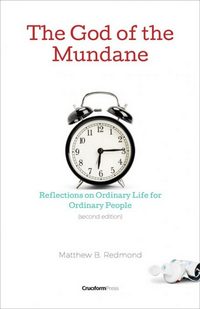
The God of the MundaneThe God of the Mundane:
Reflections on Ordinary Life
for Ordinary People

by Matthew B. Redmond

DETAILS:
Publisher: Cruciform Press
Publication Date: April 3, 2021
Format: eBook
Length: 146 pg.
Read Date: December 24, 2023

Buy from Bookshop.org Support Indie Bookstores

What’s The God of the Mundane About?

So I wondered. I wondered about the great majority I have known and know, the great majority living fairly ordinary lives.

Is there a God, for instance, for those who are not changing anything but diapers? Is there a God for those who simply love their spouse and pour out rarely appreciated affection on their children day after day? Is there a God for the mom who spends what feels like God- forsaken days changing diapers and slicing up hot dogs? Is there a God for the man who hammers out a day’s work in obscurity for the love of his wife and kids? Is there a God for just and kind employers? Generous homemakers? Day-laborers who would look at a missions trip to Romania like it was an unimaginable vacation?

Is there a God for the middle-class mom staving off cancer, struggling to raise teenagers, and simply hoping both Mom and Dad keep their job? Is there a God for the broken home with a full bank account but an empty bed? Is there a God for grown children tending to the health of their aged parents?

Is there a God who delights in the ordinary existence of the unknown faithful doing unknown work? Is there a God of grace for those who live out their faith everywhere but do not want to move anywhere?

Is there a God for those who have bigger homes than me? More money than me? Nicer cars than me? Better health than me?

Is there a God for the mundane parts of life, the small moments? Is there a God of kind smiles, good tips, and good mornings? Is there a God of goodbye hugs and parting kisses? What about firm, truthful handshakes and grasps of frail fingers in sanitized hospital rooms?…

Is there a God of the mundane?

Does this God I worship care about mundane people and moments?

The answer to this question is, obviously, yes. In fact, almost every believer, Redmond argues lives the kind of quiet life that most contemporary preachers ignore—quiet, faithful, mundane. Ordinary. (Redmond limits his arguments to New Testament believers through the present. He could’ve/should’ve gone back to Genesis if you ask me).

There’s some gentle critique of contemporary Evangelical preaching and the kind of striving for the monumental it encourages—calls for, but largely this is a positive book. Redmond is primarily focused on saying, “Your ordinary life is good. It’s nothing to be ashamed of if you’re being faithful.”

Horton’s Ordinary

It’s been nine years or so since I read it, but this book felt a lot like Michael Horton’s Ordinary: Sustainable Faith in a Radical, Restless World. I do think that Horton did a better, or at least, more thorough job of looking for the quiet, unremarkable life. And people who read and gained from Redmond should hunt Horton’s book down.

But every time I started to say something comparing the two in my notes, Redmond would say something in a way that caught me off guard. A way of framing his argument that raised my eyebrows, an illustration that made the point so clear.

So I’m not going to make any other comparisons between the two, I’m just going to say that these two are singing from the same hymn book and I hope their tribe increases. If you liked one, read the other.

So, what did I think about The God of the Mundane?

missed the obvious: the apostles are writing to normal people. Most of them are nameless. They are Jew and Gentile, yes. But they are also not apostles. And most are not pastors. They are carpenters, farmers, traders, sailors, fishermen, shepherds, guards. They are mothers and fathers and children. Compared to the life of an apostle, their lives are probably mundane. These are ordinary men and women believing an extraordinary story…

But he never asks them to stop being who they are. He never challenges them to go anywhere. We don’t even get hints that he is making them feel guilty for living with comforts he doesn’t enjoy. That’s weird. It’s weird because this is so common in our pulpits and in conferences held for zealous college students.

I’ve cut so many things from the outline I dashed out before starting this post—basically, I was going to end up providing a compressed paraphrase of this entire book as a disguise for talking about it. I don’t want to do that. But it’s tempting.

I do think that Redmond makes some of the same points too often. That’s not a crime in books, obviously, but in 146 pages, that kind of thing stands out. He could’ve added a little variation to some of his arguments, etc. to keep the text fresh. But his writing is clear, convincing, and engaging. You can easily see yourself getting this advice from a trusted friend across the table at a coffee shop or diner.

This isn’t classroom wisdom or what an Ivory Tower will come up with. It is pulpit wisdom. It’s like an application of everything the Preacher says in Ecclesiastes—and is almost as wise. It’s also the wisdom of someone who’s been around a while, has seen a lot, and has learned from that—and then coupled that experience with what the Scriptures say. (also, I just said the same thing three times in different ways) As such, it’s something we should at least hear out.

I didn’t mean to buy this book, I’d meant to put it on a “think about this later” list, but a slip of the finger later, and I had another ebook to read. I’m glad I got this, it’s not quite what Ross means when he talks about happy little accidents, but it works for me. This was encouraging to me. It was a reminder of principles I’ve tried to live by—and who doesn’t need a good reminder like that from time to time.

Do I think it could’ve been a better book? Yes. Do I think it’s a little surface-level, and frequently redundant? Sure. But when it’s good—it’s really good. It would’ve taken doubling (at least) the length of the book for it to be the kind of “better” I want—and would almost certainly leave it as the kind of thing that so many who need to read it won’t bother with. And frankly, a good message, wise words, or however you want to put it, means more than a good book any day.

But I say: Be nobody special. Do your job. Take care of your family. Clean your house. Mow your yard. Read your Bible. Attend worship. Pray. Watch your life and doctrine closely. Love your spouse. Love your kids. Be generous. Laugh with your friends. Drink your wine heartily. Eat your meat lustily. Be honest. Be kind to your waitress. Expect no special treatment. And do it all quietly.


3.5 Stars

This post contains an affiliate link. If you purchase from it, I will get a small commission at no additional cost to you. As always, the opinions expressed are my own.

Irresponsible Reader Pilcrow Icon

Saturday Miscellany—12/30/23

When going through the posts, etc. I had collected for this week, it felt like this was going to be nothing but a list of lists. Which would’ve been fine, but strange, you know? I did eventually get mostly past the lists to some other things. But I’ll warn you now, if you are looking to keep your TBR from exploding, there are several things I linked to today that you’ll want to avoid.

On the other hand, if you’re wanting it to explode with goodness…

Odds ‘n ends about books and reading that caught my eye this week. You’ve probably seen some/most/all of them, but just in case:
bullet If Not For Libraries: Authors on the Importance of Public Libraries—The New York Public Library put this together earlier this year, and I’m not sure how I missed it until this week.
bullet Five years and 2m copies later, self-published author lands UK book deal—Granted, the overwhelming majority of self-pubbed authors won’t see this kind of success. But doesn’t it make your heart warm to see that some do?
bullet A.I. : In the Age of the Absence of the Author
bullet Why Readers Love Craig Johnson’s Walt Longmire Series —this is a good overview of the series/good intro for those who’ve thought about dipping their toe in.
bullet Before We Go Blog is always a reliable source of good material, but three of the posts the team put up this week caught my eye.
bullet Top Urban Fantasy Series To Get You Hooked on the Genre—I enjoyed (the?) previous version(s?) of this, but this updated one makes me feel positively un-read in the genre.
bullet Top Ten Fantasy Characters That Probably Listen to Taylor Swift—Kudos to them for even coming up with this idea. I’m not a Swiftie (at least not after her second album), but I enjoyed the post
bullet Seven Favorite Cinnamon Rolls in SFF Novels—Is Cinnamon Roll a term I should already be familiar with? Either way, I’m adding it to my vocabulary.
bullet Top 20 Most Recommended Audiobooks of All Time—according to Libro.fm
bullet Another batch of Best of 2023 lists:
bullet Top Five Most Dramatic Twists I Read In 2023—Steven Writes comes up with another good category
bullet 10 of My Favorite Reads in 2023—from Pages Unbound’s Krysta
bullet Adam Holcombe provided “A handful of great books, given to you in the form of specialized awards”
bullet FanFiAddict’s A.J. Calvin’s Top 10 Reads of 2023
bullet Favorite Books in 2023—from A Literary Escape
bullet Out of This World SFF’s My Top 10 Reads of 2023!!!
bullet Most Memorable Reads of 2023—from Reading Ladies Book Club
bullet Top 5 Books of 2023—Top 5? As I’m going to demonstrate next week there’s no way I could get things down to 5. My hat’s off to Books are 42 for pulling it off.
bullet Tales from Absurdia’s The Best Books I Read in 2023
bullet Esmay Rosalyne’s Best Surprises of 2023
bullet What Makes a Story Comforting?—another good one from Molly Templeton. I’m also tempted to (somewhat reluctantly) rewatch Grimm.
bullet How to Plan for Your 2024 Reading Challenge —some good advice from NetGalley’s We Are Bookish blog
bullet Backlist Bingo 2024—it’s been a minute since Armed With a Book did a Bingo, this looks fun
bullet Read What You Got—a month-long push to clear up your unread books
bullet The 2024 Booktempter’s TBR Challenge—the last two of these from Runalong the Shelves have proved helpful to me. I’m back for a third go-round.
bullet The Project Backlist Reading Challenge—another good-looking challenge
bullet Bookish Travel: Visiting The 50 US States 2023—what a great idea…
bullet 2024 Ultimate Book Blogger / Reader Spreadsheet Template—a great tool for Bloggers and super-organized readers (or those wanting to be)
bullet Quotables: Words that Stuck with me in 2023—I love this annual post (which inspired my monthly posts…that I will get back to!)

This Week’s New Releases that I’m Excited About and/or You’ll Probably See Here Soon:
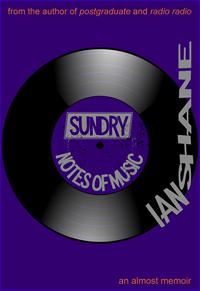
bullet Sundry Notes of Music: An Almost Memoir by Ian Shane—some of the bigger moments of Shane’s life are described through the filter of important (to him) songs. Humor, love, loss, and a lot of music. I talk a little more indepth about it here.

Lastly, I’d like to say hi and extend a warm welcome to Little Reader, who followed the blog this week. I hope you enjoy the content and keep coming back.
To Read or not to Read. Not even a question.

The Mayors of New York by S.J. Rozan: Let Your Honesty Shine…

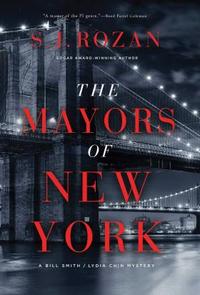
The Mayors of New YorkThe Mayors of New York

by S. J. Rozan

DETAILS:
Series: Lydia Chin & Bill Smith, #15
Publisher: Pegasus Crime
Publication Date: December 5, 2023
Format: Hardcover
Length: 280 pg.
Read Date: December 21-25, 2023
Buy from Bookshop.org Support Indie Bookstores

What’s The Mayors of New York About?

New York’s first female mayor has a problem. A few months after taking office, her fifteen-year-old son has run away. It’s not the first time, but it’s the first time since she’s been elected. She’s in the middle of high-stakes negotiations with a police union, so Mayor McCann doesn’t feel like she can turn to them without taking some PR hits/weakening in the negotiations.

So, she has her aide hire Bill Smith (who brings along Lydia, of course). It’s not easy tracking down one of the most recognizable teens in the city without letting anyone know you’re doing that—and it almost seems like the “without letting anyone know” part might overrule the “finding the teen” part of the job.

Now, Lydia’s trying to decide if she takes on a case of her own at the same time. Readers know long before they do that these cases will end up intertwined—otherwise, why would Rozan bring it up? And once Bill and Lydia cotton on to that, a hunt for a runaway takes on a whole new layer. Possibly several layers.

The Characters

Nah, I’m not going to talk about Bill and Lydia today—I honestly don’t know if I have anything else to say about them outside how they’re probably my favorite partnership in Crime Fiction (Robin/Cormoran—learn from these two. They trust each other and communicate frankly. Your lives will be the better for it, and the books will be shorter, too. Everyone wins.).

I want to talk about Mark McCann a little bit. At first, he’s just the target. He’s little more than a MacGuffin to get the plot moving. Then we start to learn a little about him and he becomes an actual character—one I want to learn more about. Then we get to meet him, and I like him a lot. And then Mark goes ahead and does some clever and stupid (read: dangerous) things and I want to see more of him.

The wanting to see more of him goes for everyone who’s alive and not under indictment of some sort at the end of the book—the McCann’s household staff, the people who help Mark along the way (and then help Bill and Lydia), and so on. I know it’s not really Rozan’s style, but if we could run across them in future books for a chapter or so just to spend more time with them, I’d really enjoy that. These all have a little more life to them than your typical witnesses, bystanders, and so on in PI Fiction. I particularly appreciated the way they all want some sort of Mayoral favor shown to their neighborhoods/communities and the way that Lydia takes notes to pass them along. A very nice—and real—note.

I feel like I should spend a few paragraphs on the most interesting character in this novel—Aubrey “Bree” Hamilton, the mayor’s aide who hires Bill to look for Mark. She and Bill dated years ago, and it’s clear from Bill’s First-Person Narration that the chip on his shoulder regarding this particular cheating %#&@ has is still pretty deep, no matter what degree of happiness he’s found elsewhere. It’s not just the way she cheated on him—Bill has no sympathy for her former PR clients (lawyers, largely) or the politicians she now works for, assuming everything they do or say is calculated for their benefit. He trusts Bree less than her bosses—and we see that throughout—but something about a 15-year-old boy who keeps running away from home speaks to Bill, so he has to investigate.

I got off target there, but I thought I’d explain Bill taking the case when he can’t stand anyone involved. Bree is a perfectly designed character—the reader can see how she’s good at her job, calculating, smart, and generally three steps ahead of anyone (aside from our protagonists occasionally). It’s impossible to tell how much she believes a lot of what she says, or if she’s saying it out of duty. And then there’s what she says to yank Bill’s chain a little bit. Bill (and therefore his narration) is so jaded against her that it’s hard for us to know how much of our negative reaction to her is justified and how much it is seeing her through Bill’s eyes. A great move by Rozan.

So, what did I think about The Mayors of New York?

The pace is fast without being breakneck. The dialogue is sharp and witty. Bill’s narration has never been more hard-boiled (his contempt for the client/client’s intermediary helps). The characters jump off the page. It’s what you want in a PI novel.

Early on, I had inklings about what was behind everything (and I’m pretty sure Rozan intended readers to). As the plot moved forward and we received more and more confirmation about those inklings, it made me uncomfortable and a little queasy. Why couldn’t I have been wrong? Why couldn’t these have been red herrings? Thanks to some skillful storytelling you don’t get bogged down in the wrongness of everything that’s afoot—it’s there and it colors everything, but your focus becomes on the characters dealing with it all, the reveals to other characters and the nail-biting way this story is resolved.

Yes, I think Rozan could’ve just as easily and skillfully let the characters and readers wallow in the muck of the crimes behind everything—but it would’ve changed the tenor of the book so much that the early chapters would feel out of place, and we probably wouldn’t have found some resolution that’s as satisfying.

Also, just because some things weren’t red herrings, don’t think that Rozan doesn’t toss enough of them at the reader to keep you wondering.

Rozan has been on a hot streak since Paper Son, and The Mayors of New York shows no signs of her slowing down anytime soon. And I am more than okay with that. If you’ve never indulged in this series before—this would work as a jumping-on point. Almost any of them would, really. The trick is to jump on somewhere for some of the best that PI fiction has to offer. A touch of the classic American PI added to a hefty helping of the 21st century. The Mayors of New York is one I heartily recommend to all.


4 1/2 Stars

This post contains an affiliate link. If you purchase from it, I will get a small commission at no additional cost to you. As always, the opinions expressed are my own.
Irresponsible Reader Pilcrow Icon

Ozark Dogs by Eli Cranor: The Sins of the Fathers…

I’ve been trying to write about this book since April. I know I’m not going to do this justice, and so I keep procrastinating. But with 2 posting days left this year…I can push it off no longer.


Ozark DogsOzark Dogs

by Eli Cranor

DETAILS:
Publisher: Soho Crime
Publication Date: April 4, 2023
Format: Hardcover
Length: 290 pgs.
Read Date: April 12-13, 2023
Buy from Bookshop.org Support Indie Bookstores

What’s Ozark Dogs About?

One of the bigger hurdles for me in completing this post was figuring out what to put here, I toyed with:

It’s by Eli Cranor, which means it’s going to have a Southern Noir sensibility, is probably going to have something to do with family, and is going to be excellent. That’s all you really need to know.

I still stand by that, but figure you need more, I just wasn’t sure what to say. I’ve finally given up and am just going to paste what Soho Crime has on their website (which, frankly, gives away more than I would’ve).

After his son is convicted of capital murder, Vietnam War veteran Jeremiah Fitzjurls takes over the care of his granddaughter, Joanna, raising her with as much warmth as can be found in an Ozark junkyard outfitted to be an armory. He teaches her how to shoot and fight, but there is not enough training in the world to protect her when the dreaded Ledfords, notorious meth dealers and fanatical white supremacists, come to collect on Joanna as payment for a long-overdue blood debt.

Headed by rancorous patriarch Bunn and smooth-talking, erudite Evail, the Ledfords have never forgotten what the Fitzjurls family did to them, and they will not be satisfied until they have taken an eye for an eye. As they seek revenge, and as Jeremiah desperately searches for his granddaughter, their narratives collide in this immersive story about family and how far some will go to honor, defend—or in some cases, destroy it.

Consequences

Don’t get me wrong—there’s plenty of crime, tension, drama, and all the rest in the novel’s “today.” But in a very real sense the novel isn’t about any of that. It’s about what happened almost two decades before this that set the families on their courses and what the outcomes of those courses are.

This is a book about ramifications, consequences, pigeons coming home to roost—however you want to put it. When you read about those earlier events a part of you is going to ask, “Why didn’t Cranor write about that?” Most—or at least many—authors would’ve, and then some would’ve added something like this as a sequel. Or maybe as Part II in a longer novel.

Cranor’s not about that, though. His focus is on what those events do to the present. How they’ve shaped the lives of those in the present (primarily without their knowledge or understanding), and how the sins of the fathers can be visited on their sons and daughters.

The Author’s Note

Frequent/Regular readers will know that I almost never mention this kind of thing when I talk about a novel. Do read this one after you finish reading about the Fitzjurls, the Ledfords, and the rest.

Unless I miss my guess, you’ll agree with every syllable.

So, what did I think about Ozark Dogs?

This, like Cranor’s first novel, would be really easy to over-hype, so I’m going to try to be restrained here.

The prose is so sharp, so…on point. You can tell every syllable was considered, if you read portions of this aloud (or, I’m sure, listen to the audiobook) you will feel the work that went into it—although it’s so smooth and flowing that it comes across as effortless. You see exactly what Cranor intends you to see, probably feel what he intended, and understand the motivations (even the ones that disgust you) of these people in precisely the way he planned.

The dialogue is so well done that you might find yourself sounding a bit like someone from Arkansas for a day or two after you finish.

These characters—it’s hard to think of them as characters, really, they’re people. People you can imagine seeing on the news or in a documentary about all this. It won’t be the most flattering documentary about anyone, I should add. I think every single one of them crosses a line—more likely many lines—that they’ve known their whole life they wouldn’t cross, at least have resolved they wouldn’t cross again years ago. But they do, sometimes with regrets, sometimes with eagerness. And your heart breaks for them, even for some of them that you hope horrible things happen to by the end of the book. Fully developed, fully realized, very human (read: fallible and flawed) characters on every page.

Earlier I said this book is about consequences, and that’s stuck with me for months. But it’s also about devotion—sometimes devotion that borders on obsession. Devotion to a cause, devotion to an idea, devotion to yourself, or (the most dangerous?) devotion to a person (or group of people). There’s a straight line between every character and what they’re devoted to and those consequences.

But if you don’t want to think about books like that—and you’re just looking for a great read? Ozark Dogs fulfills that, too. It’s a full-throttle, action-packed, revenge-driven, thrill ride with great fight scenes, enough blood and guts to satisfy the reader looking for that, and some twists and reveals that’ll stun you.

Cranor gives us another thriller that you can give to an anti-genre snob, who’ll appreciate it as much as people who only read Crime Fiction/Thrillers will. If you haven’t read him yet, do yourself a favor and get this (and Don’t Know Tough) now and start waiting for his July release while you’re at it.


5 Stars

This post contains an affiliate link. If you purchase from it, I will get a small commission at no additional cost to you. As always, the opinions expressed are my own.

Irresponsible Reader Pilcrow Icon

WWW Wednesday, December 27, 2023

This was supposed to be the 2nd or 3rd post of the day, but you know how things gang aft a-gley sometimes. Hopefully, I can eke out something else, too.

In the meantime, I’ll get to business with this and see you in 7.

This meme was formerly hosted by MizB at A Daily Rhythm and revived on Taking on a World of Words—and shown to me by Aurore-Anne-Chehoke at Diary-of-a-black-city-girl.

The Three Ws are:

What are you currently reading?
What did you recently finish reading?
What do you think you’ll read next?

Easy enough, right?

What are you currently reading?

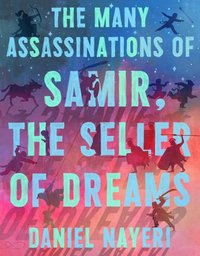
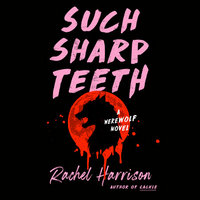
I’m reading The Many Assassinations of Samir, the Seller of Dreams by Daniel Nayeri, Daniel Miyares (Illustrator)—a book I’m not even going to try to sum up in less than a couple of paragraphs. I’m listening to Such Sharp Teeth by Rachel Harrison, Kristen Sieh (Narrator) on audiobook. I’m not so sure about the story as a whole—but it possibly includes the best description of someone becoming a werewolf that I’ve ever come across.

The Many Assassinations of Samir, the Seller of DreamsBlank SpaceSuch Sharp Teeth

What did you recently finish reading?

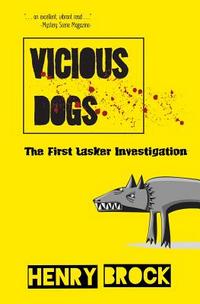
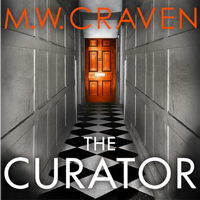
I just finished Henry Brock’s Vicious Dogs, a clever PI novel, and the superlative The Curator by M.W. Craven, John Banks (Narrator) on audio.

Vicious DogsBlank SpaceThe Curator

What do you think you’ll read next?

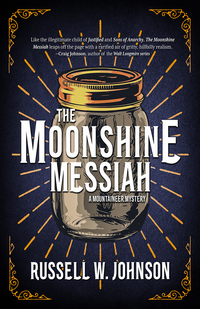
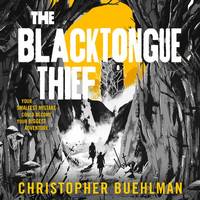
My next book should be The Moonshine Messiah by Russell W. Johnson. Next, I’m going to try the audiobook of The Blacktongue Thief by Christopher Buehlman—I’m not 100% I can devote the attention to it that it deserves in audio format, but I haven’t been able to find the time for the print version, so we’ll see how I do.

The Moonshine MessiahBlank SpaceThe Blacktongue Thief

How are you closing out the year? Trying to squeeze in a few more books for whatever your goal was?

(I’ve got three more I hope to finish. Will get at least one of them done 🙂 )

PUB DAY REPOST: Sundry Notes of Music: an Almost Memoir by Ian Shane: A Life’s Playlist

Since I inititially posted about this book, Shane has made a Spotify playlist to go along with this, I’d recommend giving it a listen as you read/after you read/before you read the book. It’s just a good mix of music (and I can’t imagine anyone else is going to come up with a playlist like this). It’s worth a listen or five even if you’re not interested in the book (and then you might be…)


Sundry Notes of MusicSundry Notes of Music:
an Almost Memoir

by Ian Shane

DETAILS:
Publisher: 45rpm Media
Publication Date: December 26, 2023
Format: eARC
Length: 248 pg.
Read Date: October 27-30, 2023

What’s Sundry Notes of Music About?

Ian Shane takes a break from fiction to bring us a memoir that’s unlike most you’ve read. These began as a series of blog posts looking at his life through songs. Forty-six songs connected to forty-six stories from various parts of his life—an almost-memoir, as he puts it.

Some of the essays are tied to a particular version of a song, how a particular copy became part of his collection (or how he hunted for it), and others are because a particular episode or person became entwined with a song.

Almost everyone can relate to this book—everyone has those songs that when you hear them make you think of a particular place, person, time of life—or an old cassette tape, CD, or beat-up vinyl (maybe I should add pirate site or streaming service, too). It doesn’t take much for anyone to start listening to music and start reminiscing. Shane’s just been a bit more formal about the process than most of us and has written them down in these essays.

The Songs

I hesitate to admit this because I’m afraid I’m going to lose a lot of credibility with Shane. But I know less than a quarter of the songs from this book (at least the ones he devotes a chapter to—I know some of the others referenced).* Even worse, I disagree with him about the quality of more than one of those.

* I may know a few others if covered by another artist, or by hearing them on the radio or in the background somewhere without knowing the artist/title.

Does this matter? Not really, no. What matters is the connection and how Shane expresses it. What he says about his life and the song. This is why books like High Fidelity, Eddie and the Cruisers, Juliet, Naked, Thank You, Goodnight, The Rome of Fall, etc., etc., etc. work—because we can connect to music and music makers even when they’re fictional. We all know how it feels when we click with a song, how it can reflect and shape memories, how it can make you feel on several levels at once.

Sure, those handful of chapters involving songs (or artists) that I’m familiar with hit on another level or two. But not in a way that made things significantly different.

Also, it must be remembered—this is not a book of music criticism, as often as it may feel like it. It’s a memoir—it’s about how a song is connected to a time or event in the life of Ian Shane. So even if he made up “Supertheory of Supereverything” by Gogol Bordello (and come on…how hard would it be to believe that?), that wouldn’t particularly impact the way that chapter worked for the reader.*

* Aside from the fact that in a memoir things should be as close to true as possible while protecting privacy and allowing for fuzzy memory.

So, what did I think about Sundry Notes of Music?

I love the concept for this book—and wish I could read more like this. I think people exchanging track listings for their version (to be expanded upon by request) would make becoming friends much easier.

I also think this helps me understand shades of Shane’s novels (not just the parts that he points to in this book, either). As he’s one of those authors at the top of my list from the last few years, I particularly appreciated that—but since not enough of the world has heeded my calls to buy and read his work, I won’t expect many to see a similar appeal in this book. And as I’ve learned these last few years, you really don’t need to know much about the life or work of someone to be able to really enjoy a memoir, if the memoir is good enough. This one is.

Sure, I’d have liked another few chapters about the Tom Petty show. Do I think his estimation of The Beatles is lacking (however apt calling them the equivalent of a boy band may be)? Yes. Do I wish (primarily for his sake) that some of these chapters had ended on a “happier” note (particularly the chapters “talk tonight – oasis” and “life fades away – roy orbison”)? Sure, but’s not a comment on Shane’s writing, it’s reality rearing its head.

You can see traces of Hornby’s Songbook/31 Songs in these pages. Possibly Al Young’s Drowning in the Sea of Love (I don’t know, I hadn’t heard of it until Shane mentioned its influence). But this struck me as something more like Rob Sheffield’s Love Is a Mix Tape and Talking to Girls About Duran Duran—just involving a longer period of time. I may have grinned and chuckled more at Shane than Sheffield (those who’ve read the former will roll their eyes at me there, of course).

There are parts of this book that are very funny—some bittersweet, some tragic, some simply thoughtful. Multiple essays will hit all of those points and more. They’re all engaging in various ways. Not one track on this playlist is going to leave you looking for the skip button.

Readers of Hornby, Young, or Sheffield should appreciate this approach to memoir. Those who find this approach intriguing likely will, too. Readers of Shane’s novels will definitely find something to enjoy here. People who simply appreciate well-written memoirs/personal essays should give this a look, as well. Really, anyone who finds good writing appealing should give this a glance. Yes, I’m casting the net wide on that last sentence—that’s my point.


4 Stars

Irresponsible Reader Pilcrow Icon

The Chimes by Charles Dickens: A Different Set of Bells You Don’t Want Tolling for You

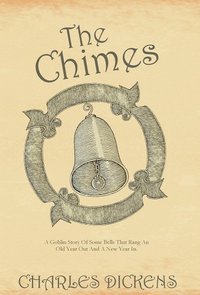
The ChimesThe Chimes

by Charles Dickens

DETAILS:
Publisher: Fahrenheit Press
Publication Date: November 15, 2023
Format: eBook
Length: 94 pg.
Read Date: December 21-22, 2023
Buy from Bookshop.org Support Indie Bookstores

There are not many people—and as it is desirable that a story-teller and a story-reader should establish a mutual understanding as soon as possible, I beg it to be noticed that I confine this observation neither to young people nor to little people, but extend it to all conditions of people: little and big, young and old: yet growing up, or already growing down again—there are not, I say, many people who would care to sleep in a church. I don’t mean at sermon-time in warm weather (when the thing has actually been done, once or twice), but in the night, and alone.

What’s The Chimes About?

Apparently, the original title of this was: The Chimes: A Goblin Story of Some Bells that Rang an Old Year Out and a New Year In. But for pretty obvious reasons, people shortened the name to The Chimes when talking about it, and this edition went with the short version, too.

The Chimes are the bells in a church steeple–powerful goblin spirits reside in them, (not everyone gets to see the goblins–or this’d be a very different kind of story). Our protagonist, Trotty, is summoned to the steeple by these bells. Bells he’s lived under for years and has come to love their ringing. However, he’s now called to account by them for…essentially losing faith in humanity and disparaging them. Particularly lower-class humanity–like he’s part of.

Trotty is a ticket-porter, barely scraping by–but is a hearty, cheerful man. His daughter is in love with someone who hopes to marry her soon. But Trotty reads something in the news one day (inspired by a true story, incidentally) that makes him doubt people’s goodness. This is followed by him being hired by/interacting with an Alderman and an MP who look down the poor, exacerbating Trotty’s dismay.

These bells show Trotty a future in which he dies that night and how the ripples from his death impact the lives of several of his acquaintances. Very much in a Ghost of Christmas Future kind of way. But these are darker futures than anything Scrooge saw, if you ask me.

Trotty repents of his negative outlook and does something in this vision that proves his sincerity. He’s brought back to the present and life is good–even better than it was thanks to his attitude adjustment.

Oversimplification, I know, but I’m still trying to stay away from details. It’s only been in print for 179 years…

These Guys are The WORST

So this year I’ve read about misanthropes, mass murderers, people who kill without remorse, people who target minorities for fun, demons and other monsters, etc., but I’m honestly not sure that there were people who disgusted me and enraged me nearly as much as Alderman Cute and Sir Joseph Bowley.

Bowley loves to think of himself as a benefactor to the poor, a charitable soul…listen to him brag about it a bit (to an actual poor person),

Every New Year’s Day, myself and friends will drink his [a generic poor person’s] health. Once every year, myself and friends will address him with the deepest feeling….‘I do my duty as the Poor Man’s Friend and Father; and I endeavour to educate his mind, by inculcating on all occasions the one great moral lesson which that class requires. That is, entire Dependence on myself. They have no business whatever with— with themselves.

He does (at least in the vision), bring poor people into a great New Year’s feast with his guests so they can see he and his friends drink to their health and hear paternalistic (at best) speeches about how they need to better themselves, although they probably can’t because if they could…well, they wouldn’t be poor, after all.

Cute dissuades Trotty’s daughter and her beloved from marrying because it’s not like they’ll be able to subsist on whatever money they can eke out–and they’ll just end up having kids they can’t afford to feed, and thereby expanding the need for welfare and whatnot.

Sure, Dickens was probably exaggerating for satirical purposes. But I doubt it was much. And it’d be really easy to imagine these despicable guys as contemporary figures.

Dickens’ Writing

He saw the tower, whither his charmed footsteps had brought him, swarming with dwarf phantoms, spirits, elfin creatures of the Bells. He saw them leaping, flying, dropping, pouring from the Bells without a pause. He saw them, round him on the ground; above him, in the air; clambering from him, by the ropes below; looking down upon him, from the massive iron- girded beams; peeping in upon him, through the chinks and loopholes in the walls; spreading away and away from him in enlarging circles, as the water ripples give way to a huge stone that suddenly comes plashing in among them. He saw them, of all aspects and all shapes. He saw them ugly, handsome, crippled, exquisitely formed. He saw them young, he saw them old, he saw them kind, he saw…

When Dickens first introduced the goblins (and I only gave you a sample), I really enjoyed it. And was reminded that he typically got paid by the word. Not necessarily for this novella–but the impulse was still there. Because the man can go on…never using 5 words when 20 will do.

I have zero problems with it in this novella–but it jumps out at you occasionally.

A few other lines that jumped out at me that I want to bring up…they’re so good.

‘There’s nothing,’ said Toby, ‘more regular in its coming round than dinner- time, and nothing less regular in its coming round than dinner. That’s the great difference between ’em. It’s took me a long time to find it out.’

This gentleman had a very red face, as if an undue proportion of the blood in his body were squeezed up into his head; which perhaps accounted for his having also the appearance of being rather cold about the heart.

‘The good old times, the good old times!’ The gentleman didn’t specify what particular times he alluded to; nor did he say whether he objected to the present times, from a disinterested consciousness that they had done nothing very remarkable in producing himself.

(I’m forever going to be thinking of this anytime I hear someone talk about the good old days)

So, what did I think about The Chimes?

I’m told that the hardcover is gorgeous–I ordered this late, so I can’t confirm (I’ll try to remember to update this post when I get it). The cover looks pretty neat, though. I bring this up so you’ll think about getting your hands on this hardcover edition for your own personal use/shelf decoration.

But what about the novella itself? I dug it. I know I don’t read enough Dickens–and never have. But when I’m exposed to him, I regret many of my life choices that lead to this dearth (not so much regret that I see that I’ll change that anytime soon). I really appreciated his writing, his characters (even the ones I spent time hating). I would’ve appreciated a little more time with some of the characters, but we didn’t need it.

The way the bells show Trotty the future really did make me think of the Ghost of Christmas Future, I know they inspired It’s a Wonderful Life, but I got more of the former vibe than the latter. I’d like for people to tell me what I’m missing, incidentally. Either way, I liked the way Dickens uses this tool to get people to change their way of thinking, even if he uses it too frequently.

The social commentary was well done (if heavy-handed), and probably needed as much then as now. And probably as effective then as now. Oh well, would be nice to think otherwise.

It’s a quick read that packs a powerful punch with some clever writing. If you’re like me, and have never heard of this novella before, take advantage of this opportunity to pick it up. If you’re a better-educated reader and are familiar with it–isn’t it about time to re-familiarize yourself?


4 Stars

This post contains an affiliate link. If you purchase from it, I will get a small commission at no additional cost to you. As always, the opinions expressed are my own.
Irresponsible Reader Pilcrow Icon

MUSIC MONDAY: Christmachanukwanzaramadanamasmukkarborday by Gangstagrass

Music Monday
Music Monday’s originated at The Tattooed Book Geek‘s fantastic blog and has shown up here and there since then.

The Irresponsible Reader Metallica Logo

Grandpappy’s Corner: Saint Nicholas the Giftgiver by Ned Bustard: The Making of a Legend

Yeah, this is a quick return to this author. But after the post a couple of weeks ago, I had to give this one a shot, too. And it seemed fitting to tackle it now. I’ll get back to “grown up books” next week, D.V.


Grandpappy's Corner Logo

Saint Nicholas the Giftgiver:
The History and Legends
of the Real Santa Claus

Written and Illustrated by Ned Bustard

DETAILS: 
Publisher: IVP Kids
Publication Date: October 12, 2021
Format: Hardcover
Length: 29 pg.
Read Date: December 17, 2023
Buy from Bookshop.org Support Indie Bookstores

What’s Saint Nicholas the Giftgiver About?

This is all in the title and subtitle, really. This is a Picture Book Biography of Saint Nicholas, covering both the history we have and some of the legends that arose about him to the point he became our Santa Claus.

He covers the life of Nicholas from birth to death pretty well—working in Diocletian’s persecution and how Nicholas was freed by Constantine, a hint of the Arian Controversy, and Nicholas’ work overall—including some of the legends that grew about him during his lifetime (that probably had a basis in truth).

Then he turns to the stories that have grown up about Nicholas as he transformed into Santa Claus with the magical reindeer—with Bustard trying to tie in even that idea of Nicholas to the work of the Savior. How successful he was I’ll leave to the reader to decide.

The Slap

No, I’m not talking about a certain actor at the Oscars in 2022. I’m talking about the legendary time that Nicholas struck (in some form) Arius at Nicea. Bustard skipped it. The most he said was:

he did all he could
to stop that bad pries.

Now, I was curious to see how he’d address it—if only because I think it’d be a real attention grabber for the target audience. But it’s probably wise to skip it, you don’t want to encourage younger readers to start assaulting people.

But c’mon, if you heard that some kid had been inspired by a Picture Book to slap a kid in Sunday School who kept giving bad answers—you’d laugh. You’d feel bad and repent after, but you’d laugh. I’m getting off the point, though.

Let’s Talk about the Art for a Minute

First, I really liked the way he made Nicholas have the skin tone of someone who was from Türkiye. Especially as white as Santa is usually depicted (and certain news programs insist on), that was a refreshing choice.

The use of mice throughout was a nice touch (and is explained in Bustard’s author’s note). But the best part was the subtle transformation of his clothing and appearance throughout to more and more look like a figure worthy of being an illustration alongside Clement Clarke Moore.

Basically, everything I’d say about the art is what I said when I talked about his Saint Valentine the Kindhearted book two weeks ago. Feel free to go check that.

There are a couple of Second-Commandment violations that naturally trouble me. But they don’t call attention to themselves and can be glossed over if that’s how you’d like to proceed. I’m honestly not sure if I’ll do that, or consign this one to the “we don’t read that one” pile.

How is it to Read Aloud?

A couple of the rhymes are…well, let’s go with imaginative. I will admit I stumbled on a them as I read it to the Grandcritter. But…other than that, it was fun.

There’s some decent rhythm to it, and the sweetness of a lot of it comes out better when you read aloud. Or maybe that was just me. Anyway, it works really well as a read-aloud.

So, what did I think about Saint Nicholas the Giftgiver?

I liked this—I do think Bustard improved his writing with his next two books, but the promise is there. Some lines—several lines—are great and made me smile. As I said before, the art is great. The two together make this a winner.

For me, I’d have appreciated it more if he’d given us a little more history and a little less explanation of the legend around Nicholas. But I’m not sure he’d have been able to do as nice of a job explaining the legend as he did had he devoted less time to it.

Which does make me think—given the age of the audience for this book, it’s a little risky to wade into anything about Santa Claus for some people. I think he handled that as well as he could, and readers who don’t understand everything about Santa the way that grown-ups do should be okay.

I do have a couple of misgivings about this book, but I’m maybe thinking about this more than I should. I don’t think so, but I imagine others will tell me I am. It’s good enough to think about getting and reading—just know that of the three books that Bustard has written so far, it’s the least successful.


3 Stars

This post contains an affiliate link. If you purchase from it, I will get a small commission at no additional cost to you. As always, the opinions expressed are my own.
Grandpappy Icon

Saturday Miscellany—12/23/23

I’m glad you stopped by for this today, but I really want you to read my earlier post of the day, I had more fun with it than I usually do. So take a moment if you haven’t to check out: The Grandcritter’s First Festivus.

With that out of the way, let’s get to the “serious business” of today.

Odds ‘n ends about books and reading that caught my eye this week. You’ve probably seen some/most/all of them, but just in case:
bullet Reading print improves comprehension far more than looking at digital text, say researchers—Not the first time I’ve heard this, but I do find it interesting. Would you all prefer if I started mailing these so you can understand it more?
bullet ‘It’s totally unhinged’: is the book world turning against Goodreads?—pretty sure I’ve posted things like this before, too. One of these days, the death knell may truly ring.
bullet Last week, I linked to the first 20 of these, and now we can read The Biggest Literary Stories of the Year: 30 to 11 The 10 Biggest Literary Stories of the Year—(at least according to LitHub). Some interesting things here…many of which I was previously unaware of. That’s how in-tune with the Big News I am.
bullet Before We Go Blog brings Five Recommended Books for Winter Reading—(or other times of the year, too)
bullet Announcing the Picture Prompt Book Bingo Challenge for 2024—It’s like Dixit or Mysterium mixed with a Reading Challenge.
bullet It’s time for some more 2023 Best Of Lists.I agree with a lot of these (and added more than I should to the overburnded TBR)
bullet The Ultimate Best Books of 2023 List—Lit Hub’s Emily Temple compiles results from 62 published lists to list the best of the best.
bullet Top Five Character-Driven Books I Read In 2023—from Steven Writes
bullet Operation 2023: Success! (Or Favorite Books From this Year)—Witty and Sarcastic Bookclub has some real winners (and you’ll never guess the 2nd book on this list!)
bullet Favourite Series of 2023—from Novel Deelights
bullet CrimeReads’ The Best Noir Fiction of 2023
bullet The Best Books I Read in 2023—from Read Betwixt Worlds
bullet Tiny Elf Arcanist Character Awards 2023
bullet CrimeReads’ The Best Traditional Mysteries of 2023
bullet Why Stories About Stories Bugs Me

This Week’s New Releases that I’m Excited About and/or You’ll Probably See Here Soon:
bullet Death in the Dark Woods by Annelise Ryan—should’ve been mentioned here last week. Moving on from lake monsters, cryptozoologist/bookstore owner Morgan Carter looks into Bigfoot.
bullet Down The Well by Veronica King—this just sounds like a ball. Sentient lamp posts? You can never go wrong with lamp posts in fantasy, making them sentient is a heckuva bons.
bullet Grimdwarf: A Magaine of Fantastic Tales edited by JCM Berne—1. It’s free. 2. It’s good. 3. It’s a quick read. 4. It’s good. I have no idea how/if I’ll be talking about this zine regularly, but for now, I’m just going to promote it when I have the opportunity.

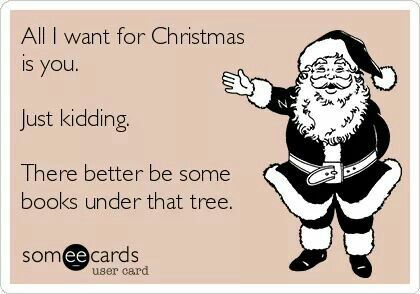
Meme Showing a Smiling Santa and the Text: All I Want for Christmas Is you. Just Kidding. There better be some books under that tree.
(can’t like back to the creator, since I don’t know where it came from)

Page 1 of 5

Powered by WordPress & Theme by Anders Norén