

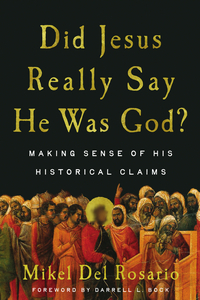
 Did Jesus Really Say He Was God?:
Making Sense of His Historical Claims
DETAILS:
Publisher: IVP Academic
Publication Date: October 23, 2025
Format: eARC
Length: 256
Read Date: September 14-October 5, 2025


What’s Did Jesus Really Say He Was God? About?
One of the most common things non-Christians will say about Jesus is something along the lines of, “He never claimed to be God, that’s something that Christians made up years/decades later.” As people probably no longer say, “big, if true.”
Del Rosario takes on this question (and variations of it) head-on—he takes just two passages of Scripture, examines what they say, looks at what critics say about it, and then argues that Jesus did claim divinity in the passages.
The Strengths
The strengths of this book come in the two parts (slightly more than 50% of the book) looking at Mark 2:1-12 (“The Healing of the Paralytic”) and Mark 14:53-65 (the examination before the Jewish leaders before going to Pilate). These passages are selected from Mark because it’s widely considered the earliest of the canonical gospels, and therefore less likely to have gone through any kind of mythologizing. Another reason they were selected is that the reaction of Jesus’ opponents highlights his claims of divinity.
For each passage, he begins by looking at the events depicted in the passage for a chapter or two. He then spends a chapter on the blasphemy accusation against Jesus. He concludes with a chapter on the claim of divinity made in the passage.
Seriously, I could’ve read more on each passage—not because he needed to say more, but because I enjoyed and benefited from the discussion. Or I could’ve read another passage or two for more examples of how his approach strengthens one’s confidence in Jesus’ claims.
The Weaknesses
Del Rosario employs a tool I’ve seen others use a couple of times—where they attempt to attach a numerical value on the probability of something happening the way a historical record says it does—and weighing that numerical value against a competing interpretation’s value.
Maybe this is just me, but it feels like trying to take history and making it a “real” science with numbers and whatnot. I just don’t understand the appeal of doing history this way.
I also tend to have a hard time following the discussion whenever it attempts to do that—maybe it’s a block on my part, maybe it’s because I already have little interest in it, or maybe it’s an inherent flaw in the idea. But I think the book would’ve been stronger without it.
So, what did I think about Did Jesus Really Say He Was God??
Del Rosario writes clearly and compellingly. The text—even when it gets technical—is straightforward and approachable by people who aren’t historical scholars (except for the numerical assignments).
Not only does reading this help buttress the confidence a reader has in the passage and Jesus’ claims in them, but Del Rosario gives his readers a model to follow when they come across similar passages. Whether that’s on your own or in reply to a challenge to Jesus’ claims of divinity.
Did he actually say x, y, or z? What do those sayings me? How did his listeners hear his claims? What is he really claiming in the passage—what does what he says mean? How does knowing that help make sense of his opponents’ reaction?
I really appreciated his focus on the text of Scripture in his apologetic here, not an appeal to reason or philosophical arguments, or a vague history—but to the revelation we’ve been given and then to see what that revelation said to the original readers/listeners.
I heartily encourage this book, and hope for a sequel or three, tackling similar passages.
Disclaimer: I received a copy of this book from IVP Academic via NetGalley—thanks to both for this. Sorry it’s up late, it’s been one of those months.
This post contains an affiliate link. If you purchase from it, I will get a small commission at no additional cost to you. As always, the opinions expressed are my own.

1 Pingback