

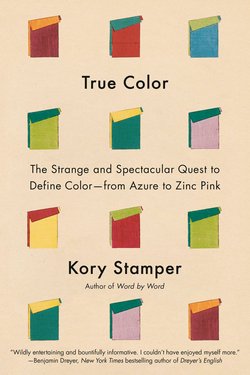
 True Color: The Strange and Spectacular Quest to Define Color—from Azure to Zinc Pink
by Kory Stamper
DETAILS:
Publisher: Knopf
Publication Date: March 31, 2026
Format: e-ARC
Length: 320 pg.
Read Date: March 21-25, 2026


What’s True Color About?
Have you ever had trouble describing a color to someone? Strange sea creatures, sunsets, a (hopefully) food stain on a shirt, paint on a wall? It’s not easy. For some of us more than others, I’m sure (I’m at the weak end)—but it’s not that easy.
Now, try to imagine doing it not for a friend or paint clerk—but for the thousands or more that might read your description (read: definition) in a dictionary or other reference work.
Stamper points to two significant markers in the development of these definitions. The first is that prior to the First World War, Germany was the world’s biggest source of commercial dyes. During the War, two things happened—first, those plants became weapons factories (and learning how easy that was is a bit disconcerting), and second, places like the U.S. had to start producing their own. And if, say, two different suppliers understood a tint of green differently—the camouflage they provided to the Army in Europe could have significant consequences.
The other is a little less dramatic, but no less impactful. When people in the U.S. started making oleomargarine in the 1800s, dairies were upset about them coloring it to look like butter—this resulted in legal battles, and eventually, the U.S. Congress weighed in.
These two things began efforts in the U.S. to codify colors, dyes, hues, and whatnot into some sort of standard.
Fast-forward to when Kory Stamper is editing Merriam-Webster’s website (and from her description, this is not an easy job), when she came across some odd color definitions. The wording was odd, the definitions themselves were puzzling—where did these come from?
Thus begins this story about the attempts to define colors—in a way that satisfies diverse audiences like artists, scientists, and general readers—during the development of their Second and Third Unabridged Dictionaries. Stamper tells the story of putting these dictionaries together, some of the editors who worked on them—and worked with outside consultants like I. H. Godlove (and his wife and colleagues) and others to craft these definitions.
It’s a book of human drama, academic politics, technological limitations, and the limits of human language and understanding.
Why did I pick this up? Why did I keep reading?
I picked this up because I enjoyed Stamper’s earlier book Word by Word: The Secret Life of Dictionaries and because I was intrigued by the question—how do you define a color? I also hoped to pick up some tips to help me with that. Spoiler: I did not. But I don’t care. This was better. It’s also encouraging to know that even professional definers struggle.
Why did I keep reading? There’s just so much trivia—especially in the beginning, so many strange little facts you pick up along the way—for example (taken from the publisher’s description, because I hate to ruin stuff like this) “did you know that the word ‘puke’ used to refer to a fashionable shade of reddish-brown before it was associated with vomit?”
But more importantly, I was just fascinated by the way these editors and experts went about putting together these dictionaries—the differences in approach between the two—and so on. Stamper can make what one might think is dry and dusty history come alive and fill it with humanity.
Readers of Nero Wolfe will learn that he wasn’t the only one who had problems with the Third Unabridged Dictionary—although most derided it in reviews or newspaper articles, rather than burning it page by page in their fireplace.
So, what did I think about True Color?
I was, again, fascinated by the people she focused on to tell her story. I wanted to talk to people about them—I’d like to learn more about them and their work.* Her following up with the Godlove family’s living relatives so we could get more insight into the people behind the work was a wonderful touch.
Like her previous book, True Color will disabuse many of what they imagine the behind-the-scenes of Dictionary production is like. You will read about one of the worst bosses around, for example. Stress, overwork, burnout, crazy turnover, rampant misogyny (okay, you might have guessed that given the time periods), tiny budgets, and more. It turns out that Dictionaries are put together by human beings, not beings of pure intellect.
Also, I cannot say enough about Stamper’s use of language. It will not come as a surprise that someone who works on dictionaries has a way with words—she has ready access to all the best ones, after al—but to see it in action is something else. Stamper’s rich vocabulary is on full display here, and she crafts it beautifully.
* I will not—particularly about their work, I wouldn’t understand it. But I wanted to.
Disclaimer: I received this eARC from Knopf via NetGalley in exchange for this post, which contains my honest opinion—thanks to both for this.
This post contains an affiliate link. If you purchase from it, I will get a small commission at no additional cost to you. As always, the opinions expressed are my own.

shelleyrae @ Book'd Out
Fascinating subject, thanks for sharing your thoughts